


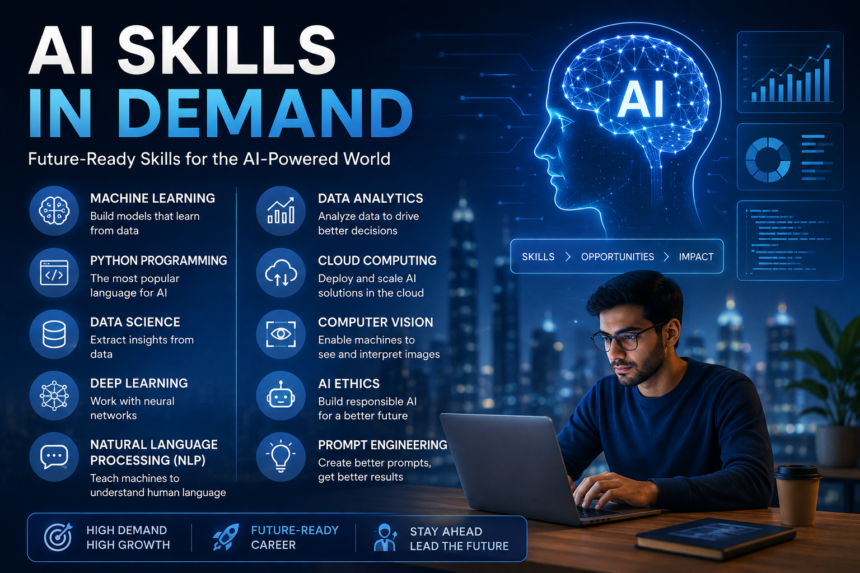
Top Skills for the Future AI Skills in Demand in 2026
Artificial intelligence is rapidly changing the global job market, and professionals with strong AI skills are increasingly in demand in 2026. Businesses across technology, finance, healthcare, retail, manufacturing, education, marketing, logistics, and professional services are using AI to automate routine work, analyse information, improve customer experiences, and create new products and services.
- Why AI Skills Are in High Demand in 2026
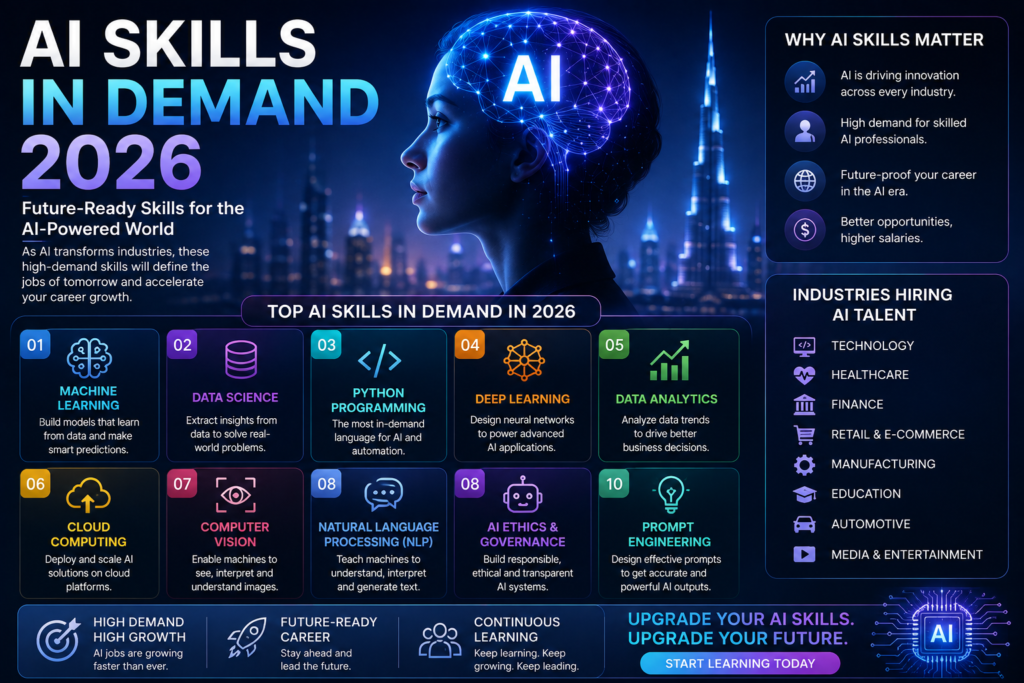
- Top AI Skills in Demand in 2026
- Human Skills That Complement AI Skills
- Best AI Skills for Students in 2026
- Best AI Skills for Working Professionals
- How to Learn AI Skills in Demand 2026
- AI Skills and Career Opportunities in 2026
- Why AI Skills Can Increase Career Value
- How Businesses Are Changing Their AI Skill Requirements
- Common Mistakes When Learning AI
- A Practical AI Skills in Demand Roadmap for 2026
- Future of AI Skills and Jobs
The demand is no longer limited to traditional AI engineers. Employers increasingly value professionals who can combine AI knowledge with industry expertise, analytical thinking, communication, creativity, cybersecurity, leadership, and problem-solving. PwC’s 2026 Global AI Jobs Barometer, based on more than one billion job advertisements across six continents, reports that jobs requiring specific AI skills are growing substantially faster than the overall jobs market, while the average wage premium associated with AI skills has risen to 62%.
For job seekers, students, entrepreneurs, and existing professionals, this creates an important opportunity. Learning the right AI skills in demand in 2026 can help improve employability, increase productivity, and prepare workers for careers in an increasingly AI-powered economy.
Why AI Skills Are in High Demand in 2026
AI has moved beyond experimentation and is becoming part of everyday business operations. Companies are using generative AI, machine learning, automation, predictive analytics, computer vision, natural language processing, and AI agents to improve the way employees work.
The World Economic Forum’s Future of Jobs Report 2025 identifies AI and big data as the fastest-growing skills, followed by networks and cybersecurity and technological literacy. At the same time, human capabilities such as creative thinking, resilience, flexibility, analytical thinking, leadership, and collaboration remain important.
This means the future of work is not simply about replacing human skills with technical skills. Instead, employers increasingly need people who can work effectively with AI while applying human judgment and expertise.
PwC’s 2026 research also highlights this shift. AI-exposed jobs are changing faster, and entry-level roles in those areas are increasingly asking for skills traditionally associated with more experienced professionals, including judgment and leadership.
Top AI Skills in Demand in 2026
The following are some of the most valuable AI skills in demand for professionals who want to remain competitive in 2026.
1. Artificial Intelligence and Machine Learning
Artificial intelligence and machine learning remain among the most valuable technical skills in the modern job market.
Machine learning allows computers to learn patterns from data and use those patterns to make predictions or decisions. AI professionals may work on recommendation systems, fraud detection, forecasting, automation, intelligent search, personalization, and many other applications.
Important machine learning concepts include:
- Supervised learning
- Unsupervised learning
- Reinforcement learning
- Classification
- Regression
- Clustering
- Feature engineering
- Model evaluation
- Model optimization
- Predictive modeling
Professionals who understand both the theory and practical application of machine learning can pursue roles such as machine learning engineer, AI engineer, data scientist, and applied AI specialist.
2. Generative AI
Generative AI has become one of the most important areas of technology for businesses and professionals.
Generative AI systems can create text, images, software code, audio, video, summaries, reports, and other content. Organizations are using these tools for marketing, customer service, research, software development, internal knowledge management, and productivity.
Learning generative AI means understanding more than simply how to use an AI chatbot. Professionals should learn how to:
- Write effective prompts
- Evaluate AI-generated content
- Build AI-assisted workflows
- Use AI tools responsibly
- Connect AI with business processes
- Identify hallucinations and inaccurate outputs
- Protect confidential information
- Apply human review
- Measure AI-generated results
Generative AI literacy is increasingly useful even for people who do not work in technology.
3. Prompt Engineering
Prompt engineering involves designing effective instructions for AI systems to produce useful, accurate, and consistent results.
As businesses use generative AI for more complex workflows, professionals who understand how to communicate effectively with AI systems can become more productive.
Prompt engineering can involve:
- Clear task instructions
- Context management
- Role-based prompting
- Few-shot examples
- Structured outputs
- Iterative prompting
- Evaluation and testing
- Workflow design
- AI agent instructions
However, prompt engineering should not be viewed as a standalone replacement for deeper expertise. The strongest professionals combine prompting skills with domain knowledge, critical thinking, and the ability to evaluate AI results.
LinkedIn reported in 2025 that AI literacy was among the most sought-after skills across jobs on its platform, while the number of C-suite executives adding AI skills such as prompt engineering and generative AI tools to their profiles had increased significantly.
4. Data Science
AI depends heavily on data, making data science an important career skill in 2026.
Data scientists collect, clean, analyze, visualize, and interpret data to help organizations make better decisions. They may also develop predictive models and work closely with machine learning teams.
Important data science skills include:
- Statistics
- Probability
- Data cleaning
- Data visualization
- Predictive analytics
- Python
- SQL
- Machine learning
- Experimental design
- Business intelligence
A strong data scientist should be able to explain technical findings in business language. This combination of technical and communication skills can make data professionals particularly valuable.
5. Python Programming
Python continues to be one of the most useful programming languages for AI, machine learning, automation, and data science.
Its extensive ecosystem includes popular libraries and frameworks for data analysis, machine learning, deep learning, and application development.
AI professionals should consider developing skills in:
- Python fundamentals
- Object-oriented programming
- Data structures
- APIs
- Automation
- NumPy
- Pandas
- Machine learning libraries
- Deep learning frameworks
- AI application development
Python is particularly useful because it can be applied across several areas rather than being limited to a single AI specialization.
6. Deep Learning
Deep learning is a specialized branch of machine learning based on neural networks with multiple layers.
It is particularly important for complex AI applications involving images, speech, language, recommendations, and other high-dimensional data.
Professionals interested in deep learning should understand:
- Neural networks
- Convolutional neural networks
- Transformers
- Embeddings
- Training and validation
- Model optimization
- Transfer learning
- Large language models
- Model evaluation
Deep learning expertise can support careers in AI research, computer vision, natural language processing, robotics, autonomous systems, and generative AI.
7. Natural Language Processing
Natural Language Processing (NLP) enables computers to understand, process, analyze, and generate human language.
NLP is central to many modern AI applications, including chatbots, virtual assistants, search systems, translation tools, document analysis, sentiment analysis, and generative AI.
Professionals can develop NLP knowledge through topics such as:
- Text classification
- Sentiment analysis
- Tokenization
- Embeddings
- Language models
- Information extraction
- Text generation
- Retrieval systems
- Large language models
- Conversational AI
As businesses increasingly use AI to interact with customers and analyze large volumes of documents and communications, NLP remains a valuable specialization.
8. Data Analytics and Business Intelligence
Not every AI professional needs to build machine learning models. Data analytics is another highly valuable AI-related skill.
Businesses need professionals who can turn large datasets into useful insights and support better decisions.
AI-powered analytics can help companies identify trends, forecast demand, monitor performance, understand customers, and detect unusual activity.
Useful AI skills in demand include:
- SQL
- Excel
- Data visualization
- Business intelligence
- Statistics
- Dashboard development
- Predictive analytics
- Data storytelling
- AI-assisted analysis
The ability to explain what data means—and what a business should do about it—is particularly important.
9. AI Agents and Automation
One of the major developments influencing AI work in 2026 is the growth of AI agents.
Unlike basic AI assistants that respond to individual prompts, AI agents can be designed to perform sequences of tasks, use tools, access information, and work toward defined objectives under appropriate human oversight.
Microsoft’s 2025 Work Trend Index described the emergence of human-agent teams and identified an expanding role for employees who build, delegate to, and manage AI agents.
Professionals can develop AI skills in demand include:
- Workflow automation
- Agent design
- Tool integration
- API usage
- Process mapping
- AI orchestration
- Evaluation
- Human-in-the-loop systems
- Automation platforms
AI agent skills can be useful in customer support, sales, marketing, finance, operations, research, software development, and other business functions.
10. Cloud Computing
AI applications often require scalable computing infrastructure, making cloud computing an important complementary skill.
Professionals should understand the fundamentals of cloud platforms, storage, databases, networking, security, deployment, and scalable AI infrastructure.
Useful areas include:
- Cloud architecture
- Cloud storage
- Virtual machines
- Containers
- APIs
- Cloud databases
- Machine learning services
- AI model deployment
- Cloud security
- Infrastructure management
Combining AI with cloud knowledge can help professionals build and deploy AI solutions rather than simply experimenting with models locally.
11. Computer Vision
Computer vision focuses on enabling machines to interpret visual information such as photographs, videos, scans, and camera feeds.
It has applications in:
- Healthcare imaging
- Manufacturing inspection
- Security
- Retail
- Automotive technology
- Robotics
- Agriculture
- Smart cities
- Quality control
Professionals interested in computer vision should learn image processing, object detection, image classification, segmentation, neural networks, and computer vision frameworks.
12. AI Cybersecurity
As AI adoption grows, cybersecurity becomes even more important.
Organizations need professionals who can protect AI systems, data, applications, models, and users from attacks and misuse.
AI cybersecurity skills can include:
- Data protection
- Model security
- Identity and access management
- Threat detection
- Secure AI development
- Prompt injection awareness
- Privacy protection
- AI risk assessment
- Security monitoring
- Incident response
The World Economic Forum identifies networks and cybersecurity among the fastest-growing technology skill areas alongside AI and big data.
13. AI Ethics and Responsible AI
AI systems can influence important decisions, making responsible AI an increasingly important skill.
Companies need professionals who understand issues involving fairness, privacy, transparency, accountability, safety, bias, and responsible deployment.
AI ethics professionals may help organizations establish policies and processes for evaluating AI systems.
Important areas include:
- AI governance
- Bias detection
- Privacy
- Transparency
- Accountability
- Risk management
- Human oversight
- Responsible data use
- AI compliance
Responsible AI is particularly important in industries such as healthcare, finance, insurance, government, and education.
14. AI Governance and Risk Management
As companies deploy more AI systems, governance becomes an important business function.
AI governance involves establishing rules, processes, controls, and accountability around how AI is developed and used.
Professionals may need to understand:
- AI risk assessment
- Model governance
- Data governance
- Compliance
- Documentation
- Auditing
- Security
- Human oversight
- Vendor management
- AI policies
This creates opportunities for professionals who combine AI understanding with legal, compliance, cybersecurity, or business expertise.
15. AI Literacy for Non-Technical Professionals
AI skills are no longer limited to programmers.
Marketing professionals, accountants, lawyers, HR managers, sales teams, project managers, designers, teachers, journalists, and entrepreneurs can all benefit from AI literacy.
Basic AI literacy includes understanding:
- What AI can and cannot do
- How generative AI works at a high level
- How to write effective prompts
- How to evaluate AI outputs
- How to protect sensitive information
- How to automate repetitive tasks
- How to integrate AI into everyday workflows
LinkedIn’s 2025 data identified AI literacy as an increasingly important skill across job categories, reinforcing the idea that AI capability is becoming a broad workplace skill rather than a niche technical specialty.
Human Skills That Complement AI Skills
Technical knowledge alone may not be enough to succeed in an AI-powered workplace.
The World Economic Forum expects human capabilities such as creative thinking, resilience, flexibility, analytical thinking, leadership, and collaboration to remain important as technology skills grow.
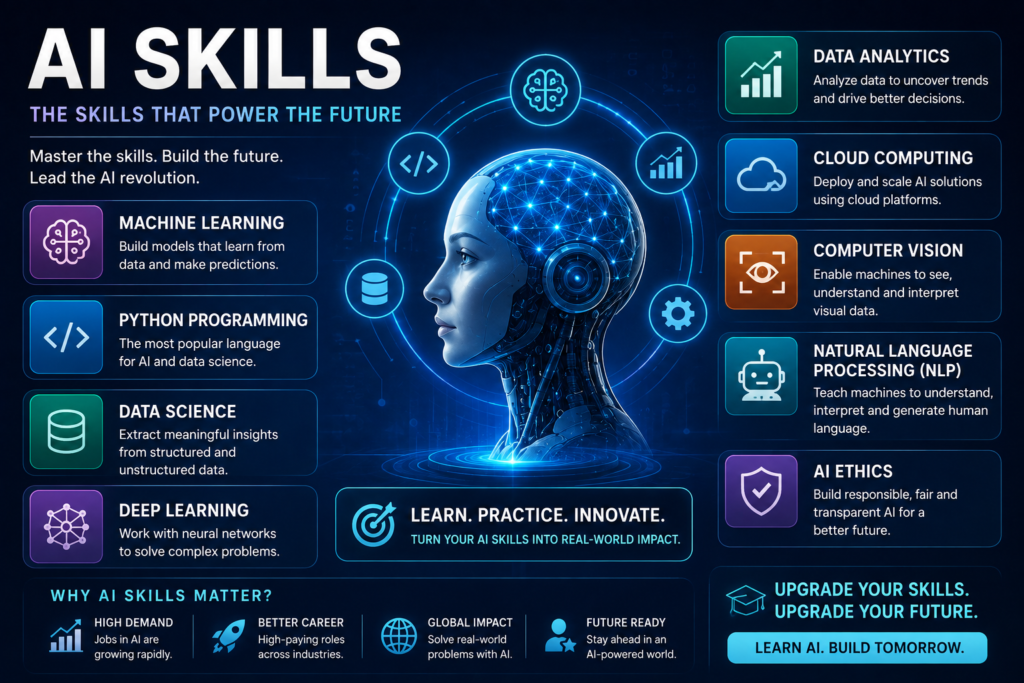
Important human AI skills in demand include:
- Critical thinking
- Creativity
- Communication
- Leadership
- Problem-solving
- Emotional intelligence
- Adaptability
- Collaboration
- Decision-making
- Strategic thinking
PwC’s 2026 research similarly points to greater importance for human-intensive skills such as judgment and leadership in jobs where AI acts as a force multiplier.
The best career strategy is therefore not AI versus humans. It is AI plus human expertise.
Best AI Skills for Students in 2026
Students have an opportunity to build AI knowledge before entering the workforce.
A strong learning pathway can include:
- Basic computer and digital literacy
- Python programming
- Mathematics and statistics
- Data analysis
- Machine learning fundamentals
- Generative AI
- Prompt engineering
- AI ethics
- Cloud fundamentals
- Communication and presentation skills
Students should also work on practical projects rather than relying entirely on theoretical learning.
Examples include:
- Building a simple chatbot
- Creating a data analytics dashboard
- Developing a recommendation system
- Creating an image classification model
- Automating a repetitive workflow
- Building an AI-powered research tool
- Creating a portfolio website that demonstrates AI projects
A practical portfolio can help demonstrate what a candidate can actually build and accomplish.
Best AI Skills for Working Professionals
Existing professionals do not necessarily need to become AI engineers.
Instead, they can identify repetitive tasks in their current role and learn how AI can improve those workflows.
For example:
Marketing professionals can learn AI-assisted content research, campaign analysis, customer segmentation, and automation.
Finance professionals can learn AI-assisted forecasting, data analysis, document processing, and risk analysis.
HR professionals can learn AI-assisted recruitment workflows, workforce analytics, employee communication, and talent management.
Sales professionals can learn AI-assisted prospect research, lead scoring, customer analysis, and personalized communication.
Managers can learn AI strategy, workflow automation, AI governance, and human-agent collaboration.
This approach allows professionals to develop domain-specific AI skills, which can be more valuable than learning AI technology without a clear business application.
How to Learn AI Skills in Demand 2026
Learning AI does not have to happen all at once. A structured approach can make the process easier.
Start With AI Fundamentals: Understand basic concepts such as machine learning, generative AI, neural networks, data, automation, and AI limitations.
Choose One Technical Skill: If you are beginning from scratch, Python, data analytics, or cloud computing can provide a strong foundation.
Learn Generative AI: Practice using AI tools for research, writing, analysis, brainstorming, coding, and workflow automation while learning how to evaluate outputs.
Build Practical Projects: Projects provide evidence that you can apply your knowledge.
Learn AI Ethics and Security: Understand privacy, responsible AI, data protection, and security risks.
Develop Human Skills: Improve communication, creativity, critical thinking, leadership, and problem-solving.
Keep Learning: AI technology changes rapidly. Continuous learning is therefore an essential part of an AI career.
AI Skills and Career Opportunities in 2026
Demand for AI skills is creating opportunities across many professional fields.
Potential career paths include:
- AI engineer
- Machine learning engineer
- Data scientist
- Data analyst
- AI product manager
- Generative AI specialist
- NLP engineer
- Computer vision engineer
- AI researcher
- Automation specialist
- AI consultant
- AI governance specialist
- AI cybersecurity professional
- Cloud AI engineer
- Prompt engineer
- Business intelligence analyst
AI skills can also strengthen careers that do not have “AI” in the job title.
For example, a marketing manager who can use AI analytics and automation may become more productive than a marketing professional who lacks those capabilities.
Why AI Skills Can Increase Career Value
AI can help professionals complete tasks faster, analyze more information, automate repetitive processes, and focus on higher-value activities.
PwC’s 2026 AI Jobs Barometer found that AI-skilled jobs are growing faster than the overall jobs market and that the average wage premium for AI skills reached 62%. The report also found that companies more exposed to AI were experiencing stronger headcount and wage growth than less AI-exposed companies.
These findings suggest that AI skills expertise is increasingly connected to economic value.
However, workers should not assume that simply adding an AI course to a résumé will automatically result in a higher salary. Employers typically value demonstrated ability, relevant experience, business impact, communication, and problem-solving alongside technical knowledge.
How Businesses Are Changing Their AI Skill Requirements
AI is also changing the skills employers request for existing jobs.
PwC’s 2025 research found that the skills requested in AI-exposed occupations were changing substantially faster than in less AI-exposed occupations.
This means professionals should not treat their existing qualifications as permanent.
A software developer may need stronger AI-assisted development skills. A financial analyst may need AI-powered analytics. A marketer may need generative AI and automation skills. A manager may need to understand AI governance and human-agent collaboration.
The ability to learn, adapt, and continuously update skills may therefore become one of the most important career advantages.
Common Mistakes When Learning AI
Many people make the mistake of trying to learn every AI technology simultaneously.
Instead, avoid these common problems:
- Learning tools without understanding fundamentals
- Collecting certificates without building projects
- Focusing only on prompt engineering
- Ignoring statistics and data
- Neglecting cybersecurity and privacy
- Copying AI-generated code without understanding it
- Ignoring human communication skills
- Failing to keep up with changing AI capabilities
- Learning AI without connecting it to a career objective
A focused learning AI skills strategy is usually more effective.
A Practical AI Skills in Demand Roadmap for 2026
If you are starting your AI skills journey, consider this progression:
Stage 1: AI Literacy: Learn the fundamentals of artificial intelligence, generative AI, automation, and responsible AI.
Stage 2: Data Skills: Learn statistics, spreadsheets, SQL, data visualization, and basic data analysis.
Stage 3: Programming: Learn Python and develop basic software development skills.
Stage 4: Machine Learning: Study machine learning concepts, model training, evaluation, and practical applications.
Stage 5: Generative AI: Learn prompting, LLMs, retrieval systems, AI applications, and workflow automation.
Stage 6: Specialization: Choose an area such as NLP, computer vision, data science, cybersecurity, cloud AI, or AI agents.
Stage 7: Portfolio Development: Build projects that demonstrate practical skills.
Stage 8: Career Application
Update your resume, professional profiles, portfolio, and interview preparation to demonstrate how your AI skills create measurable value.
Future of AI Skills and Jobs
The demand for AI skills is likely to continue evolving throughout the decade.
The World Economic Forum projects significant labor-market disruption through 2030, with technology-related skills such as AI, big data, cybersecurity, and technological literacy among the fastest-growing areas. At the same time, employers continue to emphasize human capabilities including analytical thinking, creativity, resilience, leadership, and collaboration.
This suggests that future professionals will increasingly need a combination of technical and human capabilities.
The workplace may also become more collaborative between people and AI agents. Microsoft’s Work Trend Index describes an emerging model in which humans and AI agents work together, with employees increasingly expected to direct, delegate to, and manage AI-enabled workflows.
For professionals, this means the goal should not simply be to learn one AI tool. The stronger strategy is to develop the ability to understand AI, evaluate its output, integrate it into workflows, and apply it responsibly.
Final Thoughts
The AI skills in demand in 2026 extend far beyond machine learning and programming. Generative AI, prompt engineering, data science, Python, deep learning, NLP, data analytics, cloud computing, AI agents, cybersecurity, AI governance, and responsible AI are all important areas for today’s workforce.
At the same time, technical skills should be combined with human capabilities such as critical thinking, creativity, communication, leadership, adaptability, and decision-making. Current labour-market research strongly suggests that the professionals who benefit most from AI will be those who can use technology to enhance their expertise rather than simply rely on AI skills to perform tasks for them.
For students, the priority should be building strong fundamentals and practical projects. For working professionals, the best approach may be to apply AI directly to their existing industry expertise. For businesses, developing AI literacy across the workforce can help employees adapt as roles and workflows evolve.
Whether you want to become an AI engineer, data scientist, machine learning specialist, AI consultant, automation expert, or an AI-enabled professional in another industry, 2026 is an important time to invest in skills that will remain valuable as artificial intelligence continues to reshape the world of work.
The future belongs not only to people who understand AI, but to people who know how to combine AI with expertise, creativity, judgment, and real-world problem-solving.
Do follow us on Instagram
Read More – AI Courses For Beginners 2026