The Economics of Satellite Internet in Remote Arabia
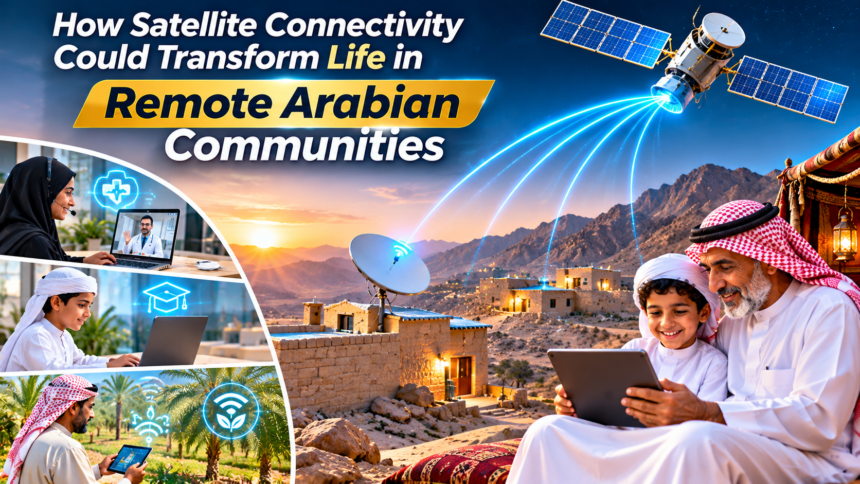
Imagine a family living in a remote mountain village in Oman, where accessing reliable internet requires travelling to a nearby town. In another part of the Arabian Peninsula, a healthcare worker needs to consult a specialist hundreds of kilometres away, while a student in an isolated desert settlement struggles to attend online classes. These situations illustrate why Arabian satellite connectivity could transform everyday life in communities where traditional telecommunications infrastructure is difficult or expensive to establish.
- Why Arabian Satellite Connectivity Matters
- 7 Ways Satellite Internet Could Improve Remote Life
- UAE, Saudi Arabia and Oman: Satellite Projects in 2026
- Satellite Connectivity for Healthcare, Education and Emergencies
- The Economics of Satellite Internet in Remote Arabia
- Challenges of Satellite Connectivity in the Gulf
- Business Opportunities From Remote Satellite Connectivity
- The Future of Arabian Satellite Connectivity and FAQs
Across the Gulf, major cities benefit from extensive fibre-optic networks, advanced mobile services and sophisticated digital infrastructure. However, geographic conditions can make reliable connectivity more challenging in remote deserts, mountain settlements, offshore locations and sparsely populated areas.
Providing internet access to these communities requires different economic and technical approaches.
Installing terrestrial cables or constructing mobile towers may be practical in densely populated cities, but the cost per household can increase significantly in isolated locations.
Satellite technology offers another option by transmitting communications through spacecraft rather than depending entirely on ground-based networks.
Recent developments indicate that Gulf countries are exploring a wider range of satellite communications solutions.
On August 28, 2026, the UAE’s Telecommunications and Digital Government Regulatory Authority granted Starlink Satellite Communications a ten-year licence to provide satellite broadband services.
The authority explained that satellite connectivity would complement the country’s existing fibre and 5G infrastructure while supporting sectors such as transport, energy, logistics and emergency response.
Saudi Arabia has also been studying direct-to-device communications, which could eventually allow compatible mobile phones to connect with satellites in areas lacking conventional network coverage.
Meanwhile, Oman already offers a practical example of satellite broadband serving remote communities.
Oman’s Telecommunications Regulatory Authority launched the AFAQ initiative in 2020 to bring broadband access to villages without fixed or mobile internet coverage.
By May 2026, Oman had recorded 1,603 satellite internet subscriptions, representing annual growth of 145.5%, according to figures published by the country’s National Centre for Statistics and Information.
The number remains small compared with conventional broadband subscriptions, but it demonstrates growing use of an alternative technology.
The potential benefits extend beyond faster internet connections. Reliable communication could support distance learning, remote healthcare, tourism, agriculture, emergency warnings and small businesses.
However, satellite connectivity also involves costs, technical limitations and regulatory requirements.
Understanding its potential means examining where the technology can offer genuine improvements and where conventional infrastructure remains the more practical option.
Why Arabian Satellite Connectivity Matters
Satellite communications are particularly relevant to places where geographic conditions make conventional networks difficult to deploy.
The Arabian Peninsula includes large desert areas, mountain ranges, coastal settlements and remote islands. Population density varies considerably, and some communities are located far from major telecommunications infrastructure.
These characteristics can influence whether fibre-optic connections or mobile towers are commercially practical.
The Challenge of Remote Infrastructure
Installing terrestrial broadband usually requires physical infrastructure, such as cables, telecommunications towers and supporting equipment.
The cost of connecting a remote community can become high when relatively few households share that infrastructure.
Difficult terrain may also complicate construction and maintenance.
Consequently, telecommunications companies and governments need to compare different delivery methods rather than applying the same network model everywhere.
How Satellite Internet Works
Satellite broadband transfers information between ground equipment and satellites in orbit.
A home or community facility typically requires compatible equipment, a suitable power supply and access to an authorised service.
Depending on the system, satellite signals may connect through ground stations or other network infrastructure.
The technology can provide coverage across large geographic areas without requiring a dedicated fibre connection to every household.
Understanding Different Satellite Systems
Satellites operate at different altitudes, affecting coverage, latency and equipment requirements.
| Satellite Type | General Characteristics | Potential Application |
|---|---|---|
| Geostationary Orbit (GEO) | High altitude and broad coverage | Broadband and communications |
| Medium Earth Orbit (MEO) | Intermediate altitude | Enterprise and regional connectivity |
| Low Earth Orbit (LEO) | Lower altitude and typically lower latency | Broadband and mobile-related services |
| Direct-to-Device Systems | Designed for compatible mobile equipment | Selected messaging or connectivity functions |
These categories should not be treated as identical products. Performance depends on the particular satellite network, terminal and service agreement.
Satellite vs Conventional Broadband
| Factor | Fibre or Mobile Networks | Satellite Broadband |
|---|---|---|
| Physical Infrastructure | Extensive terrestrial infrastructure | Ground equipment and space network |
| Remote Availability | Can be expensive to extend | Can serve suitable isolated locations |
| Urban Performance | Often highly competitive | Depends on service and capacity |
| Latency | Fibre generally offers low latency | Varies by satellite orbit |
| Weather Sensitivity | Depends on network design | Some satellite links affected by weather |
| Cost | Depends on local infrastructure | Equipment and recurring subscription costs |
Satellite technology is best viewed as a complement to terrestrial connectivity rather than a universal replacement.
7 Ways Satellite Internet Could Improve Remote Life
Improved connectivity may help remote communities access services that increasingly depend on the internet.
However, actual benefits require appropriate equipment, trained users and reliable supporting infrastructure.
1. Expanding Access to Online Education
Students in isolated communities may benefit from virtual lessons, digital libraries and educational resources.
Satellite broadband can support schools where conventional networks are unavailable or unreliable.
However, internet access alone does not guarantee improved learning outcomes.
Students still need devices, appropriate teaching support and suitable educational content.
2. Supporting Remote Healthcare
Healthcare workers in distant locations may use connectivity to communicate with specialists or access approved digital medical systems.
Telemedicine could reduce some unnecessary journeys for consultations that can safely take place remotely.
However, emergency treatment, physical examinations and many medical procedures still require in-person care.
3. Improving Emergency Communications
Remote desert, mountain and coastal communities may experience situations where ordinary communications are unavailable.
Satellite systems can provide an additional communication route during certain emergencies.
However, network capacity, power supply and equipment availability determine whether a particular service can function during a disruption.
4. Creating Opportunities for Small Businesses
Artisans, farmers and tourism providers may use internet access to advertise services, communicate with customers and manage bookings.
For example, an independent guesthouse in a remote mountain area could potentially accept online reservations.
Businesses still require suitable payment systems, transport networks and market demand.
5. Connecting Remote Tourism Destinations
Some desert camps, mountain lodges and nature-based tourism businesses operate far from urban infrastructure.
Satellite connectivity may support reservation management, customer communication and emergency planning.
However, providers need to consider service reliability, environmental impacts and operational costs.
6. Supporting Agriculture and Environmental Monitoring
Connected sensors can monitor environmental conditions, water use and equipment performance.
Satellite communications may transmit information from agricultural or environmental sites without conventional mobile coverage.
The value depends on whether the monitoring data supports useful decisions.
7. Reducing Social Isolation
Reliable communication can help residents maintain contact with relatives and access information.
Video calls, messaging and online community services may be particularly useful when travel distances are substantial.
Nevertheless, digital connectivity should support rather than replace accessible local public services and social interaction.
Seven Benefits Compared
| Opportunity | Potential Benefit | Supporting Requirement |
|---|---|---|
| Education | Access to learning resources | Devices and teachers |
| Healthcare | Remote consultations | Clinical oversight |
| Emergency Response | Additional communication routes | Reliable backup systems |
| Small Businesses | Digital sales and communication | Payment and logistics services |
| Tourism | Online bookings and coordination | Reliable customer services |
| Agriculture | Remote sensor monitoring | Appropriate equipment |
| Social Connection | Easier communication | Digital skills and affordable access |
The greatest benefits may emerge when satellite connectivity is combined with other investments in education, healthcare and local infrastructure.
UAE, Saudi Arabia and Oman: Satellite Projects in 2026
Recent developments in the Gulf show how governments and telecommunications companies are considering different approaches to satellite connectivity.
Some services are already available in designated areas, while others remain at the licensing, consultation or testing stage.
UAE: Starlink Receives a Satellite Broadband Licence
On August 28, 2026, the UAE Telecommunications and Digital Government Regulatory Authority granted Starlink Satellite Communications LLC a ten-year General Space Services Licence.
The authorisation allows the company to establish, operate and manage a public satellite communications network and provide broadband satellite internet services in the country.
The authority identified network resilience, transport, energy, logistics and emergency response among the potential areas of benefit.
However, the announcement should not be interpreted as confirmation that every UAE household could immediately purchase or install the service.
Customers must consider actual commercial availability, authorised equipment and applicable service conditions.
Saudi Arabia: Exploring Direct-to-Device Connectivity
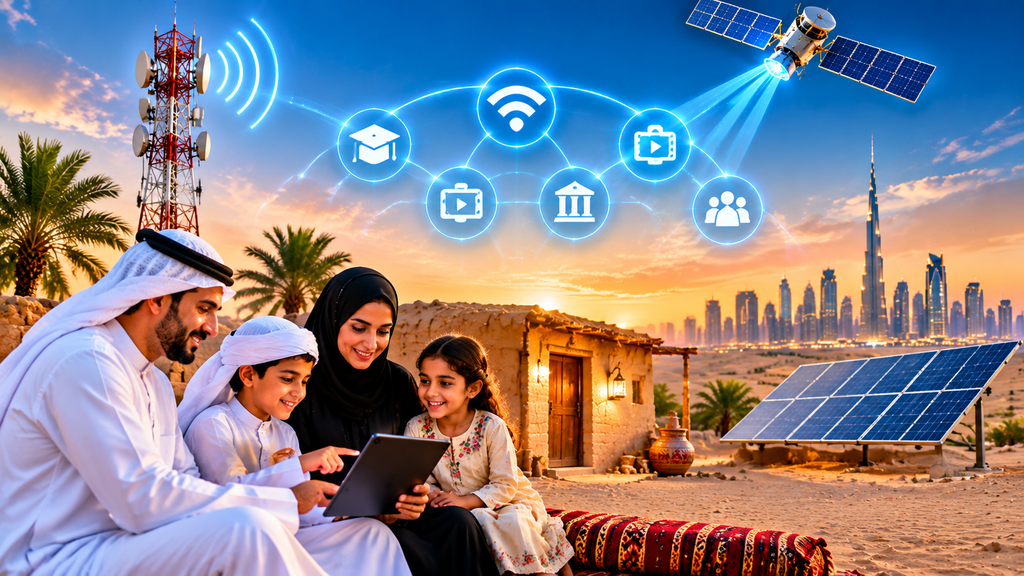
Saudi Arabia’s Communications, Space and Technology Commission has been examining direct-to-device satellite communications.
In November 2024, Viasat and its partners demonstrated satellite-enabled messages and emergency SOS communication using compatible mobile equipment during a technology event in Riyadh.
In October 2025, CST opened a consultation on the regulatory approach to direct-to-device services and updated non-terrestrial network regulations.
The proposed applications included extending communications into areas beyond terrestrial mobile coverage.
These developments establish that the technology is being evaluated, but successful demonstrations and consultations do not establish nationwide commercial availability.
Oman: Satellite Broadband for Remote Villages
Oman provides a documented example of satellite communications supporting rural connectivity.
Its AFAQ initiative began in April 2020 to connect villages without existing fixed or mobile internet access.
The project uses satellite technology to provide broadband through licensed service providers.
Ooredoo Oman advertises a satellite home internet plan for eligible rural customers with 250 GB of monthly data, speeds of up to 6 Mbps and a monthly fee of OMR 15 before 5% VAT.
The plan is an operator-specific offering, not a universal price for satellite broadband across Oman.
Regional Developments Compared
| Country | Development | Status |
|---|---|---|
| UAE | Starlink satellite broadband licence | Regulatory authorisation granted in August 2026 |
| Saudi Arabia | Direct-to-device demonstrations and regulatory consultation | Technology and regulatory development |
| Oman | AFAQ remote village connectivity | Established programme |
| Wider GCC | Satellite and non-terrestrial communications | Country-specific initiatives |
These examples demonstrate different stages of development. A licence, an operational rural service and a technology demonstration should not be treated as equivalent evidence of consumer availability.
Satellite Connectivity for Healthcare, Education and Emergencies
The most significant social benefits of satellite broadband may emerge when reliable connectivity allows essential services to reach people living far from major cities.
However, these benefits require more than purchasing an internet terminal.
Local institutions need devices, suitable software, trained employees and operational support.
Distance Learning in Remote Settlements
A school with dependable internet access could provide students with educational resources unavailable locally.
Teachers might organise interactive lessons with specialists in another city or use digital libraries to support classroom activities.
For students pursuing specialised subjects, online learning may widen educational choices.
However, live lessons require sufficient bandwidth, and unreliable electricity could interrupt access.
Recorded educational materials and offline resources may remain useful even where satellite broadband is available.
Remote Medical Consultations
A small healthcare clinic could use connectivity to communicate with larger medical institutions.
Healthcare professionals might arrange suitable remote consultations, transmit approved medical records or receive specialist guidance.
This could reduce some patient journeys, particularly for follow-up appointments that do not require physical examination.
However, medical privacy, clinical reliability and professional licensing remain essential.
Emergency Alerts and Disaster Response
Satellite communications may support emergency operations when terrestrial infrastructure is damaged, overloaded or unavailable.
For isolated mountain or desert communities, additional communication options could improve coordination between residents and response teams.
The International Telecommunication Union identifies disaster response and emergency warning systems among the important potential applications of space-based connectivity.
However, emergency readiness also requires working terminals, charged devices, trained personnel and clear response procedures.
A Practical Example
Consider a hypothetical remote settlement with a school, small healthcare facility and local community centre.
A shared satellite broadband connection could potentially support basic digital services at all three locations.
However, the installation would need sufficient capacity and appropriate network controls to prevent one activity from disrupting another.
A shared service might therefore be more economical than individual subscriptions, but it would require ongoing local management.
The Economics of Satellite Internet in Remote Arabia
The financial argument for satellite broadband differs substantially between densely populated cities and isolated settlements.
In an urban neighbourhood, a telecommunications company can spread infrastructure costs across many households and businesses.
In a remote village, a much smaller customer base may need to support relatively expensive construction and maintenance.
Satellite technology offers an alternative because it reduces the need to extend dedicated terrestrial infrastructure to every location.
Understanding Installation and Operating Costs
A satellite internet connection may involve terminal equipment, installation, a monthly subscription, power and maintenance.
The total cost depends on the provider, service capacity and location.
Oman’s published rural satellite plan demonstrates that targeted programmes can offer relatively affordable monthly service packages, although performance and eligibility restrictions remain important.
Illustrative Community Connectivity Model
Consider a hypothetical remote community establishing a shared satellite connection for a school and public service centre.
| Expense | Illustrative Amount |
|---|---|
| Satellite Equipment and Installation | AED 12,000 |
| Networking and Local Wi-Fi | AED 6,000 |
| Backup Power Equipment | AED 7,000 |
| Initial Investment | AED 25,000 |
| Monthly Satellite Service | AED 1,500 |
| Monthly Maintenance and Support | AED 500 |
| Monthly Operating Cost | AED 2,000 |
These numbers are hypothetical, not quotations from a UAE or GCC telecommunications provider.
They exclude permits, taxes, replacement equipment and other potential costs.
In this model, the first year’s estimated expenditure would reach AED 49,000, including the initial investment and twelve months of operating costs.
Cost per User Matters
If 100 people regularly used the shared facility, the illustrative monthly operating cost would equal AED 20 per user.
However, this figure assumes costs are shared equally and does not mean each user receives a dedicated broadband connection.
Actual usage, bandwidth limitations and equipment depreciation would affect the economics.
Why Public Investment May Be Necessary
Commercial operators may struggle to recover costs in communities with relatively few potential subscribers.
Governments can consider targeted programmes, universal service mechanisms or public-private partnerships where social benefits justify support.
The ITU’s 2025 research on rural telecommunications highlights financing, renewable energy and sustainable operating models as important components of digital inclusion.
Satellite Business Models Compared
| Model | Main Advantage | Main Limitation |
|---|---|---|
| Individual Subscription | Direct household access | Per-household affordability |
| Community Internet Hub | Shares infrastructure costs | Capacity and management |
| School or Clinic Connection | Supports essential services | Institutional funding |
| Enterprise Satellite Service | Serves business operations | Higher performance requirements |
| Satellite Backhaul | Supports wider local networks | Additional network infrastructure |
A successful programme should compare the complete long-term cost of satellite service against practical alternatives, including fibre, fixed wireless and mobile-network expansion.
Challenges of Satellite Connectivity in the Gulf
Although satellite communications can extend internet access, the technology has limitations that must be considered before large-scale deployment.
These include affordability, technical performance, equipment maintenance, regulatory approval and cybersecurity.
Equipment and Subscription Costs
A remote household may struggle to afford initial equipment even when a monthly subscription is reasonably priced.
Public programmes and shared connections can address some financial barriers, but they require sustainable funding.
A service that is affordable during a subsidised pilot may become difficult to maintain if financial support ends.
Weather and Environmental Conditions
Satellite links can be affected by weather, particularly heavy rain, depending on the frequencies and equipment involved.
Equipment in Arabian environments may also face high temperatures, dust and sand accumulation.
Proper installation, maintenance and equipment selection are important for reliable operation.
Latency and Network Performance
Geostationary satellites operate far above Earth and generally have higher communication latency than lower-orbit systems.
This can affect interactive applications.
LEO systems can provide lower latency, but their performance still depends on network capacity, coverage and service conditions.
Users should compare realistic performance rather than relying only on advertised maximum speeds.
Legal and Regulatory Requirements
Satellite operators must comply with national telecommunications and spectrum rules.
A service authorised in one country is not automatically permitted in another.
The UAE’s August 2026 licensing announcement explicitly identifies requirements involving security, service quality, consumer protection, privacy and radio-spectrum coordination.
Residents should therefore avoid assuming that imported satellite equipment can be activated legally without the appropriate approvals.
Cybersecurity and Privacy
A satellite connection does not automatically protect information from interception, account compromise or malicious software.
Schools, clinics and businesses still need suitable encryption, access controls and cybersecurity practices.
Common Challenges and Possible Solutions
| Challenge | Potential Response |
|---|---|
| High Equipment Costs | Shared facilities or targeted support |
| Limited Bandwidth | Appropriate capacity planning |
| Environmental Exposure | Suitable installation and maintenance |
| Power Interruptions | Backup power systems |
| Regulatory Restrictions | Use authorised providers |
| Cybersecurity Risks | Secure networks and authentication |
| Limited Digital Skills | Community training and assistance |
Reliable connectivity requires an entire service ecosystem, not merely a satellite signal.
Business Opportunities From Remote Satellite Connectivity
Improved connectivity could support new economic activity across remote Arabian communities.
However, the benefits depend on whether businesses can convert internet access into viable products, services and employment opportunities.
Remote Tourism and Hospitality
Desert camps, mountain lodges and isolated tourism businesses may use satellite internet for bookings, customer communication and operational coordination.
Improved connectivity could also support digital payment systems where the relevant financial services are available.
However, tourism operators must consider whether connectivity improves their offering without compromising the natural experience visitors seek.
Agriculture and Environmental Services
Remote agricultural businesses may use connected devices to monitor water consumption, equipment status and environmental conditions.
Satellite communications can help transmit information where mobile coverage is limited.
However, digital monitoring must be linked to useful operational decisions to justify the investment.
Telecommunications Installation and Maintenance
Satellite connectivity creates potential demand for technicians who can install terminals, configure networks and provide maintenance.
Local companies may also support customer service, equipment distribution and community connectivity programmes.
These activities are subject to relevant telecommunications and business licensing requirements.
Education and Digital Work
Reliable broadband may enable some residents to access remote training, online commerce and suitable digital employment.
However, the existence of internet access does not guarantee job creation.
Digital skills, language capabilities, employer demand and supporting services remain necessary.
Community Business Opportunities
| Opportunity | Potential Customers | Main Requirement |
|---|---|---|
| Satellite Installation | Households and institutions | Technical skills and authorisation |
| Network Maintenance | Businesses and community facilities | Reliable local support |
| Tourism Connectivity | Remote hospitality providers | Service continuity |
| Agricultural Monitoring | Farms and environmental operators | Useful sensor systems |
| Online Education Support | Schools and training centres | Devices and learning resources |
| Digital Business Services | Local entrepreneurs | Skills and customer demand |
The most sustainable opportunities will emerge where connectivity solves an identifiable problem rather than introducing technology without a clear purpose.
The Future of Arabian Satellite Connectivity and FAQs
Satellite connectivity is likely to remain part of the Gulf’s broader telecommunications development.
Advances in low Earth orbit networks, higher-capacity satellites and direct-to-device technologies may expand the range of services available to remote users.
However, countries will continue to evaluate these systems according to cost, licensing, security and performance.
Satellite and Terrestrial Networks Working Together
The future is unlikely to involve replacing fibre and mobile networks with satellite connections.
Instead, telecommunications operators may combine different technologies.
For example, a satellite link could provide backhaul connectivity to a remote mobile base station, allowing users to access a local network through conventional devices.
The ITU identifies this complementary approach as an important means of extending connectivity.
Direct-to-Device Communications
Direct-to-device technology could eventually make selected satellite communications accessible through compatible mobile phones.
Saudi Arabia’s demonstrations and regulatory consultations illustrate regional interest in this approach.
However, satellite emergency messaging, ordinary text communication and full broadband access are different capabilities.
Residents should not assume that every mobile phone can already access satellite internet throughout the Arabian Peninsula.
Frequently Asked Questions
What is satellite internet?
Satellite internet provides connectivity by transmitting data through satellites and associated ground equipment.
Why is satellite connectivity important for remote Arabian communities?
It can extend communication services to locations where installing conventional infrastructure is expensive or difficult.
Is satellite internet available in the UAE?
The UAE authorised Starlink to provide satellite broadband services in August 2026. Actual customer availability depends on service rollout and applicable conditions.
Does Oman have satellite broadband for villages?
Yes. Oman’s AFAQ initiative supports connectivity for eligible remote communities through licensed providers.
Is Saudi Arabia testing satellite-to-phone technology?
Yes. Saudi Arabia has conducted demonstrations and consultations concerning direct-to-device communications.
Can satellite internet support online education?
Yes, where the connection provides sufficient capacity. Suitable devices, teaching support and digital resources are also necessary.
Can remote hospitals use satellite connections?
Satellite networks can support appropriate remote healthcare communications, subject to clinical, security and operational requirements.
Is satellite internet faster than fibre?
Not necessarily. Performance depends on the provider and technology, while fibre often provides strong speed and latency performance where available.
Does satellite internet work during emergencies?
It can offer an additional communication path, but operation still depends on power, equipment, network availability and service conditions.
Will satellite technology replace mobile towers?
It is more likely to complement terrestrial networks, particularly in remote or underserved locations.
Final Thoughts
Satellite connectivity offers an opportunity to reduce communication barriers across remote parts of the Arabian Peninsula.
For communities in deserts, mountains, offshore areas and isolated settlements, reliable internet access could support education, healthcare, emergency communication and local economic activity.
The UAE’s satellite broadband licensing, Saudi Arabia’s direct-to-device developments and Oman’s established rural connectivity programme demonstrate different ways Gulf countries are exploring this technology.
However, meaningful digital inclusion requires more than technical coverage.
Affordability, digital skills, electricity, equipment maintenance and appropriate regulation are all important.
For governments, satellite communications may provide another tool for reaching underserved communities. For businesses, they create opportunities in telecommunications services, tourism, agriculture and digital infrastructure.
For residents, the potential benefit is greater access to information and essential services without the need to relocate to major cities.
Ultimately, Arabian satellite connectivity could help make remote communities more connected and resilient.
Its long-term success will depend on whether reliable services become accessible, affordable and genuinely useful to the people they are intended to serve.
Do follow us on Instagram
Read More – Why Gulf Technology Audits Are Becoming Essential