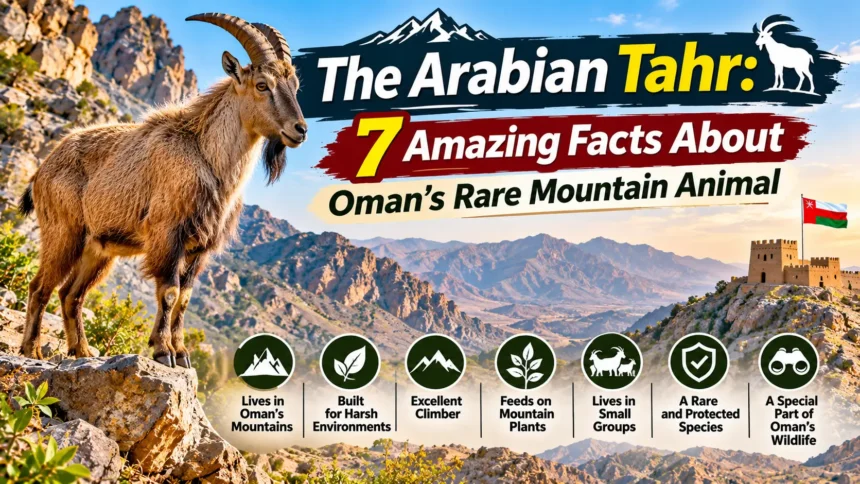
The Arabian Tahr: A Rare Mountain Animal of Oman
Oman’s mountains are home to many fascinating wildlife species, but some animals are so rare that visitors may never get the chance to see them in the wild. One of these special animals is the Arabian Tahr, a small mountain-dwelling mammal known for its thick brown coat, curved horns and ability to move across steep rocky slopes.
- 1. What Is the Arabian Tahr?
- 2. Where Does the Arabian Tahr Live in Oman?
- 3. Physical Features That Make the Arabian Tahr Special
- 4. How Does the Arabian Tahr Survive in Dry Mountain Environments?
- 5. What Does the Arabian Tahr Eat?
- 6. Behaviour and Daily Life of the Arabian Tahr
- 7. Breeding and Young Arabian Tahrs
- 8. Why Is the Arabian Tahr Endangered?
- 9. Conservation Efforts to Protect the Arabian Tahr in Oman
- 10. The Arabian Tahr and Its Importance to Oman’s Natural Heritage
- 11. Interesting Facts About the Arabian Tahr
- Conclusion
- Frequently Asked Questions (FAQs)
The Arabian Tahr (Arabitragus jayakari) is native to the Hajar Mountains of Oman and the United Arab Emirates. It is the smallest species of tahr in the world and is specially adapted to survive in dry mountain environments where fresh water and food can be limited. Its strong legs, flexible hooves and ability to find food among rocky landscapes make it well suited to this challenging habitat.
Unlike animals that prefer open grasslands or flat desert areas, the Arabian Tahr spends much of its time among mountain cliffs, rocky valleys and steep slopes. These locations provide food, shelter and protection from danger.
However, this rare animal faces several challenges, including habitat loss, illegal hunting, competition with domestic goats and changing environmental conditions. Protecting its natural habitat is important for maintaining one of the Arabian Peninsula’s most unique mountain species.
Let’s explore the appearance, habitat, feeding habits, behaviour and conservation of the Arabian Tahr and understand why this rare animal is so important to Oman’s wildlife.
1. What Is the Arabian Tahr?
The Arabian Tahr is a wild mountain animal belonging to the Bovidae family, which also includes goats, sheep, antelopes and cattle. It is scientifically known as Arabitragus jayakari and is found naturally in the Hajar Mountain range of eastern Arabia.
It is a relatively small animal with a strong body, short legs and backward-curving horns. Both males and females have horns, although males generally have larger and thicker ones.
The Arabian Tahr is particularly interesting because it is the smallest member of the tahr group. Its body structure helps it move through narrow mountain paths and uneven rocky surfaces.
Some basic facts about the Arabian Tahr include:
- Scientific name: Arabitragus jayakari
- Common name: Arabian Tahr
- Animal family: Bovidae
- Habitat: Rocky mountains, cliffs and mountain valleys
- Native range: Oman and the United Arab Emirates
- Conservation status: Endangered
- Main food: Leaves, shoots, fruits, seeds and other plant material
The species is difficult to study because it lives in rugged mountain areas and often avoids human activity. As a result, researchers depend on field surveys, local observations and camera traps to understand its behaviour and distribution.
2. Where Does the Arabian Tahr Live in Oman?
The Hajar Mountains provide the main natural habitat of the Arabian Tahr. This mountain range stretches across northern Oman and extends into the eastern United Arab Emirates.
They are mainly found in the Hajar Mountains of northern Oman and parts of the UAE, including Jabal Hafit. However, there have also been a few rare sightings in the southern region of Dhofar.
Unlike the open sandy deserts found in other parts of Oman, the Hajar Mountains have steep cliffs, deep valleys, rocky slopes and scattered vegetation. These features create suitable conditions for animals that can survive in dry and difficult terrain.
Arabian Tahrs are often found on north-facing mountain slopes, where temperatures can be cooler and vegetation is generally more diverse. They commonly use elevations around 1,000 to 1,800 metres, although they can live at different heights depending on the available habitat.
Important areas connected with Arabian Tahr conservation in Oman include:
- Wadi Sareen Nature Reserve: Located in the eastern Hajar Mountains, this protected area provides important habitat for Arabian Tahrs and other wildlife.
- Jabal Qahwan Nature Reserve: Located in Oman’s eastern mountain region, it protects another important population and area of suitable habitat.
- Jabal Akhdar region: Its mountain environment supports a variety of native plants and wildlife and is part of the wider Hajar mountain landscape.
- Sirrin Biosphere Reserve: Recognised by UNESCO in 2025, this reserve protects parts of the Eastern Hajar Mountains and provides important habitat for the Arabian Tahr.
These areas are valuable because they offer natural vegetation, rocky shelter and access to water sources.
The condition of these habitats directly affects the survival of the Arabian Tahr. When mountain vegetation decreases or human disturbance increases, finding enough food and safe shelter becomes more difficult.
3. Physical Features That Make the Arabian Tahr Special
The Arabian Tahr has several physical features that help it survive in the mountains. Its appearance may seem simple at first, but its body is well suited to the environment in which it lives.
Thick reddish-brown coat
The Arabian Tahr has long, reddish-brown hair with a darker line running along its back. This coat helps it blend into the rocky surroundings and provides protection against changing mountain temperatures.
Male tahrs develop a noticeable mane around the neck, chest and front legs. The mane becomes more impressive as they mature, making adult males look larger.
Strong curved horns
Both male and female Arabian Tahrs have horns that curve backwards. Males usually have thicker and more developed horns.
These horns can be used during conflicts between males, particularly when competing for mates or territory.
Compact and muscular body
The animal has a stocky body that helps it maintain balance while moving across uneven ground. Its compact build is useful for climbing and moving through narrow mountain paths.
Specialised hooves
One of its most useful features is its flexible hooves. Their structure provides a strong grip on rocky surfaces, allowing the animal to move across steep slopes and uneven cliffs with greater stability.
Together, these physical features make the Arabian Tahr well adapted to the rugged environment of the Hajar Mountains.
4. How Does the Arabian Tahr Survive in Dry Mountain Environments?
Living in the mountains of Oman is not always easy. Some areas receive limited rainfall, water sources can become seasonal and temperatures may rise significantly during summer.
The Arabian tahr (Arabitragus jayakari) lives in the hot and dry Hajar Mountains of Oman and the UAE. It survives in these harsh conditions by avoiding extreme heat, finding water, and using its strong body and special hooves to move easily across steep rocky slopes.
The Arabian Tahr survives through a combination of physical adaptations and natural behaviour.
Its ability to move across steep slopes helps it reach areas where suitable vegetation is available. These rocky locations also provide shade and protection from potential threats.
The animal can move between different elevations depending on food and water availability. It may also travel down towards mountain valleys, known locally as wadis, where it can find water and vegetation.
One particularly unusual adaptation was documented in a scientific study published in 2024. Researchers confirmed through camera-trap recordings that Arabian Tahrs had occasionally drunk seawater from natural pools along the rocky coast at Ras Abu Dawood, southeast of Muscat.
The observations were recorded on three occasions. Researchers suggested that seawater may provide extra minerals, particularly sodium, when these nutrients are limited in the animals’ normal plant-based diet.
This behaviour is unusual among land mammals and offers an interesting example of how Arabian Tahrs use available natural resources to survive in challenging environments.
However, drinking seawater should not be described as their normal source of water. It was an occasional behaviour recorded at a specific coastal study site.
5. What Does the Arabian Tahr Eat?
The Arabian Tahr is a herbivorous animal, meaning it mainly feeds on plants. Its diet includes different types of vegetation found across mountain slopes and valleys.
Unlike some grazing animals that depend mainly on grass, the Arabian Tahr is also a browser. It selects leaves, young shoots, seeds, fruits and other plant material.
Its food sources may include:
- Fresh leaves from mountain shrubs and trees.
- Young plant shoots.
- Wild fruits and seeds.
- Grass and other small plants.
- Bark and stems when other food is limited.
The availability of food changes throughout the year. After seasonal rainfall, mountain vegetation may become more plentiful, providing better feeding opportunities.
During dry periods, plants become less available, and tahrs may need to travel farther to find suitable food.
This is one reason why protecting mountain vegetation is so important. When domestic goats and other livestock consume large amounts of vegetation, less food may remain for wild mountain animals.
Healthy mountain ecosystems therefore play a major role in supporting the Arabian Tahr population.
6. Behaviour and Daily Life of the Arabian Tahr
The Arabian Tahr is generally active during daylight hours. It often begins feeding early in the morning and continues searching for food during the day.
During hotter periods, it may use shaded rocky areas for shelter. Steep slopes, narrow valleys and areas with natural cover provide useful places to rest and avoid disturbance.
Unlike some mountain animals that form large herds, Arabian Tahrs are usually seen in smaller groups. They may live alone or in groups of two or three, often consisting of a female and her young, or a male and female.
Their behaviour is influenced by food availability, water sources, breeding activities and environmental conditions.
Some common behaviours include:
- Searching for leaves and other plant material during the day.
- Moving across steep slopes to reach feeding areas.
- Visiting wadis to find water.
- Resting in shaded rocky locations.
- Staying in small family groups.
- Using difficult mountain terrain to escape danger.
Arabian Tahrs are also naturally cautious. Their ability to live in remote and difficult-to-reach areas helps them avoid frequent human contact.
This behaviour makes them difficult to observe in the wild and explains why camera traps are valuable tools for researchers studying their populations.
7. Breeding and Young Arabian Tahrs
Breeding plays an important role in maintaining the Arabian Tahr population. These animals can breed throughout the year, although mating activity is generally higher during November and December.
After mating, the female carries the young for around 140 to 145 days. Births are commonly recorded around March and April.
Females usually give birth to one young, although two may be born when food and environmental conditions are favourable.
Young Arabian Tahrs depend on their mothers for milk, care and protection during their early months. They gradually become more independent as they grow.
Mothers often keep their young in relatively safe areas, away from unnecessary disturbance and potential danger.
The slow process of raising young makes habitat protection especially important. If food availability declines or animals are repeatedly disturbed, breeding success and the survival of young tahrs may be affected.
Protecting suitable feeding and shelter areas gives these animals a better chance of maintaining healthy populations.
8. Why Is the Arabian Tahr Endangered?
Despite its ability to survive in difficult mountain conditions, the Arabian Tahr is facing serious threats. The International Union for Conservation of Nature (IUCN) classifies the species as Endangered.
Its population has declined because of several human-related and environmental pressures.
1. Competition with domestic goats
One of the biggest challenges is competition for food and habitat. Domestic goats often feed on the same plants used by Arabian Tahrs.
When large numbers of livestock use the same mountain areas, less vegetation may remain for wild animals. Goats can also occupy important feeding and resting areas.
Research published in the journal Oryx identified livestock presence, particularly domestic goats, as a major factor affecting the distribution of Arabian Tahrs.
2. Illegal hunting
Illegal hunting has affected the species for many years. Although hunting Arabian Tahrs has been prohibited in Oman since 1976, poaching remains a concern in some areas.
The animal’s limited population makes the loss of even a small number of individuals a serious conservation problem.
3. Habitat destruction
Road construction, development and resource extraction can damage natural mountain habitats. These activities may divide suitable areas into smaller sections and make it harder for animals to move between populations.
4. Water scarcity
Water is essential for survival in Oman’s dry mountain environment. Long periods without rainfall can reduce the availability of freshwater and vegetation.
During severe droughts, Arabian Tahrs may struggle to find enough food and water.
5. Climate change
Changing temperatures and rainfall patterns can affect mountain vegetation, water availability and habitat conditions. These changes may place additional pressure on an already vulnerable species.
Protecting the Arabian Tahr therefore requires addressing several connected environmental problems rather than focusing on hunting alone.
9. Conservation Efforts to Protect the Arabian Tahr in Oman
Protecting the Arabian Tahr is an important part of conserving Oman’s natural wildlife. The country has several protected areas that provide suitable habitats for this rare mountain animal.
Wadi Sareen and Jabal Qahwan are particularly important because research has identified them as strongholds for Arabian Tahr populations.
Camera-trap research across the Hajar Mountains has also shown that the species is more frequently recorded in protected areas where human activities are restricted and ranger patrols help reduce disturbance.
Another important development came in 2025, when UNESCO recognised the Sirrin Biosphere Reserve in Oman’s Eastern Hajar Mountains.
The reserve includes steep mountain slopes, deep wadis and freshwater springs. UNESCO specifically identifies the Arabian Tahr as one of the species supported by this protected landscape. The area also contains more than 400 plant species, including some that are endemic or nationally threatened.
Conservation efforts can be strengthened through several practical actions:
- Protect mountain habitats from unnecessary development.
- Prevent illegal hunting and increase wildlife monitoring.
- Manage domestic livestock grazing in important tahr habitats.
- Protect natural springs and water sources.
- Restore damaged mountain vegetation.
- Use camera traps and scientific surveys to monitor populations.
- Encourage local communities to participate in wildlife conservation.
Local communities also play an important role. Their knowledge of mountain environments and traditional land-use practices can help conservation authorities protect wildlife while supporting sustainable livelihoods.
10. The Arabian Tahr and Its Importance to Oman’s Natural Heritage
In Oman, the Arabian tahr is seen as a symbol of strength, independence, and survival in the mountains. It has also been featured on the country’s currency, stamps, and official environmental symbols.
The Arabian Tahr is more than just a rare mountain animal. It is an important part of Oman’s natural heritage and biodiversity.
As a plant-eating mammal, it forms part of the mountain food web and interacts with the vegetation of the Hajar Mountains. Its survival depends on healthy natural habitats that also support other wildlife species.
The same mountain landscapes are home to Arabian gazelles, foxes, wolves and many native plants.
The presence of the Arabian Tahr also highlights the importance of protecting Oman’s mountain ecosystems. These environments may look dry and rocky, but they support a wide variety of life.
Protecting the species helps preserve the ecological balance of the region and supports the wider conservation of native wildlife.
Its endangered status also reminds us that even animals well adapted to harsh environments can struggle when their natural habitats face increasing human pressure.
11. Interesting Facts About the Arabian Tahr
The Arabian Tahr has several unusual characteristics that make it one of the most fascinating mammals of the Arabian Peninsula.
Here are some interesting facts about this rare mountain animal:
- It is the smallest tahr species: The Arabian Tahr is the smallest member of the tahr group.
- Both sexes have horns: Unlike many other mammals, both males and females develop backward-curving horns.
- Males have a longer mane: Adult males develop noticeable long hair around their neck, chest and front legs.
- It is a skilled climber: Its flexible hooves help it move across steep and rocky surfaces.
- It is a browser: Its diet includes leaves, young shoots, fruits and seeds.
- It can drink seawater occasionally: A 2024 scientific study confirmed this unusual behaviour through camera-trap recordings in Oman.
- It lives in small groups: Arabian Tahrs are generally found alone or in small family groups.
- It is Endangered: Habitat loss, hunting and competition with livestock continue to threaten its survival.
These characteristics show how specially adapted the Arabian Tahr is to the mountain environment of Oman.
Conclusion
The Arabian Tahr is one of Oman’s most remarkable yet threatened mountain animals. Its small, strong body, curved horns, thick coat and specialised hooves allow it to survive in the steep and dry landscapes of the Hajar Mountains.
From feeding on mountain vegetation to moving across rocky cliffs and finding water in difficult conditions, this animal has developed several ways to adapt to its surroundings. Its unusual ability to drink seawater from coastal pools, confirmed by scientific research in 2024, makes it even more interesting.
However, the future of the Arabian Tahr depends on protecting its natural habitat. Illegal hunting, competition with domestic goats, water shortages and habitat disturbance continue to create challenges for its survival.
Protected areas such as Wadi Sareen and Jabal Qahwan, along with the UNESCO-recognised Sirrin Biosphere Reserve, play an important role in supporting this rare species.
By protecting mountain vegetation, managing livestock grazing and supporting wildlife research, Oman can help preserve the Arabian Tahr for future generations.
Its survival is not only important for one animal species. It also represents the wider value of Oman’s unique mountain ecosystems and the need to protect the wildlife that depends on them.
Frequently Asked Questions (FAQs)
1. What is the Arabian Tahr?
The Arabian Tahr is a rare, wild mountain mammal scientifically known as Arabitragus jayakari. It belongs to the Bovidae family and lives naturally in the Hajar Mountains of Oman and the United Arab Emirates.
2. Where can the Arabian Tahr be found in Oman?
It is found in parts of the Hajar Mountains, including protected areas such as Wadi Sareen and Jabal Qahwan. It prefers steep, rocky slopes and mountain valleys.
3. What does the Arabian Tahr eat?
The Arabian Tahr is a herbivore that feeds on leaves, young shoots, fruits, seeds, grass and other available plant material.
4. Why is the Arabian Tahr endangered?
The main threats include illegal hunting, competition with domestic goats, habitat destruction, water shortages and climate change.
5. Can the Arabian Tahr drink seawater?
Yes. A scientific study published in 2024 confirmed that Arabian Tahrs occasionally drink seawater from natural pools along Oman’s rocky coastline. Researchers suggested that it may provide additional minerals such as sodium.
6. Is the Arabian Tahr found only in Oman?
No. The species is native to the Hajar Mountains of both Oman and the United Arab Emirates. Oman supports important wild populations of this rare animal.
7. What makes the Arabian Tahr a good climber?
Its strong legs, compact body and flexible hooves help it maintain a firm grip while moving across steep slopes and rocky surfaces.
8. How can the Arabian Tahr be protected?
It can be protected by conserving mountain habitats, preventing illegal hunting, controlling livestock grazing, protecting water sources and supporting scientific wildlife monitoring.
Do follow us on Instagram
Read More – How the Arabian Oryx Survived in the Desert