Why Underground Infrastructure Deserves More Attention in Gulf Urban Planning
Beneath the waters surrounding the Arabian Peninsula lies an important network of marine habitats supporting fish, corals, shellfish, and many other organisms. These ecosystems contribute to regional biodiversity, fisheries, coastal protection, and marine tourism. However, increasing environmental pressures are creating challenges for the long-term health of coastal waters.
- 1. Why Artificial Reefs Are Becoming Important for Gulf Marine Ecosystems
- 2. How Artificial Reefs Support Fish Habitats and Marine Biodiversity
- 3. What Dubai and Abu Dhabi Reveal About Large-Scale Reef Restoration
- 4. How Saudi Arabia, Bahrain, and Oman Are Developing Marine Restoration Approaches
- 5. How Artificial Reef Design and Marine Technology Are Evolving
- 6. The Risks and Limitations of Artificial Reef Development
- 7. The Future of Artificial Reefs in Gulf Marine Conservation
Artificial reefs in the Gulf are becoming an important subject in marine conservation as governments, scientists, and environmental organisations explore ways to restore degraded habitats and create suitable environments for marine life.
Artificial reefs are human-made structures placed underwater to provide surfaces, shelter, and physical complexity that may support marine organisms. Depending on their design and location, these structures can attract fish, provide settlement areas for corals and other invertebrates, and contribute to broader habitat-management programmes.
Across the United Arab Emirates, Saudi Arabia, Bahrain, Oman, and other regional markets, marine restoration initiatives are increasingly combining environmental science with engineering technology.
Dubai’s DUBAI REEF initiative, Abu Dhabi’s Coral Gardens programme, and Saudi Arabia’s large-scale coral restoration research demonstrate the growing interest in marine conservation.
However, an artificial reef is not automatically a restored ecosystem. Structures that attract fish do not necessarily increase fish populations, and newly installed modules cannot immediately replace the ecological functions of established natural coral reefs.
The effectiveness of artificial reefs depends on scientific site selection, suitable materials, water quality, protection from damaging activities, and long-term monitoring.
Understanding these factors reveals how artificial reef technology could contribute to healthier marine ecosystems while supporting sustainable coastal development.
1. Why Artificial Reefs Are Becoming Important for Gulf Marine Ecosystems
Marine ecosystems across the Arabian Peninsula include natural coral reefs, rocky seabeds, seagrass meadows, coastal wetlands, and other habitats.
Each environment provides different ecological functions.
Coral reefs can offer shelter, feeding areas, and reproductive habitats for many marine species, while seagrass meadows support different communities and help stabilise marine sediments.
However, coastal development, pollution, marine heatwaves, and other pressures can affect these ecosystems.
The Environmental Challenges Facing Gulf Waters
The Arabian Gulf experiences naturally high summer seawater temperatures and significant seasonal variations in environmental conditions.
Marine organisms living in these waters may be adapted to challenging conditions, but they can still experience stress when temperatures exceed their tolerance.
Coastal construction can also alter marine habitats through dredging, sediment movement, and changes in water circulation.
These pressures may reduce suitable habitat for certain species.
The Global Coral Reef Crisis
The United States National Oceanic and Atmospheric Administration reported in June 2026 that bleaching-level heat stress had affected approximately 84.4% of the world’s coral reef area during the fourth global coral bleaching event.
The event likely ended in 2025, according to NOAA’s assessment.
This figure describes exposure to bleaching-level heat stress, not the percentage of coral reefs that died.
Nevertheless, it demonstrates the scale of environmental pressure facing reefs worldwide.
What Artificial Reefs Can Provide
Artificial reef structures can introduce suitable hard surfaces and underwater shelter in selected locations.
Over time, organisms may colonise these surfaces, potentially creating additional habitat complexity.
However, this depends on local conditions.
A structure placed in unsuitable water or on a sensitive existing habitat may provide little ecological benefit or even cause damage.
Artificial Reefs and Natural Reefs Compared
| Feature | Natural Coral Reef | Artificial Reef |
|---|---|---|
| Origin | Develops through natural biological processes | Human-designed and installed |
| Habitat Structure | Created through living organisms and geological processes | Determined initially by engineering design |
| Species Communities | Developed through ecological interactions | Depend on recruitment and local conditions |
| Coral Growth | May include established coral colonies | Requires suitable settlement or transplantation |
| Maintenance | Needs ecosystem protection | May require structural inspection |
| Restoration Value | Protecting existing habitat is essential | Can supplement selected restoration efforts |
Artificial reefs should therefore be viewed as supporting tools rather than universal substitutes for natural ecosystems.
2. How Artificial Reefs Support Fish Habitats and Marine Biodiversity
One of the most visible effects of artificial reefs is the attraction of marine organisms to structures that provide shelter and surfaces for colonisation.
Fish may gather around cavities and ledges, while invertebrates and algae can attach to suitable materials.
However, these changes require careful ecological interpretation.
Creating Underwater Habitat Complexity
Flat seabeds may provide limited shelter for some reef-associated fish species.
Artificial structures can introduce vertical surfaces, openings, crevices, and shaded areas.
These features may support different species and life stages.
For example, smaller fish may use narrow spaces for shelter, while larger species may gather near more open structures.
However, successful design depends on the needs of local species rather than assuming every fish benefits from the same type of reef.
Attracting Fish Versus Producing More Fish
A central scientific question is whether artificial reefs increase fish production or simply attract fish from surrounding areas.
If fish move from nearby natural habitats to newly installed modules, surveys may record higher numbers at the artificial reef without demonstrating an increase in the overall population.
This distinction matters when evaluating conservation success.
A scientific meta-analysis published in Frontiers in Marine Science in 2020 reviewed 39 relevant studies.
It found that artificial reefs can support fish communities comparable to natural reefs in selected measurements, but outcomes vary according to location, materials, and environmental conditions.
Supporting Marine Food Webs
Artificial surfaces may be colonised by algae, sponges, molluscs, and other organisms.
These communities can influence food availability and habitat conditions for additional species.
However, biodiversity improvement is not guaranteed.
Poorly designed structures may favour a narrow range of organisms or attract species that disrupt existing ecological relationships.
Potential Ecological Benefits
| Potential Benefit | How Artificial Reefs May Contribute |
|---|---|
| Shelter | Cavities and structures provide protected spaces |
| Habitat Diversity | Additional hard surfaces and vertical complexity |
| Coral Settlement | Suitable surfaces for larvae or transplanted corals |
| Marine Research | Defined areas for ecological monitoring |
| Fisheries Management | Possible habitat enhancement under suitable management |
| Tourism | Potential alternative diving locations |
The strongest evidence of success comes from long-term population and habitat monitoring rather than photographs of fish gathering around a newly installed structure.
3. What Dubai and Abu Dhabi Reveal About Large-Scale Reef Restoration
The UAE provides important examples of artificial reef development through government-supported programmes designed to improve marine habitat conditions.
These initiatives demonstrate how marine restoration is increasingly becoming part of wider environmental planning.
Dubai’s DUBAI REEF Initiative
Launched in 2024, DUBAI REEF is a purpose-built marine habitat initiative supported by the Dubai Department of Economy and Tourism and other partners.
The programme aims to deploy more than 20,000 artificial reef modules across approximately 600 square kilometres of Dubai’s waters by 2027.
The modules are designed in different shapes and sizes to provide habitats for different marine species.
The project also includes marine conservation research and coral rehabilitation.
However, the 600-square-kilometre figure describes the wider programme area rather than the physical surface area covered by reef structures.
Early Ecological Monitoring
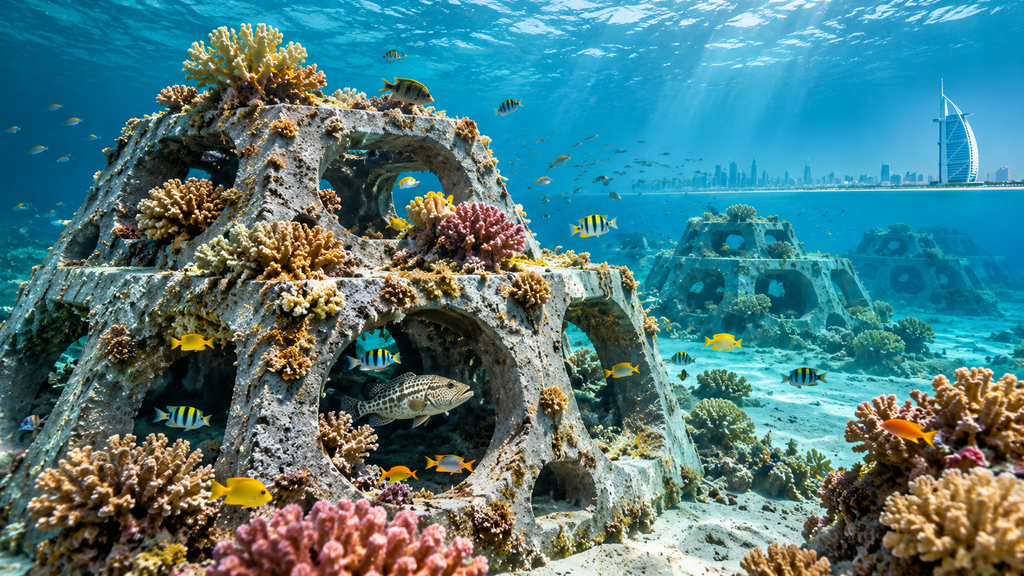
In July 2025, project partners reported encouraging results from the DUBAI REEF proof-of-concept site.
Their surveys identified fish from 15 native species and reported an eightfold increase in fish biomass at the monitored site.
They also described an estimated 10% increase in marine biodiversity.
These are early, project-reported observations from a particular site.
They should not be interpreted as proof of equivalent biodiversity improvements throughout Dubai’s coastal waters.
Abu Dhabi’s Coral Gardens
In May 2025, the Environment Agency – Abu Dhabi announced the Abu Dhabi Coral Gardens initiative.
The programme aims to deploy 40,000 artificial reef modules between 2025 and 2030 across a project area of approximately 1,200 square kilometres.
The initiative focuses on supporting marine biodiversity and creating appropriate habitat structures.
Site selection places importance on areas that do not already contain valuable coral or seagrass ecosystems.
This is particularly important because installing artificial structures on healthy natural habitats could damage the very ecosystems restoration projects aim to protect.
UAE Projects Compared
| Initiative | Announced Scope | Main Objective |
|---|---|---|
| DUBAI REEF | More than 20,000 modules across a 600 km² programme area | Marine habitat restoration and biodiversity |
| Dubai Coral Rehabilitation | Coral nursery and transplantation activities | Supporting indigenous coral growth |
| Abu Dhabi Coral Gardens | 40,000 modules planned over 2025–2030 | Habitat creation and ecosystem enhancement |
| Abu Dhabi 3D-Printed Reefs | Selected engineered demonstration installations | Testing biomimetic habitat structures |
These examples show different approaches to marine restoration rather than one identical model.
4. How Saudi Arabia, Bahrain, and Oman Are Developing Marine Restoration Approaches
Marine restoration activity extends beyond the UAE.
Saudi Arabia, Bahrain, and Oman are developing programmes involving reef conservation, habitat enhancement, and coastal ecosystem management.
However, the Arabian Gulf and Red Sea have different ecological and oceanographic conditions.
Saudi Arabia’s Coral Restoration Research
Saudi Arabia’s King Abdullah University of Science and Technology is developing large-scale coral restoration capacity through the KAUST Coral Restoration Initiative.
Working with NEOM, the programme combines coral cultivation, research, habitat assessment, and monitoring.
In November 2026, KAUST announced a major coral nursery and research facility on the Red Sea coast.
The announced plan includes producing up to 360,000 corals annually and outplanting more than two million corals across 100 hectares around Shushah Island by 2030.
These are programme capacities and future targets, not evidence that every planned coral has already been transplanted successfully.
The Difference Between Coral Restoration and Artificial Reefs
Coral propagation involves cultivating living corals and supporting their survival in suitable environments.
Artificial reefs involve placing human-made structures underwater.
The two approaches can complement one another when reef modules provide appropriate substrates for coral settlement or transplantation.
However, they remain distinct activities.
Saudi Arabia’s coral nursery achievements should not be described simply as an artificial reef installation programme.
Bahrain’s Artificial Reefs Project
Bahrain has announced an Artificial Reefs Project covering 2026–2030.
According to the country’s official Sustainable Development Goals reporting, the initiative aims to create habitats and breeding areas for marine organisms while supporting fisheries sustainability.
The project illustrates the connection between marine conservation and coastal livelihoods.
However, its planned benefits must be evaluated through ecological monitoring after deployment.
Oman’s Artificial Reef Activities
Oman has experience with artificial reef projects, including an initiative announced in Duqm in December 2021.
The project was designed to support marine organisms and provide opportunities for diving-related activities.
Oman’s government also provides a formal licensing service for fishermen seeking to establish artificial marine reefs under specified conditions.
This regulatory approach recognises that underwater habitat construction requires oversight.
Regional Approaches
| Country | Relevant Initiative | Main Focus |
|---|---|---|
| UAE | DUBAI REEF | Habitat restoration and biodiversity |
| UAE | Abu Dhabi Coral Gardens | Large-scale artificial reef modules |
| Saudi Arabia | KAUST Coral Restoration Initiative | Coral cultivation and ecosystem research |
| Bahrain | Artificial Reefs Project 2026–2030 | Marine habitats and fisheries |
| Oman | Duqm Artificial Coral Reefs Park | Habitat enhancement and marine recreation |
| Oman | Artificial Reef Licensing | Regulation of reef establishment |
The success of these efforts will depend on local ecology, maintenance, and long-term environmental outcomes.
5. How Artificial Reef Design and Marine Technology Are Evolving
Artificial reefs can be constructed using different materials and designs.
Modern approaches increasingly involve marine biology, engineering, computer modelling, and specialised manufacturing.
However, technological sophistication does not automatically guarantee ecological success.
The Importance of Suitable Materials
Artificial reef materials should be durable, appropriately stable, and suitable for marine environments.
Concrete and specially engineered marine structures are commonly used.
However, materials must be assessed for chemical composition, physical stability, and possible environmental effects.
Waste materials should not be placed underwater merely because they can provide a surface for marine organisms.
Three-Dimensional Reef Design
Three-dimensional printing can produce complex structures with different surfaces, cavities, and internal spaces.
These designs may imitate selected physical characteristics of natural reef habitats.
In Abu Dhabi, NMDC reported installing three 10-tonne, 3D-printed reef structures during 2025.
The structures were designed to increase biological surface complexity while remaining stable under local conditions.
However, installation alone does not demonstrate lasting ecosystem recovery.
Selecting Appropriate Locations
Site selection is one of the most important steps.
Marine scientists may examine seabed conditions, water depth, currents, sediment movement, existing habitats, and surrounding human activity.
A module designed for one coastline may be inappropriate elsewhere.
For example, excessive sediment can prevent some organisms from settling successfully, while strong currents may affect stability.
Artificial Reef Technologies Compared
| Technology | Potential Advantage | Important Limitation |
|---|---|---|
| Precast Concrete Modules | Durable and adaptable structures | Manufacturing and installation impacts |
| 3D-Printed Structures | Customised habitat complexity | Cost and long-term testing |
| Coral Nursery Substrates | Support selected coral cultivation | Require suitable environmental conditions |
| Underwater Sensors | Monitor local environmental conditions | Maintenance and calibration |
| Remote Imaging | Observe marine organisms | Visibility and interpretation limits |
| Digital Ecosystem Models | Support site planning | Depend on reliable scientific data |
Artificial Intelligence in Marine Conservation
AI-assisted tools can help researchers classify underwater imagery and analyse certain monitoring data.
Digital models may also support habitat mapping and restoration planning.
However, these tools require validation and cannot replace field-based ecological assessments.
6. The Risks and Limitations of Artificial Reef Development
Although artificial reefs may support marine restoration, poorly designed projects can introduce environmental risks.
These include habitat disruption, pollution, changes in fishing pressure, and misleading claims about ecological improvement.
Avoiding Damage to Existing Habitats
An artificial structure placed on a healthy seagrass meadow or natural coral habitat can cause direct damage.
Restoration planning must therefore identify sensitive ecosystems before construction.
In some cases, protecting existing marine habitats may deliver greater ecological benefits than installing new structures.
The Risk of Unsuitable Materials
Materials can deteriorate or release substances into the marine environment.
Unstable structures may also move during storms or strong currents.
Appropriate engineering and environmental approval are therefore essential.
Fishing Pressure Around Artificial Reefs
Artificial reefs may attract fish and create predictable locations where fish gather.
This can support selected fishing activities, but it may also increase fishing pressure if access is not managed appropriately.
A reef that concentrates fish without protecting breeding populations may not improve fisheries sustainability.
Marine authorities should consider appropriate regulations alongside habitat development.
Climate Change Remains a Major Threat
Artificial reefs cannot eliminate marine heatwaves, ocean warming, or other climate-related threats.
Living corals growing on artificial modules may still bleach during extreme heat.
The fourth global coral bleaching event demonstrates why restoration must be combined with broader environmental protection.
Challenges and Practical Responses
| Challenge | Potential Environmental Risk | Appropriate Response |
|---|---|---|
| Poor Site Selection | Damage to sensitive habitats | Detailed ecological surveys |
| Unsuitable Materials | Pollution or structural deterioration | Material testing |
| Unstable Modules | Seabed disturbance | Engineering assessment |
| Increased Fishing | Greater pressure on fish populations | Fisheries management |
| Invasive Species | Unwanted ecological changes | Long-term monitoring |
| Limited Coral Recruitment | Weak habitat development | Site-specific restoration |
| Ocean Warming | Bleaching and ecosystem stress | Climate adaptation and emissions reduction |
| Weak Monitoring | Unverified success claims | Independent scientific evaluation |
Why Artificial Reefs Are Not Universal Solutions
A structure may attract many fish but remain unsuitable for coral growth.
Another may support coral settlement but provide little measurable benefit to fisheries.
The objectives must therefore be defined before design and installation.
7. The Future of Artificial Reefs in Gulf Marine Conservation
The future of artificial reefs in the Gulf is likely to involve closer collaboration between marine scientists, engineering companies, environmental authorities, and coastal communities.
Large programmes may create opportunities for habitat enhancement, scientific monitoring, and environmental innovation.
However, long-term ecological results will determine their actual value.
Combining Habitat Restoration With Marine Protection
Artificial reefs can complement marine protected areas, pollution reduction, fisheries regulation, and the protection of natural coral reefs.
For example, a suitable reef structure may support habitat development in an approved location.
However, broader ecosystem health will still depend on water quality and the management of damaging activities.
The Importance of Scientific Monitoring
Researchers need to assess changes before and after installation.
Relevant measurements may include coral survival, fish abundance, species diversity, habitat condition, and water quality.
Monitoring should compare artificial reef sites with appropriate reference areas wherever possible.
Without such comparisons, it can be difficult to determine whether observed improvements resulted from the new structures or wider environmental changes.
A Practical Artificial Reef Planning Checklist
- Identify a clear ecological restoration objective.
- Survey existing coral, seagrass, and seabed habitats.
- Assess water quality, currents, depth, and sediment movement.
- Select suitable materials and structural designs.
- Obtain relevant environmental and marine permissions.
- Establish baseline biodiversity measurements.
- Consider fishing activity and other coastal uses.
- Develop a long-term monitoring programme.
- Plan for maintenance and possible structural removal.
- Report outcomes transparently, including unsuccessful results.
Measuring Ecological Success
| Indicator | What It Helps Evaluate |
|---|---|
| Coral Survival | Persistence of transplanted or recruited corals |
| Species Richness | Number of observed species |
| Fish Abundance | Number of fish recorded |
| Fish Biomass | Estimated total mass of observed fish |
| Juvenile Recruitment | Evidence of young organisms entering populations |
| Habitat Stability | Physical condition of installed structures |
| Water Quality | Environmental suitability |
| Comparison With Reference Sites | Whether changes differ from wider trends |
Opportunities for the Blue Economy
Artificial reef programmes may create demand for marine engineering, ecological surveys, underwater robotics, scientific diving, environmental consulting, and monitoring technology.
In selected locations, carefully managed diving tourism may also benefit from improved underwater attractions.
However, commercial activity should remain compatible with conservation objectives.
Tourism development must not damage the habitats it is intended to showcase.
The Need for Long-Term Commitment
Marine ecosystems develop over time.
A newly installed artificial reef may show visible fish activity within a relatively short period, but mature ecological communities can take much longer to develop.
Restoration programmes therefore need funding, monitoring, and management beyond the installation stage.
Their success cannot be measured only by the number of modules deployed.
Conclusion
Artificial reefs could play an important supporting role in restoring marine ecosystems along Gulf coastlines by creating suitable underwater structures for selected fish, corals, and other marine organisms.
Projects in Dubai and Abu Dhabi demonstrate growing investment in artificial habitat development, while initiatives in Bahrain and Oman show the wider regional interest in marine conservation.
Saudi Arabia’s coral restoration research also highlights the value of combining advanced technology with ecological science.
However, artificial reefs are not replacements for healthy natural ecosystems.
Their effectiveness depends on appropriate locations, suitable materials, protection from damaging activities, and long-term scientific monitoring.
An increase in fish numbers around a structure does not necessarily prove that overall fish populations have grown.
Similarly, successful coral attachment does not guarantee that a reef ecosystem will remain healthy during marine heatwaves.
For Gulf governments and environmental organisations, the greatest opportunity lies in integrating artificial reef technology with broader conservation policies.
This means protecting existing habitats, managing fisheries responsibly, improving coastal water quality, and responding to climate-related risks.
Ultimately, the future of marine restoration will not be determined by how many artificial structures are placed underwater.
It will depend on whether those structures contribute to measurable, lasting improvements in biodiversity, ecosystem functioning, and the resilience of the region’s coastal waters.
Do follow us on Instagram
Read More – How Reflective Building Materials Could Reduce Cooling Demand in Middle Eastern Cities