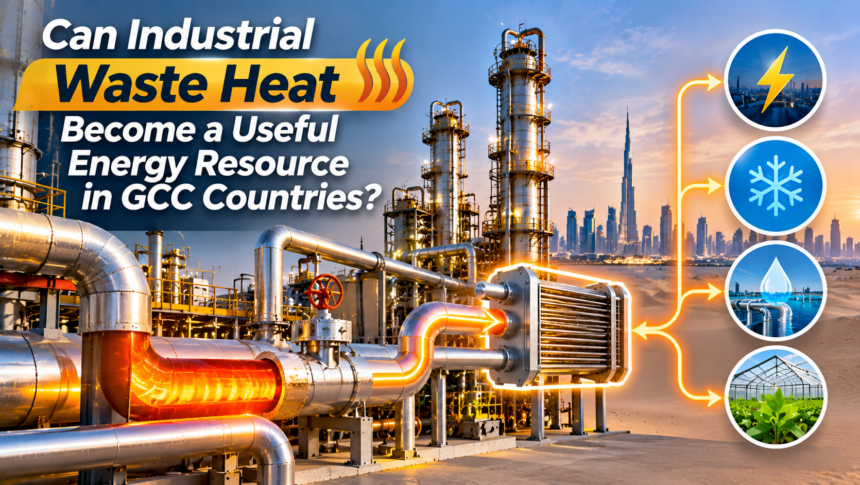
Why Industrial Waste Heat Could Be a GCC Energy Game-Changer
Across the Arabian Gulf, industrial facilities consume substantial amounts of energy to manufacture cement, process metals, refine petroleum, produce chemicals, and operate large-scale production equipment. Many of these processes depend on high temperatures, creating heat that is not always fully utilised before being released through exhaust gases, cooling equipment, or other industrial systems.
- 1. Why Industrial Waste Heat Recovery Matters for GCC Energy Efficiency
- 2. How Waste Heat Can Be Converted Into Useful Energy
- 3. What UAE Waste-Heat Recovery Projects Reveal About Industrial Potential
- 4. How Saudi Arabia and Other GCC Countries Could Expand Heat Recovery
- 5. Could Industrial Waste Heat Support District Cooling and Water Production?
- 6. The Financial, Environmental, and Technical Challenges of Waste-Heat Recovery
- 7. The Future of Industrial Waste Heat Recovery in GCC Countries
As GCC countries seek to improve industrial efficiency and reduce environmental impacts, industrial waste heat recovery in GCC countries is gaining attention as a practical way to make better use of energy already consumed.
Instead of allowing excess heat to escape into the surrounding environment, industrial facilities can sometimes capture and reuse it for other productive purposes. Depending on temperature and technical requirements, recovered heat may be used to preheat industrial materials, produce steam, generate electricity, or support selected heating and cooling applications.
This approach is particularly relevant to the United Arab Emirates, Saudi Arabia, Qatar, Oman, Bahrain, and Kuwait, where energy-intensive industries play important economic roles.
The technology is not entirely new. Waste-heat recovery systems are already used in several cement and industrial facilities across the region.
For example, Union Cement Company in Ras Al Khaimah operates waste-heat power-generation equipment, while industrial projects in Saudi Arabia and Abu Dhabi demonstrate further applications.
However, not all industrial heat can be recovered economically. Its usefulness depends on temperature, availability, equipment design, location, and whether a suitable energy demand exists nearby.
Understanding these conditions reveals how waste heat could contribute to more efficient industry, lower operating costs, and a more resource-conscious GCC economy.
1. Why Industrial Waste Heat Recovery Matters for GCC Energy Efficiency
Industrial waste heat is thermal energy remaining after an industrial process has completed its intended function.
It may leave a facility through hot exhaust gases, heated cooling water, ventilation systems, or discharged materials.
Although this energy is often described as waste, some of it can be captured and used again.
Where Industrial Waste Heat Comes From
Different industries generate heat in different ways.
Cement kilns operate at high temperatures to transform raw materials into clinker. Steel and metal production use furnaces and other thermal equipment, while refineries and chemical facilities operate complex heating and cooling systems.
Not all the energy entering these processes becomes useful output.
Some heat is lost through equipment surfaces, exhaust streams, and cooling operations.
The amount that can be recovered depends on operating conditions and engineering design.
Why Energy Efficiency Comes First
The International Energy Agency identifies waste-heat recovery, improved insulation, process optimisation, and effective energy management as important ways to reduce industrial energy requirements.
These measures can lower demand before companies invest in additional energy generation or more expensive technologies.
However, improving efficiency requires detailed measurements rather than assumptions about how much heat is available.
Understanding Heat Quality
The temperature of waste heat strongly influences what it can be used for.
High-temperature heat may be suitable for steam production or certain power-generation systems.
Lower-temperature heat may support preheating, hot-water applications, or heat-pump systems.
Extremely low-temperature waste heat can be difficult to recover economically.
Common Industrial Heat Sources
| Industry | Potential Waste Heat Source | Possible Application |
|---|---|---|
| Cement Manufacturing | Kiln and clinker cooler exhaust | Electricity or process preheating |
| Steel Production | Furnace gases and hot equipment | Heat recovery or steam production |
| Petroleum Refining | Hot process streams | Internal heat integration |
| Petrochemicals | Reactors and thermal processes | Process heat reuse |
| Aluminium Production | Furnace and process exhaust | Selected heat recovery |
| Food Processing | Hot water and exhaust streams | Water or process preheating |
| Industrial Utilities | Turbine exhaust | Steam, electricity or water production |
The first step is identifying where heat is produced, how much is available, and whether it can be used without disrupting industrial operations.
2. How Waste Heat Can Be Converted Into Useful Energy
Waste-heat recovery does not involve a single technology.
Different systems are designed to capture, transfer, upgrade, or convert thermal energy.
The most appropriate choice depends on the source temperature and the facility’s energy requirements.
Direct Heat Recovery
Direct heat recovery involves using excess heat to warm another process stream.
For example, a heat exchanger may transfer energy from hot exhaust gases to incoming air or process water.
This approach can reduce the amount of additional fuel required.
Where suitable internal heat demand exists, direct recovery may be more efficient than converting thermal energy into electricity.
However, systems must prevent contamination and maintain appropriate process conditions.
Steam and Electricity Generation
Higher-temperature waste heat can sometimes produce steam that drives a turbine connected to an electrical generator.
Cement plants are a well-established application because kilns and clinker coolers generate hot exhaust streams.
The recovered electricity can reduce the amount purchased from the grid or generated through conventional equipment.
However, actual output varies with operating conditions and equipment availability.
Organic Rankine Cycle Technology
Organic Rankine Cycle, or ORC, technology uses an appropriate working fluid in a closed-loop system to convert heat into mechanical power and electricity.
It can be suitable for certain lower-temperature sources that are less appropriate for conventional steam cycles.
The technology has attracted interest in GCC cement production.
However, its commercial performance depends on heat availability, conversion efficiency, equipment costs, and maintenance.
Industrial Heat Pumps
Heat pumps can raise the temperature of selected low-temperature waste-heat sources.
They use electricity to deliver useful heating at a higher temperature.
This may be valuable where factories require moderate-temperature hot water or process heat.
However, heat pumps do not generate energy from nothing; they require an electricity input and a suitable heat source.
Main Recovery Technologies Compared
| Technology | Main Function | Important Limitation |
|---|---|---|
| Heat Exchanger | Transfers heat between streams | Requires compatible temperature conditions |
| Waste-Heat Boiler | Produces steam using recovered heat | Requires suitable heat quality |
| Steam Turbine | Generates electricity from steam | Needs sufficient pressure and flow |
| Organic Rankine Cycle | Converts selected thermal energy into electricity | Economics depend on heat temperature |
| Industrial Heat Pump | Upgrades low-temperature heat | Electricity consumption |
| Thermal Storage | Stores recovered heat for later use | Additional equipment and losses |
Why Heat Matching Matters
Recovering energy is useful only when an appropriate demand exists.
A plant producing excess hot water may benefit more from supplying another process than from installing costly electricity-generation equipment.
Engineers must therefore evaluate the entire facility’s energy flows.
3. What UAE Waste-Heat Recovery Projects Reveal About Industrial Potential
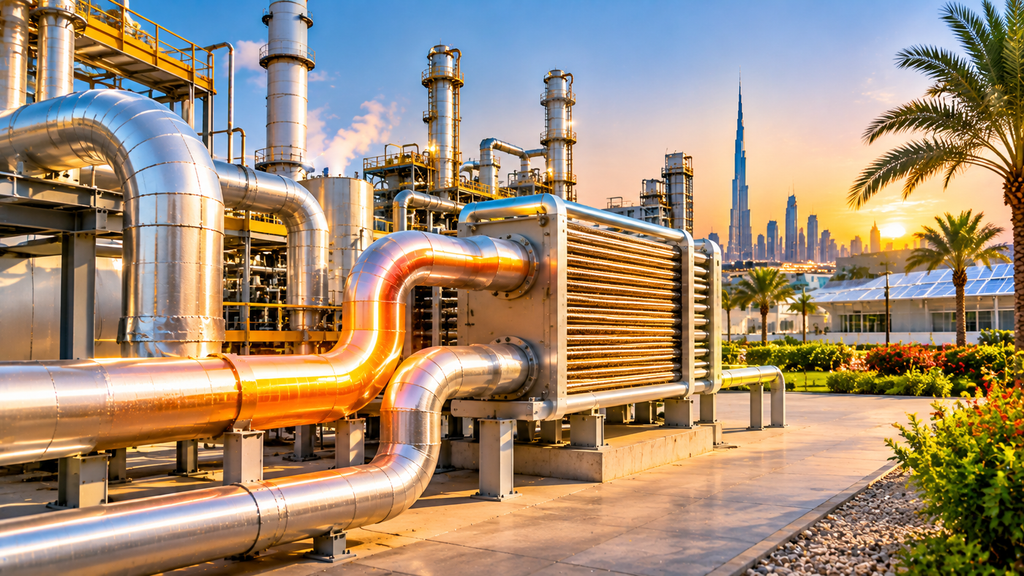
The UAE offers several examples of industrial waste-heat recovery, particularly in cement production and large industrial utilities.
These projects demonstrate how existing industrial processes can provide additional usable energy.
Union Cement Company in Ras Al Khaimah
Union Cement Company reports two waste-heat power-generation systems with a combined capacity of 31.5 MW.
The first, with a capacity of 15 MW, began operating in January 2013.
A second 16.5 MW unit entered operation in July 2020.
The systems use heat recovered from kiln and clinker cooler exhaust to produce steam and generate electricity.
These figures describe installed generation capacity rather than continuous electricity production.
Actual annual output depends on operating hours and plant conditions.
Gulf Cement Company’s Environmental Programme
Gulf Cement Company in the UAE also identifies waste-heat-based electricity generation as part of its environmental activities.
The company reports that its recovery project contributes to reducing annual carbon dioxide emissions by more than 200,000 tonnes.
This is a company-reported environmental estimate.
The underlying calculation and operating boundaries should be reviewed before comparing it directly with other projects.
Fujairah’s ORC Project
In 2023, ENGIE Solutions and Turboden announced a waste-heat recovery project for Holcim’s LEC cement plant in Fujairah.
The planned system had a capacity of 10 MW of electrical output and used Organic Rankine Cycle technology.
The developer estimated that the project could avoid approximately 29,000 tonnes of carbon dioxide emissions annually.
These were project expectations at announcement, not independently verified annual operating results.
ADNOC’s Ruwais Project
ADNOC developed a major waste-heat recovery project at its General Utilities Plant in Ruwais.
The company described a US$600 million investment designed to produce an additional 230 MW of electricity and 62,400 cubic metres of distillate water per day.
The project demonstrates how recovered industrial heat can support electricity and water production together.
However, its design targets should not be confused with independently confirmed output for every operating year.
Selected UAE Projects
| Project | Reported Capacity or Purpose | Status of Evidence |
|---|---|---|
| Union Cement Company | 31.5 MW combined installed WHR capacity | Company-reported operating systems |
| Gulf Cement Company | Waste-heat-based electricity generation | Company-reported environmental benefits |
| Fujairah LEC Cement | 10 MW planned ORC system | Announced project specification |
| ADNOC Ruwais | Electricity and distillate-water production | Company-announced project targets |
The UAE experience shows that waste-heat recovery is already part of industrial energy management, although performance must be assessed project by project.
4. How Saudi Arabia and Other GCC Countries Could Expand Heat Recovery
Saudi Arabia has significant industrial activity involving cement, petrochemicals, refining, and other energy-intensive operations.
This creates opportunities to evaluate the recovery of thermal energy that would otherwise be lost.
However, potential varies between sectors and individual facilities.
Riyadh Cement’s Waste-Heat Project
In November 2023, Riyadh Cement Company disclosed a contract with Sinoma Energy Conservation for a waste-heat recovery electricity-generation project.
The announced plant capacity was 12.64 MW, with a contract value of US$34.8 million.
The agreement specified a 20-month contract duration.
The announcement demonstrates a concrete investment in waste-heat technology.
However, the contract disclosure alone does not confirm final commissioning or measured electricity generation.
Saudi Energy Efficiency Requirements
Saudi Arabia’s Saudi Energy Efficiency Center has developed industrial energy-efficiency requirements and energy-management programmes.
A 2026 consultation document addressing requirements for 2026–2030 explicitly discusses waste-heat recovery for electricity generation.
It distinguishes heat reused internally within industrial processes from recovery used to generate electricity outside production-line boundaries.
The consultation also describes monitoring and verification expectations.
Businesses should confirm the final adopted rules before treating consultation wording as binding requirements.
Potential in Qatar, Oman, Bahrain, and Kuwait
Industrial facilities in other GCC countries may also offer opportunities for heat recovery.
Refineries, chemical plants, manufacturing sites, and industrial utilities can produce thermal streams that warrant assessment.
However, available heat is not equivalent to economically recoverable energy.
A detailed audit is necessary before making claims about national potential.
Regional Industrial Opportunities
| GCC Market | Relevant Industrial Context | Potential Recovery Application |
|---|---|---|
| UAE | Cement and industrial utilities | Electricity and process integration |
| Saudi Arabia | Cement, refining and chemicals | Electricity, steam and process heat |
| Qatar | Petrochemicals and industrial utilities | Process heat integration |
| Oman | Refining, metals and industrial manufacturing | Heat recovery and preheating |
| Bahrain | Aluminium and petroleum processing | Selected thermal recovery |
| Kuwait | Refining and petrochemicals | Heat integration and utility efficiency |
These are possible application areas, not confirmed inventories of recoverable heat.
The Importance of Industrial Clusters
Facilities located close to one another may have opportunities to exchange useful heat.
For example, an industrial plant producing excess thermal energy might supply a neighbouring process requiring heat at an appropriate temperature.
However, such arrangements need reliable demand, suitable pipelines, clear commercial contracts, and contingency plans.
5. Could Industrial Waste Heat Support District Cooling and Water Production?
Industrial waste heat is often discussed as a potential source for electricity generation.
However, other uses may be relevant in the Gulf, where cooling and water production are important parts of infrastructure demand.
Waste Heat and District Cooling
District cooling normally relies on central plants producing chilled water for multiple buildings.
Certain absorption or adsorption cooling technologies can use thermal energy to help provide cooling.
This creates a possible connection between industrial waste heat and district cooling.
However, recovered heat cannot be fed directly into an ordinary chilled-water network.
A suitable thermal cooling system is required, and its performance depends on heat temperature, available water, and operating conditions.
Absorption Cooling
Absorption chillers use heat to drive a refrigeration cycle.
They can be useful where suitable thermal energy is available and electricity demand for conventional cooling is expensive or constrained.
However, absorption systems have different efficiency characteristics from electrically driven chillers.
Their environmental performance depends on the source of heat, cooling-water requirements, and equipment design.
Potential for Water Production
Certain water-treatment and thermal desalination processes require heat.
Recovering industrial heat may help reduce the need for additional fuel in suitable configurations.
ADNOC’s Ruwais project illustrates a large-scale approach combining power and water generation.
However, not every desalination plant can utilise nearby industrial heat.
Temperature requirements, distance, water chemistry, and infrastructure compatibility must be considered.
Thermal Storage and Demand Matching
Industrial heat production may not coincide with neighbouring demand.
Thermal storage can sometimes help manage these differences by storing energy for later use.
However, storage systems introduce additional costs and thermal losses.
Potential Applications Beyond Factories
| Application | Possible Use of Recovered Heat | Main Constraint |
|---|---|---|
| District Cooling | Drive suitable thermal cooling equipment | Temperature and cooling-system integration |
| Water Production | Support selected thermal processes | Heat quality and water infrastructure |
| Industrial Parks | Supply neighbouring process heat | Distance and contractual coordination |
| Hot-Water Systems | Preheat process or service water | Demand and temperature compatibility |
| Thermal Storage | Shift heat availability over time | Cost and storage losses |
| Electricity Generation | Produce power through appropriate cycles | Conversion efficiency |
Why Location Matters
Heat is often more difficult and expensive to transport over long distances than electricity.
Consequently, a nearby industrial or utility customer may make heat recovery more viable.
The strongest opportunities are likely to involve suitable demand located close to the heat source.
6. The Financial, Environmental, and Technical Challenges of Waste-Heat Recovery
Waste-heat recovery can improve efficiency, but installations require careful technical assessment.
Not all heat sources offer sufficient temperature, volume, or operating continuity to justify investment.
The Difference Between Heat Availability and Usable Heat
A factory may release large quantities of low-temperature heat.
However, converting that heat into electricity may be inefficient or economically unattractive.
Using it directly for a suitable heating application could deliver greater value.
Therefore, heat quality matters as much as quantity.
High Initial Costs
Recovery systems may require heat exchangers, boilers, turbines, pipework, pumps, controls, and structural changes.
Installation can also disrupt production.
These factors influence project economics.
An investment may be viable in a continuously operating plant but unattractive in a facility with infrequent production cycles.
Corrosion, Fouling, and Maintenance
Industrial exhaust streams may contain dust, chemicals, or other substances that affect recovery equipment.
Heat exchangers can experience fouling, while corrosive conditions may damage materials.
Regular maintenance is therefore essential.
Systems should also be designed to avoid interfering with critical production operations.
Heat Recovery and Carbon Emissions
Recovered energy can reduce fuel or electricity requirements.
However, avoided emissions depend on what energy source is displaced.
If a facility replaces electricity with recovered heat-generated power, the environmental benefit depends partly on the electricity generation mix.
In addition, waste-heat recovery does not necessarily eliminate the emissions generated by the original industrial process.
Project Challenges Compared
| Challenge | Potential Consequence | Possible Response |
|---|---|---|
| Low Heat Temperature | Limited conversion efficiency | Consider direct use or heat pumps |
| Variable Operations | Unstable energy output | Detailed operational analysis |
| High Capital Costs | Weak financial returns | Lifecycle cost assessment |
| Fouling and Corrosion | Equipment deterioration | Suitable design and maintenance |
| Production Interference | Operational disruption | Careful integration |
| Long Heat-Transfer Distances | Increased losses and cost | Prioritise nearby demand |
| Uncertain Emission Savings | Misleading environmental claims | Transparent measurement methods |
The Importance of Independent Verification
Businesses should measure energy use before and after installation.
Savings assessments must account for production changes, operating hours, weather, and relevant auxiliary energy consumption.
A project with a stated generation capacity may produce significantly less energy over a year depending on operating conditions.
Transparent reporting can help distinguish actual performance from design expectations.
7. The Future of Industrial Waste Heat Recovery in GCC Countries
As GCC economies seek to improve industrial efficiency, waste-heat recovery could become more important within manufacturing and infrastructure planning.
Its future will depend on technology selection, financial incentives, energy prices, and access to reliable industrial data.
Starting With Industrial Energy Audits
Before selecting a recovery system, facilities should assess where energy enters and leaves their processes.
A thermal audit can identify heat sources, temperatures, operating schedules, and possible internal uses.
This allows engineers to determine whether direct recovery, electricity generation, or heat upgrading offers the strongest potential value.
The Role of Industrial Heat Pumps
Industrial heat pumps may expand the range of recoverable thermal energy.
The IEA identifies commercially available industrial heat pumps capable of supplying heat up to around 150°C.
However, suitable applications depend on electricity costs, available heat sources, and required output temperatures.
A 2026 United Nations Economic Commission for Europe assessment also highlights the importance of comparing energy prices and application-specific requirements.
Digital Monitoring and Process Optimisation
Connected sensors and industrial analytics can help facilities monitor temperatures, heat flows, and equipment performance.
These tools may identify opportunities that conventional inspections overlook.
However, digital monitoring cannot improve energy efficiency without effective engineering and operational changes.
A Practical Waste-Heat Recovery Checklist
- Map major industrial heat sources.
- Measure temperatures and operating schedules.
- Identify internal heating demand.
- Assess possible nearby heat users.
- Compare direct heat recovery with power generation.
- Evaluate industrial heat-pump options.
- Estimate capital and operating costs.
- Assess maintenance and production risks.
- Calculate expected emissions reductions using appropriate methods.
- Establish measurement and verification procedures.
How Facilities Should Measure Success
The performance of waste-heat recovery systems should be evaluated using measurable outcomes rather than installed capacity alone.
Relevant indicators include net recovered energy, electricity generated, additional equipment consumption, avoided fuel use, and operating costs.
Project results should be assessed across representative production periods.
Key Performance Indicators
| Indicator | What It Measures |
|---|---|
| Recoverable Heat | Available thermal energy under defined conditions |
| Useful Heat Delivered | Thermal energy actually reused |
| Net Electricity Generation | Output after auxiliary consumption |
| Fuel Savings | Reduction in conventional fuel requirements |
| Operating Availability | Percentage of intended operating time |
| Emissions Reduction | Appropriately calculated avoided emissions |
| Maintenance Costs | Ongoing equipment expenditure |
| Financial Payback | Time required to recover investment costs |
Opportunities for GCC Engineering Businesses
Industrial waste-heat recovery could create opportunities for engineering contractors, equipment manufacturers, energy auditors, industrial software providers, and maintenance specialists.
Companies may develop expertise in heat exchangers, ORC systems, thermal storage, and industrial heat-pump integration.
However, commercial growth requires credible project performance and suitable demand.
Integrating Waste Heat Into Industrial Sustainability Strategies
Waste-heat recovery should complement broader efforts to reduce industrial energy consumption.
Improved insulation, efficient motors, optimised production processes, suitable electrification, and cleaner electricity can provide additional benefits.
The International Energy Agency emphasises that improving efficiency can also reduce the scale of later investments needed for industrial electrification.
Conclusion
Industrial waste heat could become a useful energy resource in GCC countries by allowing factories and industrial utilities to recover part of the thermal energy that would otherwise be lost.
The region’s cement, refining, metals, and chemical industries provide potential applications for heat recovery, steam production, and electricity generation.
Operating projects in the UAE demonstrate that these technologies are already being used, while Saudi Arabia’s industrial efficiency initiatives show growing policy attention.
However, recovery is not automatically economical or environmentally beneficial in every facility.
The temperature, quantity, timing, and location of available heat determine what can realistically be achieved.
For industrial companies, the strongest approach is to identify suitable opportunities through energy audits and detailed engineering assessments.
For governments and technology providers, the opportunity lies in supporting reliable data, skilled professionals, suitable standards, and transparent performance reporting.
Ultimately, making better use of industrial waste heat could help GCC countries reduce unnecessary energy losses while improving the efficiency of existing industrial infrastructure.
The greatest value may come not from treating waste heat as an entirely new energy source, but from recognising that energy already paid for should be used as effectively as possible before it is released into the environment.
Do follow us on Instagram
Read More – Why Underground Infrastructure Deserves More Attention in Gulf Urban Planning