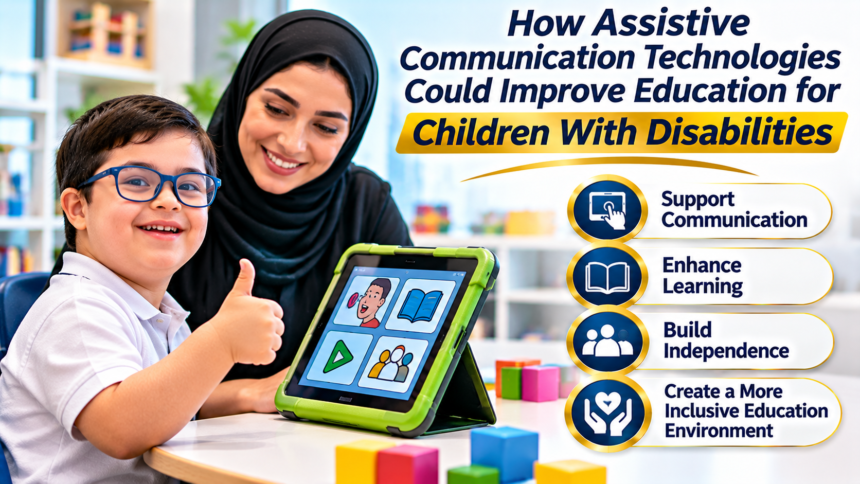
The Benefits and Challenges of Assistive Technology in Gulf Schools
Education is an important part of every child’s development, providing opportunities to gain knowledge, build relationships and develop independence. However, children with disabilities may face communication barriers that make it difficult to participate fully in classroom activities, interact with teachers or express their understanding of lessons.
- 1. What Are Assistive Communication Technologies and How Do They Work?
- 2. How Assistive Communication Tools Could Improve Classroom Participation
- 3. Why Assistive Communication Matters for Language Development and Social Inclusion
- 4. The Role of Inclusive Education Policies in the UAE and Wider Gulf
- 5. Why Teachers, Speech Therapists and Families Are Essential to Success
- 6. What Challenges Could Limit Access to Assistive Communication Technology?
- 7. How Schools Can Introduce Assistive Communication Technology Effectively
- 8. The Future of Assistive Communication Technology in Inclusive Education
- Conclusion: Communication Access Can Transform Educational Opportunities
These challenges do not necessarily reflect a child’s ability to learn. In many situations, the difficulty lies in how information is presented, how communication is supported and whether the learning environment accommodates individual needs.
This is where assistive communication technologies for children with disabilities can make a meaningful difference.
Assistive communication technologies include tools, devices and software that help individuals communicate when speaking, writing, hearing or understanding language presents difficulties. They may range from simple picture-based communication boards to advanced speech-generating devices and digital applications.
For children who cannot rely on conventional speech alone, these technologies may provide alternative ways to ask questions, participate in lessons, make choices and interact with classmates.
The World Health Organization (WHO) and UNICEF recognise assistive technology as an important contributor to education, participation and independence. Their Global Report on Assistive Technology estimates that more than 2.5 billion people worldwide need at least one assistive product, including products that support communication and cognition. This is a global estimate covering all age groups and many types of assistive technology, not a count of children requiring communication devices. World Health Organization+1
Across the Middle East, inclusive education is receiving growing policy attention. Countries such as the United Arab Emirates and Saudi Arabia have established initiatives intended to improve educational opportunities for students with disabilities.
However, the successful use of assistive technology requires more than purchasing devices. Schools must consider individual assessments, teacher training, accessible learning materials, family involvement and ongoing technical support.
When these elements work together, assistive communication technologies could help children participate more actively in education and develop important communication skills.
1. What Are Assistive Communication Technologies and How Do They Work?
Assistive communication technologies are tools designed to support individuals who experience difficulties communicating through conventional methods.
They may help children express their thoughts, understand information, interact with others or access learning materials.
The broader field is known as assistive technology, while many communication-specific tools fall under augmentative and alternative communication, commonly called AAC.
Understanding augmentative and alternative communication
Augmentative communication supports or supplements a person’s existing speech.
Alternative communication provides another way to communicate when speech is unavailable or insufficient for the person’s needs.
AAC can include gestures, signs, pictures, symbols, communication books, electronic devices and specialised software.
The American Speech-Language-Hearing Association (ASHA) describes AAC as an approach that supports people with difficulties involving speech, language production or comprehension. ASHA
AAC should not be viewed as a last resort. Children may benefit from communication support while they are developing speech, using speech inconsistently or communicating effectively through a combination of methods.
Low-tech communication tools
Not every communication solution requires advanced electronics.
Some children benefit from picture cards, printed communication boards, symbol books or visual schedules.
For example, a child may point to a picture to request a classroom activity or indicate that they need assistance.
These tools can be affordable, portable and relatively simple to use.
However, they still require appropriate vocabulary selection and consistent support from adults.
High-tech communication devices
Electronic AAC systems may include tablets, speech-generating devices and software that converts selected symbols or typed text into spoken language.
A child may select words, pictures or sentences on a screen, allowing the device to produce an audible message.
Some systems offer alternative access methods for children with limited motor control.
Communication technology examples
| Technology | Main function | Educational application |
|---|---|---|
| Picture communication boards | Expresses ideas through images and symbols | Making choices and answering questions |
| Communication books | Organises vocabulary into categories | Classroom and social conversations |
| Speech-generating devices | Produces spoken messages | Participating in discussions |
| AAC tablet applications | Supports symbol-based or text-based communication | Expressing learning and personal needs |
| Eye-gaze systems | Enables selection through eye movement | Communication for students with significant motor difficulties |
| Switch-access systems | Allows alternative device control | Using communication software |
| Hearing-assistive systems | Improves access to sound and speech | Following teacher instructions |
| Text-to-speech tools | Converts written information into audio | Supporting access to text |
Technology selection should reflect the child’s abilities, preferences and communication goals.
The most expensive device is not automatically the most effective.
2. How Assistive Communication Tools Could Improve Classroom Participation
Classroom participation involves more than listening to teachers.
Students need opportunities to ask questions, demonstrate understanding, share opinions and interact with their classmates.
Communication barriers can limit these opportunities, even when a child understands the lesson.
Assistive technologies may help teachers create more accessible ways for students to participate.
Giving children opportunities to answer questions
In a conventional classroom, teachers may ask students to respond verbally.
A child who has difficulty speaking may know the answer but be unable to respond in the expected way.
An AAC system can provide another way to demonstrate understanding.
For example, a student might select an answer using a communication board or speech-generating application.
This allows teachers to evaluate learning without relying exclusively on spoken responses.
Supporting classroom discussions
Communication technology may help children contribute to group conversations.
Students can use prepared or independently constructed messages to ask questions, express preferences and share ideas.
However, communication partners must allow sufficient time for responses.
Some AAC users need additional time to locate vocabulary or construct messages.
Improving access to classroom routines
Visual schedules and communication supports can help students understand what will happen during the school day.
For example, symbols may represent reading, mathematics, lunch and recreational activities.
Predictable information can support classroom transitions and reduce confusion for children who benefit from visual communication.
Encouraging collaborative learning
Group activities are an important part of education.
Children who experience communication difficulties may be excluded unintentionally when activities depend on rapid verbal exchanges.
Teachers can design group tasks that allow different forms of contribution.
One student may respond verbally, while another selects symbols or types a message.
Classroom applications and benefits
| Classroom activity | Possible communication support | Potential benefit |
|---|---|---|
| Question-and-answer sessions | AAC boards or speech-generating devices | More opportunities to demonstrate understanding |
| Group projects | Digital communication tools | Greater peer collaboration |
| Reading lessons | Symbols and text-to-speech | Improved access to content |
| Classroom routines | Visual schedules | Clearer understanding of activities |
| Social interaction | Personalised communication vocabulary | More opportunities for conversation |
| Assessment | Alternative response formats | Fairer demonstration of learning |
UNICEF’s accessibility initiatives include communication technologies intended to help children express ideas, participate in learning and access inclusive educational materials. UNICEF Office of Innovation
However, technology is most effective when teachers actively incorporate it into classroom activities rather than treating it as an occasional additional resource.
3. Why Assistive Communication Matters for Language Development and Social Inclusion
Communication is closely connected to learning, friendship and emotional wellbeing.
Children use communication to express preferences, share experiences, ask for help and develop relationships.
When they lack an effective way to communicate, their opportunities for social participation may become restricted.
Assistive communication systems can help address these barriers.
Supporting language development
Children benefit from exposure to language in meaningful everyday situations.
AAC systems can provide vocabulary and communication opportunities that support language learning.
For example, adults may model how to use a communication board while speaking naturally to a child.
This approach can help children understand how symbols and words are used in conversations.
AAC is not inherently an obstacle to speech development. Appropriate communication support can coexist with spoken-language intervention where clinically relevant.
Helping children express their preferences
The ability to make choices is important for independence.
A child may want to select a book, choose a classroom activity or explain that something is uncomfortable.
Without an accessible communication method, these preferences may be difficult to express.
Assistive technology can make such interactions easier.
Building friendships
Social inclusion depends on opportunities for meaningful interaction.
A communication device may help a child greet classmates, participate in games or discuss shared interests.
However, classmates also need opportunities to understand different communication methods.
Schools can encourage respectful interactions and provide age-appropriate awareness activities.
Recognising different communication needs
Children with similar diagnoses may have very different abilities and preferences.
Some may communicate effectively through speech and gestures.
Others may prefer symbols, text, sign language or a combination of methods.
Communication support should therefore be individualised rather than selected solely according to a disability label.
Supporting social and emotional communication
An effective system should include more than vocabulary for basic requests.
Children need ways to express feelings, disagreement, curiosity and humour.
For example, being able to say that a task is difficult, ask to join a game or share an opinion can be as important as requesting food or water.
ASHA’s AAC guidance emphasises access to vocabulary for academic participation, social communication and ongoing language development. ASHA
The objective is to give children greater opportunities to express themselves, rather than limit communication to a small number of predetermined responses.
4. The Role of Inclusive Education Policies in the UAE and Wider Gulf
Assistive communication technologies are especially relevant to the Gulf as education systems develop policies intended to improve access for students with disabilities.
However, regional programmes differ in their coverage, implementation and available resources.
UAE: Supporting students of determination
The United Arab Emirates uses the term people of determination in many official policies and services relating to persons with disabilities.
The UAE Ministry of Education’s Inclusive Education Policy, established through Ministerial Resolution No. 647 of 2020, provides a framework for supporting students with disabilities in shared learning environments.
The ministry describes the use of individualised educational plans, support services and assistive technologies to help students access learning. Ministry of Education UAE+1
This framework provides opportunities for schools to consider communication technology as part of a student’s educational support.
Abu Dhabi: Individualised educational support
Abu Dhabi’s Department of Education and Knowledge (ADEK) provides an inclusion policy for schools.
Its guidance addresses individualised support, specialist services and assistive technology where appropriate.
It also recognises the involvement of professionals such as speech and language therapists and occupational therapists. adek.gov.ae
These provisions are relevant because communication support often requires cooperation between educators and specialist professionals.
Dubai: Accessibility and inclusive learning
Dubai’s inclusive education framework recognises the role of assistive technology in supporting students with additional educational needs.
The Knowledge and Human Development Authority’s guidance encourages educators to use appropriate technologies to support learning and participation. khda.gov.ae
However, policy commitments alone do not establish that every student has access to the devices, training and specialist support they require.
Implementation remains essential.
Saudi Arabia: Expanding educational opportunities
Saudi Arabia’s Ministry of Education identifies the provision of educational opportunities for students with disabilities as part of its responsibilities.
Its approach includes specialised educational services and support arrangements. Ministry of Education
Research examining assistive technology use in Saudi special education schools has also highlighted the importance of teacher practices and professional development. PubMed
Opportunities across other GCC countries
Qatar, Oman, Bahrain and Kuwait may also benefit from strengthening access to communication technologies within their inclusive education systems.
However, schools should evaluate students’ individual needs and follow applicable national educational requirements.
Regional opportunities
| Country | Relevant area of development | Potential role of communication technology |
|---|---|---|
| UAE | Inclusive education and individualised support | Classroom participation and accessible communication |
| Saudi Arabia | Special education and teacher development | Improved communication support |
| Qatar | Inclusive learning and student support | Individualised classroom accessibility |
| Oman | Specialised educational services | Communication access and participation |
| Bahrain | Inclusive education development | Appropriate assistive learning support |
| Kuwait | Special education and accessibility | Improved communication opportunities |
The wider GCC opportunity is to ensure that communication access becomes part of everyday educational planning rather than an optional addition available only in selected classrooms.
5. Why Teachers, Speech Therapists and Families Are Essential to Success
Assistive communication technology does not work independently of the people supporting the child.
A communication device may contain hundreds of words or symbols, but students need meaningful opportunities to use them during everyday activities.
Teachers, speech-language therapists, families and other professionals therefore play important roles.
The teacher’s responsibility
Teachers should create classroom activities that accommodate different communication methods.
This may involve allowing additional response time, providing visual instructions and accepting appropriate alternative forms of participation.
Teachers do not need to become specialists in every communication device.
However, they should understand how to support the systems used by their students.
The role of speech-language therapists
Speech-language therapists may assess a child’s communication needs and recommend suitable AAC approaches.
Their work can involve evaluating language skills, selecting vocabulary and guiding the implementation of communication systems.
They may also help teachers and families understand how to model communication naturally.
Assessment should consider the whole child, including communication preferences, sensory needs and methods of accessing technology.
Occupational therapy and physical access
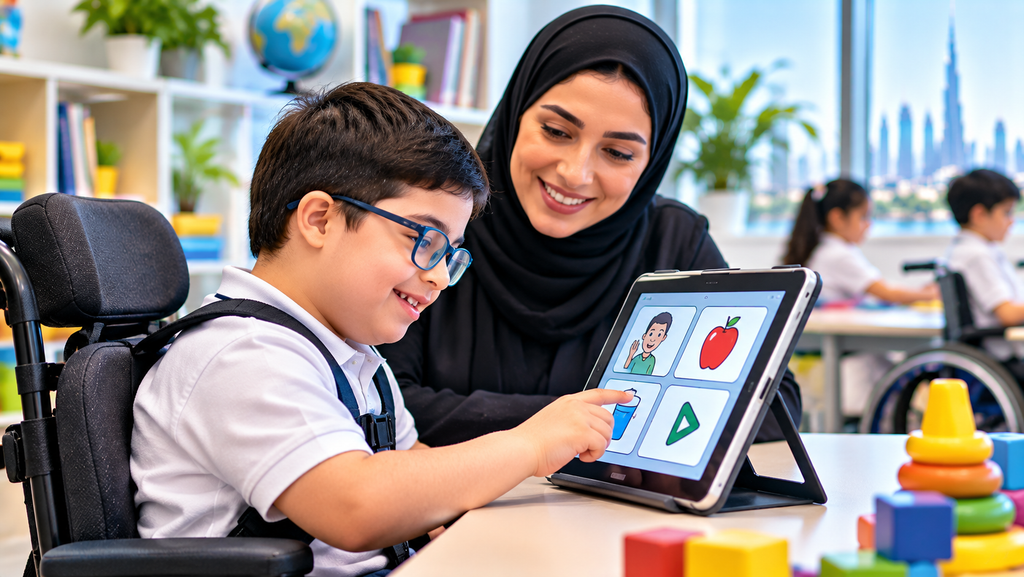
Some children experience motor difficulties that affect their ability to touch screens, point to symbols or operate devices.
Occupational therapists and other relevant specialists may help evaluate alternative access methods.
These could include switches, specialised positioning or eye-gaze systems.
Family involvement
Communication needs extend beyond the classroom.
Children also need opportunities to communicate at home, during recreational activities and within the wider community.
Families can help identify useful vocabulary, personal interests and preferred communication approaches.
However, parents should receive appropriate guidance rather than being expected to independently design or manage complex AAC systems.
Building a coordinated support team
| Team member | Main contribution |
|---|---|
| Classroom teacher | Integrates communication into lessons |
| Speech-language therapist | Assesses communication needs and supports AAC |
| Occupational therapist | Supports physical access where needed |
| Special education teacher | Helps individualise learning strategies |
| Technology specialist | Provides equipment setup and technical support |
| Family or caregiver | Encourages communication across daily activities |
| Student | Expresses preferences and participates in decisions as appropriate |
UNICEF’s capacity-building framework for assistive technology and AAC identifies trained personnel, suitable products, supportive policies and coordinated services as important requirements for successful implementation. UNICEF Europe and Central Asia
Regular communication among team members can help ensure that the child uses a consistent and functional communication system.
6. What Challenges Could Limit Access to Assistive Communication Technology?
Although assistive communication technologies offer important possibilities, access remains uneven.
Schools and families may encounter financial, technical and organisational barriers.
A device that is available but not properly supported may provide limited educational benefit.
Equipment and maintenance costs
Some AAC systems require specialised software, accessories or hardware.
Schools may also need to budget for repairs, updates and replacement devices.
Low-cost solutions can be valuable, but they must still meet individual communication needs.
Limited professional training
Teachers may receive equipment without sufficient instruction on how to use it in classroom activities.
This can result in devices being used only occasionally.
Professional training should include practical examples, ongoing support and opportunities to address implementation difficulties.
Language availability
Communication systems should reflect the languages children use at school and at home.
This is particularly relevant in GCC countries, where students may communicate in Arabic, English or other languages.
A device with limited Arabic vocabulary or inappropriate speech output may restrict its usefulness.
Programmes should evaluate symbol systems, language options and cultural relevance rather than assuming that imported software meets every student’s needs.
Poor individualisation
One common mistake is selecting a device based primarily on diagnosis or availability.
Two children with similar disabilities may have different communication abilities and preferences.
A thorough assessment should guide technology selection.
Access outside school
A child may benefit from a communication system during lessons but lose access to it at home or during community activities.
Where possible, educational planning should address how communication can continue across settings.
Common barriers and responses
| Challenge | Potential response |
|---|---|
| High equipment costs | Evaluate suitable low-cost options and funding |
| Limited teacher training | Provide practical AAC instruction |
| Language barriers | Use appropriate multilingual vocabulary |
| Technical problems | Maintain support and repair arrangements |
| Poor device selection | Conduct individual assessments |
| Inconsistent use | Coordinate home and school strategies |
| Limited student involvement | Include the child’s preferences |
| Unclear outcomes | Monitor functional communication and participation |
The WHO and UNICEF report identifies affordability, service availability and trained personnel among the broader barriers to assistive technology access worldwide. World Health Organization
Removing these barriers requires long-term planning rather than one-time technology purchases.
7. How Schools Can Introduce Assistive Communication Technology Effectively
Schools interested in expanding communication support should begin with students’ educational needs.
Purchasing the newest device before assessing those needs may lead to inappropriate spending and limited use.
Start with an individual assessment
The first step is understanding how the child currently communicates.
Professionals should consider spoken language, gestures, symbols, hearing, vision, movement and personal preferences.
The assessment should also identify the situations in which communication barriers are most significant.
Set meaningful communication goals
Goals should relate to everyday participation.
For example, a student might aim to ask questions during lessons, participate in a group activity or communicate a preference independently.
Goals should not focus exclusively on the number of symbols selected or buttons pressed.
Choose suitable technology
Technology selection should consider communication needs, physical access, languages, reliability and affordability.
A simple printed communication board may be suitable for some purposes, while another child may need a more advanced system.
Low-tech and high-tech communication methods can also complement each other.
Train communication partners
Teachers, classroom assistants and relevant family members should understand how to support the selected system.
Training may include modelling communication, allowing response time and encouraging interaction without forcing repeated performance.
Integrate AAC into ordinary lessons
Communication tools should be available during relevant classroom activities.
Students may need access during reading, mathematics, science, recreation and social interaction.
Restricting a device to therapy sessions can reduce opportunities to communicate naturally.
Monitor educational outcomes
Schools should review whether the system improves meaningful communication.
Useful indicators may include increased classroom participation, more independent expression and greater interaction with peers.
Progress should be assessed individually rather than using the same targets for every student.
A practical implementation roadmap
- Identify communication barriers: Understand the student’s needs and current methods.
- Involve specialist professionals: Obtain appropriate assessment and recommendations.
- Select suitable tools: Consider low-tech and high-tech options.
- Develop communication goals: Link support to learning and daily participation.
- Train teachers and caregivers: Establish consistent approaches.
- Integrate technology into lessons: Encourage everyday communication.
- Provide maintenance and support: Address technical and access problems.
- Review outcomes regularly: Update the approach as the child’s needs develop.
UNICEF’s guidance on selecting digital assistive technology emphasises matching products and services with individual educational needs rather than relying on device features alone. UNICEF Accessible Textbooks for All
8. The Future of Assistive Communication Technology in Inclusive Education
Assistive communication technology is likely to continue developing as digital tools become more accessible and adaptable.
Advances in software, alternative device controls and language support could expand communication opportunities for children with disabilities.
However, innovation should be evaluated according to its real educational value.
Artificial intelligence and personalised communication
AI may support features such as word prediction, vocabulary organisation and adaptive interfaces.
These tools could reduce the effort required to construct certain messages.
However, AI-generated suggestions must not be allowed to replace the child’s intended meaning or speak on their behalf without appropriate control.
Privacy and data protection are also important, especially when systems process children’s communication records.
Improving multilingual support
GCC schools may benefit from tools that accommodate Arabic, English and other languages used by students.
Future developments could improve language switching, culturally appropriate vocabulary and speech output.
However, translation features should be reviewed carefully because inaccurate output can change the meaning of a child’s message.
More accessible learning materials
Communication systems work best when classroom materials are also accessible.
Digital textbooks, visual learning resources and alternative response formats can support participation.
Inclusive education should therefore combine communication tools with accessible curriculum design.
A stronger role for student choice
Children should be involved in decisions about communication methods wherever possible.
Their comfort, preferences and experiences can help educators understand whether a system is genuinely useful.
For example, a child may prefer one communication method for classroom discussions and another for informal interaction.
Supporting appropriate choice can strengthen independence.
Moving from access to meaningful participation
A school may report that it has purchased assistive devices, but this alone does not demonstrate successful inclusion.
More useful questions include whether students can communicate their ideas, participate in learning activities and develop relationships.
The United Nations Convention on the Rights of Persons with Disabilities recognises inclusive education and appropriate communication methods as important elements of educational access. United Nations Enable
Conclusion: Communication Access Can Transform Educational Opportunities
Assistive communication technologies could improve education for children with disabilities by creating additional ways to express ideas, participate in lessons and interact with others.
From picture communication boards to speech-generating devices, these tools can help address barriers that conventional classroom methods may leave unresolved.
Their benefits are not limited to academic performance. Communication access can also support independence, confidence, social inclusion and meaningful participation in school life.
Across the Gulf, inclusive education policies and growing attention to assistive technology provide opportunities to strengthen support for students with disabilities.
However, successful implementation requires more than equipment.
Schools must invest in individual assessments, teacher preparation, specialist services, family involvement and ongoing technical support.
Communication tools should also reflect students’ languages, preferences and everyday educational needs.
Ultimately, assistive communication technologies can help create more inclusive classrooms where children with disabilities have greater opportunities to learn, communicate and participate on equal terms with their peers.
Do follow us on Instagram
Read More – Why Health Technology Assessment Matters for Public Healthcare Spending in the GCC