


Common Personal Branding Mistakes Professionals Should Avoid in the Gulf
Building a strong professional reputation has become increasingly important across the Gulf, where careers, entrepreneurship and business opportunities are often shaped by a combination of expertise, visibility and relationships. Learning how to build a personal brand in the Gulf can help professionals explain what they are known for, attract relevant opportunities and create a reputation that extends beyond a job title or company name.
- Key Steps to Build a Personal Brand in the Gulf
- Define What You Want Your Professional Reputation to Represent
- Build a Strong LinkedIn and Digital Presence
- Create Content That Demonstrates Expertise Instead of Self-Promotion
- Build Credibility Through Networking and Real-World Relationships
- Adapt Your Personal Brand to Gulf Culture and Audiences
- Build Trust With Proof, Consistency and Professional Behaviour
- Turn Personal Branding Into Career and Business Opportunities
- Create a Long-Term Personal Brand Strategy
Personal branding does not mean becoming an influencer or posting constantly on social media. At its simplest, it is the consistent impression people develop through your work, communication, expertise, behaviour and professional visibility. CIPD Middle East describes personal branding as something that goes beyond social media and includes values, strengths, credibility, visibility and the way professionals align themselves with future career opportunities.
This matters in the Gulf because business environments across the UAE, Saudi Arabia, Qatar, Kuwait, Bahrain and Oman are highly international and relationship-oriented. Professionals often work with people from different cultures, industries and countries, making clarity and reputation especially valuable. A person who becomes known for one area of expertise may find it easier to build professional relationships, earn speaking opportunities, attract clients or move into stronger career positions.
The goal is not to create a fake public personality. A sustainable personal brand should reflect real skills and real experience. This guide explains how to define your professional positioning, improve your online presence, create useful content, build relationships and grow a credible personal brand across Gulf markets.
Key Steps to Build a Personal Brand in the Gulf
A personal brand is built through repeated signals.
These signals include:
- What you work on
- What you talk about
- How you communicate
- What other people associate with your name
- What results you produce
- Which industries you understand
- How consistently you show up
A professional may have a personal brand even without actively creating one. Search results, LinkedIn profiles, company pages, past interviews and public comments can all influence what people find.
A useful personal-brand strategy therefore begins with intention.
Start by answering three questions
Ask yourself:
- What do I want to be known for?
- Who do I want to be known by?
- What evidence proves that I understand this area?
For example:
A general statement such as:
“I am a business professional.”
is too broad.
A stronger positioning could be:
“I help hospitality brands improve customer experience across GCC markets.”
The second version is much easier to remember.
Avoid being known for everything
Trying to talk about leadership, technology, real estate, marketing, entrepreneurship, motivation and personal finance at the same time can make your professional identity unclear.
A better approach is to define a small number of related themes.
| Professional Type | Possible Brand Themes |
|---|---|
| Marketing professional | GCC consumer behaviour, digital campaigns, brand growth |
| Real estate professional | Dubai property, investor education, market insights |
| HR professional | Talent, workplace culture, GCC hiring |
| Founder | Entrepreneurship, sector expertise, business lessons |
| Finance professional | Corporate finance, business growth, market analysis |
| Technology professional | AI, digital transformation, product development |
You can expand later.
Clarity is more important than variety in the beginning.
Define What You Want Your Professional Reputation to Represent
Before building visibility, decide what you actually want that visibility to communicate.
Personal branding without positioning can quickly become random content creation.
Identify your strongest professional advantage
This may be:
- Industry knowledge
- Years of experience
- Technical expertise
- Regional knowledge
- Leadership experience
- Customer relationships
- Creative ability
- A specialised qualification
The strongest personal brands are often built around a combination rather than one factor.
For example:
“Finance professional” is broad.
“Finance professional specialising in hospitality investment across the GCC” is more distinctive.
Think about audience
Your personal brand may target:
- Employers
- Recruiters
- Clients
- Investors
- Partners
- Industry peers
- Media
- Customers
The audience changes how you communicate.
A job seeker may emphasise measurable achievements and technical expertise.
A founder may focus more heavily on industry insight, company-building lessons and market trends.
A consultant may demonstrate expertise through educational content and case studies.
Develop a simple positioning statement
A useful formula is:
I help [audience] achieve [result] through [expertise].
Examples:
“I help retail brands understand changing customer behaviour across the GCC.”
“I help Dubai property investors make more informed decisions through market analysis.”
“I help growing companies improve talent acquisition and employee experience.”
This statement does not necessarily need to appear publicly word for word.
Its purpose is to guide your content and professional decisions.
Build a Strong LinkedIn and Digital Presence
For many Gulf professionals, LinkedIn is one of the most useful platforms for professional visibility.
Current regional career guidance increasingly treats LinkedIn not simply as a digital CV but as a relationship-building and professional-positioning platform. Forbes similarly notes that effective LinkedIn personal branding depends on clarity, consistency and purposeful engagement rather than simply collecting followers.
Improve your headline
Avoid headlines such as:
“Looking for opportunities.”
Instead, explain what you do.
Examples:
“Digital Marketing Manager | GCC Brand Strategy | Performance Marketing”
“Real Estate Advisor | Dubai Luxury Property | Investor Relations”
“HR Leader | Talent Strategy | Organisational Development”
A clear headline helps people understand your professional identity quickly.
Rewrite the About section
Your About section should answer:
- What do you do?
- What have you achieved?
- Which industries do you understand?
- What problems do you solve?
- What topics are you interested in?
Keep it human.
Avoid filling the section with vague statements such as:
“Highly motivated dynamic leader passionate about excellence.”
Specificity is more credible.
Show proof
Your profile can include:
- Projects
- Articles
- Media interviews
- Case studies
- Speaking events
- Certifications
- Awards
- Portfolio work
People trust evidence more than claims.
Check your search results
Search your own name.
Look at what appears.
You may find:
- Old company pages
- Outdated profiles
- Articles
- Photos
- Social accounts
Where possible, update information so that your public digital presence reflects your current professional direction.
Create Content That Demonstrates Expertise Instead of Self-Promotion
Personal-brand content works best when it helps the audience understand something useful.
Constantly announcing achievements can quickly become repetitive.
A stronger approach is to demonstrate expertise through insight.
Useful content types include:
- Industry observations
- Lessons from projects
- Career experiences
- Market analysis
- Practical advice
- Case studies
- Predictions with supporting reasoning
- Common industry mistakes
- Professional frameworks
For example, a real-estate professional could post:
“Three questions overseas buyers should ask before comparing Dubai off-plan projects.”
A marketing professional might write:
“Why the same campaign may perform differently in Saudi Arabia and the UAE.”
These topics demonstrate expertise without explicitly saying:
“I am an expert.”
Use the 80/20 idea
A simple content balance could be:
80% useful or educational content
20% personal achievements, announcements or promotion
This does not need to be followed mathematically.
The principle is simply to create more value than self-promotion.
Share experience, not just opinions
Instead of saying:
“Customer experience is very important.”
Explain:
“Three recurring customer-service problems I have seen while working with GCC retail brands.”
Specific experience creates credibility.
Consistency matters more than posting every day
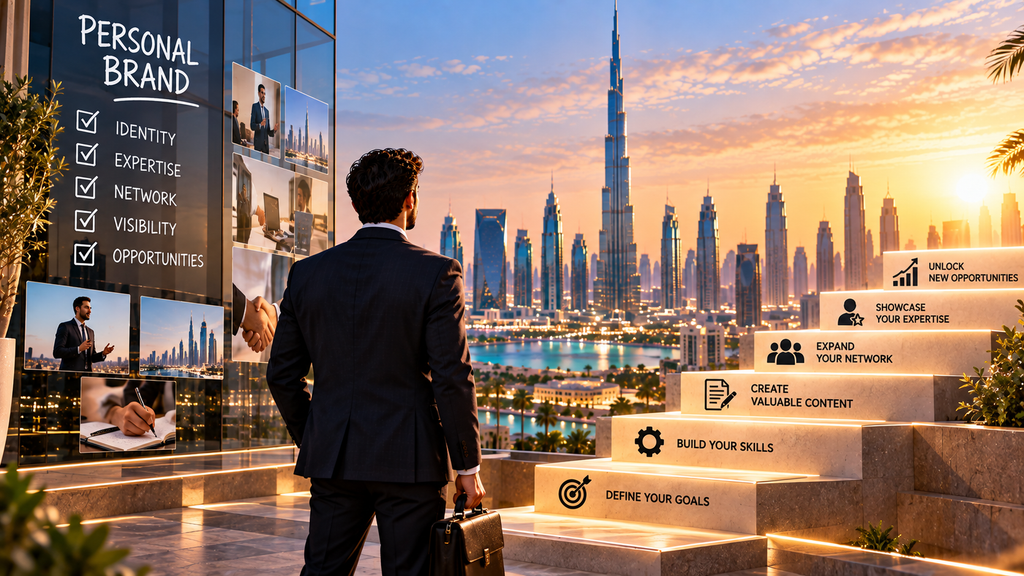
You do not need daily content.
A realistic schedule could be:
- 1–2 useful posts per week
- Several meaningful comments
- One longer article monthly
- Occasional professional updates
Consistency over one year is far more valuable than posting daily for two weeks and disappearing.
Build Credibility Through Networking and Real-World Relationships
A strong personal brand is not built entirely online.
This is particularly important across the Gulf, where professional relationships often develop through conferences, exhibitions, business communities and introductions.
CIPD Middle East’s personal-branding guidance highlights credibility and visibility in multicultural professional environments as important components of career growth.
Attend events relevant to your field
The Gulf hosts major events in areas such as:
- Technology
- Finance
- Real estate
- Hospitality
- Healthcare
- Energy
- Aviation
- Retail
- Entrepreneurship
Do not attend every event simply for visibility.
Select events where your target audience is likely to be present.
Prepare a simple introduction
You should be able to explain your work in 20 seconds.
Avoid:
“I do many things in consulting and business.”
Try:
“I work with hospitality brands on customer-experience and growth strategies across the GCC.”
Clear introductions are easier for people to remember.
Follow up
After meeting someone:
- Connect on LinkedIn.
- Mention the event.
- Refer to your conversation.
- Keep communication professional.
Networking works through repeated interactions, not one meeting.
Help before asking
A useful personal-brand principle is:
Give value before asking for something.
This could mean:
- Sharing information
- Making an introduction
- Recommending a resource
- Answering a question
- Supporting another person’s work
People remember useful professionals.
Adapt Your Personal Brand to Gulf Culture and Audiences
The Gulf is not one completely uniform market.
Communication that works in Dubai may need adjustment in Riyadh, Doha, Kuwait City, Manama or Muscat.
The safest approach is to maintain a consistent professional identity while adapting communication to the audience.
Respect cultural context
Avoid using provocative content simply to generate engagement.
Professional reputation is difficult to build and easy to damage.
Before publishing, ask:
- Is this accurate?
- Is it respectful?
- Does it add value?
- Would I be comfortable discussing it with a client?
- Could it be misunderstood?
Use language strategically
English is widely used in Gulf business environments, particularly in international companies.
Arabic can significantly increase relevance for certain audiences.
A bilingual approach may be useful if your target audience includes Arabic-speaking:
- Clients
- Executives
- Government stakeholders
- Consumers
Do not translate content mechanically.
Strong bilingual communication should feel natural in both languages.
Understand country differences
Your broader GCC personal brand can remain consistent while topics change.
| Market | Possible Content Focus |
|---|---|
| UAE | International business, innovation, real estate, digital growth |
| Saudi Arabia | Transformation, local growth, technology, entrepreneurship |
| Qatar | Investment, infrastructure, professional services |
| Kuwait | Consumer markets, entrepreneurship, established business sectors |
| Bahrain | Finance, fintech, professional communities |
| Oman | Tourism, logistics, sustainability, business development |
These are broad examples rather than fixed rules.
Always research your actual audience.
Build Trust With Proof, Consistency and Professional Behaviour
Personal branding becomes valuable when people trust it.
Follower counts alone do not create credibility.
A person with 5,000 relevant followers and strong industry relationships may have a more valuable professional brand than someone with 100,000 unrelated followers.
Use evidence
Where appropriate, show:
- Revenue generated
- Projects completed
- Teams managed
- Markets entered
- Customers served
- Results achieved
Do not share confidential information.
You can still explain outcomes without revealing sensitive company details.
Collect recommendations
LinkedIn recommendations and testimonials can provide useful third-party credibility.
Ask people who genuinely know your work:
- Managers
- Clients
- Colleagues
- Business partners
Specific testimonials are stronger than generic praise.
Protect your reputation
Think carefully before posting:
- Confidential company information
- Client disagreements
- Aggressive criticism
- Unverified rumours
- Offensive jokes
Your professional reputation travels with you between companies.
Do not fake expertise
One of the fastest ways to weaken a personal brand is to present yourself as an expert in topics you have barely worked in.
It is perfectly acceptable to say:
“I am learning more about AI in marketing.”
That is more credible than pretending to be an AI strategist after using a few tools.
Turn Personal Branding Into Career and Business Opportunities
Visibility should eventually support a professional goal.
Otherwise, content creation can become an activity without a purpose.
Possible outcomes include:
- Better job opportunities
- Client enquiries
- Partnerships
- Speaking invitations
- Media features
- Investor introductions
- Stronger professional networks
For job seekers
A strong professional profile can reinforce your CV.
Recruiters can see:
- What you know
- How you communicate
- What industries you follow
- What projects you have completed
This can create additional context beyond a two-page resume.
For executives
Executives can use personal branding to communicate leadership thinking.
Topics might include:
- Industry changes
- Leadership lessons
- Business transformation
- Organisational culture
- Future trends
The goal should not be to turn every executive into an influencer.
It is to make expertise visible.
For founders
Founders may benefit from connecting their personal reputation with the company’s story.
People often want to understand who is behind a business.
Founder content can cover:
- Why the company exists
- Industry problems
- Lessons from growth
- Customer insights
- Market changes
Regional personal-branding practitioners increasingly emphasise visibility, trust and professional storytelling as important tools for founders and executives across the GCC.
Do not make every post a sales pitch
People stop paying attention if every piece of content ends with:
“Book a call.”
Build credibility first.
Commercial opportunities often follow when people repeatedly associate your name with useful expertise.
Create a Long-Term Personal Brand Strategy
A personal brand is not built in one viral post.
It develops gradually.
Create a simple 12-month system.
Month 1: Define positioning
Choose:
- Target audience
- Core expertise
- Main topics
- Professional goal
Months 2–3: Improve digital presence
Update:
- Professional bio
- Profile photo
- Website or portfolio
- Search results where possible
Months 3–6: Build consistency
Publish regularly.
Engage with industry professionals.
Attend relevant events.
Months 6–12: Expand authority
Consider:
- Podcasts
- Speaking opportunities
- Industry articles
- Media commentary
- Panels
- Collaborative content
Measure meaningful results
Do not measure only followers.
Track:
| Metric | Why It Matters |
|---|---|
| Relevant connections | Network quality |
| Profile views | Professional visibility |
| Inbound messages | Opportunity generation |
| Speaking invitations | Industry authority |
| Client enquiries | Commercial impact |
| Recruiter approaches | Career visibility |
| Media requests | External credibility |
Quarterly personal-brand checklist
Every three months, ask:
- Is my positioning still clear?
- Does my profile reflect my current work?
- Am I creating useful content?
- Am I networking offline?
- Are the right people engaging?
- Have I built new professional relationships?
- Is my reputation supported by real results?
- Am I becoming known for the right topic?
Learning how to build a personal brand in the Gulf is ultimately about reputation rather than attention. The professionals who create sustainable visibility are usually those who combine clear expertise, useful communication, strong relationships and consistent behaviour.
Start by deciding what you want to be known for and who needs to know you. Build a digital presence that clearly communicates your expertise, but support that visibility with real experience, measurable results and professional relationships.
LinkedIn, content and social platforms can help people discover you, but they cannot replace credibility. Long-term trust comes from delivering good work, keeping commitments and showing genuine understanding of your field.
The strongest personal brand should therefore feel like an accurate extension of your professional reputation. When people hear your name, they should quickly understand what you do, what you know and why your perspective is worth paying attention to.
Do follow us on Instagram
Read More – How to Build a Career in Dubai From Scratch