


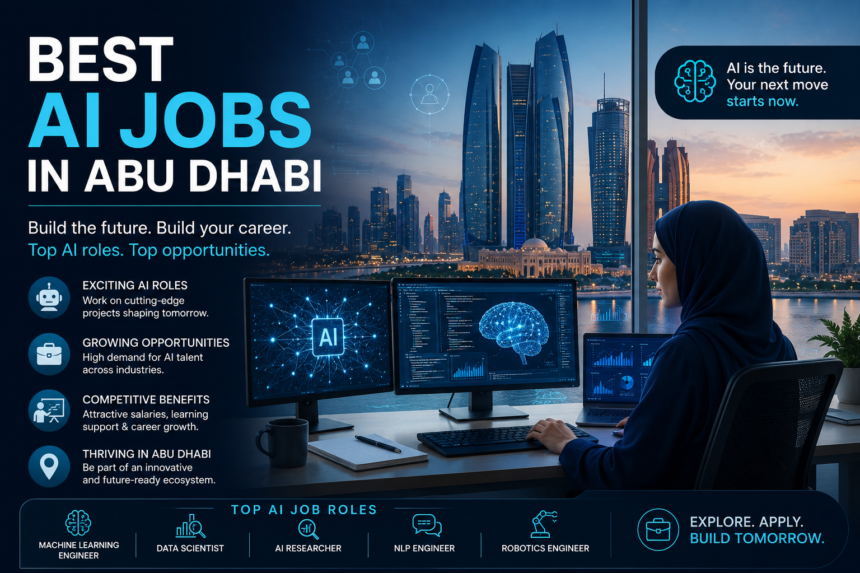
Best AI Jobs in Abu Dhabi Top Artificial Intelligence Careers in 2026
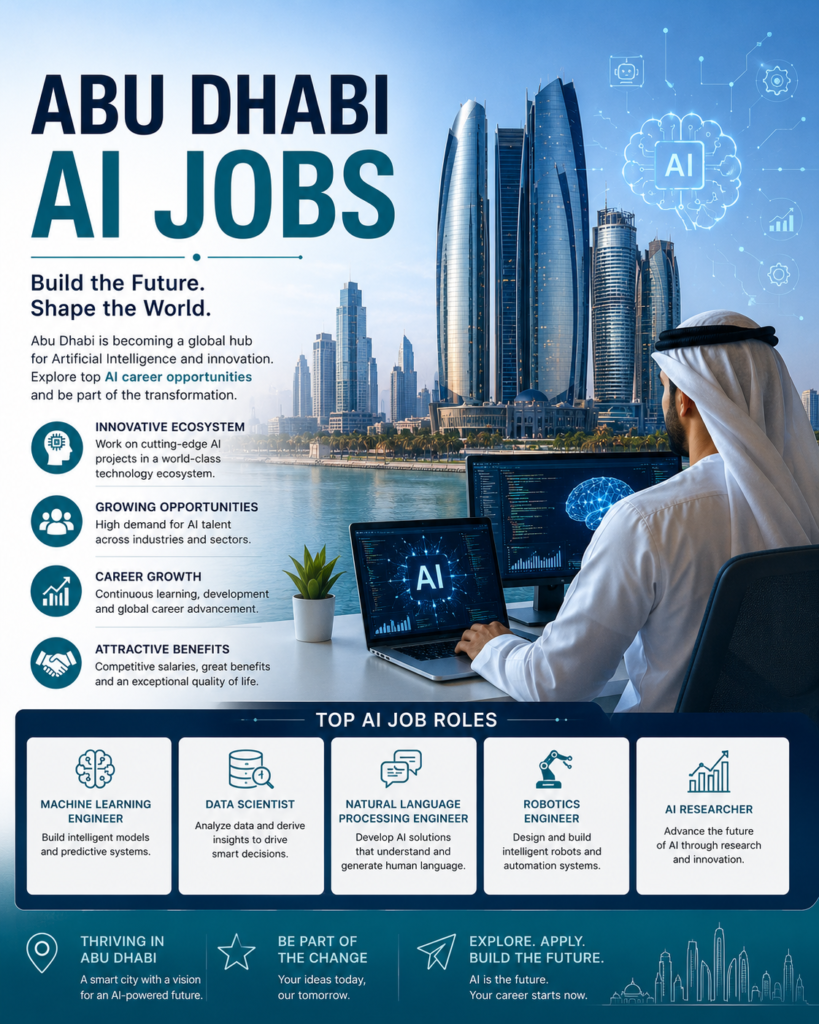
Abu Dhabi is rapidly establishing itself as an important technology and innovation hub in the Middle East. As the capital of the United Arab Emirates continues to invest in artificial intelligence, digital transformation, cloud computing, data science, automation, and advanced technologies, demand for professionals with AI-related skills is increasing. From large government initiatives and financial institutions to healthcare, energy, technology, and emerging start-ups, organizations across Abu Dhabi are adopting artificial intelligence to improve efficiency, develop new products, and solve complex business challenges.
- Why AI Jobs Are Growing in Abu Dhabi
- Best AI Jobs in Abu Dhabi
- 1. AI Engineer
- 2. Machine Learning Engineer
- 3. Data Scientist
- 4. AI Research Scientist
- 5. Computer Vision Engineer
- 6. Natural Language Processing Engineer
- 7. Generative AI Engineer
- 8. Robotics Engineer
- 9. AI Product Manager
- 10. Data Engineer
- 11. AI Solutions Architect
- 12. AI Consultant
- 13. MLOps Engineer
- 14. AI Cybersecurity Specialist
- 15. AI Business Analyst
- Industries Hiring AI Professionals in Abu Dhabi
- Technology
- Banking and Financial Services
- Healthcare
- Energy
- Government
- Aviation and Transportation
- Retail and E-Commerce
- Skills Needed for AI Jobs in Abu Dhabi
- Programming Languages for AI Careers
- Educational Qualifications for AI Jobs
- How to Get an AI Job in Abu Dhabi
- AI Certifications That Can Help
- AI Jobs in Abu Dhabi for Freshers
- AI Jobs in Abu Dhabi Without a PhD
- AI Salary Expectations in Abu Dhabi
- Benefits of Working in Abu Dhabi’s AI Sector
- Challenges of AI Careers in Abu Dhabi
- Future of AI Jobs in Abu Dhabi
- Tips for Building a Long-Term AI Career
- Frequently Asked Questions About AI Jobs in Abu Dhabi
For professionals looking to build a career in technology, the best AI jobs in Abu Dhabi offer opportunities across a wide range of specializations. These include machine learning engineering, data science, AI research, computer vision, natural language processing, robotics, AI product management, cybersecurity, and generative AI. Both experienced professionals and graduates can find potential career opportunities, although technical roles generally require strong educational backgrounds and practical skills.
This guide explores the best AI jobs in Abu Dhabi in 2026, the skills employers look for, common qualifications, industries hiring AI professionals, career paths, salary considerations, and practical tips for finding an artificial intelligence job in Abu Dhabi.
Why AI Jobs Are Growing in Abu Dhabi
Artificial intelligence is becoming increasingly important to Abu Dhabi’s economic and technological development. The emirate has been investing in digital infrastructure, research, innovation, smart government services, and advanced technologies.
AI can be applied across almost every major sector, which creates demand for professionals with different combinations of technical, business, and industry knowledge.
Companies and organizations can use AI for:
- Automating repetitive tasks
- Analyzing large datasets
- Improving customer experiences
- Detecting fraud
- Forecasting demand
- Optimizing business operations
- Supporting medical research
- Improving cybersecurity
- Developing intelligent products
- Enhancing government services
This broad range of applications means that AI careers are not limited to technology companies. Professionals can potentially find AI-related positions in banking, healthcare, energy, aviation, retail, logistics, education, government, and professional services.
Best AI Jobs in Abu Dhabi
AI is a broad field with numerous career paths. The best role for an individual depends on their education, technical expertise, professional experience, and career goals.
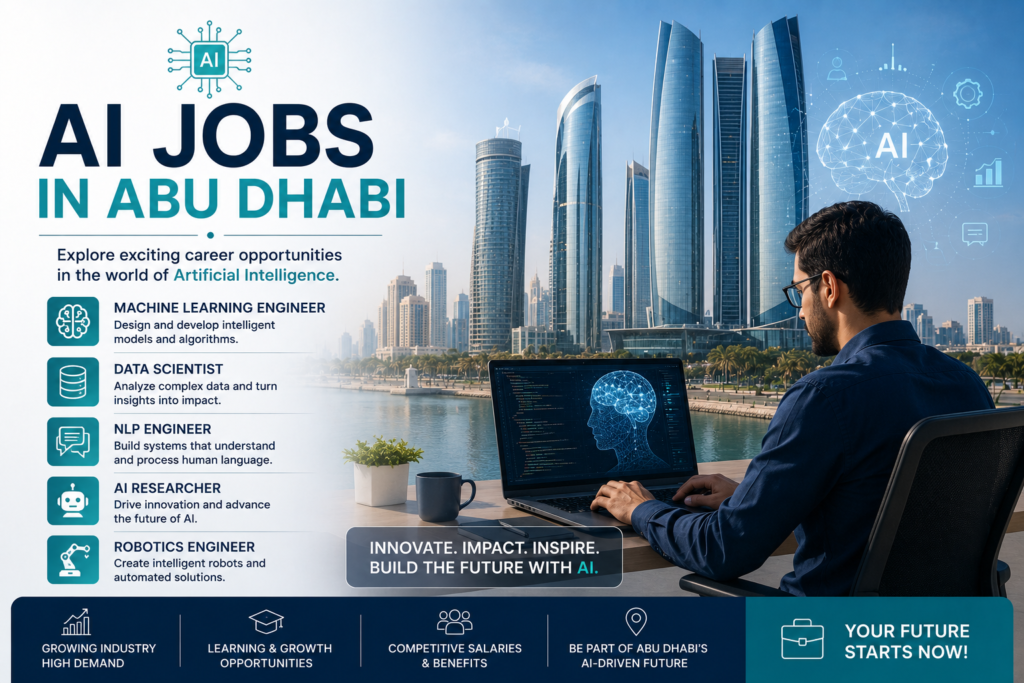
Some of the most promising AI jobs in Abu Dhabi include:
- AI Engineer
- Machine Learning Engineer
- Data Scientist
- AI Research Scientist
- Computer Vision Engineer
- Natural Language Processing Engineer
- Generative AI Engineer
- Robotics Engineer
- AI Product Manager
- Data Engineer
- AI Solutions Architect
- AI Consultant
- MLOps Engineer
- AI Cybersecurity Specialist
- AI Business Analyst
Let’s examine these careers in more detail.
1. AI Engineer
AI engineers design, develop, test, and deploy artificial intelligence systems. They work with machine learning models, software applications, data pipelines, and AI frameworks to create solutions for real-world business problems.
An AI engineer may be involved in developing recommendation systems, intelligent automation tools, predictive models, conversational applications, or generative AI solutions.
Typical responsibilities include:
- Developing AI applications
- Training and testing machine learning models
- Working with large datasets
- Integrating AI into software systems
- Improving model performance
- Collaborating with data scientists and software developers
- Deploying AI solutions into production
A strong understanding of programming, mathematics, machine learning, and software engineering is generally important for this career.
2. Machine Learning Engineer
Machine learning engineers specialize in building systems that allow computers to learn from data and make predictions or decisions.
They often work closely with data scientists and software engineers. Their responsibilities can include preparing data, developing models, optimizing algorithms, and deploying machine learning systems.
Important skills can include:
- Python
- Machine learning algorithms
- Statistics
- SQL
- TensorFlow or PyTorch
- Model deployment
- Cloud platforms
- Data processing
Machine learning engineering is particularly relevant to organizations that rely on predictive analytics, automation, fraud detection, forecasting, and intelligent decision-making.
3. Data Scientist
Data scientists use statistical analysis, programming, and machine learning to extract useful information from data.
In Abu Dhabi, data scientists can potentially work across banking, healthcare, energy, government, retail, logistics, and other industries.
A data scientist may analyze customer behavior, financial data, operational information, medical datasets, or market trends.
Common skills include:
- Python or R
- Statistics
- Machine learning
- SQL
- Data visualization
- Predictive modeling
- Business analysis
Data science is often a strong career path for people who enjoy combining mathematics, programming, and problem-solving.
4. AI Research Scientist
AI research scientists work on developing new artificial intelligence methods, models, algorithms, and technologies. These roles are generally more research-intensive than standard AI engineering positions.
Abu Dhabi’s growing technology and research ecosystem creates opportunities for professionals interested in advanced AI research.
Research areas can include:
- Machine learning
- Deep learning
- Computer vision
- Natural language processing
- Reinforcement learning
- Generative AI
- Robotics
- AI safety
Advanced positions may require a master’s degree or PhD, particularly for research-heavy roles.
5. Computer Vision Engineer
Computer vision focuses on enabling computers to understand and interpret images and video.
Computer vision can be applied to security, healthcare, autonomous systems, manufacturing, transportation, retail, and smart-city technologies.
A computer vision engineer may work on:
- Image recognition
- Object detection
- Facial recognition
- Video analytics
- Medical imaging
- Autonomous systems
- Visual inspection
Strong knowledge of deep learning, image processing, Python, and computer vision frameworks can be valuable for this career.
6. Natural Language Processing Engineer
Natural language processing, or NLP, allows computers to understand, process, and generate human language.
NLP has become particularly important with the rapid growth of conversational AI and generative AI applications.
NLP professionals can work on:
- Chatbots
- Virtual assistants
- Text classification
- Sentiment analysis
- Search systems
- Speech and language applications
- Large language model applications
Knowledge of Python, machine learning, deep learning, NLP libraries, and modern language models can help candidates pursue this career path.
7. Generative AI Engineer
Generative AI has become one of the fastest-growing areas of artificial intelligence. Generative AI engineers develop applications capable of generating text, images, code, audio, or other content.
Businesses can use generative AI to improve productivity, automate customer support, summarize documents, assist employees, and create new digital products.
Relevant skills may include:
- Large language models
- Prompt engineering
- Retrieval-augmented generation
- Vector databases
- Python
- AI APIs
- Model evaluation
- AI application development
Professionals who combine generative AI knowledge with strong software engineering skills can be particularly valuable to organizations implementing AI solutions.
8. Robotics Engineer
Robotics combines artificial intelligence, mechanical engineering, electronics, sensors, and software.
Robotics professionals can work on autonomous machines, industrial robots, drones, smart equipment, and other intelligent systems.
A robotics engineer may need knowledge of:
- Robotics
- Programming
- Computer vision
- Sensors
- Control systems
- Machine learning
- Embedded systems
This career can be attractive to professionals interested in combining physical technology with artificial intelligence.
9. AI Product Manager
Not every AI career requires advanced programming. AI product managers combine technology knowledge with business and product-management skills.
They are responsible for identifying problems that AI can solve and guiding the development of AI-powered products.
Their responsibilities may include:
- Defining product requirements
- Working with AI engineers
- Understanding customer needs
- Managing product roadmaps
- Evaluating AI capabilities
- Measuring product performance
- Coordinating business and technical teams
This role can be a strong option for experienced product managers who want to specialize in artificial intelligence.
10. Data Engineer
AI systems depend heavily on high-quality data. Data engineers build the infrastructure required to collect, process, store, and organize that data.
Their work supports data scientists and AI engineers by ensuring that information is available in reliable and usable formats.
Important skills can include:
- SQL
- Python
- Data pipelines
- Databases
- Cloud computing
- Data warehousing
- ETL technologies
- Distributed systems
Data engineering is therefore an important supporting career within the broader AI ecosystem.
11. AI Solutions Architect
AI solutions architects design the technical architecture required to implement AI systems within organizations.
They need to understand both business requirements and technical infrastructure. Their responsibilities may include selecting appropriate AI technologies, designing cloud architectures, managing data flows, and ensuring that systems can operate reliably at scale.
Experience in software engineering, cloud computing, machine learning, and enterprise architecture can be valuable.
12. AI Consultant
AI consultants help businesses understand how artificial intelligence can improve their operations.
Instead of building AI models themselves, consultants may focus on identifying use cases, developing AI strategies, evaluating technologies, managing implementation projects, and measuring business results.
AI consultants can work across multiple industries, making the career suitable for professionals with a combination of technology and business experience.
13. MLOps Engineer
MLOps combines machine learning with software operations. MLOps professionals help organizations deploy, monitor, maintain, and update machine learning models.
Their work is particularly important when companies move AI projects from experimentation into production.
Relevant areas include:
- Model deployment
- Cloud infrastructure
- Automation
- Monitoring
- Version control
- Data pipelines
- Model lifecycle management
Professionals with DevOps and machine learning experience can potentially transition into MLOps roles.
14. AI Cybersecurity Specialist
Artificial intelligence is increasingly used in cybersecurity, while AI systems themselves also create new security challenges.
AI cybersecurity specialists can work on threat detection, anomaly identification, fraud prevention, automated security analysis, and protection of AI models and data.
This career is suitable for professionals who have experience in cybersecurity and want to specialize in AI-powered security solutions.
15. AI Business Analyst
AI business analysts help organizations identify opportunities where artificial intelligence can improve processes and business performance.
They may analyze workflows, identify automation opportunities, define requirements, and work with technical teams to implement AI solutions.
This can be an attractive career path for professionals who understand business processes but do not necessarily want to become full-time programmers.
Industries Hiring AI Professionals in Abu Dhabi
One of the biggest advantages of pursuing an AI career in Abu Dhabi is the diversity of industries adopting advanced technology.
Technology
Technology companies are obvious employers for AI professionals. Roles can include machine learning engineering, software development, data science, cloud computing, and AI research.
Banking and Financial Services
Banks and financial institutions use AI for fraud detection, risk analysis, customer service, financial forecasting, and personalization.
Potential roles include:
- Data scientist
- Machine learning engineer
- AI engineer
- Fraud analytics specialist
- AI product manager
Healthcare
AI is increasingly being explored for medical imaging, healthcare analytics, research, operational optimization, and patient-support technologies.
Healthcare AI roles may require a combination of technical skills and knowledge of healthcare data and regulations.
Energy
The UAE’s energy industry generates enormous amounts of operational data, creating opportunities for AI applications involving forecasting, predictive maintenance, optimization, and automation.
Professionals with AI and energy-sector knowledge can potentially find specialized opportunities in this area.
Government
Government organizations can use AI to improve public services, analyze information, automate processes, and develop smart-city solutions.
This creates opportunities for professionals interested in applying AI to large-scale public-sector projects.
Aviation and Transportation
AI can be used in aviation, logistics, traffic management, predictive maintenance, route optimization, and autonomous systems.
Abu Dhabi’s transportation and aviation ecosystem therefore provides another potential market for AI professionals.
Retail and E-Commerce
Retailers can use artificial intelligence for recommendation systems, inventory forecasting, customer analytics, fraud prevention, and personalized marketing.
AI professionals can work with large customer datasets and develop solutions designed to improve business performance.
Skills Needed for AI Jobs in Abu Dhabi
AI employers generally look for a combination of technical knowledge, practical experience, and problem-solving ability.
Some of the most valuable technical skills include:
- Python programming
- SQL
- Machine learning
- Deep learning
- Statistics
- Data analysis
- Cloud computing
- Generative AI
- Natural language processing
- Computer vision
- Data engineering
- Model deployment
- Software development
However, technical knowledge alone may not be enough. Employers also value communication, teamwork, analytical thinking, adaptability, and the ability to explain complex technology to non-technical stakeholders.
Programming Languages for AI Careers
Python is one of the most useful programming languages for AI and machine learning. It has a large ecosystem of libraries and frameworks for data science and artificial intelligence.
Other useful technologies can include:
- SQL
- Java
- C++
- R
- JavaScript
- Scala
The language you need depends on the role. A data scientist may rely heavily on Python and SQL, while a robotics engineer may also require C++.
Educational Qualifications for AI Jobs
Educational requirements vary significantly by position.
Entry-level AI and data roles may accept candidates with bachelor’s degrees in fields such as:
- Computer science
- Artificial intelligence
- Data science
- Mathematics
- Statistics
- Engineering
- Information technology
More advanced research roles may require master’s degrees or PhDs.
However, education is only one part of the hiring process. Practical experience can be extremely important, particularly for engineering and development positions.
How to Get an AI Job in Abu Dhabi
Getting an AI job requires more than simply submitting a CV. Candidates should demonstrate that they can apply their knowledge to practical problems.
Build a Strong Portfolio
Create projects that demonstrate your AI skills. A portfolio can include machine learning models, data analysis projects, chatbots, computer vision applications, or generative AI tools.
Learn Industry-Relevant Technologies
Focus on technologies that are relevant to the position you want. For example, an aspiring MLOps engineer should learn cloud infrastructure and deployment, while an NLP specialist should study language models and text-processing techniques.
Gain Practical Experience
Internships, freelance projects, university research, and personal projects can help demonstrate practical ability.
Optimize Your CV
Keep your CV focused on measurable achievements and relevant technical skills.
Include:
- Programming languages
- AI frameworks
- Certifications
- Projects
- Professional experience
- Education
- Technical achievements
Build a Professional Network
Networking can help you learn about opportunities that may not be widely advertised. Technology events, professional communities, conferences, and online platforms can help you connect with employers and other AI professionals.
AI Certifications That Can Help
Certifications are not always mandatory, but relevant credentials can strengthen a candidate’s profile.
Depending on your career path, you may consider certifications related to:
- Machine learning
- Cloud computing
- Data science
- Artificial intelligence
- Cybersecurity
- Data engineering
The most valuable certification depends on the job. Candidates should avoid collecting certifications without developing practical skills.
AI Jobs in Abu Dhabi for Freshers
Fresh graduates can enter the AI industry, although competition for technical positions can be strong.
Students and recent graduates can improve their chances by developing practical projects while studying.
Useful entry-level roles may include:
- Junior data analyst
- Junior data scientist
- AI intern
- Machine learning intern
- Data engineer
- AI research assistant
- Software engineer
- Business analyst
Internships can be especially valuable because they provide exposure to real-world projects and professional environments.
AI Jobs in Abu Dhabi Without a PhD
A PhD is not necessary for many AI careers. While advanced research positions may require doctoral-level education, many engineering, data, product, consulting, and implementation roles prioritize practical skills and professional experience.
For example, candidates can pursue careers as:
- AI engineers
- Machine learning engineers
- Data scientists
- Data engineers
- AI product managers
- AI consultants
- MLOps engineers
- AI business analysts
A strong portfolio and practical experience can help compensate for the absence of an advanced research degree in many applied AI roles.
AI Salary Expectations in Abu Dhabi
AI salaries in Abu Dhabi can vary considerably depending on the position, experience, education, technical specialization, employer, and industry.
Senior AI engineers and specialized professionals generally command higher compensation than entry-level candidates. Professionals with expertise in areas such as generative AI, machine learning infrastructure, cloud computing, cybersecurity, and AI architecture may have access to specialized opportunities.
When evaluating a job offer, candidates should consider the entire compensation package rather than salary alone.
Factors may include:
- Basic salary
- Housing allowance
- Transportation allowance
- Health insurance
- Annual leave
- Airfare benefits
- Bonuses
- Relocation support
- Other employee benefits
Salary figures can change over time, so candidates should compare current job-market information before making career decisions.
Benefits of Working in Abu Dhabi’s AI Sector
Abu Dhabi offers several advantages for professionals interested in technology and artificial intelligence.
The emirate has a growing innovation ecosystem, strong infrastructure, international business connections, and a strategic focus on advanced technology.
Potential advantages include:
- Exposure to large-scale AI projects
- Opportunities across multiple industries
- International work environment
- Growing technology ecosystem
- Access to advanced digital infrastructure
- Opportunities for career specialization
- Potential exposure to government and enterprise AI projects
The combination of technology investment and economic diversification makes Abu Dhabi an interesting destination for AI professionals.
Challenges of AI Careers in Abu Dhabi
Although opportunities are increasing, candidates should understand that AI jobs can be competitive.
Employers often seek professionals who can demonstrate practical experience rather than only theoretical knowledge. Technology also changes quickly, meaning AI professionals need to continuously update their skills.
Common challenges include:
- Competition for senior positions
- Rapidly changing AI technologies
- High expectations for technical skills
- Need for continuous learning
- Strong competition from international candidates
Professionals who regularly develop their skills and build practical experience can improve their long-term career prospects.
Future of AI Jobs in Abu Dhabi
The future of artificial intelligence in Abu Dhabi is likely to involve increased adoption across government, finance, healthcare, energy, transportation, technology, and other industries.
Generative AI, automation, computer vision, robotics, predictive analytics, and intelligent software systems are likely to remain important areas of development.
As businesses move beyond experimentation and begin integrating AI into everyday operations, demand may increasingly shift toward professionals who can deploy reliable AI systems and demonstrate measurable business value.
This could create opportunities not only for traditional AI specialists but also for professionals in software engineering, cybersecurity, product management, cloud computing, data engineering, and business strategy.
Tips for Building a Long-Term AI Career
Artificial intelligence is evolving rapidly, so successful professionals need to treat learning as an ongoing process.
Consider these strategies:
- Keep learning new AI technologies.
- Build practical projects.
- Follow developments in generative AI.
- Improve programming skills.
- Develop communication abilities.
- Learn cloud technologies.
- Understand AI ethics and responsible AI.
- Build a professional network.
- Participate in technology communities.
- Develop expertise in a specific industry.
Specialization can be particularly valuable. Instead of trying to learn every AI technology, professionals can develop deep expertise in an area such as NLP, computer vision, healthcare AI, financial AI, robotics, or MLOps.
Frequently Asked Questions About AI Jobs in Abu Dhabi
Q1. What are the best AI jobs in Abu Dhabi?
Ans: Some of the most promising AI careers include AI engineer, machine learning engineer, data scientist, AI research scientist, generative AI engineer, computer vision engineer, NLP engineer, robotics engineer, AI product manager, data engineer, and MLOps engineer.
Q2. Is Abu Dhabi good for AI careers?
Ans: Abu Dhabi is developing a growing technology and innovation ecosystem, with artificial intelligence being applied across sectors such as government, finance, healthcare, energy, transportation, and technology. This creates opportunities for professionals with relevant AI and data skills.
Q3. What qualifications are needed for AI jobs in Abu Dhabi?
Ans: Requirements vary by position. Many roles accept bachelor’s degrees in computer science, engineering, mathematics, data science, statistics, or related fields. Research-oriented positions may require master’s degrees or PhDs.
Q4. Can freshers get AI jobs in Abu Dhabi?
Ans: Yes, graduates can pursue entry-level positions and internships in AI, data science, software engineering, and related fields. A strong portfolio of practical projects can improve a fresher’s profile.
Q5. Do AI jobs in Abu Dhabi require programming?
Ans: Many technical AI positions require programming, particularly Python. However, roles such as AI product management, consulting, and business analysis may require more limited programming knowledge.
Q6. Which programming language is best for AI jobs?
Ans: Python is one of the most widely used languages for artificial intelligence and machine learning. SQL is also highly valuable for working with data.
Q7. Are AI jobs in Abu Dhabi well paid?
Ans: Compensation varies by experience, specialization, employer, and industry. Senior and highly specialized AI professionals may command higher salaries than entry-level candidates. Candidates should evaluate the complete compensation package when comparing offers.
Q8. What skills are most important for AI jobs?
Ans: Important skills include machine learning, Python, statistics, data analysis, deep learning, cloud computing, SQL, generative AI, software engineering, and problem-solving. Communication and teamwork are also valuable.
Final Thoughts
The best AI jobs in Abu Dhabi span far beyond traditional machine learning positions. As artificial intelligence becomes increasingly integrated into business and government operations, opportunities are emerging for engineers, data scientists, researchers, product managers, consultants, cybersecurity specialists, data engineers, and other technology professionals.
For anyone planning an AI career in Abu Dhabi, the most important step is to develop practical, job-ready skills. A relevant degree can provide a strong foundation, but employers also want to see evidence that candidates can apply AI technologies to real-world problems.
Whether you are a recent graduate, an experienced software engineer, a data professional, or a technology manager looking to specialize in AI, Abu Dhabi’s evolving technology ecosystem offers a range of potential career paths. By building a strong portfolio, keeping your technical skills current, understanding industry requirements, and networking with professionals, you can improve your chances of finding suitable AI opportunities in the emirate.
As AI continues to influence industries across the UAE, professionals who combine technical expertise with business understanding and continuous learning are likely to be well positioned for the changing employment landscape in 2026 and beyond.
Do follow Gulf Prime on Instagram
Read More – Best AI Jobs in Dubai