



Understanding VAT in the Gulf
GCC VAT Guide rules are important for entrepreneurs, companies and investors operating across the UAE, Saudi Arabia, Bahrain, Oman, Qatar and Kuwait because VAT is not applied in exactly the same way across all six Gulf countries.
- GCC VAT Guide: 2026 Overview
- Understanding VAT in the Gulf
- 1. Standard VAT Rates Across the GCC
- 2. VAT Registration Thresholds
- 3. Standard-Rated Supplies
- 4. Zero-Rated Supplies
- 5. VAT-Exempt Supplies
- 6. Input VAT and Output VAT
- 7. VAT Invoices and Business Records
- 8. VAT Returns and Payments
- 9. Imports and the Reverse Charge Mechanism
- 10. Cross-Border GCC Transactions
- 11. VAT for Online and Digital Businesses
- 12. VAT Compliance and Penalties
- VAT in the UAE
- VAT in Saudi Arabia
- VAT in Bahrain
- VAT in Oman
- VAT in Qatar
- VAT in Kuwait
- VAT for Small Gulf Businesses
- VAT for Free Zone Companies
- VAT and Corporate Tax
- Common GCC VAT Mistakes
- GCC VAT Comparison Table
- GCC VAT Business Checklist
- Final Thoughts on GCC VAT
The GCC states agreed on a common VAT framework, but individual countries remain responsible for implementing the tax through their own national legislation. This has produced major differences in both timing and rates.
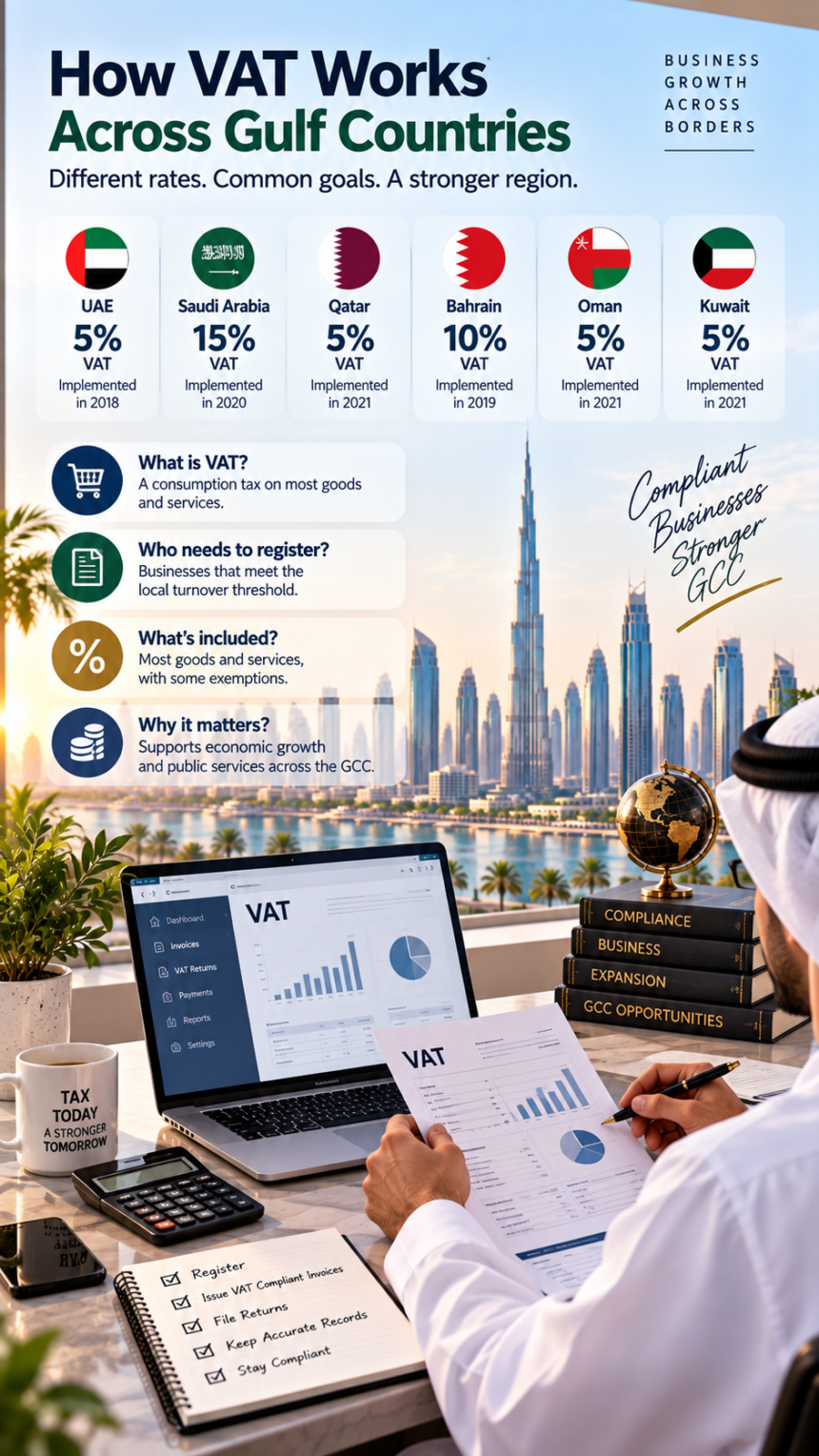
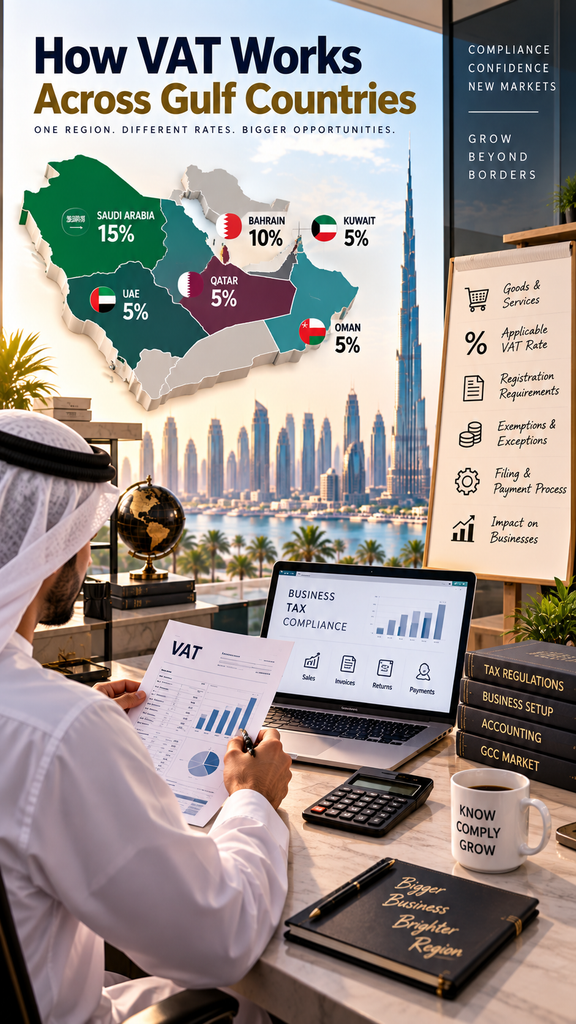
As of September 2026, the UAE and Oman apply a standard VAT rate of 5%, Bahrain applies 10%, and Saudi Arabia applies 15%. Qatar and Kuwait have not yet introduced VAT.
That distinction is important for businesses operating regionally.
A company selling the same product in Dubai, Riyadh and Manama may face three different standard VAT rates. A company operating in Doha or Kuwait City currently operates without a domestic VAT system, although other taxes, customs duties and regulatory obligations can still apply.
Businesses should therefore avoid treating the GCC as one tax jurisdiction.
The GCC VAT Agreement provides the common framework, but registration, invoicing, exemptions, filing and administration are handled at national level.
GCC VAT Guide: 2026 Overview
The current position can be summarised as follows:
| GCC Country | Standard VAT Rate | VAT Status |
|---|---|---|
| UAE | 5% | Implemented |
| Saudi Arabia | 15% | Implemented |
| Bahrain | 10% | Implemented |
| Oman | 5% | Implemented |
| Qatar | No VAT currently | Not yet implemented |
| Kuwait | No VAT currently | Not yet implemented |
The UAE and Saudi Arabia introduced VAT in 2018.
Bahrain followed in 2019.
Oman’s VAT law became effective on April 16, 2021.
Saudi Arabia originally introduced VAT at 5%, but the standard rate increased to 15% from July 1, 2020.
Bahrain originally introduced VAT at 5%, before increasing its standard rate to 10% from January 1, 2022.
The UAE has retained a standard rate of 5%, while Oman’s current standard rate is also 5%.
Understanding VAT in the Gulf
VAT stands for Value Added Tax.
It is an indirect consumption tax charged at different stages of the supply chain.
Imagine a furniture manufacturer sells a table to a retailer.
The manufacturer may charge VAT.
The retailer then sells the table to the final customer and also charges VAT.
The registered businesses account for VAT through their tax returns, while the final consumer generally carries the ultimate tax cost.
The UAE Federal Tax Authority describes VAT as a transaction-based indirect tax levied at each step in the supply chain, with the end consumer generally bearing the cost.
Saudi Arabia and Oman follow the same basic principle.
Businesses therefore act partly as tax collectors.
They collect VAT from customers where required and pay the tax to the relevant authority after considering eligible VAT already paid on business purchases.
1. Standard VAT Rates Across the GCC
The original GCC VAT framework contemplated a standard rate of 5%, but national rates have since developed differently.
UAE: 5%
The standard UAE VAT rate remains 5% on taxable goods and services unless the transaction is zero-rated or exempt.
Saudi Arabia: 15%
Saudi Arabia currently has the highest standard VAT rate in the GCC at 15%.
Bahrain: 10%
Bahrain’s standard VAT rate has been 10% since January 1, 2022.
Oman: 5%
Oman applies 5% to most goods and services.
Qatar
Qatar’s General Tax Authority states that Qatar has not applied VAT.
Kuwait
VAT is also not currently applicable in Kuwait. PwC’s Kuwait tax summary, last reviewed in July 2026, confirms that VAT has not yet been introduced.
Businesses entering multiple GCC countries therefore need country-specific pricing systems.
A price quoted as “plus VAT” can mean very different final customer costs depending on where the transaction takes place.
2. VAT Registration Thresholds
VAT does not necessarily require every small business to register immediately.
Countries generally use registration thresholds.
UAE
A UAE-resident business must generally register when taxable supplies and imports exceed AED 375,000 over the relevant period or are expected to exceed that amount within the applicable forward-looking period.
Voluntary registration is available from AED 187,500 of qualifying taxable supplies, imports or expenses.
Saudi Arabia
The mandatory VAT registration threshold is generally SAR 375,000 in taxable annual revenue.
Businesses exceeding SAR 187,500 but remaining below SAR 375,000 can generally register voluntarily.
Bahrain
Bahrain’s mandatory registration threshold is BHD 37,500 of annual taxable supplies.
Voluntary registration is available when taxable supplies or qualifying expenses exceed BHD 18,750.
Oman
Oman’s mandatory VAT registration threshold is OMR 38,500.
The voluntary threshold is OMR 19,250.
Qatar and Kuwait currently have no domestic VAT registration requirement because VAT has not yet been implemented.
Businesses should monitor turnover regularly rather than checking only once each year.
Growing beyond the registration threshold without registering can create tax liabilities and penalties.
3. Standard-Rated Supplies
A standard-rated supply is a sale of goods or services to which the normal VAT rate applies.
For example, a standard-rated product selling for AED 1,000 in the UAE would generally attract AED 50 of VAT.
The customer pays:
AED 1,000 product value
AED 50 VAT
AED 1,050 total
In Saudi Arabia, a SAR 1,000 standard-rated transaction would generally attract SAR 150 VAT because the rate is 15%.
In Bahrain, the equivalent VAT would be BHD 100 on a BHD 1,000 taxable transaction.
Businesses should therefore make clear whether quoted prices:
- Include VAT
- Exclude VAT
- Are subject to VAT where applicable
This is particularly important in B2B contracts.
A contract signed without clearly addressing VAT can later create disputes over whether the supplier or customer bears the additional cost.
4. Zero-Rated Supplies
Zero-rated does not mean the same thing as exempt.
A zero-rated supply is still considered taxable, but VAT is charged at 0%.
This distinction matters because businesses making zero-rated supplies can generally still recover eligible input VAT associated with those supplies.
Examples vary by country.
The UAE provides zero-rating for qualifying transactions including certain exports, international transport, investment precious metals, qualifying education and healthcare services, and certain first supplies of buildings.
Oman lists examples including:
- Exports
- International transport
- Certain essential goods
as zero-rated supplies.
Bahrain also applies zero-rating to specified goods and services under its VAT law.
Businesses should never apply 0% VAT merely because a customer is overseas.
Export and place-of-supply rules still need to be satisfied.
5. VAT-Exempt Supplies
An exempt transaction is generally outside the VAT charge under a specific exemption.
The important difference is input tax recovery.
Input VAT connected with exempt activities is usually not recoverable in the same way as VAT connected with taxable activities.
The UAE identifies examples of exempt supplies including:
- Certain financial services
- Residential property
- Bare land
- Local passenger transport
Oman also identifies exemptions including certain financial services and residential property rentals.
Bahrain similarly distinguishes between standard-rated, zero-rated, exempt and outside-scope transactions.
This distinction can significantly affect business profitability.
A company earning AED 1 million from exempt activities may be unable to recover some VAT incurred on related costs.
Tax treatment should therefore be considered before setting prices and budgets.
6. Input VAT and Output VAT
Two important VAT terms are input VAT and output VAT.
Output VAT is VAT a registered business charges its customers.
Input VAT is VAT the business pays on eligible purchases and expenses.
Imagine a UAE business:
Collects AED 30,000 VAT from customers.
Pays AED 18,000 VAT on eligible business purchases.
The basic net VAT position may be:
AED 30,000 output VAT
minus AED 18,000 recoverable input VAT
equals AED 12,000 net VAT payable
The actual calculation can be more complicated when the business has exempt activities, non-business expenses or partially recoverable costs.
The UAE FTA confirms that input tax relating to taxable supplies can generally be recovered, while input VAT connected with exempt supplies cannot normally be recovered in full.
Oman’s rules similarly distinguish recoverable input tax on taxable supplies from exempt activities.
Businesses should therefore record purchase VAT correctly rather than treating every expense automatically as recoverable.
7. VAT Invoices and Business Records
VAT-registered businesses generally need compliant tax invoices.
An invoice can include information such as:
- Supplier name
- Tax registration number
- Invoice date
- Customer information
- Description of supply
- Taxable value
- VAT rate
- VAT amount
- Total amount
Exact requirements differ by country.
Bahrain, for example, requires simplified VAT invoices to include the supplier’s name, address and VAT registration number, invoice date, description, total amount including VAT and the applicable rate and VAT amount.
Businesses also need to keep supporting records.
These can include:
- Sales invoices
- Purchase invoices
- Credit notes
- Customs documents
- Contracts
- Import records
- Accounting ledgers
Good VAT compliance therefore begins with good bookkeeping.
Trying to reconstruct an entire year’s transactions shortly before a VAT filing deadline creates unnecessary risk.
8. VAT Returns and Payments
After VAT registration, businesses normally need to submit VAT returns.
A VAT return summarises figures including:
- Taxable sales
- Output VAT
- Eligible purchases
- Recoverable input VAT
- Adjustments
- Net tax due or refundable
Filing frequency varies according to jurisdiction and taxpayer profile.
Bahrain, for example, generally uses monthly periods for businesses with annual taxable supplies above BHD 3 million and quarterly periods for smaller registered taxpayers, with some qualifying smaller taxpayers able to request annual filing.
Businesses should confirm their exact filing period through their tax authority account.
Missing a filing deadline can create penalties even where the business has little or no VAT to pay.
Never assume that “no payment due” means “no return required.”
9. Imports and the Reverse Charge Mechanism
VAT becomes more complicated when businesses buy goods or services from overseas.
Imported goods may attract VAT at customs or through other import mechanisms.
Imported services can sometimes be accounted for using the reverse charge mechanism.
Under reverse charge, the local VAT-registered customer calculates VAT on the imported service instead of relying on the foreign supplier to collect local VAT.
This mechanism is common where services are purchased from overseas suppliers.
For example, a Gulf company might purchase:
- Software
- International consultancy
- Digital advertising
- Cloud services
from a foreign supplier.
The local business may need to account for VAT under reverse-charge rules depending on its country and circumstances.
Bahrain’s VAT return guidance includes specific reporting for imports subject to its reverse-charge mechanism.
Oman’s registration calculations also take certain supplies subject to reverse charge into account.
International service businesses should therefore review VAT even when the supplier does not charge Gulf VAT on the invoice.
10. Cross-Border GCC Transactions
The GCC VAT Agreement creates a common regional framework, but the regional VAT system is not equivalent to a single European Union-style VAT area operating with completely unified administration.
National implementation remains important.
This becomes especially relevant because Qatar and Kuwait have not yet implemented VAT.
Businesses may therefore need to treat transactions differently depending on:
- Supplier location
- Customer location
- Whether the customer is VAT registered
- Whether goods physically cross borders
- Where services are deemed supplied
- Whether the transaction qualifies as an export
Bahrain’s VAT return guidance currently notes transitional treatment for certain GCC transactions until the fully integrated GCC electronic VAT arrangements are implemented.
Regional companies should therefore avoid creating one automatic “GCC VAT rate” in their accounting software.
Each transaction needs the correct national tax treatment.
11. VAT for Online and Digital Businesses
Online companies are not outside VAT simply because they have no physical store.
VAT can apply to:
- E-commerce goods
- Software
- Subscriptions
- Advertising
- Online consulting
- Digital services
A UAE online store that exceeds the applicable registration threshold may need to register and collect VAT.
A Saudi online business may face the 15% standard rate on taxable domestic supplies once registration rules apply.
Cross-border digital services can become more complicated.
A company selling software from Europe to Gulf customers may face different registration or reverse-charge treatment depending on whether the customer is:
- A registered business
- An individual consumer
- Located in the UAE
- Located in Saudi Arabia
- Located in Qatar or Kuwait
Oman’s official e-commerce VAT guidance specifically addresses registration and VAT treatment for non-resident e-commerce suppliers making taxable supplies in Oman.
Digital companies should therefore not assume that having no physical Gulf office automatically removes VAT responsibilities.
12. VAT Compliance and Penalties
VAT is a self-assessed tax system in several GCC countries.
That means businesses carry significant responsibility for:
- Registering correctly
- Charging the right rate
- Issuing compliant invoices
- Recovering input VAT properly
- Filing returns
- Paying on time
- Keeping records
Common compliance problems include:
- Late registration
- Incorrect tax invoices
- Late returns
- Incorrect VAT rates
- Unsupported input VAT claims
- Failure to update registration information
Businesses should maintain a monthly VAT review even when returns are filed quarterly.
The longer an error remains undetected, the more transactions may be affected.
Tax authorities also continue updating their rules.
The UAE FTA, for example, published new VAT legislation and public clarifications during 2026, including updated guidance in September.
VAT should therefore be treated as an ongoing compliance responsibility rather than a one-time registration exercise.
VAT in the UAE
The UAE introduced VAT on January 1, 2018.
The current standard rate remains 5%.
Businesses generally need to register when taxable supplies and imports exceed AED 375,000, while voluntary registration is available above AED 187,500.
The UAE system contains:
- Standard-rated supplies
- Zero-rated supplies
- Exempt supplies
- Outside-scope transactions
The FTA identifies exemptions including residential property, bare land, local passenger transport and certain financial services.
Zero-rated categories can include qualifying exports, international transport, certain education and healthcare supplies and qualifying first supplies of buildings.
The UAE also treats VAT registration separately from Corporate Tax.
A company can have obligations under both systems.
Free-zone companies are not automatically excluded from VAT either. Tax treatment depends on the transaction, location and applicable VAT rules.
VAT in Saudi Arabia
Saudi Arabia introduced VAT at 5% on January 1, 2018.
The rate increased to 15% from July 1, 2020, where it remains in 2026.
The mandatory VAT registration threshold is generally SAR 375,000, while voluntary registration becomes available above SAR 187,500.
Saudi Arabia therefore has a significantly higher standard VAT rate than other GCC states that have implemented VAT.
For a business selling a standard-rated SAR 10,000 service:
Base price: SAR 10,000
VAT: SAR 1,500
Customer total: SAR 11,500
Companies operating in both the UAE and Saudi Arabia need to ensure pricing and invoicing systems reflect this difference.
ZATCA administers VAT and maintains the country’s VAT legislation and implementing rules.
Saudi Arabia has also developed extensive electronic invoicing requirements, making tax-compliant billing systems increasingly important for businesses.
VAT in Bahrain
Bahrain introduced VAT at 5% in January 2019.
The standard rate increased to 10% from January 1, 2022.
The mandatory registration threshold is BHD 37,500.
Businesses can generally register voluntarily when taxable supplies or eligible expenses exceed BHD 18,750.
Bahrain distinguishes between:
- Standard-rated transactions at 10%
- Zero-rated transactions
- Exempt transactions
- Outside-scope transactions
The National Bureau for Revenue administers VAT.
Businesses with large annual taxable supplies may file monthly, while many smaller businesses file quarterly.
Bahrain therefore sits between the UAE/Oman 5% rate and Saudi Arabia’s 15% rate.
VAT in Oman
Oman’s VAT law became effective on April 16, 2021.
The standard VAT rate is 5% on most taxable goods and services.
The mandatory registration threshold is OMR 38,500.
The voluntary registration threshold is OMR 19,250.
Oman also provides zero-rating for selected supplies such as exports, qualifying essential goods and international transport.
Certain financial services and residential property rentals can be exempt.
Oman’s Tax Authority continues to update VAT regulations. Its official legislation page lists amendments to the Executive Regulations issued in 2022, 2023 and 2025.
Businesses should therefore use current guidance rather than relying entirely on material published when VAT first launched in 2021.
VAT in Qatar
Qatar is part of the GCC VAT Agreement framework, but VAT has not yet been implemented domestically.
Qatar’s General Tax Authority explicitly states in its current investor guide that:
Qatar has not applied Value Added Tax.
This means there is currently no standard domestic Qatar VAT rate or ordinary VAT registration system comparable with the UAE or Saudi Arabia.
However, companies operating in Qatar still face other tax and regulatory obligations.
Businesses should also avoid assuming that VAT will never be introduced.
Qatar remains a party to the GCC VAT framework, and the General Tax Authority continues to publish the Unified VAT Agreement within its tax legislation resources.
Companies with long-term Qatar operations should therefore maintain accounting systems that could accommodate future VAT implementation if required.
VAT in Kuwait
Kuwait has also not yet implemented VAT as of 2026.
PwC’s Kuwait tax summary, reviewed on July 22, 2026, states that the GCC VAT framework remains under consideration and that VAT has not yet been introduced domestically.
KPMG’s 2026 Kuwait Tax Guide similarly states that VAT is currently not applicable in Kuwait and that no official implementation date has been announced.
This makes Kuwait, together with Qatar, one of the two remaining GCC states without domestic VAT.
However, companies should distinguish VAT from customs duties and other taxes.
The absence of VAT does not mean every import or business transaction is tax-free.
Businesses planning long-term operations should also monitor future government announcements because Kuwait remains a signatory to the GCC VAT framework.
VAT for Small Gulf Businesses
Small businesses should start monitoring VAT before reaching the mandatory registration threshold.
Imagine a UAE business currently generating AED 340,000 annually.
If sales are growing rapidly, the company may soon exceed AED 375,000.
Waiting until long after crossing the limit creates compliance risk.
Small companies should monitor:
- Monthly taxable sales
- Rolling annual turnover
- Expected new contracts
- Zero-rated sales
- Imports
Voluntary registration can sometimes be useful for companies with substantial VAT-bearing startup expenses.
However, registration also creates ongoing filing and accounting obligations.
A small business should therefore consider both potential VAT recovery and administrative cost before voluntarily registering.
VAT for Free Zone Companies
One common misconception is that free-zone companies do not pay VAT.
That is incorrect as a general rule.
In the UAE, VAT registration thresholds apply to businesses whether they operate in a free zone or mainland, subject to the specific rules governing their transactions. The FTA explicitly states that businesses exceeding the registration threshold may need to register regardless of whether they are based in a free zone or mainland.
Certain designated zones can receive special VAT treatment for qualifying transactions involving goods.
However, that does not make every free-zone transaction VAT-free.
Businesses should distinguish between:
Free zone for company licensing
and
Designated zone for VAT purposes.
They are not automatically the same concept.
VAT and Corporate Tax
VAT and Corporate Tax are completely different taxes.
VAT
A consumption tax generally collected on taxable sales.
Corporate Tax
A tax based on taxable business profits.
A company can therefore have both obligations.
For example, a UAE business may:
- Charge 5% VAT on taxable sales
- File VAT returns
- Separately calculate taxable profit for Corporate Tax
VAT collected from customers is not simply ordinary company revenue.
Registered businesses need to account for it separately.
Entrepreneurs should therefore avoid looking at the full amount received from customers as available profit.
A portion may represent VAT owed to the tax authority.
Common GCC VAT Mistakes
Using one VAT rate across the GCC
Rates differ significantly.
Assuming Qatar and Kuwait already have VAT
Neither currently applies domestic VAT.
Confusing zero-rated with exempt
Input tax recovery can be very different.
Registering too late
Monitor turnover continuously.
Charging VAT before registration
Businesses should understand when they are legally authorised and required to charge tax.
Using incorrect invoices
Tax invoices need mandatory information.
Claiming every input VAT expense
Not every expense qualifies for recovery.
Ignoring reverse charge
Foreign services can create VAT obligations.
Assuming free zones are VAT-free
This is not generally correct.
Mixing VAT with Corporate Tax
They are separate tax regimes.
Failing to retain supporting records
Invoices, contracts and customs documentation are essential.
GCC VAT Comparison Table
| Feature | UAE | Saudi Arabia | Bahrain | Oman | Qatar | Kuwait |
|---|---|---|---|---|---|---|
| Standard VAT | 5% | 15% | 10% | 5% | Not implemented | Not implemented |
| VAT introduced | 2018 | 2018 | 2019 | 2021 | No | No |
| Mandatory threshold | AED 375,000 | SAR 375,000 | BHD 37,500 | OMR 38,500 | N/A | N/A |
| Voluntary threshold | AED 187,500 | SAR 187,500 | BHD 18,750 | OMR 19,250 | N/A | N/A |
| Zero-rated supplies | Yes | Yes | Yes | Yes | N/A | N/A |
| Exempt supplies | Yes | Yes | Yes | Yes | N/A | N/A |
| Tax authority | FTA | ZATCA | NBR | Tax Authority | GTA | Tax authorities/MoF |
This comparison shows why regional businesses need separate tax settings for different GCC markets.
GCC VAT Business Checklist
Before selling goods or services in the Gulf:
- Identify the customer’s country
- Check whether VAT is implemented there
- Confirm the standard VAT rate
- Determine whether the supply is taxable
- Check zero-rating conditions
- Check exemption rules
- Monitor the VAT registration threshold
- Register when legally required
- Obtain a tax registration number
- Configure accounting software
- Issue compliant tax invoices
- Record input VAT
- Record output VAT
- Review input VAT recovery
- Check reverse-charge transactions
- Review imported services
- Review imported goods
- Check cross-border place-of-supply rules
- Prepare VAT returns
- Submit returns by the deadline
- Pay VAT on time
- Retain supporting documentation
- Reconcile VAT with accounting records
- Monitor regulatory updates
- Obtain professional advice for complex transactions
Final Thoughts on GCC VAT
The GCC VAT Guide landscape is more varied than many entrepreneurs initially expect.
Four GCC countries currently operate VAT systems.
The UAE applies a 5% standard rate with mandatory registration generally beginning at AED 375,000 of taxable supplies and imports.
Saudi Arabia applies the region’s highest standard VAT rate at 15%, with the general mandatory registration threshold set at SAR 375,000.
Bahrain applies 10% VAT and requires mandatory registration from BHD 37,500 of annual taxable supplies.
Oman applies a 5% standard rate and has a mandatory registration threshold of OMR 38,500.
Qatar has not yet applied VAT, according to the General Tax Authority.
Kuwait also remains without VAT as of September 2026.
For entrepreneurs, the key lesson is that the GCC VAT Agreement does not create one identical tax system across the Gulf.
Every business needs to identify where the transaction takes place, which country’s law applies, whether the business has crossed its registration threshold and whether the supply is standard-rated, zero-rated, exempt or outside the VAT system.
Businesses operating across several GCC markets need even stronger systems.
A company may need to charge 5% in one country, 10% in another and 15% in another while charging no domestic VAT in Qatar or Kuwait under the current rules.
Good VAT management therefore depends on accurate invoices, strong bookkeeping, correct tax classification and regular monitoring of regulatory changes.
VAT should not be treated as money earned by the business.
It is money collected and accounted for under tax law.
Once entrepreneurs understand that principle, VAT becomes far easier to manage as part of normal business operations rather than an unexpected financial burden.
Do follow us on Instagram
Read More – GCC Business Banking: 12 Essential Things Entrepreneurs Should Know in 2026