


Quick Comparison of British, American and IB Schools
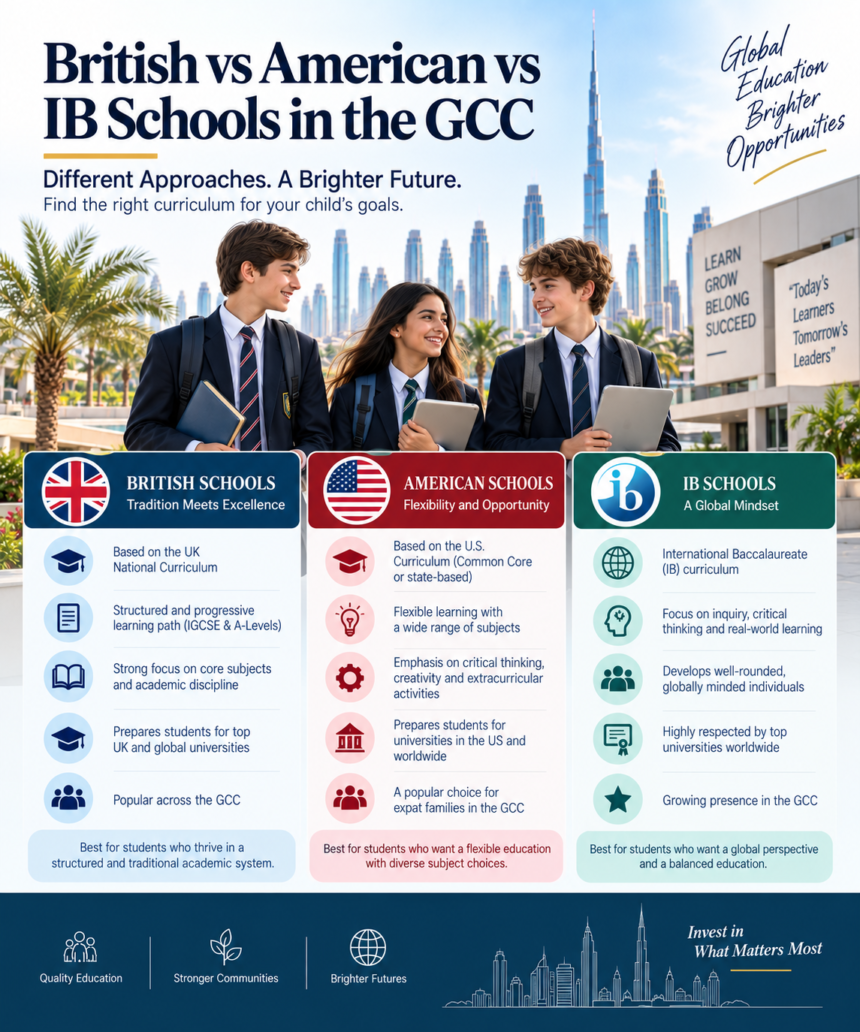
British vs American vs IB Schools in the GCC are among the most popular education choices for expatriate families living in the UAE, Saudi Arabia, Qatar, Kuwait, Bahrain and Oman. Each curriculum offers a different approach to teaching, assessment, subject selection and university preparation, making the decision especially important for families planning their children’s long-term education in the Gulf.
- British, American and IB Education in the Gulf
- Quick Comparison of British, American and IB Schools
- 1. Curriculum Structure and Academic Pathways
- 2. Teaching and Learning Styles
- 3. Exams, Assessment and Grading
- 4. Subject Choice and Academic Specialisation
- 5. University Preparation and Global Recognition
- 6. Academic Workload and Student Pressure
- 7. Curriculum Transferability for Expat Families
- 8. GCC National Subjects and Local Requirements
- 9. School Quality, Accreditation and Authorisation
- 10. School Fees, Admissions and Availability
- British Curriculum Schools in the GCC
- American Curriculum Schools in the GCC
- International Baccalaureate Schools in the GCC
- Curriculum Choices for Different Types of Students
- Curriculum Decisions for Primary School Children
- Curriculum Decisions for Secondary School Students
- Switching Between British, American and IB Schools
- University Planning Before Choosing a Curriculum
- School Choices Across GCC Countries
- Common Mistakes When Comparing Curricula
- Practical Curriculum Comparison Checklist
- Final Thoughts on British vs American vs IB Schools in the GCC
British schools generally follow a structured pathway through Key Stages, GCSEs or IGCSEs and later A Levels. American schools usually provide a broader and more flexible credit-based system leading to a High School Diploma, often supported by Advanced Placement courses. IB schools follow an internationally designed framework focused on inquiry, critical thinking and academic breadth.
Understanding these differences can help parents choose a curriculum that matches their child’s learning style, academic strengths, future university plans and the family’s potential relocation needs.
The differences become particularly important as children grow older.
Choosing one curriculum for a six-year-old may still leave considerable flexibility later. Moving a 16-year-old between completely different education systems can be much more complicated because subjects, credits and examination requirements may no longer align.
The best curriculum is therefore not simply the one with the strongest reputation.
It is the one that matches the child’s academic strengths, learning style, likely university destination and the family’s future relocation plans.
British, American and IB Education in the Gulf
International education has become a major feature of the GCC because of the region’s large expatriate population.
Dubai alone offers private schools across 17 different curricula, according to KHDA, with British, American and IB programmes forming an important part of that choice. KHDA also provides dedicated curriculum guidance for parents comparing UK and US educational pathways.
Similar international programmes operate throughout major Gulf cities such as Abu Dhabi, Riyadh, Jeddah, Doha, Manama, Muscat and Kuwait City.
These schools still operate within the education regulations of the country where they are located.
Saudi Arabia, for example, maintains specific regulations for private and international schools. Oman requires Ministry approval for international educational programmes, and its updated framework specifies local subjects that international schools must include.
This creates an important distinction.
A British school in Dubai is not identical in every respect to a school in London. An American school in Doha is not simply an American public school transferred overseas. An IB school in Riyadh must still operate within Saudi educational requirements.
Parents are therefore choosing both an international curriculum and a Gulf school implementing that curriculum.
Quick Comparison of British, American and IB Schools
| Feature | British | American | IB |
|---|---|---|---|
| General structure | Key Stages and subject qualifications | Grade levels and credits | PYP, MYP, DP and CP |
| Senior qualification | GCSE/IGCSE followed by A Levels or alternatives | High School Diploma, often with AP options | IB Diploma |
| Learning style | Structured and subject-focused | Broad and flexible | Inquiry-based and interdisciplinary |
| Assessment | Increasingly exam-focused in later years | Coursework, tests, GPA and optional external exams | Internal and external assessment |
| Senior specialisation | High | Moderate to high | Broad curriculum maintained |
| Flexibility | Moderate | High | Moderate |
| Best known for | Academic depth and specialisation | Breadth and course flexibility | International approach and academic breadth |
| University pathways | Strong globally | Strong, especially US pathways | Strong international recognition |
| Transfer within same system | Usually straightforward | Can vary by school and credit system | Strong between authorised IB programmes, subject availability permitting |
| Typical senior workload | Concentrated around selected subjects | Spread across multiple courses | Broad and academically demanding |
These are general characteristics rather than guarantees.
Two schools following the same curriculum can differ considerably in teaching quality, subject availability, assessment policy and student support.
1. Curriculum Structure and Academic Pathways
The first major difference is the way each system organises education.
British education generally follows the National Curriculum for England or an international version based closely on it.
The English national curriculum establishes subjects and standards across primary and secondary education. British international schools typically organise students through Key Stages, with senior pupils eventually preparing for qualifications such as GCSEs or International GCSEs followed by A Levels or another sixth-form pathway.
The system becomes increasingly specialised as students get older.
American education is less nationally uniform.
The United States does not have one single national school curriculum equivalent to England’s National Curriculum. Standards, graduation requirements and diploma structures can vary between states and educational systems. US government education data confirms that states can define different credit and graduation requirements.
American international schools in the GCC therefore need to be examined individually.
One may follow Common Core-aligned standards, another may use particular state standards, and schools can offer different Advanced Placement courses and graduation-credit requirements.
The International Baccalaureate provides a different structure.
IB offers four programmes covering ages three to nineteen: the Primary Years Programme, Middle Years Programme, Diploma Programme and Career-related Programme. Schools must be authorised by the IB to offer its programmes.
This gives IB a more explicitly international structure from the beginning.
2. Teaching and Learning Styles
The three systems can also feel different inside the classroom.
British education often combines teacher-led instruction with independent work, practical activities and discussion. As students move towards GCSE and A Level courses, individual subjects become increasingly defined by examination specifications.
This can suit students who appreciate clear content expectations and structured academic progression.
American schools are often associated with a broader educational experience.
Students may be assessed through projects, class participation, homework, quizzes, presentations and tests throughout the year. Because the high-school diploma can depend on earning credits across several areas, students normally continue studying a broad group of subjects.
IB education places especially strong emphasis on inquiry and connections between areas of knowledge.
The IB describes its programmes as encouraging students to think critically, ask questions and think across disciplines. The MYP specifically encourages students to connect classroom learning with the real world.
None of these teaching styles is automatically superior.
A highly independent student may enjoy IB inquiry. A child who performs well with clear academic structure may prefer British education. Another student may benefit from the variety and continuous assessment offered by a strong American programme.
3. Exams, Assessment and Grading
Assessment is one of the biggest practical differences.
British students face increasingly significant external examinations as they progress through secondary education.
GCSEs or International GCSEs usually become major qualifications around the end of Year 11. Students continuing into A Levels then specialise further, with external examination performance playing an important role.
The UK government maintains defined subject content for AS and A Level qualifications.
American schools generally rely more heavily on continuous academic performance.
Students can receive grades throughout high school, which contribute to their Grade Point Average or another school-defined academic record. Graduation depends on completing the required courses and credits.
Some students additionally take Advanced Placement courses and exams.
College Board describes AP as allowing high-school students to undertake college-level work. AP exams are scored from 1 to 5, and many US universities may offer credit or advanced placement for qualifying results, although individual university policies differ.
IB combines internal and external forms of assessment.
In the Diploma Programme, students study six subjects plus the IB core. Subjects receive grades from 1 to 7, with additional potential points from Theory of Knowledge and the Extended Essay. A maximum Diploma score is 45, and candidates must meet detailed passing requirements.
Students who strongly dislike high-stakes final exams should therefore examine assessment patterns carefully rather than choosing only by curriculum reputation.
4. Subject Choice and Academic Specialisation
British education allows significant specialisation in the senior years.
A student may study a reasonably broad set of GCSE subjects before narrowing their focus substantially for A Levels.
This can be advantageous for teenagers who already know their strongest academic areas.
A future engineering student, for example, may concentrate heavily on mathematics and sciences.
The potential disadvantage is that students give up some subjects relatively early.
American high schools generally maintain greater breadth because students continue accumulating credits across several subject areas. Electives may allow them to explore areas including technology, business, art, psychology, media or additional sciences.
AP subjects can add greater depth for stronger students. College Board currently lists dozens of AP course and exam options across the arts, English, history, mathematics, sciences, languages and other areas.
IB sits somewhere between breadth and specialisation.
Diploma students take six subjects across major academic groups while selecting some at Higher Level and others at Standard Level. They must normally take at least three and no more than four subjects at Higher Level.
This prevents very narrow specialisation.
For some students that breadth is one of IB’s greatest strengths. For others it is one of its biggest challenges.
5. University Preparation and Global Recognition
All three pathways can lead to universities internationally.
The important issue is not simply whether a qualification is recognised but whether the student has taken the subjects required for the degree they want to study.
British A Levels provide a straightforward pathway for many UK universities because students apply with specialised subject combinations.
American high-school applicants may be evaluated using transcripts, course rigour, GPA, AP results and other requirements depending on the institution and country.
AP can strengthen an American academic programme, and some universities award credit or advanced placement for qualifying AP scores.
The IB Diploma is designed as an international university-preparation programme and is widely recognised by universities. IB recommends that families nevertheless check individual university requirements when selecting Diploma subjects.
This point matters especially for medicine, engineering, architecture and other courses with strict subject prerequisites.
A student can complete an excellent curriculum but still discover that their particular subject combination does not meet the requirements of a chosen university.
University planning should therefore begin before senior subject selection.
6. Academic Workload and Student Pressure
Every curriculum can be demanding at a strong school.
The pressure simply appears in different forms.
British students may feel more pressure around major examination periods because GCSE and A Level results carry substantial importance.
American students may experience more continuous pressure to maintain grades throughout each semester because coursework and assessments build the transcript over several years.
IB Diploma students face a particularly broad workload.
The programme requires six subjects together with Theory of Knowledge, Creativity, Activity, Service and an Extended Essay. The IB describes the Extended Essay as a substantial independent research project, while TOK requires students to examine how knowledge is constructed.
The IB Diploma can therefore suit organised students who can balance several deadlines simultaneously.
A teenager who performs brilliantly in three subjects but struggles considerably with others might find A Level specialisation more comfortable.
7. Curriculum Transferability for Expat Families
International mobility is a major consideration for Gulf families.
A parent may begin a job in Dubai and later transfer to Saudi Arabia, Qatar or another country.
Staying within the same curriculum can reduce disruption, but the transfer is never completely automatic.
Moving from one British school to another can be relatively straightforward in earlier years, although examination boards and GCSE or A Level subject choices need checking for older students.
American school transfers require close attention to credits.
Because graduation requirements can differ between schools and systems, parents of high-school students should request a complete transcript review before accepting a place.
IB provides a standard international framework, which can be useful for mobile families, but schools do not necessarily offer identical subjects.
A student studying a particular Higher Level subject at one IB school may discover that the receiving school does not offer it.
For this reason, curriculum mobility becomes increasingly important from around age 14 onwards.
8. GCC National Subjects and Local Requirements
International schools in the Gulf cannot operate as though they were physically located in London, New York or Geneva.
Local education requirements still apply.
These may include Arabic language, Islamic education, social studies, national identity or citizenship-related subjects depending on the country and student’s nationality or religion.
Oman’s Ministry of Education provides a clear example. Its framework for international programmes requires private schools to incorporate specified national subjects, including Arabic language, Islamic education and identity or social-studies requirements, alongside the international curriculum.
Saudi Arabia also regulates private and international schools through Ministry of Education rules.
Parents should therefore compare the entire weekly timetable.
A school may advertise itself as British, American or IB, but children will often study additional locally required subjects alongside that programme.
9. School Quality, Accreditation and Authorisation
Curriculum is not the same thing as quality.
A good British school and a weak British school still belong to the same broad curriculum family.
The same applies to American schools.
Families should therefore look at regulatory inspections, recognised accreditation, teacher quality, leadership, student outcomes and university guidance.
For American schools, accreditation deserves particular attention because the underlying educational model is more decentralised.
Ask which organisation accredits the school and whether that accreditation is appropriate for the qualification being offered.
IB is different because schools must receive formal IB authorisation before describing themselves as an IB World School offering a particular programme.
A school may be an IB candidate during the authorisation process, which is not the same status as an authorised IB World School.
Parents should confirm the exact status of the programme their child will enter.
10. School Fees, Admissions and Availability
Curriculum does not determine fees by itself.
A premium British school may cost much more than another British school in the same city. The same applies to American and IB schools.
Costs depend on factors such as campus facilities, school reputation, location, year group, staffing and extracurricular provision.
Families should compare the full annual cost, including tuition, transport, uniforms, devices, examinations and activities.
Admissions also vary by school.
Some schools conduct academic assessments or interviews. Others have waiting lists for particular year groups.
Moving a senior student may be especially difficult because the school must determine whether the student’s previous courses fit its qualification requirements.
Curriculum availability also differs across GCC cities.
Dubai has an especially diverse private-school market, with KHDA listing 17 curricula.
Smaller cities may offer fewer options, making future relocation an important consideration for families expecting regular international moves.
British Curriculum Schools in the GCC
British schools can be particularly attractive to families who value structured academic progression and expect their children to study in the UK or another university system familiar with GCSEs and A Levels.
The biggest advantage becomes clearer in the senior years.
A student with strong academic interests can eventually focus on a relatively small group of subjects at considerable depth.
The system also has a well-established examination framework.
Families should note, however, that England is currently developing a revised national curriculum. The UK government says the final version is expected in spring 2027, with schools in England beginning to teach it from September 2028.
International British schools will determine how relevant changes are implemented within their own regulated programmes, so parents should follow information from the individual school rather than assuming every Gulf school will change at exactly the same moment.
American Curriculum Schools in the GCC
American education can appeal strongly to families seeking flexibility.
Students often retain a broad academic programme for longer and can use electives to explore different interests.
This can be particularly useful for teenagers who are not yet certain whether they want to pursue science, business, humanities or creative subjects.
The main challenge for parents is variation.
“American curriculum” is a broad description rather than one universally identical programme.
Parents should ask which standards the school follows, how many credits are required for graduation, which external assessments are used and how many AP courses are genuinely available.
Do not assume an American school offers a strong AP programme simply because AP appears in its brochure.
Check the actual subjects available to students in Grades 11 and 12.
International Baccalaureate Schools in the GCC
IB is often attractive to internationally mobile families because the educational framework itself is international.
The PYP covers ages 3–12, the MYP generally serves ages 11–16 and the Diploma Programme covers ages 16–19.
Its educational philosophy places considerable emphasis on inquiry, independent thinking and international awareness.
At Diploma level, the programme becomes highly structured.
Students study six subjects alongside TOK, CAS and the Extended Essay. Higher Level and Standard Level courses allow some specialisation while retaining breadth.
IB can be an excellent option for capable, organised students who enjoy research and discussion.
It should not, however, be chosen simply because the word “international” sounds more prestigious.
The Diploma workload deserves serious consideration.
Curriculum Choices for Different Types of Students
The strongest choice often becomes clearer when parents stop comparing systems abstractly and think about the child.
| Student profile | Curriculum worth considering |
|---|---|
| Strong in a few clear academic subjects | British |
| Wants broad subject choice for longer | American |
| Enjoys research and interdisciplinary learning | IB |
| Likely to attend a UK university | British, IB or strong American programme |
| Likely to attend a US university | American, IB or British |
| Internationally mobile family | IB, British or consistent American network |
| Strong independent learner | IB |
| Prefers continuous assessment | American may feel more natural |
| Comfortable with major external examinations | British |
| Unsure about future specialisation | American or IB |
These are starting points rather than rules.
Excellent universities accept students from all three systems.
Curriculum Decisions for Primary School Children
For younger children, the quality of the school can matter more than the curriculum label.
At primary level, parents should focus heavily on teaching quality, reading, mathematics, classroom environment, language development, wellbeing and teacher communication.
A warm and well-run American primary school may be better for a particular child than a poorly managed British school, even if the family originally preferred British education.
Curriculum becomes more consequential as students approach secondary qualifications.
Families expecting several international moves should nevertheless think ahead so that children are not repeatedly changing educational structures.
Curriculum Decisions for Secondary School Students
For teenagers, curriculum choice requires much greater care.
By secondary school, academic systems begin shaping university pathways.
British students start choosing GCSE subjects and later A Levels.
American students build transcripts and graduation credits, potentially adding AP subjects.
IB students eventually need to select Standard and Higher Level Diploma subjects.
A curriculum transfer at this stage can create lost credits, repeated content or missing prerequisites.
Parents moving with teenagers should therefore send transcripts and current subject details to the receiving school before making the final decision.
Switching Between British, American and IB Schools
Changing curriculum is possible, but timing matters.
Switching at age eight is generally easier than switching at age seventeen.
Students moving from British to American education may need their previous work converted into the receiving school’s credit system.
Students moving from American to British education may need to enter an examination programme with defined subject content that their previous school did not follow.
Moving into the IB Diploma after following another curriculum can work very well, but the student must be academically prepared for the relevant Higher Level subjects.
The safest approach is to make major curriculum changes before the final years of secondary education whenever circumstances allow.
University Planning Before Choosing a Curriculum
Parents sometimes ask which curriculum universities prefer.
The better question is whether the student is taking the right subjects at the right level.
A future medical student may need particular combinations of biology and chemistry.
An engineering applicant may require advanced mathematics and physics.
Architecture, economics and computer science can each have different requirements.
IB itself advises students to check university admission requirements when choosing Diploma subjects.
The same principle applies to A Levels and American high-school programmes.
Do not wait until the university application year to discover that a required subject is missing.
School Choices Across GCC Countries
British, American and IB options are available across the GCC, but the scale of choice varies.
The UAE, particularly Dubai and Abu Dhabi, has one of the region’s most diverse international education markets.
Saudi Arabia has a growing private and international education sector regulated by the Ministry of Education.
Qatar’s private education system includes international schools alongside its national system, with private education overseen by the Ministry of Education and Higher Education.
Oman formally regulates international programmes and requires Ministry approval before schools introduce them.
Families in Bahrain and Kuwait also have access to established international-school communities.
Wherever the family lives, parents should verify current licensing and curriculum status through the relevant education authority rather than relying solely on the school’s marketing material.
Common Mistakes When Comparing Curricula
One of the biggest mistakes is assuming that one curriculum is universally harder or better.
Another is choosing according to university reputation without considering the child’s learning style.
Parents can also focus too heavily on school facilities while ignoring subject options, accreditation and teacher quality.
For older students, failing to examine university prerequisites is particularly risky.
Another common problem is looking only at the curriculum name.
Two American schools may have very different graduation programmes. Two British schools may offer different GCSE and A Level subjects. Two IB schools may provide different Higher Level options.
Compare the actual school programme, not just the label.
Practical Curriculum Comparison Checklist
Before choosing between British, American and IB schools, compare curriculum structure, assessment style, senior qualifications, subject availability, university preparation, school accreditation, local inspection performance, learning support, total fees, location and the child’s preferred learning style.
For secondary students, also check examination boards or graduation-credit requirements, AP availability, IB Higher Level subjects and university prerequisites.
Families expecting another international move should ask how easily the child’s current academic record can transfer to the next likely destination.
The final decision should balance academic ambition with wellbeing and practical family life.
Final Thoughts on British vs American vs IB Schools in the GCC
The debate around British vs American vs IB schools in the GCC does not produce one universal winner.
British education offers a clear and structured academic pathway with increasing specialisation through GCSEs and A Levels.
American education generally provides greater flexibility and allows students to maintain broader subject choices while building a high-school transcript, with AP offering additional academic challenge at many schools.
IB provides a distinctly international framework built around inquiry, breadth and independent learning, culminating in a demanding Diploma Programme combining six subjects with TOK, CAS and independent research.
For younger children, school quality, teaching and wellbeing may matter more than the curriculum name.
For teenagers, subject combinations, qualifications and university plans become increasingly important.
The best decision comes from looking beyond labels.
Examine the actual school’s curriculum. Check its accreditation or IB authorisation. Review the subjects offered in the final years. Understand the assessment system. Calculate the total cost. Consider the commute and think realistically about where the family may live three or five years from now.
Most importantly, consider the student.
A curriculum should challenge a child without placing them in an educational environment that works against the way they learn.
British, American and IB schools can all provide excellent international education in the Gulf.
The right one is the system that gives your child the strongest combination of academic progress, confidence, future opportunity and continuity.
Do follow us on Instagram
Read More – 12 Essential Things to Know About Schools in the Gulf: Complete 2026 Guide