


Public and Private Schools in the GCC
Moving to the Gulf with children creates one decision that can influence almost every other part of family life: choosing a school.
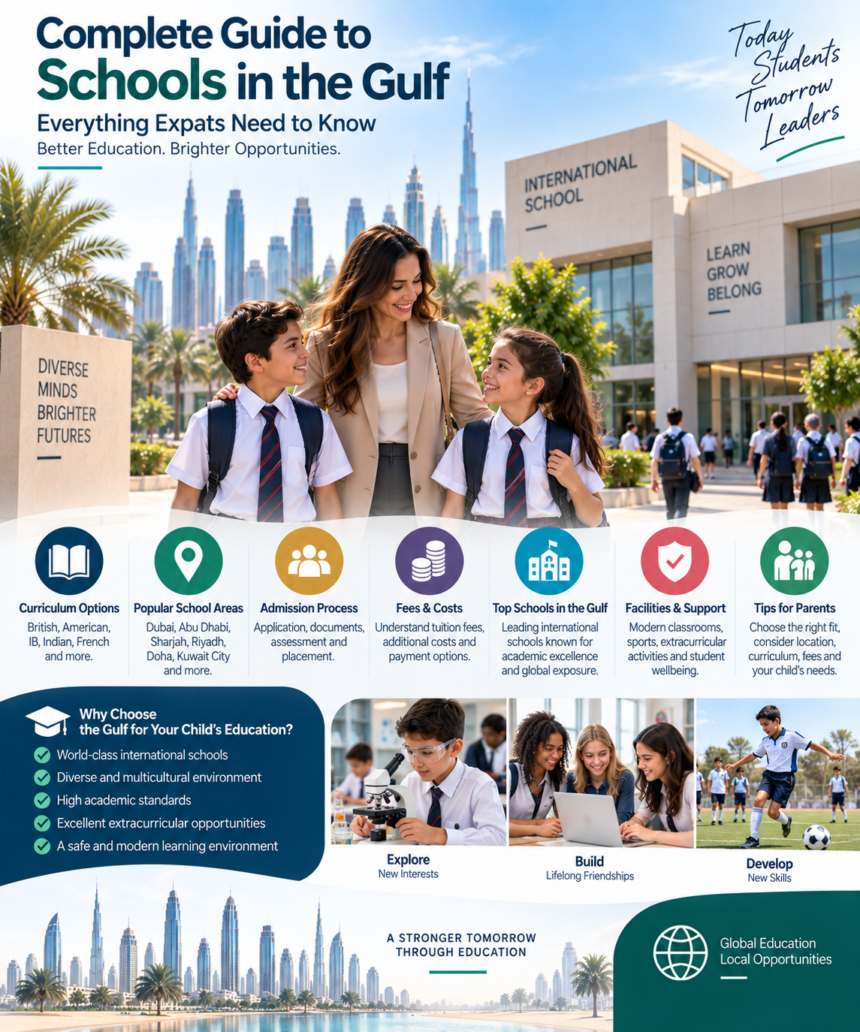
- Education Systems Across the Gulf
- Public and Private Schools in the GCC
- 1. British Curriculum Schools
- 2. American Curriculum Schools
- 3. International Baccalaureate Schools
- 4. Indian Curriculum Schools
- 5. Other International and National Curricula
- 6. School Fees and Additional Education Costs
- 7. School Admissions and Registration
- 8. School Ratings, Inspections and Quality Standards
- 9. Special Educational Needs and Inclusive Education
- 10. School Transport and Daily Commutes
- 11. Academic Calendars and School Holidays
- 12. Extracurricular Activities and Student Wellbeing
- Schools in the UAE
- Schools in Saudi Arabia
- Schools in Qatar
- Schools in Bahrain
- Schools in Oman
- Schools in Kuwait
- Choosing a School Based on the Child
- School Location and Family Housing Decisions
- Preparing Documents for School Admission
- Changing Schools Between GCC Countries
- Budgeting for Education in the Gulf
- Common Mistakes When Choosing a Gulf School
- Practical School Comparison Checklist
- Final Thoughts on Schools in the Gulf
The UAE, Saudi Arabia, Qatar, Kuwait, Bahrain and Oman have large and diverse education sectors. Alongside government schools, families can find British, American, International Baccalaureate, Indian and other international education systems, particularly in the main expatriate centres.
For parents arriving from overseas, this variety is an advantage. It can allow children to continue a curriculum similar to the one they studied at home or choose an internationally recognised qualification that may make future relocation easier.
It also makes the decision considerably more complicated.
School fees can differ dramatically. Academic calendars may not be the same. Admission ages vary between systems. Some schools are highly selective, while others have broader admissions policies. The school closest to a parent’s workplace may not offer the curriculum the family wants, and a highly rated school may require a difficult daily commute.
A useful complete guide to schools in the Gulf therefore needs to look beyond school names.
Families should consider curriculum, academic quality, fees, location, teacher continuity, inclusion, university pathways, extracurricular opportunities and the child’s personality before making a final decision.
Education Systems Across the Gulf
All six GCC countries maintain national education systems alongside private education.
Private and international schools play an especially important role for expatriate communities because they can provide qualifications that are familiar to families from other countries.
The scale is particularly visible in Dubai. KHDA’s school directory listed 232 private schools in 2026, allowing parents to filter schools by factors such as curriculum, location, fees and inspection performance.
Other GCC countries have also developed formal frameworks around private education. Saudi Arabia has regulations specifically covering private and international schools, while Qatar licenses private schools under its education legislation. Bahrain’s Ministry of Education regulates and monitors private schools, and Oman formally distinguishes between monolingual, bilingual and international private schools.
This means an international curriculum does not place a school outside local regulation. Private schools still need to comply with national requirements relating to licensing, safety, education and other locally mandated subjects.
Public and Private Schools in the GCC
Government schools are a major part of education throughout the Gulf, but access for expatriate children varies by country and family status.
Some GCC countries permit specific groups of foreign residents to access government education under defined conditions. Qatar, for example, lists categories eligible for public-school registration, including GCC citizens and children of certain residents employed in approved sectors.
For many expatriate families, however, private or international education becomes the main option.
Private schools can range from comparatively affordable community schools to premium institutions with extensive sports facilities, advanced science laboratories and very high annual tuition.
Parents should therefore separate three questions:
Which curriculum suits my child?
Which schools deliver that curriculum well?
Which of those schools can our family realistically afford and reach every day?
The most expensive school does not automatically provide the best fit for every child.
1. British Curriculum Schools
British education is one of the most widely available international options in major Gulf cities.
Schools generally follow the English National Curriculum or a related British framework, although exact programmes can vary.
Students typically progress through Key Stages before working towards qualifications such as GCSEs or International GCSEs. Older students may continue to A Levels, BTEC programmes or other recognised qualifications depending on the school.
The British system can be particularly useful for families who previously lived in the UK or expect their children to study at universities following British-style admission pathways.
Parents transferring between British schools should still compare subjects carefully.
Two schools may both describe themselves as British but offer different GCSE subjects, sixth-form pathways, languages and extracurricular opportunities.
Dubai’s official school directory, for example, identifies numerous UK-curriculum institutions alongside American, IB, Indian, French and other options.
2. American Curriculum Schools
American schools provide another major international option in the Gulf.
These schools generally organise education into elementary, middle and high school, with students working towards a US-style high school diploma.
However, the label “American curriculum” alone does not tell parents everything.
Schools may follow different state standards or educational frameworks. High-school students may have access to Advanced Placement courses, the International Baccalaureate or other advanced programmes.
Families considering an American school should examine accreditation, graduation requirements and university preparation.
This becomes particularly important for older students. A child entering Grade 10 or Grade 11 may need specific credits to graduate, so transferring between schools late in secondary education requires much more careful planning than changing schools at primary level.
3. International Baccalaureate Schools
The International Baccalaureate has developed a strong presence in Gulf international education.
Depending on authorisation, a school may offer one or several IB programmes, including the Primary Years Programme, Middle Years Programme and Diploma Programme.
The IB is often attractive to internationally mobile families because it is designed as an international education framework rather than belonging to one national school system.
Its teaching style can also appeal to families seeking inquiry, research, independent thinking and interdisciplinary learning.
The Diploma Programme can be academically demanding, however.
Parents should not choose IB simply because it has a strong international reputation. The child’s learning style, academic strengths and future university plans should also be considered.
Some schools combine curricula. Dubai’s official directory, for example, includes schools offering American education alongside IB programmes.
4. Indian Curriculum Schools
Indian schools are an important part of Gulf education because of the region’s large South Asian expatriate population.
CBSE and other Indian educational pathways are available across several GCC countries.
These schools can be particularly useful for families expecting their children eventually to return to India because curriculum continuity can make transitions easier.
Parents should compare academic results, subject choices, class sizes, extracurricular programmes and preparation for major board examinations.
Academic calendars may also differ from many Western international schools.
KHDA notes that Dubai schools generally operate from September to June, while Indian, Pakistani and Japanese curriculum schools follow an April-to-March academic year.
This becomes important when families transfer between curricula because a move made at the wrong time can place a child between two different academic cycles.
5. Other International and National Curricula
Gulf families are not limited to British, American, IB and Indian schools.
Depending on the city, parents may find schools offering French, German, Canadian, Filipino, Pakistani and other national education systems.
Qatar’s official private-school search tool, for example, includes curriculum categories ranging from British, American and IB to Indian, French, German, Canadian, Finnish, Filipino and several other national programmes.
Oman also distinguishes formally between international schools and bilingual or monolingual private schools. The Ministry of Education issued updated rules for international educational programmes in private schools for the 2025–26 academic year, including curriculum requirements.
This diversity gives internationally mobile families flexibility, but curriculum continuity matters.
A move from one curriculum to another is usually easier for a young child than for someone approaching major secondary-school examinations.
6. School Fees and Additional Education Costs
Tuition is often one of the largest household expenses for expatriate families.
Fees vary enormously according to country, curriculum, school reputation, year group and facilities.
The annual tuition figure is also not necessarily the full education cost.
Families may additionally pay for transport, uniforms, books, devices, meals, examinations, extracurricular activities, school trips and learning support.
Dubai provides a useful example of fee transparency. KHDA requires each private school to provide a School Fees Fact Sheet showing mandatory and optional charges. These fact sheets are accessible through the official school directory.
Individual 2026–27 KHDA fact sheets demonstrate why families need to examine the details. Charges for items such as transportation, uniforms, extracurricular activities and support services can sit outside headline tuition or appear as separate mandatory or optional expenses.
Dubai also froze private-school tuition increases for the 2026–27 academic year.
That decision applies specifically to Dubai and should not be interpreted as a GCC-wide fee policy.
Parents should build an annual education budget around the total cost of attendance, not tuition alone.
7. School Admissions and Registration
Admissions processes vary substantially.
Some schools accept applications throughout the year when places are available. Others have waiting lists or defined application periods.
Parents may encounter academic assessments, language tests, interviews or reviews of previous school reports.
Saudi Arabia introduced an important change in 2026 by adopting the Madares platform as the official channel for enrolling students in private schools listed on the platform, giving parents a digital route for exploring options and managing enrolment.
Qatar also provides electronic registration processes for private schools. Its official guidance states that parents can review information such as curriculum, school fees and location before submitting an application, while individual private schools may interview or assess students according to their policies.
Families relocating internationally should begin school research before arriving whenever possible.
Places in popular year groups can be limited, particularly at well-established schools.
8. School Ratings, Inspections and Quality Standards
A polished campus does not necessarily tell parents how effectively students are learning.
Independent regulatory information can therefore be valuable.
Dubai’s KHDA directory publishes school ratings and information covering areas such as overall performance, wellbeing and inclusion.
Abu Dhabi’s Department of Education and Knowledge oversees private schools and maintains policies covering quality assurance, inclusion, safeguarding, student wellbeing, transport and other areas.
Bahrain has another useful model. Its Education and Training Quality Authority publishes school review reports that allow parents to examine current performance judgments. Bahrain’s 2025 annual report recorded 66 private schools and showed that the latest private-school review cycle was expected to be completed by the end of 2026.
Inspection ratings should be treated as important evidence, but not the only deciding factor.
A school rated highly overall may still not be the right environment for a particular child.
9. Special Educational Needs and Inclusive Education
Families of children who need additional educational support should investigate provision early.
Do not rely only on a statement that a school is “inclusive.”
Ask how support actually works.
Consider specialist teachers, learning-support teams, individual education plans, classroom assistance, speech and language services and communication with parents.
Abu Dhabi’s current school policy framework includes dedicated requirements for inclusion and in-school specialist services, as well as policies addressing educational risk and student mental health.
Costs also need attention.
Some forms of additional learning support can carry separate charges depending on the school and service. Dubai school fee fact sheets can identify charges relating to learning-support assistants and special-needs support where applicable.
Parents should request a realistic explanation of both support and cost before paying an enrolment deposit.
10. School Transport and Daily Commutes
The location of a school can change the entire family’s routine.
A school that looks 15 kilometres away on a map may involve a long journey during morning traffic.
This is particularly important in large metropolitan areas such as Dubai, Riyadh and Doha.
Parents should estimate door-to-door travel at the actual time children will travel rather than relying on off-peak map estimates.
School bus services can reduce the burden, but journey times still matter. Young children spending long periods on buses every morning and afternoon can become tired even if the school itself is excellent.
Transport is also a regulated area in parts of the GCC. Abu Dhabi’s school policies, for example, establish requirements concerning safe and efficient school bus services.
When comparing schools, consider education quality and commute together rather than as separate issues.
11. Academic Calendars and School Holidays
School calendars across the Gulf can differ according to country and curriculum.
Families should check:
| Calendar issue | Why it matters |
|---|---|
| Academic-year start | Important when relocating |
| Term dates | Affects travel planning |
| Examination periods | Important for older students |
| Ramadan schedules | School hours may be adjusted |
| National holidays | Differ between GCC countries |
| Curriculum calendar | Indian and Western systems may differ |
| Transfer timing | Can affect grade placement |
Dubai provides a clear example of curriculum differences, with most schools running September to June while several Asian curriculum schools operate April to March.
Parents moving between Gulf countries should obtain the child’s complete academic record and confirm grade placement before finalising relocation dates.
12. Extracurricular Activities and Student Wellbeing
Education extends beyond examination results.
Sports, music, art, theatre, debating, robotics, coding, community service and student leadership can play a major role in children’s development.
Facilities can therefore matter, but parents should look at how they are actually used.
A school may advertise swimming pools and sports fields, but families should ask how frequently students have access to them and whether extracurricular programmes are included in fees.
Wellbeing is equally important.
Abu Dhabi’s regulatory framework now contains dedicated policies covering student mental health, safeguarding, wellbeing, physical education and extracurricular activities.
When visiting a school, observe how students interact with teachers and one another.
A supportive culture may be harder to measure than examination scores, but it can significantly affect a child’s experience.
Schools in the UAE
The UAE has one of the Gulf’s largest international-school markets, particularly in Dubai and Abu Dhabi.
Dubai parents benefit from an extensive KHDA directory containing curriculum, location, fee and inspection information for private schools.
Abu Dhabi private education is overseen by ADEK, which regulates areas ranging from licensing and fees to safeguarding, inclusion and school quality.
Families moving to other emirates should check the relevant education authority because procedures can differ.
The main advantage of the UAE is choice. The challenge is narrowing that choice into a realistic shortlist based on location and budget.
Schools in Saudi Arabia
Saudi Arabia has both national private schools and international schools operating under Ministry of Education regulation.
The Ministry’s current framework aims to regulate private and international education while encouraging quality and private-sector participation. It also maintains provisions relating to tuition fees.
The launch of Madares as the official private-school enrolment platform in 2026 is particularly relevant for parents because it centralises more of the application process.
International-school choice is greatest in major employment centres such as Riyadh, Jeddah and the Eastern Province.
Families should pay particular attention to location because city size and traffic can make school commuting a significant consideration.
Schools in Qatar
Qatar has a diverse private education sector centred largely around Doha.
Its official private-school directory allows families to search by curriculum, education level, school type and region, demonstrating the wide range of international programmes available.
Private-school licensing is regulated by the Ministry of Education and Higher Education.
Admissions procedures should be checked early. Qatar’s electronic private-school process allows schools to interview or assess students according to their individual policies.
Families considering public education should also verify eligibility because admission is limited to specified categories.
Schools in Bahrain
Bahrain’s relatively compact geography can make school commuting more manageable than in some larger Gulf cities, although traffic and residential location still matter.
The Ministry of Education’s private education division oversees licensing and monitors quality, safety and accountability. It also provides an official educational institution finder covering public and private schools.
Parents also have access to BQA school review reports, giving them an independent source of school-performance information.
This makes it useful to combine a school visit with both Ministry information and the latest quality review rather than relying only on marketing material.
Schools in Oman
Oman’s private education sector includes monolingual, bilingual and international schools.
The Ministry of Education defines international schools as institutions offering recognised international programmes and qualifications under the appropriate supervision and regulation.
In 2025, Oman introduced updated regulations for international educational programmes in private schools for the 2025–26 academic year, including curriculum requirements for younger grades.
Muscat naturally offers the broadest range of international choices, while families living elsewhere should pay closer attention to local availability and transport.
Schools in Kuwait
Kuwait has a long-established private and international education market serving expatriate communities from many countries.
Families can find schools following different national and international curricula, but school availability and admission policies can vary by year group.
Parents should verify current licensing, registration procedures, tuition and curriculum directly with the school and Kuwait’s Ministry of Education rather than relying on old online fee lists.
For 2026–27, Kuwait’s Ministry of Education is also introducing a dedicated gifted-school model within the government system, beginning at middle-school level before planned future expansion.
Choosing a School Based on the Child
The best school is not always the one with the highest inspection result.
Consider the individual child.
A highly academic student may thrive in a demanding school with strong examination outcomes. Another child may perform better in an environment with smaller classes, stronger pastoral support or more opportunities in sport and creative subjects.
Age matters as well.
For a five-year-old, proximity, teacher warmth and classroom environment may matter more than university placement statistics.
For a 16-year-old, subject availability and recognised qualifications become critical.
Parents should therefore evaluate the school their child will actually attend rather than the school they believe sounds most impressive.
School Location and Family Housing Decisions
Families relocating to the Gulf often choose a home first and a school second.
Reversing that order can sometimes produce a better result.
Once a shortlist of realistic schools has been created, families can examine residential communities that provide manageable journeys to both school and work.
This is particularly useful when several children attend the same school.
A cheaper home with a long school commute may create higher fuel, transport and time costs than expected.
Housing and education should therefore be planned together.
Preparing Documents for School Admission
International school applications often require previous academic records and identification documents.
Exact requirements differ, but families relocating between countries should keep original and digital copies of report cards, transfer certificates, passport information, birth documents, vaccination information and any specialist educational assessments.
Documents may need official attestation depending on the country and situation.
Families should contact the receiving school before relocation and request the complete current admission-document list.
Older students should also obtain detailed transcripts showing subjects and grades because these may affect course placement.
Changing Schools Between GCC Countries
Moving from Dubai to Riyadh or Doha may sound like a regional transfer, but it is still an international school move.
Even when both schools use the same broad curriculum, grade structure and subject sequencing can differ.
Before transferring, parents should compare the exact programme.
For secondary students, check examination boards, subject choices and graduation credits.
For younger children, ask how the receiving school determines year-group placement.
Whenever possible, avoid major curriculum changes immediately before important examinations.
Budgeting for Education in the Gulf
Families should calculate schooling as a multi-year expense rather than looking only at the first year’s tuition.
Fees often increase as children progress into higher grades.
Additional expenses may include transport, laptops, uniforms, examinations, trips and extracurricular programmes.
Parents receiving an employer education allowance should understand exactly what it covers.
Some allowances cover tuition only. Others may have annual caps, eligible-school restrictions or documentation requirements.
A strong family budget should therefore compare the employer contribution against the total school cost.
Common Mistakes When Choosing a Gulf School
One common mistake is selecting by reputation alone.
Another is ignoring travel time.
Parents can also underestimate additional fees, choose a curriculum without considering future relocation, or pay a deposit before understanding learning-support requirements.
Waiting too long to apply can create another problem if preferred schools have no places available.
Families should also avoid choosing purely according to facilities. A spectacular campus cannot compensate for poor teaching, weak communication or an environment that does not suit the child.
Practical School Comparison Checklist
| Factor | What to compare |
|---|---|
| Curriculum | British, American, IB, Indian or another system |
| Regulation | Licensed and officially recognised |
| Inspection | Latest available quality report |
| Tuition | Annual fee by year group |
| Extra costs | Transport, uniforms, devices and activities |
| Admissions | Tests, interviews and waiting lists |
| Location | Real peak-hour journey |
| Class environment | Size, teaching style and student support |
| Inclusion | Support for individual learning needs |
| Secondary pathways | Qualifications and subject options |
| University preparation | Guidance and recognised credentials |
| Activities | Sport, arts, clubs and leadership |
| Wellbeing | Safeguarding and pastoral care |
| Parent communication | Reports, meetings and school systems |
A family does not necessarily need the school that scores highest in every category.
It needs the school with the strongest overall fit.
Final Thoughts on Schools in the Gulf
Schools in the Gulf provide families with a level of international education choice that is difficult to find in many other regions.
Across the UAE, Saudi Arabia, Qatar, Kuwait, Bahrain and Oman, parents can choose from national education systems and a broad range of international curricula.
That variety makes it possible to build an educational path around a child’s future plans, but it also means families need to research carefully.
Begin with curriculum.
Then examine independent quality information where available.
Calculate the full cost rather than tuition alone. Visit the campus. Understand learning support. Test the commute during school hours. Review the secondary qualifications if the child is older, and ask how easily those qualifications will transfer if the family eventually leaves the Gulf.
Most importantly, choose for the child rather than the school’s reputation.
A school may have exceptional facilities and impressive results, yet another institution may offer the teaching environment, support and community in which a particular student is more likely to thrive.
The strongest approach to choosing schools in the Gulf is therefore not searching for one universal “best school.” It is finding the school that balances academic quality, curriculum, affordability, location, wellbeing and long-term continuity for your family.
Do follow us on Instagram
Read More – 12 Essential Health Checkups for Expats Living in the GCC in 2026