


Cities With Best Public Transport in GCC for Easy Travel in 2026
Public transport is changing rapidly across the Gulf.
- Cities With Best Public Transport in GCC Are Changing Urban Life
- 1. Dubai, UAE
- Why Dubai Ranks First
- 2. Doha, Qatar
- Lusail Adds Another Dimension
- 3. Riyadh, Saudi Arabia
- Why Riyadh Could Challenge the Leaders
- 4. Abu Dhabi, UAE
- Abu Dhabi Is Experimenting With Future Mobility
- 5. Jeddah, Saudi Arabia
- 6. Manama, Bahrain
- 7. Muscat, Oman
- Muscat Is Becoming More Digital
- 8. Kuwait City, Kuwait
- 9. Al Ain, UAE
- 10. Salalah, Oman
- Dubai vs Doha Public Transport
- Dubai vs Riyadh Public Transport
- Which GCC City Is Best Without a Car
- Which GCC City Has the Best Metro
- Public Transport Is Becoming Essential for GCC Growth
- What the Future Could Look Like
- Final Ranking of Cities With the Best Public Transport in GCC
For decades, many cities in the GCC were designed around private cars. Wide highways, inexpensive fuel and rapidly expanding suburbs made driving the natural choice for millions of residents.
That picture is changing.
Dubai has built one of the region’s most integrated public transport networks. Doha has developed a modern automated metro and tram system. Riyadh’s Metro has transformed mobility in the Saudi capital, while Abu Dhabi continues expanding buses, smart mobility and environmentally friendly transport.
Other cities across Saudi Arabia, Bahrain, Oman and Kuwait are also investing in buses, digital payments and better connections.
For residents, tourists and professionals planning to relocate, the quality of public transport can significantly influence everyday life.
Here are the Cities With Best Public Transport in GCC in 2026 and what makes each one worth considering.
Cities With Best Public Transport in GCC Are Changing Urban Life
The Gulf Cooperation Council consists of the UAE, Saudi Arabia, Qatar, Kuwait, Bahrain and Oman.
Transport systems across these countries vary significantly.
Some cities already have advanced metro networks.
Others depend mainly on buses.
A few are investing heavily in rail projects that could reshape mobility over the coming years.
When comparing cities, it is important to look beyond whether they simply have a metro.
A strong public transport system should offer several things.
It should connect important residential and commercial areas.
Services should operate frequently.
Fares should remain practical.
Passengers should be able to move easily between different transport modes.
Airport connectivity is also important.
Digital journey planning, payment systems, accessibility and reliability can make an enormous difference.
Using these factors, several GCC cities clearly stand out.
1. Dubai, UAE
Dubai currently provides the strongest overall public transport experience in the GCC.
The biggest advantage is integration.
Passengers can travel using Dubai Metro, Dubai Tram, public buses and marine transport within one wider transport ecosystem.
Dubai Metro forms the backbone of the system.
Its Red and Green lines connect many of the city’s most important residential, commercial and tourist districts.
The Red Line is particularly valuable for visitors because it connects Dubai International Airport with areas including Deira, Downtown Dubai, Business Bay, Mall of the Emirates, Dubai Marina related districts and communities extending toward Expo City.
Dubai Tram strengthens transport around Dubai Marina, Jumeirah Beach Residence, Media City and Al Sufouh.
The city’s public bus network then fills many of the gaps that rail cannot reach.
RTA currently says its bus network covers around 87 percent of Dubai’s urban area.
Marine transportation provides another distinctive option through abras, ferries and other services.
All of this makes Dubai the GCC city where living without a private car is most realistic for people who choose their residential location carefully.
Why Dubai Ranks First
Dubai’s biggest strength is not simply having a metro.
It is the ability to combine different transport modes.
The nol card can be used across Metro, buses, Tram and several marine services.
This reduces the need to purchase separate tickets for every stage of a journey.
The city is divided into fare zones, and transfers between eligible transport modes can be incorporated into a journey when passengers follow the applicable transfer rules.
Digital journey planning makes the network easier for visitors to understand.
Dubai’s ridership also demonstrates how heavily the system is being used.
During the first half of 2026, RTA reported around 348.1 million riders across public transport, shared mobility and taxis, averaging almost 1.9 million riders per day.
For the GCC, Dubai remains the benchmark for integrated urban mobility.
2. Doha, Qatar
Doha deserves a high position because of the quality and simplicity of its rail system.
The Doha Metro provides a modern way to travel around the Qatari capital and surrounding destinations.
The network consists of the Red, Green and Gold lines.
The Red Line is particularly useful because it connects important destinations and provides access toward Hamad International Airport.
Major interchange stations make transferring between lines relatively straightforward.
One of Doha Metro’s strongest advantages is affordability.
Standard travel currently costs QR2 for a single journey, while a standard day pass costs QR6.
That makes the system attractive for residents and tourists.
Doha also benefits from feeder transport connections that help passengers reach locations beyond walking distance from metro stations.
For visitors attending events or exploring central Doha, the combination of Metro and connecting services can reduce the need for taxis significantly.
Lusail Adds Another Dimension
Doha’s transport story extends beyond the Metro.
Lusail Tram provides rail connectivity within the rapidly developing city of Lusail.
Passengers can transfer between Doha Metro and Lusail Tram under the integrated fare structure.
This creates a wider rail based transport environment connecting important parts of Doha and Lusail.
The network is modern, air conditioned and designed around the expectations of a city operating in the Gulf climate.
Qatar’s experience during major international events also demonstrated the value of having high capacity public transport available.
For travellers, the simplicity of the fare structure makes Doha particularly easy to understand.
3. Riyadh, Saudi Arabia
Riyadh has undergone one of the biggest public transport transformations in the GCC.
For many years, the Saudi capital was strongly dependent on private vehicles.
Its enormous geographic size and road focused development made driving essential for most residents.
The Riyadh Metro has changed that equation.
The network was developed with six lines covering a large part of the city and connecting important residential, business and government districts.
Metro stations have been designed as major mobility points rather than simply train platforms.
The wider public transport transformation also includes Riyadh Bus.
Together, buses and Metro create a much more comprehensive network than Riyadh previously had.
The scale of the change makes Riyadh one of the most important cities to watch in global urban mobility.
Why Riyadh Could Challenge the Leaders
Riyadh has something other GCC cities cannot easily replicate: enormous scale combined with major transport investment.
The Saudi capital continues to grow rapidly.
New business districts, housing developments, entertainment destinations and major projects are changing how the city functions.
A high capacity Metro network can help reduce dependence on cars while giving residents another way to reach employment centres.
The real test is integration.
A metro station becomes far more useful when passengers can easily reach it by bus, walking or another transport service.
As connections improve and development increasingly forms around public transport corridors, Riyadh could become significantly easier to navigate without a private car.
4. Abu Dhabi, UAE
Abu Dhabi does not currently have the extensive urban metro network found in Dubai, Doha or Riyadh.
Instead, buses form the foundation of its public transport system.
That does not mean the city lacks innovation.
Abu Dhabi Mobility operates public buses serving Abu Dhabi city and its suburbs, while wider services extend to Al Ain and Al Dhafra.
The standard bus fare begins with an AED2 boarding charge plus a distance based component, with the standard journey fare capped at AED5.
Passengers use the Hafilat smart card.
The city has also introduced on-demand transportation through Abu Dhabi Link.
Passengers in supported areas can request a bus through an application rather than relying exclusively on fixed routes.
Abu Dhabi Is Experimenting With Future Mobility
One of the most interesting parts of Abu Dhabi’s transport strategy is its use of alternative technologies.
Automated Rapid Transit operates as an electric powered high capacity service without conventional railway tracks.
The system serves a route on Abu Dhabi Island and is designed to complement the wider transport network.
Abu Dhabi has also introduced Green Bus services using electric and hydrogen technologies.
These initiatives demonstrate that improving public transportation does not always require immediately building a conventional metro.
For residents who live and work along strong bus corridors, Abu Dhabi’s network can already provide an affordable alternative to driving.
5. Jeddah, Saudi Arabia
Jeddah remains more dependent on road transport than cities such as Dubai or Doha.
However, its importance and population make public transport development essential.
Buses provide the main mass transport option.
The city faces unique transport challenges because it stretches across a large coastal urban area.
Residential communities, commercial districts, the airport and waterfront attractions can be separated by significant distances.
Saudi Arabia’s wider investment in urban transport is creating pressure for better mobility solutions in major cities beyond Riyadh.
For Jeddah, the long term opportunity is significant.
Improved buses, dedicated corridors, better pedestrian access and future mass transit development could reduce dependence on private vehicles.
For now, however, it remains behind Riyadh in terms of comprehensive mass transit.
6. Manama, Bahrain
Bahrain’s compact geography creates an interesting environment for public transport.
The Bahrain Public Transport Company operates the country’s bus network.
Services connect Manama with major residential, commercial and suburban destinations.
For residents living close to established bus corridors, the network provides an affordable alternative to taxis and private vehicles.
Bahrain’s smaller scale can be an advantage.
Unlike sprawling metropolitan areas, distances between many important destinations are relatively manageable.
However, private cars remain extremely important and public transport does not yet offer the same level of rail based connectivity available in Dubai, Doha or Riyadh.
Future improvements in integrated transport could make Manama considerably easier to navigate without a car.
7. Muscat, Oman
Muscat is one of the most geographically challenging GCC capitals for public transportation.
The city stretches along the coast between mountains and the sea.
This creates a long urban form rather than a compact central area.
Mwasalat operates the public bus network.
City routes connect important areas including Ruwi, Al Khuwair, Azaiba, Seeb, Al Mabelah and Muscat International Airport.
The network is particularly useful for residents whose origin and destination are located near major corridors.
Mwasalat also operates intercity routes connecting Muscat with destinations across Oman.
This gives the capital an important role as the centre of Oman’s national bus network.
Muscat Is Becoming More Digital
Technology is gradually improving the public transport experience in Oman.
Mwasalat has developed digital tools for journey information and ticketing.
In 2026, city bus services in Muscat and Salalah also moved toward cashless payment, making digital payment methods increasingly important for passengers.
These improvements make the bus experience easier.
The challenge remains coverage.
Muscat’s spread-out geography means buses cannot always provide convenient door-to-door travel.
Many residents therefore combine buses with taxis or private vehicles.
Even so, Muscat’s network represents an important foundation for future sustainable mobility.
8. Kuwait City, Kuwait
Kuwait City has an established public bus network but remains heavily dependent on cars.
Kuwait Public Transport Company and private operators provide routes connecting the capital with major residential and employment districts.
Buses can be extremely affordable, which makes them important for expatriate workers and budget conscious residents.
The challenge is that Kuwait does not currently have an operational urban passenger metro comparable with Dubai, Doha or Riyadh.
This limits the speed and capacity of mass public transportation.
Road congestion can also affect buses because they operate within the same traffic environment as private vehicles.
For passengers living close to direct routes, buses remain useful.
For people making complicated cross-city journeys, private transport can still be considerably more convenient.
9. Al Ain, UAE
Al Ain offers a different public transport experience from Abu Dhabi city or Dubai.
The city is less dense and more spread out, making buses particularly important.
Abu Dhabi Mobility’s standard public transport services cover Al Ain as part of the wider emirate network.
Residents can also use intercity services for connections with Abu Dhabi.
Al Ain’s quieter urban environment means congestion is generally a different challenge from the busiest parts of Dubai.
However, lower density also means public transport cannot always compete with the convenience of private cars.
For students, workers and residents living near established routes, buses provide an affordable mobility option.
10. Salalah, Oman
Salalah is smaller than most of the cities on this list, but its developing bus network deserves attention.
Mwasalat operates city services in Salalah alongside longer distance connections.
The city’s airport also has a public bus connection.
Public transport becomes particularly relevant during the Khareef season when large numbers of tourists visit southern Oman.
Like Muscat, Salalah’s city bus system moved toward cashless fare payment in 2026.
For visitors, buses can provide an affordable option for selected journeys.
However, many natural attractions surrounding Salalah are spread across the wider Dhofar region, meaning rental cars and taxis remain important for tourism.
Dubai vs Doha Public Transport
Dubai and Doha offer two of the easiest public transport experiences in the GCC, but they have different strengths.
Dubai wins on overall network diversity.
Metro, Tram, buses and marine services cover a large range of journeys.
Doha offers a simpler rail experience.
The Metro is modern, affordable and relatively easy for newcomers to understand.
For tourists visiting central attractions, Doha’s system can feel extremely convenient.
For someone planning to live without a car long term, Dubai generally provides more transport options and wider urban coverage.
Dubai vs Riyadh Public Transport
Dubai has the advantage of maturity.
Its Metro has been operating for many years, and development has increasingly grown around public transport corridors.
Riyadh has the advantage of a newer, large scale Metro system built as part of a major transformation.
The Riyadh network has enormous potential because it serves one of the Gulf’s largest and fastest changing cities.
In 2026, Dubai still offers the more established car-free lifestyle.
Riyadh, however, may experience some of the region’s fastest improvement.
Which GCC City Is Best Without a Car
Dubai is currently the strongest choice.
A resident living near the Metro can commute to many employment and lifestyle destinations without driving.
Metro feeder buses and the wider bus network extend coverage.
Doha can also be excellent without a car if your home and regular destinations are near Metro or tram connections.
Riyadh is becoming increasingly realistic for car-free commuting along its Metro and bus corridors.
Abu Dhabi can work without a car for residents whose routines align well with bus routes.
In Muscat, Kuwait City, Manama and Jeddah, living completely without private transportation can require more planning.
Which GCC City Has the Best Metro
Dubai, Doha and Riyadh each offer different advantages.
Dubai Metro has the advantage of integration and established ridership.
Doha Metro stands out for its modern stations, simple fares and ease of use.
Riyadh Metro stands out because of the enormous scale of the project and the transformation it represents for the Saudi capital.
Instead of declaring one rail network universally better, travellers should consider what they need.
For tourism, Doha and Dubai are particularly straightforward.
For a rapidly expanding commuter network, Riyadh is one of the most important systems to watch.
Public Transport Is Becoming Essential for GCC Growth
Public transportation in the Gulf is no longer simply a service for people who cannot drive.
It has become part of economic development.
Cities want to attract international companies, tourists, professionals and major events.
Congested roads can reduce productivity and quality of life.
Efficient public transportation allows more people to move through limited urban space.
It can also support development around stations and create neighbourhoods where residents need cars less frequently.
Environmental goals provide another motivation.
Electric buses, automated rail, smart mobility and integrated ticketing are becoming increasingly important across GCC transport strategies.
What the Future Could Look Like
The next stage of GCC public transport will likely focus heavily on integration.
Building a Metro is only one part of the solution.
Passengers need convenient ways to reach stations.
That means feeder buses, safe walking routes, taxis, cycling infrastructure and on-demand services must work together.
Digital systems will also become more important.
One application could eventually help passengers plan, book and pay for multiple forms of transportation.
Dubai already demonstrates many benefits of integrated mobility.
Doha has built a strong modern rail foundation.
Riyadh has made an enormous leap through its Metro and bus system.
Abu Dhabi is experimenting with electric buses, on-demand services and Automated Rapid Transit.
Other GCC cities are gradually improving their bus systems.
Final Ranking of Cities With the Best Public Transport in GCC
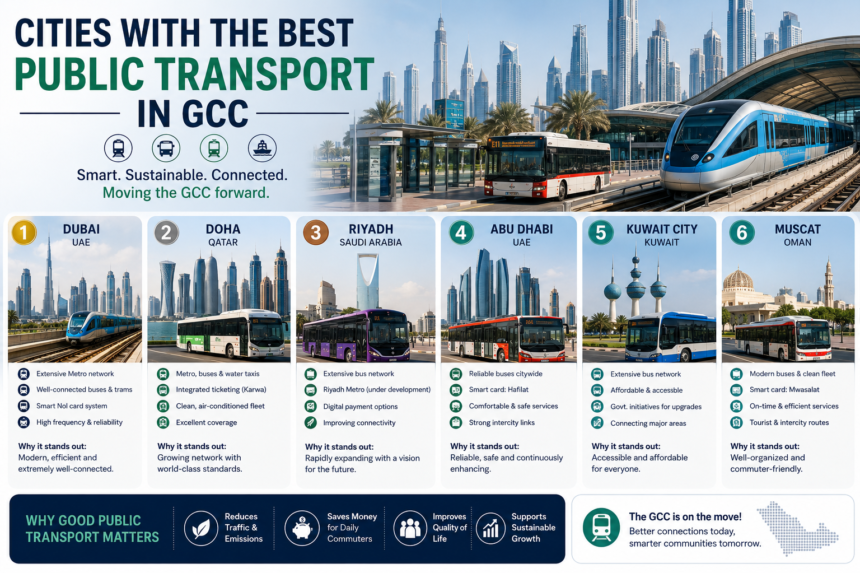
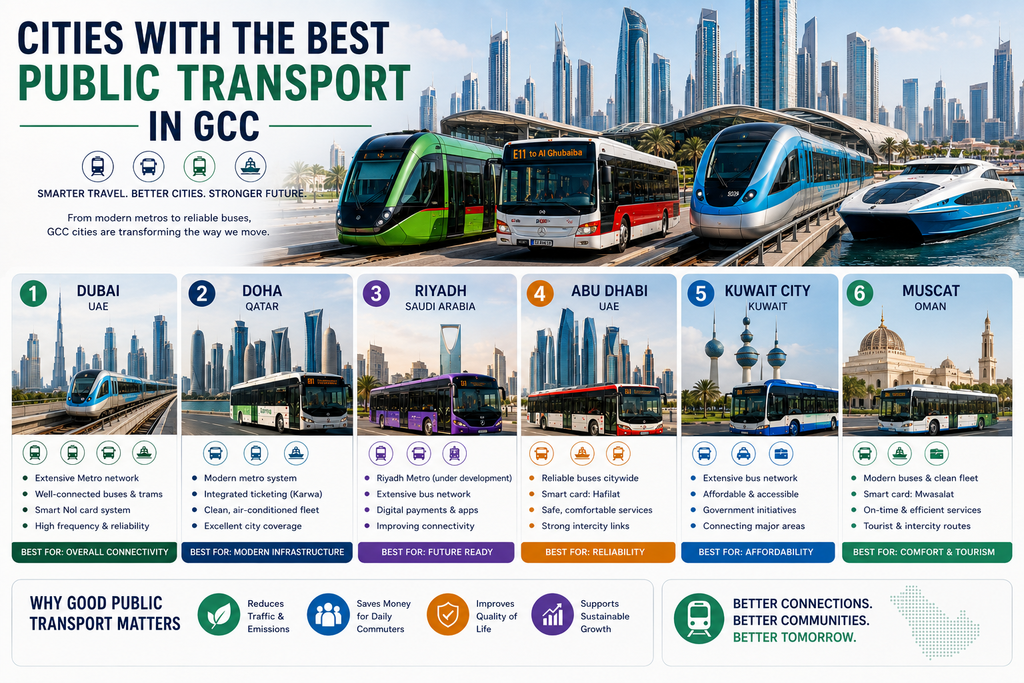
Based on network diversity, rail availability, integration, accessibility and usefulness for residents and visitors, a practical 2026 ranking is:
- Dubai, UAE
- Doha, Qatar
- Riyadh, Saudi Arabia
- Abu Dhabi, UAE
- Jeddah, Saudi Arabia
- Manama, Bahrain
- Muscat, Oman
- Kuwait City, Kuwait
- Al Ain, UAE
- Salalah, Oman
The exact ranking can change depending on what a traveller values.
Dubai remains the strongest all-round choice because Metro, Tram, buses and marine transport operate as parts of an integrated network.
Doha provides one of the easiest and most affordable modern Metro experiences.
Riyadh is the biggest emerging competitor following the development of its extensive Metro network.
Abu Dhabi demonstrates how buses, on-demand services and new technology can create alternatives even without a conventional Metro.
The broader direction is clear.
The Gulf is moving away from complete dependence on private cars.
As cities expand and transport investment continues, the Cities With the Best Public Transport in GCC are likely to become increasingly competitive with major urban transport systems elsewhere in the world.
Follow us on Instagram
Read More – Traditional Breakfasts Around the World: 20 Amazing Morning Meals