



Moving to the Gulf? Compare Living Costs Before You Decide
Moving to the Gulf can look financially attractive, particularly when a job offer includes a strong salary and limited personal income taxation. But salary alone does not determine whether someone will actually save money.
- Why Cost of Living Matters More Than Salary Alone
- GCC Cost of Living Comparison at a Glance
- 1. UAE: Dubai Offers Opportunity but Comes at a Price
- Dubai Can Still Work for High Savers
- 2. Qatar: Doha Is Also One of the GCC’s More Expensive Markets
- Doha Housing Can Change the Entire Budget
- 3. Saudi Arabia: Often Better Value, but Riyadh Costs Are Rising
- Riyadh vs Jeddah
- 4. Bahrain: Smaller Market With Moderate Living Costs
- Bahrain Can Work Well for Couples and Professionals
- 5. Kuwait: Moderate Costs With No General VAT
- Kuwait’s Short Distances Can Help
- 6. Oman: Muscat Often Offers the Most Relaxed Cost Structure
- Which GCC Country Is Cheapest?
- Housing Is the Most Important Expense to Compare
- School Fees Can Cost More Than Rent
- Grocery Costs Depend on What You Buy
- Eating Out Can Be Cheap or Extremely Expensive
- Transport Costs Vary by City
- Utilities Can Become Significant in Summer
- Internet and Mobile Costs
- Healthcare Costs Depend on Insurance
- Lifestyle Is the Biggest Variable
- Single Professional vs Family Costs
- Expat Benefits Can Be Worth More Than Salary Increases
- Inflation Still Matters in the Gulf
- GCC Cost Ranking Is Not the Same as Quality of Life
- Cost of Living Comparison for Families
- Who May Prefer Dubai?
- Who May Prefer Riyadh?
- Who May Prefer Doha?
- Who May Prefer Bahrain?
- Who May Prefer Kuwait?
- Who May Prefer Oman?
- How to Compare a GCC Job Offer Properly
- Common Cost of Living Mistakes
- FAQs About Cost of Living Comparison
- Conclusion
A proper Cost of Living Comparison across the GCC reveals major differences in rent, school fees, groceries, transport, utilities and lifestyle spending between the UAE, Saudi Arabia, Qatar, Kuwait, Bahrain and Oman.
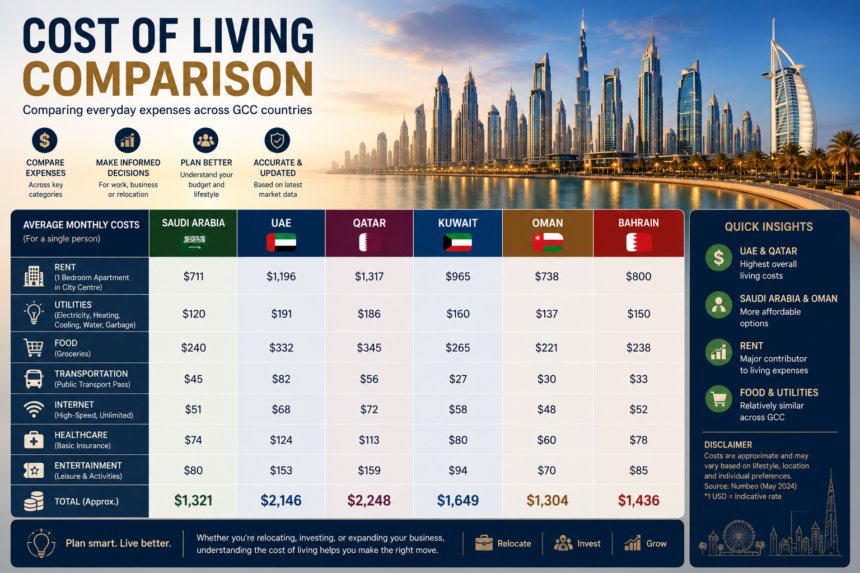
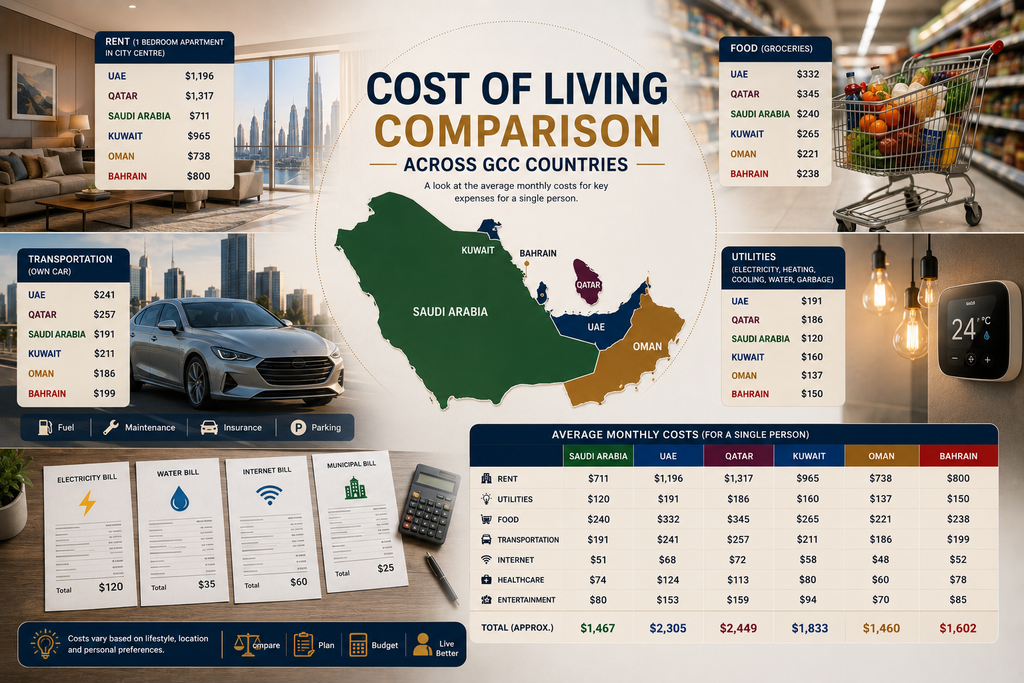
Recent 2026 cost-of-living data places the UAE and Qatar among the most expensive Arab countries once rent is included. Numbeo-based figures published in July ranked the UAE first among Arab countries on the Cost of Living Plus Rent Index at 48.2, followed by Qatar at 45.8. Bahrain and Kuwait were lower at 35.9 and 33.3 respectively.
But country averages do not tell the whole story.
Living in Dubai can cost far more than living in another UAE city. Riyadh and Jeddah differ. Doha housing can vary dramatically by neighbourhood. Family budgets can also look completely different from those of single professionals.
So which GCC country offers the best value in 2026?
The answer depends heavily on your lifestyle.
Why Cost of Living Matters More Than Salary Alone
Imagine two job offers.
One pays the equivalent of $6,000 per month.
Another pays $5,000.
The first looks better immediately.
But if the first job requires expensive housing, international school fees and significant commuting costs, while the second includes accommodation and transport, the lower salary could leave you with more money at the end of the month.
This is why expatriates should compare disposable income, not just salaries.
A realistic monthly budget should consider:
- Housing
- Utilities
- Groceries
- Transport
- Education
- Healthcare
- Mobile and internet
- Eating out
- Entertainment
- Insurance
- Household help
- Travel
- Savings
Housing and education are often the two categories capable of completely changing the result.
GCC Cost of Living Comparison at a Glance
The broad 2026 picture looks like this:
| Country / Main City | General Cost Position | Biggest Pressure |
|---|---|---|
| UAE / Dubai | High | Rent and lifestyle |
| Qatar / Doha | High | Housing and schooling |
| Bahrain / Manama | Moderate | Housing and utilities |
| Kuwait / Kuwait City | Moderate | Housing |
| Saudi Arabia / Riyadh | Moderate | Rising housing costs |
| Oman / Muscat | Lower to moderate | Housing and private education |
These are broad comparisons rather than fixed monthly budgets.
A family living in central Dubai can spend several times more than a single worker sharing accommodation in the same city.
1. UAE: Dubai Offers Opportunity but Comes at a Price
The UAE is one of the Gulf’s most attractive destinations for international professionals.
It also has some of the region’s highest living costs.
Dubai is particularly expensive because it combines:
- strong demand for housing,
- international schools,
- tourism-driven lifestyle spending,
- premium restaurants,
- entertainment,
- and globally competitive property markets.
Current 2026 comparative data places the UAE at the top of Arab countries on the cost-of-living-plus-rent measure.
That does not mean every resident lives expensively.
Dubai contains a huge range of lifestyles.
Someone renting a premium apartment in Downtown Dubai, dining out regularly and using taxis daily may have a very different budget from someone living in Deira, Al Nahda or International City and commuting by Metro.
Housing Is the Biggest Dubai Expense
Rent usually determines whether Dubai feels manageable or expensive.
Neighbourhood matters enormously.
Premium areas such as:
- Downtown Dubai,
- Dubai Marina,
- Palm Jumeirah,
- and beachfront districts
can command significantly higher rents than outer residential areas.
For many expatriates, the best financial decision is not choosing the cheapest possible apartment.
It is choosing housing that balances rent and commuting cost.
Living far from work may save on rent but increase spending on cars, fuel, parking and time.
Dubai Can Still Work for High Savers
Dubai’s advantage is that many professional salaries remain internationally competitive.
People who control housing and lifestyle costs can still build substantial savings.
The danger is lifestyle inflation.
Dubai makes spending very easy.
Common budget leaks include:
- frequent food delivery,
- taxis,
- premium gyms,
- weekend brunches,
- shopping,
- expensive neighbourhoods,
- and repeated entertainment spending.
A high salary does not automatically create high savings.
2. Qatar: Doha Is Also One of the GCC’s More Expensive Markets
Qatar ranks immediately behind the UAE in the latest Arab cost-of-living-plus-rent comparison, with an index score of 45.8.
Doha’s biggest expenses typically include:
- accommodation,
- international schooling,
- imported groceries,
- and premium leisure activities.
Like Dubai, Doha can feel much more expensive when someone chooses an internationally oriented lifestyle.
However, employment packages can make a major difference.
Many expatriate packages in Qatar have historically included some combination of:
- housing allowance,
- health insurance,
- transportation,
- flights,
- and education support.
When these are included, the effective cost of living can fall significantly.
Doha Housing Can Change the Entire Budget
A family prioritizing a large apartment or villa in a premium location may spend heavily.
A single professional sharing housing may have a much lower cost base.
This is why headline statements such as “Doha is expensive” do not tell you whether a specific employment offer is good.
You need to ask:
Is housing included?
Is school support included?
Is medical insurance included?
Those benefits can be worth thousands each month.
3. Saudi Arabia: Often Better Value, but Riyadh Costs Are Rising
Saudi Arabia can offer better value than Dubai or Doha in several spending categories.
However, Riyadh has experienced significant development, population growth and increasing housing demand.
Saudi official statistics showed that housing remained an important inflation driver in 2026. In March, housing, water, electricity, gas and other fuels were up 3.9% year on year, with actual rents up 4.8%.
That matters because even relatively moderate inflation becomes noticeable when it affects a household’s largest expense.
Food Can Be Relatively Competitive
Crowdsourced June 2026 comparisons suggest food costs in Saudi Arabia were around 9% lower than Bahrain in that specific dataset.
Saudi Arabia benefits from:
- a very large retail market,
- strong supermarket competition,
- local food production,
- and extensive restaurant choices.
People who cook at home and avoid premium compounds can often manage expenses more easily than in Dubai.
Riyadh vs Jeddah
Saudi Arabia should not be treated as one single cost market.
Riyadh has become increasingly expensive as investment and business activity accelerate.
Jeddah can offer a different housing and lifestyle profile.
Smaller cities can be considerably cheaper.
For professionals evaluating Saudi opportunities, compare the specific city and neighbourhood, not just the country.
4. Bahrain: Smaller Market With Moderate Living Costs
Bahrain’s cost profile generally sits below the UAE and Qatar.
The July 2026 regional comparison placed Bahrain behind both, with a cost-of-living-plus-rent index of 35.9.
Manama offers an interesting balance.
The country has:
- an established expatriate community,
- developed financial services,
- international schools,
- restaurants,
- and relatively short commuting distances.
The island’s small geography can also reduce travel time compared with much larger Gulf cities.
But Utilities Can Surprise New Residents
Some 2026 crowdsourced comparisons show Bahrain utilities as potentially expensive relative to Saudi Arabia, depending on accommodation and tariff circumstances.
This is one reason rental advertisements need careful reading.
Ask whether rent includes:
- electricity,
- water,
- internet,
- municipality charges,
- or cooling.
A seemingly cheap apartment can become less attractive once these are added.
Bahrain Can Work Well for Couples and Professionals
For people who do not need large villas or expensive private-school packages, Bahrain can offer a relatively manageable lifestyle.
Dining and entertainment options are extensive enough to provide city life without the same cost intensity seen in certain premium Dubai areas.
5. Kuwait: Moderate Costs With No General VAT
Kuwait offers another distinctive GCC cost structure.
The country ranked below Bahrain in the July 2026 Arab cost-of-living-plus-rent comparison, with an index score of 33.3.
One factor helping consumers is the absence of a general VAT system in 2026.
That means ordinary spending does not face the same broad consumption tax applied in:
- Saudi Arabia at 15%,
- Bahrain at 10%,
- UAE at 5%,
- Oman at 5%.
However, housing still represents a major cost for expatriates.
A June 2026 comparison showed furnished housing in normal and expensive areas in Kuwait costing more than comparable Saudi accommodation in the dataset.
So again, there is no universal “cheap Gulf country.”
Every country is cheaper in some categories and more expensive in others.
Kuwait’s Short Distances Can Help
Kuwait City is geographically more compact than sprawling metropolitan areas such as Riyadh.
That can potentially reduce commuting complexity.
However, car ownership remains important for many residents because public transport coverage does not serve every lifestyle equally.
Fuel costs remain relatively manageable compared with many global cities.
6. Oman: Muscat Often Offers the Most Relaxed Cost Structure
Oman, and particularly Muscat, is often viewed as one of the more affordable major GCC lifestyle options.
Recent Gulf cost calculators based on 2026 pricing data have placed Muscat below cities such as Dubai and Doha in estimated monthly household budgets. One comparative estimate described a gap of roughly 60% between Muscat and Dubai for a couple under its selected assumptions.
The exact percentage should not be treated as universal, but the general direction is useful.
Muscat usually provides lower-cost options for:
- rent,
- restaurants,
- leisure,
- and some household expenses
than premium districts in Dubai or Doha.
Oman Offers a Different Lifestyle
Muscat is less focused on high-intensity urban entertainment.
That can naturally reduce discretionary spending.
Someone living in Dubai may regularly spend money on:
- major attractions,
- nightlife,
- malls,
- delivery,
- and expensive social activities.
Muscat offers a quieter lifestyle centred more heavily around:
- beaches,
- mountains,
- outdoor activities,
- and smaller-scale social venues.
For people who prefer that lifestyle anyway, Oman can deliver strong value.
Which GCC Country Is Cheapest?
There is no single answer for every resident.
But broadly:
Oman and Saudi Arabia can offer lower everyday costs in many situations.
Kuwait and Bahrain often sit in the middle.
Qatar and the UAE generally sit toward the higher end, especially once rent is included.
The July 2026 Numbeo-based regional comparison clearly positioned the UAE and Qatar at the top among Arab countries when both living expenses and rent were considered.
However, an employer-provided apartment can completely reverse the ranking for an individual employee.
Housing Is the Most Important Expense to Compare
For most expatriates, housing is the largest monthly cost.
A 2026 family relocation estimate showed substantial differences in typical three-bedroom housing ranges, with Dubai and Doha at the upper end of its GCC comparison and Muscat, Manama and Kuwait generally lower under its assumptions.
Housing cost depends on:
- city,
- neighbourhood,
- building age,
- furnished vs unfurnished,
- facilities,
- proximity to business districts,
- proximity to schools,
- and market demand.
Always compare actual live listings before accepting a relocation package.
Country averages are useful only as a starting point.
School Fees Can Cost More Than Rent
For families, international education is often the most underestimated Gulf expense.
A household with two children can easily spend a substantial share of annual income on private schooling.
Recent GCC relocation estimates place international-school costs at thousands of local currency units per child each month in major Gulf cities.
Parents should check:
- tuition,
- registration fees,
- uniforms,
- transport,
- meals,
- books,
- extracurricular activities,
- and annual increases.
An employer offering education allowance can therefore provide an enormous financial advantage.
A slightly lower salary with school support may be better than a higher salary without it.
Grocery Costs Depend on What You Buy
Grocery comparisons are complicated because expatriates often buy very different products.
Locally produced staples may be inexpensive.
Imported organic products, speciality European foods and premium brands can be far more expensive.
The Gulf imports a significant amount of food, meaning international products can carry higher prices.
People can usually reduce grocery spending by:
- choosing local and regional brands,
- shopping at hypermarkets,
- buying promotions,
- cooking more often,
- and avoiding convenience delivery.
A Western-style premium grocery basket may make the Gulf appear far more expensive than a mixed local and regional basket.
Eating Out Can Be Cheap or Extremely Expensive
This is one category where Gulf cities offer remarkable range.
A meal at a luxury Dubai restaurant can cost hundreds of dirhams.
A shawarma, biryani or local cafeteria meal can cost a small fraction of that.
The same pattern exists in:
- Doha,
- Riyadh,
- Manama,
- Kuwait City,
- and Muscat.
Expatriates often overspend not because food itself is unaffordable but because restaurant choice becomes part of social life.
Regular delivery is another major expense.
Small delivery charges combined with higher menu prices can significantly increase monthly spending.
Transport Costs Vary by City
Transportation is another area where city infrastructure matters more than country ranking.
Dubai
The Metro can significantly reduce commuting costs for residents living near stations.
Riyadh
The expanding public transport network is changing commuting, but cars remain important for many households.
Doha
Metro access can be useful, particularly around central areas.
Bahrain, Kuwait and Oman
Private cars remain important for many expatriates.
Fuel is generally cheaper across the Gulf than in many European markets, making car ownership relatively manageable.
But residents must also consider:
- vehicle finance,
- insurance,
- registration,
- parking,
- tolls,
- maintenance,
- and depreciation.
Utilities Can Become Significant in Summer
Air conditioning is not optional in Gulf summers.
That means electricity consumption can rise sharply.
Actual utility costs depend on:
- country,
- subsidy structure,
- apartment size,
- insulation,
- air-conditioning system,
- and whether utilities are included in rent.
Large villas naturally cost more to cool than small apartments.
Before signing a lease, ask previous tenants or the landlord about typical summer bills.
This is more useful than relying on generic online averages.
Internet and Mobile Costs
Telecommunications are generally modern across GCC markets, but plans vary considerably.
Residents should compare:
- home broadband,
- mobile data,
- international calling,
- roaming,
- and contract duration.
People who communicate frequently with family abroad should pay particular attention to international packages and internet-based calling options permitted in the relevant country.
A salary package that includes phone or internet allowance can still provide useful savings.
Healthcare Costs Depend on Insurance
Healthcare should never be excluded from a relocation budget.
In many Gulf employment markets, employers provide medical insurance.
But insurance quality varies dramatically.
Check:
- hospital network,
- outpatient cover,
- dental,
- maternity,
- chronic medication,
- specialist consultations,
- co-payments,
- and dependents.
A cheaper insurance plan with high out-of-pocket costs can make healthcare unexpectedly expensive.
Families should examine the actual policy, not simply accept the phrase “medical insurance included.”
Lifestyle Is the Biggest Variable
Two people earning identical salaries in Dubai can have completely different financial lives.
Person A:
- shares housing,
- uses Metro,
- cooks at home,
- travels occasionally,
- saves aggressively.
Person B:
- rents alone in a premium district,
- owns an expensive car,
- uses delivery daily,
- attends brunches,
- travels frequently,
- shops regularly.
Their country is identical.
Their cost of living is not.
This is why personal budgeting matters more than internet rankings.
Single Professional vs Family Costs
Single Professional
The largest costs are usually:
- accommodation,
- transport,
- food,
- and lifestyle.
Sharing accommodation can reduce expenditure dramatically.
Couple
Housing becomes easier to manage if both partners work.
A two-income household can often achieve strong savings.
Family With Children
The picture changes completely.
Major expenses become:
- larger housing,
- school fees,
- health insurance,
- childcare,
- family travel,
- and potentially domestic help.
This is why families should negotiate employment packages much more carefully.
Expat Benefits Can Be Worth More Than Salary Increases
Gulf compensation packages can include benefits that significantly reduce living expenses.
Examples include:
- housing allowance,
- company accommodation,
- education allowance,
- medical insurance,
- annual flights,
- transport allowance,
- relocation support.
If Employer A offers a salary of 25,000 with no benefits and Employer B offers 22,000 plus housing and school support, Employer B may provide much higher real compensation.
Always calculate the annual monetary value of benefits.
Inflation Still Matters in the Gulf
GCC inflation has generally remained more controlled than in many parts of the world, but specific categories can rise much faster than the headline rate.
Saudi Arabia provides a good example.
Official March 2026 data showed annual inflation around 1.8%, but actual rents were up 4.8% year on year.
For someone whose rent represents 35% of monthly spending, the housing increase matters much more than the national average.
This is why inflation headlines need context.
Consumers experience personal inflation, depending on what they spend money on.
GCC Cost Ranking Is Not the Same as Quality of Life
The cheapest location is not automatically the best place to live.
Residents also consider:
- career opportunities,
- safety,
- schools,
- healthcare,
- entertainment,
- environment,
- transport,
- community,
- and travel connectivity.
Dubai may cost more but provide greater career opportunities for some professions.
Muscat may offer lower costs and a quieter lifestyle.
Riyadh may provide stronger opportunities in a rapidly expanding Saudi market.
Doha may be attractive when employers provide strong benefits.
Personal priorities determine value.
Cost of Living Comparison for Families
| Expense | UAE / Dubai | Saudi / Riyadh | Qatar / Doha | Bahrain | Kuwait | Oman |
| Housing | High | Moderate to high | High | Moderate | Moderate | Lower to moderate |
| Groceries | High-moderate | Moderate | High-moderate | Moderate | Moderate | Moderate |
| Transport | Moderate | Moderate | Moderate | Moderate | Moderate | Moderate |
| Schooling | High | High | High | Moderate-high | Moderate-high | Moderate |
| Dining | Wide range | Wide range | High-moderate | Moderate | Moderate | Lower-moderate |
| Lifestyle | High potential spend | Moderate-high | High | Moderate | Moderate | Lower |
This is best used as an orientation rather than a fixed price table.
Who May Prefer Dubai?
Dubai may suit someone who prioritizes:
- global career opportunities,
- networking,
- entertainment,
- international schools,
- travel connectivity,
- and a highly developed urban lifestyle.
The trade-off is higher housing and discretionary spending.
Who May Prefer Riyadh?
Riyadh may suit professionals targeting:
- Saudi Vision 2030 opportunities,
- government projects,
- consulting,
- technology,
- finance,
- construction,
- and large domestic-market roles.
Costs can be lower than Dubai in several categories, although rent pressure is increasing.
Who May Prefer Doha?
Doha can work particularly well when employment includes:
- accommodation,
- school allowance,
- health insurance,
- and transportation.
Without those benefits, housing and family costs can become significant.
Who May Prefer Bahrain?
Bahrain can suit professionals seeking:
- financial-sector careers,
- a smaller urban environment,
- shorter travel distances,
- and generally moderate living costs.
Housing remains an important variable.
Who May Prefer Kuwait?
Kuwait may appeal to residents prioritizing:
- strong earning potential,
- comparatively moderate cost levels,
- and no general VAT.
Its lifestyle and transport structure will suit some residents better than others.
Who May Prefer Oman?
Oman can be attractive for people who value:
- outdoor lifestyle,
- nature,
- lower-intensity urban living,
- and potentially lower housing costs.
Muscat may be particularly appealing to families or professionals who do not need Dubai-style entertainment every weekend.
How to Compare a GCC Job Offer Properly
Before accepting a role, calculate:
Step 1: Net monthly salary
What actually reaches your account?
Step 2: Housing
Use live rental listings near the workplace.
Step 3: Education
If you have children, check real school fees.
Step 4: Transport
Will you need a car?
Step 5: Insurance
Are dependents included?
Step 6: Annual benefits
Include flights, bonuses and allowances.
Step 7: Lifestyle spending
Be realistic about how you actually live.
Then calculate:
Income − total realistic expenses = potential monthly savings
That figure is more useful than salary alone.
Common Cost of Living Mistakes
Comparing country averages instead of cities
Dubai and Fujairah are not the same market.
Ignoring school fees
A major mistake for families.
Assuming company accommodation is free money
Check quality and location.
Underestimating lifestyle spending
Restaurants, delivery and entertainment accumulate quickly.
Ignoring annual costs
Insurance, flights and school registration may not appear monthly.
Choosing housing too far from work
Cheap rent can produce expensive commuting.
Believing one online calculator
Cost databases are useful benchmarks, not personal budgets.
FAQs About Cost of Living Comparison
Which GCC country has the highest cost of living?
Current 2026 Numbeo-based regional data places the UAE first among Arab countries on the Cost of Living Plus Rent Index, followed by Qatar.
Is Dubai more expensive than Riyadh?
Generally, Dubai tends to be more expensive, especially for housing and lifestyle spending. Riyadh costs are rising, however, with official Saudi statistics showing rental inflation continuing in 2026.
Is Qatar expensive for expatriates?
Doha can be expensive, particularly for housing and international schooling. Employer allowances can significantly reduce the effective cost.
Which GCC country is cheapest for families?
There is no universal answer, but Muscat and some Saudi cities can offer lower living costs than Dubai or Doha under many household scenarios. Schooling and employer benefits can reverse the comparison.
Is Bahrain cheaper than the UAE?
Broad regional cost indices currently place Bahrain below the UAE when rent is included.
Is Kuwait expensive to live in?
Kuwait generally sits below the UAE and Qatar on current regional cost indices, although accommodation can still be significant.
What is the biggest expense for GCC expatriates?
Housing is typically the biggest expense for singles and couples. For families, international schooling can become equally important or even larger.
Are GCC salaries tax-free?
Most GCC countries still do not impose broad personal income tax on ordinary employment salaries. However, taxation rules differ and Oman has enacted a personal income tax scheduled to begin in 2028 for qualifying higher-income individuals.
Conclusion
A Cost of Living Comparison across GCC countries shows why choosing where to live cannot be reduced to one salary number.
The UAE and Qatar currently sit toward the higher end of regional living costs, especially when rent is included. Recent 2026 data places them first and second respectively among Arab countries on the Cost of Living Plus Rent Index.
Saudi Arabia can offer stronger value in several everyday spending categories, although housing costs in Riyadh are increasing. Official Saudi statistics show that rent remained an important source of inflation in 2026.
Bahrain and Kuwait occupy a more moderate position, while Muscat and Oman can provide a comparatively lower-cost lifestyle for residents who prefer a quieter urban environment.
But the ranking changes dramatically once individual circumstances are considered.
A Dubai employee with company housing may save more than someone earning a similar salary in a cheaper city.
A Doha family receiving school allowance may be better off than a family paying tuition independently elsewhere.
A single professional sharing accommodation in Riyadh may have extremely low monthly expenses compared with a family renting a villa.
The smartest comparison therefore looks beyond country rankings.
Compare salary, rent, school fees, benefits, transport and realistic lifestyle spending together.
Because in the Gulf, the most expensive country is not always the worst financial choice.
And the cheapest city is not always where you will save the most.
follow us on Instagram
Read More – Tax Comparison Across GCC Countries: 6 Powerful Differences in 2026