


Living in Kuwait: 15 Essential Things Expats Should Know in 2026
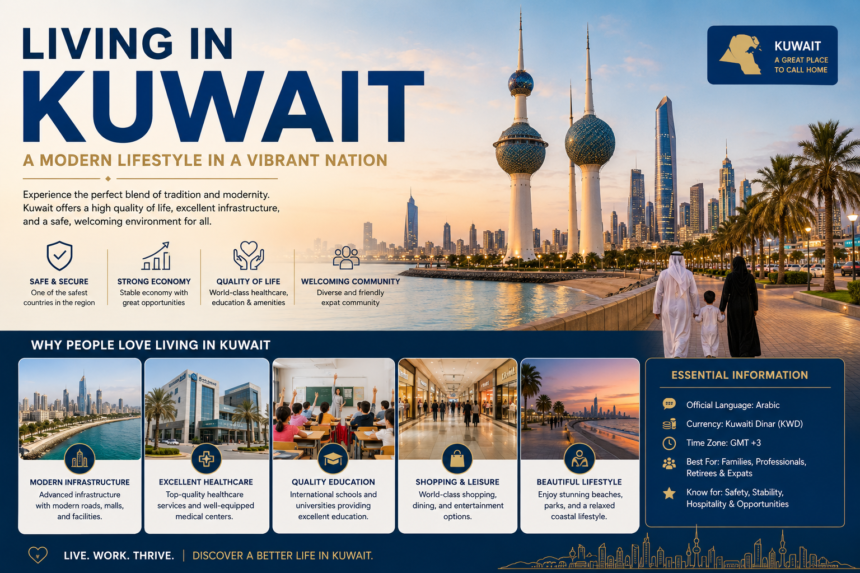
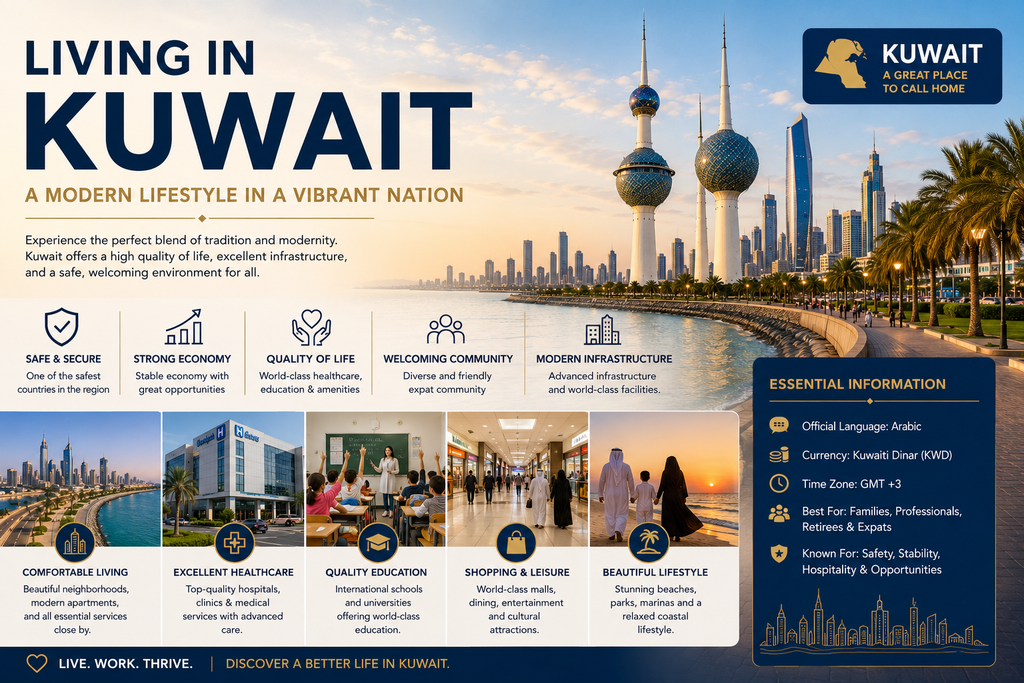
Living in Kuwait can offer expatriates a distinctive combination of career opportunities, modern infrastructure, Gulf culture, family-oriented communities and access to a well-developed urban lifestyle. Located at the northern edge of the Arabian Gulf, Kuwait has long attracted professionals and workers from across Asia, the Middle East, Europe and other regions.
- Living in Kuwait for Expats, Families and Professionals in 2026
- Why Do Expats Choose Kuwait?
- Kuwait Vision 2035 and the Future of Living in Kuwait
- Cost of Living in Kuwait
- Housing and Accommodation in Kuwait
- Popular Areas for Expats in Kuwait
- Working in Kuwait
- Residency in Kuwait
- Medical Examination for New Expatriate Workers
- Healthcare in Kuwait
- Health Insurance for Expats
- Family Life in Kuwait
- Education and Schools
- Transportation in Kuwait
- Driving in Kuwait
- Weather and Climate
- Food and Dining in Kuwait
- Shopping in Kuwait
- Social Life in Kuwait
- Culture and Local Customs
- Alcohol Laws in Kuwait
- Safety in Kuwait
- Living in Kuwait as a Single Professional
- Living in Kuwait With a Family
- Living in Kuwait for Indian Expats
- Saving Money While Living in Kuwait
- Long-Term Residency and Investment Changes
- Advantages of Living in Kuwait
- Challenges of Living in Kuwait
- Is Kuwait Expensive to Live In?
- Is Kuwait Good for Expats?
- The Future of Living in Kuwait
- Final Thoughts on Living in Kuwait
For someone considering moving to Kuwait in 2026, however, the decision involves much more than finding a job.
Where should you live?
How expensive is everyday life?
How does healthcare work?
Can you bring your family?
What is transportation like?
What should newcomers know about local laws and culture?
These questions matter because the experience of living in Kuwait can vary considerably according to salary, employer benefits, family size, accommodation and lifestyle.
Kuwait is also undergoing economic and infrastructure development under Kuwait Vision 2035, which aims to strengthen the private sector, diversify the economy, improve infrastructure and create a more sustainable living environment.
For expatriates, understanding these changes alongside everyday realities is essential.
This guide explains what living in Kuwait in 2026 can look like for professionals, workers, couples and families.
Living in Kuwait for Expats, Families and Professionals in 2026
Kuwait has a large expatriate workforce, and foreign residents play a major role in the country’s private-sector economy.
The IMF noted in its 2026 assessment of Kuwait that expatriates continue to fill the vast majority of private-sector jobs, while Kuwait’s economic reforms are increasingly focused on diversification and private-sector-led growth.
This means expatriates moving to Kuwait will encounter communities representing many different nationalities.
English is widely useful in professional and commercial environments, although Arabic is the country’s official language and learning basic Arabic expressions can make everyday interactions easier.
Life is heavily concentrated around Kuwait City and its surrounding metropolitan areas.
Residents have access to shopping malls, restaurants, cafés, hospitals, private schools, supermarkets, entertainment facilities and extensive road infrastructure.
At the same time, Kuwait remains a conservative Gulf society.
Understanding local customs and regulations is an important part of settling successfully into the country.
Why Do Expats Choose Kuwait?
Employment remains the main reason foreigners move to Kuwait.
The country’s economy has historically been strongly connected to oil and government spending, but opportunities also exist across sectors such as:
Healthcare
Engineering
Construction
Education
Finance
Banking
Retail
Hospitality
Information technology
Logistics
Professional services
Oil and gas
Manufacturing
Telecommunications
For skilled professionals, the complete employment package can matter just as much as basic salary.
Housing allowances, health insurance, transportation, annual flights and family benefits can significantly affect the overall value of an offer.
Before accepting employment, newcomers should calculate what they will actually receive after housing and other major expenses.
Kuwait Vision 2035 and the Future of Living in Kuwait
Kuwait is working toward a long-term national transformation through Kuwait Vision 2035, also known as New Kuwait.
The strategy aims to transform Kuwait into a regional and international financial and commercial hub while increasing private-sector participation and developing non-oil industries.
Its seven pillars include a diversified sustainable economy, effective public administration, sustainable living environment, developed infrastructure, high-quality healthcare, creative human capital and stronger international positioning.
These objectives are relevant to residents because economic transformation influences employment, transportation, housing, healthcare and infrastructure.
The IMF reported in February 2026 that Kuwait had announced major public investment in housing, electricity, water and transportation infrastructure for the 2025–2030 period.
For long-term residents, these developments could gradually change everyday life.
Cost of Living in Kuwait
The cost of living in Kuwait depends heavily on lifestyle.
Housing will usually be one of the largest monthly expenses.
Families may also face significant education costs if children attend private or international schools.
Other major expenses can include:
Groceries
Utilities
Internet
Mobile services
Transportation
Healthcare
School fees
Dining
Entertainment
Domestic help
Travel
A single professional sharing accommodation will naturally have a very different budget from a family renting a large apartment and paying private-school fees.
Employer benefits can therefore make a major difference.
Someone receiving housing and family medical coverage may be able to save considerably more than another person earning a similar salary without those benefits.
Housing and Accommodation in Kuwait
Most expatriates rent accommodation.
Apartments dominate many areas popular with foreign residents, while larger families may look for more spacious apartments, floors or villas depending on budget.
Housing prices depend on:
Location
Building age
Property size
Furnishing
Parking
Facilities
Sea views
Maintenance
Proximity to schools
Access to major roads
Before renting, residents should inspect the property rather than relying entirely on photographs.
Check air conditioning carefully because Kuwait’s summer climate makes effective cooling essential.
Parking should also be taken seriously.
A beautiful apartment can become frustrating if finding parking every evening is difficult.
Popular Areas for Expats in Kuwait
Different neighbourhoods suit different lifestyles.
Salmiya is one of the best-known areas among expatriates, with apartments, restaurants, shops and convenient access to everyday services.
Hawally is densely populated and practical, particularly for residents looking for access to shops, restaurants and relatively central locations.
Salwa can appeal to families seeking residential surroundings while remaining within the wider Kuwait City metropolitan area.
Mahboula and Fintas are popular among many expatriate workers and families, particularly people employed in southern commercial or industrial areas.
Jabriya provides relatively central access to healthcare, schools and other services.
The right area depends more on workplace and school location than reputation.
Always test the commute before signing a lease.
Working in Kuwait
For most expatriates, legal residency is closely connected to employment or another qualifying sponsorship category.
Employees should understand their employment contract before relocating.
Important details include:
Basic salary
Working hours
Probation
Annual leave
End-of-service benefits
Medical insurance
Housing allowance
Transportation allowance
Annual flight benefits
Family benefits
Notice period
Employment contracts should be reviewed carefully rather than relying solely on verbal promises.
Kuwait’s expatriate residency framework has also undergone significant changes in recent years, so workers should check current requirements through official authorities before travelling or changing employment.
Residency in Kuwait
Residency is one of the most important practical issues for foreign nationals.
The requirements depend on the person’s category, such as employment, family sponsorship, investment or another permitted route.
New residents generally need to complete several administrative procedures connected with residency.
These may involve:
Entry documentation
Medical examinations
Residency procedures
Health insurance
Biometric or identification requirements where applicable
Civil ID procedures
The Kuwait Government Online portal provides access to many official services related to residents, ministries and government procedures.
Because immigration rules can change, residents should always verify the latest requirements before making important decisions.
Medical Examination for New Expatriate Workers
New expatriate workers may be required to complete medical examinations as part of residency procedures.
According to Kuwait Government Online, expatriate labourers undergo medical testing to confirm fitness and compliance with health requirements before legitimate residency can be issued.
The official process includes screening for specified communicable diseases and requires applicants to attend an expatriate examination centre.
Workers should therefore keep passports, visa documentation and other required records organised when arriving.
Medical requirements should be checked before travel because documentation requirements can differ according to individual circumstances.
Healthcare in Kuwait
Kuwait has public healthcare services as well as a substantial private healthcare sector.
The Ministry of Health provides hospitals, health centres, specialised services and electronic healthcare services.
Official government services include hospital and specialist clinic appointments, healthcare directories, health insurance services and expatriate medical examinations.
Private hospitals and clinics provide additional options, particularly for residents seeking particular specialists or greater appointment flexibility.
Families should understand their medical coverage before relocating.
Do not simply ask whether an employer provides health insurance.
Ask what the insurance actually covers.
Health Insurance for Expats
Health insurance is an important component of expatriate residency and healthcare access.
Kuwait Government Online currently lists annual government health insurance premiums for different resident categories.
For example, its current published schedule lists KD50 annually for holders of commercial residence permits and government or private-sector employees, while amounts differ for spouses, children, students and other categories.
These government insurance arrangements should not automatically be confused with comprehensive private medical insurance.
Employees should investigate whether their employer also provides private coverage and which hospitals are included.
For families, check maternity, dental, paediatric and emergency benefits carefully.
Family Life in Kuwait
Kuwait can offer a comfortable lifestyle for expatriate families when the employment package supports it.
Families can find:
Private schools
International schools
Shopping malls
Children’s entertainment
Restaurants
Parks and waterfront spaces
Private hospitals
Sports facilities
Family-oriented residential communities
Much of Kuwait’s social life revolves around family gatherings, restaurants, malls and private homes.
During the cooler months, outdoor activities become significantly more comfortable.
Families often spend time along waterfront areas, parks and desert locations.
Education and Schools
Education is one of the biggest considerations for expatriate parents.
Kuwait has private schools serving different curricula and communities.
Depending on the school, families may find British, American, Indian and other educational systems.
Before choosing accommodation, parents should shortlist schools.
This is important because school runs can significantly affect daily routines.
Living close to the office but far from children’s schools may create a difficult commute every morning and afternoon.
School fees should also be included in relocation calculations before accepting a job.
Transportation in Kuwait
Private cars play a major role in everyday transportation.
Kuwait’s urban development and climate mean many residents depend heavily on vehicles.
Taxis and app-based transportation services provide alternatives, while public bus services operate across different areas.
However, many professional and family households still consider a private vehicle the most convenient option.
When choosing accommodation, examine road access and expected commuting times.
Traffic can vary considerably depending on the area and time of day.
A shorter geographic distance does not always mean a faster commute.
Driving in Kuwait
Driving can provide considerably more independence.
New residents should check whether they qualify for a Kuwaiti driving licence and what documents or tests apply to their situation.
Driving eligibility can depend on residency and other requirements.
Road conditions are generally modern, but traffic can become heavy.
Defensive driving is advisable.
Residents should also become familiar with local traffic laws, speed limits, parking restrictions and penalties.
Never assume driving regulations are identical to those in your home country.
Weather and Climate
Kuwait has a desert climate.
Summer is extremely hot.
Temperatures can reach levels that make extended outdoor activity uncomfortable or unsafe, particularly during the hottest part of the day.
Air-conditioned homes, vehicles, workplaces, malls and other indoor spaces therefore become central to everyday summer life.
Winter is completely different.
The cooler months can be pleasant and provide excellent conditions for outdoor dining, walking, desert activities and waterfront visits.
Dust and sandstorms can occasionally affect visibility and air quality.
People with respiratory sensitivities should monitor conditions during dusty periods.
Food and Dining in Kuwait
Food is one of the enjoyable parts of living in Kuwait.
The country’s multicultural population has created a diverse restaurant scene.
Residents can find Kuwaiti, Lebanese, Indian, Pakistani, Egyptian, Turkish, Iranian, Filipino and numerous international cuisines.
Dining ranges from inexpensive local restaurants to premium restaurants inside luxury hotels and shopping centres.
Kuwaiti cuisine itself is worth exploring.
Rice, meat, seafood, spices and Gulf culinary traditions feature prominently.
Machboos is among the dishes commonly associated with Kuwaiti cuisine.
For expatriates, the variety of food can make settling into the country easier.
Shopping in Kuwait
Shopping malls are an important part of social life, particularly during hot summer months.
Large malls combine retail stores with restaurants, cinemas, cafés and family entertainment.
Residents can also find traditional markets and smaller commercial districts.
Supermarkets stock both local and imported products.
Imported speciality items can be more expensive, so households trying to reduce grocery spending may benefit from combining major supermarkets with local markets and value-focused stores.
Shopping habits can have a surprisingly large effect on monthly expenses.
Social Life in Kuwait
Social life often develops through work, family connections, schools, sports and expatriate communities.
Restaurants and cafés are popular meeting places.
Home gatherings are also common.
During cooler months, outdoor gatherings and desert trips become more attractive.
New expatriates should give themselves time to build a social network.
Joining sports activities, professional groups and community events can make settling into Kuwait much easier.
Culture and Local Customs
Kuwait combines modern urban life with strong Arab and Islamic traditions.
Foreign residents should respect local culture.
Modest clothing is advisable in public places.
Behaviour considered ordinary in another country may not always be appropriate in Kuwait.
During Ramadan, residents should pay particular attention to local rules and customs.
Learning basic Arabic greetings can also be appreciated.
Respect for culture does not require abandoning your own identity.
It means understanding the society in which you are living.
Alcohol Laws in Kuwait
Kuwait has strict alcohol laws.
Unlike some other Gulf destinations, alcohol is prohibited.
Foreign residents should understand this clearly before moving.
Attempting to bring prohibited alcohol into the country or violating related laws can have serious consequences.
New residents should never rely on assumptions based on regulations in Dubai, Bahrain or other Gulf destinations.
Every GCC country has its own legal framework.
Safety in Kuwait
Kuwait generally provides an organised urban environment, but residents should use normal personal safety precautions.
Keep important documents secure.
Protect banking information.
Avoid sharing one-time passwords.
Be cautious about online scams.
Follow official instructions during emergencies.
The national emergency number for police, ambulance and fire services is 112, according to Kuwait’s Ministry of Health.
Save important emergency contacts when you first arrive rather than waiting until they are needed.
Living in Kuwait as a Single Professional
Single professionals may have greater flexibility in choosing accommodation.
Sharing accommodation where legally and contractually appropriate can reduce costs, while professionals with stronger packages may prefer independent apartments.
Areas with restaurants, supermarkets and easier road access can be particularly convenient.
The biggest financial advantages for single professionals can come from controlling housing and lifestyle expenses.
Frequent restaurant meals, premium accommodation and constant shopping can quickly reduce potential savings.
Creating a monthly budget is therefore worthwhile.
Living in Kuwait With a Family
Family relocation requires more planning.
Before moving, calculate:
Housing
School fees
Medical expenses
Transportation
Groceries
Flights home
Childcare
Activities
Utilities
Emergency savings
A salary that seems excellent for one person may feel completely different when supporting several dependants.
Employer-provided accommodation, school allowance and family insurance can therefore be extremely valuable.
Families should evaluate the total package rather than focusing only on salary.
Living in Kuwait for Indian Expats
Kuwait has a significant Indian expatriate community, which can make settling easier for newcomers from India.
Indian restaurants, grocery products, schools and community networks are widely available.
Professionals and workers from India are employed across healthcare, engineering, construction, finance, retail, hospitality, IT and numerous other industries.
However, newcomers should avoid informal assumptions about visa or employment rules simply because friends or relatives have lived in Kuwait previously.
Rules change.
Always verify current requirements through official sources.
Saving Money While Living in Kuwait
Saving potential depends more on spending habits than salary alone.
Housing is usually the first place to evaluate.
Living slightly farther from premium districts can reduce rent, but calculate transportation costs before moving too far away.
Cooking at home can significantly reduce food expenses.
Avoid unnecessary debt.
Compare mobile and internet packages.
Use employer benefits wherever appropriate.
Create a monthly savings target rather than saving whatever happens to remain at the end of the month.
Workers who move to Kuwait primarily for financial reasons should have a clear financial objective.
Long-Term Residency and Investment Changes
Kuwait has also begun introducing new residency options connected with investment.
In June 2026, the Kuwait Direct Investment Promotion Authority announced a framework allowing eligible foreign investors and key executives associated with KDIPA-licensed companies to obtain residency permits of up to 15 years.
This does not mean every expatriate automatically qualifies for long-term residency.
Eligibility is tied to defined categories and requirements.
However, it demonstrates Kuwait’s broader effort to make its investment environment more competitive and stable as part of economic diversification.
Advantages of Living in Kuwait
Living in Kuwait can offer several advantages.
Career opportunities remain the biggest attraction for many foreign residents.
Other potential benefits include:
Modern infrastructure
Large expatriate communities
Diverse food
Family-oriented lifestyle
Strong retail sector
Access to private healthcare
Regional travel opportunities
Professional experience in the Gulf
Potential savings depending on salary and benefits
The actual value of these advantages depends on the individual’s circumstances.
A strong employment package can make Kuwait considerably more attractive.
Challenges of Living in Kuwait
There are also challenges.
The summer heat can be difficult for newcomers.
Traffic can become frustrating.
Families may face significant private-school expenses.
Residency is an important administrative consideration for expatriates.
Some residents may find the social environment quieter than in cities such as Dubai.
Cultural and legal differences require adjustment.
Housing quality can vary significantly.
Understanding these realities before relocating can prevent disappointment.
Is Kuwait Expensive to Live In?
Kuwait can be affordable or expensive depending on lifestyle and employment benefits.
For a single employee with employer-provided accommodation, transportation and insurance, living costs may be relatively manageable.
For a family paying rent, private-school fees and medical costs independently, expenses can rise significantly.
This is why comparing salaries without comparing benefits is misleading.
Two people earning the same monthly salary may have completely different disposable incomes.
Always calculate the complete package.
Is Kuwait Good for Expats?
Kuwait can be a good destination for expatriates whose employment, salary and lifestyle expectations align with what the country offers.
Professionals looking for Gulf experience may find valuable career opportunities.
Families can benefit from established schools, healthcare and residential communities.
Workers focused on saving money may also find Kuwait attractive when accommodation and other benefits are included.
However, people primarily seeking nightlife or a highly tourism-oriented environment may find other Gulf destinations better suited to their preferences.
The decision should be based on individual priorities.
The Future of Living in Kuwait
Kuwait is entering an important period of economic and infrastructure transformation.
Vision 2035 aims to create a more diversified economy, improve infrastructure, develop human capital and increase private-sector participation.
The IMF has also highlighted ongoing reforms and major planned investment in infrastructure through 2030.
These developments could influence jobs, housing, transportation and business opportunities over the coming years.
For expatriates, the most important approach is to stay informed.
Employment and residency regulations can evolve alongside economic reforms.
Final Thoughts on Living in Kuwait
Living in Kuwait in 2026 offers a combination of professional opportunity, modern city life, cultural tradition and a large international community.
For expatriates, the quality of life depends heavily on preparation.
Understand your employment contract.
Research accommodation before signing a lease.
Calculate school fees if moving with children.
Understand your healthcare coverage.
Complete residency procedures correctly.
Choose housing based on workplace and school locations.
Respect local laws and culture.
And most importantly, evaluate the complete financial package rather than salary alone.
Kuwait is also changing.
Under Vision 2035, the country is pursuing economic diversification, infrastructure development, high-quality healthcare and stronger private-sector participation.
For professionals, workers and families who understand the country’s lifestyle and prepare carefully, Kuwait can offer a valuable Gulf living experience and an opportunity to build both career and financial goals.
Follow us on Instagram
Read More – Best Areas to Live in Oman: 12 Amazing Places for Expats in 2026