

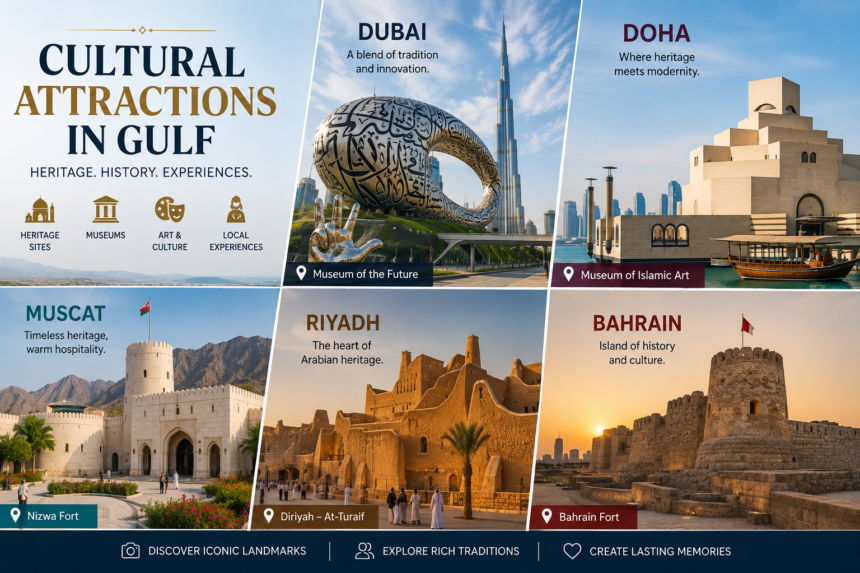
12 Powerful Heritage Sites That Reveal the Real Gulf
The Gulf is often associated with skyscrapers, luxury hotels, shopping malls and futuristic development. But beyond the modern skyline is a much older story shaped by trade, pearl diving, desert communities, seafaring, religion, architecture and ancient settlements.
- Why Cultural Attractions in Gulf Matter
- 1. Al Fahidi Historical Neighbourhood, Dubai
- 2. Dubai Creek
- 3. Diriyah, Saudi Arabia
- 4. AlUla, Saudi Arabia
- 5. Souq Waqif, Doha
- 6. National Museum of Qatar
- 7. Museum of Islamic Art, Doha
- 8. Nizwa Fort, Oman
- 9. Bahla Fort, Oman
- 10. Bahrain Fort
- 11. Muharraq and the Pearling Path
- 12. Kuwait’s Cultural Museums and Historic Areas
- Best Cultural Attractions in Gulf at a Glance
- Traditional Souqs Are Living Cultural Attractions
- Gulf Architecture Tells a Climate Story
- Pearl Diving Shaped Gulf Culture
- Maritime Culture Is Equally Important
- Cultural Attractions for Families
- Cultural Attractions for Couples
- Best Cultural Destinations for Photography
- How to Dress at Cultural Attractions
- Visit Cultural Sites During Cooler Hours
- Cultural Tourism and Modern Development
- Culture Is Not Frozen in the Past
- Food Is Part of Cultural Tourism
- A Seven-Day Gulf Cultural Itinerary
- Common Cultural Travel Mistakes
- FAQs About Cultural Attractions in Gulf
- Conclusion
The best Cultural Attractions in Gulf reveal this deeper identity.
Across the UAE, Saudi Arabia, Qatar, Oman, Bahrain and Kuwait, travellers can explore historic forts, traditional neighbourhoods, archaeological sites, museums, old souqs and places connected with the region’s political and social development.
Dubai’s Al Fahidi Historical Neighbourhood preserves traditional wind-tower architecture, Saudi Arabia’s Diriyah reflects the origins of the Saudi state, Qatar’s museums connect national history with modern design, Oman’s forts reveal centuries of regional power, while Bahrain’s archaeological heritage reaches far deeper into the past.
Together, these places show that Gulf culture is not simply preserved inside museums.
It still lives in architecture, food, markets, crafts and everyday traditions.
Why Cultural Attractions in Gulf Matter
Modern Gulf cities have changed rapidly.
That speed can sometimes make visitors assume there is little history to explore.
The opposite is true.
The region has been connected to:
- Indian Ocean trade,
- pearl diving,
- caravan routes,
- Islamic scholarship,
- maritime commerce,
- tribal traditions,
- spice routes,
- regional empires.
Many Gulf cities grew around ports, forts and markets long before oil transformed their economies.
Cultural tourism helps visitors understand what existed before highways and skyscrapers.
It also explains why the Gulf became internationally connected so quickly.
Trade and cultural exchange were already part of the region’s identity.
1. Al Fahidi Historical Neighbourhood, Dubai
Al Fahidi is one of the best places to experience traditional Dubai.
The district preserves:
- narrow lanes,
- courtyards,
- historic houses,
- wind towers,
- galleries,
- cultural spaces.
The architecture provides insight into how Gulf communities adapted buildings to hot climates before modern air conditioning.
Traditional barjeel, or wind towers, helped direct air into homes.
The neighbourhood is particularly valuable because it allows visitors to walk through heritage rather than simply observe it behind museum glass.
It can easily be combined with:
- Dubai Creek,
- abra rides,
- Spice Souk,
- Gold Souk.
Best for: First-time visitors, history lovers and photographers.
2. Dubai Creek
Dubai Creek is one of the most important cultural landscapes in the UAE.
Before Dubai became a global business centre, the Creek supported:
- trade,
- fishing,
- pearl diving,
- maritime transport.
Traditional abras still cross between Bur Dubai and Deira.
That short journey provides one of the simplest ways to connect with the city’s older identity.
Nearby souqs continue the commercial character that made the Creek important.
The area works especially well at sunset when traditional boats and modern buildings share the same view.
3. Diriyah, Saudi Arabia
Diriyah is one of Saudi Arabia’s most important heritage destinations.
Located near Riyadh, it is closely connected with the origins of the first Saudi state.
The At-Turaif district is especially significant for its traditional Najdi architecture.
Visitors can explore:
- mud-brick structures,
- restored historic areas,
- museums,
- cultural spaces,
- traditional streets.
Diriyah represents a very different atmosphere from modern central Riyadh.
Its value comes from helping visitors understand Saudi political and architectural history.
Best for: History, architecture and Saudi heritage.
4. AlUla, Saudi Arabia
AlUla combines natural beauty and cultural heritage in one of the Gulf’s most dramatic landscapes.
The region contains:
- archaeological sites,
- ancient tombs,
- sandstone formations,
- historic settlements,
- old trade-route connections.
Hegra is the most famous archaeological site in the area.
AlUla also demonstrates how heritage tourism is being developed around history rather than only modern attractions.
For travellers, it provides one of the strongest examples of how deeply human settlement in the Arabian Peninsula reaches into the past.
5. Souq Waqif, Doha
Souq Waqif is one of Qatar’s best-known cultural spaces.
The market has been restored while maintaining a traditional atmosphere.
Visitors can explore:
- spices,
- perfumes,
- textiles,
- handicrafts,
- restaurants,
- traditional products.
The souq is especially lively during the evening.
Unlike a conventional museum, Souq Waqif lets visitors experience culture through movement, food, shopping and social activity.
This makes it particularly useful for families and first-time visitors.
6. National Museum of Qatar
The National Museum of Qatar provides a much deeper understanding of the country.
Its exhibitions explore:
- natural history,
- Bedouin traditions,
- pearl diving,
- political development,
- modern transformation.
The building itself has become an architectural landmark.
For visitors, the museum helps connect modern Doha with the country’s older social and economic foundations.
It is particularly useful for anyone who wants to understand how Qatar changed from a relatively small Gulf community into a major global state.
7. Museum of Islamic Art, Doha
The Museum of Islamic Art is one of the Gulf’s most important cultural institutions.
Its collections include works connected with centuries of Islamic civilisation.
Visitors can encounter:
- manuscripts,
- ceramics,
- textiles,
- metalwork,
- jewellery,
- calligraphy.
The museum’s significance extends beyond Qatar.
It presents Islamic art from different regions and periods, showing how broad and diverse Islamic cultural history really is.
Best for: Art, history and architecture.
8. Nizwa Fort, Oman
Oman’s forts are among the strongest cultural attractions in the GCC.
Nizwa Fort is one of the most famous.
The structure reflects the historical importance of Nizwa as a political, commercial and religious centre.
Visitors can explore:
- defensive architecture,
- towers,
- traditional rooms,
- exhibitions,
- historic views over the surrounding town.
Nearby Nizwa Souq adds another cultural dimension.
Combining the fort and market creates a complete heritage experience.
9. Bahla Fort, Oman
Bahla Fort is another major Omani heritage site.
Its architecture reflects centuries of regional history and defensive building traditions.
The surrounding area is also known for traditional pottery.
Bahla is especially useful for travellers interested in understanding how settlements developed around fortified urban centres.
The atmosphere is very different from Muscat’s more modern areas.
10. Bahrain Fort
Bahrain’s history stretches back thousands of years.
Qal’at al-Bahrain, commonly known as Bahrain Fort, is one of the clearest places to understand that history.
The archaeological site reflects multiple periods of settlement.
It is connected with the ancient Dilmun civilisation, which played an important role in regional trade.
Visitors can explore:
- archaeological remains,
- fortified structures,
- museum displays,
- coastal surroundings.
This makes Bahrain particularly interesting for travellers who want archaeological depth rather than only recent Gulf history.
11. Muharraq and the Pearling Path
Bahrain’s pearling heritage is another important part of Gulf history.
Before oil, pearls were central to the region’s economy.
The Pearling Path in Muharraq helps preserve this legacy.
Visitors can encounter historic houses and urban spaces connected with:
- merchants,
- pearl divers,
- trade,
- community life.
This is especially meaningful because pearl diving was not simply an industry.
It shaped social life and economic survival across much of the Gulf.
12. Kuwait’s Cultural Museums and Historic Areas
Kuwait also offers a distinct cultural story.
The country’s heritage is closely connected with:
- maritime trade,
- pearling,
- merchant families,
- regional commerce.
Cultural institutions and historic areas help explain Kuwait’s development before oil wealth.
Visitors can explore museums, traditional architecture and cultural districts that highlight maritime and social history.
The strongest experiences often combine modern Kuwait City with older traditions and market culture.
Best Cultural Attractions in Gulf at a Glance
| Country | Major Cultural Attraction |
|---|---|
| UAE | Al Fahidi Historical Neighbourhood |
| UAE | Dubai Creek |
| Saudi Arabia | Diriyah |
| Saudi Arabia | AlUla |
| Qatar | Souq Waqif |
| Qatar | National Museum of Qatar |
| Oman | Nizwa Fort |
| Oman | Bahla Fort |
| Bahrain | Bahrain Fort |
| Bahrain | Pearling Path |
| Kuwait | Cultural museums and old commercial districts |
Traditional Souqs Are Living Cultural Attractions
Museums preserve objects.
Souqs preserve behaviour.
Across the Gulf, traditional markets remain one of the best ways to experience local culture.
Visitors can observe:
- bargaining,
- perfume culture,
- spice trading,
- textile shopping,
- jewellery,
- traditional food.
Popular examples include:
- Dubai Spice Souk,
- Souq Waqif,
- Nizwa Souq,
- Manama Souq.
Markets are especially useful for travellers who prefer cultural experiences that feel active rather than formal.
Gulf Architecture Tells a Climate Story
Traditional Gulf architecture was not decorative only.
It responded to the environment.
Features such as:
- thick walls,
- courtyards,
- wind towers,
- shaded lanes,
- small windows
helped manage heat.
The architecture therefore shows how people adapted to harsh climates before modern technology.
Al Fahidi in Dubai and Najdi architecture in Saudi Arabia provide good examples of regionally different solutions.
Pearl Diving Shaped Gulf Culture
Before oil, pearling was one of the most important economic activities in the Gulf.
Communities depended on:
- divers,
- boat crews,
- traders,
- merchants.
Pearling connected Gulf ports with international markets.
Bahrain’s Pearling Path preserves this history particularly well.
But the tradition also influenced Kuwait, Qatar and the UAE.
Understanding pearl diving helps explain the economic foundations that existed before modern hydrocarbons.
Maritime Culture Is Equally Important
The Gulf’s identity is often described through desert culture.
The sea was equally important.
Communities relied on:
- fishing,
- trade,
- dhow building,
- navigation,
- pearl diving.
Dubai Creek, coastal Oman and Kuwait’s maritime heritage all reflect this.
This is why the Gulf should not be understood only as a desert region.
It is also a maritime region.
Cultural Attractions for Families
Good choices include:
- National Museum of Qatar,
- Souq Waqif,
- Al Fahidi,
- Nizwa Fort,
- Diriyah.
Children often respond better to interactive experiences than long museum visits.
Use storytelling.
Instead of saying:
“This building is 200 years old.”
Explain:
“Imagine living here before electricity and air conditioning.”
That makes history easier to understand.
Cultural Attractions for Couples
Couples may prefer:
- evening walks in Souq Waqif,
- Al Fahidi at golden hour,
- Diriyah after sunset,
- AlUla landscapes,
- Bahrain Fort.
Cultural trips can feel surprisingly romantic because they involve slower walking and exploration rather than constant high-energy entertainment.
Best Cultural Destinations for Photography
Strong photography locations include:
- Al Fahidi wind towers,
- Diriyah mud-brick architecture,
- AlUla sandstone landscapes,
- Nizwa Fort,
- Bahrain Fort,
- traditional souqs.
The best light is usually early morning or late afternoon.
Always ask before photographing people.
How to Dress at Cultural Attractions
Most heritage areas are relaxed, but visitors should still dress respectfully.
This is especially important at:
- mosques,
- religious sites,
- conservative communities.
Comfortable walking shoes are also useful because historic districts often involve uneven surfaces and long walks.
Visit Cultural Sites During Cooler Hours
Much of the Gulf becomes extremely hot during daytime for part of the year.
For outdoor heritage districts, early morning and late afternoon can be more comfortable.
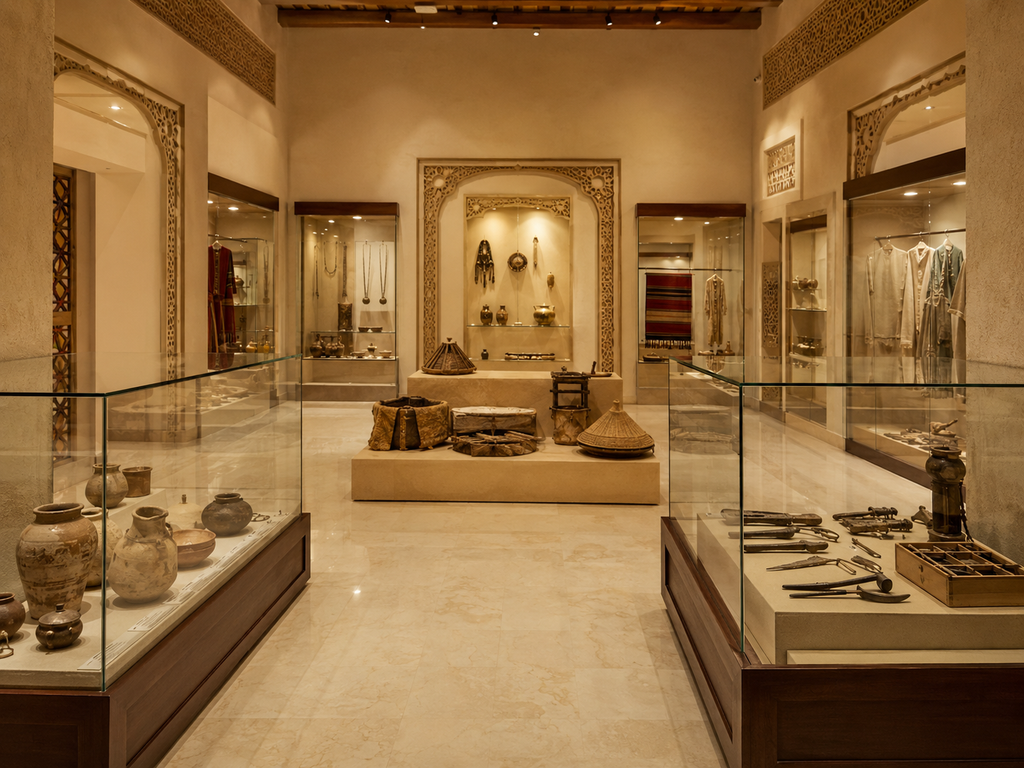
Museums work well during midday.
A practical itinerary might look like:
Morning: Historic neighbourhood
Midday: Museum
Evening: Souq
This reduces heat exposure.
Cultural Tourism and Modern Development
The Gulf faces an interesting challenge.
Cities are developing rapidly.
Historic areas can easily be lost if preservation is not planned.
That is why many GCC governments have invested heavily in:
- restoring forts,
- protecting archaeological sites,
- rebuilding traditional districts,
- creating museums.
The goal is not simply tourism.
Heritage also supports national identity.
Culture Is Not Frozen in the Past
One important mistake visitors make is assuming culture means only old buildings.
Modern Gulf culture includes:
- contemporary art,
- design,
- film,
- music,
- fashion,
- food,
- architecture.
Dubai’s Alserkal Avenue and Qatar’s modern museums demonstrate that cultural identity continues evolving.
The Gulf is not choosing between heritage and modernity.
It is increasingly presenting both.
Food Is Part of Cultural Tourism
One of the easiest ways to explore Gulf culture is through food.
Travellers can try:
- Emirati cuisine,
- Saudi dishes,
- Omani food,
- Bahraini dishes,
- Qatari cuisine,
- Kuwaiti food.
Traditional meals can reveal:
- trade influences,
- spices,
- seafood,
- rice traditions,
- desert lifestyles.
Food creates a direct connection between history and everyday life.
A Seven-Day Gulf Cultural Itinerary
A regional trip could look like:
Day 1–2: Dubai
Al Fahidi, Creek and souqs.
Day 3: Doha
National Museum and Souq Waqif.
Day 4–5: Oman
Nizwa and Bahla.
Day 6: Bahrain
Bahrain Fort and Muharraq.
Day 7: Departure or local museum visit
In practice, flights and visa rules need to be planned carefully, but the itinerary shows how different Gulf cultural experiences can be.
Common Cultural Travel Mistakes
Avoid these:
- Visiting only modern attractions
- Rushing through museums
- Ignoring local etiquette
- Photographing people without permission
- Visiting outdoor sites during extreme heat
- Treating every souq only as a shopping opportunity
- Skipping local food
- Assuming all Gulf cultures are identical
- Ignoring smaller museums
- Not learning the story behind a site
The most meaningful cultural trips happen when travellers understand what they are looking at.
FAQs About Cultural Attractions in Gulf
What are the best Cultural Attractions in Gulf?
Strong choices include Al Fahidi and Dubai Creek in the UAE, Diriyah and AlUla in Saudi Arabia, Souq Waqif and major museums in Qatar, Nizwa and Bahla forts in Oman, and Bahrain Fort and the Pearling Path in Bahrain.
Which Gulf country is best for cultural tourism?
There is no single winner. Saudi Arabia offers major archaeological and historical landscapes, Oman is excellent for forts, Bahrain for ancient archaeology and pearling history, while the UAE and Qatar combine heritage with modern museums.
Is Dubai good for cultural tourism?
Yes. Al Fahidi Historical Neighbourhood, Dubai Creek, traditional souqs and cultural museums reveal a very different side of the city beyond its modern attractions.
Is AlUla a cultural attraction?
Yes. AlUla combines archaeology, ancient settlements, sandstone landscapes and heritage tourism, making it one of Saudi Arabia’s strongest cultural destinations.
What is special about Bahrain Fort?
The site reflects multiple historical periods and is closely connected with the ancient Dilmun civilisation and Gulf trade history.
Are Gulf cultural attractions suitable for families?
Yes. Museums, forts, markets and heritage districts can work particularly well for families when visits are kept interactive and not overly long.
What should I wear at cultural sites in the Gulf?
Comfortable, respectful clothing is generally best. Religious sites may have more specific modest-dress requirements.
When is the best time to visit Gulf heritage attractions?
Cooler months are generally better for outdoor heritage sites, while museums can be visited year-round.
Conclusion
The best Cultural Attractions in Gulf reveal a region far older and more complex than its modern skyline suggests.
Al Fahidi tells the story of traditional Dubai.
Diriyah connects visitors with the origins of Saudi political history.
AlUla reveals ancient settlement and extraordinary archaeology.
Souq Waqif and Qatar’s museums show how culture can be both traditional and modern.
Oman’s forts demonstrate centuries of regional power and architecture.
Bahrain’s archaeological sites reveal a Gulf history that stretches back thousands of years.
These places also explain something important about the region.
The Gulf did not suddenly become internationally connected after oil.
Its people had already spent centuries trading, sailing, migrating and exchanging ideas across the Indian Ocean and Arabian world.
Modern development changed the scale.
It did not create the connection from nothing.
That is why cultural travel matters.
It helps visitors understand the story behind the buildings, markets and landscapes they see today.
The Gulf’s future may be built around technology, finance and modern cities, but its identity remains deeply connected to heritage, trade, family, faith, sea and desert.
follow us on Instagram
Read More – Desert Adventures in Gulf: 12 Amazing Experiences to Try