


Modern Gulf Hospitality Has Turned Dates Into a Premium Gift
Dates in Gulf hospitality are far more than a traditional snack served to guests. Across the UAE, Saudi Arabia, Qatar, Oman and other parts of the Arabian Peninsula, dates are closely connected with welcome, generosity, respect and centuries of life in the desert.
- Dates in Gulf Hospitality and the Tradition of Arabic Coffee
- Dates Became Valuable Because They Could Thrive in Harsh Conditions
- The Majlis Helped Turn Dates Into a Hospitality Tradition
- Dates Represent Generosity Without Requiring an Elaborate Meal
- Dates Have a Special Importance During Ramadan
- Different Gulf Countries Have Their Own Date Traditions
- Dates Are Also Connected to Gulf Agricultural Heritage
- Date Varieties Show That Not All Dates Taste the Same
- Modern Gulf Hospitality Has Turned Dates Into a Premium Gift
- Coffee and Dates Create a Balance of Flavour and Ritual
- Visitor Etiquette When You Are Offered Dates in the Gulf
- Why Dates Still Matter in Modern Gulf Cities
- Common Misunderstandings About Dates and Gulf Hospitality
- Why Dates Are So Important in Gulf Hospitality Today
The tradition of serving dates with Arabic coffee remains visible in homes, majlis gatherings, hotels, cultural centres and formal receptions across the Gulf. In Abu Dhabi, official tourism guidance describes dates as an important symbol of hospitality, heritage and nourishment that are traditionally served with Arabic coffee.
Saudi Arabia follows a similar tradition, where guests entering a home or office may be welcomed with dates and qahwa. Qatar also places dates at the centre of local hospitality customs, particularly during majlis gatherings and cultural occasions.
The importance of dates comes from several parts of Gulf life at once. They are linked with agriculture, family traditions, Ramadan, coffee culture, gifting and the long-established responsibility of looking after guests.
Understanding dates in Gulf hospitality therefore means understanding how one simple fruit became a symbol of welcome throughout the region.
Dates in Gulf Hospitality and the Tradition of Arabic Coffee
The strongest connection between dates and hospitality can be seen in the way they are served with Arabic coffee.
Across much of the Gulf, a guest may receive a small cup of aromatic gahwa together with a plate or bowl of dates soon after arriving.
In Emirati culture, Arabic coffee represents generosity and welcome. Dates traditionally accompany the drink because their natural sweetness balances the slightly bitter and aromatic flavour of the coffee.
Qatar follows a similar custom. Guests entering a majlis may receive dates and coffee poured from a traditional dallah, while Saudi households also commonly offer qahwa and dates as an immediate gesture of hospitality.
This combination works for practical reasons as well.
The host can welcome someone immediately without having to prepare a full meal. Dates provide something nourishing and sweet, while coffee creates an opportunity for conversation and repeated interaction between the host and guest.
The tradition is therefore about much more than flavour.
It creates the first moment of connection between visitor and host.
Dates Became Valuable Because They Could Thrive in Harsh Conditions
The cultural significance of dates is closely tied to geography.
For generations, people living across the Arabian Peninsula had to adapt to environments with high temperatures, limited rainfall and difficult agricultural conditions. Date palms were particularly valuable because they could grow in oasis environments where many other crops struggled.
This made dates more than a luxury.
They became a reliable food source.
Date palms provided fruit that could be eaten fresh or preserved, while other parts of the tree could historically be used for practical purposes such as shelter, household items and agricultural materials.
Because dates could also be stored for long periods, they were especially useful in communities where food security depended on crops that could survive beyond a short harvest season.
Visit Saudi notes that dates have been cultivated and traded in the region for thousands of years and have remained a staple of the Saudi diet since ancient times.
Qatar’s official tourism platform similarly describes dates as one of the oldest cultivated fruits and notes their long relationship with life on the Arabian Peninsula.
That historical importance helps explain why offering dates became a meaningful gesture.
A host was not simply offering something sweet. The host was sharing one of the most dependable foods available in the local environment.
Over generations, that practical act developed into a cultural symbol of generosity.
The Majlis Helped Turn Dates Into a Hospitality Tradition
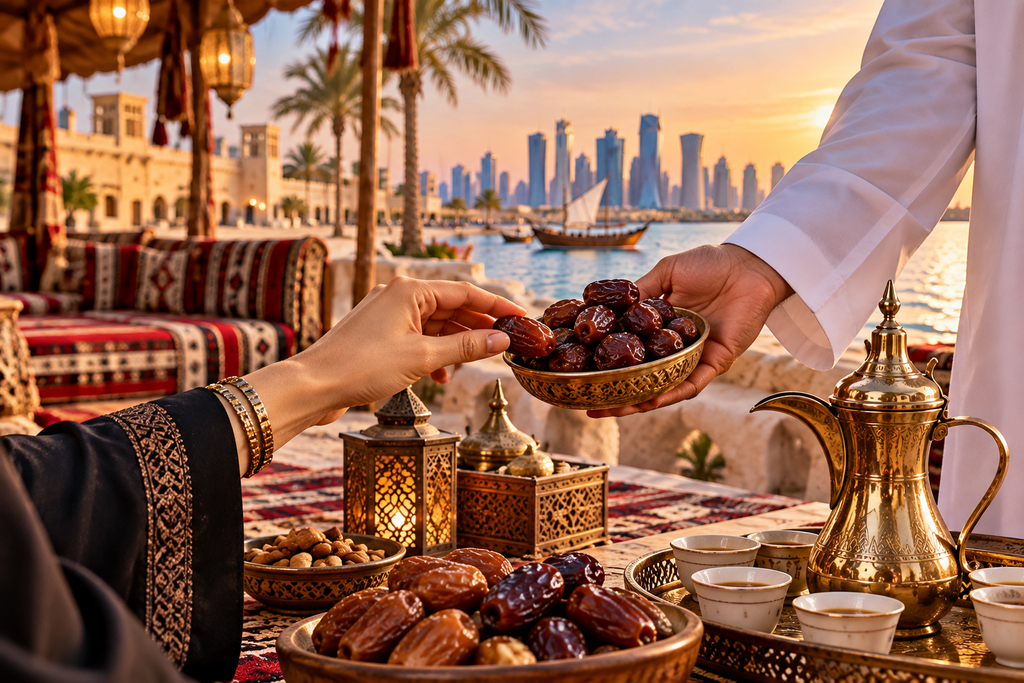
The majlis is one of the most important social spaces in Gulf culture.
The Arabic word refers to a place of sitting or gathering. Traditionally, a majlis could be used to welcome guests, discuss community matters, exchange news and strengthen family or social relationships.
Visit Qatar explains that majlis culture goes back to Bedouin times and that guests traditionally receive dates and Arabic coffee while sitting together.
The UAE, Oman, Qatar and Saudi Arabia jointly succeeded in having majlis culture included on UNESCO’s Representative List of the Intangible Cultural Heritage of Humanity in 2015.
Within this setting, dates make sense as a hospitality food because they can be served immediately and shared easily.
They do not require complicated cutlery or preparation at the table. A plate can be placed between guests, allowing people to eat while conversation continues.
This simplicity supports the wider purpose of the majlis.
Hospitality is not only about feeding someone. It is about making that person feel comfortable enough to sit, talk and remain part of the gathering.
Dates therefore became part of the social rhythm of welcoming guests rather than simply part of the meal.
Dates Represent Generosity Without Requiring an Elaborate Meal
One reason traditional hospitality customs survive is that they are easy to practise in everyday life.
A host does not need to organise a banquet whenever someone visits.
Offering dates and Arabic coffee creates an immediate gesture of generosity even during a short visit.
That flexibility is important.
A friend may stop by unexpectedly. A business guest may arrive at an office. A visitor may enter a heritage centre or traditional gathering. In each case, a small serving of dates can communicate welcome without requiring a formal dining arrangement.
Visit Saudi describes hospitality as one of the defining characteristics of Saudi society and says welcoming guests with dates and coffee reflects long-established values of generosity and respect.
Abu Dhabi tourism information uses very similar language, explaining that coffee and dates are traditional ways of welcoming visitors into hotels, homes and cultural environments.
The important point is that hospitality is not measured only by cost.
A relatively simple plate of dates can carry more cultural meaning than an expensive dessert because the gesture is connected with tradition.
This is why the custom remains visible even in modern luxury settings.
Five-star hotels, government receptions and cultural attractions may all present dates and gahwa despite having access to far more elaborate food.
The ritual itself is what matters.
Dates Have a Special Importance During Ramadan
Dates also have a strong relationship with Ramadan, which reinforces their cultural significance across the Gulf.
Muslims traditionally break the daily fast at sunset, and dates are closely associated with the first moments of iftar.
In Saudi Arabia, Visit Saudi specifically notes that dates are eaten to break the fast during Ramadan as well as being part of everyday hospitality.
The practice connects religious tradition with a food that has already been central to life in the region for generations.
During Ramadan, families may gather around the table with dates, water, coffee, soups and other dishes ready for sunset.
Hotels, restaurants and Ramadan tents across Gulf cities also commonly place dates on iftar tables.
Because Ramadan is strongly associated with family, generosity, charity and community, the date becomes part of several layers of meaning at once.
It is nourishment after fasting.
It is a traditional food.
It is shared with family and guests.
It is offered during one of the most socially important periods of the year.
This is one reason visitors travelling during Ramadan may notice dates appearing even more frequently than usual in hotels, restaurants and cultural events.
Different Gulf Countries Have Their Own Date Traditions
The basic hospitality meaning is shared across the Gulf, but individual countries and regions have their own varieties, farming traditions and preferences.
Saudi Arabia
Saudi Arabia has one of the region’s strongest date cultures. Visit Saudi describes dates as an iconic symbol of Arabian hospitality and notes that they have been cultivated and traded throughout the region for thousands of years.
Ajwa is particularly associated with Madinah, while other well-known varieties include Anbara and Khalas.
Dates can be eaten at different stages of ripeness, from firmer fresh fruit to soft fully ripened dates.
United Arab Emirates
The UAE has extensive date-growing traditions, particularly around oasis regions such as Al Ain and Al Dhafra.
Abu Dhabi’s Liwa Date Festival celebrates local agriculture every year, with farmers competing across different varieties and quality categories.
Visitors may encounter fresh dates, dried dates and modern versions filled with nuts, chocolate or citrus peel.
Qatar
Visit Qatar identifies dates as the national fruit and notes that they are deeply connected with Qatari hospitality.
Qatar also holds an annual local dates festival and has invested in domestic date production.
The fruit remains visible in homes, majlis gatherings, cultural events and Ramadan hospitality.
Oman
Oman also has a long date-growing tradition, with palms forming an important part of oasis agriculture.
Dates are commonly served with Omani kahwa, particularly when guests arrive.
Across the Gulf, therefore, the hospitality custom remains broadly similar even though the varieties and regional preferences differ.
Dates Are Also Connected to Gulf Agricultural Heritage
Date palms are culturally important not only because people eat the fruit but because the trees shaped traditional agricultural communities.
Oasis settlements depended heavily on careful water management.
In places such as Al Ain in the UAE and Al Ahsa in Saudi Arabia, palm cultivation became part of landscapes supported by irrigation systems and groundwater sources.
Date palms also helped create conditions in which other crops could grow by providing shade.
This gave the palm a wider agricultural value beyond its fruit.
For generations, successful date harvests could influence food supplies, trade and household security.
The importance of the crop therefore became embedded in local identity.
Modern Gulf countries now celebrate this heritage through agricultural festivals, markets and cultural events.
Abu Dhabi’s annual Liwa Date Festival, for example, brings together farmers, competitions and public activities centred around date production.
Qatar similarly celebrates the fruit through a local dates festival, reflecting both agricultural heritage and contemporary farming.
For visitors, these events show that dates are not simply decorative items placed beside coffee.
They remain part of a living agricultural tradition.
Date Varieties Show That Not All Dates Taste the Same
Visitors unfamiliar with dates may imagine that every variety tastes roughly identical.
In reality, differences can be significant.
Some dates are soft and caramel-like, while others are firmer, less sweet or more complex in flavour.
Texture can also range from juicy and fresh to chewy and dried.
Saudi Arabia alone produces numerous recognised varieties.
Visit Saudi also describes four stages of ripening: kimri, khalal, rutab and tamr. The fruit changes colour, texture and sweetness as it develops.
Visitors may therefore encounter:
- Fresh yellow dates
- Soft semi-ripe dates
- Fully ripened brown dates
- Drier stored dates
- Stuffed dates
- Premium gift-box varieties
The stage of ripeness can dramatically change the eating experience.
Fresh khalal-stage dates may be firm and crisp, while rutab dates are softer and sweeter.
Tamr is the familiar darker, fully ripened form that travels and stores particularly well.
Trying several varieties is one of the easiest ways for visitors to understand why date culture is much richer than a single supermarket product might suggest.
Modern Gulf Hospitality Has Turned Dates Into a Premium Gift
Traditional date hospitality has also evolved.
Dates are now frequently packaged as premium gifts, especially during Ramadan, Eid, weddings, corporate occasions and international visits.
Luxury date boxes may contain fruit filled with:
- Almonds
- Pistachios
- Orange peel
- Chocolate
- Other nuts
Abu Dhabi tourism guidance notes that dates are now sold in many contemporary forms, including chocolate-dipped and almond- or orange-peel-filled versions.
This transformation has allowed an old hospitality tradition to fit naturally into modern gift culture.
A beautifully presented box of dates can communicate both luxury and regional identity.
That is important in cities such as Dubai, Abu Dhabi, Riyadh and Doha, where corporate hospitality often involves international guests.
Instead of giving a generic box of chocolates, dates offer something closely connected with local culture.
They can therefore function as:
- Business gifts
- Ramadan gifts
- Eid gifts
- Wedding gifts
- Hotel welcome gifts
- Travel souvenirs
The presentation may change, but the underlying message remains similar: the guest is valued.
Coffee and Dates Create a Balance of Flavour and Ritual
The pairing of coffee and dates is not only cultural; it also works remarkably well from a flavour perspective.
Traditional Gulf gahwa is generally lighter than heavily roasted Western coffee and can include cardamom, saffron or other aromatics.
Visit Qatar describes qahwa as a fragrant golden coffee and notes that families preserve their own recipes and serving traditions.
A date provides natural sweetness without changing the coffee itself.
This allows the guest to alternate between the aromatic drink and sweet fruit.
In Qatar, visitors are traditionally served coffee in small finjan cups, and Visit Qatar notes that guests commonly nibble on dates or something sweet while drinking.
The small serving size is also important.
Hospitality is designed around repeated interaction.
The host pours a little coffee, the guest drinks it, the cup may be refilled and conversation continues.
Dates can be eaten throughout this process.
The ritual therefore encourages social connection rather than simply delivering a large drink and ending the service.
Visitor Etiquette When You Are Offered Dates in the Gulf
Visitors do not need to know complicated rules to participate respectfully in Gulf hospitality.
The most important thing is to recognise that an offering of dates and coffee is a gesture of welcome.
If you are comfortable doing so, accepting at least a small amount is usually a polite way to acknowledge the host’s generosity.
Use your right hand
In traditional settings, food and coffee are generally received with the right hand.
Visit Qatar specifically notes that the traditional finjan coffee cup is handed and received with the right hand.
The same approach can be followed when taking a date from a communal plate.
You do not need to eat many
Hospitality does not require guests to overeat.
One or two dates and a small coffee are enough to participate in the tradition.
Watch the host
If you are unsure what to do, observe how other people behave.
Gulf hosts are used to international visitors and generally do not expect tourists to understand every detail immediately.
How to stop coffee refills
In several Gulf traditions, gently shaking the finjan indicates that you have finished drinking coffee.
Visit Qatar documents this custom as part of Arabic coffee etiquette.
The small gesture can be useful when attending a cultural meal, majlis or traditional event.
Why Dates Still Matter in Modern Gulf Cities
Gulf societies have changed enormously.
Dubai, Doha, Abu Dhabi and Riyadh now contain international restaurants, specialty coffee shops, luxury hotels and global retail brands.
Yet dates remain visible.
That continuity is significant.
Traditional hospitality customs have survived because they remain simple, meaningful and adaptable.
A family can serve dates at home.
A government office can place them in a reception room.
A five-star hotel can offer them at check-in.
A Ramadan tent can place them on every table.
A company can send them as a corporate gift.
The same fruit works across each setting without losing its connection to the region.
In Qatar, dates remain associated with both majlis culture and modern cultural events.
In Saudi Arabia, they remain a standard welcome in homes and offices.
In the UAE, they continue to appear alongside gahwa at traditional gatherings, cultural institutions and hotels.
This makes dates an unusually successful bridge between traditional life and contemporary Gulf hospitality.
Common Misunderstandings About Dates and Gulf Hospitality
One common misunderstanding is that dates are served simply because they are sweet.
Their sweetness certainly complements coffee, but their cultural role is much deeper. They represent generations of agriculture, nourishment and guest hospitality.
Another mistake is assuming all Gulf date traditions are identical. The general custom is shared, but Saudi Arabia, the UAE, Qatar, Oman and individual regions have different varieties, agricultural traditions and serving preferences.
Visitors may also assume that only older or traditional households maintain the custom.
In reality, dates remain common in modern hotels, government venues, corporate gifting and formal events.
Another misunderstanding is that visitors must follow complicated rules when offered dates. Gulf hospitality is designed to welcome guests, not test them.
Receiving food politely, using the right hand in traditional settings and following the host’s lead are usually sufficient.
Finally, dates should not be understood as only a Ramadan food. They become especially visible during the Holy Month, but the tradition of serving dates with coffee continues throughout the year.
Why Dates Are So Important in Gulf Hospitality Today
The answer to why dates are so important in Gulf hospitality lies in the way one small fruit connects many parts of regional culture.
Dates provided nourishment in a difficult climate.
Date palms supported oasis agriculture and community life.
The fruit could be preserved and shared easily, making it practical for households and travellers.
Over time, offering dates became closely connected with generosity and the obligation to welcome a guest.
The majlis strengthened that social tradition, with dates and Arabic coffee becoming central elements of receiving visitors. In Qatar, for example, official cultural guidance still describes dates and coffee as standard majlis hospitality.
Saudi Arabia continues the same tradition in homes and offices, where guests are commonly greeted with qahwa and dates.
The UAE similarly treats coffee and dates as symbols of hospitality, heritage and nourishment.
Ramadan gives dates an additional religious and social importance, while modern packaging has turned them into one of the Gulf’s most recognisable food gifts.
The custom therefore survives because it is both practical and symbolic.
When a visitor receives a cup of Arabic coffee and a plate of dates, the host is offering much more than food.
The gesture says that the guest is welcome, that time can be shared together and that a tradition carried through generations is still alive.
Do follow us on Instagram
Read More – Traditional Qatari Foods Worth Trying: A Local Food Guide for Visitors