Powerful Benefits of Intergenerational Knowledge Transfer
Across the Arabian Gulf, workplaces are experiencing significant changes as new technologies, economic diversification, and evolving employment expectations reshape the skills businesses require. From financial institutions and energy companies to hospitals, construction firms, family businesses, and technology startups, organisations are investing in digital capabilities and professional development to prepare for the future.
- 1. Why Intergenerational Knowledge Transfer in the Gulf Is Becoming Essential
- 2. How Experienced Professionals Can Support Younger Employees
- 3. Why Reverse Mentoring and Digital Skills Matter for Future Workforces
- 4. How UAE and Saudi Arabia Are Supporting Workforce Knowledge Development
- 5. Why Knowledge Transfer Matters for Family Businesses and Critical Industries
- 6. The Barriers to Effective Intergenerational Knowledge Sharing
- 7. The Future of Intergenerational Knowledge Transfer in the Gulf Workforce
However, while companies focus on artificial intelligence, automation, and emerging technical skills, another important source of competitive advantage deserves attention: the experience and practical knowledge already held by their employees.
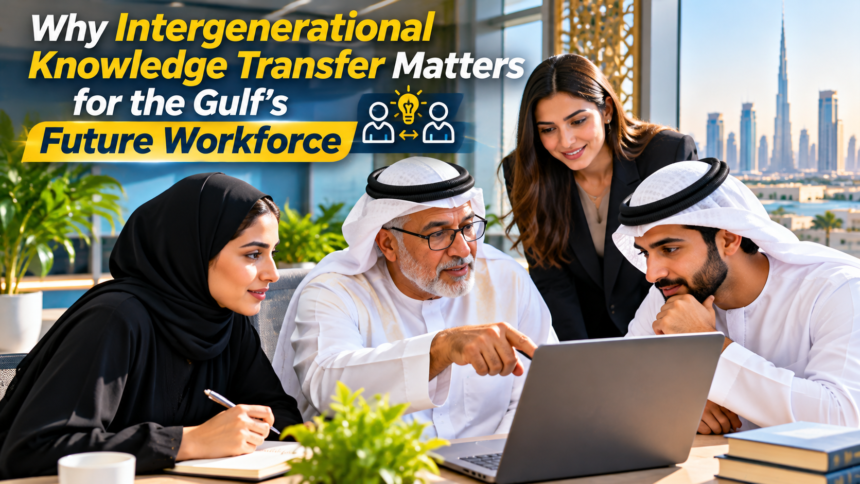
Intergenerational knowledge transfer in the Gulf could become increasingly important as organisations seek to connect the professional experience of established workers with the skills, ideas, and technological familiarity of newer employees.
Knowledge transfer involves sharing expertise, practical techniques, professional judgement, and organisational understanding between individuals or teams. When this learning takes place across different career stages and age groups, it can help businesses preserve valuable experience while encouraging adaptation and innovation.
This matters across the United Arab Emirates, Saudi Arabia, Qatar, Kuwait, Bahrain, and Oman, where workforce development is closely connected to economic transformation and the growth of knowledge-based industries.
Saudi Arabia’s Human Capability Development Program prioritises future skills, lifelong learning, and workforce readiness. The UAE is also investing in leadership development, mentorship, and professional opportunities for national talent.
At the same time, global research suggests that workforce requirements will continue changing. The World Economic Forum’s Future of Jobs Report 2025 estimates that 39% of workers’ existing core skills will change by 2030.
However, transferring knowledge is not simply a matter of older employees teaching younger colleagues. Effective learning can move in both directions, combining technical experience, digital capabilities, cultural understanding, and fresh perspectives.
Understanding how organisations can encourage these exchanges may help explain why intergenerational learning is relevant to the Gulf’s future workforce.
1. Why Intergenerational Knowledge Transfer in the Gulf Is Becoming Essential
Modern workplaces depend on many forms of knowledge.
Some information is documented in manuals, policies, training materials, and digital systems. Other knowledge develops gradually through professional experience.
An engineer may understand how equipment behaves during unusual operating conditions, while an experienced customer-service manager may recognise the early signs of a difficult client relationship.
These skills can be difficult to capture completely in formal instructions.
Understanding Explicit and Tacit Knowledge
Explicit knowledge includes information that can be recorded and shared through documents, procedures, databases, and training materials.
Tacit knowledge involves experience-based understanding that may be difficult to explain without practical demonstration.
For example, a maintenance technician may follow an official inspection checklist while also using years of experience to recognise subtle warning signs.
Both forms of knowledge are valuable.
Organisations that preserve written procedures but overlook practical expertise may lose important capabilities when experienced employees leave.
Why the Gulf Workforce Is Changing
GCC economies are developing new industries while modernising established sectors.
Digital services, tourism, advanced manufacturing, logistics, healthcare, and renewable energy are creating demand for different combinations of skills.
This requires organisations to develop new talent without losing the expertise needed to operate existing businesses.
The challenge is particularly relevant to companies combining experienced professionals, newly recruited graduates, and employees from different national backgrounds.
The Risk of Knowledge Loss
When employees retire, change organisations, or relocate internationally, they may take valuable institutional knowledge with them.
This can include supplier relationships, technical problem-solving experience, and an understanding of previous operational decisions.
Without appropriate knowledge-sharing arrangements, remaining employees may need to rediscover solutions to familiar problems.
Types of Workplace Knowledge
| Knowledge Type | Example | Transfer Method |
|---|---|---|
| Technical Expertise | Equipment maintenance | Supervised practical training |
| Organisational Knowledge | Internal procedures | Documentation and mentoring |
| Industry Relationships | Supplier communication | Joint meetings and introductions |
| Leadership Judgement | Difficult decisions | Case discussions |
| Digital Skills | Automation tools | Reverse mentoring |
| Cultural Understanding | Cross-border communication | Collaborative learning |
The objective is to preserve useful knowledge while allowing outdated practices to be questioned and improved.
2. How Experienced Professionals Can Support Younger Employees
Formal education provides important foundations for professional careers, but many workplace capabilities develop through experience.
Young employees may understand technical concepts while needing guidance on applying them in complex situations.
Experienced colleagues can help connect theoretical knowledge with operational realities.
Learning Through Practical Experience
An engineering graduate may know how a system is designed but have limited experience troubleshooting failures under time pressure.
Working alongside an experienced engineer can provide exposure to real operational decisions.
Similarly, a junior journalist may understand reporting principles while benefiting from an editor’s experience handling sensitive interviews or verifying complicated information.
These learning opportunities often involve observation, feedback, and repeated practice.
The Importance of Mentorship
Mentorship creates a structured relationship in which an experienced professional supports another person’s development.
This can involve career guidance, technical advice, workplace communication, and leadership preparation.
The OECD identifies mentoring and job shadowing as useful approaches for sharing knowledge across career stages.
However, mentorship is most effective when participants have clear expectations and sufficient time to engage.
Evidence From UAE Workplaces
Research associated with Khalifa University examined knowledge management across multiple generations in UAE workplaces.
The study involved interviews with 85 supervisors and 91 employees receiving supervision.
It found that younger participants particularly valued on-the-job training and individual coaching for learning technical work skills.
The research also identified communication difficulties and organisational barriers to knowledge transfer.
Although the study predates current workforce changes, it provides relevant evidence about the importance of practical learning.
Mentorship Models Compared
| Learning Model | Main Purpose | Suitable Application |
|---|---|---|
| One-to-One Mentoring | Ongoing professional guidance | Career development |
| Job Shadowing | Learning through observation | Operational knowledge |
| Structured Coaching | Developing a specific capability | Technical or leadership skills |
| Apprenticeship | Practical skill development | Skilled trades |
| Group Mentoring | Sharing expertise with multiple employees | Graduate programmes |
| Project-Based Learning | Learning through real assignments | Cross-functional development |
Why Mentorship Should Be Structured
Simply assigning an experienced employee to a younger colleague does not guarantee useful learning.
Successful programmes require suitable pairing, specific objectives, agreed meeting schedules, and opportunities to apply new skills.
Participants should also understand how progress will be evaluated.
3. Why Reverse Mentoring and Digital Skills Matter for Future Workforces

Knowledge transfer should not be understood as a one-way process.
Employees at different career stages often possess different strengths.
A newer employee may have experience using emerging digital tools, while a senior colleague contributes industry knowledge and professional judgement.
Combining these capabilities can improve organisational learning.
Understanding Reverse Mentoring
Reverse mentoring typically involves a less experienced employee sharing particular knowledge with a more experienced colleague.
Common topics include digital communication, emerging software, online collaboration, and new approaches to customer engagement.
However, reverse mentoring should not assume that all younger employees are digitally skilled or that older professionals are unfamiliar with technology.
Participants should be selected according to actual expertise.
Artificial Intelligence and Workplace Learning
AI systems are influencing how employees research information, analyse data, develop content, and automate selected tasks.
A younger employee familiar with a specific AI tool may help colleagues understand its practical features.
Meanwhile, an experienced manager can contribute knowledge about accuracy, legal obligations, professional ethics, and operational risks.
Together, they may identify more responsible ways to use technology.
Combining Innovation With Experience
Consider a financial services company introducing an automated customer-support system.
A digitally experienced employee may understand the software’s technical capabilities.
An established customer-service professional may recognise situations requiring personal attention or escalation.
Both perspectives are important.
Technology adoption can become more effective when the people responsible for implementation understand both new systems and existing business requirements.
Two-Way Learning Opportunities
| Established Professional May Contribute | Emerging Professional May Contribute |
|---|---|
| Industry experience | Familiarity with selected new tools |
| Complex decision-making | Alternative workflow ideas |
| Client relationship knowledge | Digital communication approaches |
| Regulatory experience | New research methods |
| Operational risk awareness | Technology experimentation |
| Institutional history | Fresh perspectives on existing processes |
Creating Mutual Respect
Reverse mentoring requires an environment in which employees feel comfortable asking questions regardless of their position.
Senior professionals should not be embarrassed about learning new tools.
Similarly, younger workers should not be discouraged from questioning established approaches.
The strongest outcome is mutual learning rather than competition between generations.
4. How UAE and Saudi Arabia Are Supporting Workforce Knowledge Development
Workforce development is already an important policy priority across the GCC.
Although national programmes differ in their objectives, several initiatives demonstrate the importance placed on skills, leadership, and professional learning.
The UAE’s Nafis Leadership Programme
The UAE Government Leaders Programme includes a Nafis Leadership Programme aimed at developing Emirati talent in the private sector.
It combines executive education, mentorship, experiential learning, and practical challenges.
The programme focuses on capabilities including decision-making, communication, leadership, and technology-related understanding.
In April 2026, Abu Dhabi’s Government Media Office announced the extension of the wider Nafis programme until 2040.
However, the broader Nafis programme includes multiple employment and workforce initiatives. Its extension should not be interpreted as applying exclusively to mentoring.
Abu Dhabi’s Qudwati Programme
In August 2026, Abu Dhabi’s Department of Community Development launched Qudwati.
The programme connects Emirati youth with experienced professionals and retirees through interactive workshops and discussions.
Its objectives include strengthening decision-making, developing confidence, and encouraging the exchange of practical knowledge and life experience.
Qudwati provides a direct example of a public initiative designed around intergenerational learning.
However, it is a broader youth-development programme rather than a mandatory corporate workplace system.
Saudi Arabia’s Human Capability Development Program
Saudi Arabia’s Human Capability Development Program is a component of Vision 2030.
It focuses on education, preparation for future labour markets, workforce upskilling, and lifelong learning.
The programme recognises the need for capabilities that support technological change and economic diversification.
Businesses can complement these objectives through workplace mentoring, knowledge documentation, and professional development.
However, individual employers must develop their own systems rather than assuming national programmes automatically transfer expertise within companies.
Regional Workforce Development Approaches
| Initiative | Main Focus | Knowledge-Transfer Relevance |
|---|---|---|
| UAE Nafis Leadership Programme | Developing national leadership talent | Mentorship and practical learning |
| Abu Dhabi Qudwati | Connecting youth with experienced individuals | Direct intergenerational exchange |
| Saudi Human Capability Development Program | Skills and lifelong learning | Broader workforce capability development |
| Saudi Sectoral Skills Councils | Aligning sector skills with labour-market requirements | Identifying capability gaps |
| Employer Mentoring Programmes | Company-specific professional development | Sharing institutional experience |
These initiatives provide different forms of support and should not be treated as identical programmes.
5. Why Knowledge Transfer Matters for Family Businesses and Critical Industries
The Gulf’s workforce includes industries in which accumulated experience is particularly valuable.
Energy, utilities, construction, aviation, logistics, and healthcare depend on professional judgement developed through extensive practice.
Family-owned businesses can also benefit from preserving knowledge as leadership responsibilities change.
Family Business Succession
Many family businesses operate through relationships and practices developed over long periods.
Founders and senior family members may possess detailed knowledge of customers, suppliers, negotiations, and business strategy.
When responsibilities move to the next generation, transferring this experience can be important.
However, succession should involve more than informal conversations.
Documented responsibilities, governance arrangements, leadership preparation, and clear decision-making processes can support continuity.
Knowledge Transfer in Energy and Utilities
Industrial facilities often contain specialised equipment and operating systems.
Experienced engineers may understand historical maintenance issues, previous modifications, and uncommon technical failures.
This knowledge can be useful when training employees responsible for future operations.
However, informal expertise must be checked against current engineering standards and official safety procedures.
Healthcare and Professional Judgement
Healthcare professionals develop clinical skills through education, supervised practice, and continuing development.
Experienced practitioners can support trainees through appropriate mentoring and supervision.
However, clinical knowledge transfer must follow professional regulations and evidence-based standards.
Personal experience should never replace validated medical protocols.
Industry-Specific Applications
| Industry | Important Knowledge | Possible Transfer Approach |
|---|---|---|
| Energy | Equipment behaviour and safety procedures | Supervised training |
| Construction | Project coordination and risk management | Site mentoring |
| Healthcare | Clinical judgement within professional standards | Structured supervision |
| Aviation | Operational procedures and decision-making | Approved training programmes |
| Hospitality | Guest relations and service recovery | Coaching |
| Family Business | Governance and commercial relationships | Succession planning |
| Financial Services | Risk management and client relationships | Case-based learning |
The Importance of Business Continuity
Knowledge transfer helps organisations reduce dependence on particular individuals.
If critical information is held by only one employee, unexpected absence or departure can disrupt operations.
Documenting essential processes and training suitable successors can improve resilience.
However, confidential business information must be managed securely.
6. The Barriers to Effective Intergenerational Knowledge Sharing
Although knowledge transfer offers potential benefits, workplace programmes can fail when organisations overlook practical challenges.
These may include communication difficulties, time pressures, hierarchy, cultural differences, and unclear incentives.
The Problem of Workplace Hierarchy
Employees may hesitate to ask questions when they fear appearing inexperienced.
Similarly, senior professionals may feel uncomfortable discussing unfamiliar technologies.
A strongly hierarchical environment can discourage open learning if employees believe that expertise must always flow from the top downward.
Managers can help by treating questions and constructive feedback as normal parts of professional development.
Different Communication Preferences
Employees may prefer different ways of learning.
Some value detailed written instructions, while others prefer demonstrations or interactive sessions.
However, these preferences should not be assigned automatically according to age.
Individual experience, language ability, job responsibilities, and learning needs can be more informative.
Limited Time for Mentoring
Employees managing demanding workloads may find it difficult to dedicate time to training others.
Without organisational support, knowledge sharing can become an additional unpaid or unrecognised responsibility.
Businesses should allocate appropriate time and clarify expectations.
Knowledge Hoarding and Job Security
Some employees may hesitate to share specialised expertise because they believe it protects their position.
Others may worry that transferring knowledge will make their role less valuable.
Management can address these concerns by recognising mentoring contributions and supporting fair career development.
Common Barriers and Responses
| Barrier | Potential Consequence | Practical Response |
|---|---|---|
| Poor Communication | Misunderstood information | Clear learning objectives |
| Workplace Hierarchy | Reluctance to ask questions | Supportive leadership |
| Lack of Time | Irregular mentoring | Dedicated development time |
| Unclear Responsibilities | Limited progress | Defined mentor roles |
| Knowledge Hoarding | Loss of organisational learning | Recognition and incentives |
| Language Differences | Communication gaps | Accessible training materials |
| Unstructured Documentation | Difficulty finding information | Centralised knowledge management |
| Age-Based Assumptions | Missed learning opportunities | Skills-based participation |
Why Cultural Awareness Matters in the Gulf
GCC workplaces often bring together employees from different countries and professional backgrounds.
Language, communication style, and expectations regarding workplace authority may influence collaboration.
Effective programmes should account for these differences without stereotyping employees.
The objective is to make valuable expertise accessible across teams.
7. The Future of Intergenerational Knowledge Transfer in the Gulf Workforce
The future of workforce development is likely to involve a combination of formal education, continuous training, mentoring, digital learning, and practical experience.
Businesses that connect these approaches may be better positioned to preserve essential expertise while adapting to technological change.
Building Structured Knowledge-Transfer Programmes
Organisations can begin by identifying important skills concentrated among a limited number of employees.
These may include technical procedures, client relationships, specialised software knowledge, or leadership capabilities.
Once critical knowledge areas are identified, managers can select suitable transfer methods.
Some skills are best taught through demonstrations, while others can be documented through written procedures or case studies.
The Role of Digital Knowledge Systems
Digital platforms can help companies organise training resources, technical instructions, and lessons learned from completed projects.
Videos, searchable documents, and internal knowledge bases may make information more accessible.
However, these tools cannot capture every aspect of professional judgement.
Practical coaching remains important.
A Practical Workforce Knowledge-Transfer Checklist
- Identify roles containing essential institutional knowledge.
- Assess risks associated with employee departure or retirement.
- Document critical procedures and operating decisions.
- Create structured mentoring opportunities.
- Encourage reverse mentoring based on actual expertise.
- Allocate time for knowledge-sharing activities.
- Support communication across languages and cultures.
- Protect confidential and sensitive information.
- Recognise employees who contribute to training.
- Measure learning outcomes and update programmes regularly.
How Businesses Should Measure Success
Knowledge-sharing activities should be evaluated through practical outcomes rather than the number of mentoring meetings alone.
Useful indicators include skill development, training completion, employee confidence, operational performance, and succession readiness.
Managers may also assess whether employees can independently perform tasks previously concentrated among a few specialists.
However, improvements should not be attributed exclusively to mentoring when other organisational changes may have contributed.
Knowledge-Transfer Performance Indicators
| Indicator | What It Measures |
|---|---|
| Skill Development | Improvement in demonstrated capability |
| Mentoring Participation | Employee engagement |
| Succession Readiness | Availability of prepared successors |
| Documentation Quality | Accessibility of essential knowledge |
| Training Application | Use of learned skills in real work |
| Employee Feedback | Practical usefulness of learning |
| Operational Continuity | Ability to maintain key functions |
| Cross-Functional Collaboration | Knowledge sharing between teams |
Preparing for the Future of Leadership
Strategy& Middle East estimated in a 2025 analysis that GCC economic diversification and technological development could create demand for around 700,000 additional top and middle managers by 2030 compared with requirements in 2024.
This projection highlights the importance of developing leadership capabilities.
Formal qualifications can provide valuable foundations, but practical experience and mentoring may also help emerging leaders manage complex responsibilities.
Creating Learning Organisations
A learning organisation encourages employees to update their knowledge throughout their careers.
Senior professionals continue developing new capabilities while less experienced workers gain practical understanding.
This model can reduce the assumption that training ends after recruitment or that professional development belongs only to younger employees.
The OECD recommends age-inclusive workplace practices involving mentoring, job rotation, reverse mentoring, and continuing education.
Conclusion
Intergenerational knowledge transfer could become an important part of strengthening the Gulf’s future workforce as organisations adapt to technological change, economic diversification, and evolving employment expectations.
Experienced professionals possess practical knowledge developed through years of work, while newer employees may contribute different technical capabilities, ideas, and approaches.
Connecting these strengths can help organisations preserve important expertise while encouraging innovation.
Initiatives in the UAE and Saudi Arabia demonstrate growing regional attention to mentorship, leadership development, and lifelong learning.
However, effective knowledge transfer requires more than assigning employees to mentoring programmes.
Businesses must create supportive environments, recognise contributors, document essential information, and establish measurable development goals.
For family businesses, these practices can support succession and continuity. For industrial companies, they can strengthen technical capability and operational resilience. For emerging industries, they can help combine new technologies with established professional judgement.
Ultimately, the Gulf’s future workforce will depend not only on the new skills employees acquire but also on how effectively organisations preserve and share the knowledge they already possess.
A workplace where people at different career stages continuously learn from one another may be better equipped to manage change, develop future leaders, and build long-term organisational strength.
Do follow us on Instagram
Read More – How Extreme Heat Workplace Safety is Changing the Design of Outdoor Workplaces in the Middle East