


Digital Nomad Options in Dubai for Remote Professionals
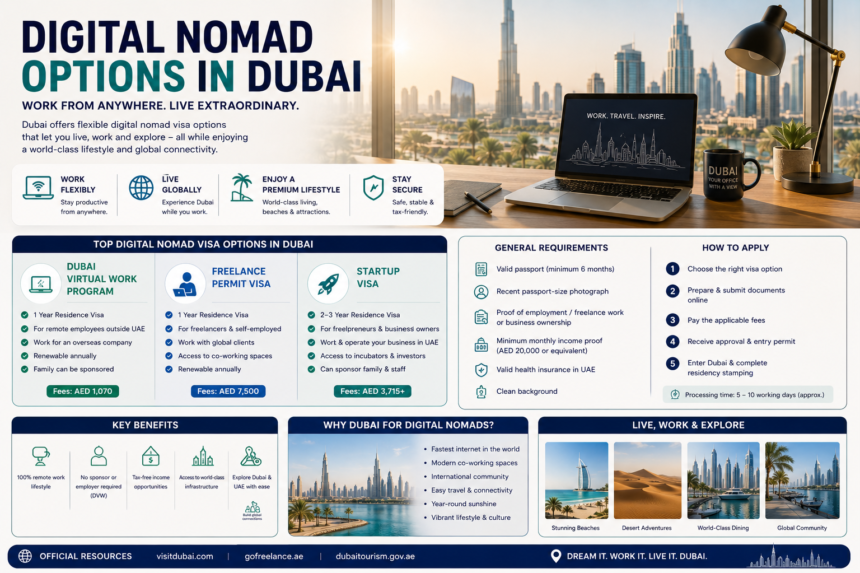
Digital Nomad Options in Dubai have become increasingly attractive to professionals who want to live in the UAE while continuing to work remotely for an employer or organisation based outside the country.
- Digital Nomad Options in Dubai at a Glance
- 1. Virtual Work Residence for Digital Nomads
- Digital Nomad Options in Dubai Income Requirement
- Proof of Remote Employment
- 2. Virtual Work Entry Visa
- 3. Digital Nomad Options in Dubai Through Green Residence
- 4. Golden Residence for High Value Professionals
- 5. Setting Up a Dubai Business or Freelance Activity
- 6. Standard Dubai Employment Residence
- 7. Tourist Visas for Short Remote Stays
- Digital Nomad Options in Dubai Requirements
- Passport Validity
- Health Insurance Is Required
- Medical Fitness Test
- Emirates ID for Digital Nomads
- Digital Nomad Options in Dubai Fees
- How Long Does the Application Take
- Can Digital Nomads Sponsor Their Family
- Renewing the Dubai Virtual Work Residence
- Virtual Work Residence Renewal Fees
- Grace Period After Virtual Work Residence Expires
- Can You Open a Bank Account
- Does Dubai Have Personal Income Tax
- Corporate Tax Can Matter for Self Employed Digital Nomads
- Digital Nomad Options in Dubai for Employees vs Freelancers
- Best Areas in Dubai for Digital Nomads
- Coworking and Remote Work Culture
- Dubai’s Time Zone Can Be an Advantage
- Internet and Digital Infrastructure
- Cost of Living for Digital Nomads
- Should You Rent Before Arriving
- Can Digital Nomads Work for UAE Clients
- Common Digital Nomad Mistakes in Dubai
- How to Avoid Dubai Remote Work Visa Scams
- Who Should Consider Dubai as a Digital Nomad Base
- Digital Nomad Options in Dubai Application Steps
- Frequently Asked Questions
- Conclusion
Dubai offers high speed digital infrastructure, international air connectivity, modern coworking spaces and a large expatriate community. But remote workers planning to stay for more than a short visit need to understand an important distinction.
Working remotely while physically living in Dubai is not simply a matter of entering on a tourist visa and staying indefinitely.
Dubai operates an official Virtual Work Residence Permit specifically for foreigners who work remotely for organisations outside the UAE. The permit is issued without a local sponsor or host and is valid for one year, subject to renewal. Current GDRFA requirements include proof of remote work, valid health insurance, medical fitness, identity documentation and proof of monthly income of at least USD 3,500 or the equivalent.
This makes Dubai one of the more structured Gulf destinations for internationally mobile remote professionals.
Digital Nomad Options in Dubai at a Glance
| Option | Best For | Typical Structure |
|---|---|---|
| Virtual Work Residence | Employees working remotely for foreign organisations | 1 year, renewable |
| Virtual Work Entry Visa | Applicants entering Dubai to complete residence formalities | 60 days to complete residency |
| Green Residence | Qualifying skilled professionals and self employed individuals | Longer term self sponsored route |
| Golden Residence | Qualifying investors and exceptional professionals | Long term residence |
| Business or Freelance Setup | Professionals genuinely operating a UAE business | Licence plus relevant residence |
| Standard Employment Residence | Remote professionals hired by a UAE employer | Employer sponsored |
| Tourist or Visit Status | Short visits only | Not a substitute for long term residence |
For a genuine overseas remote employee, the Virtual Work Residence is usually the most directly relevant option.
1. Virtual Work Residence for Digital Nomads
The main route for remote workers in Dubai is the Virtual Work Residence Permit.
GDRFA describes it as a residence permit for a foreigner who performs remote work for an organisation outside the UAE.
It does not require a guarantor or local host.
The residence period is one year and can be renewed when the applicant continues to satisfy the requirements.
This structure can appeal to:
Software developers
Designers
Marketing professionals
Consultants
Remote managers
Writers
Digital professionals
Finance professionals
Online project managers
Other employees working for companies outside the UAE
The critical requirement is that the applicant’s remote employment or work relationship is genuinely outside the UAE.
Digital Nomad Options in Dubai Income Requirement
One of the most important eligibility rules is income.
GDRFA currently requires Virtual Work Residence applicants to provide evidence of monthly earnings of at least USD 3,500, or the equivalent in another currency.
This is the current official Dubai threshold and is particularly important because older articles online may show different income figures.
Applicants should use the current GDRFA requirement rather than relying on an outdated blog.
A salary certificate or other acceptable income documentation will generally need to support the application.
Proof of Remote Employment
Income alone is not enough.
The applicant must also prove that they work remotely for an organisation outside the UAE.
GDRFA specifically lists proof of remote work outside the UAE as a compulsory requirement.
This could potentially involve documents such as:
Employment confirmation
Remote working letter
Employment contract
Salary certificate
Company documentation
The exact evidence can vary according to the data entered in the application.
The important point is that the authorities need to understand where the work relationship is based.
2. Virtual Work Entry Visa
A remote worker who needs to enter Dubai to complete residence formalities can use the Virtual Work entry visa process where applicable.
GDRFA currently states that the Virtual Work visa allows the foreign applicant to remain in the UAE for 60 days from entry while completing the requirements needed to issue the residence permit.
Current requirements include:
Recent photograph
Passport valid for at least six months
Evidence of remote work for an organisation outside the UAE
Monthly income of at least USD 3,500 or equivalent
Valid health insurance
This 60 day period should not be confused with the final residence validity.
The final Virtual Work Residence itself is valid for one year.
3. Digital Nomad Options in Dubai Through Green Residence
Some remote professionals may have circumstances that fit another UAE residence category more appropriately.
The UAE Green Residence is designed for qualifying skilled employees, self employed professionals, freelancers and other eligible categories.
This can be relevant for someone who is not simply a salaried remote employee but has an independent professional structure.
For example, someone operating as a genuine freelancer or self employed professional may want to compare Green Residence requirements with the Virtual Work Residence route.
The right choice depends on:
Where the clients are based
How income is earned
Whether the person is employed or self employed
Whether they have a UAE business activity
How long they want to stay
The Virtual Work Residence remains the clearest route for someone employed remotely by a foreign organisation.
4. Golden Residence for High Value Professionals
Some remote professionals may independently qualify for UAE Golden Residence.
Golden Residence is not a standard digital nomad visa.
However, qualifying investors, entrepreneurs, scientists, exceptional professionals or other eligible applicants may receive longer term residency independent of the Virtual Work programme.
This can become relevant for senior professionals who want to build a more permanent base in Dubai.
A highly experienced technology executive, investor or entrepreneur should therefore not automatically assume the one year virtual residence is their only option.
Long term residency categories may provide greater stability when the person qualifies independently.
5. Setting Up a Dubai Business or Freelance Activity
Some digital nomads are not employees.
They operate consulting businesses, creative agencies, ecommerce companies or other independent ventures.
For these professionals, simply describing themselves as remote workers may not accurately reflect what they are doing.
A genuine UAE commercial activity may require:
Business licence
Freelance permit
Professional licence
Corporate structure
Appropriate residence status
Tax registration where required
This option should therefore be considered when someone plans to conduct business from Dubai rather than merely perform an overseas employment role while living there.
The immigration structure and commercial licensing structure should match the real activity.
6. Standard Dubai Employment Residence
Another scenario involves a remote professional who eventually receives a job from a UAE based employer.
Once that happens, the Virtual Work route may no longer be the most appropriate status.
GDRFA’s standard private sector residence route provides two year renewable residence for employees working for qualifying UAE employers.
The key distinction is straightforward.
Foreign employer plus remote work from Dubai
Virtual Work Residence may be appropriate.
UAE employer
Standard employment residence may be appropriate.
Applicants should not retain one status simply because it is more convenient if their employment circumstances have materially changed.
7. Tourist Visas for Short Remote Stays
Some travelers may come to Dubai for a short period and continue answering emails or performing minor work connected with an overseas job.
But tourist status should not be confused with long term digital nomad residency.
A tourist visa is intended for temporary visits.
The official Virtual Work Residence exists specifically because people living in Dubai while working remotely need an appropriate residence framework.
Professionals planning to make Dubai their base should use a residence option that matches their circumstances.
Digital Nomad Options in Dubai Requirements
For the official Virtual Work Residence, GDRFA currently lists the following compulsory requirements:
- Colour photograph
- Passport copy
- Health insurance
- Medical fitness test
- Proof of remote work outside the UAE
- Salary certificate showing at least USD 3,500 monthly or equivalent
- ID receipt
The required documents can vary according to application information, so applicants should always review the final checklist generated by the official service.
Passport Validity
For the Virtual Work entry visa, GDRFA requires the passport to have at least six months of validity.
Remote professionals who travel frequently should pay particular attention to this.
A passport approaching expiry can create problems with:
Visa processing
International travel
Bank records
Emirates ID
Airline check in
Renew the passport before applying if necessary.
Health Insurance Is Required
Valid health insurance is a compulsory element of Dubai’s Virtual Work Residence process.
Applicants should therefore include insurance when calculating the real cost of becoming a Dubai based digital nomad.
A cheap visa estimate that ignores medical insurance does not represent the full financial commitment.
Medical Fitness Test
Virtual Work Residence also requires an approved medical fitness result.
This is part of becoming a UAE resident.
Applicants should complete medical testing through approved UAE channels rather than assuming an overseas health certificate will automatically be accepted.
Emirates ID for Digital Nomads
The Virtual Work Residence process includes identity registration.
GDRFA currently requires an ID receipt as part of the residence application.
Once residence and identification procedures are completed, the Emirates ID becomes a key document for day to day life in Dubai.
It can be important for services such as:
Banking
Telecommunications
Contracts
Government services
Other resident transactions
This makes the virtual work route much more substantial than simply having permission to visit.
Digital Nomad Options in Dubai Fees
GDRFA currently lists the Virtual Work Residence permit fee at AED 200.
Additional listed charges include:
AED 10 Knowledge Dirham
AED 10 Innovation Dirham
AED 500 inside country fee where applicable
AED 20 delivery
For the entry visa itself, GDRFA lists a AED 200 virtual work visa fee plus VAT, with additional charges where the applicant is already inside the UAE.
These are immigration service fees.
The total cost can be higher after including:
Medical fitness
Emirates ID
Health insurance
Document preparation
Service centre fees where applicable
Applicants should budget for the complete process.
How Long Does the Application Take
GDRFA currently lists an expected completion time of approximately 48 hours for both the Virtual Work visa and Virtual Work Residence service once the relevant requirements are satisfied.
This should not be interpreted as a guarantee that your entire relocation process will take only two days.
Preparation can require additional time for:
Insurance
Medical testing
Income documentation
Employment proof
Identity registration
Missing documentation can also cause delays.
Can Digital Nomads Sponsor Their Family
Yes.
GDRFA currently states that a Virtual Work visa holder can sponsor family members for the same one year period.
This can make the route particularly useful for remote professionals moving to Dubai with:
Spouse
Children
The family will still need to satisfy the applicable family residence requirements.
Applicants should calculate the financial effect of family relocation carefully because housing, health insurance and schooling can significantly increase costs.
Renewing the Dubai Virtual Work Residence
Virtual Work Residence can be renewed.
GDRFA currently allows renewal under the same conditions used when the original permit was issued.
That means applicants need to continue proving:
Remote work for an organisation outside the UAE
Monthly income of at least USD 3,500 or equivalent
Health insurance
Medical fitness
Other required documents
Remote workers should therefore keep employment and income records organised throughout the year.
Virtual Work Residence Renewal Fees
The current GDRFA renewal fee is AED 200.
Additional listed costs include:
AED 10 Knowledge Dirham
AED 10 Innovation Dirham
AED 500 inside country fee
AED 20 delivery
As with first issuance, other costs can apply separately.
Grace Period After Virtual Work Residence Expires
GDRFA currently provides a 60 day grace period after Virtual Work Residence expires or is cancelled.
This does not mean the visa has been renewed.
The grace period gives the resident time to regularise their position.
They may need to:
Renew the residence
Move to another qualifying residence category
Complete cancellation procedures
Leave the UAE
Remote professionals should deal with renewal before the original residence expires rather than relying on the grace period.
Can You Open a Bank Account
Residency can make access to banking easier than visiting as a tourist, although individual banks maintain their own onboarding and compliance requirements.
The UAE government’s general banking information states that expatriate residents may need documents such as a passport, residence visa, Emirates ID and salary or employment documentation when opening accounts.
A Virtual Work Residence can therefore make Dubai more practical as a long term base.
But a residence permit does not guarantee that every bank will approve every applicant.
Does Dubai Have Personal Income Tax
The UAE currently does not levy personal income tax on individuals.
This is one reason Dubai often attracts international professionals.
However, digital nomads should avoid oversimplifying their tax position.
Moving to Dubai does not automatically eliminate tax obligations in another country.
Tax residency can depend on:
Time spent in different countries
Nationality
Domicile rules
Employment arrangements
Tax treaties
Where business activities are conducted
A remote worker should therefore consider both UAE rules and the tax system of their home or previous country of residence.
Corporate Tax Can Matter for Self Employed Digital Nomads
The UAE personal income tax position is different from business taxation.
The Federal Tax Authority states that a natural person conducting a business or business activity in the UAE may become subject to UAE Corporate Tax when total turnover from those business activities exceeds AED 1 million in a calendar year. Wages, personal investment income and real estate investment income are excluded from that business turnover test.
This distinction matters.
A salaried remote employee is not in exactly the same tax position as someone operating a consulting business from Dubai.
Self employed professionals should get appropriate tax advice when their activities become substantial.
Digital Nomad Options in Dubai for Employees vs Freelancers
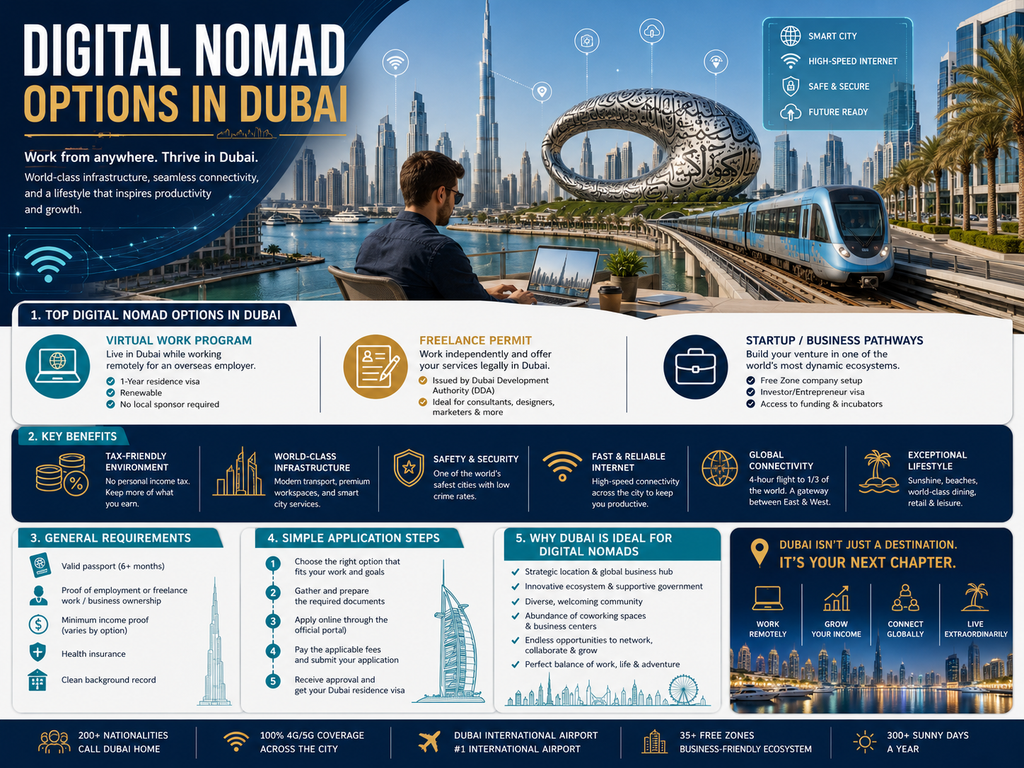
The best route depends on how you work.
Foreign Salaried Employee
The Virtual Work Residence can be a natural fit when you work remotely for an overseas organisation.
Freelancer
You may need to consider whether a freelance or Green Residence structure better matches your activity.
Business Owner
A business licence and investor or partner residence may be more appropriate.
UAE Employee
Standard employment residence usually fits better.
The legal structure should reflect reality.
Best Areas in Dubai for Digital Nomads
Remote professionals often consider areas based on lifestyle, commuting needs and budget.
Popular categories include:
Dubai Marina and JLT
Good for high rise living, restaurants and access to coworking environments.
Downtown Dubai and Business Bay
Useful for professionals who want to be close to major business districts.
Dubai Hills and Dubai Creek Harbour
Can appeal to people preferring newer residential communities.
Al Barsha
Often offers practical access to different parts of the city.
Deira and Bur Dubai
Can provide more traditional neighbourhood experiences and, depending on the property, lower accommodation costs.
Housing costs can vary dramatically, so digital nomads should compare realistic rents before relocating.
Coworking and Remote Work Culture
Dubai has a large professional ecosystem involving:
Coworking spaces
Business centres
Hotel workspaces
Cafes
Startup communities
Free zones
Professional networking events
Remote professionals who work entirely from home may miss one of Dubai’s biggest advantages.
Networking.
The city attracts professionals from many countries and industries.
Coworking and business communities can therefore become useful for people who want to build professional relationships while keeping an overseas job.
Dubai’s Time Zone Can Be an Advantage
Dubai operates on Gulf Standard Time.
That can make the city particularly useful for professionals working across several regions.
A Dubai based worker can often overlap with:
Asia in the morning
Europe during the middle of the day
Parts of North America later in the day
This geographic position is valuable for globally distributed teams.
However, remote employees working primarily with the United States should consider whether late evening meetings will become a regular part of their schedule.
Internet and Digital Infrastructure
Digital connectivity is obviously essential for remote work.
Dubai’s positioning as a global digital economy centre means internet connectivity, mobile services and business technology infrastructure are widely available.
Remote workers should still check:
Home internet speed
Building connectivity
Mobile backup options
Coworking internet reliability
Video call environment
A beautiful apartment is less useful to a digital nomad if its connectivity is poor.
Cost of Living for Digital Nomads
Dubai can be expensive.
Major expenses may include:
Rent
Utilities
Health insurance
Groceries
Transport
Coworking
Dining
Entertainment
Schooling for families
The USD 3,500 minimum income threshold for Virtual Work Residence is an immigration eligibility figure.
It should not be interpreted as a guarantee that USD 3,500 provides a luxurious lifestyle.
Lifestyle expectations matter enormously.
A single professional sharing accommodation will have very different expenses from a family renting a large apartment and paying international school fees.
Should You Rent Before Arriving
Remote professionals should be cautious about signing a long term rental contract without understanding the city.
A temporary stay can provide time to compare neighbourhoods.
Consider:
Distance from coworking spaces
Metro access
Traffic
Gym availability
Restaurants
Supermarkets
Noise
Building quality
The neighbourhood that looks best on social media may not be the best location for your daily routine.
Can Digital Nomads Work for UAE Clients
This question becomes more complicated.
The Virtual Work Residence is built around proof that the applicant works remotely for an organisation outside the UAE.
If someone begins actively operating a local UAE business or building a significant UAE client base, they should assess whether their immigration and commercial licensing structure still matches their activity.
A freelance permit, business licence or another residence pathway may become more appropriate.
Do not assume that one remote work visa automatically covers every form of commercial activity.
Common Digital Nomad Mistakes in Dubai
Avoid these common errors:
Using outdated income requirements
Assuming tourist status equals digital nomad residence
Failing to maintain health insurance
Ignoring renewal deadlines
Not checking passport validity
Confusing employment income with business income
Assuming Dubai residence automatically removes foreign tax obligations
Taking UAE employment while remaining on an inappropriate remote work status
Underestimating housing costs
Using unverified immigration agents
The legal route should match the real working arrangement.
How to Avoid Dubai Remote Work Visa Scams
Digital nomad programmes attract unofficial agents.
Be cautious of anyone advertising:
Guaranteed approval
No income requirement
No health insurance
No employment proof
Permanent digital nomad residence
Instant Golden Visa upgrades
Special government connections
Dubai’s official Virtual Work Residence requirements are publicly available through GDRFA.
If an agent’s claims contradict official requirements, treat that as a warning sign.
Who Should Consider Dubai as a Digital Nomad Base
Dubai can work particularly well for:
Remote professionals with stable salaries
Entrepreneurs travelling frequently
Consultants working across Asia and Europe
Technology professionals
Digital marketers
International managers
Professionals seeking a low personal income tax jurisdiction
Families wanting a highly international environment
It may be less suitable for people whose income is unstable or whose clients require them to work constantly in North American business hours.
Digital Nomad Options in Dubai Application Steps
A simplified process can look like this:
Step 1
Confirm that you genuinely work remotely for an organisation outside the UAE.
Step 2
Check that monthly income meets the USD 3,500 threshold.
Step 3
Make sure your passport has sufficient validity.
Step 4
Arrange valid health insurance.
Step 5
Prepare proof of employment and salary.
Step 6
Apply through the appropriate GDRFA digital or Amer channel.
Step 7
Complete medical fitness and identity requirements.
Step 8
Receive and maintain the Virtual Work Residence.
GDRFA offers the service digitally through its smart services system and through Amer centres.
Frequently Asked Questions
What are Digital Nomad Options in Dubai?
Digital Nomad Options in Dubai include the official Virtual Work Residence for foreign remote employees, alongside other residence pathways such as Green Residence, business residence and Golden Residence when the applicant independently qualifies.
Does Dubai have a digital nomad visa?
Dubai has an official Virtual Work Residence route for foreigners working remotely for organisations outside the UAE. It is issued without a local sponsor for one year and can be renewed.
How much income do I need for the Dubai remote work visa?
GDRFA currently requires proof of monthly income of at least USD 3,500 or the equivalent in another currency.
How long is the Dubai Virtual Work Residence valid?
The residence is valid for one year and is renewable when the applicant continues satisfying the conditions.
Can digital nomads sponsor their families?
Yes. GDRFA states that Virtual Work visa holders can sponsor their family for the same residence period.
Do I need health insurance?
Yes. Valid health insurance is one of the compulsory requirements for Virtual Work Residence.
Do I need a medical test?
Yes. GDRFA lists an approved medical fitness result among the compulsory residence requirements.
What is the current Virtual Work Residence fee?
GDRFA currently lists an AED 200 residence permit fee plus additional applicable charges.
How long does approval take?
GDRFA currently lists an expected completion time of around 48 hours once all conditions and documentation are fulfilled.
Does Dubai tax remote worker salaries?
The UAE currently does not levy personal income tax on individuals. However, foreign tax obligations may still apply depending on the worker’s circumstances and tax residency elsewhere.
Can self employed people be subject to UAE Corporate Tax?
Potentially. The Federal Tax Authority says a natural person conducting business or business activity in the UAE can become subject to Corporate Tax when business turnover exceeds AED 1 million in a calendar year. Wages and certain personal investment and real estate income are excluded from that test.
Conclusion
Digital Nomad Options in Dubai provide remote professionals with a much clearer route than simply trying to live in the city on repeated tourist visits.
The most relevant programme is Dubai’s Virtual Work Residence.
Current GDRFA rules allow qualifying foreigners who work remotely for organisations outside the UAE to receive a one year self sponsored residence permit. Applicants must demonstrate remote employment, monthly income of at least USD 3,500, valid health insurance, medical fitness and the required identity documentation.
The permit can also be renewed under the same conditions, and GDRFA currently provides a 60 day grace period following expiry or cancellation.
Families can also benefit because Virtual Work visa holders can sponsor qualifying family members for the same period.
For remote employees, this can make Dubai a practical international base.
For freelancers and business owners, however, another structure such as Green Residence, a freelance permit or business licence may better reflect the actual activity.
The smartest approach is therefore to begin with one question:
How do I really earn my income?
If you are a salaried professional working remotely for an overseas organisation, Virtual Work Residence may provide a straightforward solution.
If you operate your own business, work extensively with UAE clients or plan to build a company locally, a different commercial and immigration structure may be more appropriate.
Dubai offers excellent connectivity, global professional networks and an attractive tax environment, but long term remote work works best when your visa, employment structure, tax position and actual business activity all match.
follow us on Instagram
Read More – Residency by Investment in Dubai: 7 Powerful Routes for 2026