


GCC Entry Requirements for Tourists and GCC Residents
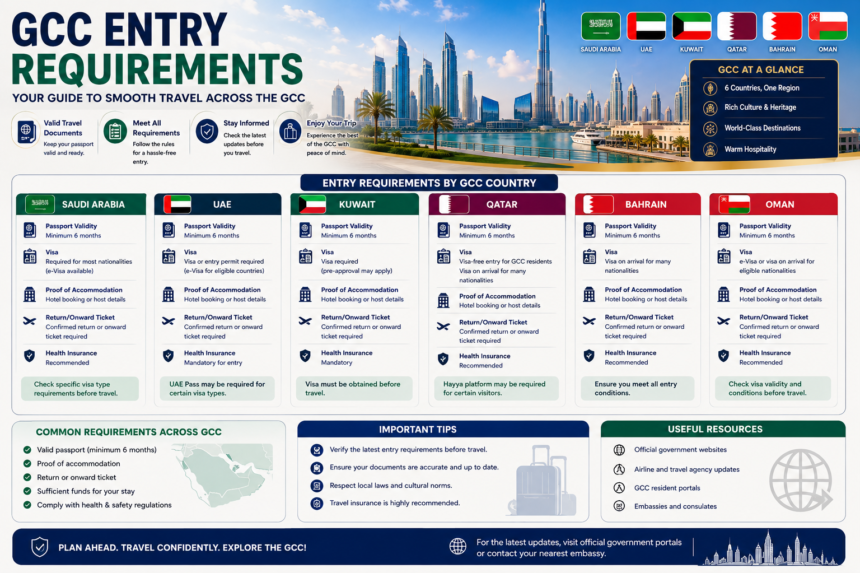
GCC Entry Requirements are one of the first things travelers should understand before planning a trip to the Gulf. The Gulf Cooperation Council includes six countries: the United Arab Emirates, Saudi Arabia, Qatar, Bahrain, Oman and Kuwait.
- GCC Entry Requirements for Tourists and GCC Residents
- 1. UAE Entry Requirements
- UAE Entry Requirements for GCC Residents
- UAE Five Year Tourist Visa
- 2. Saudi Arabia Entry Requirements
- Saudi eVisa Validity and Stay Duration
- Saudi Arabia Entry for GCC Residents
- 3. Qatar Entry Requirements
- Qatar Passport Validity
- Qatar Entry Requirements for GCC Residents
- Qatar Tourist Visa Fees
- Qatar and Oman Joint Tourist Visa
- 4. Bahrain Entry Requirements
- Bahrain One Year Visa for GCC Residents
- Bahrain Three Month GCC Resident Visa
- Bahrain Visitor Passport Rules
- 5. Oman Entry Requirements
- Oman Entry for GCC Residents
- Applying for Oman eVisa
- 6. Kuwait Entry Requirements
- Kuwait Tourist Visa Fees
- 7. GCC Entry Requirements and Passport Validity
- Common GCC Entry Documents
- Hotel Booking Requirements
- Return or Onward Tickets
- Health Insurance Requirements
- GCC Resident Visa Rules
- Can GCC Residents Travel Without Visas
- Visa Free Entry Versus Visa on Arrival
- Single Entry Versus Multiple Entry Visas
- Visa Validity Versus Stay Duration
- Can You Work on a Tourist or Visit Visa
- Traveling Between GCC Countries by Road
- Entry Requirements for Children
- Entry Requirements for Indian Passport Holders
- Entry Requirements for Pakistani and Filipino Travelers
- GCC Entry Requirements for Business Travelers
- GCC Entry Requirements for Transit Travelers
- Overstay Rules and Penalties
- Visa Extensions Across the GCC
- Common GCC Entry Mistakes
- How to Avoid Gulf Visa Scams
- GCC Entry Requirements Checklist Before Travel
- Which GCC Country Has the Easiest Entry Requirements
- Future of GCC Travel and Unified Visa Plans
- Frequently Asked Questions
- Conclusion
Although these countries are closely connected economically and geographically, they do not operate one universal immigration system for international travelers. A visa or residence permit issued by one GCC country does not automatically guarantee entry into another.
Nationality remains one of the most important factors.
Some travelers can enter certain Gulf countries without a visa. Others may qualify for visa on arrival, an electronic visa or a special GCC resident visa. Some nationalities must obtain approval before departure.
Residency status can also matter. A foreign national legally living in the UAE, for example, may have access to visitor routes in Bahrain, Qatar, Oman or other Gulf countries that are different from those available to someone applying directly from their home country.
The safest approach is simple: check the entry requirements for every country separately before travelling.
GCC Entry Requirements for Tourists and GCC Residents
The first distinction travelers should understand is the difference between being a GCC citizen and a GCC resident.
A GCC citizen is a national of Bahrain, Kuwait, Oman, Qatar, Saudi Arabia or the UAE.
A GCC resident is a foreign national who holds legal residence in one of those countries.
These two groups do not receive the same immigration treatment.
For example, GCC citizens can enter the UAE without a visa. Foreign residents of GCC countries, however, need to obtain an online UAE entry permit before arrival under the relevant route. The current UAE eVisa for GCC residents allows a 30 day stay and can be extended once for another 30 days. The applicant’s GCC residence must generally be valid for at least one year from arrival, and the passport must be valid for at least six months. (u.ae)
Qatar similarly provides visa free entry for GCC citizens but uses the Hayya A2 visa route for foreign residents of GCC countries who need a visa. (visitqatar.com)
This difference is essential for anyone planning regional travel.
1. UAE Entry Requirements
The UAE is one of the Gulf’s busiest international travel destinations.
Dubai and Abu Dhabi attract tourists, business travelers and visitors from around the world.
Current UAE rules divide travelers broadly into three categories:
GCC citizens
Nationalities eligible for visa free entry or visa on arrival
Nationalities requiring a visa before travel
The official UAE government portal confirms that GCC citizens do not need a visa to enter the country. Other travellers should check whether their nationality qualifies for visa on arrival or requires advance permission.
Travelers who are not eligible for visa on arrival or visa free entry can use tourist visa routes, which may be arranged through eligible airlines, hotels or travel agents.
UAE Entry Requirements for GCC Residents
Foreign residents of GCC countries need an eVisa before entering the UAE.
Under current rules, the entry permit is valid for 30 days from the date of issue and allows a stay of 30 days after entry.
It can be extended once for an additional 30 days.
The GCC residence must generally remain valid for at least one year from the arrival date.
The passport must be valid for at least six months.
The applicant’s profession may also need to appear on the list approved by the relevant UAE authority.
This makes it important for expatriate residents to check both passport and residence permit validity before applying.
UAE Five Year Tourist Visa
The UAE also provides a five year multiple entry tourist visa.
Current official guidance says the visa is available to all nationalities and permits stays of up to 90 days on each visit, with the possibility of extension for another 90 days under the applicable conditions.
The applicant currently needs to demonstrate a bank balance of at least USD 4,000 or equivalent during the previous six months.
This route can be useful for frequent travelers who regularly visit the UAE.
2. Saudi Arabia Entry Requirements
Saudi Arabia has greatly expanded international tourism access.
Its official tourist eVisa portal currently allows citizens from 66 eligible countries to apply online.
The tourist eVisa is generally valid for one year, allows multiple entries and permits a maximum stay of three months. (visa.visitsaudi.com)
The visa can be used for permitted purposes including:
Tourism
Leisure
Events
Family and relative visits
Umrah outside the Hajj framework
The Saudi tourist eVisa does not cover activities such as study and should not be treated as a work permit.
Saudi eVisa Validity and Stay Duration
The difference between visa validity and stay duration is important.
The current Saudi tourist eVisa is valid for one year from issuance.
It normally allows multiple entries.
But the maximum length of stay permitted under the eVisa is three months.
The eVisa also cannot currently be extended.
A traveler should therefore not assume that a one year visa means one continuous year of residence in Saudi Arabia.
Saudi Arabia Entry for GCC Residents
Saudi Arabia also considers GCC residence status when assessing visitor eligibility.
Foreign residents of GCC countries should check the official Saudi visa system using their passport nationality, country of residence and other relevant details.
Residence in the Gulf can create easier entry opportunities for some travelers, but it does not automatically make all GCC residents visa free.
The exact result depends on nationality and current Saudi eligibility rules.
3. Qatar Entry Requirements
Qatar has one of the region’s most flexible visitor systems.
According to Visit Qatar, travellers from more than 100 countries are eligible for visa free entry, while other travellers can apply through the Hayya platform. (visitqatar.com)
Visa type depends on:
Nationality
GCC residence status
Residence in certain other countries
Valid visas held for certain destinations
For some visitors, hotel booking requirements may also apply.
Qatar Passport Validity
Qatar currently requires passports to generally be valid for at least three months from the date of arrival for several visitor categories.
Travelers may also need:
Confirmed hotel booking
Round trip ticket
Appropriate visa or Hayya approval
Some nationalities can receive visa on arrival but must book accommodation through Discover Qatar before travelling.
That is why nationality specific checking is essential.
Qatar Entry Requirements for GCC Residents
Foreign GCC residents who require a visa can use the Hayya A2 Entry Visa route.
Visit Qatar’s visa checker specifically identifies GCC residency as one of the factors used to determine the correct visa type.
GCC citizens, by comparison, can enter Qatar visa free.
This again demonstrates why citizenship and residency should not be treated as the same thing.
Qatar Tourist Visa Fees
Qatar’s current Hayya tourist visa fee is generally QAR 100 for applicable categories.
Some travellers who obtain visa on arrival may also pay QAR 100 at the airport.
However, travelers should not assume every nationality follows the same fee structure.
The visa checker should be used to identify the exact route.
Qatar and Oman Joint Tourist Visa
One interesting regional arrangement is the Qatar Oman Joint Tourist Visa.
Current Visit Qatar guidance states that eligible nationals can receive this visa on arrival.
It is valid for 30 days and allows multiple entry between Qatar and Oman.
It can also be extended for an additional 30 days for a fee.
Only specific nationalities qualify.
This is one of the closest examples of multi country tourist access currently available in the Gulf.
4. Bahrain Entry Requirements
Bahrain operates a broad electronic visa system.
Entry eligibility can depend on:
Nationality
GCC residence
GCC visitor status
Purpose of travel
Bahrain’s Nationality, Passports and Residence Affairs provides several electronic visa categories for GCC residents.
One particularly useful route is the one year multiple entry electronic visa for qualifying GCC residents.
Bahrain One Year Visa for GCC Residents
Bahrain currently offers a one year multiple entry electronic visa to qualifying foreign residents of GCC countries.
The applicant must normally be outside Bahrain at the time of application.
Required documents include:
Passport valid for more than six months
GCC residence permit and valid return visa with at least three months remaining
The visa currently has a processing time of approximately one working day.
The application fee is BHD 5 and the visa issuance fee is BHD 40.
This can be particularly useful for expatriates living in Saudi Arabia, the UAE, Qatar, Kuwait or Oman who travel frequently to Bahrain.
Bahrain Three Month GCC Resident Visa
Bahrain also provides a three month multiple entry electronic visa for GCC residents under applicable conditions.
Current fees include a BHD 5 non refundable application charge and BHD 12 issuance fee.
The correct visa will depend on how frequently the traveler expects to visit Bahrain.
Bahrain Visitor Passport Rules
For many Bahrain visitor visa routes, the passport needs to be valid for more than six months.
Bahrain’s general visit visa guidance also makes an important point: visitors must not carry out work, whether paid or unpaid, while on the visit visa.
This distinction matters for people travelling for meetings or exploring job opportunities.
Visit permission does not automatically create employment rights.
5. Oman Entry Requirements
Oman operates an official electronic visa system through the Royal Oman Police.
The eVisa system includes:
Unsponsored tourist visas
Sponsored tourist visas
Tourist visas for GCC residents
Express visas
Travelers should use the online eligibility system to determine the correct visa type before travelling.
Oman Entry for GCC Residents
Oman provides specific routes for foreign residents of GCC countries.
According to the Royal Oman Police eVisa guidance, a GCC resident travelling as the primary applicant may use Visa Type 29A when their profession is on the approved list.
A companion may use Visa Type 29B under the applicable conditions.
This means profession can matter in Oman just as it can for UAE GCC resident entry permits.
Applicants should check the current approved profession requirements before travelling.
Applying for Oman eVisa
The Royal Oman Police advises applicants to apply for tourist visas through the official eVisa system.
For road travel, the visa should be obtained online before arriving at the land border.
Oman recommends lodging an eVisa application at least four days in advance because processing time can vary between applications.
This is important for travelers driving from Dubai, Abu Dhabi or another Gulf city.
Do not assume a land crossing removes the visa requirement.
6. Kuwait Entry Requirements
Kuwait also maintains separate tourist and visit visa procedures.
Current Kuwait Government Online information states that tourist visit entry visas can be issued through the official immigration system.
A copy of the visitor’s passport is required, and the passport must have at least six months of validity.
Depending on the application route, additional documentation can include:
Visit application form
Sponsor documentation
Proof of relationship
Salary certificate
Sponsor Civil ID
Hotel sponsorship documents
Kuwait Tourist Visa Fees
The current Kuwait Government Online service page lists a fixed tourist visit fee of KWD 10 per month.
The actual entry route can differ according to nationality and sponsorship arrangements.
Travelers should therefore confirm whether they qualify for an electronic or simpler route under the latest Ministry of Interior system.
7. GCC Entry Requirements and Passport Validity
Passport validity is one of the most important parts of Gulf travel planning.
Several GCC countries use six months as a common minimum for particular visitor routes.
The UAE requires six months for the GCC resident eVisa.
Bahrain requires more than six months for many electronic visit visas.
Kuwait requires at least six months for the tourist visit route described by the official government service.
Qatar, by contrast, currently accepts at least three months for several visitor categories.
The safest approach for a multi country GCC trip is to travel with considerably more than six months of passport validity whenever possible.
Common GCC Entry Documents
Different countries require different evidence, but international visitors should commonly prepare:
- Passport
- Visa or eVisa where required
- GCC residence permit where relevant
- Confirmed hotel booking
- Return or onward ticket
- Travel or health insurance where required
- Proof of sufficient funds where requested
- Sponsor information where applicable
- GCC return visa where required
- Supporting visa or residence documentation for third country based eligibility
Not every traveler will need all these documents.
The exact checklist depends on nationality and visa category.
Hotel Booking Requirements
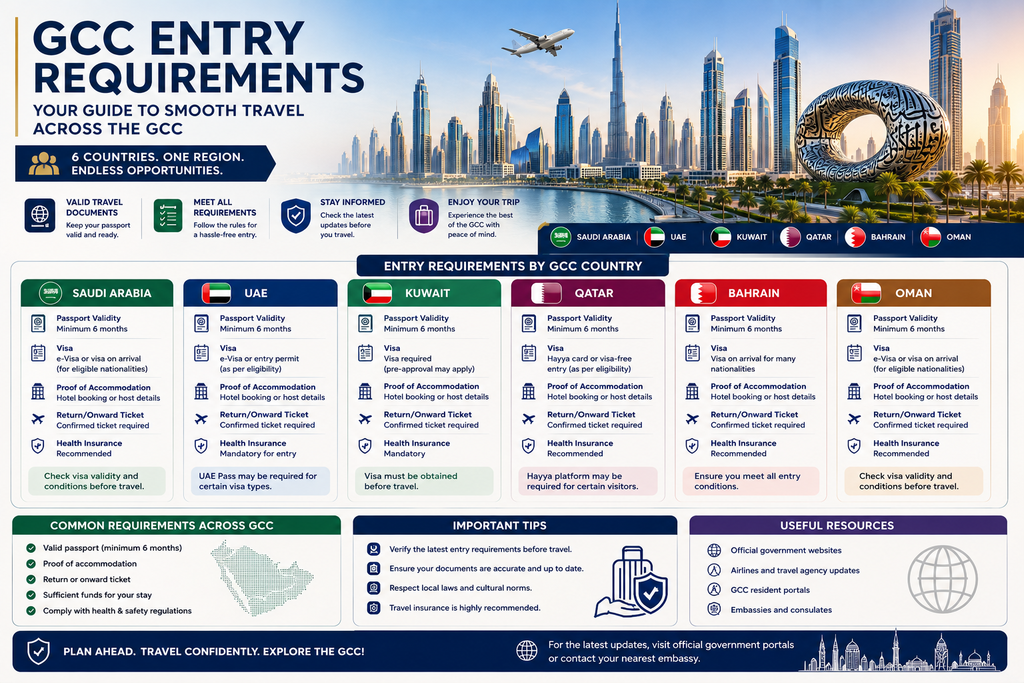
Accommodation evidence is becoming increasingly important.
Qatar, for example, requires confirmed hotel booking for several visitor categories. Some nationalities must book specifically through Discover Qatar before receiving visa on arrival.
Bahrain also asks for hotel or accommodation details under some electronic visitor categories.
Travelers should therefore avoid arriving without clear accommodation arrangements.
Return or Onward Tickets
A confirmed return or onward ticket is commonly expected for short term visitors.
Qatar explicitly identifies a confirmed round ticket for several visa on arrival categories.
Bahrain also requires a return ticket for some visitor visa routes.
Even when the airline does not request the document at check in, immigration officers can ask for evidence that the traveler intends to leave within the permitted period.
Health Insurance Requirements
Health insurance rules differ across the region.
Qatar recommends that visitors hold valid health insurance covering medical facilities in the country and provides a mechanism for visitors who need to obtain coverage.
Other GCC visa categories can also include insurance requirements depending on the traveler and visa.
Travel insurance is therefore worth checking even when it is not automatically included in the visa.
GCC Resident Visa Rules
Foreign GCC residents receive several advantages around the region, but those advantages have conditions.
For the UAE, GCC residency must currently be valid for at least one year when using the GCC resident eVisa route.
For Bahrain’s one year GCC resident electronic visa, the resident permit and return visa must be valid for at least three months.
Oman may consider the applicant’s profession for its GCC resident tourist visa route.
This means a valid GCC residence card alone does not always guarantee eligibility.
Can GCC Residents Travel Without Visas
Not automatically.
This is one of the biggest misconceptions around GCC Entry Requirements.
GCC citizens have extensive regional mobility.
Foreign GCC residents do not.
They may qualify for easier visas, online visas or special residence based visitor routes.
But they should still check the destination country’s visa policy before every trip.
Never assume that showing a UAE Emirates ID, Saudi Iqama or Qatar residence card automatically guarantees entry.
Visa Free Entry Versus Visa on Arrival
These terms sound similar but can have different procedures.
Visa free entry generally means the traveler can enter without obtaining a visa beforehand.
Visa on arrival means immigration permission is formally issued when the traveler reaches the border or airport, possibly after paying a fee or presenting additional documentation.
Qatar now describes many previously called visa on arrival routes as visa free entry, while other categories still use paid arrival arrangements.
Travelers should understand exactly which category applies to their passport.
Single Entry Versus Multiple Entry Visas
Single entry permission generally becomes unusable after the traveler exits.
Multiple entry visas can be reused during their validity, subject to stay limits.
Examples include:
Saudi Arabia’s one year multiple entry tourist eVisa.
Bahrain’s one year multiple entry eVisa for GCC residents.
The UAE’s five year multiple entry tourist visa.
Multiple entry visas can be extremely useful for business travelers and families visiting relatives across the Gulf.
Visa Validity Versus Stay Duration
Do not confuse these two terms.
Visa validity tells you the period during which your visa remains usable.
Stay duration tells you how long you can remain after entering.
Saudi Arabia’s eVisa provides a useful example.
It is valid for one year but only permits a maximum stay of three months.
A long validity period therefore does not provide unlimited residence.
Can You Work on a Tourist or Visit Visa
Generally, tourist and visitor status should not be treated as employment permission.
Bahrain’s official guidance explicitly states that visitors are not permitted to work, whether paid or unpaid, while on a visit visa.
The same basic principle applies across the region: employment usually requires the appropriate work permit and residence arrangements.
A job interview while visiting is not the same as beginning work.
If you receive an employment offer, complete the correct legal process first.
Traveling Between GCC Countries by Road
Road trips are increasingly popular between Gulf countries.
Examples include:
UAE to Oman
Saudi Arabia to Bahrain
Saudi Arabia to Qatar
Saudi Arabia to UAE
Travelers should remember that land borders use the same immigration principles as airports.
Oman’s Royal Oman Police specifically tells tourists travelling by road to apply through the official eVisa website before entering through a legal border crossing when a visa is required.
Drivers may also need:
Vehicle registration
Insurance valid in the destination
Owner authorisation for borrowed or financed vehicles
Driving licence
Border insurance
Check vehicle rules separately from personal immigration requirements.
Entry Requirements for Children
Children generally need their own travel documentation.
Depending on the country and nationality, this may include:
Passport
Visa or entry permission
Birth certificate in certain situations
Consent documentation when travelling without both parents
Do not assume a child is automatically included in a parent’s visa.
For most immigration systems, every traveler needs to satisfy their own entry requirements.
Entry Requirements for Indian Passport Holders
Indian passport holders represent one of the largest expatriate and visitor groups across the Gulf.
Entry conditions vary significantly by destination.
An Indian passport holder may qualify for simplified entry in some Gulf countries because they are a legal GCC resident or because they hold a valid visa or residence permit from another recognised country.
In another destination, advance approval may still be required.
Because these arrangements can change, Indian travelers should always check their passport nationality and residence status together when using official visa eligibility tools.
Entry Requirements for Pakistani and Filipino Travelers
The same principle applies to Pakistani, Filipino, Bangladeshi, Egyptian, Nepalese and other large expatriate communities in the GCC.
Do not rely only on your GCC residence card.
Check:
Nationality
Occupation
Residence validity
Destination
Visa category
Passport validity
Some Gulf resident entry routes consider all of these factors.
GCC Entry Requirements for Business Travelers
Business travelers should also distinguish between short business visits and employment.
A visitor may travel to attend:
Meetings
Trade fairs
Conferences
Negotiations
Investment discussions
But if the activity involves actual local employment, technical work or a long term assignment, a work or business specific authorisation may be necessary.
When in doubt, ask the host company which visa category legally covers the planned activity.
GCC Entry Requirements for Transit Travelers
Transit rules vary depending on whether the traveler remains airside or passes through immigration.
A passenger changing aircraft without entering the country may not need the same visa as someone leaving the airport.
Qatar, for example, offers transit experiences and has a specific transit visa arrangement for certain Qatar Airways passengers interested in entering Doha during a qualifying connection.
Dubai and other major Gulf airports also operate transit visa options under relevant circumstances.
Check the airline and destination rules before leaving the transit zone.
Overstay Rules and Penalties
Every visa has a permitted period of stay.
Remaining beyond that period can result in fines or immigration complications.
Travelers should note their final legal date of stay immediately after arrival.
Do not simply assume the exit deadline based on your flight date or visa validity.
If your trip changes, confirm whether an extension is available before the original stay expires.
Some visas can be extended.
Others cannot.
Saudi Arabia’s standard tourist eVisa, for example, cannot currently be extended.
Visa Extensions Across the GCC
Extension rules vary.
UAE GCC resident eVisas can currently be extended once for 30 days.
Bahrain offers extension options for several electronic visitor visa categories. Its one year GCC resident visa currently carries an extension charge of BHD 25 for 14 days.
Saudi Arabia’s tourist eVisa currently cannot be extended.
Always check the individual visa conditions rather than assuming Gulf countries use the same extension policy.
Common GCC Entry Mistakes
Travelers frequently make avoidable errors.
These include:
Assuming GCC residence means visa free travel
Using an expired or nearly expired passport
Not checking residence permit validity
Ignoring profession requirements
Arriving without hotel documentation
Failing to carry return travel proof
Confusing visa validity with permitted stay
Using tourist status for employment
Booking non refundable travel before visa approval
Relying on outdated social media information
Most of these problems can be prevented with a short pre travel checklist.
How to Avoid Gulf Visa Scams
Visa scams are common because travelers may not understand local systems.
Be cautious of anyone offering:
Guaranteed visas
Instant approval for every nationality
Special immigration connections
Employment rights on tourist visas
Huge unexplained processing fees
Payment to personal accounts
Use official portals whenever possible.
For the UAE, rely on official UAE government, ICP or GDRFA information.
For Saudi Arabia, use the official Saudi eVisa platform.
For Qatar, use Hayya and Visit Qatar.
For Bahrain, use NPRA and the official eVisa portal.
For Oman, use Royal Oman Police eVisa.
For Kuwait, use Kuwait Government Online and Ministry of Interior channels.
GCC Entry Requirements Checklist Before Travel
Before going to the airport or land border, confirm these points:
- Is your passport valid long enough?
- Does your nationality require a visa?
- Is your visa still valid?
- Does your GCC residence meet the destination’s requirements?
- Is your profession relevant to a GCC resident visa route?
- Do you have accommodation confirmation?
- Do you have a return or onward ticket?
- Do you need travel or health insurance?
- Is your stay within the permitted duration?
- Are you using the visa for the correct purpose?
Keep digital and printed copies of important documents.
Which GCC Country Has the Easiest Entry Requirements
There is no universal answer.
A nationality eligible for Saudi Arabia’s eVisa may still require another type of visa elsewhere.
A GCC resident may find Bahrain or Oman relatively convenient but face different conditions for entering the UAE.
A traveler from a visa exempt nationality may find Qatar extremely straightforward.
The easiest country depends on:
Passport
Residence status
Profession
Purpose of travel
Travel history
The better question is not which Gulf country is easiest overall.
It is which Gulf country is easiest for your specific passport and circumstances.
Future of GCC Travel and Unified Visa Plans
The GCC has been working toward closer tourism integration, including proposals for a unified tourist visa.
A regional visa could eventually make travel between the six Gulf countries easier.
However, travelers should not plan trips around a proposed or announced system until authorities confirm that it is fully active and that they personally qualify.
For now, country specific immigration requirements remain the practical rule.
Check each destination independently.
Frequently Asked Questions
What are GCC Entry Requirements?
GCC Entry Requirements are the visa, passport, residence and supporting document rules travelers must meet before entering Bahrain, Kuwait, Oman, Qatar, Saudi Arabia or the UAE.
Can GCC citizens travel without visas?
GCC citizens generally benefit from extensive visa free regional mobility. For example, both the UAE and Qatar currently provide visa free entry to citizens of other GCC states.
Can GCC residents travel visa free?
Not automatically. Foreign GCC residents may qualify for special eVisa or visitor routes, but the rules vary by destination.
How long must my passport be valid?
Requirements differ. Several UAE, Bahrain and Kuwait visitor categories require at least six months of passport validity, while Qatar currently uses a three month minimum for several entry routes.
How long can GCC residents stay in the UAE?
The current UAE GCC resident eVisa allows a 30 day stay and can be extended once for another 30 days.
How long is the Saudi tourist eVisa valid?
The current Saudi tourist eVisa is valid for one year and normally permits multiple entries with a maximum stay of three months.
Does Qatar have a GCC resident visa?
Yes. Qatar’s Hayya platform offers an A2 Entry Visa for relevant GCC residents.
Does Bahrain offer special visas for GCC residents?
Yes. Bahrain currently offers several GCC resident eVisa options, including a one year multiple entry electronic visa.
Can GCC residents travel to Oman?
Yes, subject to eligibility. Oman has a dedicated GCC resident tourist visa route, including Visa Type 29A for primary applicants with approved professions.
Does Kuwait require six months of passport validity?
Kuwait’s current tourist visit service requires the visitor’s passport to have at least six months of validity.
Conclusion
GCC Entry Requirements can seem complicated because the six Gulf countries are closely connected while still maintaining separate immigration systems.
The UAE offers visa free entry to GCC citizens and a specific 30 day eVisa route for qualifying foreign GCC residents.
Saudi Arabia provides a one year multiple entry tourist eVisa for eligible nationalities, with stays of up to three months.
Qatar combines broad visa free access with the Hayya visa system and dedicated GCC resident options.
Bahrain provides several electronic visitor visas specifically designed for GCC residents, including three month and one year multiple entry options.
Oman uses an online eVisa system with a dedicated GCC resident tourist route.
Kuwait maintains its own tourist visit procedures and requires at least six months of passport validity for the official tourist visit route.
The most important lesson is not to assume anything.
Check your passport.
Check your nationality.
Check your GCC residence validity.
Check whether your profession matters.
Confirm your visa before booking expensive non refundable travel.
Keep hotel, insurance and return ticket documents ready.
And use official immigration portals rather than relying on old articles or social media posts.
With the right preparation, travelling between Gulf countries can be straightforward. The key is treating every destination as its own immigration system while taking advantage of the special entry options available to GCC citizens and qualifying GCC residents.
Do follow us on Instagram
Read More – Digital Nomad Options in Dubai: 7 Powerful Routes for 2026