Why Gulf District Cooling Systems Offer Lessons for Global Cities
As global temperatures rise and urban populations grow, keeping buildings cool is becoming an increasingly important challenge for cities. Air conditioning supports comfortable homes, productive workplaces, healthcare facilities, shopping centres, and other essential services. However, expanding cooling demand also places pressure on electricity systems, increases infrastructure costs, and can contribute to greenhouse gas emissions.
- 1. How District Cooling Works and Why Gulf Cities Adopted It
- 2. Why District Cooling Could Improve Electricity Efficiency and Reduce Peak Demand
- 3. What Dubai and Abu Dhabi Can Teach Other Cities About Sustainable Cooling
- 4. How Singapore, India, and Colombia Are Testing District Cooling Beyond the Gulf
- 5. The Environmental Benefits and Trade-Offs of District Cooling Systems
- 6. Why District Cooling May Not Work for Every City
- 7. The Future of District Cooling for Energy-Efficient Cities Worldwide
District cooling for energy-efficient cities offers a different approach to managing these challenges. Instead of relying entirely on separate air-conditioning systems installed in individual buildings, district cooling uses central facilities to produce chilled water that is distributed through insulated pipes to multiple properties.
This approach has become an established part of infrastructure development in several Gulf cities, particularly Dubai and Abu Dhabi. Large residential developments, commercial districts, hospitals, and mixed-use communities have adopted centralised cooling networks to meet substantial demand.
The Gulf’s experience is attracting attention as other regions search for efficient ways to manage growing cooling requirements.
Cities in Southeast Asia, South Asia, Latin America, and other parts of the world face challenges involving rising temperatures, dense urban development, and electricity demand. For some districts, shared cooling infrastructure could provide a practical alternative to conventional systems.
However, district cooling is not automatically the most economical or environmentally sustainable option. Its performance depends on building density, cooling demand, network design, electricity sources, water availability, and long-term infrastructure planning.
Understanding how these systems operate, where they have succeeded, and what limits their usefulness can help cities evaluate whether the Gulf’s cooling model offers lessons for sustainable development elsewhere.
1. How District Cooling Works and Why Gulf Cities Adopted It
District cooling is a centralised system designed to provide cooling services to multiple buildings within a defined area.
A central plant uses refrigeration equipment or other suitable cooling technologies to produce chilled water.
The water travels through insulated underground pipes to connected buildings, where heat exchangers transfer cooling to the buildings’ internal air-conditioning systems.
The water then returns to the central plant to be cooled again.
A Shared Cooling System
In conventional developments, individual buildings often contain their own chillers, rooftop equipment, or air-conditioning systems.
District cooling combines some of these functions at a central location.
By sharing infrastructure, operators may achieve economies of scale and improve system management.
However, the distribution network introduces its own costs and energy requirements, including pumping and pipe maintenance.
Why the Gulf Became an Important Market
Gulf cities experience substantial cooling requirements because of high temperatures and extensive urban development.
Large commercial towers, hotels, shopping malls, and residential communities can require significant cooling capacity.
These conditions create opportunities for centralised systems, particularly when multiple buildings are developed together.
District cooling can also be integrated into the planning of new urban districts before roads and underground utilities are completed.
Dubai’s District Cooling Infrastructure
Dubai-based Empower illustrates the scale that district cooling can achieve.
According to figures announced by the Dubai Government Media Office in February 2026, Empower’s connected cooling capacity reached approximately 1.7 million refrigeration tons at the end of 2025.
Its network served 1,747 buildings and extended across more than 430 kilometres of distribution pipelines.
These figures describe Empower’s operations, not all cooling infrastructure in Dubai.
They demonstrate how centralised cooling can become a major urban utility.
District Cooling Versus Conventional Building Cooling
| Feature | District Cooling | Individual Building Cooling |
|---|---|---|
| Cooling Production | Shared central plant | Building-specific equipment |
| Distribution | Insulated chilled-water network | Internal building systems |
| Infrastructure Planning | Requires district coordination | Usually managed by each property |
| Maintenance | Central plant plus network | Separate equipment at each building |
| Initial Investment | Significant shared infrastructure | Building-level equipment investment |
| Expansion | Depends on network capacity and layout | Depends on individual property |
| Efficiency | May benefit from scale and load diversity | Depends on equipment and management |
The appropriate approach depends on each development’s technical and financial circumstances.
2. Why District Cooling Could Improve Electricity Efficiency and Reduce Peak Demand
One of district cooling’s main potential advantages is improved energy efficiency.
Centralised plants can use large refrigeration systems, professional operating teams, and advanced controls to optimise cooling production.
However, energy savings must be assessed against a suitable alternative system.
Economies of Scale
Large cooling plants can operate equipment according to changes in demand across connected buildings.
A commercial district may have offices, hotels, residential towers, and retail properties with different daily cooling patterns.
Combining these loads can sometimes improve equipment utilisation.
However, the benefits depend on how similar or different demand patterns actually are.
Managing Peak Electricity Demand
Electricity demand can increase sharply during periods of extreme heat.
If thousands of buildings operate independent cooling equipment simultaneously, the resulting demand can place pressure on electrical networks.
District cooling may help manage this pressure through coordinated operation and thermal energy storage.
It may allow some cooling production to occur outside periods of highest electricity demand.
However, this requires suitable equipment and appropriate operating strategies.
What the International Energy Agency Says
The International Energy Agency’s 2026 report, Renewables in District Energy, identifies growing opportunities for district cooling.
It explains how modern centralised systems can reduce peak electricity demand, improve operating efficiency, and provide more predictable long-term costs in suitable dense urban areas.
The report also emphasises that district cooling is less widespread globally than district heating.
Thermal Energy Storage
Some district cooling systems store chilled water or ice produced during selected hours.
This stored cooling can then be used when electricity demand is higher.
Such systems may reduce peak electrical requirements without reducing the cooling delivered to buildings.
However, storage involves additional equipment, capital costs, thermal losses, and operational complexity.
Potential Energy Benefits
| Benefit | How It May Be Achieved |
|---|---|
| Higher Equipment Efficiency | Optimised central refrigeration plants |
| Lower Peak Demand | Coordinated operation and thermal storage |
| Improved Load Management | Combining cooling needs across buildings |
| Reduced On-Site Equipment | Shared cooling production |
| Better Maintenance | Specialised central operations |
| Renewable Integration | Coordinating cooling with suitable energy supply |
Why Energy Savings Are Not Guaranteed
A poorly designed network may experience excessive pumping requirements or thermal losses.
An efficient standalone building system may sometimes outperform an unsuitable district cooling installation.
Therefore, planners should compare total electricity consumption, including central production, pumping, and relevant building-side equipment.
3. What Dubai and Abu Dhabi Can Teach Other Cities About Sustainable Cooling
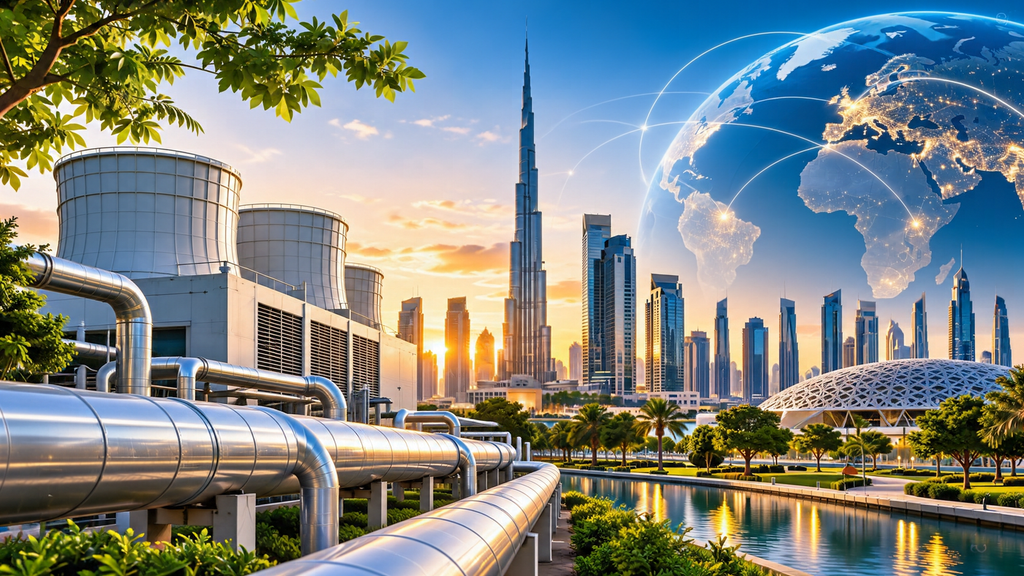
The UAE provides practical lessons in planning, financing, constructing, and operating large cooling networks.
Its experience demonstrates how district cooling can support major developments while also highlighting the importance of long-term contracts and infrastructure coordination.
Dubai’s Utility-Scale Approach
Empower’s operations across Dubai demonstrate the potential to connect commercial, residential, hospitality, retail, and healthcare properties.
The company announced further network expansion during 2026, including additional capacity and projects serving new developments.
This model depends on substantial infrastructure investment and long-term customer relationships.
Cities seeking to replicate it must assess whether enough buildings can be connected to justify the initial costs.
Abu Dhabi’s Experience Through Tabreed
Abu Dhabi-headquartered Tabreed operates district cooling projects across several markets.
Its 2025 results, announced in February 2026, reported approximately 1.57 million refrigeration tons of connected capacity.
The company attributed 2.62 billion kilowatt-hours of avoided electricity consumption during 2025 to its district cooling operations.
This is a company-reported estimate based on its assessment methodology, rather than an independently measured reduction across an entire national electricity system.
The Importance of Long-Term Planning
Cooling infrastructure may operate for decades.
Central plants and underground distribution networks must therefore be designed around future urban development.
If projected buildings are delayed or never constructed, a cooling network may operate below its intended capacity.
Conversely, inadequate expansion planning can limit its ability to serve new customers.
Three Lessons From Gulf Projects
First, integrate cooling into urban planning instead of treating it as an afterthought.
Second, establish reliable technical and commercial arrangements between operators, developers, and customers.
Third, evaluate performance throughout the system’s life rather than focusing exclusively on the initial installation.
What Other Cities Can Learn
| Gulf Experience | Potential International Lesson |
|---|---|
| Large Shared Cooling Networks | Coordinate cooling across multiple buildings |
| Integration Into New Developments | Plan infrastructure before construction |
| Specialised Utility Operators | Establish operating and maintenance expertise |
| Long-Term Concessions | Develop suitable financing and governance |
| Network Expansion | Plan for realistic demand growth |
| Performance Monitoring | Measure actual electricity and service outcomes |
These lessons can guide other cities, although local conditions may require different technical solutions.
4. How Singapore, India, and Colombia Are Testing District Cooling Beyond the Gulf
District cooling is not exclusive to the Arabian Gulf.
Several countries have already introduced centralised cooling networks or evaluated their potential.
These examples demonstrate that the approach can be adapted to different climates, urban structures, and economic conditions.
Singapore’s Marina Bay District
Singapore provides one of the strongest examples of district cooling outside the Middle East.
SP Group operates a district cooling network serving commercial developments around Marina Bay.
In August 2026, the company marked 20 years of operations and announced further connections and expansion plans.
The network demonstrates how shared cooling infrastructure can support a dense urban business district.
Its development also illustrates the importance of long-term planning and the ability to connect additional buildings over time.
Retrofitting Existing Singapore Neighbourhoods
Newly built districts are not the only potential locations.
In March 2025, SP Group launched Singapore’s first distributed district cooling network serving an existing town centre in Tampines.
The company projected annual electricity savings exceeding 2.3 million kilowatt-hours and carbon-emissions reductions of approximately 1,000 tonnes.
These were project performance estimates associated with the system, rather than measured results for every similar redevelopment.
The project demonstrates a different approach: connecting and optimising cooling assets within an already developed urban environment.
Opportunities in India
India faces growing cooling demand as urban development and temperatures increase.
The UN Environment Programme’s district energy initiative has examined opportunities in cities including Bhopal, Pune, Thane, Coimbatore, and Rajkot.
These assessments considered cooling demand, financial feasibility, infrastructure requirements, and potential environmental benefits.
However, completing a feasibility study does not mean a district cooling network has been constructed in every city assessed.
Colombia’s District Cooling Experience
Medellín offers an example from Latin America.
Its La Alpujarra district cooling system began operations in 2016.
According to a case study published through the UN Environment Programme’s ozone-related technical work, the project demonstrated approximately 25% energy savings and a 35% reduction in greenhouse gas emissions compared with the assessed alternative.
These results describe a specific project and should not be applied automatically to other cities.
Examples Beyond the Gulf
| Location | Development | Main Lesson |
|---|---|---|
| Singapore, Marina Bay | Established centralised network | Long-term urban integration |
| Singapore, Tampines | Existing-town retrofit | Opportunities in developed neighbourhoods |
| India, Selected Cities | Feasibility assessments | Importance of local demand analysis |
| Colombia, Medellín | Operating district cooling project | Potential energy and emissions benefits |
| Other Global Cities | Emerging district energy planning | Adaptation to local climate and infrastructure |
The diversity of these cases suggests that district cooling can operate beyond desert environments.
Its suitability depends more on local conditions than on geographic similarity to the Gulf.
5. The Environmental Benefits and Trade-Offs of District Cooling Systems
District cooling can support sustainability objectives when it reduces overall energy consumption or enables cleaner cooling production.
However, environmental assessment must extend beyond electricity savings.
Water demand, refrigerants, infrastructure materials, and energy sources also matter.
Reducing Carbon Emissions
If district cooling consumes less electricity than comparable standalone systems, associated emissions may decrease.
However, the actual reduction depends on the electricity generation mix.
A central plant powered by high-emission electricity may produce different environmental outcomes from one supplied by lower-carbon electricity.
Similarly, energy savings do not always translate into proportional emissions savings.
Refrigerant Management
Cooling equipment often uses refrigerants that can contribute to global warming if released.
Centralised facilities may offer opportunities for specialised refrigerant management and monitoring.
However, district cooling plants still require appropriate refrigerant selection, maintenance, and leak prevention.
Centralisation alone does not guarantee low environmental impact.
Water Consumption
Some district cooling facilities use cooling towers that consume water through evaporation.
In water-stressed locations, this can create an important environmental trade-off.
Alternative systems may use dry cooling or other heat-rejection methods, although these can require additional electricity.
Site-specific assessment is essential.
Construction and Infrastructure Impacts
Building a central cooling plant and underground pipe network requires materials, excavation, transport, and construction activity.
These activities have environmental consequences.
A complete evaluation should consider construction emissions alongside operational performance.
Environmental Factors Compared
| Environmental Factor | Potential Advantage | Possible Trade-Off |
|---|---|---|
| Electricity | Efficient centralised production | Pumping and distribution losses |
| Emissions | Lower consumption may reduce emissions | Depends on electricity sources |
| Water | Can use appropriately treated water | Evaporative cooling may consume water |
| Refrigerants | Centralised professional management | Leakage remains possible |
| Construction | Shared infrastructure | Material use and excavation |
| Urban Space | Fewer building-level cooling plants | Requires space for central facilities |
| Climate Resilience | Coordinated service and storage | Central equipment may create shared failure risks |
The Importance of Lifecycle Assessment
Sustainability claims should compare district cooling against realistic alternatives over a defined period.
The assessment should include operating energy, maintenance, construction, water use, and relevant equipment replacement.
A project may have higher initial environmental costs but lower operational impacts.
Whether that delivers a net benefit depends on the lifetime of the system and the assumptions used.
6. Why District Cooling May Not Work for Every City
Although district cooling offers opportunities, its economic performance is highly sensitive to local conditions.
A system suitable for a dense commercial district may not work well in a low-density residential area.
The most important barriers involve capital costs, infrastructure, demand uncertainty, and governance.
High Initial Investment
District cooling requires central plants, distribution pipes, pumping equipment, controls, and connections to buildings.
Installing underground networks can be expensive, especially in existing urban areas.
Road excavation, utility relocation, and construction disruption may add significant costs.
These investments generally require sufficient long-term demand to become commercially viable.
The Importance of Building Density
District cooling is often more attractive where many buildings are located within a relatively compact area.
Higher density can help spread infrastructure costs across more customers.
Long distances between buildings may increase piping expenses and thermal losses.
Therefore, geographically dispersed neighbourhoods may be less suitable.
Cooling Demand and Climate
Cities with long cooling seasons may offer stronger utilisation of centralised systems.
However, district cooling can also be relevant in temperate cities with concentrated cooling demand, particularly commercial districts or specialised facilities.
The important consideration is the actual load profile rather than average outdoor temperature alone.
Consumer Pricing and Transparency
Customers may pay capacity charges, consumption charges, or other fees according to their contracts.
These charges can differ from conventional electricity bills.
Residents and building owners should understand the complete cost structure.
A district cooling system that benefits the wider electricity grid may still create affordability concerns if individual customers face unclear or excessive charges.
Challenges and Possible Responses
| Challenge | Potential Impact | Practical Response |
|---|---|---|
| High Capital Costs | Difficult project financing | Long-term financial planning |
| Low Building Density | Higher cost per customer | Target suitable districts |
| Construction Disruption | Delays and public inconvenience | Coordinate utility installation |
| Uncertain Demand | Underused infrastructure | Secure realistic connection commitments |
| Water Scarcity | Environmental pressure | Assess appropriate heat rejection |
| Pricing Complexity | Customer dissatisfaction | Transparent tariffs and billing |
| Central Plant Failures | Service disruption | Redundancy and emergency planning |
When Individual Cooling May Be Better
Small buildings in dispersed locations may be better served by efficient standalone equipment.
Existing high-performance buildings may also offer limited additional savings from joining a district network.
District cooling should therefore be considered one possible solution rather than a universal replacement for building-level air conditioning.
7. The Future of District Cooling for Energy-Efficient Cities Worldwide
The future of district cooling will depend on urban development, electricity-system planning, technology improvements, and the ability to finance reliable infrastructure.
Cities seeking to reduce cooling-related energy demand may find opportunities to combine centralised networks with thermal storage, smart controls, and lower-carbon energy.
However, projects should be designed around local needs rather than copied directly from other markets.
The Role of Artificial Intelligence and Digital Monitoring
Digital monitoring systems can help operators analyse cooling demand, equipment performance, and network conditions.
AI-assisted tools may support forecasting and optimisation.
However, automated systems require reliable data, cybersecurity, and professional oversight.
A poorly configured control system can undermine efficiency rather than improve it.
Connecting Cooling With Cleaner Energy
District cooling may be integrated with renewable electricity or suitable low-carbon energy sources.
Thermal storage can also help shift some electricity demand to periods when energy is more available or less expensive.
However, environmental benefits depend on the complete system design and actual operating conditions.
A Practical District Cooling Feasibility Checklist
- Estimate annual and peak cooling demand.
- Study building density and distances between customers.
- Compare against efficient individual cooling systems.
- Calculate construction and distribution costs.
- Assess electricity prices and projected operating expenses.
- Review water availability and cooling technology.
- Evaluate thermal storage opportunities.
- Plan for realistic future development.
- Establish transparent customer contracts and pricing.
- Analyse environmental performance over the system’s lifetime.
How Cities Should Measure Success
District cooling performance should be evaluated using measurable outcomes.
Important indicators include electricity consumed per unit of cooling delivered, peak electricity requirements, system reliability, water consumption, and total lifecycle costs.
Emissions should be calculated using appropriate electricity and refrigerant information.
Customer satisfaction and tariff transparency are also relevant.
Key Performance Indicators
| Indicator | What It Measures |
|---|---|
| Energy Efficiency | Electricity required per unit of cooling |
| Peak Demand | Maximum electrical load |
| System Availability | Reliability of cooling delivery |
| Water Consumption | Water required for operations |
| Carbon Emissions | Relevant greenhouse gas impacts |
| Operating Costs | Annual maintenance and energy expenses |
| Lifecycle Cost | Total expenditure over system life |
| Customer Experience | Billing clarity and service quality |
Opportunities for International Collaboration
Gulf district cooling companies, engineering firms, and utility operators have gained experience in large-scale cooling networks.
This expertise may be relevant to cities considering similar investments.
However, transferring experience does not mean transferring identical designs.
Climate, electricity prices, regulations, building layouts, and construction costs differ.
International partnerships should therefore focus on technical assessment, workforce development, suitable financing, and local adaptation.
The Importance of Urban Planning
District cooling is most effective when considered early in development planning.
Municipalities can assess where shared infrastructure is appropriate and coordinate it with transport, electricity, water, and other utility systems.
For existing neighbourhoods, distributed cooling networks may provide alternatives to constructing an entirely new central plant.
These options require detailed engineering analysis.
Conclusion
District cooling could become an important model for energy-efficient cities beyond the Gulf, particularly where large numbers of buildings require substantial and predictable cooling.
The experience of Dubai and Abu Dhabi demonstrates how centralised cooling can be integrated into major urban developments and operated as shared infrastructure.
International examples from Singapore and Colombia show that similar approaches can also work outside the Middle East.
District cooling may improve energy efficiency, reduce peak electricity demand, support thermal storage, and create opportunities for lower-carbon cooling.
However, its benefits are not automatic.
High initial costs, water use, pipe networks, electricity sources, pricing arrangements, and local cooling demand all influence performance.
For city planners, the central lesson is not that every building should connect to a district cooling network.
It is that cooling should be treated as an important part of urban infrastructure rather than an isolated responsibility for individual properties.
As climate change and urban growth increase global cooling demand, cities will need solutions that combine efficiency, reliability, affordability, and environmental responsibility.
District cooling could be one of those solutions, provided its deployment is guided by realistic engineering assessments and transparent long-term planning.
The Gulf’s experience offers valuable lessons, but the future success of district cooling worldwide will depend on adapting those lessons to the specific needs of each city.
Do follow us on Instagram
Read More – Why Repair Culture Could Become the Next Consumer Movement in the Middle East