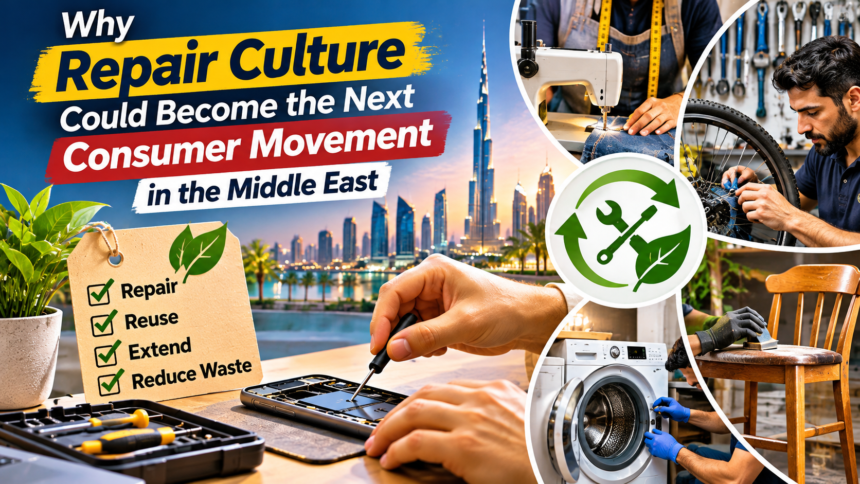
The Future of Product Repair and Circular Consumption in the Gulf
Across the Middle East, consumer markets have long been shaped by new product launches, international brands, advanced technology, and expanding retail destinations. From smartphones and household appliances to luxury handbags, clothing, and furniture, shoppers have access to an enormous variety of products. However, growing interest in sustainability, affordability, and product longevity could encourage more consumers to reconsider whether replacing a damaged item is always the best decision.
- 1. Why Repair Culture Is Becoming Relevant to Middle Eastern Consumers
- 2. How Electronics Repair Could Reduce Waste and Extend Product Lifespans
- 3. Why Fashion Repair and Restoration Could Change Shopping Habits
- 4. How Right-to-Repair Policies and Consumer Protection Could Influence the Gulf
- 5. How Repair Businesses Could Create New Economic Opportunities
- 6. The Barriers That Could Prevent Repair Culture From Becoming Mainstream
- 7. The Future of Repair Culture in the Middle East’s Consumer Economy
Repair culture in the Middle East could become an important part of this change. Rather than automatically purchasing a replacement when something breaks, consumers may increasingly explore professional repairs, refurbishment, alterations, and maintenance services.
The concept is not entirely new. Tailors, cobblers, watchmakers, appliance technicians, and electronics repair specialists have served Middle Eastern communities for generations. What could change is the visibility and commercial importance of these services within modern retail.
Digital booking platforms, independent repair businesses, authorised service centres, and sustainability initiatives may help make repair a more convenient option.
The environmental case is particularly relevant. According to the United Nations’ Global E-waste Monitor 2024, the world generated 62 million tonnes of electronic waste in 2022, while only 22.3% was documented as formally collected and recycled.
Regional initiatives also demonstrate growing attention to product lifespans. Saudi Arabia’s Recycle Your Device programme includes repairing usable electronics before donating them, while the UAE’s circular-economy strategy supports more efficient use of materials and resources.
However, repair is not always cheaper, safer, or environmentally preferable. Costs, product condition, spare-part availability, energy efficiency, and technical safety must all be considered.
Understanding these trade-offs reveals why repair culture could influence the future of Middle Eastern shopping, business development, and sustainable consumption.
1. Why Repair Culture Is Becoming Relevant to Middle Eastern Consumers
Repair culture refers to attitudes and practices that encourage maintaining, restoring, and extending the useful life of products rather than immediately replacing them.
It can involve simple clothing alterations, professional electronics servicing, furniture restoration, or specialist repairs for expensive accessories.
The central principle is to preserve the usefulness of an existing product when doing so is practical and safe.
From Replacement to Product Longevity
Modern consumer markets often encourage frequent upgrades through new designs, software features, seasonal collections, and promotional campaigns.
For some customers, purchasing a replacement may be more convenient than identifying a reliable repair service.
However, this approach can create repeated expenditure and additional demand for materials.
Repair offers another possibility.
A smartphone with a replaceable battery may remain useful for longer. A well-made jacket can be altered to fit its owner, while a damaged chair may be restored instead of discarded.
These examples illustrate how maintaining products can preserve their practical value.
The Role of Household Budgets
Financial considerations may encourage people to compare repair costs with replacement prices.
For example, replacing a damaged appliance could involve purchasing a new unit, paying delivery charges, and arranging disposal of the old one.
A suitable repair may cost less.
However, if repairs are expensive or the product repeatedly fails, replacement may become more economical.
Consumers need reliable information before deciding.
Repair Is Different From Recycling
Repair, reuse, refurbishment, and recycling are related but distinct activities.
| Approach | Main Purpose | Example |
|---|---|---|
| Repair | Restore a product’s working condition | Replacing a damaged phone screen |
| Maintenance | Prevent deterioration or breakdown | Servicing an air conditioner |
| Refurbishment | Improve a used product’s condition | Restoring a laptop |
| Reuse | Continue using an existing product | Giving furniture to another household |
| Upcycling | Transform an item into something different | Turning old textiles into accessories |
| Recycling | Recover materials from discarded products | Processing electronic waste |
These activities can complement one another.
A product that cannot be repaired may still contain materials suitable for authorised recycling.
2. How Electronics Repair Could Reduce Waste and Extend Product Lifespans
Electronic devices are one of the most important categories for repair and refurbishment.
Smartphones, laptops, tablets, televisions, and household electronics contain materials that require energy and resources to manufacture.
Their disposal can also present environmental challenges.
The Scale of Electronic Waste
The International Telecommunication Union and UNITAR reported that global electronic waste increased significantly between 2010 and 2022.
The Global E-waste Monitor 2024 projected that annual generation could reach 82 million tonnes by 2030 if underlying trends continue.
These figures are worldwide estimates, not measurements of GCC electronic waste.
Nevertheless, they demonstrate the importance of improving product longevity and responsible end-of-life management.
Saudi Arabia’s Recycle Your Device Initiative
Saudi Arabia’s Communications, Space and Technology Commission operates the Recycle Your Device initiative in collaboration with government and private-sector partners.
According to the commission’s 2026 reporting, the programme had collected more than 400,000 devices through the end of 2025.
More than 960 tonnes of devices were recycled or repaired, with usable equipment donated to charitable organisations and educational institutions.
The initiative illustrates how repair, responsible recycling, and digital inclusion can work together.
Importantly, these figures combine different activities and should not be interpreted as a count of repaired devices alone.
Why Spare Parts Matter
A product may be technically repairable but difficult to service if replacement components are unavailable.
Manufacturers and service providers therefore influence how long products remain useful.
Access to batteries, screens, connectors, and other components can make a significant difference.
However, repair requires suitable parts, technical competence, and safe working procedures.
Electronics Repair Considerations
| Product | Possible Repair | Important Limitation |
|---|---|---|
| Smartphone | Battery or screen replacement | Component compatibility |
| Laptop | Storage, battery or selected component repair | Design and parts availability |
| Television | Certain electronic component repairs | Safety and cost |
| Tablet | Screen or charging-system repair | Sealed construction |
| Gaming Console | Selected hardware servicing | Warranty and technical requirements |
| Home Electronics | Fault diagnosis and component replacement | Availability of trained technicians |
The Importance of Data Security
Electronics may contain photographs, documents, accounts, and personal information.
Consumers should review backup and data-protection procedures before handing over a device.
Repair businesses also need appropriate privacy practices.
Where devices are refurbished for donation or resale, secure data erasure is essential.
Saudi Arabia’s programme specifically describes data-wiping and destruction procedures as part of its processing model.
3. Why Fashion Repair and Restoration Could Change Shopping Habits
Fashion provides another important opportunity for repair culture.
Clothing, shoes, bags, and accessories may remain useful even after experiencing ordinary wear.
Alterations and restoration can help consumers retain items that still have practical or personal value.
The Return of Clothing Alterations
Tailoring has long been part of everyday life across the Middle East.
Services such as shortening trousers, replacing zippers, repairing seams, and adjusting garments are familiar to many consumers.
These activities may gain renewed relevance as more shoppers consider how to extend the life of their wardrobes.
A high-quality garment that no longer fits perfectly may not need to be discarded.
Alterations can make it suitable for continued use.
Luxury Fashion and Restoration
Luxury handbags, watches, shoes, and accessories may justify specialist restoration because of their craftsmanship and replacement costs.
Potential services include stitching repairs, leather conditioning, hardware replacement, and professional cleaning.
However, restoration must be handled carefully.
Inappropriate materials or workmanship can damage valuable products or affect their resale value.
Customers should seek qualified specialists and understand whether repairs will alter the original item.
The UAE’s Textile Circularity Initiative
In June 2026, the UAE launched Naseej, a national initiative intended to support textile circularity.
The programme brings together government and other partners to improve resource use and develop circular approaches across the textile value chain.
Its broader objectives are relevant to repair, reuse, and material recovery.
However, the initiative should not be described as a nationwide clothing-repair service.
Community Interest in Sustainable Fashion
Reporting in 2026 highlighted a small but developing UAE ecosystem involving repair, reuse, upcycling, and sustainable fashion.
Community events and workshops are introducing consumers to alternatives to rapid clothing replacement.
However, these initiatives remain relatively limited compared with the scale and convenience of mainstream fashion retail.
Fashion Repair Opportunities
| Product Category | Potential Service |
|---|---|
| Everyday Clothing | Alterations, seam repairs and zipper replacement |
| Formalwear | Tailoring and restoration |
| Designer Handbags | Specialist cleaning and leather repair |
| Footwear | Sole and heel replacement |
| Watches | Qualified servicing and component replacement |
| Jewellery | Suitable restoration and resizing |
| Home Textiles | Upholstery and fabric repairs |
Changing the Meaning of Value
Repair culture could encourage consumers to value durability and craftsmanship alongside appearance.
A carefully maintained item may continue serving its owner for years.
However, repair should remain a practical choice rather than a moral obligation to retain every product indefinitely.
4. How Right-to-Repair Policies and Consumer Protection Could Influence the Gulf
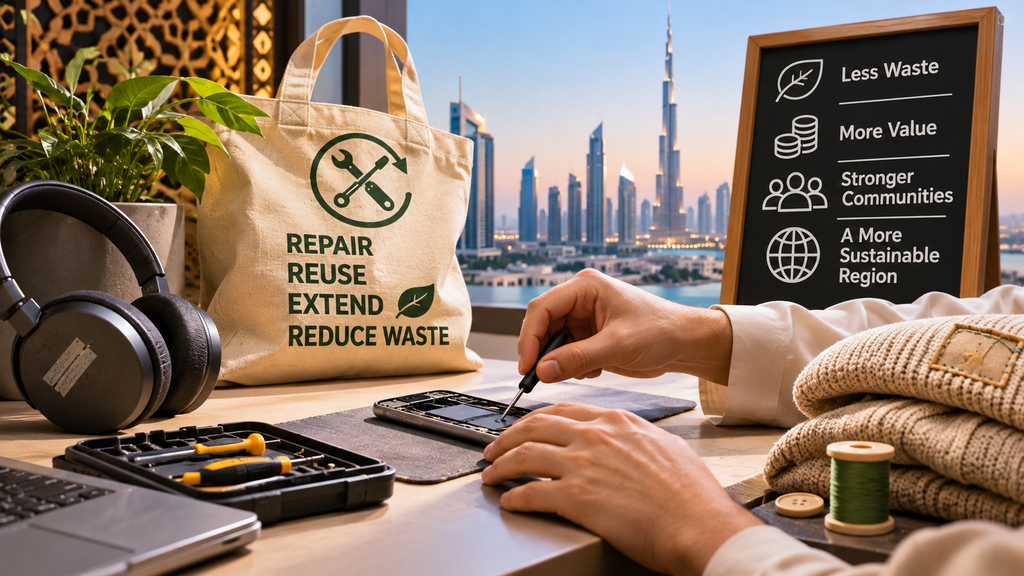
The development of repair culture depends partly on access to spare parts, reliable technicians, transparent prices, and appropriate consumer rights.
Regulation can influence these conditions.
However, the legal framework differs significantly between countries.
The European Right-to-Repair Approach
The European Union adopted Directive 2024/1799 in June 2024 to encourage the repair of certain goods.
Member states were required to apply national implementing rules from 31 July 2026.
The framework includes measures intended to make repair more accessible and provide consumers with better information.
However, the directive applies within the relevant EU legal framework.
It does not automatically establish equivalent rights in the GCC.
Existing Consumer Rights in the UAE
The UAE’s Federal Law No. 15 of 2020 on Consumer Protection addresses suppliers’ responsibilities relating to warranties, spare parts, maintenance, and after-sales services.
Cabinet Decision No. 66 of 2023 provides further implementing requirements.
These provisions can be relevant when consumers seek repairs or maintenance.
However, rights depend on the circumstances, product, applicable warranty, and legal requirements.
The UAE framework should not be described as an identical version of the European right-to-repair directive.
Saudi Arabia’s Maintenance and Spare-Part Requirements
Saudi Arabia’s Ministry of Commerce also supervises obligations involving maintenance, spare parts, and product quality.
Its consumer guidance explains responsibilities associated with warranties and after-sales services.
In August 2023, the ministry announced penalties against four agents and distributors of electrical and electronic devices for violations involving maintenance and spare-part obligations.
This demonstrates that after-sales service is already an established consumer-protection concern.
Regulatory Comparison
| Framework | Main Relevance |
|---|---|
| EU Right-to-Repair Directive | Promotes repair under defined European legal requirements |
| UAE Consumer Protection Law | Addresses warranty and after-sales obligations |
| UAE Implementing Regulations | Provide more detailed maintenance and warranty provisions |
| Saudi Consumer Protection Guidance | Explains relevant supplier and commercial-agent responsibilities |
| GCC National Frameworks | Require country-specific legal assessment |
Why Repair Transparency Matters
Consumers should be able to understand repair estimates, parts availability, timeframes, and warranty implications.
Unclear charges can discourage customers from repairing products.
Transparent documentation can help build confidence and reduce disputes.
5. How Repair Businesses Could Create New Economic Opportunities
Repair culture could support business development across multiple industries.
Independent technicians, specialist workshops, established retailers, logistics providers, and digital platforms may all find opportunities to serve consumers interested in extending product life.
However, repair businesses must offer dependable service to compete with the convenience of buying new products.
The Growth Potential of Specialist Services
Repair businesses can differentiate themselves through expertise.
For example, a company may specialise in professional smartphone servicing, luxury handbag restoration, appliance maintenance, or furniture refurbishment.
Specialisation may help businesses develop reputations for particular products.
However, demand must be assessed locally.
A service popular in Dubai may not automatically attract equivalent demand in another Gulf city.
Repair-as-a-Service Models
Businesses could introduce booking platforms that connect consumers with qualified technicians.
Services may include online quotations, collection and delivery, repair tracking, and post-service support.
These features could make repair more convenient.
However, platforms must verify service-provider competence and clarify responsibility if damage or disputes occur.
Retailers Offering Repairs
Traditional retailers may benefit from providing maintenance or refurbishment services alongside product sales.
Such arrangements can extend customer relationships beyond the original purchase.
For example, an electronics retailer may offer authorised servicing, while a fashion brand could provide alterations or selected product restoration.
However, commercial viability depends on staffing, parts, facilities, and demand.
Potential Business Models
| Model | Revenue Opportunity | Main Challenge |
|---|---|---|
| Independent Repair Shop | Fees for completed repairs | Competition and equipment costs |
| Authorised Service Centre | Approved maintenance work | Brand requirements |
| Mobile Repair Service | On-site convenience | Travel and scheduling |
| Digital Repair Marketplace | Booking or service commissions | Quality control |
| Fashion Restoration Studio | Specialist restoration fees | Skilled craftsmanship |
| Refurbishment Business | Sale of restored products | Inventory and warranty risk |
| Maintenance Subscription | Recurring service fees | Pricing and service commitments |
The Importance of Skilled Workers
Repair requires technical knowledge and practical experience.
Electronics technicians, tailors, leather specialists, and appliance engineers may need different training.
Professional certification, appropriate equipment, and quality assurance can help maintain standards.
Untrained repair work may cause additional damage and create safety risks.
6. The Barriers That Could Prevent Repair Culture From Becoming Mainstream
Despite its potential benefits, repair culture faces several commercial and practical obstacles.
Consumers may continue choosing replacement products when repairs are inconvenient, expensive, unreliable, or difficult to arrange.
Understanding these barriers is essential for businesses and policymakers.
When Repair Costs Too Much
A repair may cost nearly as much as a new item.
In such cases, consumers may reasonably choose replacement, particularly if the existing product has additional defects.
Businesses should provide realistic quotations rather than assuming customers will repair items solely for environmental reasons.
Product Design and Spare-Part Availability
Some products are difficult to disassemble or contain components that are not independently replaceable.
Spare parts may also be expensive or unavailable.
These factors can limit repair options.
Manufacturers can influence repairability through design choices, technical documentation, and component availability.
Warranty and Quality Concerns
Consumers may worry that independent repairs will affect their product warranties.
The legal consequences depend on applicable law and the circumstances.
Customers should review warranty terms and seek clarification when necessary.
Repair businesses should also disclose whether they use original, compatible, refurbished, or other replacement components.
Safety Limitations
Some repairs should only be carried out by qualified professionals.
Electrical equipment, lithium-ion batteries, gas appliances, and other hazardous products can present serious risks.
Repairing a recalled or structurally unsafe product may not be appropriate.
In such circumstances, manufacturer instructions and official safety notices should take priority.
Common Repair Barriers
| Challenge | Consumer Concern | Possible Response |
|---|---|---|
| High Repair Cost | Replacement appears better value | Transparent estimates |
| Long Waiting Period | Inconvenience | Clear service timeframes |
| Unavailable Parts | Repair cannot be completed | Better sourcing and inventory |
| Uncertain Workmanship | Risk of repeated failure | Quality standards and service guarantees |
| Limited Access | Difficult to find specialists | Digital directories and pickup services |
| Data Privacy | Exposure of personal information | Secure handling procedures |
| Safety Risks | Potential injury or equipment failure | Qualified technicians and proper assessment |
Environmental Benefits Are Not Automatic
Repair may reduce waste and avoid some manufacturing impacts, but the outcome depends on the product.
Replacing an extremely inefficient appliance with a substantially more efficient model may sometimes deliver environmental benefits over its lifetime.
Repair assessments should therefore consider operational energy use, remaining lifespan, materials, and waste.
7. The Future of Repair Culture in the Middle East’s Consumer Economy
Repair culture could become more prominent as businesses, consumers, and public institutions explore ways to reduce unnecessary waste and preserve product value.
However, its future will depend on whether repair becomes accessible, trustworthy, and financially sensible.
Connecting Repair With Circular Economy Strategies
The UAE’s Circular Economy Policy 2021–2031 supports resource efficiency, reuse, and more sustainable production and consumption.
Its priorities include sustainable manufacturing and infrastructure.
These objectives provide a relevant policy context for businesses developing repair and refurbishment services.
Saudi Arabia’s electronic-device collection and refurbishment programme provides another example of practical circular-economy activity.
However, these initiatives do not establish that repair has already become a dominant consumer movement.
The Role of Community Education
Workshops and community programmes can help people understand basic maintenance and identify when professional assistance is necessary.
For example, sewing classes may teach simple clothing repairs, while consumer education campaigns can explain responsible electronics disposal.
However, programmes should avoid encouraging inexperienced people to attempt hazardous repairs.
What Consumers Can Do Before Replacing a Product
- Check whether the item is still covered by a warranty.
- Identify the problem and whether repair is appropriate.
- Obtain a clear quotation from a qualified service provider.
- Ask about replacement components and workmanship.
- Compare repair costs with suitable replacement options.
- Consider the product’s likely remaining lifespan.
- Assess safety and any official recall notices.
- Protect personal information before device servicing.
- Request documentation for completed repairs.
- Use authorised recycling when an item cannot be safely repaired.
A Business Checklist for Repair Services
- Identify products with sufficient local repair demand.
- Establish quality and technical standards.
- Source appropriate replacement components.
- Use transparent pricing and written estimates.
- Explain service warranties and limitations.
- Provide secure handling of customer information.
- Train employees in relevant safety procedures.
- Maintain reliable booking and communication systems.
- Comply with applicable consumer and business regulations.
- Track customer satisfaction and repeat failures.
How Should Repair Culture Be Measured?
Useful indicators include repair completion rates, average service costs, customer satisfaction, repeat faults, and the number of products returned to useful service.
Environmental assessments may also examine estimated product life extension and avoided waste.
However, claims about emissions savings should use credible lifecycle methods.
A repaired product does not automatically represent a fixed amount of carbon savings.
Why Convenience Will Matter
Consumers accustomed to rapid delivery and online shopping may expect comparable convenience from repair providers.
Businesses offering dependable appointments, clear quotations, and collection services could reduce practical barriers.
However, convenience should not come at the expense of proper diagnosis or safe workmanship.
Conclusion
Repair culture could become an increasingly important part of Middle Eastern consumer behaviour as households and businesses reconsider the cost and environmental consequences of frequent product replacement.
Electronics servicing, clothing alterations, luxury restoration, appliance maintenance, and furniture refurbishment provide practical ways to extend the usefulness of existing products.
Saudi Arabia’s Recycle Your Device initiative and the UAE’s circular-economy programmes demonstrate growing regional attention to resource efficiency and the preservation of product value.
Consumer protection rules relating to maintenance, warranties, and spare parts also provide an important foundation.
However, repair culture will not expand simply because sustainability has become a popular topic.
Consumers need reasonable prices, reliable technicians, accessible services, and confidence that repaired products will remain safe and useful.
For entrepreneurs, the opportunity lies in turning traditional technical skills into convenient, professional services suited to modern shopping habits.
For retailers, repair and maintenance can strengthen long-term customer relationships.
Ultimately, a successful repair movement would not require consumers to stop buying new products. It would encourage them to make more informed decisions about maintaining, repairing, replacing, and responsibly disposing of the items they own.
As the Middle East develops its circular economy ambitions, making repair a practical everyday option could help create a consumer market that values durability, craftsmanship, and responsible resource use alongside innovation and convenience.
Do follow us on Instagram
Read More – How Longer Life Expectancy Could Reshape the Gulf’s Consumer Economy