



Can Expats Get a Mortgage to Buy Property in Dubai?
Buying property in Dubai does not always mean paying the entire purchase price in cash. For many residents and investors, a mortgage is what makes homeownership possible.
- What Is a Dubai Mortgage and How Does It Work?
- Can Expats Get a Mortgage to Buy Property in Dubai?
- How Much Down Payment Do Expats Need for a Dubai Mortgage?
- How Much Down Payment Do UAE Nationals Need?
- Can You Borrow the Down Payment for a Dubai Mortgage?
- How Much Salary Do You Need for a Dubai Mortgage?
- What Is the Debt Burden Ratio for Dubai Mortgages?
- How Much Can a Bank Lend Based on Your Annual Income?
- What Is the Maximum Mortgage Term in Dubai?
- Should You Choose a Fixed or Variable Mortgage Rate in Dubai?
- Which Is Better Between Fixed and Variable Mortgage Rates?
- What Mortgage Fees Should Dubai Buyers Expect?
- Why Is Property Valuation Important for a Dubai Mortgage?
- What Is Mortgage Pre Approval and Why Should You Get It First?
- What Documents Do You Usually Need for a Dubai Mortgage?
- Can Self Employed Buyers Get a Dubai Mortgage?
- Can Non Residents Get a Mortgage in Dubai?
- Can You Get a Mortgage for an Investment Property in Dubai?
- Can You Get a Mortgage for Off Plan Property in Dubai?
- How Does the Dubai First Time Home Buyer Programme Help Mortgage Applicants?
- Should First Time Buyers Use Their Maximum Mortgage Approval?
- What Happens After Mortgage Pre Approval?
- Can You Buy a Property That Already Has a Mortgage?
- Can You Refinance or Transfer Your Dubai Mortgage?
- What Should You Compare Between Dubai Mortgage Offers?
- How Can Buyers Improve Their Chances of Mortgage Approval?
- What Mortgage Mistakes Should Dubai Buyers Avoid?
- Is a Dubai Mortgage Better Than Paying Cash?
- Is 2026 a Good Time to Take a Dubai Mortgage?
- Can a Dubai Mortgage Be a Smart Way to Buy Property in 2026?
- What Are the Most Common Questions About Dubai Mortgages?
Dubai offers mortgage products for UAE nationals, expatriate residents and, through selected lenders, some non resident buyers. However, financing a property involves much more than comparing monthly payments. Buyers need to understand down payments, loan to value limits, interest rates, bank eligibility, property valuation, Dubai Land Department charges and how existing debts affect borrowing capacity.
The rules are especially important in 2026 because Dubai property prices remain elevated in many popular communities. A buyer considering a AED 1 million apartment faces a very different financing requirement from someone purchasing a AED 7 million villa.
The Central Bank of the UAE regulates important parts of mortgage lending, including maximum loan to value ratios, debt burden limits and maximum mortgage terms. Dubai Land Department then handles mortgage registration against the property.
So, how much deposit do you need for a Dubai mortgage? Can expatriates get 80 percent financing? How much salary is required? Should you choose a fixed or variable mortgage? Can non residents borrow to buy Dubai property?
This Dubai Mortgage Guide 2026 explains the process in simple English.
What Is a Dubai Mortgage and How Does It Work?
A mortgage is financing secured against a property.
The buyer contributes part of the property price as a down payment, while a bank or approved financing institution provides the remaining amount.
The property is then registered as mortgaged in favour of the lender until the loan is repaid or legally settled.
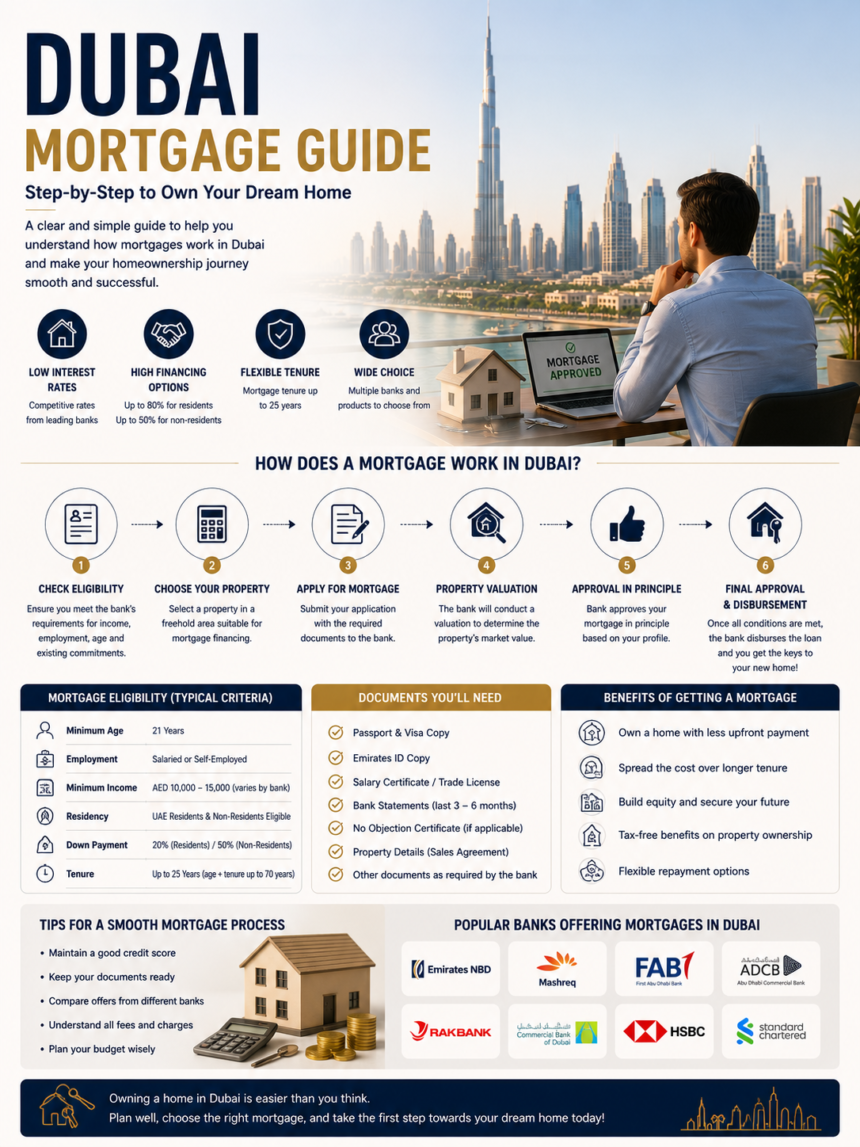
A typical Dubai mortgage process involves several stages:
- Checking financial eligibility
- Obtaining mortgage pre approval
- Choosing a property
- Completing a bank valuation
- Receiving final mortgage approval
- Signing the property sale documents
- Registering the mortgage with Dubai Land Department
- Completing the property transfer
- Beginning monthly repayments
The bank does not simply decide how much to lend based on the property price.
Income, employment, existing debts, credit history, age, property type and valuation can all affect the final mortgage offer.
Can Expats Get a Mortgage to Buy Property in Dubai?
Yes.
Expatriate residents form an important part of Dubai’s mortgage market.
The Central Bank mortgage regulations specifically set loan to value limits for expatriate borrowers, confirming the regulatory framework for expat home financing.
However, being a UAE resident does not automatically guarantee approval.
Banks normally assess factors such as:
- Monthly income
- Employment stability
- Employer profile
- Existing loans and credit cards
- Credit history
- Age
- Property value
- Property type
- Down payment
- Length of UAE residency
- Whether the applicant is salaried or self employed
Each bank can apply its own lending criteria within the wider Central Bank rules.
This means one bank may approve an applicant while another offers a smaller amount or different rate.
How Much Down Payment Do Expats Need for a Dubai Mortgage?
The required down payment depends on whether the property is the buyer’s first owner occupied home, its value and whether the property is ready or off plan.
For expatriates purchasing their first owner occupied property, current Central Bank rules allow a maximum LTV of 80 percent where the property value is up to AED 5 million.
That means the buyer needs at least 20 percent from their own resources.
For a first owner occupied property worth more than AED 5 million, the maximum LTV falls to 70 percent, meaning a minimum 30 percent down payment.
| Expat Property Category | Maximum LTV | Minimum Equity |
|---|---|---|
| First home up to AED 5 million | 80% | 20% |
| First home above AED 5 million | 70% | 30% |
| Second or investment property | 60% | 40% |
| Off plan property | 50% | 50% |
These are maximum regulatory LTV limits.
A bank can choose to lend less.
How Much Down Payment Do UAE Nationals Need?
UAE nationals have higher maximum financing limits for a first owner occupied property.
For properties valued at AED 5 million or less, the maximum LTV is currently 85 percent.
For properties above AED 5 million, it is 75 percent.
For a second or subsequent property, the maximum is 65 percent.
| UAE National Property Category | Maximum LTV | Minimum Equity |
|---|---|---|
| First home up to AED 5 million | 85% | 15% |
| First home above AED 5 million | 75% | 25% |
| Second or investment property | 65% | 35% |
| Off plan property | 50% | 50% |
Again, individual lenders may apply stricter requirements.
Can You Borrow the Down Payment for a Dubai Mortgage?
The Central Bank expects the mortgage down payment to come from the borrower’s own financial resources rather than being funded through additional borrowing such as personal loans or credit cards.
This is important because buyers sometimes focus only on whether they can obtain mortgage approval.
The bigger question is whether they have enough cash available to complete the transaction comfortably.
A buyer may need money for:
- Down payment
- DLD registration
- Mortgage registration
- Bank processing
- Property valuation
- Broker fees
- Trustee fees
- Insurance
- Moving expenses
- Initial maintenance
- Emergency savings
Using every available dirham for the down payment can create financial pressure immediately after the purchase.
How Much Salary Do You Need for a Dubai Mortgage?
There is no single minimum salary that applies to every Dubai mortgage.
Individual banks determine their own income requirements based on the mortgage product, employment category and borrower profile.
A stronger salary can improve access to financing, but banks also consider existing financial commitments.
Someone earning AED 30,000 per month with several loans and large credit card limits may have less borrowing capacity than someone earning AED 22,000 with very little existing debt.
The most important regulatory measure is the debt burden ratio.
What Is the Debt Burden Ratio for Dubai Mortgages?
The debt burden ratio measures how much of the borrower’s gross monthly income is already committed to debt repayments.
The Central Bank currently limits the DBR to 50 percent for expatriates and 60 percent for UAE nationals.
For expatriates, this means total monthly debt obligations, including the proposed mortgage, should generally not exceed half of gross monthly income.
Existing obligations can include:
- Car loans
- Personal loans
- Existing mortgages
- Credit card liabilities
- Other recognised monthly debt commitments
This is why reducing existing debt before applying for a mortgage can improve borrowing capacity.
Large unused credit card limits can also affect a bank’s affordability assessment depending on its internal policy.
How Much Can a Bank Lend Based on Your Annual Income?
The Central Bank also places a limit on total financing relative to annual income.
For expatriates, the maximum mortgage financing amount is up to seven years of annual income.
For UAE nationals, it can be up to eight years of annual income.
These limits work alongside the LTV and debt burden rules.
A property may qualify for 80 percent LTV based on its value, but that does not automatically mean the buyer’s income supports the full amount.
The bank normally applies all relevant affordability tests.
What Is the Maximum Mortgage Term in Dubai?
The maximum mortgage tenor under the Central Bank framework is 25 years.
A longer term can reduce the monthly payment, but it also means interest or profit is paid over more years.
A shorter mortgage usually results in higher monthly repayments but can reduce the total financing cost.
The lender will also consider the borrower’s age when determining the final term.
Banks have their own policies for maximum age at final repayment, so a 30 year old and a 55 year old applying for the same mortgage may receive different maximum terms.
Should You Choose a Fixed or Variable Mortgage Rate in Dubai?
Dubai mortgage products generally use fixed rate periods, variable pricing or a combination of both.
A fixed mortgage can offer more predictable repayments for an agreed introductory period.
After that period, the mortgage may move to a variable structure linked to a benchmark such as EIBOR plus the bank’s margin.
Variable mortgages can change as benchmark rates move.
The Emirates Interbank Offered Rate is therefore important for Dubai mortgage borrowers.
On September 2, 2026, the official three month EIBOR was approximately 4.052 percent, while six month EIBOR was approximately 4.183 percent and one year EIBOR was around 4.349 percent. EIBOR changes over time, so borrowers should always check the current rate rather than relying on an old article.
Which Is Better Between Fixed and Variable Mortgage Rates?
Neither is automatically better.
Fixed rates provide more certainty.
Variable rates provide greater exposure to interest rate movements.
A simple comparison looks like this:
| Fixed Rate Mortgage | Variable Rate Mortgage |
|---|---|
| Predictable payment during fixed period | Payment can change |
| Easier household budgeting | Can benefit if benchmark rates fall |
| May carry higher initial pricing in some cases | Can become more expensive if rates rise |
| Fixed period eventually ends | Pricing usually follows benchmark plus margin |
Borrowers should ask the bank what happens after the introductory fixed period.
The headline interest rate alone is not enough.
Understand the follow on rate.
What Mortgage Fees Should Dubai Buyers Expect?
Mortgage buyers face property transaction costs in addition to the down payment.
Dubai Land Department currently charges 0.25 percent of the mortgage value to register the mortgage.
Additional title deed and Registration Trustee charges also apply depending on the transaction.
A mortgage purchase can involve costs such as:
| Cost | Typical Basis |
|---|---|
| Property registration | DLD sale registration charges |
| Mortgage registration | 0.25% of mortgage value |
| Bank processing | Depends on lender |
| Property valuation | Depends on lender |
| Trustee fee | Depends on transaction |
| Broker commission | If applicable |
| Mortgage insurance | Depends on lender and borrower |
| Life insurance | Often linked to financing requirements |
The exact cost should be confirmed before signing the final mortgage offer.
Why Is Property Valuation Important for a Dubai Mortgage?
The bank usually arranges an independent valuation before final approval.
This is important because the mortgage may be based on the bank’s assessed property value rather than simply the purchase price agreed between buyer and seller.
Imagine a buyer agrees to purchase a property for AED 2 million.
If the bank values it lower, the buyer may need to contribute more cash than expected.
This is one reason mortgage buyers should avoid stretching their finances before the valuation is completed.
The valuation also helps the lender assess whether the property provides sufficient security for the loan.
What Is Mortgage Pre Approval and Why Should You Get It First?
Mortgage pre approval gives the buyer an indication of how much a bank may be willing to lend before a specific property purchase is completed.
It usually involves an initial assessment of income, debts, employment and credit history.
Pre approval is useful because it gives buyers a realistic budget.
Without it, someone may spend weeks searching for AED 3 million properties only to discover that the bank will support a much smaller loan.
Pre approval can also make the buyer more credible during negotiations.
However, pre approval is not final mortgage approval.
The property still needs to meet the lender’s requirements and pass valuation.
What Documents Do You Usually Need for a Dubai Mortgage?
The exact documents depend on the lender and whether the applicant is salaried, self employed, resident or non resident.
Resident salaried applicants may commonly be asked for:
- Passport
- UAE residence visa
- Emirates ID
- Salary certificate
- Recent salary slips
- Bank statements
- Details of existing debts
- Property documents
- Sale agreement
- Proof of down payment
Self employed applicants may need additional documents such as:
- Trade licence
- Company ownership documents
- Business bank statements
- Audited accounts where requested
- Personal bank statements
- Company financial records
Banks can request additional information during underwriting.
Can Self Employed Buyers Get a Dubai Mortgage?
Yes, but the process can be more detailed.
A salaried borrower has a relatively simple income trail through monthly salary payments.
Self employed borrowers may have variable income, business expenses and different ownership structures.
Banks therefore tend to examine a longer financial history.
A successful business owner can still qualify for competitive mortgage financing, but they may need stronger documentation.
Self employed buyers should prepare early rather than waiting until after finding the property.
Can Non Residents Get a Mortgage in Dubai?
Some UAE banks offer property financing to non residents, but the terms are usually different from mortgages available to UAE residents.
Non resident buyers may face:
- Lower maximum LTV
- Higher down payment
- Fewer participating banks
- More documentation
- Country restrictions
- Different income requirements
- Different rate structures
Foreigners who do not live in the UAE can legally own property in designated Dubai freehold areas.
However, legal ownership eligibility and mortgage approval are separate issues.
A buyer may legally be allowed to own the property while still not meeting a bank’s financing criteria.
Can You Get a Mortgage for an Investment Property in Dubai?
Yes.
However, maximum LTV is lower for second and subsequent properties.
For expatriates, the current maximum is 60 percent of the property value for a second or investment property.
For UAE nationals, it is 65 percent.
This means investors need more equity than first time owner occupiers.
Rental income can sometimes be considered in the bank’s affordability assessment, depending on the lender and structure, but investors should not assume the full expected rent will automatically be counted.
Can You Get a Mortgage for Off Plan Property in Dubai?
Mortgage financing for off plan property is more restricted.
The Central Bank currently caps the maximum LTV at 50 percent for off plan property regardless of whether the buyer is a UAE national or expatriate.
Many off plan properties are initially purchased through developer payment plans rather than traditional bank mortgages.
Financing may become more available as construction reaches certain stages or closer to handover, depending on the project and bank.
Buyers should never assume that a bank will finance the remaining balance at handover without checking eligibility in advance.
How Does the Dubai First Time Home Buyer Programme Help Mortgage Applicants?
Dubai’s First Time Home Buyer Programme provides additional support for eligible UAE residents purchasing their first freehold residential property in Dubai.
Applicants must generally:
- Be UAE residents
- Be at least 18 years old
- Not currently own a freehold residential property in Dubai
- Seek a property valued below AED 5 million
Participating banks currently include Commercial Bank of Dubai, Dubai Islamic Bank, Emirates NBD, Emirates Islamic and Mashreq.
Mortgage related benefits can include preferential rates, preferential fees and faster approval processes depending on the participating bank.
The programme also covers both eligible off plan and ready property opportunities.
Should First Time Buyers Use Their Maximum Mortgage Approval?
Not necessarily.
A bank may approve a larger amount than the buyer is personally comfortable repaying.
Mortgage affordability should be based on household life rather than the maximum regulatory limit.
Consider future costs such as:
- School fees
- Children
- Car expenses
- Job changes
- Travel
- Service charges
- Property maintenance
- Insurance
- Emergency savings
- Interest rate changes
A mortgage should leave enough financial flexibility for life outside the property.
Buying at the maximum possible limit may create unnecessary stress if circumstances change.
What Happens After Mortgage Pre Approval?
Once pre approval is in place, the buyer can begin searching within a more realistic price range.
The typical process then includes:
- Select a property
- Negotiate the price
- Sign the relevant sale agreement
- Pay the agreed deposit
- Submit property documents to the bank
- Complete valuation
- Receive final mortgage approval
- Complete lender documentation
- Obtain developer NOC where required
- Register mortgage and property transfer
The exact sequence can vary depending on whether the property is mortgaged already, off plan or ready.
Can You Buy a Property That Already Has a Mortgage?
Yes.
Dubai Land Department provides a specific process for registering the sale of mortgaged property.
The process involves coordination between the seller, buyer, bank and DLD so that the existing mortgage can be settled or released and the ownership legally transferred.
These transactions can take more coordination than a cash purchase of an unencumbered property.
Buyers should make sure the contract provides enough time to complete the bank procedures.
Can You Refinance or Transfer Your Dubai Mortgage?
Mortgage borrowers may later decide to refinance or transfer financing to another lender.
Dubai Land Department provides a mortgage transfer process, with a mortgage registration fee of 0.25 percent of the mortgage value applying under the current service schedule.
Refinancing may be considered when:
- Another lender offers a better rate
- The fixed period is ending
- The borrower wants different repayment terms
- The borrower wants to release equity
- Monthly repayments have become expensive
However, switching mortgages also creates costs.
Compare the total saving after fees rather than focusing only on the new headline rate.
What Should You Compare Between Dubai Mortgage Offers?
A mortgage comparison should go beyond the advertised interest rate.
Compare:
- Initial rate
- Fixed period
- Follow on rate
- EIBOR margin
- Processing fee
- Valuation fee
- Insurance cost
- Early settlement fee
- Partial payment rules
- Refinancing conditions
- Maximum LTV
- Maximum term
- Salary transfer requirements
- Bank account requirements
A slightly higher rate with lower fees and better flexibility can sometimes be more suitable than the cheapest headline offer.
How Can Buyers Improve Their Chances of Mortgage Approval?
Preparation can make the mortgage process easier.
Before applying:
- Reduce unnecessary personal debt
- Avoid taking new loans
- Keep salary credits consistent
- Maintain good credit repayment history
- Avoid repeated late payments
- Save enough for the down payment and fees
- Keep bank statements organised
- Prepare business documents if self employed
- Obtain pre approval before property hunting
- Avoid changing jobs immediately before applying where possible
The goal is to present the bank with a stable financial profile.
Banks are lending for periods that can extend for decades, so income stability matters.
What Mortgage Mistakes Should Dubai Buyers Avoid?
Common mortgage mistakes include:
- Searching for property before obtaining pre approval
- Using every available dirham for the deposit
- Forgetting DLD and bank fees
- Comparing only headline rates
- Ignoring the variable rate after the fixed period
- Taking additional debt before final approval
- Assuming the bank valuation will match the purchase price
- Buying at the maximum affordability limit
- Not checking early settlement conditions
- Assuming an off plan balance will automatically be financed
- Forgetting annual service charges
- Not comparing multiple lenders
Mortgage decisions can affect finances for 20 years or more.
Taking several extra days to compare offers is usually worthwhile.
Is a Dubai Mortgage Better Than Paying Cash?
This depends on the buyer.
Cash buyers avoid mortgage interest and financing fees.
They can also complete transactions more simply and may have stronger negotiating power in some cases.
Mortgage buyers preserve more liquidity.
Instead of placing all available capital into one property, they may keep cash for investments, emergencies or other opportunities.
A simple comparison looks like this:
| Cash Purchase | Mortgage Purchase |
|---|---|
| No mortgage interest | Preserves more cash |
| Simpler transaction | Allows leveraged property ownership |
| No monthly repayment | Creates monthly obligation |
| More capital locked in property | Includes bank and mortgage fees |
| Less financing risk | Interest rates can affect cost |
Neither option is universally better.
The buyer’s financial position should determine the decision.
Is 2026 a Good Time to Take a Dubai Mortgage?
The answer depends on the property, financing offer and buyer’s income stability.
Mortgage rates remain connected to the broader interest rate environment.
As of early September 2026, three month EIBOR was slightly above 4 percent, meaning variable mortgage pricing remains an important cost consideration.
Buyers should therefore avoid making decisions based only on hopes that rates will fall.
A stronger question is whether the mortgage is affordable at today’s rate and whether the borrower could still manage payments if financing costs changed.
If the property is suitable, the purchase price is reasonable and repayments fit comfortably within the household budget, a mortgage can still be a practical route into Dubai homeownership.
Can a Dubai Mortgage Be a Smart Way to Buy Property in 2026?
For many residents, yes.
Dubai mortgage rules provide a structured framework around LTV, debt burden and loan terms. First time expatriate owner occupiers can currently access financing of up to 80 percent on properties below AED 5 million, subject to bank approval.
Dubai’s First Time Home Buyer Programme has also created additional mortgage support through participating lenders.
But financing should not be treated as free money.
The buyer still needs a meaningful deposit, transaction costs and the ability to manage monthly repayments for many years.
The smartest mortgage is not necessarily the one with the highest approved amount.
It is the mortgage that allows someone to buy the right property while keeping enough financial flexibility for everything else in life.
What Are the Most Common Questions About Dubai Mortgages?
Can expats get mortgages in Dubai?
Yes. Expatriate residents can apply for Dubai mortgages subject to bank eligibility and Central Bank lending limits.
How much deposit does an expat need for a first Dubai property?
For a first owner occupied property valued at AED 5 million or less, the maximum expat LTV is 80 percent, meaning at least 20 percent equity is required. Above AED 5 million, the maximum LTV is 70 percent.
What is the maximum mortgage term in Dubai?
The Central Bank sets a maximum mortgage term of 25 years.
What is the maximum debt burden ratio for expats?
The current maximum DBR is 50 percent of gross monthly income for expatriates.
How much can an expat borrow compared with annual income?
The maximum financing amount is capped at up to seven years of annual income for expatriates, subject to other lending rules.
What is the mortgage registration fee in Dubai?
Dubai Land Department currently charges 0.25 percent of the mortgage value for mortgage registration, plus applicable additional fees.
Can non residents get mortgages in Dubai?
Selected banks provide non resident mortgages, but financing levels and eligibility can be more restrictive than for UAE residents.
Can self employed buyers get mortgages?
Yes. Self employed applicants can qualify but normally need additional financial and business documentation.
Can you mortgage an off plan property?
Yes in certain circumstances, but Central Bank rules cap maximum LTV for off plan property at 50 percent.
What is EIBOR?
EIBOR is the Emirates Interbank Offered Rate and is commonly used as a benchmark in variable UAE mortgage pricing.
Should I choose a fixed or variable mortgage?
Fixed mortgages provide greater payment certainty during the fixed period, while variable pricing moves with the applicable benchmark and lender margin. The right choice depends on risk tolerance and the individual product.
Do I need pre approval before looking for property?
It is strongly recommended for mortgage buyers because it provides a clearer purchasing budget before committing to a property.
Does pre approval guarantee the mortgage?
No. The bank still needs to approve the property, valuation and final documentation.
Can I refinance my Dubai mortgage later?
Yes. Mortgage refinancing and transfers are possible, although fees and eligibility requirements apply.
Does Dubai have support for first time mortgage buyers?
Yes. Dubai’s First Time Home Buyer Programme provides eligible UAE residents with access to preferential mortgage offers and other property purchase benefits through participating banks and developers.
Is it better to pay cash or use a mortgage?
It depends on the buyer’s liquidity, investment strategy, interest cost and risk tolerance. Cash avoids financing costs, while a mortgage allows the buyer to preserve more capital.
Do follow us on Instagram
Read More – Mortgage Guide UAE: Everything First Time Home Buyers Should Know