

Are Dubai Property Prices Still Rising in 2026?
Dubai real estate entered 2026 from an unusually strong position. Years of rising transaction volumes, international investment, population growth, new development launches and luxury property demand transformed the city into one of the most closely watched property markets in the world.
- Is Dubai Real Estate Still Growing Strongly in 2026?
- Are Dubai Property Prices Still Rising in 2026?
- Why Are Villa Prices More Resilient Than Apartment Prices?
- Are Apartments Becoming More Affordable in Dubai?
- Is Off Plan Property Still Dominating Dubai Real Estate?
- Is the Ready Property Market Making a Comeback?
- Are Dubai Rental Prices Finally Stabilising in 2026?
- Why Does Villa Rental Demand Remain Strong?
- Are Affordable Areas Becoming More Important for Investors?
- Is Dubai’s Luxury Property Market Still Breaking Records?
- Why Is Dubai Attracting More Wealthy Property Buyers?
- Is Foreign Investment Still Driving Dubai Real Estate?
- Are More Buyers Purchasing Dubai Property to Live In?
- Is New Property Supply Becoming a Major Market Trend?
- Which Communities Are Attracting Strong Buyer Interest in 2026?
- Are Emerging Dubai Communities Becoming More Attractive?
- Is Infrastructure Still Driving Dubai Property Demand?
- Is Dubai’s Office Property Market Still Strong in 2026?
- Are Studios Becoming More Popular With Investors?
- Is the Market Moving From Investors Toward End Users?
- How Are Dubai Real Estate Regulations Changing the Market?
- Are Buyers Becoming More Selective About Developers?
- What Risks Could Affect Dubai Real Estate During the Rest of 2026?
- Could Dubai Property Prices Fall Further in 2026?
- Is 2026 Becoming a Better Market for Property Buyers?
- Is 2026 Becoming a More Difficult Market for Sellers?
- What Could Happen to Dubai Real Estate After 2026?
- What Are the Most Important Dubai Real Estate Market Trends to Watch?
- Are Dubai Real Estate Market Trends Positive for Investors in 2026?
- What Are the Most Common Questions About Dubai Real Estate Market Trends?
But the story in 2026 is becoming more interesting.
Dubai is no longer experiencing the same kind of broad based acceleration across every segment. Instead, the market is becoming more selective. Villas remain resilient, affordable apartments continue to attract yield focused investors, luxury property is breaking records, off plan developments dominate sales activity and the ready property market is beginning to strengthen again.
At the same time, some apartment values have softened as more supply enters the market.
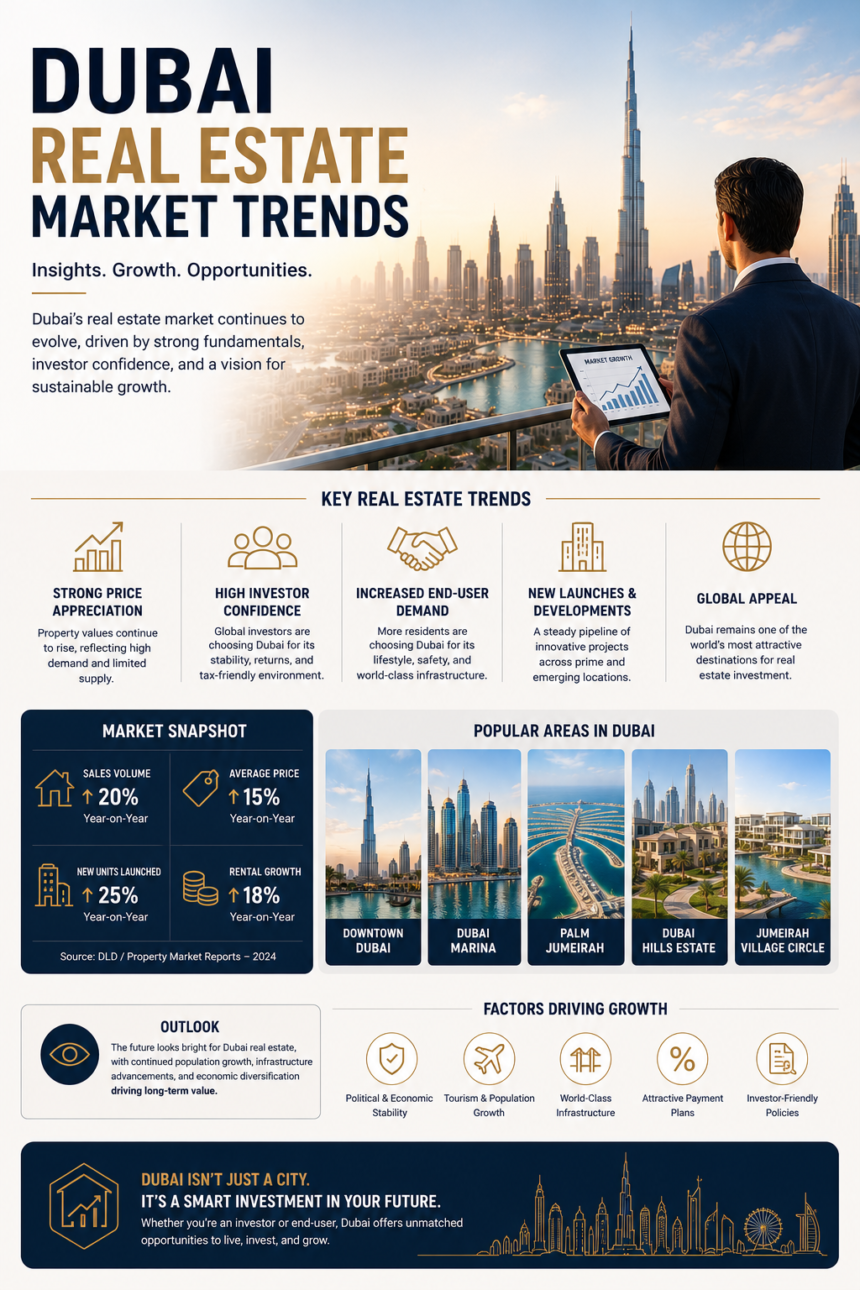
Dubai Land Department reported AED 252 billion in total real estate transactions during the first quarter of 2026, representing a 31 percent increase in value compared with the same period of 2025. Investment activity reached AED 173 billion, while foreign investment reached AED 148.35 billion.
By July, however, independent residential indices showed a more balanced picture. ValuStrat reported a marginal 0.3 percent monthly decline in citywide residential values and a 1.6 percent annual adjustment, suggesting that Dubai is moving from rapid expansion toward a more stable phase.
So, what are the biggest Dubai Real Estate Market Trends in 2026? Are prices still rising? Why are villas outperforming apartments? Is off plan still dominating? Are rents finally stabilising?
This guide looks at the trends shaping Dubai property in 2026 and what they could mean for buyers, investors, landlords and tenants.
Is Dubai Real Estate Still Growing Strongly in 2026?
Yes, but growth is becoming more complicated than simply saying prices are rising.
Dubai Land Department’s Q1 figures showed strong transaction activity. The emirate recorded 60,303 real estate transactions worth AED 252 billion during the first quarter, with transaction value up 31 percent and volume up 6 percent year on year.
Real estate investment also remained strong. There were 57,744 investments worth AED 173 billion, representing a 22 percent increase in value.
More importantly, the investor base continued expanding.
Dubai recorded 48,448 investors during Q1, including 29,312 new investors. The number of new investors increased 14 percent compared with the same period of 2025.
However, later 2026 market indicators point toward moderation.
CBRE reported that Dubai’s residential sector softened during Q2 as demand became more measured and new supply reduced some pricing pressure.
This suggests Dubai is moving into a more mature phase.
The market remains active, but buyers are becoming more selective.
Are Dubai Property Prices Still Rising in 2026?
Not everywhere.
This is one of the most important Dubai Real Estate Market Trends to understand.
During several earlier years, price growth was visible across a large part of the market. In 2026, performance is increasingly different between communities and property types.
ValuStrat’s July 2026 Residential Price Index stood at 219.2 points, down only 0.3 percent month on month but 1.6 percent lower than a year earlier.
Apartment values were more affected.
Citywide apartment capital values were approximately 4.2 percent lower year on year in July, while villa values were broadly unchanged annually.
However, some communities continued growing.
Dubai Silicon Oasis apartment values increased around 6 percent annually, while Dubai Sports City gained approximately 5.4 percent.
Jumeirah Islands villa values increased around 15 percent annually.
The lesson is simple.
There is no longer one Dubai property price trend.
A buyer needs to analyse the exact community and property type.
Why Are Villa Prices More Resilient Than Apartment Prices?
Villas remain one of the strongest parts of Dubai’s residential market.
The reason is partly supply.
Dubai can add thousands of apartments relatively quickly through high rise developments. Villas require larger plots, lower density master communities and considerably more land.
Demand has also changed.
Families increasingly value:
- Additional bedrooms
- Private outdoor space
- Larger living areas
- Family communities
- Schools nearby
- Parks and recreational facilities
- Privacy
- Longer term residential stability
Bayut’s H1 2026 analysis showed stronger price momentum across villa communities than across many apartment districts. Palm Jumeirah, Dubai Hills Estate, Al Furjan, DAMAC Hills 2, Al Barari and Jumeirah Islands were among areas showing continued villa strength.
ValuStrat’s July index also showed villas remaining broadly flat year on year even while apartments recorded a noticeable correction.
For investors, this indicates that limited supply and strong end user demand are supporting quality villa communities.
Are Apartments Becoming More Affordable in Dubai?
In some communities, yes.
Apartment prices are no longer moving upward at the same pace seen during the earlier boom.
ValuStrat recorded a citywide weighted average apartment capital value of approximately AED 1.397 million per square foot in July 2026 and reported a 4.2 percent year on year adjustment in apartment values.
Certain premium locations experienced larger corrections, while more affordable areas remained resilient.
This creates a more interesting environment for buyers.
During periods of rapid growth, buyers may feel forced to decide quickly.
A stabilising market gives them more opportunity to:
- Compare buildings
- Negotiate
- Check service charges
- Review actual transaction prices
- Evaluate developer quality
- Compare off plan and ready alternatives
Apartment investors should still pay close attention to new supply.
Areas with large pipelines of similar units may experience greater competition.
Is Off Plan Property Still Dominating Dubai Real Estate?
Yes.
Off plan remains one of the defining trends of Dubai’s property market.
ValuStrat reported that off plan registrations accounted for approximately 73 percent of residential sales activity in July 2026.
Developers continue attracting investors through:
- Instalment payment plans
- New master communities
- Branded residences
- Waterfront projects
- Post handover payment options
- New infrastructure stories
- Smaller initial payment requirements
Off plan property is especially attractive to investors who want to spread payments across construction rather than commit the full capital immediately.
However, the dominance of off plan sales also creates risks.
A large pipeline means future buyers need to consider how many competing units could arrive at the same time.
The best off plan investment is not necessarily the project with the most attractive marketing campaign.
Price and future demand still matter.
Is the Ready Property Market Making a Comeback?
Yes, and this is one of the more significant trends emerging during the second half of 2026.
ValuStrat reported that ready home transactions increased by 11.4 percent month on month in July to reach 3,546 sales. It was the second consecutive monthly increase in completed property activity.
The strongest ready property activity was concentrated in established communities.
JVC accounted for approximately 14.4 percent of completed home sales during July, followed by Dubai Marina at around 6 percent and Business Bay at 5.3 percent.
Why are buyers returning to ready property?
Completed homes provide several advantages.
Buyers can inspect the exact property.
They can understand the building quality.
They can see the real view.
They know the current service charges.
Investors can also begin earning rent almost immediately.
This does not mean ready property will overtake off plan.
But the gap between the two segments may become more balanced if buyers become increasingly cautious about future supply.
Are Dubai Rental Prices Finally Stabilising in 2026?
Rental growth has become more moderate across several parts of Dubai.
Bayut described H1 2026 as a relatively balanced rental market, with several affordable and mid market communities showing minor adjustments while premium villa demand remained strong.
This is a change from earlier periods when tenants experienced widespread rapid rental increases.
The current market is giving renters greater choice.
Dubai Marina and Downtown Dubai remained major luxury apartment rental destinations, while JVC, Business Bay and Arjan continued attracting mid market tenants.
Affordable areas such as Al Nahda, Deira and International City remained popular with cost conscious households.
The direction is not identical everywhere.
Palm Jumeirah apartment rents increased, while certain premium city apartment markets became more competitive.
For tenants, this means negotiation may become easier in buildings with more vacant units.
Why Does Villa Rental Demand Remain Strong?
Villa rental demand remains particularly resilient.
Families are increasingly seeking larger homes within master planned communities, and quality villas are still limited compared with apartments.
Bayut’s H1 2026 rental analysis showed continued demand across Dubai Hills Estate, Arabian Ranches, Palm Jumeirah, Jumeirah Islands and other villa communities.
Some affordable suburban developments also remained attractive because families were seeking more space without paying prime Dubai prices.
This difference between apartment and villa rentals is important.
Apartment tenants generally have more alternatives.
A one bedroom renter can compare dozens of buildings.
A family looking for a five bedroom villa close to a specific school may have far fewer suitable choices.
Scarcity therefore gives landlords greater pricing power in some villa communities.
Are Affordable Areas Becoming More Important for Investors?
Yes.
As property prices increased across Dubai, affordability became a more important investment theme.
Investors are increasingly looking beyond famous premium neighbourhoods and evaluating communities based on rental return.
Bayut’s H1 2026 data showed some of Dubai’s strongest apartment rental yields in lower priced communities.
| Area | Approximate Reported ROI |
|---|---|
| Discovery Gardens | 9.06% |
| International City | 8.79% |
| Dubai Silicon Oasis | 8.23% |
| Dubai Sports City | 8.12% |
| Al Furjan | 7.69% |
These communities can produce higher percentage returns because property purchase prices are lower relative to rent.
However, investors should calculate net yield.
Service charges, maintenance and vacancy can reduce the final return significantly.
Is Dubai’s Luxury Property Market Still Breaking Records?
Yes.
Dubai’s ultra luxury property market remains remarkably strong even while parts of the mainstream apartment sector are stabilising.
Knight Frank recorded 296 homes valued above USD 10 million sold during the first half of 2026.
This included 165 transactions during Q1 and another 131 during Q2.
The total value of USD 10 million plus home sales reached approximately USD 5.1 billion, up 14 percent compared with H1 2025.
Another 26 properties sold for more than USD 25 million during the period.
This reflects continued demand from high net worth individuals looking for:
- Waterfront villas
- Branded residences
- Large plots
- Privacy
- Premium lifestyle
- Limited supply
- International wealth preservation
Luxury and mainstream property are therefore moving at different speeds.
Why Is Dubai Attracting More Wealthy Property Buyers?
Dubai increasingly operates as both a residential market and an international wealth destination.
Knight Frank reported that Dubai’s prime residential values increased by approximately 25.1 percent during 2025, placing it among the strongest performing luxury markets globally.
Several factors continue attracting wealthy buyers.
Dubai offers a combination of lifestyle, global connectivity, luxury services, international schools, security and property ownership opportunities.
High net worth residents are also increasingly choosing Dubai as a primary or secondary home rather than purchasing property purely as an investment.
This helps explain why ultra prime demand can remain strong even when wider apartment prices are moderating.
Is Foreign Investment Still Driving Dubai Real Estate?

Yes.
Foreign investment remains one of the strongest foundations supporting Dubai property.
Dubai Land Department reported AED 148.35 billion in foreign real estate investment during Q1 2026, a 26 percent increase year on year. The number of foreign investments increased by 11 percent to 48,445.
Dubai’s freehold ownership system allows international buyers to purchase property across many of the city’s most important communities.
Foreign capital also comes from several different buyer types.
These include:
- International investors
- UAE expatriate residents
- High net worth individuals
- Entrepreneurs relocating to Dubai
- Families purchasing permanent homes
- Buyers seeking long term residency
- Overseas investors seeking rental income
This diversity helps the market avoid dependence on only one buyer category.
Are More Buyers Purchasing Dubai Property to Live In?
End user demand is becoming increasingly important.
During earlier market cycles, Dubai was often viewed primarily as an investor driven property market.
Today, more residents are treating Dubai as a long term home.
Families are buying villas.
Professionals are purchasing apartments in communities where they previously rented.
Government initiatives such as Dubai’s First Time Home Buyer Programme are also designed to increase homeownership.
This shift can improve market stability.
An investor may sell quickly when market conditions change.
An owner occupier purchasing a long term family home may be less sensitive to short term price movements.
Communities with strong end user demand may therefore prove more resilient during market adjustments.
Is New Property Supply Becoming a Major Market Trend?
Yes.
Supply may be one of the most important variables to watch through the rest of 2026 and beyond.
Dubai has experienced an extraordinary number of residential launches.
As more projects reach completion, buyers and tenants gain additional choice.
CBRE specifically identified new supply as one of the factors easing residential pricing pressure during Q2 2026.
Supply does not affect every area equally.
A mature villa community with limited available land can remain relatively protected.
A developing apartment district with thousands of similar units entering the market can experience stronger competition.
Before investing, buyers should therefore ask:
- How many units are under construction nearby?
- When will they be delivered?
- Are they similar to my property?
- Will most investors be trying to rent at the same time?
- Is population growth sufficient to absorb the supply?
Future competition matters just as much as current demand.
Which Communities Are Attracting Strong Buyer Interest in 2026?
Buyer interest remains spread across several different price segments.
Bayut’s H1 2026 analysis showed Palm Jumeirah remaining a major ultra luxury apartment and villa destination.
Dubai Marina continued leading luxury apartment interest.
JVC remained a prominent mid market choice.
Dubai Silicon Oasis and Dubai Sports City were popular affordable apartment locations.
Ready property activity in July also showed strong liquidity in JVC, Dubai Marina and Business Bay.
This indicates that established communities remain important even while new developments continue launching.
Investors should not assume new automatically means better.
Older established districts can offer proven tenant demand and more predictable resale liquidity.
Are Emerging Dubai Communities Becoming More Attractive?
Yes.
New infrastructure and major development plans are bringing attention to newer districts.
Dubai South continues attracting investors because of the long term development around Al Maktoum International Airport, Expo City Dubai and logistics zones.
Dubai Creek Harbour is building a new waterfront residential market.
Dubai Islands and Dubai Maritime City have gained greater visibility within the off plan segment.
Property Finder’s market analysis noted that off plan demand has expanded into newer communities such as Dubai Harbour and Maritime City, while established areas including Business Bay, Dubailand and JVC continue generating significant new launch activity.
Emerging communities can offer stronger upside if infrastructure and population develop as expected.
They also require more patience.
Is Infrastructure Still Driving Dubai Property Demand?
Infrastructure remains one of the strongest long term property themes.
Road expansions, Metro development, airport investment and new urban districts can change the attractiveness of residential areas.
The Dubai Metro Blue Line is particularly important for communities that currently have weaker public transport access.
The line is expected to connect growing areas including Dubai Silicon Oasis, Dubai Creek Harbour, International City, Mirdif and Academic City.
Investors should not buy property only because a new Metro station is planned.
However, improved connectivity can increase the number of people willing to live in an area.
Infrastructure therefore matters most when it improves an already sensible property investment.
Is Dubai’s Office Property Market Still Strong in 2026?
Yes.
Dubai’s commercial property market is showing a different pattern from the moderating residential sector.
CBRE reported that Dubai office rents increased approximately 13 percent year on year during Q2 2026, while prime office rents increased around 16 percent.
Office occupancy remained approximately 94 percent.
This reflects continued demand from companies establishing or expanding operations in Dubai.
Limited supply of high quality office space also supports rents.
For property investors, this shows that Dubai’s real estate story extends beyond apartments and villas.
Commercial, office and industrial property are benefiting from business growth and company relocation trends.
Are Studios Becoming More Popular With Investors?
Studios have become increasingly important in Dubai’s investment market.
Property Finder’s 2025 analysis showed studios increasing their share of apartment transaction activity, driven by affordability and stronger investment economics.
This trend remains relevant in 2026.
Studios require lower investment capital than larger apartments and can attract tenants such as:
- Young professionals
- New Dubai residents
- Single expatriates
- Short term tenants
- Budget conscious renters
However, investors should check future studio supply carefully.
A building containing hundreds of almost identical studios can create intense competition among landlords.
Affordability creates demand, but scarcity still matters.
Is the Market Moving From Investors Toward End Users?
Not completely, but the balance is changing.
Off plan activity remains heavily investor driven.
At the same time, ready property and villa demand point toward a stronger end user market.
The 11.4 percent monthly rise in ready home transactions in July is particularly interesting because completed properties are often attractive to buyers who want immediate occupancy.
This creates a healthier mix.
Investors provide liquidity and support new project launches.
End users support established communities and longer term demand.
A market with both groups can be more stable than one dominated entirely by speculative resale activity.
How Are Dubai Real Estate Regulations Changing the Market?
Dubai continues increasing transparency and digital oversight.
Dubai Land Department has expanded digital services, advertising regulation, market data and rental tools.
The Smart Rental Index provides clearer guidance around eligible rental increases.
Dubai has also expanded digital property transaction services and compliance monitoring.
Bayut’s H1 2026 reports highlighted DLD initiatives including the Smart Rental Index, rental heatmaps and technology driven property management infrastructure as part of the market’s increased transparency.
For investors, better regulation can reduce uncertainty.
It can also make buyers more informed.
This means brokers and developers increasingly need to compete through genuine property quality rather than information gaps.
Are Buyers Becoming More Selective About Developers?
Yes.
The enormous number of off plan projects has made developer reputation more important.
During a rapidly rising market, investors may accept higher risk because they expect price appreciation to compensate for mistakes.
During a stabilising market, construction quality, handover history, service charges and developer reputation matter more.
Buyers are increasingly comparing:
- Previous project delivery
- Construction quality
- Payment plans
- Service charges
- Escrow registration
- Community management
- Handover history
- Resale performance
This is a healthy development.
A more selective buyer market rewards developers that deliver consistently.
What Risks Could Affect Dubai Real Estate During the Rest of 2026?
Dubai remains strong, but no property market is risk free.
Potential challenges include:
- Large future residential supply
- Higher financing costs
- Regional geopolitical uncertainty
- Slower global economic growth
- Reduced speculative demand
- Greater competition between landlords
- Oversupply in individual communities
- Buyers resisting high off plan launch prices
CBRE reported that the UAE experienced a more difficult macroeconomic backdrop during Q2, while Dubai residential activity moderated as new supply and softer demand reduced some pricing pressure.
The key risk may not be a major citywide crash.
It may be local oversupply.
Some communities can continue performing well while others struggle.
Could Dubai Property Prices Fall Further in 2026?
Further adjustment is possible, particularly in apartment locations with high supply.
However, current data does not point to a uniform collapse.
ValuStrat’s July index showed only a 0.3 percent monthly decline, suggesting that the pace of correction was relatively mild.
Ready property transactions were simultaneously increasing.
Villa values remained broadly stable annually.
Affordable communities such as Dubai Silicon Oasis continued recording positive price growth.
Luxury transactions remained exceptionally strong.
This creates a market where different segments can move in opposite directions.
The most likely trend is continued differentiation rather than every Dubai property rising or falling together.
Is 2026 Becoming a Better Market for Property Buyers?
For selective buyers, potentially yes.
A slower price environment can provide more time for research and negotiation.
Buyers may have greater ability to compare:
- Ready versus off plan
- New versus older buildings
- Developer payment plans
- Rental yields
- Service charges
- Recent transaction prices
- Future supply
The market remains competitive in highly desirable properties, particularly quality villas and luxury homes.
But mainstream apartment buyers may have more choice than during the fastest growth periods.
That can create healthier buying conditions.
Is 2026 Becoming a More Difficult Market for Sellers?
In some segments, yes.
When buyers have more options, sellers need to become more realistic.
An apartment owner cannot necessarily price a property significantly above comparable transactions simply because Dubai performed strongly during the previous several years.
Properties that may sell more easily include those with:
- Good views
- Strong building management
- Low or reasonable service charges
- Upgraded interiors
- Attractive layouts
- Established rental demand
- Reputable developers
- Limited competing supply
Average properties in areas with heavy supply may take longer to sell.
Quality is becoming increasingly important.
What Could Happen to Dubai Real Estate After 2026?
Dubai’s long term real estate outlook remains tied to population growth, infrastructure, economic development and the Real Estate Sector Strategy 2033.
The city continues positioning itself as a global destination for business, wealth, tourism and long term residence.
New Metro infrastructure, airport development, growing business districts and expanded residential communities could continue creating property demand.
However, market maturity changes the investment strategy.
During an early growth phase, buying almost anything in the right city can sometimes produce strong gains.
In a mature market, individual property selection becomes much more important.
The strongest future investments are likely to be properties with genuine tenant or end user demand rather than those depending entirely on speculation.
What Are the Most Important Dubai Real Estate Market Trends to Watch?
For buyers and investors, the current market can be summarised through several major trends.
| 2026 Trend | What It Means |
|---|---|
| High transaction activity | Investor confidence remains strong |
| Apartment price moderation | Buyers may gain negotiating power |
| Villa resilience | Family demand and limited supply remain important |
| Off plan dominance | New projects continue driving sales |
| Ready market recovery | Completed homes are gaining interest |
| More stable rents | Tenants have greater choice in some areas |
| Strong affordable yields | Budget communities attract investors |
| Record luxury demand | High net worth capital remains active |
| Rising supply | Community selection becomes critical |
| Strong foreign investment | Dubai remains internationally attractive |
| Office rental growth | Commercial property remains resilient |
| More regulation | Transparency and buyer protection continue improving |
The overall message is not that Dubai has stopped growing.
It is that the market is becoming more sophisticated.
Are Dubai Real Estate Market Trends Positive for Investors in 2026?
Overall, Dubai still offers significant opportunities, but the easy part of the cycle may be changing.
Transaction values remain high.
Foreign investment remains strong.
Luxury property is setting records.
Villas continue attracting families.
Affordable apartments offer attractive rental returns.
Ready property demand is recovering.
But investors now need to think more carefully about supply, pricing and property quality.
The strongest strategy in 2026 is not simply buying because Dubai property has performed well in the past.
Investors should ask whether their exact property has a reason to remain desirable in the future.
A property near employment, schools, transport and established amenities may have a stronger foundation.
A villa in a limited supply community may behave differently from an apartment in a district with thousands of new units.
A lower priced apartment with an 8 percent rental yield may outperform a fashionable luxury project from an income perspective.
Dubai real estate remains active, but 2026 increasingly rewards research over hype.
What Are the Most Common Questions About Dubai Real Estate Market Trends?
Is the Dubai real estate market still strong in 2026?
Yes. Dubai recorded AED 252 billion in real estate transactions during Q1 2026, although residential price growth became more moderate during Q2 and July.
Are Dubai property prices increasing in 2026?
Performance varies. Some communities continue recording growth, while citywide apartment values have experienced moderate adjustments.
Are apartment prices falling in Dubai?
ValuStrat reported apartment capital values approximately 4.2 percent lower year on year in July 2026, although several affordable communities still recorded growth.
Are Dubai villa prices still rising?
Villa performance is stronger than apartments overall. Citywide villa values were broadly flat annually in July, while selected communities such as Jumeirah Islands recorded strong growth.
Is off plan still popular in Dubai?
Yes. Off plan properties accounted for approximately 73 percent of residential sales in July 2026 according to ValuStrat.
Is ready property becoming more popular?
Yes. Ready home transactions increased 11.4 percent month on month in July 2026.
Are Dubai rents still increasing?
Rental growth has become more moderate. Some premium and villa communities are still recording increases, while several apartment areas are becoming more tenant friendly.
Which Dubai properties offer strong rental yields?
Affordable apartment communities such as Discovery Gardens, International City, Dubai Silicon Oasis and Dubai Sports City continue to report comparatively strong estimated returns.
Is Dubai luxury real estate still growing?
Yes. Knight Frank recorded a record 296 home sales above USD 10 million during H1 2026.
Are foreign investors still buying Dubai property?
Yes. Foreign real estate investment reached AED 148.35 billion during Q1 2026, representing a 26 percent annual increase.
Is there too much new property supply in Dubai?
Supply is increasing and is becoming an important consideration, especially in apartment communities with large development pipelines.
Are villas safer investments than apartments?
Not automatically. Villas currently benefit from more limited supply and strong family demand, but price, location and individual property quality remain important.
Which Dubai communities are attracting buyers?
Palm Jumeirah, Dubai Marina, JVC, Dubai Silicon Oasis, Dubai Sports City, Business Bay and Dubai Hills Estate remain important across different market segments.
Is Dubai property becoming a buyer’s market?
Some apartment segments are becoming more balanced and buyers may have greater negotiating power, but desirable villas and luxury properties remain competitive.
Will Dubai property prices crash in 2026?
Current data indicates measured adjustment rather than a uniform citywide collapse. Market performance varies significantly by property type and community.
Is Dubai real estate still a good investment?
Dubai can still provide investment opportunities through rental yield, long term ownership and capital growth, but investors should be increasingly selective about price, supply, developer and location.
Do follow us on Instagram.
Read More – Dubai Real Estate: Market Trends, Investment, and Opportunities