



Which City Is Better for Expats in 2026 Dubai vs Abu Dhabi?
Dubai vs Abu Dhabi is one of the most common comparisons for professionals, families, entrepreneurs, students, and international workers planning to move to the UAE. Both cities offer excellent infrastructure, modern residential communities, international schools, high-quality healthcare, global connectivity, and a large expatriate population. However, the experience of living in Dubai can be very different from living in Abu Dhabi.
- Dubai vs Abu Dhabi at a Glance
- Dubai vs Abu Dhabi: Cost of Living
- Housing Costs
- Food and Groceries
- Utilities and Internet
- Which City Has Better Job Opportunities?
- Dubai May Be Better for Your Career If:
- Abu Dhabi May Be Better for Your Career If:
- Dubai vs Abu Dhabi: Salary Comparison
- Dubai vs Abu Dhabi: Lifestyle
- Which City Is Better for Families?
- Education and Schools
- Healthcare in Dubai vs Abu Dhabi
- Transportation: Dubai vs Abu Dhabi
- Traffic and Commute
- Entertainment and Nightlife
- Culture and Heritage
- Safety and Quality of Life
- Taxes in Dubai vs Abu Dhabi
- Business and Entrepreneurship
- Dubai vs Abu Dhabi for Young Professionals
- Dubai vs Abu Dhabi for Couples
- Dubai vs Abu Dhabi for Long-Term Living
- Pros and Cons of Living in Dubai
- Pros and Cons of Living in Abu Dhabi
- Dubai vs Abu Dhabi: Which City Is Cheaper?
- Dubai vs Abu Dhabi: Which City Is Better for Expats?
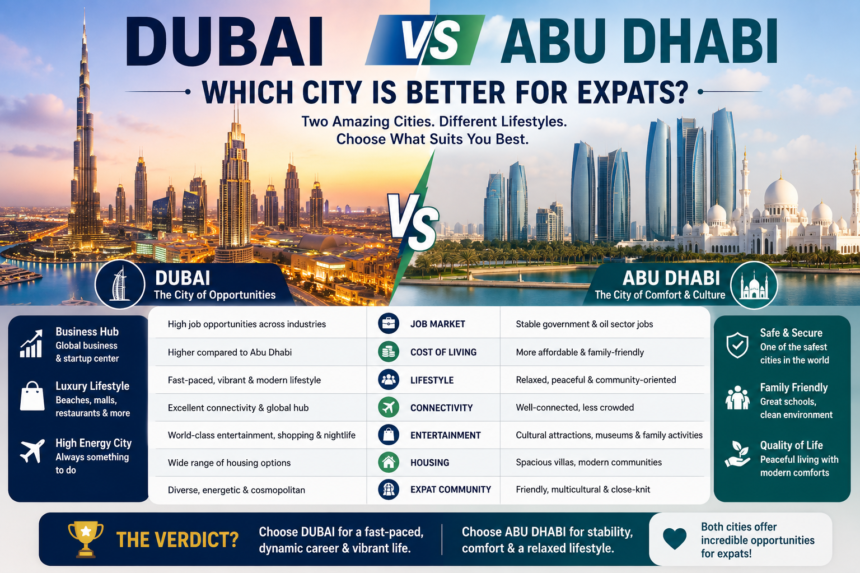
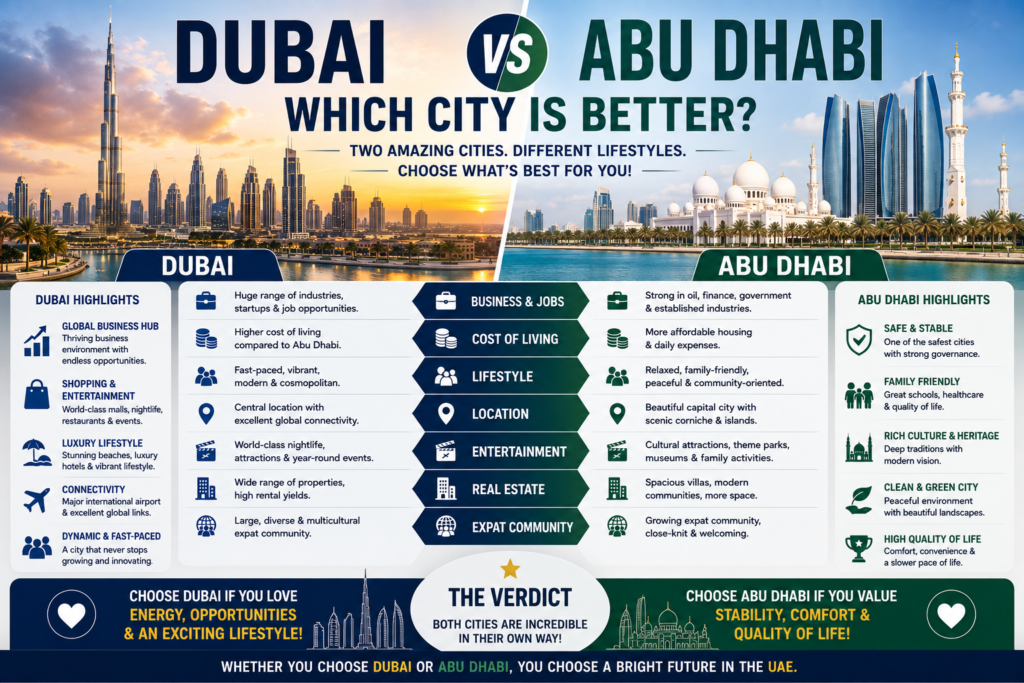
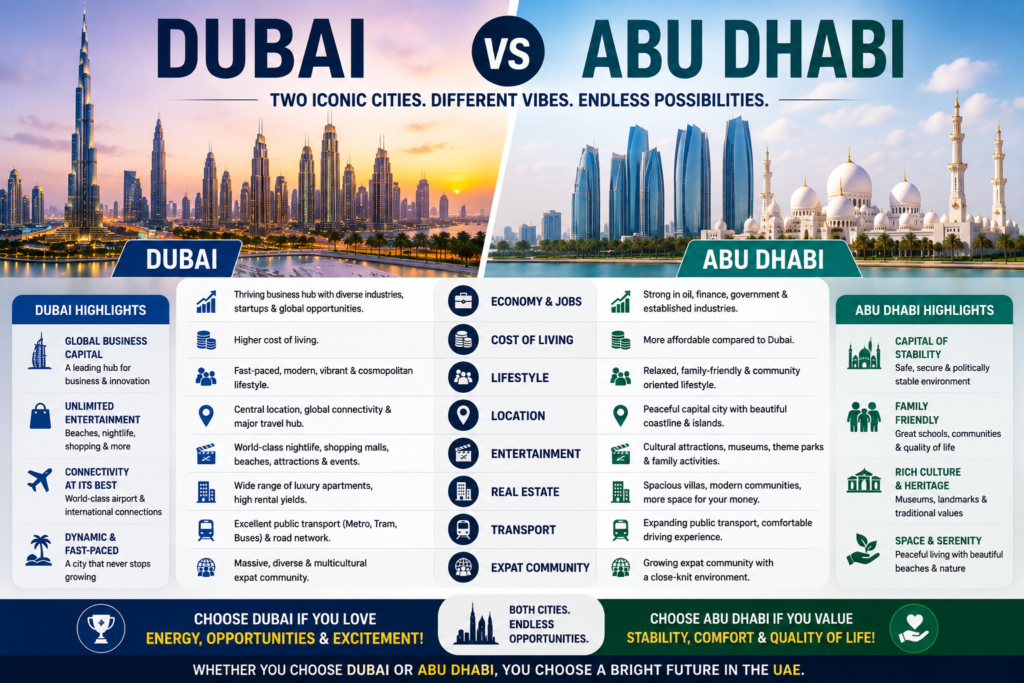
Dubai is generally associated with a fast-paced, international, business-focused lifestyle, while Abu Dhabi is known for its calmer atmosphere, government and energy-sector opportunities, spacious communities, and family-oriented environment. Recent 2026 comparisons generally find Abu Dhabi somewhat less expensive overall, particularly for housing, although the difference depends heavily on the neighbourhood and lifestyle you choose.
So, which city is better for expats: Dubai or Abu Dhabi? There is no universal answer. Dubai may be the better choice for professionals seeking a large private-sector job market, entertainment, networking, and an energetic urban lifestyle. Abu Dhabi may be better for families, professionals in government or energy-related industries, and people who prefer a quieter pace of life.
This comprehensive Dubai vs Abu Dhabi guide for expats compares cost of living, jobs, salaries, housing, transportation, lifestyle, family life, education, healthcare, entertainment, business opportunities, and quality of life to help you make the right decision.
Dubai vs Abu Dhabi at a Glance
Before examining each category in detail, here is a quick comparison:
- Dubai: Fast-paced, international, highly commercial, diverse and entertainment-focused.
- Abu Dhabi: Calmer, spacious, family-friendly, government-oriented and culturally rich.
- Jobs: Dubai generally offers a broader range of private-sector opportunities, while Abu Dhabi is particularly strong in government, energy, finance, defence and related industries.
- Housing: Abu Dhabi is generally more affordable for comparable residential space, although premium locations in both cities can be expensive.
- Public transport: Dubai has a major metro and tram network; Abu Dhabi relies heavily on buses, taxis and road transport.
- Lifestyle: Dubai is more energetic and cosmopolitan; Abu Dhabi is more relaxed and residential.
- Families: Both are excellent, but Abu Dhabi can appeal particularly to families seeking space and a quieter environment.
- Entertainment: Dubai has the edge for nightlife, shopping and large-scale entertainment.
- Culture and heritage: Abu Dhabi offers a particularly strong mix of cultural institutions, heritage attractions and modern development.
- Business: Dubai is a major international commercial and entrepreneurship hub, while Abu Dhabi has major strengths in energy, finance, government-linked sectors and large-scale investment.
Dubai vs Abu Dhabi: Cost of Living
Cost of living is one of the most important factors for expats deciding where to live.
Neither city should be considered universally cheap. Your actual expenses depend on rent, school fees, transportation, dining, insurance, entertainment, family size and personal spending habits.
However, 2026 comparisons generally place Abu Dhabi below Dubai in overall living costs, with housing being one of the biggest reasons for the difference. Some current comparisons estimate Dubai’s cost of living to be roughly 6%–12% higher, although the exact gap varies by lifestyle and location.
Housing Costs
Rent is normally the largest expense for expats in both cities.
In Dubai, popular areas such as Downtown Dubai, Dubai Marina, Jumeirah, Palm Jumeirah and Business Bay can command premium rents. At the same time, Dubai has a very large residential market, giving tenants many options across different budgets.
Abu Dhabi also has premium communities such as Saadiyat Island, Yas Island and Al Raha Beach, but more affordable residential options are available in areas such as Khalifa City, Al Reef and other mainland communities.
Indicative 2026 comparisons show that one-bedroom and larger apartments can often be cheaper in Abu Dhabi than in comparable Dubai locations, although the gap can narrow significantly in premium neighbourhoods.
For an expat trying to reduce monthly expenses, location is often more important than the city itself.
Food and Groceries
Grocery prices are broadly comparable because both cities are part of the same UAE market. Imported products can be expensive, while locally available products and supermarket promotions can help reduce household expenses.
Dining out can become considerably more expensive in both cities if you regularly choose premium restaurants, hotels and entertainment venues.
For budget-conscious expats:
- Cook more meals at home.
- Compare supermarkets and promotions.
- Choose neighbourhood restaurants instead of premium venues.
- Use meal deals when available.
- Set a monthly entertainment budget.
Utilities and Internet
Electricity, water, cooling, mobile services and internet should also be included in your monthly budget.
The actual amount varies according to apartment size, cooling usage, number of residents and service provider.
Dubai and Abu Dhabi both have highly developed digital infrastructure, making remote work and online services convenient for residents.
Which City Has Better Job Opportunities?
For many expats, the most important question is not simply Dubai vs Abu Dhabi, but where can I find the best job for my career?
Dubai has built a reputation as an international business centre with strong activity across:
- Tourism and hospitality
- Retail
- Real estate
- Construction
- Marketing
- Media
- Technology
- E-commerce
- Logistics
- Aviation
- Finance
- Professional services
- Startups
- International trade
This diversity can make Dubai particularly attractive to younger professionals and people changing industries.
Abu Dhabi has a different employment profile. As the UAE’s capital, it has strong government and government-related employment, while the wider emirate has major economic activity in energy, finance, infrastructure, defence, healthcare and investment.
For professionals working in oil and gas, energy, government, engineering, defence, large financial institutions or major infrastructure projects, Abu Dhabi can be especially attractive.
Dubai May Be Better for Your Career If:
- You work in marketing or media.
- You are building a startup.
- You work in tourism or hospitality.
- You are in technology or e-commerce.
- You work in sales.
- You want access to a large private-sector market.
- You want frequent networking opportunities.
- You plan to change industries.
Abu Dhabi May Be Better for Your Career If:
- You work in energy.
- You want government-sector opportunities.
- You work in engineering or infrastructure.
- You work in defence-related industries.
- You are interested in institutional finance.
- You prefer established organisations.
- Your employer is already based in Abu Dhabi.
Ultimately, your specific job offer matters more than the city label. A higher salary with housing, insurance, flights and other benefits in Abu Dhabi may be financially better than a lower salary in Dubai.
Dubai vs Abu Dhabi: Salary Comparison
It is difficult to state that one city always pays higher salaries because compensation depends heavily on industry, seniority, company, qualifications and experience.
Some 2026 expat guides report that Abu Dhabi salaries can be higher for certain specialised government, energy, finance and institutional roles, while Dubai offers a much wider variety of private-sector positions.
When comparing job offers, look beyond the headline salary.
Consider:
- Basic salary
- Housing allowance
- Transport allowance
- Health insurance
- Annual flight allowance
- School allowance
- Performance bonus
- End-of-service benefits
- Visa sponsorship
- Working hours
- Annual leave
- Commute time
A slightly lower salary in a city with lower rent and a shorter commute could produce more disposable income.
Dubai vs Abu Dhabi: Lifestyle
Lifestyle is perhaps the biggest difference between the two cities.
Life in Dubai
Dubai is dynamic, international and constantly changing. It offers an enormous variety of restaurants, malls, beaches, events, attractions and nightlife.
The city attracts professionals from around the world, creating a highly multicultural environment.
Dubai may suit you if you enjoy:
- Busy city life
- Restaurants and cafés
- Shopping
- Nightlife
- Beaches
- Sporting events
- Networking
- Festivals
- Concerts
- International communities
- Luxury experiences
The downside is that the same energy can feel overwhelming for people who prefer quiet surroundings.
Life in Abu Dhabi
Abu Dhabi generally feels more spacious and relaxed. Residential areas can have a more community-oriented atmosphere, while the city combines modern infrastructure with strong cultural and heritage elements.
Abu Dhabi may suit you if you prefer:
- A quieter lifestyle
- Family activities
- Beaches and waterfront areas
- Spacious communities
- Cultural attractions
- Outdoor activities
- Less hectic surroundings
- A slower pace after work
This does not mean Abu Dhabi lacks entertainment. Yas Island, Saadiyat Island, museums, beaches, restaurants and major events provide plenty to do.
Which City Is Better for Families?
Both Dubai and Abu Dhabi are excellent options for families.
However, Abu Dhabi often appeals to families looking for space, quieter neighbourhoods and a more relaxed daily routine. Current comparisons also highlight its family-oriented residential environment.
Dubai, meanwhile, provides an enormous selection of family attractions, schools, shopping destinations, restaurants and entertainment venues.
Dubai for Families
Advantages include:
- Large selection of international schools
- Numerous family attractions
- Extensive shopping and entertainment
- Large expatriate communities
- Wide range of residential neighbourhoods
- Strong international connectivity
Potential disadvantages include:
- Higher housing costs in popular areas
- Traffic congestion
- A faster pace of life
- Potentially higher entertainment spending
Abu Dhabi for Families
Advantages include:
- Spacious residential areas
- Family-friendly communities
- Beaches and parks
- Strong healthcare infrastructure
- Cultural attractions
- Relatively calmer lifestyle
- Potentially lower housing costs
Potential disadvantages include:
- Smaller entertainment and nightlife scene than Dubai
- Some activities may require a car
- Fewer neighbourhood choices than Dubai’s enormous residential market
Education and Schools
Education is a major consideration for expat families.
Both Dubai and Abu Dhabi have numerous international schools offering different curricula, including British, American, Indian and International Baccalaureate programmes.
Parents should not choose a city solely based on the number of schools. Instead, compare:
- School fees
- Curriculum
- Distance from home
- School ratings
- Transport
- Availability
- Waiting lists
- Extracurricular activities
The ideal location is often one that puts your home, workplace and children’s school within a manageable travel distance.
Healthcare in Dubai vs Abu Dhabi
Both cities offer extensive healthcare services, including public and private hospitals, specialist clinics, pharmacies and medical centres.
For expats, employer-provided health insurance can significantly influence healthcare costs.
When comparing job offers or relocation packages, check exactly what the health insurance covers.
Important factors include:
- Hospital network
- Specialist coverage
- Dental benefits
- Maternity coverage
- Prescription coverage
- Emergency treatment
- Family coverage
- Deductibles and co-payments
For most expats, healthcare quality is unlikely to be the deciding factor between Dubai and Abu Dhabi. Instead, the insurance package and proximity to suitable facilities may matter more.
Transportation: Dubai vs Abu Dhabi
Transportation is another major difference.
Dubai Public Transport
Dubai has an extensive public transportation system that includes Metro, Tram, buses, marine transport and taxis.
The Dubai Metro operates on Red and Green lines, while the tram network serves areas around Dubai Marina, Jumeirah Beach Residence and Al Sufouh. Dubai’s bus network also connects a large portion of the urban area.
This makes Dubai particularly convenient for expats who want to live without owning a car, provided they choose a neighbourhood close to public transport.
Abu Dhabi Public Transport
Abu Dhabi has a strong bus and taxi network, along with services such as Abu Dhabi Link and journey-planning tools. Abu Dhabi Mobility lists public buses, taxis, micromobility and on-demand transport among its services.
The standard Abu Dhabi bus fare is currently listed at AED 2 boarding plus 5 fils per kilometre, with a maximum fare of AED 5 for longer standard-service journeys.
For some residents, especially those living and working in areas well served by buses, public transport can be practical. However, many Abu Dhabi residents still prefer cars for daily commuting.
Which City Is Better Without a Car?
Dubai generally has the advantage.
The Metro gives residents in connected neighbourhoods a practical alternative to driving. Abu Dhabi’s bus network is useful, but the absence of a metro system means car ownership can be more convenient for many residents.
Traffic and Commute
Traffic can affect your quality of life regardless of which city you choose.
Dubai’s large population, business districts and extensive road network can produce heavy traffic during peak hours.
Abu Dhabi can also experience congestion, particularly on major routes and bridges, but the city’s more compact core can make some journeys straightforward.
The best strategy is to choose your home based on your workplace.
For example:
A cheaper apartment that adds 90 minutes to your daily commute may not actually be cheaper when you consider time, fuel, stress and vehicle costs.
Entertainment and Nightlife
If entertainment is a major priority, Dubai is usually the stronger choice.
Dubai offers:
- International concerts
- Nightclubs
- Beach clubs
- Luxury restaurants
- Shopping festivals
- Theme parks
- Waterparks
- Sporting events
- Large entertainment venues
- Rooftop restaurants
- Global hotel brands
Abu Dhabi has a growing entertainment sector, particularly around Yas Island, along with cultural venues, restaurants, beaches and major events.
However, the overall nightlife and entertainment scene is generally less extensive than Dubai’s.
Choose Dubai If You Love:
- Nightlife
- Restaurants
- Shopping
- Events
- International entertainment
- Social networking
- Busy weekends
Choose Abu Dhabi If You Prefer:
- Cultural activities
- Beaches
- Family outings
- Museums
- Outdoor recreation
- Quieter evenings
- Community-based activities
Culture and Heritage
Abu Dhabi has a particularly strong cultural identity.
The capital combines modern architecture with traditional Emirati heritage and major cultural institutions. Saadiyat Island is an important part of the city’s cultural development, while the Sheikh Zayed Grand Mosque remains one of the UAE’s most recognisable landmarks.
Dubai also has a rich history, particularly around areas such as Al Fahidi, Dubai Creek and Deira, but its international commercial identity is more dominant.
For expats who want to experience a balance between modern UAE life and local culture, Abu Dhabi may have the edge.
Safety and Quality of Life
Safety is a major attraction for expats moving to the UAE.
Both Dubai and Abu Dhabi offer modern infrastructure, strong public services and highly developed residential communities. Current expat comparisons consistently identify both cities as strong choices for quality of life.
Quality of life, however, is subjective.
A young professional may define quality of life as nightlife, networking and career opportunities.
A family may define it as:
- Good schools
- Safe neighbourhoods
- Affordable housing
- Short commute
- Healthcare
- Parks
- Community
This is why the same city can be perfect for one expat and unsuitable for another.
Taxes in Dubai vs Abu Dhabi
Taxation is broadly governed by UAE federal rules rather than being a simple Dubai-versus-Abu-Dhabi distinction.
The UAE does not levy personal income tax on individuals. However, the UAE does levy VAT and has a Corporate Tax regime for businesses.
For businesses, the Federal Tax Authority’s guidance provides for a 0% Corporate Tax rate on taxable income up to AED 375,000 and 9% on taxable income above that threshold, subject to the applicable rules.
Therefore, expats should not simply describe the UAE as a completely “tax-free” country. Personal employment income is not subject to individual income tax, but businesses can have Corporate Tax obligations and consumers pay VAT.
Business and Entrepreneurship
Dubai is particularly attractive to entrepreneurs because of its international business ecosystem, Free Zones, Mainland companies, startup communities, financial services and large consumer market.
It is a popular location for:
- E-commerce
- Technology
- Digital marketing
- Consulting
- Real estate
- Tourism
- Trading
- Professional services
- Media
- Logistics
Abu Dhabi also provides major opportunities, particularly in:
- Energy
- Financial services
- Investment
- Government-related industries
- Technology
- Healthcare
- Infrastructure
- Advanced industries
Entrepreneurs should select a city based on customers, industry ecosystem, licensing requirements and operating costs rather than simply choosing the city with the stronger global reputation.
Dubai vs Abu Dhabi for Young Professionals
For a young professional, Dubai can be particularly attractive.
The large private-sector economy creates opportunities across numerous industries, while the city’s restaurants, events, nightlife and international community can make it easier to build a social network.
Dubai may be better if you want:
- Career mobility
- Networking
- Social activities
- International exposure
- Entrepreneurship
- Fast-paced living
Abu Dhabi can be better for young professionals who value stability and work-life balance, especially if their employer is in the capital.
Dubai vs Abu Dhabi for Couples
Couples should consider whether both partners can find suitable employment.
Dubai can provide a larger range of private-sector roles, which may be advantageous when both partners are building careers.
Abu Dhabi may be attractive when one or both partners work in government, energy, finance, healthcare or related sectors.
Lifestyle preferences also matter. Couples who enjoy restaurants, events and nightlife may prefer Dubai, while couples who prefer quiet weekends, beaches and cultural activities may enjoy Abu Dhabi.
Dubai vs Abu Dhabi for Long-Term Living
For long-term living, the decision becomes more personal.
Dubai may be ideal for someone who wants constant activity and career growth.
Abu Dhabi may be preferable for someone who wants stability, space and a calmer family environment.
Consider where you see yourself in five years rather than simply where you want to spend your first six months.
Ask yourself:
- Will I have children?
- Where will I work?
- Do I need a car?
- How much can I spend on rent?
- Do I enjoy nightlife?
- How important is cultural life?
- Do I want a large international social network?
- Will my partner work?
- What type of school will my children attend?
- How long am I willing to commute?
Pros and Cons of Living in Dubai
Pros
- Huge international business ecosystem
- Broad private-sector job market
- Excellent public transportation
- Large expatriate community
- World-class entertainment
- Extensive shopping
- Major international airport
- Wide choice of residential areas
- Strong startup ecosystem
- Fast-paced lifestyle
Cons
- Housing can be expensive
- Traffic can be challenging
- Busy lifestyle may feel overwhelming
- Entertainment can increase monthly spending
- Premium areas can be extremely expensive
Pros and Cons of Living in Abu Dhabi
Pros
- Generally calmer lifestyle
- Strong family environment
- Attractive residential communities
- Strong government and energy-sector employment
- Excellent cultural attractions
- Good beaches and outdoor spaces
- Housing can offer more space for the money
- High-quality infrastructure
- Strong healthcare and education options
Cons
- Smaller private-sector job market than Dubai in some industries
- Less extensive nightlife
- Public transportation is more bus-focused
- Car ownership can be more useful
- Social and entertainment options can feel quieter
Dubai vs Abu Dhabi: Which City Is Cheaper?
Abu Dhabi generally has the advantage for cost-conscious expats, especially when comparing similar residential space. However, this is not a universal rule.
Dubai has a much wider range of neighbourhoods, meaning budget-conscious residents can sometimes find competitive rental options outside premium districts.
The best way to save money is to compare the total cost of your specific lifestyle.
For example, an expat living in a reasonably priced Dubai neighbourhood near a Metro station may spend less on transportation than someone living in a cheaper Abu Dhabi suburb who needs to drive everywhere.
Therefore, compare:
Rent + utilities + transport + groceries + school + healthcare + entertainment + commuting.
Dubai vs Abu Dhabi: Which City Is Better for Expats?
The final answer depends on what you value most.
Dubai is better for expats who want:
- More career variety
- International business opportunities
- A vibrant social life
- Nightlife
- Shopping
- Entertainment
- Public transport
- Entrepreneurship
- A highly cosmopolitan environment
Abu Dhabi is better for expats who want:
- A calmer lifestyle
- Family-friendly communities
- Potentially lower housing costs
- Government and energy-sector opportunities
- Cultural experiences
- More space
- A quieter environment
- Work-life balance
Final Verdict: Dubai or Abu Dhabi?
So, Dubai vs Abu Dhabi — which city is better for expats?
The answer is Dubai for opportunity and excitement, Abu Dhabi for balance and stability.
Dubai is likely to appeal more to ambitious professionals, entrepreneurs, young couples and people who enjoy an active international lifestyle. Its huge business ecosystem, public transportation network, entertainment options and diverse communities make it one of the most attractive cities for global professionals.
Abu Dhabi is an excellent alternative for families, established professionals and anyone who prefers a quieter environment. Its strong government and energy-related economy, cultural attractions, spacious communities and relaxed lifestyle make it a compelling choice for long-term living.
Neither city is objectively better.
The right choice depends on your job, salary, family situation, housing budget, commute, lifestyle and long-term goals.
If your priority is career opportunities, entertainment, networking and a fast-paced lifestyle, Dubai may be the better fit.
If your priority is family life, space, stability, culture and a calmer daily routine, Abu Dhabi may be the better choice.
And if you are still undecided, remember that the two cities are connected by regular inter-emirate bus services, so living in one does not necessarily mean completely giving up access to the other. Abu Dhabi Mobility currently lists daily E100, E101 and E102 services between Abu Dhabi and Dubai.
Ultimately, the best UAE city for an expat is not the one with the biggest skyline or the most famous attractions. It is the city that gives you the best combination of career growth, financial comfort, personal happiness and quality of life.
Quick Decision Guide
Choose Dubai if you want:
- A larger and more diverse private-sector job market
- A highly international lifestyle
- Better rail-based public transport
- More nightlife and entertainment
- Greater networking opportunities
- A fast-moving business environment
Choose Abu Dhabi if you want:
- A calmer lifestyle
- More family-oriented communities
- Strong government and energy-sector opportunities
- A potentially lower housing budget
- Cultural and heritage experiences
- A more relaxed pace of life
Dubai and Abu Dhabi are both outstanding destinations for expats in 2026. The best choice is ultimately the city that matches your priorities, budget and vision for life in the UAE.
Note: Rental prices, job markets, transport services and living costs can change. The figures and comparisons above are intended as general guidance rather than guaranteed prices. Always check current housing listings, employment packages, school fees and official government information before making a relocation decision.
Do follow us on Instagram
Read More – Visiting Abu Dhabi from Dubai: Amazing Ultimate Day Trip Guide