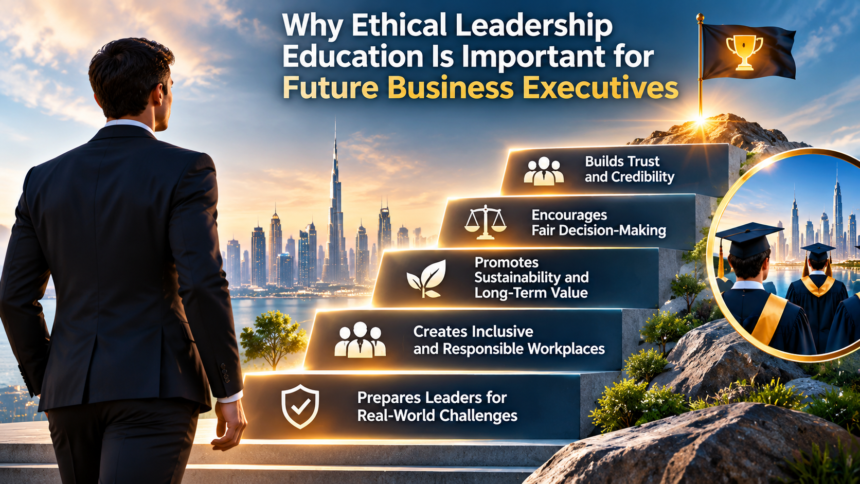
Why Business Ethics Education Matters More Than Ever
The responsibilities of business executives are changing as companies operate in an increasingly complex environment shaped by artificial intelligence, economic uncertainty, environmental challenges, and evolving expectations from employees and customers.
- 1. Why Ethical Leadership Education Matters in Modern Business
- 2. How Business Schools Are Integrating Ethics Into Leadership Education
- 3. What UAE and GCC Leadership Initiatives Reveal About Responsible Management
- 4. How AI and Digital Transformation Are Creating New Ethical Decisions
- 5. Why Ethical Leadership Supports Trust, Culture, and Long-Term Business Resilience
- 6. The Challenges of Teaching Ethical Leadership to Future Executives
- 7. The Future of Ethical Leadership Education for Business Executives
Business leaders are expected to deliver financial results, but their decisions can also influence workplace conditions, data privacy, consumer protection, environmental performance, and public confidence.
As a result, ethical leadership education is becoming an important part of preparing future executives for the responsibilities associated with managing modern organisations.
Traditionally, management education has focused on subjects such as finance, marketing, operations, strategy, and organisational behaviour. These disciplines remain essential, but technical business knowledge alone may not prepare leaders to address every difficult decision.
An executive may understand how to increase profitability while still needing to consider whether a particular business practice is fair, transparent, legally compliant, or harmful to other stakeholders.
Across the United Arab Emirates, Saudi Arabia, Qatar, Bahrain, Oman, and Kuwait, business schools and professional institutions are increasingly discussing responsible management, corporate governance, sustainability, and ethical decision-making.
The UN-supported Principles for Responsible Management Education initiative has established an international network encouraging universities to integrate responsibility and sustainability into business education.
Meanwhile, regulators across the Gulf have introduced governance and conduct requirements that place practical responsibilities on executives and company boards.
However, ethical leadership cannot be developed through classroom lectures alone. Meaningful learning requires practical scenarios, opportunities to challenge assumptions, and an understanding of how organisational incentives influence behaviour.
Exploring the changing role of leadership education reveals why ethics may become an increasingly valuable capability for future business executives.
1. Why Ethical Leadership Education Matters in Modern Business
Ethical leadership involves making and encouraging decisions guided by integrity, fairness, accountability, and consideration of those affected.
It includes the conduct of individual leaders and the systems they establish within their organisations.
An executive may personally support honest business practices, but ethical leadership also requires ensuring that company policies, incentives, and reporting arrangements reinforce those standards.
The Difference Between Legal Compliance and Ethical Judgement
Legal compliance means following applicable laws and regulations.
Ethical judgement involves considering what responsible action requires, including situations where the law leaves room for discretion.
A business practice may satisfy minimum legal requirements while raising concerns about fairness, transparency, or potential harm.
For example, a company may legally collect certain customer information but still need to consider whether its collection methods are understandable and proportionate.
Executives should understand both legal obligations and broader ethical considerations.
Why Business Decisions Have Wider Consequences
A pricing decision can affect customers.
A procurement contract can influence suppliers and employees.
A technology investment may alter staffing requirements, while a new industrial project can create environmental and community impacts.
Future executives need to recognise these connections when assessing business options.
This does not mean every decision has a perfect outcome.
It means leaders should identify important trade-offs, understand who may be affected, and explain their reasoning.
Essential Ethical Leadership Capabilities
| Capability | What It Involves | Business Application |
|---|---|---|
| Integrity | Acting consistently with stated values | Financial reporting |
| Accountability | Accepting responsibility for decisions | Corporate oversight |
| Fairness | Applying defensible and consistent standards | Hiring and compensation |
| Transparency | Communicating material information appropriately | Customer relations |
| Responsible Judgement | Evaluating competing interests | Strategic decisions |
| Courage | Raising concerns despite pressure | Reporting misconduct |
| Empathy | Understanding stakeholder experiences | Employee management |
Why These Capabilities Require Education
Employees do not automatically develop sound ethical judgement when promoted into senior roles.
They may face conflicts that differ substantially from those encountered earlier in their careers.
Structured learning can help future executives recognise such situations and prepare appropriate responses.
2. How Business Schools Are Integrating Ethics Into Leadership Education

Business education is increasingly examining the relationship between commercial performance and wider responsibilities to society.
International education initiatives encourage institutions to teach students how business decisions affect people, communities, and the environment.
The Principles for Responsible Management Education
The UN-supported Principles for Responsible Management Education, or PRME, was launched in 2007.
Its objective is to encourage management education that develops responsible decision-makers and supports sustainable development.
PRME participants work on issues involving ethics, sustainability, educational methods, research, and collaboration.
The initiative includes more than 800 participating business and management education institutions across over 90 countries.
However, being a PRME signatory does not guarantee that every graduate demonstrates ethical leadership.
Institutions must translate their commitments into effective teaching and measurable outcomes.
Ethics Across the Curriculum
Business ethics can be taught as a standalone subject.
However, integrating ethical reasoning into multiple disciplines may help students understand its relevance to everyday management.
A finance course might examine conflicts of interest.
Marketing students could evaluate misleading advertising.
Operations students might investigate supplier working conditions, while technology courses address data privacy and algorithmic fairness.
This approach treats ethics as part of business decision-making rather than an unrelated subject.
AACSB and Societal Impact
AACSB International, a major business-school accreditation organisation, has emphasised societal impact as part of business education quality.
Its 2026 report reviewing five years of societal-impact initiatives describes how schools are connecting teaching, research, and engagement with wider social objectives.
The direction reflects increasing attention to what management education contributes beyond academic qualifications.
Educational Approaches Compared
| Teaching Method | Main Objective | Limitation |
|---|---|---|
| Ethics Lectures | Introduce principles and concepts | Limited practical experience |
| Business Case Studies | Analyse complex situations | Often based on past decisions |
| Role-Playing | Practise stakeholder perspectives | Requires realistic facilitation |
| Leadership Simulations | Experience competing pressures | Cannot replicate every consequence |
| Industry Projects | Connect theory with business practice | Depends on project quality |
| Reflective Exercises | Examine personal judgement | Requires honest participation |
| Mentorship | Learn from experienced professionals | Mentor quality varies |
Why Practical Learning Is Important
Students may understand ethical principles but struggle to apply them when financial targets, workplace hierarchy, or personal interests create pressure.
Practical exercises can help close this gap.
However, education should also acknowledge that ethical behaviour depends on organisational culture, incentives, and accountability mechanisms.
3. What UAE and GCC Leadership Initiatives Reveal About Responsible Management
The Gulf provides an important setting for ethical leadership education because regional businesses operate across finance, energy, technology, construction, tourism, and international trade.
These sectors involve decisions that can affect large numbers of customers, employees, and communities.
The PRME Middle East Network
The PRME Middle East chapter includes business schools and universities across GCC countries.
Participating institutions include Abu Dhabi University, the American University of Sharjah, Qatar University, the University of Bahrain, and business schools in Oman and Saudi Arabia.
The chapter supports discussion of responsible management education and regional sustainability challenges.
In December 2025, it held its twelfth regional forum in Dubai, attended by 131 educators, business leaders, policymakers, and students.
The forum focused on education for sustainable business models and connections between academia, industry, and society.
This illustrates regional interest in responsible management, although a conference is not itself evidence of improved executive conduct.
UAE Banking Conduct Requirements
The Central Bank of the UAE requires licensed financial institutions to maintain standards of fair and responsible consumer treatment.
Its Consumer Protection Standards place responsibility on boards and management for appropriate conduct, employee competence, and customer protection.
These requirements show that ethical decision-making has practical regulatory consequences.
Executive education can help prepare future financial-sector leaders to understand such obligations.
Saudi Arabia’s Corporate Governance Requirements
Saudi Arabia’s Capital Market Authority Corporate Governance Regulations address conflicts of interest, board responsibilities, and integrity.
The regulations include obligations for directors to avoid prioritising personal interests over company and shareholder interests.
These are legal governance requirements within their applicable scope, not merely voluntary ethical recommendations.
The Regional Relevance of Ethics Education
| Area | Leadership Responsibility | Educational Priority |
|---|---|---|
| Banking | Consumer treatment and disclosure | Fairness and conduct |
| Public Companies | Board accountability | Corporate governance |
| Family Businesses | Succession and related-party decisions | Conflicts of interest |
| Technology | Responsible data and AI use | Digital ethics |
| Construction | Worker and contractor treatment | Supply-chain responsibility |
| Healthcare | Patient interests and organisational decisions | Professional ethics |
| Energy | Safety and environmental management | Long-term risk judgement |
Why International Business Matters
GCC businesses frequently operate across jurisdictions with different regulations and commercial practices.
Executives may need to understand several legal systems while applying consistent internal standards.
Ethical leadership education can help them distinguish local regulatory obligations from company-wide commitments.
4. How AI and Digital Transformation Are Creating New Ethical Decisions
Artificial intelligence is changing how businesses analyse information, serve customers, recruit employees, and automate operations.
These applications create opportunities for efficiency but also introduce difficult questions about fairness, responsibility, and transparency.
AI in Recruitment
A company may use automated systems to screen job applications.
Such tools can help manage large numbers of candidates.
However, executives need to consider whether the system treats applicants fairly and whether outcomes can be appropriately reviewed.
Poor-quality data or unsuitable models may create discriminatory results.
Ethical leadership requires appropriate oversight rather than assuming technology is neutral.
Customer Data and Privacy
Businesses increasingly collect information through websites, mobile applications, loyalty programmes, and digital payment services.
Executives must understand how this information is collected, stored, shared, and protected.
A system may offer commercial value while still creating privacy or cybersecurity risks.
Leaders should assess these risks before approving deployment.
The UAE’s AI Ethics Principles
The UAE’s AI Ethics Principles and Guidelines describe eight principles covering fairness, transparency, accountability, explainability, human-centred values, privacy, robustness and security, and sustainability.
The guidance is non-binding and intended to support responsible AI development and use.
The UAE also provides an AI ethics self-assessment tool to help organisations examine potential risks.
Its advisory nature should not be confused with mandatory regulations that may apply separately.
Ethical Questions Around Digital Business
| Business Decision | Ethical Question |
|---|---|
| Automated Recruitment | Are candidates treated fairly? |
| Customer Data Collection | Is data use proportionate and understandable? |
| AI Customer Service | Can people obtain appropriate human support? |
| Employee Monitoring | Is monitoring necessary and respectful? |
| Automated Pricing | Could vulnerable customers be treated unfairly? |
| AI-Generated Content | Are accuracy and disclosure adequate? |
| Cybersecurity Investment | Are sensitive systems sufficiently protected? |
Why Executives Need Technical Understanding
Business leaders do not need to become software engineers to govern AI responsibly.
However, they should understand enough about technological limitations to ask useful questions.
These include who is accountable for errors, how systems are tested, and what happens when automated decisions cause harm.
Effective ethical oversight combines technical expertise with management judgement.
5. Why Ethical Leadership Supports Trust, Culture, and Long-Term Business Resilience
Trust is an important consideration in relationships between businesses and their stakeholders.
Customers expect accurate information, employees expect fair treatment, and investors expect credible governance.
Ethical leadership can support these expectations when organisational behaviour is consistent with public commitments.
The Relationship Between Leaders and Organisational Culture
Employees observe how executives respond to mistakes, complaints, and competing priorities.
A company may publish a detailed code of conduct, but employees may pay closer attention to the behaviour of managers.
If leaders reward results obtained through questionable practices, formal ethical policies may lose credibility.
Conversely, consistent accountability can help reinforce responsible behaviour.
Psychological Safety and Reporting Concerns
Employees should have appropriate ways to raise concerns about misconduct, unsafe practices, or operational risks.
Leaders can help by ensuring reporting procedures are accessible and that employees are protected against prohibited retaliation.
However, a supportive culture requires more than encouraging people to speak up.
Organisations must investigate concerns fairly and take suitable action when problems are identified.
Ethics in Supplier Relationships
Executives also influence how businesses select and manage suppliers.
Procurement decisions may involve pricing, quality, labour practices, environmental considerations, and conflicts of interest.
Ethics education can help managers evaluate these dimensions without ignoring legitimate commercial constraints.
Responsible Leadership and Business Benefits
| Leadership Practice | Possible Organisational Benefit |
|---|---|
| Transparent Communication | Better-informed stakeholders |
| Fair Employment Practices | Stronger workplace relationships |
| Conflict-of-Interest Controls | More defensible decisions |
| Responsible Data Use | Improved risk management |
| Effective Reporting Channels | Earlier identification of concerns |
| Supplier Due Diligence | Greater visibility into operational risks |
| Consistent Accountability | More credible governance |
These are potential relationships rather than guaranteed financial outcomes.
Why Ethics Cannot Be Reduced to Reputation
Some companies present ethical behaviour primarily as a way to improve brand image.
However, ethical leadership should concern actual decisions and consequences.
An organisation that promotes sustainability while overlooking serious operational problems may create a gap between communication and reality.
Education should encourage executives to examine measurable outcomes, not just public statements.
6. The Challenges of Teaching Ethical Leadership to Future Executives
Although business schools and companies may recognise the importance of ethics, effective education presents several challenges.
Ethical decisions often involve uncertainty, incomplete information, competing duties, and pressure from multiple stakeholders.
There may be no solution that satisfies every interest.
The Limitations of Simple Case Studies
Educational examples sometimes present an obvious choice between right and wrong.
Real business situations can be more difficult.
An executive may need to balance employee concerns, financial constraints, customer obligations, and legal requirements simultaneously.
Training should therefore include realistic cases in which several options have costs and benefits.
Different Cultural and Professional Perspectives
Gulf workplaces often bring together professionals from different countries.
Employees may have different expectations about hierarchy, communication, negotiation, and workplace relationships.
Ethics education should encourage respectful discussion while making applicable legal obligations and professional standards clear.
Cultural differences should not be used to excuse unlawful or harmful conduct.
The Pressure of Performance Targets
Executives may face financial targets, investor expectations, or competitive pressures.
These incentives can influence decisions.
A leader who understands ethical principles may still face difficulty applying them when organisational rewards encourage short-term results.
Education should therefore consider how compensation, promotion criteria, and governance systems shape behaviour.
Can Ethical Leadership Actually Be Taught?
Education can improve awareness, ethical reasoning, and familiarity with decision-making tools.
However, it cannot guarantee integrity.
A 2025 systematic review of responsible management education found that greater awareness of ethics and sustainability does not always translate into action.
This suggests that educational programmes must be supported by organisational conditions that encourage responsible behaviour.
Common Challenges and Possible Responses
| Challenge | Why It Matters | Educational Response |
|---|---|---|
| Unrealistic Scenarios | Limited practical relevance | Complex cases and simulations |
| Performance Pressure | Incentives may undermine ethics | Examine reward systems |
| Cultural Differences | Conflicting expectations | Facilitated discussion |
| Limited Executive Time | Reduced training participation | Focused learning modules |
| Weak Accountability | Principles may not influence behaviour | Governance-based exercises |
| Difficult Measurement | Behaviour changes are hard to prove | Multiple evaluation methods |
| Overemphasis on Compliance | Ethical judgement remains underdeveloped | Include stakeholder analysis |
Why Personal Reflection Matters
Future executives can benefit from examining their own assumptions.
For example, they might consider how they would respond when a senior colleague requests an inappropriate action.
Reflective learning can help identify pressure points before similar situations occur in professional settings.
7. The Future of Ethical Leadership Education for Business Executives
Ethical leadership education is likely to become increasingly relevant as businesses adopt AI, expand internationally, and face greater scrutiny over their decisions.
The objective should not be to produce leaders who can simply repeat ethical principles.
It should be to develop executives capable of recognising complex problems, seeking relevant advice, and acting responsibly.
Combining Ethics With Executive Education
Business schools can integrate ethics into finance, strategy, marketing, technology, and governance courses.
Executive education programmes can also use case studies from industries relevant to participants.
For example, a banking executive may benefit from consumer-protection scenarios, while a technology leader may need training in algorithmic accountability.
Learning Through Simulation
Leadership simulations can recreate situations involving financial pressure, workplace complaints, or conflicting stakeholder expectations.
Participants may be required to make decisions and explain their reasoning.
A structured debriefing can help them evaluate what they overlooked and how different choices might affect others.
However, simulation performance should not be treated as proof of ethical conduct in real workplaces.
A Practical Ethical Leadership Education Checklist
- Understand applicable laws and governance requirements.
- Recognise conflicts of interest and disclose them appropriately.
- Evaluate who may be affected by major decisions.
- Assess financial and nonfinancial consequences.
- Understand responsible AI and data governance.
- Practise transparent communication.
- Learn how to respond to reported misconduct.
- Examine incentives that may encourage poor decisions.
- Develop responsible approaches to employee management.
- Seek independent advice when necessary.
- Review decisions and learn from identified failures.
How Should Business Schools Measure Progress?
The number of students completing an ethics module provides limited information about educational quality.
Institutions may also assess decision-making skills, the ability to identify conflicts, and the quality of explanations provided in case studies.
However, long-term workplace behaviour is difficult to measure directly.
Business schools should therefore avoid claiming that course completion guarantees ethical leadership.
Suggested Evaluation Indicators
| Indicator | What It Assesses |
|---|---|
| Ethical Reasoning | Ability to analyse complex dilemmas |
| Conflict Recognition | Identification of competing interests |
| Governance Knowledge | Understanding of responsibilities |
| Stakeholder Analysis | Consideration of affected groups |
| Decision Justification | Quality of supporting reasoning |
| Practical Application | Performance in realistic scenarios |
| Reflective Learning | Recognition of assumptions and errors |
| Professional Follow-Up | Longer-term learning and development |
The Role of Lifelong Learning
Ethical questions change as technologies, regulations, and business practices evolve.
Executives who completed formal education years earlier may encounter new issues involving AI systems, digital privacy, or environmental disclosure.
Continuing professional education can help leaders update their knowledge.
Companies should also review internal policies when new risks emerge.
Preparing Leaders for the Gulf’s Economic Future
GCC economies are investing in technology, infrastructure, tourism, financial services, and advanced industries.
These developments create opportunities but also require leaders who can manage increasingly complex decisions.
Business schools, employers, regulators, and professional associations all have roles in building those capabilities.
However, responsible leadership must ultimately be demonstrated through conduct rather than qualifications alone.
Conclusion
Ethical leadership education is becoming increasingly important for future business executives because commercial success now involves decisions with significant consequences for employees, customers, investors, and communities.
As organisations expand their use of artificial intelligence, digital services, and complex supply chains, executives need more than financial knowledge and technical management skills.
They must understand governance responsibilities, conflicts of interest, fairness, transparency, and the practical consequences of business decisions.
International initiatives such as PRME and AACSB’s work on societal impact demonstrate growing attention to responsible management education.
In the Gulf, business-school collaboration, banking conduct standards, corporate governance requirements, and AI ethics guidance provide additional reasons for strengthening these capabilities.
However, education alone cannot guarantee ethical behaviour.
Effective leadership also depends on organisational culture, appropriate incentives, credible reporting systems, and accountability.
For future executives, the goal should be to develop the ability to recognise difficult ethical questions and respond through informed, responsible judgement.
Ultimately, the strongest business leaders will need to understand not only how organisations generate value but also how their decisions affect the people and systems that make long-term success possible.
Do follow us on Instagram
Read More – Countries Leading the Digital Economy