



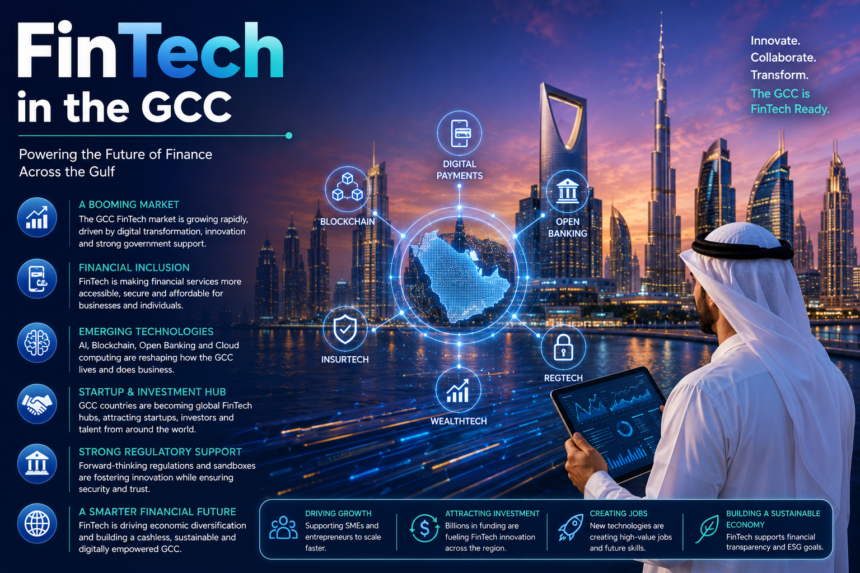
Why the GCC Is Becoming a Global Hotspot for FinTech
A decade ago, banking in the Gulf was largely associated with branches, cards, paperwork and traditional financial institutions. Today, a customer can open an account digitally, transfer money within seconds, pay with a phone, access financing online and manage investments without visiting a bank.
- What Is FinTech and Why Does It Matter in the GCC?
- Why FinTech in the GCC Is Growing So Quickly
- Saudi Arabia Is Building One of the Region’s Largest FinTech Ecosystems
- Open Banking Could Change Saudi Financial Services
- UAE FinTech Is Becoming More Sophisticated
- Open Finance Could Be a Major UAE FinTech Trend
- Bahrain’s Early FinTech Advantage
- What About Qatar, Kuwait and Oman?
- Digital Payments Are Becoming Part of Everyday Life
- The Rise of Digital Banking in the GCC
- AI Could Become the Next Big FinTech Engine
- FinTech and SME Financing
- Cross-Border Payments Remain a Major Opportunity
- Embedded Finance Could Make Financial Services Almost Invisible
- Regulation Is One of the GCC’s Biggest FinTech Advantages
- Cybersecurity and Financial Crime Will Remain Major Challenges
- FinTech Jobs in the GCC Could Expand
- Biggest FinTech Opportunities Across the GCC
- Challenges Facing FinTech in the GCC
- What Could FinTech in the GCC Look Like by 2030?
- FAQs About FinTech in the GCC
- Conclusion
That transformation explains why FinTech in the GCC has become one of the most important developments in the region’s digital economy.
Across Saudi Arabia, the UAE, Bahrain, Kuwait, Qatar and Oman, financial technology is changing how consumers and businesses interact with money. Digital payments, mobile banking, open banking, artificial intelligence, embedded finance and new financial platforms are creating a financial ecosystem that looks very different from the one that existed only a few years ago.
Saudi Arabia and the UAE are building particularly ambitious FinTech ecosystems, while Bahrain has established itself as an early regional supporter of regulatory innovation.
But the bigger story is not simply about new apps.
It is about how the GCC is trying to build a faster, more connected and technology-driven financial system.
What Is FinTech and Why Does It Matter in the GCC?
FinTech, short for financial technology, describes the use of technology to deliver or improve financial products and services.
It includes far more than mobile banking.
FinTech can cover:
- digital payments,
- mobile wallets,
- digital banking,
- online lending,
- crowdfunding,
- investment platforms,
- insurance technology,
- regulatory technology,
- open banking,
- cross-border payments,
- embedded finance,
- artificial intelligence in finance,
- and blockchain-based financial services.
The technology is important because financial services affect almost every part of an economy.
Individuals need payments, savings, insurance and financing. Businesses need banking, payment processing, credit and international transfers.
Making those services faster and easier can improve efficiency across the wider economy.
For the Gulf, FinTech also fits into a much larger transformation.
GCC economies are investing heavily in digital infrastructure and economic diversification. Financial technology supports both goals by creating new businesses while modernizing established financial institutions.
Suggested image placement: Gulf skyline connected by digital payment and financial network graphics.
Why FinTech in the GCC Is Growing So Quickly
Several conditions are helping financial technology expand across Gulf markets.
The region has a digitally connected population, extensive smartphone usage, established banking systems, strong government support for digital transformation and significant investment capacity.
But another factor is equally important: consumer expectations have changed.
People increasingly expect financial services to work like other digital services.
They want to:
- register remotely,
- transfer money quickly,
- receive instant notifications,
- make contactless payments,
- access services 24/7,
- avoid unnecessary paperwork,
- and manage finances through one device.
Traditional banks have responded by investing heavily in digital services, while FinTech startups are developing products around specific customer problems.
Regulators are also playing an active role.
Rather than allowing innovation to develop completely outside the regulated financial system, Gulf regulators have introduced strategies, licensing frameworks and regulatory sandboxes designed to support innovation while managing financial risks.
That combination is helping create a more mature GCC FinTech market.
Saudi Arabia Is Building One of the Region’s Largest FinTech Ecosystems
Saudi Arabia has made FinTech a significant part of its wider economic transformation under Vision 2030.
The country’s FinTech Strategy was approved as a pillar of the Financial Sector Development Program. It focuses on six transformational drivers, including regulation, talent, technology, market development, collaboration and Saudi Arabia’s global positioning.
The long-term ambitions are substantial.
Saudi Arabia’s strategy targets 525 FinTech companies, 18,000 FinTech jobs and SAR 13.3 billion in cumulative venture capital investment by 2030.
The ecosystem has already expanded significantly.
Saudi Central Bank Governor Ayman Al-Sayari said in September 2025 that the number of FinTech companies operating in the Kingdom had grown from 82 in 2022 to 281 by August 2025, while cumulative investments had exceeded SAR 8.9 billion as of July 2025.
That growth demonstrates why FinTech in Saudi Arabia has become an important part of the wider GCC technology story.
Open Banking Could Change Saudi Financial Services
One particularly important development is open banking.
Traditionally, financial information has remained largely within the bank holding a customer’s account.
Open banking can allow customers to securely authorize regulated third parties to access certain financial information or provide services using that data.
The result could be more personalized financial products and stronger competition.
In March 2026, the Saudi Central Bank announced that it had begun licensing FinTech companies to provide open banking services following the regulatory sandbox phase.
This could create opportunities for applications that help customers:
- understand spending,
- manage multiple accounts,
- compare financial products,
- access personalized services,
- automate financial management,
- and potentially receive more relevant financial offers.
For businesses, open banking can support new approaches to payments, accounting, cash-flow management and financial services.
The key principle, however, remains customer consent and secure data handling.
UAE FinTech Is Becoming More Sophisticated
The UAE has also developed an extensive FinTech ecosystem, supported by financial institutions, regulators, technology companies, investors and international businesses.
The Central Bank of the UAE launched its FinTech Office in 2020 with the goal of developing a mature ecosystem and positioning the country as a leading FinTech hub.
Its framework focuses on five pillars: demand, capital, policy, talent and infrastructure.
This approach is important because successful FinTech ecosystems require more than startups.
Companies need investment.
Investors need regulatory clarity.
Financial institutions need secure infrastructure.
The industry needs skilled professionals.
Consumers need confidence.
By addressing these elements together, the UAE is trying to create an environment where financial innovation can move from experimental projects into mainstream services.
Open Finance Could Be a Major UAE FinTech Trend
The UAE’s ambitions extend beyond traditional open banking.
The Central Bank has been developing an Open Finance framework intended to enable customers to share financial information with licensed third-party providers and access services beyond those provided directly by their existing financial institution.
Open Finance could eventually go further than bank accounts.
The UAE’s approach considers areas such as open insurance and foreign exchange alongside banking services.
That could make it possible for consumers to manage different financial products through more connected digital experiences.
Imagine a single authorized financial application capable of helping someone understand:
- bank balances,
- spending habits,
- insurance,
- investments,
- foreign exchange,
- savings,
- and financial planning.
That type of connected ecosystem could become an important part of the future of FinTech in the GCC.
Bahrain’s Early FinTech Advantage
Bahrain may be smaller than Saudi Arabia and the UAE, but it has played an influential role in regional financial innovation.
The Central Bank of Bahrain established a dedicated FinTech & Innovation Unit and introduced a regulatory sandbox that allows eligible startups, FinTech companies and licensed financial institutions to test innovative products in a controlled environment.
Bahrain has also developed FinHub 973.
The Central Bank describes it as a cross-border digital innovation platform connecting financial institutions and FinTech companies for collaboration, testing and prototyping.
Bahrain’s approach highlights an important lesson for the GCC.
A country does not need the region’s largest population to become important in financial technology.
Clear regulation, financial-sector expertise and the ability to test new products can create a competitive advantage.
Suggested image placement: Manama financial district with a digital banking interface.
What About Qatar, Kuwait and Oman?
Although Saudi Arabia, the UAE and Bahrain often receive the most international attention, the broader FinTech in the GCC story includes Qatar, Kuwait and Oman.
Each market has its own financial institutions, regulatory environment, consumer behavior and economic priorities.
That means FinTech adoption will not happen at exactly the same speed or in exactly the same way across all six countries.
However, several common opportunities exist across the Gulf:
- digital payments,
- SME financing,
- cross-border transfers,
- financial automation,
- digital banking,
- insurance technology,
- investment platforms,
- compliance technology,
- and financial inclusion.
The long-term opportunity becomes even more interesting when these markets are considered collectively.
A FinTech company that develops successfully in one GCC country may eventually look toward neighboring Gulf markets for expansion.
This makes regional scalability an important part of the GCC FinTech opportunity.
Digital Payments Are Becoming Part of Everyday Life
Payments are perhaps the most visible example of FinTech adoption.
For consumers, the transition is easy to see.
Cash is increasingly competing with cards, mobile wallets, online payment gateways and instant digital transfers.
The UAE’s National Payment Systems Strategy, for example, aims to support safe, innovative and convenient electronic payments while strengthening the country’s position as a global financial hub and moving toward a leading cashless economy.
Saudi Arabia has similarly made payment digitalization a strategic priority.
Why do digital payments matter so much?
Because payments sit at the centre of almost every commercial transaction.
A better payment system can benefit:
Consumers: Faster and more convenient transactions.
Retailers: Easier payment acceptance and potentially better transaction data.
Online businesses: More seamless checkout experiences.
Governments: Greater digitalization of economic activity.
Financial institutions: Opportunities to build new products around payments.
Payments may appear simple to users, but behind a two-second transaction sits an increasingly sophisticated financial infrastructure.
The Rise of Digital Banking in the GCC
The traditional bank branch is unlikely to disappear completely.
But its role is changing.
Many customers now expect routine banking services to be available digitally.
That includes account management, transfers, cards, financing applications and customer support.
This shift has encouraged traditional banks to improve their mobile services while creating opportunities for digital-first financial businesses.
The competitive question has therefore changed.
It is no longer simply:
Which bank has the most branches?
Increasingly, it is:
Which financial provider offers the easiest, fastest and most trustworthy digital experience?
That puts user experience at the centre of modern financial competition.
AI Could Become the Next Big FinTech Engine
Artificial intelligence may become one of the most transformative technologies in Gulf finance.
Financial institutions process enormous amounts of information every day.
AI can help identify patterns that humans might struggle to detect manually.
Potential applications include:
- fraud detection,
- customer service,
- credit assessment,
- transaction monitoring,
- document processing,
- personalized financial recommendations,
- compliance,
- cybersecurity,
- and investment analysis.
Generative AI adds another layer.
A banking customer could eventually interact with an intelligent financial assistant capable of explaining spending patterns, answering questions and helping navigate financial products.
Businesses could use AI to analyse cash flow and identify financial risks.
Banks could use AI tools to support employees handling complicated customer requests.
However, finance is a high-trust industry.
That means accuracy, security, privacy, transparency and human oversight will remain critical.
FinTech and SME Financing

Small and medium-sized businesses are another major opportunity.
Traditional financing processes can sometimes be difficult for smaller companies, particularly businesses with limited credit histories.
FinTech can create alternative ways to evaluate companies.
Instead of relying only on traditional documentation, financial platforms may use authorized digital information to understand cash flow, transaction history and business performance.
This could support faster decision-making.
FinTech tools can also help SMEs with:
- invoicing,
- payroll,
- accounting,
- payment collection,
- expense management,
- business banking,
- and financial forecasting.
This matters because SMEs are important to economic diversification across GCC countries.
A more efficient financial ecosystem can make it easier for entrepreneurs to start and grow companies.
Cross-Border Payments Remain a Major Opportunity
The GCC has a unique financial characteristic: an enormous number of international transactions.
Businesses trade across borders.
Expatriate workers send money internationally.
Tourists spend across currencies.
Companies operate across several Gulf markets.
Yet international transfers can sometimes remain slower or more expensive than domestic payments.
This creates a major FinTech opportunity.
New technology could improve:
- remittances,
- business-to-business transfers,
- settlement,
- currency conversion,
- payment tracking,
- and cross-border transaction efficiency.
At the same time, cross-border finance brings additional compliance responsibilities. Regulators and financial institutions must manage anti-money-laundering requirements, financial crime risks and international regulatory obligations.
The future is therefore not simply about making money move faster.
It is about making it move faster, securely and transparently.
Embedded Finance Could Make Financial Services Almost Invisible
One of the biggest global FinTech trends is embedded finance.
The idea is simple.
Instead of visiting a bank or financial app, users access financial services inside another platform.
For example, a customer purchasing something online might receive a payment or financing option directly during checkout.
A business platform might provide payments, insurance or financing without requiring the user to leave the software.
Financial services effectively become part of another digital experience.
In the GCC, embedded finance could expand through:
- e-commerce,
- travel,
- property,
- business software,
- mobility,
- retail,
- logistics,
- and hospitality.
This could fundamentally change how people think about banking.
The bank may still provide the regulated financial infrastructure, but the customer’s interaction may happen somewhere else entirely.
Regulation Is One of the GCC’s Biggest FinTech Advantages
Financial innovation cannot grow sustainably without trust.
If consumers believe a financial app may lose their money or misuse their information, adoption will suffer.
That is why regulation is so important.
Gulf regulators have increasingly used regulatory sandboxes to balance innovation with consumer protection.
Saudi Arabia’s sandbox allows financial institutions and FinTech companies to test innovative products with real consumers within defined controls.
Bahrain has developed a similar sandbox approach, while the UAE has established regulatory interfaces and sandbox initiatives as part of its FinTech strategy.
These environments can help regulators understand emerging technologies before creating permanent frameworks.
They can also help startups learn what is required before launching at scale.
Cybersecurity and Financial Crime Will Remain Major Challenges
The more financial activity moves online, the more valuable financial data becomes to criminals.
This means cybersecurity cannot be treated as an afterthought.
FinTech companies and banks must defend against:
- account takeovers,
- identity theft,
- phishing,
- payment fraud,
- data breaches,
- money laundering,
- and increasingly sophisticated AI-assisted scams.
Regulators are therefore likely to place greater emphasis on cybersecurity, customer identification, data protection and transaction monitoring.
Bahrain’s regulatory sandbox, for example, requires participants to comply with customer due diligence and anti-money-laundering requirements and maintain customer confidentiality.
Innovation will continue, but trust will determine which FinTech companies survive long term.
FinTech Jobs in the GCC Could Expand
As the industry develops, employment opportunities are likely to extend well beyond software development.
The ecosystem needs professionals in:
- software engineering,
- cybersecurity,
- data science,
- artificial intelligence,
- product management,
- financial analysis,
- compliance,
- risk management,
- user experience design,
- digital marketing,
- business development,
- and financial regulation.
Saudi Arabia’s national FinTech strategy alone targets 18,000 FinTech jobs by 2030.
One particularly valuable combination will be financial expertise plus technology knowledge.
A programmer who understands banking can be valuable.
So can a banker who understands AI.
A compliance professional who understands digital platforms may become increasingly important.
The future FinTech workforce will therefore not belong only to “tech people.”
It will require people capable of connecting technology with real financial problems.
Biggest FinTech Opportunities Across the GCC
| FinTech Area | Potential Opportunity |
|---|---|
| Digital payments | Faster cashless transactions |
| Open banking | New services using customer-authorized data |
| Open finance | Connected financial products |
| AI | Fraud detection and personalized services |
| Digital banking | Mobile-first financial experiences |
| SME FinTech | Financing and business-management tools |
| InsurTech | Faster and more personalized insurance |
| RegTech | Automated compliance |
| Embedded finance | Finance inside non-banking platforms |
| Cross-border payments | Faster regional and international transfers |
These areas will develop differently across each GCC country, but together they show how broad the financial transformation could become.
Challenges Facing FinTech in the GCC
Growth does not mean the industry is free from challenges.
One issue is regulation across multiple jurisdictions.
A company licensed in one GCC country cannot automatically assume that the same rules apply everywhere else.
Another challenge is talent.
As banks, startups and technology companies compete for people with expertise in AI, cybersecurity, finance and data, highly skilled workers may become increasingly valuable.
Other challenges include:
- cybersecurity,
- customer trust,
- access to funding,
- data privacy,
- financial crime,
- profitability,
- regulatory complexity,
- and competition from established banks.
FinTech companies also face a fundamental business challenge.
Creating a popular app is not enough.
They need sustainable business models.
What Could FinTech in the GCC Look Like by 2030?
By the end of the decade, financial technology may become so deeply integrated into everyday life that consumers stop thinking of it as “FinTech.”
People may simply expect money to work digitally.
A typical user could manage accounts from multiple providers through one interface, receive AI-powered financial insights, make instant payments, access personalized insurance and apply for financing digitally.
Businesses may operate financial functions directly through their accounting or commerce platforms.
Banks may increasingly become technology companies with banking licenses.
FinTech startups may become important partners to established financial institutions rather than simply competitors.
And financial services could increasingly move into the background of everyday digital experiences.
That is perhaps the most important shift.
The future of finance may be less about where people bank and more about how seamlessly financial services fit into their lives.
FAQs About FinTech in the GCC
What is FinTech in the GCC?
FinTech in the GCC refers to technology-based financial services operating across Saudi Arabia, the UAE, Bahrain, Kuwait, Qatar and Oman. It includes digital payments, digital banking, open banking, lending, insurance technology, AI-powered finance and other financial innovations.
Which GCC country has the biggest FinTech market?
Saudi Arabia and the UAE are currently among the most prominent FinTech ecosystems in the Gulf due to their market size, investment, regulatory initiatives and digital-transformation strategies. Bahrain has also developed a significant reputation for FinTech regulation and innovation.
Why is FinTech growing in Saudi Arabia?
Saudi Arabia has made FinTech part of its Vision 2030 Financial Sector Development Program. Its National FinTech Strategy includes targets for companies, employment, investment and economic contribution.
What is open banking?
Open banking allows customers to authorize regulated third parties to access certain financial data and provide innovative financial services. Saudi Arabia began licensing FinTech companies for open banking services in 2026 following its sandbox phase.
What is the difference between open banking and open finance?
Open banking generally focuses on banking data and services. Open finance can extend the concept into areas such as insurance, investments and foreign exchange, creating a broader connected financial ecosystem.
Will FinTech replace traditional banks in the GCC?
Complete replacement is unlikely. A more probable outcome is deeper collaboration and competition between traditional banks and FinTech companies. Banks provide regulatory expertise, infrastructure and customer relationships, while FinTech businesses can bring specialized technology and new user experiences.
What are the biggest FinTech trends in the GCC?
Digital payments, open banking, open finance, AI, embedded finance, digital banking, cross-border payments, RegTech and SME financial services are among the major areas to watch.
Conclusion
FinTech in the GCC is no longer a niche startup story.
It is becoming part of the Gulf’s wider economic transformation.
Saudi Arabia is building an ambitious FinTech ecosystem under Vision 2030, with the Kingdom targeting hundreds of companies and thousands of jobs by the end of the decade.
The UAE is developing a financial ecosystem built around regulation, infrastructure, talent, capital and technologies such as Open Finance.
Bahrain continues to demonstrate how regulatory sandboxes and cross-border collaboration can support financial innovation.
Meanwhile, the broader Gulf market offers opportunities in digital payments, AI, SME finance, cross-border transactions, digital banking and embedded financial services.
The biggest change may ultimately be one consumers barely notice.
Financial technology will stop feeling like a separate industry and simply become the way financial services work.
For GCC businesses, investors and professionals, that means the opportunity is no longer limited to asking which FinTech trend will become popular next.
The more important question is who will build the financial infrastructure, products and skills that the next generation of the Gulf economy will depend on?
follow us on Instagram
Read More – Future of AI in the UAE: How Artificial Intelligence Is Shaping the Emirates