

Future of AI in the UAE: What the Next Decade Could Look Like
Artificial intelligence is moving from an emerging technology to part of the infrastructure behind modern economies. Few countries have made that transition as deliberately as the United Arab Emirates.
- Why the Future of AI in the UAE Matters
- UAE Artificial Intelligence Strategy 2031: The Bigger Vision
- From Smart Government to AI-Powered Government
- Dubai and Abu Dhabi Could Become Major AI Hubs
- AI Infrastructure Could Become the UAE’s Next Strategic Advantage
- How AI Could Transform Healthcare in the UAE
- AI Could Change Transportation and Logistics
- The Future of AI in the UAE Energy Sector
- AI Could Redefine Tourism and Hospitality
- AI Education Could Become One of the UAE’s Biggest Investments
- What Will Happen to Jobs?
- UAE AI Jobs: Which Skills Could Become More Valuable?
- What UAE Professionals Can Do to Prepare
- AI Startups and Entrepreneurship Could Grow
- Arabic AI Could Become Strategically Important
- Responsible AI Will Become Increasingly Important
- Could the UAE Become a Global AI Hub?
- What Could an AI-Powered UAE Look Like by 2031?
- Biggest Opportunities and Challenges
- FAQs About the Future of AI in the UAE
- Conclusion
The future of AI in the UAE is therefore about much more than chatbots, automated offices or futuristic robots. It involves how government services operate, how doctors use data, how companies make decisions, how students prepare for careers and how industries ranging from logistics to energy become more efficient.
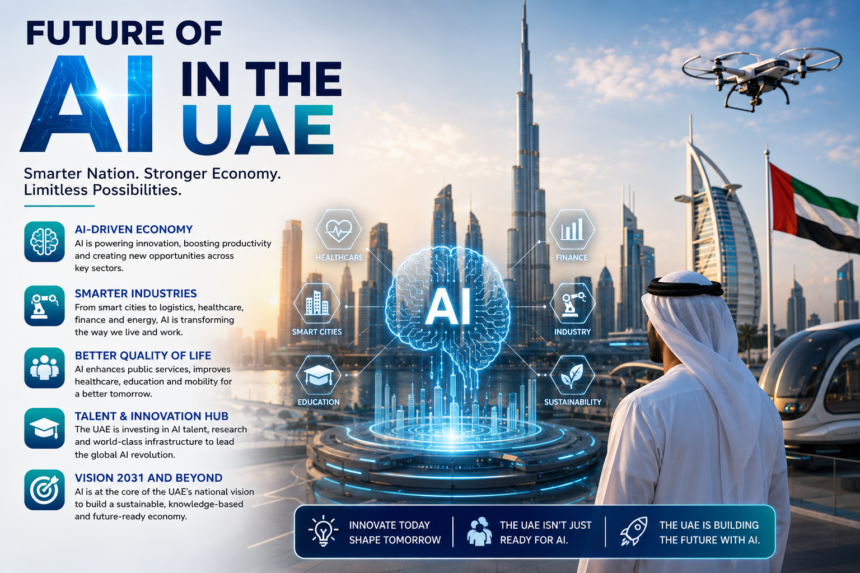
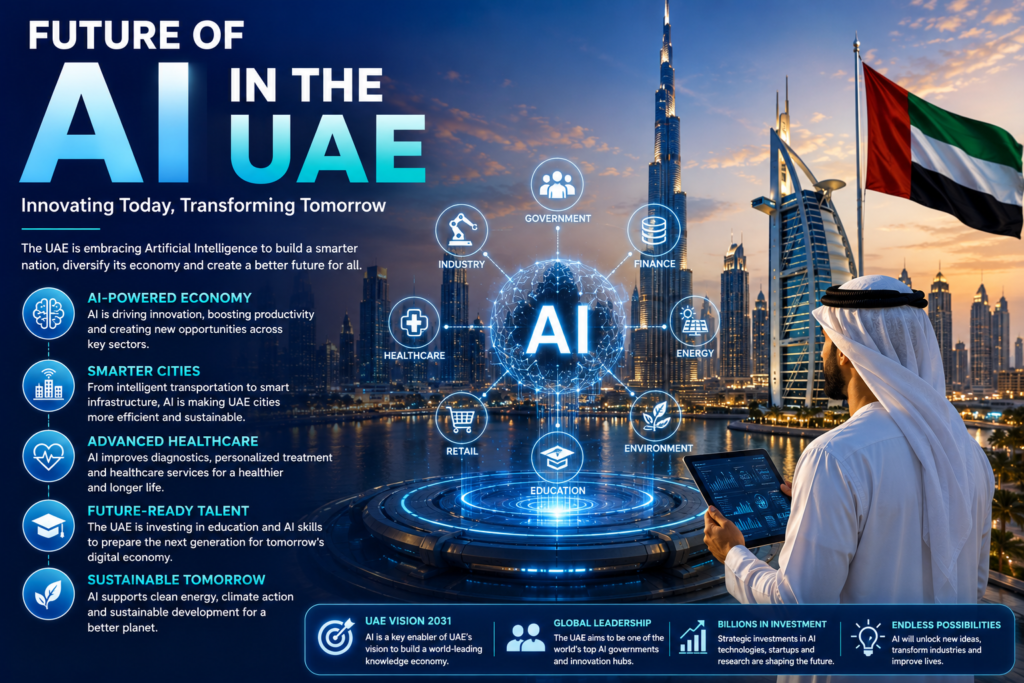
The country’s National Strategy for Artificial Intelligence 2031 sets out an ambition for the UAE to become one of the world’s leading nations in AI. Priority areas identified in the national strategy include resources and energy, logistics and transport, tourism and hospitality, healthcare and cybersecurity.
At the same time, major investments in infrastructure, research and talent are creating an ecosystem that could make the Emirates an important testing ground for the next generation of AI.
So what might an AI-powered UAE actually look like?
The answer is beginning to emerge.
Why the Future of AI in the UAE Matters
Many countries are exploring artificial intelligence, but the UAE has approached AI as part of a broader economic and national development strategy.
That distinction matters.
Instead of treating AI as something belonging only to technology companies, the UAE is exploring applications across government, healthcare, transport, energy, education and other industries.
The UAE National Strategy for Artificial Intelligence 2031 focuses not only on deploying AI but also on developing important foundations around talent, infrastructure, governance, regulation and research.
This creates a much larger opportunity.
If AI is successfully integrated across the economy, its impact could be visible in everyday experiences: dealing with government departments, receiving medical care, travelling around cities, running businesses and applying for jobs.
For residents and professionals, understanding this transition is becoming increasingly important because AI may influence both how people work and what skills employers value.
Suggested image placement: UAE skyline combined with a subtle digital AI network.
UAE Artificial Intelligence Strategy 2031: The Bigger Vision
The UAE’s AI ambitions did not appear overnight.
The country developed the UAE National Strategy for Artificial Intelligence 2031 with the stated vision of becoming one of the world’s leaders in AI by 2031. The strategy combines technology adoption with talent development, research, infrastructure and governance.
Rather than focusing on a single application, the strategy identifies several sectors where artificial intelligence could create significant value.
| Priority Area | Potential Role of AI |
|---|---|
| Energy and resources | Forecasting, optimization and predictive maintenance |
| Transport and logistics | Traffic management, routing and automation |
| Tourism and hospitality | Personalized services and customer support |
| Healthcare | Diagnostics, medical imaging and data analysis |
| Cybersecurity | Threat detection and automated monitoring |
| Government services | Faster and more personalized digital services |
The important point is that AI is being positioned as an economic and public-service capability, rather than simply a technology trend.
That could determine how quickly AI becomes part of daily life across the Emirates.
From Smart Government to AI-Powered Government
Government services may become one of the clearest examples of AI transformation in the UAE.
The country already has extensive digital government infrastructure. AI provides another layer: systems capable of understanding requests, processing information, identifying patterns and helping users navigate services more efficiently.
Over time, residents could increasingly interact with intelligent digital systems capable of handling routine administrative processes.
Potential applications include:
- answering government-related questions,
- processing routine requests,
- translating information,
- identifying the correct service for residents,
- analysing public data,
- predicting demand for government services,
- automating repetitive administrative work,
- and supporting public-sector decision-making.
This does not necessarily mean removing humans from government.
A more realistic future is one in which AI handles repetitive processes while human employees focus on complicated cases, policy decisions and situations requiring judgment or empathy.
The UAE’s national AI strategy specifically highlights public-sector adoption as an important part of its AI ambitions.
Dubai and Abu Dhabi Could Become Major AI Hubs
Dubai and Abu Dhabi are likely to play complementary roles in the growth of artificial intelligence.
Dubai’s established position in technology, finance, tourism, logistics and entrepreneurship creates opportunities for commercial AI adoption.
Abu Dhabi, meanwhile, has become increasingly important for AI research, advanced computing and large-scale technology investment.
One important institution is the Mohamed bin Zayed University of Artificial Intelligence, or MBZUAI.
The university describes itself as the first university dedicated entirely to advancing science through AI. Its research covers areas including machine learning, computer vision, natural language processing and other emerging fields.
This matters because becoming an AI hub requires more than attracting technology companies.
A sustainable ecosystem needs:
- researchers,
- engineers,
- entrepreneurs,
- universities,
- investors,
- computing infrastructure,
- startups,
- government support,
- and skilled workers.
The UAE is increasingly bringing these pieces together.
Suggested image placement: Researchers working in a modern Abu Dhabi AI laboratory.
AI Infrastructure Could Become the UAE’s Next Strategic Advantage
Powerful artificial intelligence requires enormous computing resources.
That makes data centres, advanced chips, cloud infrastructure and energy increasingly important parts of the global AI race.
The UAE has been moving into this space as well.
One major development was the announcement of Stargate UAE in May 2025, described as the first international deployment of Stargate, OpenAI’s AI infrastructure platform. The initiative involves G42, Oracle, NVIDIA, Cisco and SoftBank.
Another significant development came when Microsoft announced a $1.5 billion strategic investment in UAE-based G42 in 2024. The partnership also included plans to support a $1 billion developer fund focused on building AI skills and talent.
These developments demonstrate something important about the future of AI in the UAE.
The country is not only interested in using AI applications. It is also working to build some of the infrastructure, expertise and partnerships required to support advanced AI systems.
How AI Could Transform Healthcare in the UAE
Healthcare is one of the industries where AI could have a direct impact on people’s lives.
Doctors and healthcare professionals increasingly work with enormous amounts of information, from medical images and laboratory results to patient histories and genetic data.
AI systems can help analyse this information faster.
Potential applications include medical image analysis, early disease detection, personalized treatment recommendations, hospital resource planning and patient monitoring.
MBZUAI, for example, lists healthcare-related AI research covering areas such as medical image analysis, cancer treatment and women’s and fetal health.
The most promising model is not necessarily AI replacing doctors.
Instead, AI could become another tool available to medical professionals.
Imagine a radiologist reviewing hundreds of scans. An AI system could highlight images requiring urgent attention, allowing the doctor to focus expertise where it is most valuable.
However, healthcare AI also requires strong safeguards.
Medical information is sensitive, and decisions can have serious consequences. Privacy, accuracy, accountability and human oversight will therefore remain essential.
AI Could Change Transportation and Logistics
The UAE’s position as a global aviation, shipping and logistics centre makes transportation another natural area for AI development.
AI systems can analyse large volumes of information from vehicles, roads, warehouses, ports and supply chains.
That could help companies and authorities improve:
- traffic prediction,
- route planning,
- warehouse management,
- fleet maintenance,
- delivery scheduling,
- demand forecasting,
- pedestrian detection,
- and logistics operations.
MBZUAI’s research portfolio already includes transportation and logistics applications such as pedestrian detection, object recognition, pattern recognition and crowd counting.
Over time, these technologies could contribute to more efficient movement across cities while helping logistics companies reduce delays and better predict demand.
For a country positioned between Asia, Europe and Africa, even relatively small improvements in logistics efficiency can have significant economic value.
The Future of AI in the UAE Energy Sector
Energy remains another major opportunity.
Artificial intelligence can analyse complex industrial data far faster than traditional manual processes.
In oil, gas and industrial operations, AI could support predictive maintenance by identifying early signs that equipment may require attention.
That can help companies address problems before equipment fails.
AI can also contribute to smart grids, energy-demand forecasting, renewable-energy management and industrial safety.
MBZUAI lists applications such as machine inspection, anomaly detection, intelligent robots, smart grids and computer vision for workplace safety among its energy-related research areas.
As the UAE continues developing both conventional and renewable energy industries, AI could increasingly serve as a bridge between energy production, sustainability and operational efficiency.
AI Could Redefine Tourism and Hospitality
Tourism is another important part of the UAE economy, particularly in Dubai and Abu Dhabi.
Here, AI may often operate quietly in the background.
A traveller planning a UAE holiday could interact with AI before even arriving.
An intelligent travel system might recommend hotels according to budget, build an itinerary, suggest restaurants, translate conversations and provide real-time travel information.
Hotels could use AI to personalize guest experiences.
Airlines and airports could use predictive systems to improve operations and passenger flow.
Tourism businesses could analyse demand patterns to understand when travellers are likely to visit and what experiences they prefer.
However, hospitality remains fundamentally human.
The most successful businesses are likely to use AI to support service rather than remove the personal connection that defines good hospitality.
Suggested image placement: Futuristic UAE airport or luxury hotel with subtle AI interface elements.
AI Education Could Become One of the UAE’s Biggest Investments
Infrastructure alone cannot create an AI economy.
People do.
This makes education one of the most important elements in the future of AI in the UAE.
MBZUAI is a major part of that ecosystem, offering programs across fields including machine learning, computer vision, natural language processing, robotics and computer science.
But AI education will increasingly extend beyond specialist universities.
Students studying business, journalism, marketing, finance, medicine, engineering and design may all need some level of AI literacy.
They may not need to become machine-learning engineers.
They will, however, need to understand what AI can do, where it fails, how to evaluate its output and how to use it responsibly.
This leads to an important shift:
AI literacy could become similar to digital literacy.
Twenty years ago, knowing how to work with digital tools became increasingly important across industries.
AI may follow the same path.
What Will Happen to Jobs?
This is probably the biggest question for many workers.
Will artificial intelligence take jobs in the UAE?
Some roles will certainly change, and some repetitive tasks are likely to become automated.
But describing the future simply as “AI versus workers” misses the larger transformation.
AI can automate tasks without eliminating an entire profession.
Consider marketing.
AI can generate first drafts, analyse campaign data and suggest content ideas. But companies still need people who understand customers, strategy, brand positioning and cultural context.
The same pattern applies elsewhere.
An accountant may use AI to analyse documents.
A journalist may use it to organize research.
An engineer may use it to identify technical patterns.
A doctor may use it to analyse medical information.
A customer-service employee may use it to retrieve information more quickly.
The workplace may therefore shift from humans doing everything manually to humans supervising, directing and collaborating with intelligent systems.
UAE AI Jobs: Which Skills Could Become More Valuable?
As AI adoption grows, demand could increase for both technical and non-technical skills.
Technical roles may include:
- machine-learning engineers,
- data scientists,
- AI researchers,
- robotics engineers,
- cybersecurity specialists,
- cloud engineers,
- AI infrastructure specialists,
- and software developers.
But another category may grow just as quickly: professionals who understand both AI and a specific industry.
Examples could include:
- AI + healthcare,
- AI + finance,
- AI + marketing,
- AI + logistics,
- AI + energy,
- AI + law,
- AI + education,
- and AI + media.
This combination is important because companies do not simply need people who understand algorithms.
They need professionals who understand how technology solves actual business or social problems.
Soft skills will matter too.
Critical thinking, communication, creativity, leadership, problem solving and ethical judgment could become more valuable precisely because machines are becoming better at routine knowledge tasks.
What UAE Professionals Can Do to Prepare
Preparing for AI does not necessarily require changing careers.
For most professionals, a better strategy is to understand how AI is changing their existing profession.
A practical approach could look like this:
- Understand AI fundamentals. Learn what generative AI, machine learning, automation and large language models actually do.
- Learn the AI tools relevant to your profession. A marketer, architect and programmer will need different tools.
- Develop data literacy. Learn how to interpret information rather than simply accepting an AI-generated answer.
- Strengthen human skills. Communication, creativity, leadership and judgment remain difficult to automate completely.
- Build practical projects. Employers often value evidence that you can apply technology to a real problem.
- Keep learning. AI tools are evolving rapidly, meaning skills that are useful today may need updating tomorrow.
The goal should not be to compete with AI at everything.
The better question is: How can you use AI to become more effective at work?
AI Startups and Entrepreneurship Could Grow
The UAE’s startup ecosystem creates another major opportunity.
Artificial intelligence lowers some barriers to starting a company.
Small teams can now use AI for coding, research, customer support, marketing, translation and data analysis.
That means entrepreneurs may be able to test ideas faster and operate with smaller teams.
The UAE could see new AI startups emerge in fields such as:
- fintech,
- healthcare,
- education,
- property technology,
- cybersecurity,
- logistics,
- climate technology,
- tourism,
- Arabic-language technology,
- and enterprise software.
MBZUAI itself identifies supporting high-tech innovation and AI startups in the UAE and wider MENA region as one of its strategic objectives.
The opportunity is particularly interesting for technologies designed around regional needs.
AI products that understand Arabic language varieties, Gulf business practices and regional industries could create advantages that generic global tools do not always provide.
Arabic AI Could Become Strategically Important
Language represents another important opportunity.
Many leading AI systems were initially developed using enormous amounts of English-language material.
But the Arab world contains diverse dialects, cultural contexts and linguistic patterns.
Developing stronger Arabic AI systems could improve applications across education, government, customer service, media and healthcare.
MBZUAI’s research ecosystem already includes foundation models such as Jais among its projects.
Better Arabic-language AI could also make advanced digital services more accessible across the wider Middle East.
This gives the UAE an opportunity not only to consume global AI technology but also to contribute technologies designed specifically for the region.
Responsible AI Will Become Increasingly Important
Rapid adoption creates difficult questions.
Who is responsible when an AI system makes a serious mistake?
How should personal data be protected?
How can companies identify AI-generated misinformation?
How do organizations prevent biased automated decisions?
What happens when realistic AI-generated images, voices or videos are misused?
These issues will become more important as AI moves into healthcare, finance, recruitment and public services.
The future of AI in the UAE will therefore depend not only on technological capability but also on trust.
Businesses will need clear internal policies.
Developers will need to test systems carefully.
Employees will need AI literacy.
Governments will need frameworks that protect society without unnecessarily blocking useful innovation.
Microsoft’s partnership with G42, for example, explicitly included commitments around AI safety and security alongside infrastructure and technology development.
Could the UAE Become a Global AI Hub?
The possibility is increasingly credible.
The UAE has several advantages: significant investment capacity, strong digital infrastructure, internationally connected cities, a diverse workforce and the ability to launch large technology initiatives relatively quickly.
It is also developing institutions focused specifically on AI research and education.
But global AI leadership is extremely competitive.
The United States and China remain dominant technology powers, while countries across Europe and Asia are investing heavily in AI.
The UAE therefore does not necessarily need to become the world’s largest AI producer.
Its opportunity may be different.
It could become a global centre for deploying, testing, financing and commercializing AI, particularly across the Middle East, Africa and South Asia.
Its geographic position could strengthen that role.
What Could an AI-Powered UAE Look Like by 2031?
By 2031, artificial intelligence may become much less visible precisely because it will be integrated into everyday systems.
Residents may not think, “I am using AI.”
They may simply notice that a service works faster.
A possible day could involve an intelligent transport system recommending the fastest route to work, automated systems helping manage traffic, AI assisting doctors at a hospital, personalized digital government services and companies using predictive tools to manage operations.
Schools and universities may integrate AI tutors and research assistants.
Businesses may use AI agents to handle routine workflows.
Energy companies may use predictive systems to improve efficiency.
Airports and logistics networks may increasingly rely on intelligent forecasting.
Some of these applications already exist in early forms. Others remain developing technologies.
The larger change will be integration.
The real AI revolution may arrive when people stop noticing that AI is there.
Biggest Opportunities and Challenges
| Opportunities | Challenges |
|---|---|
| More efficient government services | Data privacy |
| New technology jobs | Workforce disruption |
| Better healthcare tools | Accuracy and accountability |
| Smarter transportation | Cybersecurity risks |
| AI-powered entrepreneurship | Skills shortages |
| More efficient energy systems | High infrastructure requirements |
| Arabic AI development | Bias and cultural accuracy |
| Global AI investment | International competition |
Managing these two sides simultaneously will determine how successful the UAE’s AI transformation becomes.
Technology alone will not decide the outcome.
Education, regulation, infrastructure, investment and public trust will matter just as much.
FAQs About the Future of AI in the UAE
What is the future of AI in the UAE?
AI is expected to play an increasing role across government services, healthcare, transportation, logistics, energy, cybersecurity, tourism, education and business. The UAE aims to become one of the world’s leading nations in AI by 2031.
What is the UAE Artificial Intelligence Strategy 2031?
It is the UAE’s national framework for developing and adopting artificial intelligence. It covers AI applications as well as important supporting areas including talent, infrastructure, governance, regulation and research.
Will AI create jobs in the UAE?
AI adoption is likely to create opportunities in areas such as machine learning, data science, cybersecurity, cloud computing, robotics and AI research. It may also increase demand for professionals who combine AI knowledge with expertise in industries such as healthcare, finance, logistics and marketing.
Will AI replace jobs in Dubai and Abu Dhabi?
Some repetitive tasks are likely to become automated, but many professions are more likely to change than disappear entirely. Workers who learn to use AI effectively may be better positioned as employers redesign workflows.
Is the UAE investing in artificial intelligence?
Yes. Investments are occurring across infrastructure, education, research and commercial partnerships. Examples include MBZUAI, Microsoft’s strategic investment in G42 and the Stargate UAE AI infrastructure initiative.
Which UAE industries could benefit most from AI?
Healthcare, logistics, transportation, energy, tourism, cybersecurity, government services, finance and education are among the areas with significant potential.
What AI skills should professionals in the UAE learn?
The right skills depend on the profession, but AI literacy, data analysis, prompt design, automation, critical thinking and responsible AI use can be valuable across many industries. Technical professionals may additionally benefit from machine learning, programming, cloud computing and data engineering.
Conclusion
The future of AI in the UAE will not be defined by one company, one technology or one breakthrough.
It will be shaped by an ecosystem.
Government strategy, international investment, research institutions, startups, infrastructure, universities and skilled professionals are gradually building the foundations of that ecosystem.
The UAE’s National Strategy for Artificial Intelligence 2031 provides a clear direction, while initiatives involving AI research, advanced infrastructure and international technology partnerships demonstrate how that ambition is being translated into practical development.
There will still be difficult questions about employment, privacy, cybersecurity, regulation and responsible AI. Those challenges cannot be ignored.
But the biggest transformation may be more practical than futuristic.
AI could make hospitals smarter, businesses faster, government services simpler, transportation more efficient and entirely new careers possible.
For businesses and professionals in the Emirates, the important question is therefore changing.
It is no longer simply whether AI will become important in the UAE.
It is how quickly people, companies and industries can learn to use it effectively and responsibly.
follow us on Instagram
Read More – How to Get AI Jobs in the Gulf: A Practical Career Guide