

How Jobs Are Changing Fast
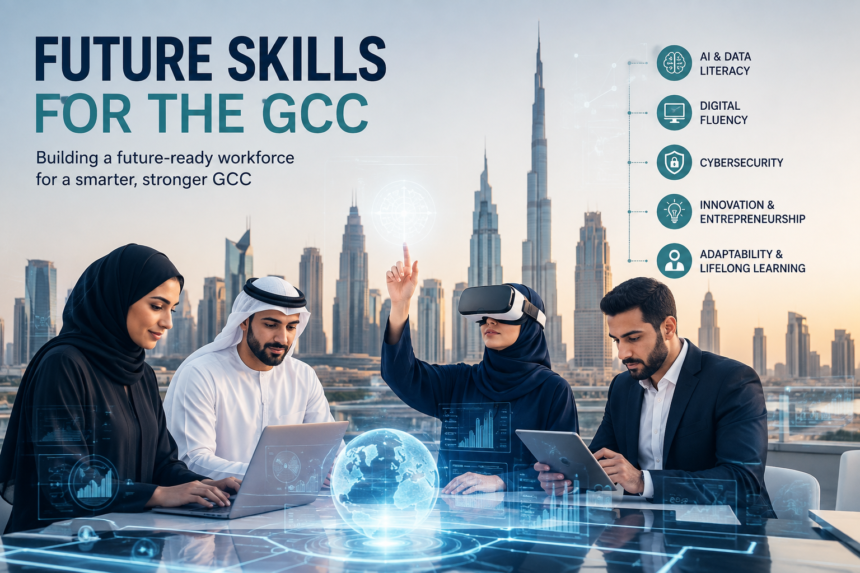
The Gulf Cooperation Council is entering a period of major economic and technological change, and future skills for the GCC are becoming increasingly important for workers, students, businesses and governments. Artificial intelligence, automation, digital platforms, cybersecurity, clean energy and advanced technologies are changing how organisations operate and what employers expect from their people. The International Monetary Fund has highlighted both the GCC’s rapid progress in digital transformation and the region’s remaining gaps in advanced digital talent.
- Why Future Skills for the GCC Matter Now
- The GCC Is Building A New Economic Model
- 1. Artificial Intelligence And AI Literacy
- 2. Data Analysis And Data Literacy
- 3. Cybersecurity And Digital Risk
- 4. Cloud Computing And Digital Infrastructure
- 5. Critical Thinking And Problem Solving
- 6. Communication And Collaboration
- 7. Adaptability And Continuous Learning
- 8. Leadership And People Management
- 9. Green Skills And Sustainability
- 10. Entrepreneurship And Innovation
- The Rise Of Human Skills In An AI Economy
- How GCC Students Can Prepare
- How Existing Professionals Can Reskill
- What Employers Should Do
- The GCC Skills Gap Is Also An Opportunity
- Future Skills For Different GCC Industries
- A Practical Future Skills Roadmap
- What The GCC Workforce Could Look Like By 2035
- Frequently Asked Questions
- Conclusion: Preparing For The GCC Workforce Of Tomorrow
For professionals, this does not simply mean learning another software program. It means becoming adaptable enough to work alongside technology, understand data, solve unfamiliar problems, communicate across cultures and continue learning as industries evolve.
The opportunity is significant. But the people best positioned to benefit will be those who start preparing before the next generation of jobs becomes mainstream.
Why Future Skills for the GCC Matter Now
The GCC economies are changing beyond their traditional dependence on oil and gas.
Saudi Arabia, the United Arab Emirates, Qatar, Oman, Bahrain and Kuwait are investing in technology, tourism, logistics, healthcare, finance, advanced manufacturing, renewable energy and digital services.
These economic changes are creating new career paths.
At the same time, artificial intelligence is changing existing jobs.
The ILO and ESCWA reported in 2026 that AI could significantly reshape employment across the Arab region between 2025 and 2035. The report identifies a range of priorities, from basic AI literacy to advanced technical and AI governance capabilities.
That means future skills are not only for programmers.
A marketing professional may need AI skills.
A financial analyst may need stronger data capabilities.
A healthcare professional may work with intelligent systems.
A manager may need to understand AI governance.
A business owner may need to know how automation can improve operations.
The future workforce will therefore be more technology aware across almost every sector.
The GCC Is Building A New Economic Model
Economic diversification is one of the biggest forces behind the changing skills landscape.
Across the GCC, governments are pursuing national development strategies that encourage industries beyond traditional energy.
This creates demand for professionals who can operate in emerging sectors.
The future workforce may increasingly find opportunities in areas such as:
- Artificial intelligence
- Cloud computing
- Cybersecurity
- Data science
- Financial technology
- Renewable energy
- Advanced manufacturing
- Tourism and hospitality
- Healthcare technology
- Robotics
- Digital commerce
- Smart cities
- Logistics
- Space technology
- Creative industries
The important point is that these sectors require a mixture of technical and human abilities.
Knowing technology is valuable.
Knowing how to use technology to solve a business problem is even more valuable.
1. Artificial Intelligence And AI Literacy
Artificial intelligence is likely to become one of the most important areas of future skills for the GCC.
The IMF has noted that GCC governments have moved quickly on AI strategies and infrastructure, while also identifying gaps in digital talent and AI expertise. The average proportion of AI specialists in the GCC workforce was estimated at 1.7 percent, compared with 5.4 percent in the European Union.
This creates an opportunity for people who develop practical AI capabilities.
Not everyone needs to become a machine learning engineer.
Most professionals need a basic understanding of how AI works and how it can be applied to their role.
Useful AI skills include:
- Generative AI
- AI assisted research
- Prompt design
- AI powered productivity
- Machine learning fundamentals
- AI data interpretation
- Automation
- Responsible AI
- AI risk awareness
The most valuable employees may be those who understand both their profession and AI.
A marketer who knows how to use AI for research, content analysis and campaign optimisation can bring a different level of value.
A human resources professional who understands AI recruitment tools can improve workflows.
The same principle applies across industries.
2. Data Analysis And Data Literacy
Businesses increasingly make decisions based on data.
That means employees who can understand numbers, identify patterns and turn information into useful decisions will have an advantage.
Data literacy does not necessarily mean becoming a data scientist.
It can mean knowing how to read a dashboard, question a result, identify a trend or explain a business metric.
More advanced professionals may learn:
- SQL
- Python
- Data visualisation
- Business intelligence
- Predictive analytics
- Machine learning
- Statistical analysis
The GCC’s digital transformation makes these skills increasingly relevant.
Companies are collecting more information from customers, operations, logistics and digital platforms.
The challenge is turning that information into action.
3. Cybersecurity And Digital Risk
As businesses become more digital, cybersecurity becomes more important.
Banks, hospitals, government departments, retailers, airports and energy companies all depend on digital infrastructure.
A cyberattack can affect operations, finances, customer trust and national security.
This makes cybersecurity one of the strongest areas among future jobs in the GCC.
Professionals can develop skills in:
- Network security
- Cloud security
- Threat detection
- Identity management
- Data protection
- Security operations
- Risk management
- Cybersecurity compliance
- Incident response
There is also a growing need for employees who understand cybersecurity even when cybersecurity is not their main job.
An accountant handling sensitive financial information needs security awareness.
A marketing employee handling customer data needs privacy awareness.
A manager approving technology investments needs to understand digital risks.
Cybersecurity is therefore becoming a company wide responsibility.
4. Cloud Computing And Digital Infrastructure
Cloud technology has become an essential part of modern business.
Companies use cloud systems for storage, software, collaboration, analytics and artificial intelligence.
As GCC economies continue to digitise, cloud related capabilities are expected to remain important.
Professionals can build knowledge in:
- Cloud architecture
- Cloud security
- Cloud administration
- Infrastructure management
- DevOps
- Software development
- Cloud data systems
The value of cloud skills is not limited to technology companies.
Banks, retailers, governments, healthcare organisations and logistics businesses all depend on digital infrastructure.
People who understand how these systems work can contribute to digital transformation projects across multiple industries.
5. Critical Thinking And Problem Solving
Technology can process information quickly.
But it does not remove the need for human judgment.
Critical thinking may become even more important as AI generated information becomes common.
Professionals will need to ask:
Is this information accurate?
What evidence supports this conclusion?
What assumptions are being made?
What could go wrong?
Is the AI recommendation appropriate for this situation?
These questions require human judgment.
Problem solving is equally important.
The future workplace will contain unfamiliar challenges.
Employees who can break complex problems into manageable steps and develop practical solutions will remain valuable.
This is one reason technical skills alone are not enough.
The strongest future professionals will combine digital knowledge with analytical thinking.
6. Communication And Collaboration
Communication remains one of the most important future skills for the GCC.
The region has highly international workplaces where professionals often work with colleagues, customers and partners from different countries.
Technology can make communication faster, but it cannot automatically make communication effective.
Professionals need to explain ideas clearly.
They need to listen.
They need to negotiate.
They need to give constructive feedback.
They also need to collaborate across departments.
Strong communication becomes especially important when technical professionals work with nontechnical business teams.
An AI engineer may understand a complex system but still need to explain its business value to executives.
A data analyst may discover an important trend but needs to communicate what it means for the organisation.
Technical knowledge becomes more powerful when it can be understood by others.
7. Adaptability And Continuous Learning
Perhaps the most important future skill is the ability to learn new skills.
Technology changes quickly.
A tool that is popular today may be replaced tomorrow.
This means professionals cannot depend entirely on what they learned at university or in their first job.
The ILO has emphasised the importance of proactive training and education as AI transforms Arab labour markets.
Continuous learning can take many forms.
It might involve:
- Online courses
- Professional certifications
- Industry workshops
- Mentorship
- Practical projects
- Reading industry research
- Experimenting with new technology
- Learning directly from colleagues
The goal is not to collect certificates.
The goal is to remain useful as the workplace changes.
8. Leadership And People Management
Technology may automate many tasks, but organisations will still need leaders.
In fact, leadership could become more important as workplaces become more complex.
Future leaders will need to manage people and technology at the same time.
They will need to understand employee expectations, motivate teams, manage change and make decisions under uncertainty.
Important leadership skills include:
- Emotional intelligence
- Strategic thinking
- Decision making
- Conflict management
- Coaching
- Delegation
- Change management
- Cross cultural communication
The GCC’s economic transformation also creates demand for leaders who can build organisations rather than simply manage existing processes.
This is particularly important for young professionals who want to move into management.
9. Green Skills And Sustainability
The future of the GCC will not be defined only by digital technology.
Sustainability is also becoming a major economic priority.
The region is investing in renewable energy, energy efficiency, sustainable construction, electric mobility, water management and environmental technologies.
This creates demand for green skills.
Potential areas include:
- Renewable energy
- Sustainable engineering
- Environmental management
- Green construction
- Energy efficiency
- Carbon management
- Sustainable supply chains
- Climate risk
- Circular economy
Professionals who understand both sustainability and business can become especially valuable.
Companies increasingly need people who can reduce environmental impact without compromising operational performance.
10. Entrepreneurship And Innovation
The GCC’s future economy will also depend on entrepreneurs.
New businesses create products, services and employment while helping economies diversify.
Entrepreneurial skills are useful even for people who do not plan to start a company.
Entrepreneurs learn how to identify problems, test ideas, understand customers and work with limited resources.
Important skills include:
- Opportunity identification
- Business planning
- Customer research
- Financial literacy
- Product development
- Marketing
- Negotiation
- Innovation
- Risk management
An employee who thinks like an entrepreneur can identify opportunities inside an organisation.
This is often called intrapreneurship.
The Rise Of Human Skills In An AI Economy
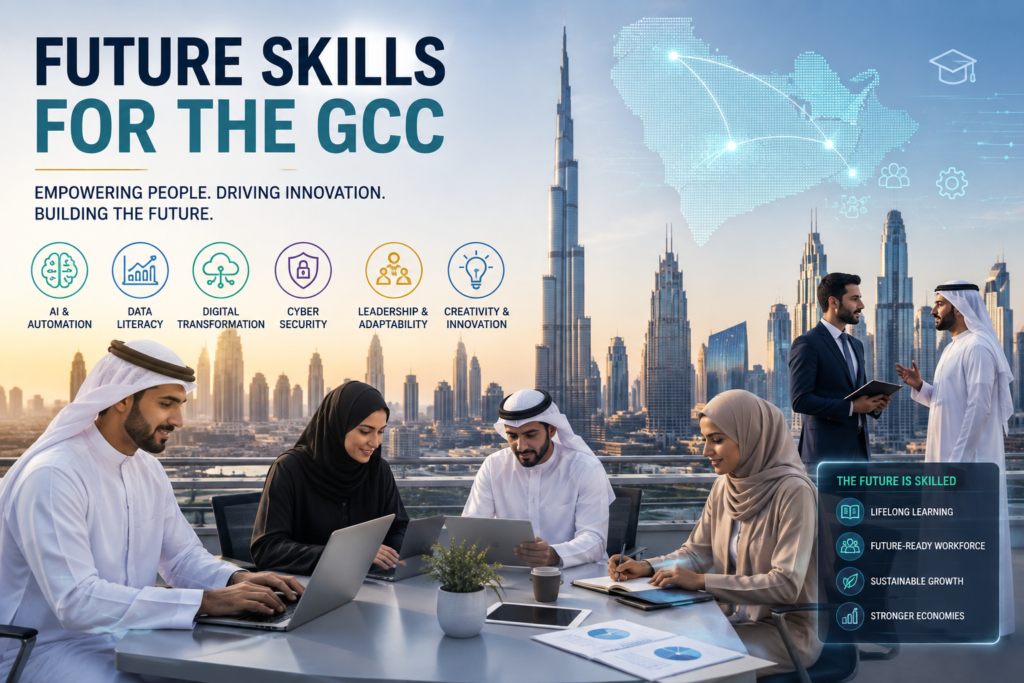
It may seem strange that communication, creativity and emotional intelligence are becoming more important while technology becomes more advanced.
But the two trends are connected.
AI can increasingly handle routine cognitive tasks.
That makes uniquely human abilities more valuable.
The ILO’s regional research suggests that AI’s impact will involve both job transformation and potential displacement, with policy, training and inclusion playing important roles in determining outcomes.
The future employee may therefore work alongside AI rather than compete directly with it.
AI can analyse information.
The human can decide what matters.
AI can generate options.
The human can judge which option fits the situation.
AI can automate a process.
The human can redesign the process.
This combination creates a new definition of productivity.
How GCC Students Can Prepare
Students entering the workforce should avoid focusing only on academic qualifications.
Degrees remain valuable, but employers increasingly need evidence that candidates can apply what they know.
Students can start by developing one technical skill and one human skill.
For example:
AI plus communication
Data analysis plus business strategy
Cybersecurity plus risk management
Programming plus entrepreneurship
Digital marketing plus creative thinking
Practical projects can make learning more meaningful.
A student interested in AI could build a simple AI powered project.
A marketing student could analyse a real business campaign.
A finance student could create a financial dashboard.
These projects demonstrate initiative and practical ability.
How Existing Professionals Can Reskill
Professionals do not need to restart their careers to prepare for the future.
Instead, they can identify how technology is changing their current role.
Ask three questions:
Which parts of my job are becoming automated?
Which new technologies could make me more productive?
Which skills would make me more valuable to my employer?
The answers can reveal a practical learning path.
An accountant might learn data analytics.
A salesperson might learn CRM automation and AI tools.
A designer might learn generative design workflows.
A human resources manager might learn workforce analytics.
Reskilling becomes easier when connected to an existing profession.
What Employers Should Do
Future skills are not only an employee responsibility.
Businesses need to invest in their workforce.
The GCC workforce is already experiencing rapid change. Recent regional research shows strong employee use of AI alongside a significant interest in skills development. PwC’s 2025 Middle East Workforce Hopes and Fears Survey found that 75 percent of surveyed regional workers had used AI at work during the previous year, while 69 percent reported learning new skills.
Employers can respond by creating:
- Skills based hiring
- Internal training
- Mentorship programs
- Career development pathways
- AI literacy programs
- Leadership development
- Cross functional projects
- Reskilling opportunities
Training should also be practical.
Employees learn more effectively when they can immediately apply new skills to real problems.
The GCC Skills Gap Is Also An Opportunity
The region’s skills gap should not only be viewed as a problem.
It is also an opportunity.
The IMF has identified gaps in advanced digital talent across the GCC, including a relatively low share of AI specialists compared with advanced economies.
For ambitious professionals, this creates space to differentiate themselves.
If a particular skill is difficult to find, developing that skill can improve career opportunities.
The key is to identify skills before they become crowded.
AI governance is one example.
Cybersecurity is another.
Advanced data skills, robotics, renewable energy and digital infrastructure can also provide opportunities as investment expands.
Future Skills For Different GCC Industries
| Industry | Important Future Skills |
|---|---|
| Finance | AI, data analytics, cybersecurity, fintech |
| Healthcare | Health technology, AI, data, digital patient systems |
| Tourism | Digital marketing, customer experience, languages, AI |
| Energy | Renewable energy, automation, data, sustainability |
| Construction | Smart buildings, BIM, robotics, sustainability |
| Retail | E commerce, analytics, automation, customer technology |
| Logistics | AI, robotics, supply chain analytics, automation |
| Government | Digital services, AI governance, cybersecurity, data |
| Education | EdTech, AI literacy, digital learning |
| Real Estate | PropTech, data analytics, digital marketing, AI |
This shows why there is no single definition of future skills.
The right skills depend on the industry and career direction.
A Practical Future Skills Roadmap
Professionals who want to prepare can follow a simple progression.
Step one: Understand the change.
Identify which technologies are affecting your industry.
Step two: Choose one priority skill.
Do not try to learn everything at once.
Step three: Learn the fundamentals.
Use courses, books, workshops and practical resources.
Step four: Apply the skill.
Build a project or use the skill at work.
Step five: Measure the result.
Find out whether the new skill improves productivity or creates business value.
Step six: Add a complementary human skill.
Pair technology with communication, leadership or creativity.
Step seven: Keep learning.
Treat professional development as a continuous process.
What The GCC Workforce Could Look Like By 2035
The workplace of 2035 may look very different from today’s workplace.
AI assistants could become standard.
Routine administrative work could become increasingly automated.
Digital services may become more deeply integrated into everyday life.
Healthcare could become more data driven.
Energy systems could become more diversified.
Smart cities could create new technology roles.
At the same time, human workers will still be needed to make decisions, build relationships, create new ideas and manage complex situations.
The ILO and ESCWA’s 2026 analysis presents different possible AI futures through 2035, demonstrating that policy choices, investment in skills and workforce preparation can influence whether AI produces more inclusive growth or deeper disruption.
That makes today’s skills decisions important.
Frequently Asked Questions
What are the most important future skills for the GCC?
AI literacy, data analysis, cybersecurity, cloud technology, critical thinking, communication, adaptability, leadership, sustainability and entrepreneurship are among the most valuable areas.
Will AI replace jobs in the GCC?
AI is expected to transform many jobs rather than simply eliminate every affected position. The impact will vary by occupation, sector and level of AI adoption. The ILO expects both opportunities and risks across Arab labour markets.
Do GCC workers need to learn programming?
Programming can be highly valuable, particularly in technology careers, but it is not necessary for every profession. AI literacy, data skills and the ability to use digital tools can also be highly useful.
Which AI skills should beginners learn first?
Beginners can start with AI fundamentals, responsible AI, generative AI tools, prompt design, data awareness and practical workplace applications.
Are soft skills still important in the GCC?
Yes. Communication, leadership, creativity, emotional intelligence and critical thinking remain important because technology does not eliminate the need for human judgment and collaboration.
What skills will be important in green industries?
Renewable energy, energy efficiency, sustainable engineering, environmental management, carbon management and sustainable supply chains are likely to remain important as the region invests in sustainability.
How can students prepare for future GCC jobs?
Students can combine academic study with practical projects, internships, certifications, digital skills and communication abilities. Building a portfolio can also demonstrate what they can actually do.
Why is cybersecurity important for the GCC workforce?
As governments and businesses become increasingly digital, protecting systems, customer information and critical infrastructure becomes increasingly important.
Can older professionals benefit from reskilling?
Absolutely. Reskilling is not limited to young workers. Professionals with strong industry experience can combine their existing knowledge with new technologies to remain competitive.
What is the most important future skill overall?
Adaptability may be the most transferable skill because technology and job requirements continue to change. A person who can learn effectively can continue developing new technical and professional capabilities.
Conclusion: Preparing For The GCC Workforce Of Tomorrow
The story of future skills for the GCC is ultimately a story about preparation.
The region is investing heavily in digital infrastructure, artificial intelligence, economic diversification and emerging industries. At the same time, research continues to highlight gaps in advanced digital talent and the importance of developing workers who can adapt to technological change.
For workers, the message is clear.
Do not wait for your job to change before learning something new.
Develop AI awareness.
Understand data.
Strengthen cybersecurity knowledge.
Improve communication.
Learn to solve unfamiliar problems.
Build leadership abilities.
Understand sustainability.
Most importantly, become comfortable with continuous learning.
The GCC’s future economy will need people who can connect technology with real world problems.
The strongest professionals may not be those who know every new tool.
They may be the people who know how to learn, adapt and use the right technology at the right moment.
For students, employees, entrepreneurs and employers across the Gulf, preparing for that future starts now.
follow us on Instagram
Read More – Best Areas in Dubai for Remote Workers: 7 Smart Places to Live and Work