

GCC Expansion Checklist for International Companies
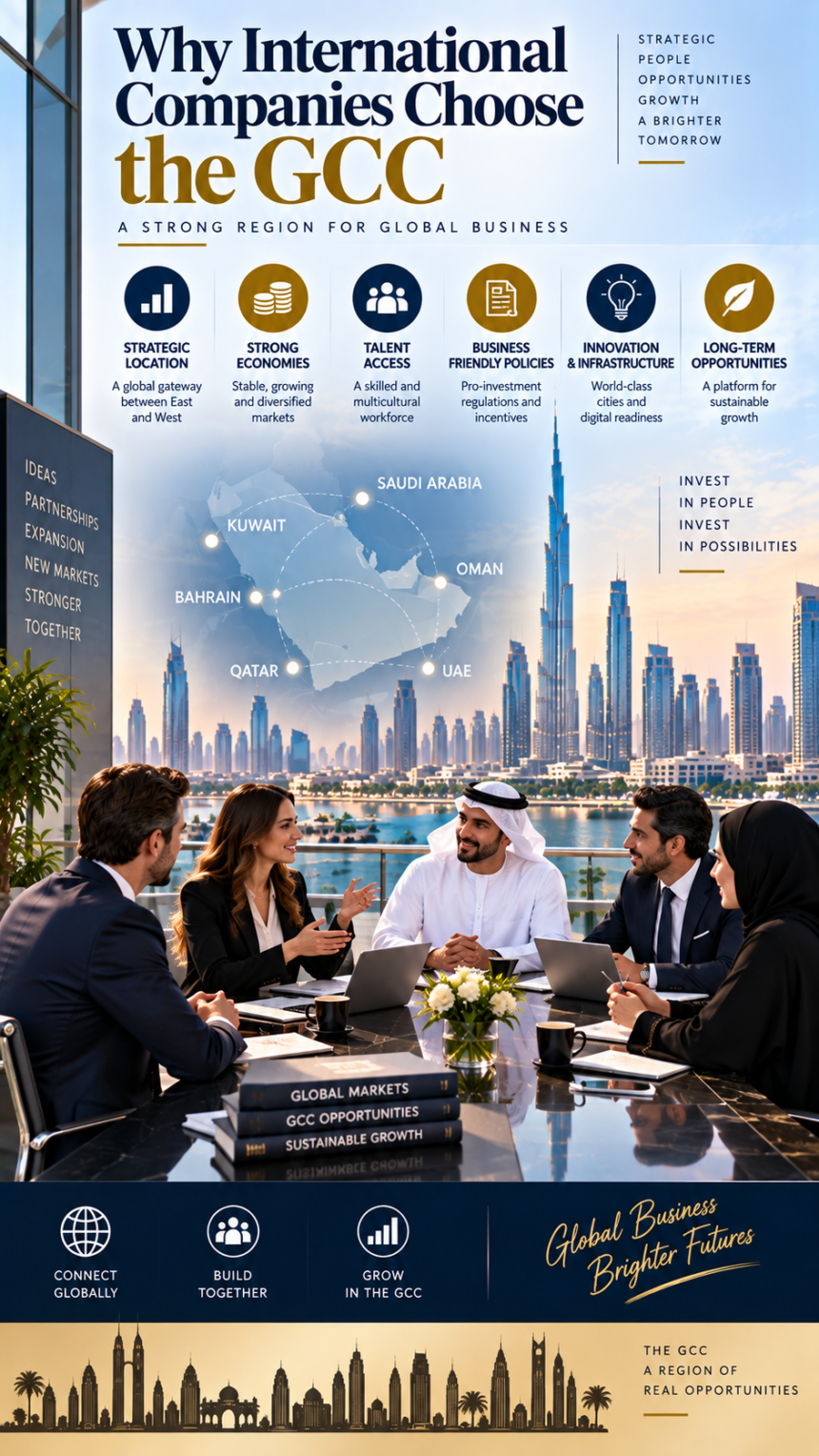
GCC Business Investment has become increasingly important to international companies searching for new markets, regional headquarters, logistics centres and long-term growth opportunities. The Gulf Cooperation Council brings together the UAE, Saudi Arabia, Qatar, Bahrain, Oman and Kuwait, six economies that are investing heavily in infrastructure, technology, tourism, financial services, manufacturing and economic diversification.
- GCC Business Investment: Why the Gulf Attracts Global Companies
- The GCC as a Major International Business Region
- 1. Access to a Large and Valuable Regional Market
- 2. Strategic Location Between Major Global Markets
- 3. Greater Foreign Business Ownership
- 4. Competitive Business Tax Environments
- 5. World-Class Logistics and Infrastructure
- 6. Regional Headquarters Opportunities
- 7. Strong Government Investment Programmes
- 8. Access to International Talent
- 9. Fast-Growing Digital Economies
- 10. Free Zones and Special Economic Zones
- 11. Long-Term Economic Diversification
- 12. Strong Opportunities for Regional Expansion
- Why Companies Choose the UAE
- Why Companies Choose Saudi Arabia
- Why Companies Choose Qatar
- Why Companies Choose Bahrain
- Why Companies Choose Oman
- Why Companies Choose Kuwait
- Best GCC Markets for Different Business Sectors
- Challenges International Companies Should Consider
- GCC Expansion Checklist for International Companies
- Final Thoughts on GCC Business Investment
For global companies, the region offers a combination that is difficult to find in many other parts of the world. It has substantial consumer purchasing power, major energy resources, internationally connected airports and ports, rapidly modernising business laws and strategic access between Asia, Europe and Africa.
The GCC is also becoming more economically integrated. The GCC Secretariat reported that the combined GDP of member states reached approximately $2.3 trillion in 2024, while foreign trade was around $1.5 trillion and intra-GCC trade exceeded $145 billion. The bloc already has a Customs Union and Common Market framework, while work continues on deeper economic integration and cross-border trade in services.
These factors help explain why international corporations are establishing regional offices, logistics centres, factories, technology operations and investment platforms across Gulf cities.
However, companies should not treat the GCC as one identical business market. Each country offers different strengths, regulations, ownership structures and investment incentives. The right location depends on what the company wants to achieve.
GCC Business Investment: Why the Gulf Attracts Global Companies
International companies typically enter the Gulf for several reasons at the same time. One business may use Dubai as a regional sales and management hub, Saudi Arabia as its largest operating market, Oman as a logistics or industrial base and Bahrain as a financial-services location.
| Business Advantage | Why It Matters |
|---|---|
| Large regional economy | Access to substantial consumer and government spending |
| Strategic geography | Connects Asia, Europe and Africa |
| Foreign ownership | Up to 100% available across many activities |
| Competitive tax systems | Several GCC states maintain relatively low business taxes |
| Infrastructure | Major airports, ports, roads and digital networks |
| Government investment | Large-scale national development programmes |
| Regional headquarters | Growing demand for local executive presence |
| International talent | Highly diverse expatriate workforces |
| Free zones | Specialised environments for international companies |
| Economic diversification | New opportunities beyond oil and gas |
| Capital availability | Strong banking, investment and sovereign capital ecosystems |
| Regional expansion | One base can support wider Middle East operations |
The strongest attraction is often the combination of these advantages rather than one individual incentive. A business may accept slightly higher office costs in one GCC city because it gains better access to customers, talent, airports and regional decision-makers.
The GCC as a Major International Business Region
The Gulf has historically been associated with oil and gas, but modern GCC economies are becoming far more diversified.
Governments are investing heavily in sectors such as:
- Artificial intelligence
- Tourism
- Logistics
- Manufacturing
- Renewable energy
- Financial technology
- Healthcare
- Education
- Entertainment
- Real estate
- Advanced industries
This creates opportunities not only for large multinational corporations but also for specialist suppliers, technology firms, professional service companies and startups.
The wider GCC economic framework also matters. The GCC Customs Union was created to improve the movement of goods between member states, while the Common Market is designed to deepen regional economic integration. In 2026, GCC leaders continued work on customs-data exchange and cross-border service regulations, showing that integration remains an active policy priority rather than a completed project.
For international companies, this creates the possibility of thinking regionally rather than viewing every Gulf market completely in isolation.
1. Access to a Large and Valuable Regional Market
One of the most obvious reasons international companies enter the GCC is access to customers.
The region contains affluent consumers, large government procurement programmes and companies investing in major infrastructure and transformation projects. Saudi Arabia provides the largest individual market in the GCC, while the UAE functions as a major regional commercial and financial centre.
The combined scale becomes even more important when companies consider the Gulf as a regional business platform.
The GCC Secretariat reported combined economic output of approximately $2.3 trillion in 2024.
For a multinational company, this means establishing a Gulf office can provide access not only to one city but to several commercially important markets within relatively short travel distances.
A software provider headquartered in Dubai, for example, may serve customers in Abu Dhabi, Riyadh, Doha and Manama. A manufacturing business in Oman or Bahrain may distribute products more widely throughout the Gulf.
Companies should still obtain the correct local licences and understand individual market-access rules, but regional scale is a major strategic advantage.
2. Strategic Location Between Major Global Markets
Geography has always been one of the Gulf’s greatest commercial strengths.
The GCC sits between:
- Europe
- South Asia
- East Asia
- Africa
- The wider Middle East
This makes the region particularly attractive for logistics, aviation, shipping, trading and regional management.
Major Gulf cities can connect executives with business centres in Europe, India, Southeast Asia and Africa within relatively manageable flight times. Ports on the Arabian Gulf, Red Sea and Arabian Sea also provide multiple trade routes.
Oman provides an especially interesting example because its location gives companies direct access to the Arabian Sea while remaining deeply connected to GCC markets. Oman’s government describes its location between Asia, Africa and the Middle East as a central element of its investment proposition.
This geographic advantage has also become strategically important during supply-chain disruption. In May 2026, the GCC Secretariat described coordinated efforts to redirect shipments through alternative Red Sea and Arabian Sea logistics corridors when regional conditions required greater resilience.
For global companies, the Gulf can therefore function both as a market and as a distribution platform.
3. Greater Foreign Business Ownership
Foreign ownership rules have become significantly more attractive across much of the GCC.
In the UAE, foreign investors can own up to 100% of many mainland companies, with restrictions remaining for selected strategic sectors. The UAE Government confirms that the earlier general requirement for 51% Emirati ownership was removed for most business activities.
Qatar’s Foreign Investment Law also enables fully foreign-owned companies across many sectors, subject to exclusions such as certain banking, insurance, natural-resource and commercial agency activities.
Oman allows 100% foreign ownership in most sectors under its Foreign Capital Investment Law, while Bahrain permits full foreign ownership across most activities. Kuwait offers up to 100% ownership through qualifying investments under the KDIPA framework.
These reforms matter because multinational companies often prefer direct control over regional subsidiaries.
Greater ownership flexibility can simplify:
- Corporate governance
- Profit distribution
- International reporting
- Intellectual property management
- Shareholder decisions
- Group restructuring
Local partnerships can still be commercially valuable, but they are increasingly chosen for strategic reasons rather than simply because regulations demand them.
4. Competitive Business Tax Environments
Tax is another important part of Gulf investment decisions.
The GCC does not have one corporate tax system, and companies must examine each jurisdiction individually. However, several Gulf markets maintain internationally competitive tax structures.
The UAE generally applies 9% Corporate Tax on taxable income above AED 375,000, while qualifying free-zone businesses can receive special treatment on qualifying income under the applicable conditions.
Qatar generally operates a 10% corporate income tax regime and promotes additional incentives through qualifying investment and economic-zone arrangements. Invest Qatar also highlights the ability to repatriate profits and access tax or customs incentives for qualifying projects.
Bahrain remains particularly notable because most ordinary businesses are not currently subject to a broad general corporate income tax, although specific industries and large multinational groups can face separate tax regimes.
Oman has a standard corporate income tax system but offers significant incentives through certain economic and free zones.
The important point is that tax should be evaluated alongside operational substance, customer access, staffing and regulatory requirements.
A low headline tax rate is valuable only if the jurisdiction also works commercially for the company.
5. World-Class Logistics and Infrastructure
Infrastructure is one of the Gulf’s most visible investment advantages.
International companies operating in the region can access major airports, deep-water ports, highways, industrial zones and increasingly sophisticated digital infrastructure.
The UAE has built a major international aviation and logistics ecosystem around Dubai and Abu Dhabi. Saudi Arabia is investing heavily in transportation and logistics as part of its wider economic transformation, while Qatar has developed modern airport and port infrastructure.
Oman has invested in logistics hubs including Sohar, Salalah and Duqm. Government investment materials highlight the country’s ports, highways, airports and dedicated economic zones as important components of its investment proposition.
Bahrain’s geographic position also provides relatively fast access to eastern Saudi Arabia. Bahrain EDB promotes the country as a gateway to the wider Gulf, with road access to Saudi Arabia forming an important part of the value proposition.
Reliable infrastructure reduces the practical difficulty of operating a regional business, particularly for companies involved in manufacturing, distribution and international trade.
6. Regional Headquarters Opportunities
The Gulf is increasingly competing for regional decision-making centres rather than simply branch offices.
Saudi Arabia’s Regional Headquarters programme provides one of the strongest examples.
The programme encourages international companies to establish regional management operations in the Kingdom. In August 2026, the Ministry of Investment announced that more than 750 companies had joined the RHQ programme, already exceeding its original target of 500 companies by 2030.
Saudi authorities have also linked regional headquarters presence with eligibility for certain government contracting opportunities, strengthening the commercial incentive for multinationals serving the Saudi market.
The UAE remains another major regional headquarters destination, particularly Dubai, because of its international workforce, aviation connectivity, professional-service ecosystem and established multinational business community.
This competition between Gulf cities can benefit international companies because governments are actively improving investment services, residency options and regulatory systems to attract regional decision-makers.
7. Strong Government Investment Programmes
One unusual feature of the GCC investment environment is the scale of government-led economic development.
National strategies are directing large amounts of capital into new sectors and infrastructure.
Saudi Vision 2030 continues to create opportunities in tourism, construction, entertainment, technology, manufacturing and logistics. Qatar’s National Development Strategy is targeting advanced industries, logistics, technology and financial services, while Oman Vision 2040 is driving diversification into manufacturing, tourism, mining, logistics and renewable energy.
Qatar provides a particularly clear example of direct investor support. Invest Qatar launched a $1 billion incentives programme in 2025 targeting advanced industries, logistics, technology and financial services. Eligible projects can receive support covering part of qualifying local investment expenses, subject to programme requirements.
Kuwait’s KDIPA framework can also provide qualifying investors with tax incentives, customs exemptions and access to land alongside foreign ownership benefits.
International companies therefore sometimes enter the GCC not simply because market demand already exists but because governments are actively building entire new industries.
8. Access to International Talent
The GCC has one of the world’s most international labour markets.
Cities such as Dubai, Abu Dhabi, Riyadh, Doha, Manama and Muscat attract professionals from across Asia, Europe, Africa, North America and the wider Middle East.
The UAE specifically identifies its multicultural workforce and international talent pool as major investment advantages. Its visa framework is designed to attract skilled professionals in technology, science, healthcare and other priority areas.
Qatar has also expanded its approach to global talent. In February 2026, it announced new long-term residency visa categories for high-growth entrepreneurs and senior executives, designed to strengthen business continuity and attract international leadership.
Oman offers investor residency programmes as part of its investment proposition, including long-term residency options for qualifying investors.
For multinational companies, the ability to move executives and specialist employees into the region is an important practical consideration.
9. Fast-Growing Digital Economies
Technology has become a central part of Gulf diversification.
Governments are investing in:
- Artificial intelligence
- Cloud infrastructure
- Fintech
- Cybersecurity
- Smart cities
- Digital government
- Data centres
The result is a market where global technology companies can sell to both governments and private businesses while also using the region as an innovation base.
Qatar’s investment incentives specifically target technology activities including cybersecurity, cloud computing, artificial intelligence and data-driven innovation.
The UAE has also positioned itself aggressively around AI and advanced digital infrastructure, while Saudi Arabia continues building technology and digital services as part of its broader economic transformation.
For global technology companies, the Gulf offers something particularly attractive: governments and major corporations willing to invest heavily in modern systems rather than slowly replacing legacy infrastructure over decades.
This can create opportunities for companies introducing new technologies at significant scale.
10. Free Zones and Special Economic Zones
Specialised business zones remain a major attraction for international companies.
The UAE has an extensive free-zone ecosystem covering sectors including:
- Finance
- Commodities
- Technology
- Logistics
- Media
- Healthcare
- Manufacturing
These zones can provide 100% foreign ownership, specialist infrastructure and business communities built around particular industries.
Oman has also developed major economic and free zones in Duqm, Sohar, Salalah and other locations. Current official investment guidance highlights incentives that can include full foreign ownership, customs benefits and long-term tax exemptions, depending on the zone and project.
Bahrain takes a somewhat different approach and promotes the fact that international companies do not need to operate inside conventional free zones to access many of its investment advantages. Bahrain EDB highlights 100% foreign ownership in most sectors and relatively open commercial access across the wider economy.
Companies should choose zones based on operational needs rather than simply the cheapest licence or strongest tax marketing.
11. Long-Term Economic Diversification
Global companies generally prefer markets where long-term investment priorities are clear.
The GCC’s diversification strategies provide that visibility.
Saudi Arabia is reducing dependence on oil by expanding tourism, entertainment, manufacturing and technology. The UAE has already built strong non-oil sectors in finance, aviation, logistics, tourism and real estate while continuing to invest in advanced technology.
Qatar is building on its energy wealth by investing more heavily in logistics, technology, financial services and advanced manufacturing.
Oman continues developing non-oil industries, with the government reporting that foreign direct investment had reached approximately OMR 31 billion by mid-2026, alongside expanding industrial activity.
Diversification creates secondary opportunities as well.
A major tourism project needs hotels, software, security systems, food suppliers, architects and professional services. A new manufacturing hub needs logistics, equipment, insurance, banking and workforce training.
International companies can therefore benefit even when they are not directly involved in the headline megaproject.
12. Strong Opportunities for Regional Expansion
International companies rarely enter the GCC planning to remain in only one neighbourhood or city forever.
The region’s geography makes multi-market expansion practical.
A company can establish operations in one Gulf state, understand the regional business environment and then gradually enter neighbouring markets.
The GCC’s Customs Union and Common Market framework provide a foundation for deeper regional integration, although companies still need to comply with each country’s licensing, tax and product requirements. The GCC continued working in 2026 on completing Customs Union requirements and improving cross-border trade in services.
A sensible expansion path might look like:
Stage 1: Establish regional headquarters.
Stage 2: Build sales in the largest nearby markets.
Stage 3: Create local subsidiaries where commercial volume justifies them.
Stage 4: Add warehousing, manufacturing or specialist operations in the most appropriate Gulf location.
This approach allows companies to learn the region before committing to large infrastructure in every market.
Why Companies Choose the UAE
The UAE remains one of the most established international business centres in the Gulf.
Its major strengths include full foreign ownership across many business activities, extensive free zones, global aviation connections, a sophisticated banking sector and an exceptionally international workforce.
Official UAE investment guidance highlights 100% foreign ownership opportunities, full profit repatriation and relatively low foreign-exchange restrictions among the country’s investor incentives.
Foreign investment flows also illustrate the country’s international appeal. UAE Government data shows foreign direct investment inflows reached $45.6 billion in 2024, up 48.7% from 2023.
Dubai is especially attractive for regional headquarters, professional services, finance, trading, technology, tourism and international sales.
Abu Dhabi offers additional strengths in energy, sovereign investment, technology, manufacturing and financial services.
For companies wanting one highly international base from which to manage several Middle Eastern markets, the UAE remains a major contender.
Why Companies Choose Saudi Arabia
Saudi Arabia offers something different: scale.
For many international businesses, it is the most commercially important consumer and government market in the GCC. Large development programmes, infrastructure investment and economic diversification are creating opportunities across multiple industries.
The Regional Headquarters programme has also increased the incentive for international companies to place senior management inside the Kingdom. More than 750 companies had joined the programme by August 2026.
Saudi Arabia can be especially attractive for companies working in:
- Construction
- Tourism
- Technology
- Healthcare
- Entertainment
- Manufacturing
- Financial services
- Professional services
However, companies need to understand local licensing, investment registration, employment requirements and sector rules carefully.
Saudi Arabia may require more substantial local operations than a small regional representative office, but the size of the opportunity can justify that investment.
Why Companies Choose Qatar
Qatar combines strong energy wealth with a concentrated programme of economic diversification.
Foreign investors can obtain up to 100% ownership across many activities under the country’s Foreign Investment Law, while qualifying projects may receive tax and customs incentives.
Its $1 billion incentives programme provides additional support for targeted sectors including:
- Advanced manufacturing
- Logistics
- Technology
- Financial services
Qatar also offers a relatively low general corporate tax rate, modern infrastructure and long-term plans to attract international executives and entrepreneurs.
For companies operating in energy, technology, aviation, finance or specialist professional services, Doha can offer a high-value market within a relatively compact business environment.
Why Companies Choose Bahrain
Bahrain is smaller than Saudi Arabia or the UAE, but that can itself be an advantage.
The country provides access to the wider Gulf while maintaining relatively competitive operating costs and an established financial-services sector.
Bahrain EDB highlights:
- 100% foreign ownership in most sectors
- Competitive operating costs
- Access to Saudi Arabia
- International trade agreements
- A bilingual talent pool
Its proximity to eastern Saudi Arabia makes Bahrain especially interesting for companies that need access to the Saudi market but also value Bahrain’s smaller and highly established commercial ecosystem.
The country is particularly strong in finance, fintech, professional services and certain manufacturing activities.
Why Companies Choose Oman
Oman combines strategic geography with a comparatively understated investment proposition.
Its direct access to the Arabian Sea makes it particularly interesting for logistics, manufacturing and international trade.
Oman’s Foreign Capital Investment Law permits 100% foreign ownership across most sectors, while special economic and free zones can provide additional tax and customs incentives.
The country has also developed major industrial and logistics areas around:
- Sohar
- Salalah
- Duqm
Oman can be attractive for companies that need land, manufacturing capacity, port access or a long-term industrial location rather than only a prestigious regional sales office.
Its Vision 2040 strategy continues encouraging investment in logistics, tourism, renewable energy, mining, manufacturing and technology.
Why Companies Choose Kuwait
Kuwait combines substantial purchasing power, financial resources and established commercial activity.
Its investment structure differs from several neighbouring markets because full foreign ownership is particularly associated with qualifying investments under the Kuwait Direct Investment Promotion Authority framework.
KDIPA states that qualifying investors can establish a Kuwaiti company with up to 100% foreign ownership or operate through an approved foreign-company branch. Incentives can include tax benefits, customs exemptions and land allocation.
Kuwait may be attractive for companies serving:
- Government projects
- Infrastructure
- Energy
- Consumer markets
- Professional services
- Financial sectors
However, international investors should plan ownership and licensing carefully because ordinary company rules and KDIPA investment structures are not identical.
For larger strategic projects, the direct-investment framework can provide meaningful advantages.
Best GCC Markets for Different Business Sectors
No single GCC country is the best choice for every international company.
| Business Sector | GCC Markets Often Worth Considering |
|---|---|
| Regional headquarters | UAE, Saudi Arabia |
| Financial services | UAE, Bahrain, Saudi Arabia, Qatar |
| Technology | UAE, Saudi Arabia, Qatar |
| Logistics | UAE, Oman, Saudi Arabia, Qatar |
| Tourism | UAE, Saudi Arabia, Oman |
| Manufacturing | Saudi Arabia, UAE, Oman, Bahrain |
| Energy | Saudi Arabia, UAE, Qatar, Kuwait, Oman |
| International trading | UAE, Oman, Bahrain |
| Professional services | UAE, Saudi Arabia, Qatar, Bahrain |
| Large consumer market | Saudi Arabia, UAE |
| Advanced industries | Saudi Arabia, Qatar, UAE, Oman |
The company should choose the country based on its own commercial requirements rather than simply following where competitors are located.
A logistics company needs different infrastructure from a fintech business. A consulting firm may prioritise access to clients and talent, while a manufacturer may care more about industrial land, power costs and port access.
Challenges International Companies Should Consider
The Gulf offers significant opportunities, but entering the region still requires preparation.
Different regulations across six countries
A UAE licence does not automatically allow unrestricted business activity in Saudi Arabia, Qatar or another GCC state.
Localisation requirements
Some countries require or encourage companies to hire greater numbers of local nationals.
Sector restrictions
Banking, insurance, defence, healthcare and other regulated activities can require additional approvals.
Different tax systems
Corporate tax, VAT, zakat and withholding tax vary across the region.
Competition
International companies are increasingly competing with strong local companies as well as other multinational groups.
Cost differences
Office, salary and housing costs can differ dramatically between Gulf cities.
Relationship building
Commercial relationships and trusted introductions can remain particularly valuable in some industries and government-related business.
These challenges do not necessarily reduce the attractiveness of the region, but they make careful market-entry planning essential.
GCC Expansion Checklist for International Companies
Before choosing a Gulf location, international companies should examine the complete operating model rather than only headline incentives.
- Identify the largest customer market.
- Decide whether the company needs a regional headquarters or local sales office.
- Compare foreign ownership rules.
- Check sector-specific approvals.
- Compare Corporate Tax and VAT.
- Review free-zone and mainland options.
- Calculate complete operating costs.
- Examine office and industrial property requirements.
- Review employee and localisation rules.
- Check executive and investor residency options.
- Compare banking availability.
- Review logistics and airport connectivity.
- Study customs requirements.
- Examine government procurement opportunities.
- Identify incentives available for the project.
- Compare access to professional talent.
- Review intellectual property protection.
- Understand profit repatriation rules.
- Evaluate potential neighbouring GCC markets.
- Build a three-to-five-year regional expansion plan.
A location that appears cheapest during incorporation may not remain the cheapest once staffing, logistics, customer access and expansion are considered.
Final Thoughts on GCC Business Investment
GCC Business Investment continues to attract international companies because the Gulf combines market scale, infrastructure, capital, strategic geography and increasingly investor-friendly business regulations.
The UAE remains one of the region’s most internationally established commercial hubs, offering extensive foreign ownership opportunities, major free zones and a deeply international workforce. Foreign direct investment inflows reached $45.6 billion in 2024, highlighting continued international interest in the market.
Saudi Arabia offers the largest individual market in the GCC and is actively encouraging international companies to move greater levels of decision-making into the Kingdom. More than 750 companies had joined its Regional Headquarters programme by August 2026.
Qatar combines full foreign ownership opportunities with targeted investment incentives, including a $1 billion programme supporting priority industries such as technology, logistics and advanced manufacturing.
Bahrain provides a comparatively compact and cost-competitive business environment with strong access to Saudi Arabia and full foreign ownership across most sectors.
Oman offers strategic access to the Arabian Sea, important industrial and logistics zones and 100% foreign ownership across most sectors, making it particularly interesting for long-term industrial and trading operations.
Kuwait provides international investors with opportunities through its KDIPA framework, including up to 100% foreign ownership for qualifying investment projects and potential tax and customs incentives.
The wider region also continues moving toward deeper economic integration. The GCC’s combined GDP reached approximately $2.3 trillion in 2024, while its Common Market and Customs Union provide a foundation for greater regional trade and investment cooperation.
For international companies, the most important decision is therefore not simply whether to enter the GCC.
It is deciding which Gulf country should perform which role within the company’s regional strategy. Dubai may provide the ideal management base, Riyadh may represent the largest customer opportunity, Oman may offer attractive logistics infrastructure, Bahrain may support financial operations and Qatar or Kuwait may provide access to specific high-value projects.
Companies that understand these differences can use the GCC as more than one destination. They can build an interconnected regional platform serving some of the world’s most ambitious and rapidly changing economies.
That combination of market opportunity, strategic location, government investment and long-term economic transformation is why the Gulf continues attracting global companies looking for their next stage of growth.
Do follow us on Instagram
Read More – Technology in Everyday Life: 12 Powerful Changes Making Life Smarter