



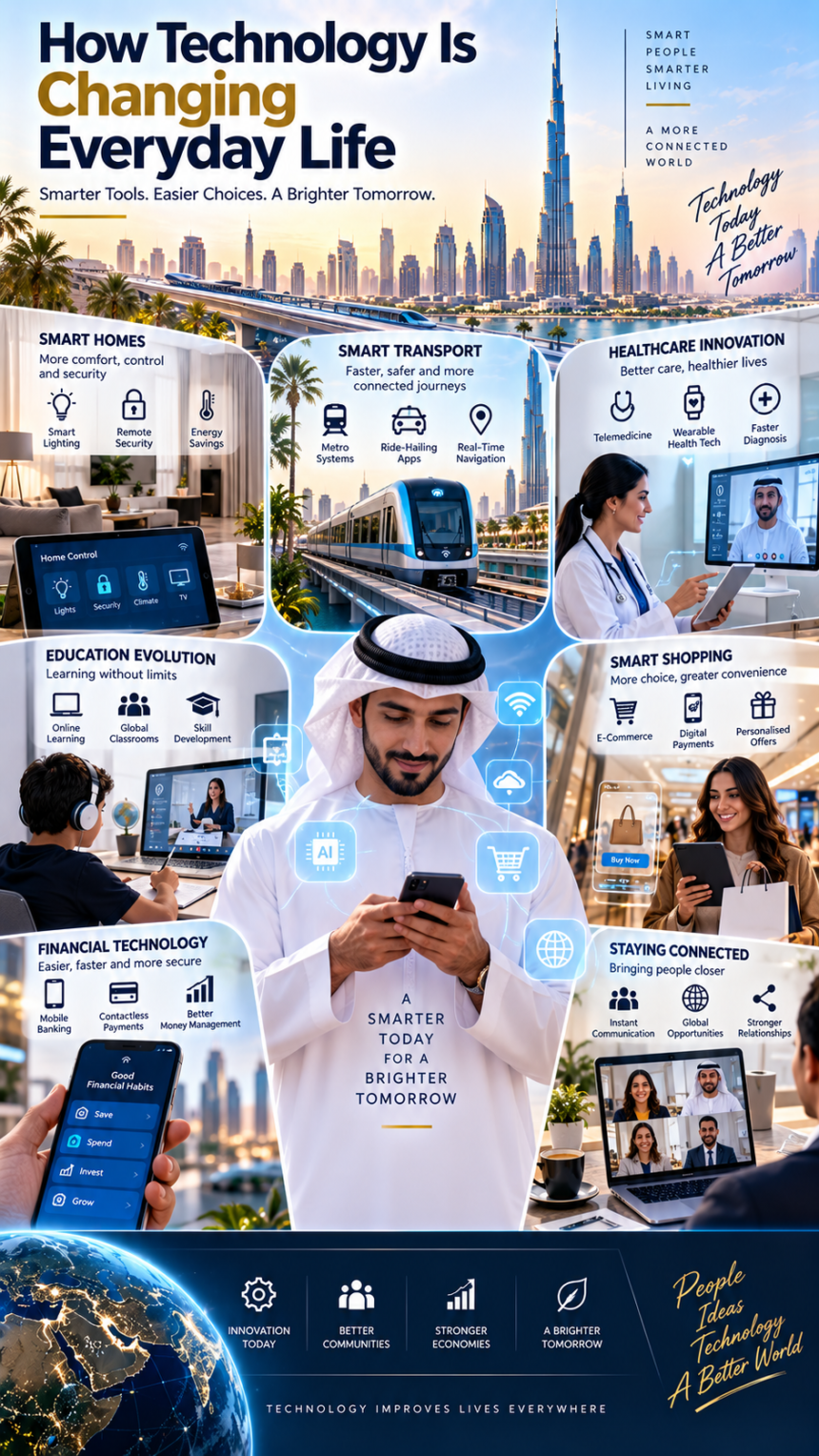
The Digital Transformation of Daily Life
Technology in Everyday Life has changed from something people occasionally use into something that quietly supports almost every part of the day. Smartphones wake people in the morning, digital maps guide their commute, contactless payments handle purchases, streaming platforms provide entertainment, wearable devices track activity, and artificial intelligence increasingly helps with writing, planning, searching and decision-making.
- Technology in Everyday Life: Modern Living Explained
- The Digital Transformation of Daily Life
- 1. Smartphones Have Become Everyday Control Centres
- 2. Artificial Intelligence Is Becoming a Daily Assistant
- 3. Smart Homes Are Automating Everyday Tasks
- 4. Technology Is Changing How People Work
- 5. Digital Tools Are Transforming Education
- 6. Healthcare Is Becoming More Connected
- 7. Digital Payments Are Replacing Cash
- 8. Online Shopping Is Changing Consumer Habits
- 9. Navigation and Transport Are Becoming Smarter
- 10. Communication Has Become Instant and Global
- 11. Entertainment Has Become More Personalised
- 12. Technology Is Changing Personal Safety and Privacy
- Technology and Everyday Life at Home
- Technology in the Workplace
- Technology for Families and Children
- Benefits of Technology in Daily Life
- Challenges Created by Everyday Technology
- The Digital Divide Still Matters
- Building Healthier Technology Habits
- The Future of Everyday Technology
- Final Thoughts on Technology in Everyday Life
This transformation has happened so gradually that many technologies now feel almost invisible. Tasks that once required visiting a bank, buying a newspaper, waiting for a taxi, travelling to an office or searching through shelves of books can now be completed from a device that fits inside a pocket.
The scale of this digital transformation is enormous. The International Telecommunication Union estimated that around 6 billion people, or 74% of the world’s population, were using the internet in 2025, compared with 60% in 2020. Mobile broadband now reaches most of the world, while 5G covers more than half of the global population.
Technology is not simply making existing activities faster. It is changing expectations about how quickly people should communicate, how easily services should be available and how much information should be accessible at any moment.
Technology in Everyday Life: Modern Living Explained
Technology now influences almost every major area of daily activity. The changes are particularly noticeable when comparing everyday routines today with those of only twenty years ago.
| Area of Life | Earlier Experience | Technology-Driven Experience |
|---|---|---|
| Communication | Calls, letters and SMS | Messaging, video calls and social media |
| Banking | Branch visits and cash | Mobile banking and digital payments |
| Shopping | Physical stores | E-commerce and instant delivery |
| Navigation | Printed maps | GPS and live traffic |
| Work | Fixed office | Hybrid and remote collaboration |
| Education | Classroom and textbooks | Online courses and AI learning tools |
| Healthcare | Mostly in-person visits | Telehealth, apps and wearables |
| Entertainment | Scheduled TV | On-demand streaming |
| Home | Manual appliances | Connected smart devices |
| Travel | Physical tickets and agents | Apps, digital tickets and online booking |
| Photography | Separate cameras | Smartphone cameras |
| Information | Libraries and newspapers | Search engines and AI assistants |
The biggest shift is convenience. People increasingly expect services to be available instantly, digitally and from almost anywhere.
However, greater convenience also creates new responsibilities. Privacy, cybersecurity, misinformation, screen time and unequal access have become important parts of the technology conversation.
The Digital Transformation of Daily Life
The internet provides the foundation for much of modern digital life. Banking apps, streaming platforms, cloud-based work, online shopping, social networks and artificial intelligence all depend on reliable connectivity.
The ITU estimates that approximately 96% of the world’s population is now covered by a mobile broadband network. However, being covered by a network does not guarantee meaningful access because affordability, device quality, skills and connection speeds still differ substantially between countries and communities.
This helps explain why technology can feel completely different depending on where someone lives. In one city, a person might pay bills, work remotely, receive medical advice and order groceries entirely through a smartphone. Elsewhere, expensive data, limited connectivity or lack of digital skills can make even basic online services difficult to use.
Technology is therefore changing everyday life quickly, but not equally.
1. Smartphones Have Become Everyday Control Centres
Few inventions have changed daily behaviour as dramatically as the smartphone. What began primarily as a communication device has effectively become a portable computer, wallet, camera, map, entertainment system and personal organiser.
A single smartphone can now handle tasks that previously required several separate products. People use phones to check email, photograph documents, scan QR codes, buy airline tickets, navigate unfamiliar cities, pay bills, monitor bank accounts and speak with relatives thousands of kilometres away.
The World Bank’s Global Findex 2025 found that 86% of adults worldwide owned a mobile phone, while 68% owned smartphones. Mobile technology is also becoming increasingly important for access to banking, savings and digital payments.
Smartphones have therefore become gateways to many essential services. Losing access to a phone can now affect banking, transportation, communication, work and even digital identity at the same time.
That convenience explains why device security has become increasingly important. Strong passwords, biometric authentication and software updates are no longer only technical concerns; they protect a large part of a person’s everyday life.
2. Artificial Intelligence Is Becoming a Daily Assistant
Artificial intelligence has moved rapidly from specialist laboratories into ordinary consumer products. AI now appears in search engines, smartphones, productivity software, customer service systems, photo tools, translation apps and recommendation platforms.
Generative AI has accelerated this shift. People increasingly use AI to draft emails, summarise documents, brainstorm ideas, translate text, plan trips, study unfamiliar subjects and analyse information.
OECD data shows how quickly adoption has grown. More than one-third of individuals across OECD countries used generative AI tools in 2025, while approximately three-quarters of students aged 16 and older reported using them.
At work, AI can reduce time spent on repetitive tasks. OECD research reviewing experimental studies found productivity improvements in areas including writing, customer support, software development and consulting, although results vary considerably depending on the task and the user’s experience.
The important change is that AI is becoming less visible as a separate technology. Increasingly, it will simply operate inside the applications people already use.
3. Smart Homes Are Automating Everyday Tasks
Homes are becoming more connected as ordinary household devices gain internet connections, sensors and automation.
Smart-home technology can now control lighting, air conditioning, security cameras, door locks, entertainment systems and household appliances. A homeowner can adjust the temperature before arriving home, check a security camera while travelling or schedule lights to turn off automatically.
Voice assistants and smartphone applications have made these systems easier to control. Instead of operating every device separately, users can create routines that connect several actions.
For example, a nighttime routine might automatically:
- Lock selected doors
- Switch off lights
- Adjust air conditioning
- Activate security systems
- Silence notifications
Energy management is another potential benefit. Smart thermostats, lighting systems and connected appliances can help users understand and reduce unnecessary energy consumption.
The challenge is security. Every connected device creates another potential point where personal information or home networks need protection, making strong passwords and reliable manufacturers increasingly important.
4. Technology Is Changing How People Work
Work is no longer always tied to one office, one computer or even one country. Cloud computing, video meetings and collaborative software have made it possible for many professionals to work across locations and time zones.
Employees can edit documents together without sitting in the same building. Teams can hold meetings between Dubai, London, Mumbai and Singapore without anyone travelling, while project-management platforms allow managers to follow tasks in real time.
Artificial intelligence is pushing workplace change even further. OECD research suggests AI can improve productivity across certain tasks while also changing the types of skills employees need. Human judgement remains particularly important where decisions involve ambiguity, responsibility or complex relationships.
Technology has also created entirely new professions. Social media managers, app developers, cloud engineers, cybersecurity specialists, content creators and AI professionals represent careers that either did not exist or were far smaller a generation ago.
At the same time, employees need to keep learning. Digital skills that were optional several years ago can quickly become basic workplace expectations.
5. Digital Tools Are Transforming Education
Technology has moved learning beyond the physical classroom. Students can access recorded lectures, digital textbooks, interactive exercises, educational videos and international courses from almost anywhere with an internet connection.
This has made education more flexible. A working professional can study at night, while someone in a smaller city may access a course offered by an institution thousands of kilometres away.
Artificial intelligence is creating another major shift. Students can use AI tools to explain difficult concepts, generate practice questions, translate material and receive personalised support.
However, education systems are also asking difficult questions about how these tools should be used. The OECD has argued that rapidly developing AI capabilities require educators to reconsider which knowledge, skills and attitudes students will need in a future where AI performs more tasks.
The goal should not simply be to use more technology. Effective education needs to combine digital tools with critical thinking, independent learning, communication and the ability to evaluate whether information is accurate.
6. Healthcare Is Becoming More Connected
Healthcare technology is increasingly moving beyond hospitals and clinics.
Patients can now use smartphones and wearable devices to track information such as activity, sleep patterns and heart rate. Medical organisations can use digital systems to manage appointments, records, diagnostic information and communication.
Telemedicine can also connect patients with healthcare professionals without requiring every consultation to happen physically. This can be especially useful for routine follow-ups, people living far from medical centres and patients with mobility limitations.
The World Health Organization describes digital technologies as increasingly integral to daily life and sees significant potential for digital health solutions to improve healthcare systems and access. WHO’s digital health work includes areas such as data sharing, health applications, interoperability and the responsible implementation of emerging technologies.
Digital health does not eliminate the need for doctors or physical examinations. Instead, technology can make certain parts of healthcare more convenient while giving medical professionals better tools for information management and communication.
Privacy becomes particularly important in this area because medical data is highly sensitive.
7. Digital Payments Are Replacing Cash
Paying for something has become one of the clearest examples of technology changing everyday behaviour.
People increasingly use mobile banking, contactless cards, QR payments, digital wallets and instant bank transfers rather than carrying large amounts of cash. The smartphone is gradually becoming both a communication device and a financial tool.
World Bank data shows how widespread this shift has become. Around 79% of adults globally now own a financial account, while mobile phones are helping expand access to payments, saving and borrowing. In low- and middle-income countries, 42% of adults made an in-store or online digital merchant payment in 2024, compared with 35% in 2021.
Digital payments offer several advantages. Transactions are faster, spending records are easier to maintain and people can transfer money without visiting a branch.
However, digital finance creates new types of fraud. Phishing messages, fake payment links, stolen passwords and social engineering can target users who are unfamiliar with digital security.
Convenience needs to grow alongside financial awareness.
8. Online Shopping Is Changing Consumer Habits
Shopping no longer requires travelling to a physical store. Consumers can compare hundreds of products, read reviews, check prices and arrange delivery without leaving home.
E-commerce has also changed expectations about speed. Customers increasingly expect same-day or next-day delivery, simple returns and real-time tracking.
Technology has made shopping more personalised as well. Online retailers analyse browsing history, purchase behaviour and other signals to recommend products that may interest individual customers.
This can be useful, but it also raises privacy questions about how much information companies collect and how that information influences purchasing decisions.
Physical retail is adapting rather than disappearing. Many stores now combine offline and online experiences through click-and-collect services, mobile loyalty programmes, digital receipts and in-store applications.
The boundary between e-commerce and traditional retail is becoming increasingly difficult to see.
9. Navigation and Transport Are Becoming Smarter

Finding an unfamiliar address once required printed maps, written directions or asking people along the way. GPS technology has transformed that experience.
Navigation applications now provide:
- Live traffic information
- Alternative routes
- Estimated arrival times
- Public transport directions
- Walking routes
- Location sharing
Ride-hailing platforms have changed urban transport as well. Passengers can see vehicle location, estimated fares and driver information before entering a car.
Public transport systems are increasingly adopting digital tickets, contactless payments and live arrival information. Travellers can plan journeys across trains, buses and walking routes from a single application.
Electric vehicles and advanced driver-assistance technology are adding another layer of change. Cars can increasingly provide lane assistance, collision warnings, parking assistance and intelligent navigation.
Autonomous driving may eventually transform transport even further, although safety, regulation and infrastructure will determine how quickly widespread adoption occurs.
10. Communication Has Become Instant and Global
Technology has almost eliminated distance as a barrier to everyday communication.
A family spread across several countries can maintain a group conversation every day. Businesses can hold video meetings internationally, while friends can share photographs and videos immediately rather than waiting for physical copies or letters.
Messaging services have also changed expectations around response time. People now often expect messages to be seen and answered quickly, which can create both convenience and pressure.
Social media has expanded communication beyond personal relationships. Individuals can speak to thousands or even millions of people, allowing creators, entrepreneurs and small companies to build audiences without traditional media channels.
However, faster communication does not always produce better communication. Misunderstandings can spread quickly, misinformation can reach enormous audiences and permanent connectivity can make it difficult for people to disconnect from work.
The challenge is no longer simply gaining access to communication. It is managing constant communication effectively.
11. Entertainment Has Become More Personalised
Television once followed a fixed schedule. Music required physical records, tapes or CDs, while video games were usually played on dedicated devices.
Streaming has transformed this model.
Movies, television programmes, music, podcasts and games can now be accessed instantly through internet-connected devices. Consumers increasingly decide what to watch and when to watch it.
Recommendation algorithms make entertainment more personal by analysing viewing or listening behaviour.
This creates convenience but also changes how people discover culture. Instead of everyone watching the same programme at the same time, audiences are increasingly divided across highly personalised digital experiences.
Gaming has become more social as well. Players can compete or cooperate with people around the world, while cloud gaming is beginning to reduce dependence on expensive local hardware.
Entertainment is becoming less about owning individual media products and more about continuously accessing digital services.
12. Technology Is Changing Personal Safety and Privacy
Technology can improve safety in several ways. Smartphones can share live locations, vehicles can automatically contact emergency services after serious accidents, and smart security systems allow homeowners to monitor properties remotely.
Wearable devices can also provide emergency functions. Some can detect falls or unusual health patterns and alert selected contacts.
However, the same technologies can collect enormous quantities of personal information.
Modern digital activity can reveal:
- Location
- Shopping behaviour
- Search history
- Financial activity
- Health information
- Social relationships
- Entertainment preferences
Cybersecurity therefore increasingly affects ordinary people rather than only large companies.
The ITU’s Global Connectivity Report notes that security is one of the fundamental dimensions of meaningful connectivity and highlights growing risks associated with online threats and misinformation.
Basic digital security habits are becoming as important as locking a physical front door.
Technology and Everyday Life at Home
Home is one of the clearest places to see how digital habits have changed. Entertainment, shopping, work, communication and household management increasingly happen through the same collection of connected devices.
A typical connected household may contain smartphones, smart televisions, laptops, security cameras, smart speakers, gaming systems and wearable devices. These products communicate through home internet connections and cloud services.
This creates convenience, but it also means families should think about technology as part of household management.
Important habits include regularly updating devices, protecting Wi-Fi networks, reviewing application permissions and deciding which devices genuinely need to remain connected.
Technology should simplify the home rather than fill it with unnecessary complexity.
Technology in the Workplace
Workplace technology is increasingly focused on automation and collaboration.
Cloud software enables employees to access information from different locations, while automation can handle repetitive administrative work. AI systems can support research, summarisation, customer service and data analysis.
The strongest organisations will likely use technology to support employees rather than simply replacing every human task possible.
Human skills remain particularly valuable in areas involving:
- Leadership
- Empathy
- Negotiation
- Creativity
- Ethical judgement
- Complex decision-making
Technology can process information quickly, but professional relationships and responsibility still require people.
Workers should therefore think about technology as something they need to learn continuously rather than as one set of permanent computer skills.
Technology for Families and Children
Children are growing up in an environment where screens and connected devices are normal from an early age. Education, entertainment and social communication may all involve digital technology.
This creates genuine opportunities. Children can explore educational resources, learn languages, practise creative skills and communicate with relatives around the world.
Families also need boundaries.
Parents should pay attention to age-appropriate content, online privacy, cyberbullying, excessive screen time and the information children share publicly.
Digital literacy should eventually become as normal as teaching children road safety or money management.
The goal does not need to be eliminating technology. It should be helping children understand how to use it safely and intelligently.
Benefits of Technology in Daily Life
The advantages of modern technology are substantial when digital tools are used appropriately.
| Benefit | Everyday Impact |
|---|---|
| Convenience | Tasks can be completed from home |
| Speed | Communication and payments happen instantly |
| Information access | Knowledge is available almost anywhere |
| Productivity | Automation reduces repetitive work |
| Connectivity | Families and teams remain connected globally |
| Healthcare access | Digital tools support remote care |
| Education | Learning becomes more flexible |
| Financial inclusion | Mobile technology expands access to banking |
| Safety | Devices provide monitoring and emergency functions |
| Accessibility | Technology can support people with disabilities |
These improvements explain why digital adoption continues to grow rapidly. Technology becomes especially powerful when it removes barriers that previously prevented people from accessing information, financial services, education or healthcare.
However, benefits should always be considered alongside the risks created by dependence on digital systems.
Challenges Created by Everyday Technology
Technology solves problems, but it also creates new ones.
One major concern is distraction. Notifications, short-form video, social media and constant messaging can compete continuously for attention.
Privacy is another challenge. Many useful digital services depend on collecting information about users, creating difficult questions about how personal data should be stored, shared and protected.
Cybercrime has become an everyday concern as well. Individuals can lose money through scams that arrive through email, SMS, messaging services or fake websites.
Other challenges include:
- Screen dependency
- Misinformation
- Loss of certain jobs through automation
- Reduced face-to-face interaction
- Digital fraud
- Electronic waste
- Unequal technology access
Technology itself is rarely entirely positive or negative. Outcomes usually depend on design, regulation and how people choose to use it.
The Digital Divide Still Matters
It is easy to assume that almost everyone is connected because smartphones and high-speed internet are common in major cities.
The global picture is very different.
Although approximately 6 billion people were online in 2025, the ITU estimates that 2.2 billion people remained offline. Internet quality and affordability also vary considerably, while advanced networks such as 5G remain concentrated disproportionately in higher-income markets.
This matters because digital access increasingly affects access to jobs, education, banking and government services.
A person without reliable connectivity may therefore face disadvantages far beyond simply being unable to watch online videos.
The next stage of technological progress needs to focus not only on making devices more powerful but also on making meaningful digital access more widely available.
Building Healthier Technology Habits
People do not need to reject technology to reduce its negative effects. Small behavioural changes can create a healthier relationship with digital devices.
Useful habits include:
- Disable unnecessary notifications so every application cannot interrupt the day.
- Use strong and unique passwords for important accounts and enable multi-factor authentication where possible.
- Check information before sharing it, especially when a claim appears designed to create fear or anger.
- Keep devices updated so known security weaknesses are repaired.
- Create screen-free periods during meals, exercise or family time.
- Review privacy permissions and remove applications that are no longer used.
- Avoid using digital tools automatically when a simpler offline option works better.
The objective is to remain in control of technology rather than allowing every device and application to compete continuously for attention.
Convenience works best when it still leaves space for concentration, relationships and offline life.
The Future of Everyday Technology
The next phase of everyday technology is likely to become even more personalised and less visible.
Artificial intelligence will increasingly operate inside existing applications rather than requiring people to open separate AI tools. Smart devices may anticipate routines automatically, while digital assistants could coordinate calendars, travel, shopping and household tasks.
Wearable technology may become more sophisticated in monitoring health and activity. Augmented reality could add digital information directly to physical surroundings, while transport may become increasingly automated and connected.
Digital identity could also reduce dependence on physical documents as governments and businesses adopt secure electronic credentials.
At the same time, society will face important questions about privacy, employment, data ownership and the role of human decision-making.
Technological progress is likely to continue. The more important challenge will be deciding how that technology should fit into human life.
Final Thoughts on Technology in Everyday Life
Technology in Everyday Life has developed so quickly that activities once considered futuristic are now completely ordinary. People carry computers in their pockets, make payments by tapping a phone, speak instantly with relatives across continents, stream almost unlimited entertainment and increasingly ask artificial intelligence for help with everyday tasks.
The numbers show how deeply digital technology has spread. Around 6 billion people were online by 2025, while mobile broadband covers most of the world’s population. At the same time, billions of people still face connectivity, affordability or skills barriers, showing that the digital transformation remains incomplete.
Artificial intelligence is likely to become one of the next major drivers of change. More than one-third of people across OECD countries already used generative AI in 2025, demonstrating how rapidly a technology that was recently unfamiliar has entered ordinary work, education and personal activities.
Digital finance provides another powerful example. Mobile phones are helping more people access accounts, payments and savings, while digital merchant payments continue expanding around the world.
Healthcare, education, transport and homes are following the same pattern. Technology is gradually moving from being an additional service to becoming infrastructure supporting normal life.
Yet convenience should not be the only measure of progress.
The most successful technologies will be those that save time without demanding constant attention, improve access without excluding people who lack expensive devices, provide useful information without destroying privacy and assist human decision-making without eliminating human judgement.
Technology is unlikely to slow down.
The challenge for individuals, businesses and governments is therefore not simply to adopt every new tool. It is to choose technology carefully and use it in ways that make everyday life simpler, safer, more productive and genuinely better.
Do follow us on Instagram
Read More – Gulf Business Networking: 12 Powerful Strategies for Successful Connections