

What Makes an Industry Good for a Long-Term Career
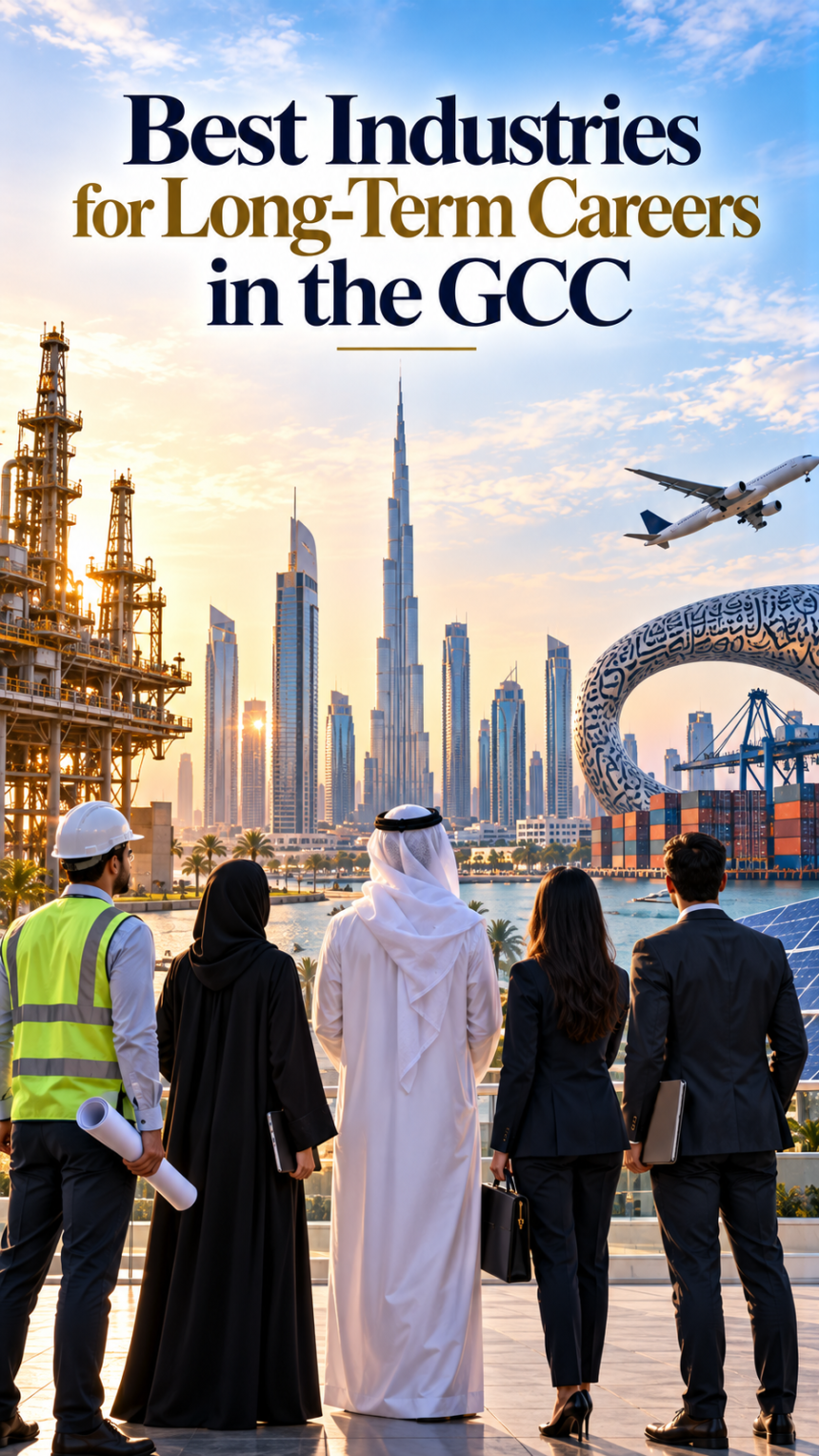
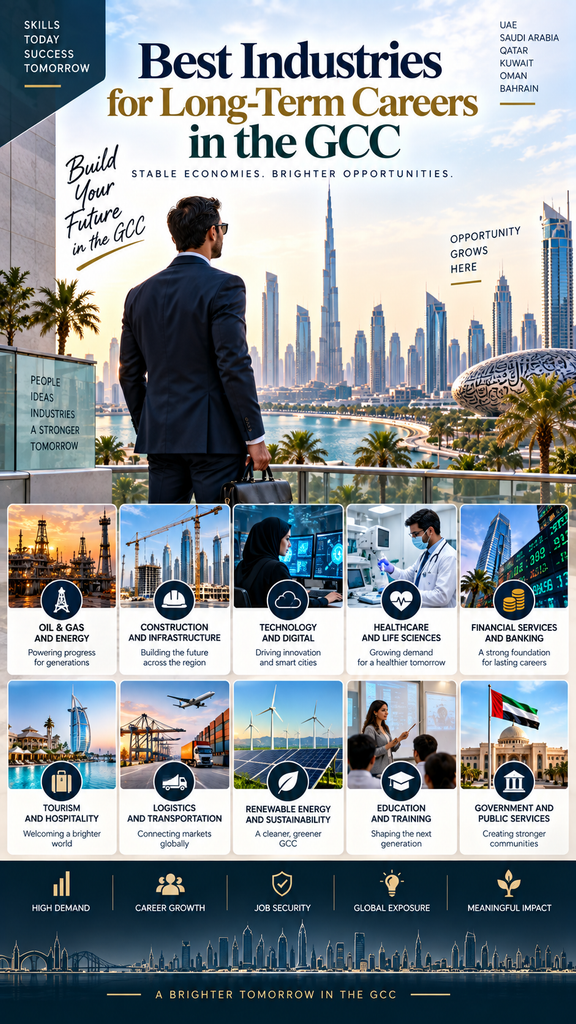
Choosing among the GCC Career Industries is becoming increasingly important for professionals planning careers that may last twenty or thirty years. The UAE, Saudi Arabia, Qatar, Bahrain, Oman and Kuwait are transforming their economies through artificial intelligence, advanced manufacturing, healthcare, logistics, financial technology, renewable energy, tourism and major infrastructure investment.
- GCC Career Industries and the Changing Gulf Economy
- What Makes an Industry Good for a Long-Term Career
- 1. Technology, AI and Digital Services
- 2. Healthcare and Life Sciences
- 3. Energy and Renewable Energy
- 4. Financial Services and Fintech
- 5. Logistics, Aviation and Supply Chains
- 6. Advanced Manufacturing
- 7. Cybersecurity
- 8. Tourism and Hospitality
- 9. Construction, Infrastructure and Smart Cities
- 10. Professional and Consulting Services
- 11. Education and Professional Training
- 12. Sustainability, Environment and Green Industries
- Best Long-Term Career Industries in the UAE
- Best Long-Term Career Industries in Saudi Arabia
- Best Long-Term Career Industries in Qatar
- Best Long-Term Career Industries in Bahrain
- Best Long-Term Career Industries in Oman
- Best Long-Term Career Industries in Kuwait
- Industries With the Strongest Technology Exposure
- Best Industries for Technical Professionals
- Best Industries for Business Professionals
- Long-Term Careers for Expats in the GCC
- Long-Term Careers for GCC Nationals
- Industries Most Exposed to Automation
- How to Choose the Right GCC Industry
- GCC Career Industries Comparison Table
- Long-Term Career Preparation Checklist
- Final Thoughts on GCC Career Industries
This transformation means career planning should not focus only on which industries are hiring today. A strong long-term career sector should have structural demand, continuing investment, opportunities to develop specialist skills and enough flexibility to survive technological and economic changes.
Global employment trends reinforce this approach. The World Economic Forum expects some of the fastest-growing occupations through 2030 to include big data specialists, fintech engineers, AI and machine-learning specialists, software developers, cybersecurity professionals and renewable-energy engineers. Healthcare, education, construction and logistics-related occupations are also expected to contribute substantial employment growth globally.
The GCC’s own investment strategies point in many of the same directions. The UAE identifies healthcare, manufacturing, ICT, logistics, fintech, tourism, renewable energy and smart infrastructure among promising sectors. Saudi Arabia maintains dedicated workforce skills councils for manufacturing, energy, tourism, digital technology, finance, healthcare, logistics, consulting and cybersecurity. Qatar is offering investment incentives in advanced industries, logistics, technology and financial services.
No industry can guarantee permanent job security. However, professionals who choose sectors supported by long-term economic demand and continue updating their skills can improve their chances of building durable careers.
GCC Career Industries and the Changing Gulf Economy
Gulf economies are becoming more diversified, digital and technically specialised. Oil and gas remain important, but economic policy increasingly encourages private-sector growth in industries capable of creating knowledge, technology and higher-value employment.
Several sectors appear repeatedly across national economic strategies.
| Long-Term Industry | Major Career Themes |
|---|---|
| Technology | AI, software, cloud and data |
| Healthcare | Clinical care, digital health and life sciences |
| Energy | Oil and gas, renewables and energy technology |
| Finance | Banking, fintech, investment and compliance |
| Logistics | Supply chains, ports, aviation and automation |
| Manufacturing | Engineering, robotics and industrial technology |
| Cybersecurity | Information security and digital risk |
| Tourism | Hotels, destinations, events and visitor services |
| Infrastructure | Engineering, construction and smart cities |
| Professional services | Consulting, tax, legal and risk |
| Education | Teaching, technical training and reskilling |
| Sustainability | ESG, climate, water and green technologies |
These industries differ significantly in working conditions, qualifications and salary structures. A healthcare professional requires a completely different educational path from a software engineer or investment analyst.
The objective should therefore not be to chase whichever industry appears most fashionable. Professionals should identify where long-term economic demand overlaps with their own strengths.
What Makes an Industry Good for a Long-Term Career
A strong career industry normally has several characteristics.
Structural demand means customers will continue needing the service even when economic conditions change. Healthcare is a good example because people require medical services regardless of short-term business trends.
Government and private investment also matters. Infrastructure, manufacturing, digital technology and renewable-energy programmes can create years of project activity and specialist employment.
Another factor is transferability. Skills learned in logistics, finance, cybersecurity or project management can often be used across several companies and countries.
Professionals should also consider how vulnerable routine work may be to automation. Global employers expect almost 40% of workers’ existing skills to change by 2030, while AI and digital technologies are likely to transform a wide range of occupations.
The strongest long-term industries are therefore not necessarily those protected from technology. They are often sectors where technology creates new higher-value professional roles.
1. Technology, AI and Digital Services
Technology is one of the clearest long-term career industries across the GCC.
The UAE describes its future economy as one founded on knowledge, innovation and entrepreneurship, with major emphasis on artificial intelligence, biotechnology and advanced technologies. It also identifies ICT among its promising business sectors.
Saudi Arabia has created a dedicated Sectoral Skills Council for the digital sector, while Qatar’s investment incentives specifically target cybersecurity, data centres, cloud services, AI, data analytics, semiconductors and other emerging technologies.
Career possibilities include:
- AI engineer
- Software developer
- Data scientist
- Cloud architect
- Product manager
- Technology consultant
- Data engineer
- UX specialist
The advantage of technology is that skills can transfer across industries. A cloud engineer can work for a bank, hospital, government organisation or logistics company.
The risk is rapid change. Technical knowledge can become outdated faster than in many traditional industries, making continuous learning essential.
2. Healthcare and Life Sciences
Healthcare is one of the strongest industries for professionals seeking long-term relevance.
Demand is supported by population growth, increasing healthcare expectations, private-sector expansion and growing use of digital health technologies.
The UAE lists healthcare facilities, therapeutics, medical devices and e-health among its promising areas. Saudi Arabia has a dedicated Health Sector Skills Council, while Kuwait Vision 2035 identifies high-quality healthcare as a major development pillar and healthcare as a targeted investment sector.
Qatar’s advanced-industries programme also supports pharmaceutical and high-value healthcare-related manufacturing.
Career opportunities extend beyond doctors and nurses. They include:
- Pharmacists
- Biomedical engineers
- Healthcare administrators
- Medical technologists
- Health data specialists
- Digital health professionals
- Hospital operations managers
Global employment research also expects care roles, particularly nursing and personal-care occupations, to experience substantial growth through 2030.
Healthcare can therefore offer both stability and technological transformation.
3. Energy and Renewable Energy
Energy will remain central to Gulf economies for many years, but careers in the sector are becoming more diverse.
Traditional oil and gas companies still require engineers, geologists, project managers, finance professionals and technical specialists. At the same time, the region is investing heavily in solar power, energy efficiency, hydrogen and other cleaner technologies.
The UAE’s future-economy framework includes clean energy and renewable technologies, while its AI strategy also targets energy as an important application sector.
Oman Vision 2040 specifically identifies renewable energy as a promising sector and promotes solar and wind development as part of economic and environmental sustainability.
Kuwait’s investment strategy includes both renewable energy and industrial oil and gas, demonstrating how traditional and future energy systems will coexist.
Potential careers include renewable-energy engineer, electrical engineer, energy analyst, carbon specialist, hydrogen project professional and energy project manager.
The strongest long-term energy careers will increasingly combine traditional technical expertise with digitalisation and sustainability.
4. Financial Services and Fintech
Finance remains one of the Gulf’s most important professional industries.
Dubai and Abu Dhabi host major financial centres, Bahrain has a long-established banking ecosystem, Riyadh is expanding as a regional financial hub, while Qatar and Kuwait maintain strong banking and investment sectors.
Qatar’s current incentives specifically target financial services including financial innovation and fintech.
Bahrain Economic Development Board identifies financial services as one of the country’s core economic sectors alongside ICT, manufacturing, logistics and tourism.
Kuwait’s official investment strategy similarly identifies banking, financial services and insurance among Vision 2035 priority sectors.
Long-term career paths include:
- Investment banking
- Asset management
- Wealth management
- Accounting
- Risk management
- Compliance
- Fintech
- Corporate finance
- Insurance
Technology is transforming the sector rapidly. Global employers expect fintech engineers to be among the fastest-growing occupations through 2030, while financial institutions expect substantial growth in AI, automation and data skills.
Finance therefore remains promising, but routine processing jobs may become less secure than analytical, advisory and technology-enabled positions.
5. Logistics, Aviation and Supply Chains
The Gulf’s strategic location makes logistics one of its most durable economic strengths.
Ports, airports and road networks connect Asia, Europe and Africa, while expanding e-commerce and manufacturing create additional demand for warehousing and supply-chain expertise.
Saudi Arabia has a dedicated Logistics and Transportation Sector Skills Council. Qatar’s investment programme explicitly supports advanced logistics, automation, re-export and distribution infrastructure.
Bahrain identifies logistics as one of its core investment sectors, while Kuwait Vision 2035 includes storage, logistics and air, maritime and rail transport among priority opportunities.
Oman’s diversification strategy also places major importance on transport, aviation and logistics.
Careers can include:
- Supply-chain manager
- Procurement professional
- Freight specialist
- Aviation operations manager
- Warehouse automation specialist
- Transport planner
- Logistics data analyst
Technology will automate parts of logistics, but this can increase demand for people who understand robotics, forecasting, procurement systems and complex global supply chains.
6. Advanced Manufacturing
Manufacturing is becoming increasingly important as GCC countries try to produce more goods domestically and reduce dependence on imports.
The UAE lists manufacturing among its promising sectors, while Saudi Arabia operates a dedicated Manufacturing Sector Skills Council.
Qatar’s advanced-industries incentive programme focuses on high-value sectors such as pharmaceuticals, automotive products, chemicals and electronics.
Bahrain also identifies manufacturing as one of its core economic strengths, while Oman is focusing investment on manufacturing, green industries, mining and related supply chains.
Modern manufacturing creates careers for:
- Industrial engineers
- Automation engineers
- Robotics specialists
- Quality managers
- Production planners
- Maintenance engineers
- Supply-chain specialists
The strongest opportunities are likely to be in advanced rather than purely labour-intensive manufacturing.
Engineers who understand AI, data and automated production systems could become particularly valuable.
7. Cybersecurity
Cybersecurity deserves separate attention because it is becoming essential infrastructure for every digital economy.
Banks, hospitals, government organisations, energy companies and retailers all depend on connected systems. As those systems become more important, attacks can cause larger financial and operational damage.
Saudi Arabia maintains a dedicated Cybersecurity Sector Skills Council, while Qatar’s technology incentives specifically target cybersecurity investment.
The UAE also identifies cybersecurity among promising digital opportunities and as a priority area within its technology strategies.
Global employment research places information security and security-management specialists among faster-growing occupations.
Long-term roles include:
- Security analyst
- Security architect
- Incident response specialist
- Cloud security engineer
- Governance and risk professional
- Penetration testing specialist
Cybersecurity has an additional advantage: professionals can move between industries without changing their fundamental expertise.
8. Tourism and Hospitality
Tourism has become a serious diversification industry throughout much of the GCC.
The UAE already has a mature tourism and hospitality economy and aims to significantly increase tourism’s contribution to GDP under its long-term economic plans.
Saudi Arabia maintains a dedicated Tourism and Hospitality Sector Skills Council, reflecting the sector’s importance for workforce development.
Bahrain identifies tourism as one of its core growth sectors, while Oman’s diversification agenda includes tourism among its major investment priorities. Kuwait Vision 2035 also lists tourism, hotels and entertainment among investment opportunities.
Career opportunities include:
- Hotel management
- Revenue management
- Destination development
- Culinary leadership
- Event management
- Tourism marketing
- Guest experience
Technology will increasingly influence booking, pricing and customer service, but hospitality remains strongly dependent on human interaction.
For professionals with strong service, management and digital skills, the sector can provide long-term regional mobility.
9. Construction, Infrastructure and Smart Cities
The Gulf will continue requiring major physical development even as digital industries grow.
Transport systems, housing, tourism destinations, industrial zones, data centres, hospitals and renewable-energy facilities all require construction and engineering expertise.
Saudi Arabia has a dedicated Construction and Real Estate Activities Skills Council.
Kuwait Vision 2035 identifies infrastructure and construction, integrated housing and urban development among priority investment areas and aims to strengthen the country’s role as a financial and trade hub through major infrastructure development.
The UAE identifies smart cities, autonomous transportation and transport infrastructure among promising sectors.
Long-term opportunities include:
- Civil engineering
- Architecture
- Project management
- BIM
- Quantity surveying
- Smart-building technology
- Facilities management
The sector can be cyclical, so careers based only on basic construction activity may fluctuate. Professionals with specialist expertise in digital construction, sustainability or infrastructure management may have greater resilience.
10. Professional and Consulting Services
As Gulf economies become more complex, businesses need specialists who understand strategy, law, tax, risk, regulation and corporate transformation.
Saudi Arabia has a dedicated Sectoral Skills Council for Professional and Consulting Services, reflecting the growing importance of specialist business knowledge.
Financial reform, new tax systems, foreign investment and digital transformation also create continuing demand for accountants, lawyers, management consultants and compliance professionals across the GCC.
Career possibilities include:
- Management consulting
- Tax advisory
- Legal services
- Internal audit
- Compliance
- Corporate strategy
- HR consulting
- Risk management
AI will automate significant amounts of research and administrative work in these fields. That does not mean professional services will disappear.
Instead, the most valuable professionals will increasingly be those capable of combining technology with judgement, client relationships and specialist regulatory knowledge.
11. Education and Professional Training
Education is sometimes overlooked when people discuss Gulf career growth, but it has strong long-term potential.
Fast-changing economies need schools, universities, vocational institutions and corporate training systems capable of preparing people for new industries.
Global employment research expects education-related roles, including secondary and higher-education teachers, to contribute substantial employment growth through 2030.
Kuwait Vision 2035 identifies education and training among priority investment areas, while Oman Vision 2040 focuses heavily on a labour market capable of keeping pace with technological and knowledge changes.
Saudi Arabia’s extensive sector skills system also creates continuing demand for vocational training, skills assessment and professional development.
Potential careers include teachers, technical trainers, instructional designers, corporate learning specialists and education technology professionals.
Professionals who can teach future skills such as AI, cybersecurity, engineering or finance may be particularly well positioned.
12. Sustainability, Environment and Green Industries
Sustainability is becoming a career sector in its own right.
Governments and companies increasingly need people who understand renewable energy, carbon management, ESG reporting, water efficiency and sustainable construction.
Oman Vision 2040 explicitly promotes renewable energy, diversified energy sources, a green and circular economy and sustainable use of natural resources.
The UAE’s Green Growth Strategy similarly covers green energy, sustainable cities, green investment and environmental technologies.
Kuwait’s investment priorities include renewable energy, while global employment forecasts place environmental and renewable-energy engineers among the fastest-growing professional roles.
Potential careers include:
- Sustainability manager
- Environmental engineer
- ESG analyst
- Carbon specialist
- Renewable-energy consultant
- Water-management specialist
The field becomes particularly powerful when sustainability knowledge is combined with finance, engineering or construction expertise.
Best Long-Term Career Industries in the UAE
The UAE offers one of the GCC’s broadest industry mixes.
Its current promising-sector framework includes healthcare, manufacturing, ICT, logistics, fintech, tourism, renewable energy, cybersecurity and smart-city technologies.
The country’s future-economy strategy also emphasises AI, advanced technology, entrepreneurship, green growth and talent attraction.
Strong long-term sectors therefore include:
- Technology and AI
- Finance and fintech
- Healthcare
- Logistics and aviation
- Renewable energy
- Advanced manufacturing
- Tourism
- Professional services
Dubai is particularly strong for finance, technology, logistics, tourism and international corporate careers. Abu Dhabi offers significant opportunities in energy, finance, investment, healthcare and advanced technology.
Because competition is highly international, professionals need specialist skills rather than simply general experience.
Best Long-Term Career Industries in Saudi Arabia
Saudi Arabia currently provides one of the broadest economic expansion stories in the GCC.
Its official skills framework covers manufacturing, energy, tourism, digital technology, finance, construction, healthcare, logistics, professional services, retail and cybersecurity.
That makes the Kingdom particularly attractive for careers in:
- Technology and AI
- Healthcare
- Tourism
- Construction
- Manufacturing
- Logistics
- Finance
- Energy
- Consulting
For Saudi nationals, localisation policies may create additional opportunities in specialist private-sector roles.
International professionals should increasingly focus on high-value expertise rather than generalist positions that can be filled domestically.
Saudi Arabia’s scale means many industries can develop substantial domestic career markets rather than depending entirely on regional demand.
Best Long-Term Career Industries in Qatar
Qatar has clearly identified several sectors it wants to expand beyond traditional hydrocarbons.
Its investment incentive programme focuses on four core areas: advanced industries, logistics, technology and financial services.
Technology incentives specifically cover cybersecurity, cloud computing, AI, data analytics and high-skilled digital employment.
Strong career areas therefore include:
- Technology
- Cybersecurity
- Finance
- Logistics
- Advanced manufacturing
- Healthcare
- Energy
Doha’s market is smaller than Riyadh or Dubai, which means opportunities can be more specialised.
Professionals with strong technical expertise can have an advantage over broad generalists.
Best Long-Term Career Industries in Bahrain
Bahrain’s economy is particularly strong in services and specialised sectors.
Bahrain Economic Development Board identifies financial services, manufacturing, ICT, logistics and tourism as the country’s major investment strengths.
This creates promising careers in:
- Banking
- Fintech
- Cybersecurity
- Technology
- Logistics
- Manufacturing
- Tourism
Bahrain’s financial-services history makes the combination of finance and technology particularly attractive.
Its compact market also allows professionals to develop strong networks across related industries, although regional expansion may become important for senior career growth.
Best Long-Term Career Industries in Oman
Oman Vision 2040 aims to create a diversified economy based on technology, knowledge and innovation alongside a labour market capable of responding to technological change.
Its investment priorities have included energy, mining, manufacturing, transport, aviation, tourism, ICT and food security.
Long-term career industries therefore include:
- Logistics
- Energy and renewables
- Manufacturing
- Mining
- Tourism
- Technology
- Sustainability
Oman’s location and port infrastructure provide particularly strong foundations for logistics and industrial careers.
Renewable-energy development could also create a growing group of specialist engineering and sustainability roles.
Best Long-Term Career Industries in Kuwait
Kuwait Vision 2035 aims to develop the country as a financial and trade hub while increasing private-sector participation in the economy.
KDIPA currently identifies targeted opportunities in infrastructure, renewable energy, education, healthcare, banking, logistics, transport, tourism and IT.
Promising long-term career sectors therefore include:
- Finance
- Healthcare
- Technology
- Infrastructure
- Energy
- Logistics
- Education
- Tourism
Kuwait’s challenge is translating investment ambitions into sustained private-sector career creation, but the range of targeted industries provides significant long-term possibilities.
Industries With the Strongest Technology Exposure
Almost every industry is becoming more digital, but some are likely to experience particularly rapid technological transformation.
| Industry | Major Technology Change |
|---|---|
| Banking | AI, fintech and automated compliance |
| Healthcare | Digital health and medical AI |
| Logistics | Robotics and predictive analytics |
| Manufacturing | Smart factories |
| Energy | Digital monitoring and automation |
| Construction | BIM and digital twins |
| Tourism | AI customer service and revenue systems |
| Professional services | Generative AI and analytics |
The World Economic Forum expects AI and big data skills to rise across almost every industry, with particularly strong increases expected in sectors such as automotive, technology, professional services, financial services, transport, healthcare and energy.
This means career resilience increasingly depends on learning how technology affects your existing profession.
Best Industries for Technical Professionals
Engineers, developers and technical graduates have several strong GCC options.
Technology and cybersecurity offer particularly strong opportunities for software, AI and data specialists.
Manufacturing provides careers for mechanical, electrical, industrial and automation engineers.
Energy remains important for engineers while increasingly incorporating renewable technologies.
Healthcare creates opportunities for biomedical and medical-technology professionals.
Construction and infrastructure remain major employers of civil and structural engineers.
Technical professionals should avoid becoming too dependent on one specific software tool.
Industry knowledge combined with transferable engineering and analytical skills generally provides stronger career resilience.
Best Industries for Business Professionals
Professionals from business, finance and management backgrounds also have substantial opportunities.
Financial services naturally require accountants, analysts, auditors and investment professionals.
Professional services need consultants, tax specialists, lawyers and risk professionals.
Tourism and hospitality require revenue managers, marketers and business leaders, while logistics companies need procurement and commercial specialists.
Technology companies also increasingly employ non-technical professionals in sales, product management, operations and business development.
A business degree therefore does not limit someone to traditional administration.
The strongest approach is to combine commercial knowledge with a specialist sector.
Long-Term Careers for Expats in the GCC
Expats will continue playing an important role in Gulf economies, but the type of international talent employers need is likely to change.
Localisation programmes are expanding across several GCC states, particularly Saudi Arabia, the UAE and Oman. General administrative positions may therefore become less attractive long-term for expatriates than specialist occupations.
International professionals should focus on areas where they bring:
- Technical expertise
- Leadership experience
- Specialist certifications
- International market knowledge
- Scarce professional skills
Technology, engineering, healthcare, specialist finance, consulting and advanced industrial roles may remain particularly relevant.
Expats should also follow localisation regulations because employment eligibility can change by profession and country.
Long-Term Careers for GCC Nationals
GCC nationals are likely to gain more opportunities as governments strengthen national participation in private-sector industries.
Saudi Arabia’s sector skills framework demonstrates how workforce policy is becoming aligned with specific industries rather than simply encouraging employment generally.
Young nationals should consider sectors where both national investment and specialist skills requirements are increasing.
Technology, finance, engineering, healthcare, logistics, manufacturing and tourism all provide examples.
The strongest strategy is not to depend only on localisation policy. Nationals who develop internationally competitive expertise can eventually move into senior technical and leadership positions.
Industries Most Exposed to Automation
Long-term career planning should also consider which tasks technology can perform more efficiently.
Routine administrative work, data entry and repetitive clerical processing face relatively high automation exposure. Global employers expect several clerical occupations to decline as AI and automation spread.
However, industries themselves rarely disappear because some tasks become automated.
Finance will continue, but basic processing may decline while analytics and advisory work grows. Manufacturing will remain important, but factories may require more automation engineers and fewer repetitive operators.
The safest career strategy is therefore to move toward work involving:
- Judgement
- Technical expertise
- Complex problem solving
- Human relationships
- Management
- Responsibility
These tasks are generally harder to automate completely.
How to Choose the Right GCC Industry
Do not choose an industry purely because it appears on a list of future careers.
Start with your own strengths.
If you enjoy technical problem-solving, technology, engineering or cybersecurity may fit better than hospitality.
If you are strong with people and commercial relationships, finance, consulting or tourism may provide better opportunities.
Then examine four factors:
Demand: Is the industry supported by long-term economic need?
Skills: Can you realistically develop the required expertise?
Mobility: Can your skills transfer between GCC countries or international markets?
Technology: Is the industry adapting in a way that creates higher-value roles?
The best career decision is where these factors overlap with genuine interest.
GCC Career Industries Comparison Table
| Industry | Long-Term Potential | Key GCC Markets | Typical Professional Roles |
|---|---|---|---|
| Technology and AI | Very strong | UAE, Saudi, Qatar | AI, software, data |
| Healthcare | Very strong | All GCC | Clinical, management, digital health |
| Energy | Very strong | Saudi, UAE, Qatar, Oman, Kuwait | Engineering, operations, renewables |
| Finance and fintech | Strong | UAE, Bahrain, Saudi, Qatar, Kuwait | Banking, investment, compliance |
| Logistics | Strong | UAE, Saudi, Oman, Qatar, Bahrain | Supply chain, aviation, ports |
| Manufacturing | Strong | Saudi, UAE, Oman, Bahrain, Qatar | Engineering, automation |
| Cybersecurity | Very strong | All GCC | Security, governance, cloud |
| Tourism | Strong | UAE, Saudi, Oman, Qatar, Bahrain | Hospitality, events, tourism |
| Infrastructure | Strong | Saudi, UAE, Kuwait, Qatar | Engineering, project management |
| Consulting | Strong | UAE, Saudi, Qatar, Bahrain | Strategy, tax, risk |
| Education | Stable to strong | All GCC | Teaching, training, edtech |
| Sustainability | Growing strongly | UAE, Saudi, Oman, Qatar | ESG, environment, clean energy |
This table should be treated as a strategic guide rather than a guarantee of employment.
Demand varies by profession, seniority, nationality, qualifications and economic conditions.
Long-Term Career Preparation Checklist
Professionals planning a Gulf career should prepare for industries rather than simply individual vacancies.
- Choose a sector supported by long-term demand.
- Research which GCC countries are investing most heavily in that industry.
- Develop recognised specialist qualifications where useful.
- Understand how AI will change your profession.
- Build strong data and digital literacy.
- Gain practical project experience.
- Develop communication and leadership skills.
- Learn applicable Gulf regulations.
- Follow localisation rules affecting your profession.
- Build an industry-specific professional network.
- Develop transferable skills that work across companies.
- Avoid relying entirely on one software product or employer.
- Keep professional certifications current.
- Learn basic financial and commercial concepts.
- Monitor new technologies entering your industry.
- Review your career direction every two or three years.
- Move gradually toward higher-value responsibilities.
- Maintain a strong CV and LinkedIn profile.
- Build evidence of measurable achievements.
- Continue learning throughout your career.
The strongest long-term career is usually built through several deliberate upgrades rather than one perfect job choice.
Final Thoughts on GCC Career Industries
The best GCC Career Industries for long-term growth are those supported by major economic needs rather than short-lived trends.
Technology and AI stand out because Gulf governments are actively developing digital economies and attracting advanced technology investment. The UAE is positioning its future economy around innovation and AI, Saudi Arabia has formal workforce structures for digital skills, and Qatar is directly incentivising investment in AI, cloud computing, cybersecurity and other emerging technologies.
Healthcare remains strong because medical services represent an essential need while digital health and life sciences create additional specialist roles. Healthcare appears among the UAE’s promising sectors, Saudi Arabia’s formal skills priorities and Kuwait’s Vision 2035 investment areas.
Energy will remain fundamental to the Gulf, but career opportunities will increasingly combine traditional hydrocarbons with renewables, sustainability and technology. Oman specifically identifies renewable energy and a green economy as long-term development priorities, while the UAE continues investing in clean technologies.
Financial services, logistics and manufacturing also have strong foundations. Qatar’s national incentives actively support all three areas, Bahrain identifies finance, manufacturing and logistics among its core economic strengths, while Saudi Arabia maintains dedicated workforce structures for these sectors.
Tourism, infrastructure, professional services and education should not be underestimated either. They support the wider economic transformation and require people with management, technical and human skills that cannot simply be automated away.
The global employment picture also supports a diversified career strategy. Technology jobs are growing quickly, but healthcare, construction, education and logistics-related roles are expected to generate significant employment as well.
The most important lesson is therefore not to search for one industry that will remain completely unchanged.
Such an industry probably does not exist.
Instead, choose a sector with strong economic demand, continuing investment and room for specialist expertise, then continue developing as the sector changes.
A finance professional should learn fintech and analytics. An engineer should understand automation and sustainability. A healthcare professional can build digital skills, while a logistics specialist can learn data and supply-chain technology.
That combination of industry knowledge, technology skills and continuous learning is likely to provide the strongest foundation for long-term career success across the GCC.
Do follow us on Instagram
Read More – Leading EV Countries: 15 Powerful Markets Driving the Revolution