

Inside Dubai’s Tech Startup Boom: AI, FinTech, Funding and Opportunity
Dubai was once known internationally mainly for trade, tourism, aviation, property and ambitious infrastructure. Today, another industry is becoming increasingly important to the city’s identity: technology entrepreneurship.
- Why Tech Startups in Dubai Are Growing
- Dubai’s Startup Ecosystem Is Becoming More Structured
- Dubai Founders HQ Could Become an Important Startup Gateway
- AI Startups Are Becoming a Major Part of Dubai’s Tech Story
- FinTech Startups Have a Natural Advantage in Dubai
- Venture Capital Is Becoming Part of Dubai’s Startup Infrastructure
- Dubai Is Connecting Startups With Global Investors
- Global Startups Are Increasingly Looking at Dubai
- SaaS Startups Could Find Strong Opportunities
- E-commerce Startups Remain Relevant
- PropTech Has an Obvious Market in Dubai
- Climate Tech Could Become the Next Growth Area
- HealthTech Could Create High-Value Businesses
- Dubai’s Multicultural Population Can Be a Startup Advantage
- Talent Will Determine How Far Dubai’s Startup Ecosystem Can Grow
- Why Accelerators Matter for Early-Stage Startups
- What Makes a Dubai Tech Startup Investable?
- Biggest Opportunities for Tech Startups in Dubai
- Challenges Facing Tech Startups in Dubai
- Dubai Is Trying to Create More Unicorns
- What Could Dubai’s Startup Ecosystem Look Like by 2033?
- FAQs About Tech Startups in Dubai
- Conclusion
Tech Startups in Dubai are emerging across artificial intelligence, financial technology, e-commerce, software, mobility, property technology and other digital industries. At the same time, government initiatives, investors, accelerators and innovation hubs are creating an ecosystem designed to help companies launch and scale.
The momentum is visible in the numbers. Dubai Chamber of Digital Economy says it supported the establishment and expansion of 1,690 digital startups during 2025, an increase of 39.7% from the previous year. Around 15% specialised in artificial intelligence and 12% in FinTech.
Dubai is also setting ambitious longer-term goals. Under the Dubai Economic Agenda D33, initiatives such as Dubai Founders HQ are supporting an objective to scale 30 unicorns from Dubai by 2033.
But numbers explain only part of the story.
Dubai’s real startup advantage may lie in the combination of capital, global talent, infrastructure, regulation and access to rapidly developing markets.
Why Tech Startups in Dubai Are Growing
Startups rarely succeed because of one factor.
They need customers, talent, funding, infrastructure, regulations and connections.
Dubai is attempting to bring these elements together.
The city sits geographically between major markets across Asia, Europe and Africa. It has extensive international air connectivity and attracts professionals from around the world.
At the same time, the government has made the digital economy an important part of Dubai’s economic strategy.
The Dubai Chamber of Digital Economy was established specifically to strengthen Dubai’s position in the digital economy by attracting global companies and talent while developing infrastructure for the startup ecosystem.
For founders, that can create an environment where a company is not necessarily built only for Dubai.
It can be built from Dubai for a much larger regional or global market.
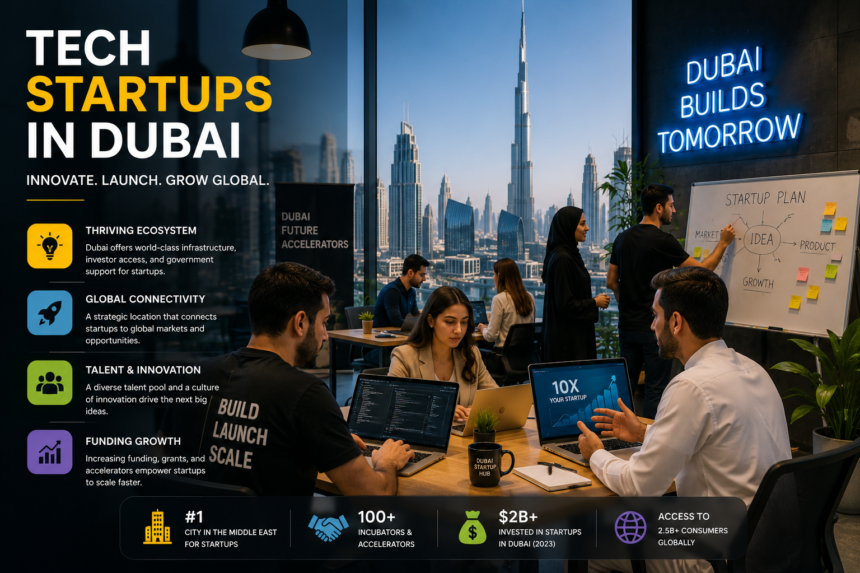
Suggested image placement: Startup founders working in a Dubai office overlooking the city.
Dubai’s Startup Ecosystem Is Becoming More Structured
A strong startup city requires more than entrepreneurs.
It needs an ecosystem around them.
That includes:
- incubators,
- accelerators,
- investors,
- venture capital firms,
- universities,
- corporate partners,
- regulators,
- mentors,
- talent,
- and government support.
Dubai has gradually developed organizations covering many of these areas.
The city’s ecosystem now includes initiatives and hubs such as Dubai Chamber of Digital Economy, Dubai Founders HQ, DIFC Innovation Hub and Dubai AI Campus.
These organizations serve different purposes but collectively make the startup journey more structured.
A founder may need help setting up a company.
Another startup may need an accelerator.
A growth-stage company may need venture capital.
A FinTech company may need access to financial institutions and regulatory expertise.
A global technology company may need help entering the Dubai market.
The ecosystem increasingly attempts to connect those needs.
Dubai Founders HQ Could Become an Important Startup Gateway
One of Dubai’s newer startup initiatives is Dubai Founders HQ.
Launched in 2025, the initiative is jointly operated by the Dubai Department of Economy and Tourism and Dubai Chamber of Digital Economy.
It combines a physical campus with a digital platform, bringing founders, investors, corporations and other ecosystem participants together.
The concept is particularly interesting because startup ecosystems can become confusing.
Entrepreneurs may need to navigate different accelerators, government departments, investors, licensing options and support programs.
Dubai Founders HQ is designed to make parts of that ecosystem easier to access.
Its services include acceleration and mentorship programs, market-entry support, learning resources and opportunities to connect with other participants in Dubai’s startup community.
The initiative is also linked to major D33 objectives, including scaling 30 unicorns from Dubai and helping 400 SMEs grow by 2033.
That shows how startups are becoming part of Dubai’s wider economic strategy rather than simply a niche technology sector.
AI Startups Are Becoming a Major Part of Dubai’s Tech Story
Artificial intelligence is one of the most important areas to watch.
Of the digital startups supported by Dubai Chamber of Digital Economy in 2025, approximately 15% specialised in AI.
That share is significant because AI increasingly connects with almost every other technology sector.
An AI company may develop tools for:
- healthcare,
- finance,
- logistics,
- property,
- marketing,
- cybersecurity,
- education,
- tourism,
- customer service,
- or enterprise automation.
Dubai has also developed dedicated infrastructure around the sector.
The Dubai AI Campus, based within DIFC, is positioned as a major cluster for AI and technology companies. It connects technology firms with investors, innovation companies, digital laboratories, regulators and educational institutions.
For founders, this type of cluster can be valuable because AI businesses often require more than office space.
They need access to computing infrastructure, technical talent, investment and potential enterprise customers.
Suggested image placement: AI engineers working in a futuristic Dubai technology laboratory.
FinTech Startups Have a Natural Advantage in Dubai
Financial technology is another major startup sector.
Dubai already has a substantial financial-services industry, creating potential customers and partners for FinTech companies.
The DIFC Innovation Hub has become an important part of this ecosystem.
According to DIFC, the Innovation Hub is home to more than 1,670 innovation and technology firms, bringing together growth-stage companies, established businesses, digital labs, venture capital firms, regulators and educational entities.
This creates opportunities across:
- digital payments,
- digital banking,
- InsurTech,
- RegTech,
- Islamic FinTech,
- wealth technology,
- AI-powered finance,
- compliance technology,
- and financial infrastructure.
The advantage of building a FinTech company within a financial district is proximity.
Startups can potentially interact with the very banks, investors, regulators and institutions that may become their customers or partners.
Venture Capital Is Becoming Part of Dubai’s Startup Infrastructure
Ideas alone do not build large technology companies.
Capital matters.
Early-stage companies may begin with founder savings or angel investment, but companies attempting to scale often need institutional funding.
Dubai has been developing a venture capital ecosystem around this need.
DIFC says Dubai is home to one-third of all investors in the Middle East and North Africa, with technology among the most popular investment areas.
The ecosystem also includes the AED 1 billion Dubai Future District Fund, created to support the growth of the digital economy and attract regional and international capital.
This does not mean every startup in Dubai will easily receive funding.
Investors still expect strong business fundamentals.
Founders need to demonstrate:
- a genuine customer problem,
- a scalable solution,
- market demand,
- a capable team,
- realistic economics,
- and potential for growth.
Dubai can provide access to investors.
The startup still needs to convince them.
Dubai Is Connecting Startups With Global Investors
Large startup events are another part of the ecosystem.
Expand North Star has developed into an important meeting point for technology companies and investors.
According to Dubai Chamber of Digital Economy, the 2025 edition connected more than 2,000 startups with over 1,200 investors.
Events of this scale matter because startup funding is heavily relationship-driven.
A founder may have an excellent product but struggle if the right investors, customers or partners never discover it.
Startup events create opportunities for:
- pitching,
- networking,
- fundraising,
- partnerships,
- recruitment,
- customer acquisition,
- and international expansion.
They also help Dubai market itself globally as a place where technology companies can connect with capital.
Global Startups Are Increasingly Looking at Dubai
One particularly revealing statistic from 2025 is that 75% of the digital startups supported by Dubai Chamber of Digital Economy were global companies.
That suggests Dubai’s startup story is not limited to locally founded companies.
International founders are also using the city as a base for expansion.
Why?
For many companies, Dubai can offer access to multiple markets from one location.
A startup established in Dubai may consider opportunities across:
- the UAE,
- Saudi Arabia,
- the wider GCC,
- the Middle East,
- North Africa,
- South Asia,
- and parts of Africa.
This geographical position is particularly valuable for B2B technology companies.
A software company does not necessarily need millions of Dubai customers.
It may use Dubai as a regional headquarters while serving enterprise customers across multiple countries.
SaaS Startups Could Find Strong Opportunities
Software-as-a-Service, or SaaS, is another promising category.
SaaS companies sell software through subscriptions rather than traditional one-time purchases.
Businesses increasingly use SaaS for:
- accounting,
- customer management,
- HR,
- cybersecurity,
- marketing,
- project management,
- logistics,
- analytics,
- and business automation.
Dubai has a large concentration of companies across hospitality, real estate, finance, trade, logistics, retail and professional services.
Each sector has operational problems that software can potentially solve.
This gives founders an important opportunity.
Instead of building another general consumer application, entrepreneurs can create specialized software addressing specific business problems in the Gulf.
E-commerce Startups Remain Relevant
Online commerce is another significant part of Dubai’s digital economy.
But the startup opportunities extend beyond building online stores.
E-commerce requires an entire technology stack.
Companies can build solutions around:
- payments,
- delivery,
- fulfilment,
- inventory management,
- returns,
- customer service,
- marketplace management,
- personalization,
- digital marketing,
- and fraud prevention.
Dubai Chamber reported that mobility technology, SaaS and e-commerce companies collectively represented around 20% of the digital companies it supported in 2025.
That demonstrates how the city’s startup ecosystem is diversifying beyond a single technology trend.
PropTech Has an Obvious Market in Dubai

Few industries are more closely associated with Dubai than real estate.
That creates a natural environment for property technology, commonly called PropTech.
Startups can develop technology for:
- property search,
- building management,
- property analytics,
- smart buildings,
- construction,
- digital transactions,
- tenant management,
- maintenance,
- and real-estate investment.
DIFC Innovation Hub has also developed a dedicated PropTech Hub within its broader innovation ecosystem.
The opportunity is straightforward.
Wherever a large traditional industry exists, technology companies can look for inefficient processes to improve.
Dubai’s property sector gives PropTech entrepreneurs an unusually active environment in which to identify those problems.
Climate Tech Could Become the Next Growth Area
Technology entrepreneurship in Dubai is also increasingly connected to sustainability.
The UAE’s broader focus on renewable energy, sustainable cities, water management and net-zero ambitions creates potential opportunities for climate-focused startups.
Possible areas include:
- energy efficiency,
- solar technology,
- smart buildings,
- water management,
- carbon accounting,
- sustainable mobility,
- waste management,
- and environmental data.
Climate technology can be particularly attractive because the Gulf faces real environmental challenges.
Extreme temperatures, high cooling demand and water scarcity create problems that technology can help address.
Solutions developed successfully in Dubai may also be relevant to other hot and rapidly urbanizing regions.
HealthTech Could Create High-Value Businesses
Healthcare is another industry where technology companies can solve important problems.
HealthTech startups can develop solutions involving:
- appointment management,
- telemedicine,
- AI diagnostics,
- medical imaging,
- patient monitoring,
- healthcare data,
- hospital operations,
- wellness,
- and personalized medicine.
The opportunity is significant, but healthcare technology is also more complicated than launching a typical consumer application.
Companies need to consider privacy, patient safety, clinical accuracy and regulatory requirements.
For founders capable of navigating these requirements, however, healthcare can offer meaningful and defensible business opportunities.
Dubai’s Multicultural Population Can Be a Startup Advantage
Dubai’s diversity is often discussed as a lifestyle feature.
For technology founders, it can also be a product-development advantage.
The city brings together people from different nationalities, languages, income levels and professional backgrounds.
A startup testing a consumer product can therefore receive feedback from a diverse user base.
This can be particularly useful for companies hoping to expand internationally.
If a product works only for one narrow type of customer, Dubai may expose that weakness quickly.
If it works across several different communities, the company may have stronger evidence that the concept can travel.
Talent Will Determine How Far Dubai’s Startup Ecosystem Can Grow
Capital and regulation are important, but technology companies ultimately depend on people.
Startups need:
- software engineers,
- AI specialists,
- data scientists,
- designers,
- product managers,
- sales professionals,
- cybersecurity experts,
- marketers,
- and experienced founders.
Dubai’s ability to attract international professionals is therefore an important part of its startup proposition.
But competition for highly skilled technology workers is global.
Dubai competes not only with cities in the Gulf but with established technology centres around the world.
Building local capabilities will be equally important.
Programs focused on entrepreneurship, app development, artificial intelligence and digital skills can help create a stronger pipeline of talent.
Dubai Chamber of Digital Economy, for example, runs initiatives such as Create Apps in Dubai, designed to develop digital skills and support careers in mobile application development.
Why Accelerators Matter for Early-Stage Startups
A first-time founder may have a strong idea but limited knowledge about building a company.
That is where accelerators can help.
Accelerator programs typically provide some combination of:
- mentorship,
- workshops,
- investor introductions,
- customer connections,
- workspace,
- technical support,
- and business guidance.
The goal is not simply to provide money.
It is to help founders avoid expensive mistakes.
DIFC Innovation Hub provides accelerator programs alongside licensing, co-working and access to its wider innovation community.
Dubai Chamber of Digital Economy similarly reported that 48% of the digital companies it supported in 2025 benefited from setup services and opportunities involving accelerators and incubators.
For early-stage founders, choosing the right accelerator can sometimes be as valuable as raising an initial investment.
What Makes a Dubai Tech Startup Investable?
Dubai may provide an attractive environment, but investors still evaluate startups on fundamentals.
A company does not become valuable simply because it is based in a technology hub.
Investors generally want evidence that the business can become significantly larger.
Important factors can include:
A real problem
The startup should solve something customers genuinely care about.
A large market
Investors usually prefer companies capable of expanding beyond a very small niche.
A strong team
Founders need the technical and commercial ability to execute.
Evidence of demand
Users, revenue, partnerships or strong engagement can demonstrate that the product has value.
Scalability
The business should be able to grow without costs increasing at exactly the same rate.
Competitive advantage
There should be a reason another company cannot easily copy the product.
Dubai can connect founders with capital.
Strong businesses are what ultimately attract it.
Biggest Opportunities for Tech Startups in Dubai
| Technology Sector | Startup Opportunity |
|---|---|
| Artificial Intelligence | Enterprise automation and intelligent services |
| FinTech | Payments, banking and financial infrastructure |
| SaaS | Business software and productivity |
| E-commerce | Retail technology and digital commerce |
| PropTech | Real estate and smart-building solutions |
| HealthTech | Digital healthcare and AI diagnostics |
| Climate Tech | Energy, water and sustainability |
| Mobility Tech | Transport and logistics solutions |
| Cybersecurity | Digital protection and compliance |
| EdTech | Digital learning and workforce skills |
The strongest opportunities may emerge where two sectors overlap.
Examples include AI + healthcare, AI + finance, AI + property or climate technology + smart buildings.
Challenges Facing Tech Startups in Dubai
No startup ecosystem is perfect.
Dubai offers significant opportunities, but founders still face challenges.
One is competition.
As more startups enter the city, standing out becomes harder.
Another is customer acquisition.
Building a technology product may be easier than convincing businesses or consumers to pay for it.
Funding can also become difficult, particularly between early-stage investment and larger growth rounds.
Other challenges include:
- hiring experienced technical talent,
- managing operating costs,
- understanding regulations,
- expanding into neighboring countries,
- maintaining cash flow,
- finding product-market fit,
- and competing with international technology companies.
Founders should therefore avoid assuming that moving to Dubai automatically creates success.
The ecosystem can create opportunities.
Execution determines what happens next.
Dubai Is Trying to Create More Unicorns
The word “unicorn” refers to a privately held startup valued at more than $1 billion.
Most startups will never reach that scale.
But the number of companies capable of doing so can indicate the maturity of an ecosystem.
Dubai’s D33 ambitions include helping 30 companies reach unicorn scale from Dubai by 2033.
Achieving that goal would require more than creating thousands of small startups.
Companies need to successfully move through several stages:
Idea → Startup → Product-market fit → Growth → Regional expansion → Global scale
The difficult part is often the middle.
Many cities can generate early-stage companies.
Far fewer can help those businesses become global technology leaders.
Dubai’s next challenge is therefore not simply attracting startups.
It is helping the strongest ones scale.
What Could Dubai’s Startup Ecosystem Look Like by 2033?
The coming years could significantly change Dubai’s technology economy.
AI may become integrated into almost every startup category.
FinTech could become more connected with open finance and intelligent financial services.
PropTech could become closely linked with smart-city infrastructure.
Climate technology could expand alongside sustainability investment.
SaaS businesses could increasingly build products specifically for companies operating across the Middle East.
And international startups may continue choosing Dubai as a regional headquarters.
If the ecosystem matures successfully, Dubai could evolve from a city that hosts technology startups into one that produces globally important technology companies.
That distinction matters.
The first requires attractive business conditions.
The second requires deep talent, patient capital, experienced founders and the ability to scale companies internationally.
FAQs About Tech Startups in Dubai
Is Dubai good for tech startups?
Dubai offers an increasingly developed startup ecosystem with access to international talent, investors, accelerators, infrastructure and regional markets. Dubai Chamber of Digital Economy supported 1,690 digital startups with establishment and expansion during 2025.
Which technology sectors are growing in Dubai?
AI, FinTech, SaaS, e-commerce, mobility technology, PropTech, cybersecurity, HealthTech and climate technology are among the important areas. AI companies represented around 15% of the digital startups supported by Dubai Chamber of Digital Economy in 2025.
Does Dubai have funding for startups?
Dubai has angel investors, venture capital firms, corporate investors and government-backed initiatives. DIFC also highlights the AED 1 billion Dubai Future District Fund as part of the city’s digital investment ecosystem.
What is Dubai Founders HQ?
Dubai Founders HQ is a joint initiative of Dubai’s Department of Economy and Tourism and Dubai Chamber of Digital Economy. It combines a physical campus with a digital ecosystem connecting founders, investors, corporates and startup support organizations.
Does Dubai have an AI startup ecosystem?
Yes. Dubai has developed the Dubai AI Campus within DIFC, while AI companies represented around 15% of digital startups supported by Dubai Chamber of Digital Economy in 2025.
What is DIFC Innovation Hub?
DIFC Innovation Hub is a major Dubai innovation ecosystem focused particularly on financial technology and related industries. DIFC says the community contains more than 1,670 innovation and technology firms.
Can foreign founders start tech companies in Dubai?
Dubai actively works to attract international businesses and entrepreneurs. In fact, global companies represented 75% of the digital startups supported by Dubai Chamber of Digital Economy during 2025.
Conclusion
Tech Startups in Dubai are becoming an increasingly important part of the city’s economic identity.
The numbers already show substantial momentum. Dubai Chamber of Digital Economy supported 1,690 digital startups during 2025, representing 39.7% annual growth. Artificial intelligence companies accounted for around 15% of those businesses, while FinTech represented 12%.
Around this growing startup community, Dubai is building deeper infrastructure.
Dubai Founders HQ is connecting entrepreneurs with investors and support programs. DIFC Innovation Hub has developed a large community of technology and financial innovation firms. Dubai AI Campus is creating a dedicated environment for artificial intelligence businesses. Venture capital and major startup events are connecting founders with funding opportunities.
The next challenge is scale.
Building thousands of startups is one achievement.
Turning the strongest of those businesses into sustainable international technology companies is much harder.
Dubai’s D33 ambition to scale 30 unicorns from the city by 2033 reflects how seriously it is approaching that next stage.
For entrepreneurs, this creates an interesting opportunity.
Dubai is no longer simply a place to register a technology company.
It is trying to become a place where founders can build, fund, scale and internationalize one.
follow us on Instagram
Read More – Green Energy Projects Dubai: How the City Is Building a Cleaner Future