

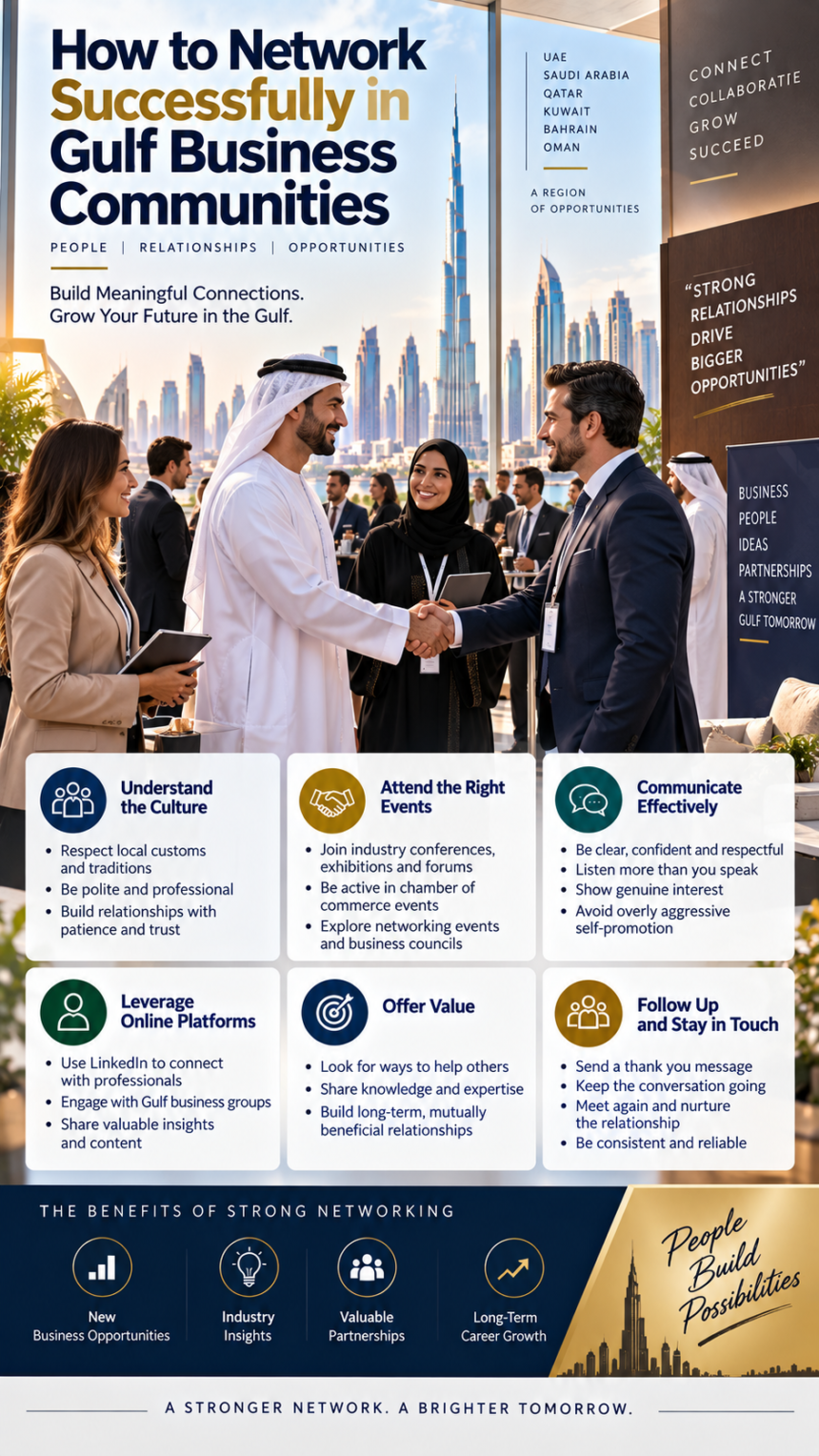
Understanding Business Communities in the GCC
Gulf Business Networking can play a major role in how entrepreneurs, professionals and companies find clients, partners, investors, suppliers and new opportunities across the UAE, Saudi Arabia, Qatar, Bahrain, Oman and Kuwait. The region has a highly active business environment, but successful networking usually depends on more than collecting business cards or adding hundreds of people on LinkedIn.
- Gulf Business Networking: Professional Overview
- Understanding Business Communities in the GCC
- 1. Build Relationships Before Asking for Business
- 2. Attend the Right Networking Events
- 3. Use Chambers and Business Councils
- 4. Prepare a Clear Introduction
- 5. Focus on Quality Connections
- 6. Use LinkedIn Professionally
- 7. Ask for Warm Introductions
- 8. Follow Up Without Being Pushy
- 9. Give Value Before Asking for Value
- 10. Respect Gulf Business Culture
- 11. Maintain Relationships Over Time
- 12. Turn Networking Into Real Opportunities
- Business Networking in the UAE
- Business Networking in Saudi Arabia
- Business Networking in Qatar
- Business Networking in Bahrain
- Business Networking in Oman
- Business Networking in Kuwait
- Best Places to Network in the Gulf
- Online vs In-Person Networking
- Networking for New Entrepreneurs
- Networking for Expats in the GCC
- Common Gulf Networking Mistakes
- Gulf Business Networking Checklist
- Final Thoughts on Gulf Business Networking
Relationships carry real commercial value across the Gulf. A strong introduction from someone trusted can open doors faster than a cold sales email, while repeated conversations at industry events can gradually build the confidence needed for a partnership or major contract. This does not mean business is conducted only through personal connections, but it does mean trust, reputation and professional relationships can influence how opportunities develop.
The strongest networkers therefore do not walk into every event trying to sell something immediately. They learn who people are, understand their business challenges, stay in contact after meetings and become useful members of the wider business community.
That approach is especially important in the GCC, where business communities are supported by chambers of commerce, sector groups, national business councils, investment forums, professional associations and large industry exhibitions. Dubai Chambers, for example, currently operates sector-specific Business Groups and country-specific Business Councils designed to connect companies, support collaboration and create networking opportunities.
Gulf Business Networking: Professional Overview
Networking becomes more effective when entrepreneurs stop treating every conversation as a sales opportunity. The goal should be to create a network of people who understand what you do, trust your professionalism and know when it makes sense to introduce you to someone else.
| Networking Area | Best Approach |
|---|---|
| First meeting | Build rapport before selling |
| Events | Choose relevant industry gatherings |
| Introductions | Keep your explanation short and clear |
| Connect with context, not random requests | |
| Follow-up | Send a useful message within a reasonable time |
| Referrals | Ask after trust has been established |
| Business councils | Use them for industry and country connections |
| Conferences | Prepare target contacts in advance |
| Relationship building | Stay in touch without always asking for something |
| Sales | Move toward business only when there is a clear fit |
A good network should not simply be large. It should contain people who are relevant to your industry, geography and commercial goals.
Five hundred random contacts may be far less useful than twenty strong relationships with people who understand your work and are comfortable introducing you to others.
Understanding Business Communities in the GCC
Gulf business communities are highly international. Local entrepreneurs work alongside professionals from India, Europe, Africa, North America, Southeast Asia and other parts of the Middle East, which means networking styles can vary greatly even within the same city.
Dubai may offer one of the clearest examples. Its business environment includes industry associations, national business councils, startup communities, trade exhibitions, investment conferences and informal professional groups. Dubai Chamber of Commerce currently says its Business Groups and Business Councils serve as platforms connecting stakeholders from specific industries and countries while supporting collaboration and dialogue with government.
The same principle appears elsewhere in the GCC. Riyadh Chamber describes chambers as institutions that help create commercial opportunities, connect the private sector with authorities and support cooperation among businesspeople. Its sector committees also bring together experienced members of the business community around specific industries.
Qatar Chamber similarly positions itself as a representative of Qatar’s private sector and currently provides a B2B international business platform alongside training, commercial information and business cooperation activities.
Networking therefore happens through both formal and informal channels. Entrepreneurs should learn how to use both.
1. Build Relationships Before Asking for Business
A common networking mistake is introducing yourself and immediately moving into a sales pitch. That approach can work occasionally, but it often creates pressure before any trust exists.
A better first conversation focuses on understanding the other person. Ask what their company does, what industry they work in and what type of projects they are currently focused on. If there is an obvious connection to your own work, explain it naturally rather than forcing the conversation.
For example, instead of saying, “We provide marketing services and I would like to send you a proposal,” you might explain that your company works with hospitality brands and then ask how their business currently approaches digital customer acquisition.
That creates a real conversation rather than a scripted pitch.
Relationships become particularly important when the potential opportunity is large. A senior executive considering a strategic partnership, investment or major supplier agreement is unlikely to make a decision simply because someone delivered an impressive elevator pitch at one event.
Give the relationship enough time to develop.
2. Attend the Right Networking Events
Not every event deserves your time.
Some entrepreneurs attend every conference, breakfast and networking evening available, only to discover that most attendees are trying to sell services to one another.
The better strategy is to choose events based on who is likely to attend.
An entrepreneur running a logistics company might receive more value from a trade and supply-chain conference than from a general startup networking evening. A property consultant may benefit more from real estate forums, while a technology founder should prioritise investor meetings, startup programmes and sector-focused technology events.
Before attending an event, research:
- The organiser
- Speaker list
- Participating companies
- Industry focus
- Previous editions
- Whether B2B meetings are available
Dubai Chambers, for example, currently promotes industry forums, networking opportunities, workshops and business-matching meetings as part of its member ecosystem. Its Business in Dubai platform also includes business matchmaking designed to connect companies with partners, investors and customers.
Qatar Chamber similarly operates business matchmaking services and an international B2B platform, showing how structured business connections are increasingly built into official Gulf business organisations.
The objective should be to attend fewer events with greater relevance.
3. Use Chambers and Business Councils
Chambers of commerce and business councils can be some of the most useful networking platforms in the Gulf because they already organise professionals around industries, national communities and commercial interests.
Dubai Chamber of Commerce currently maintains numerous sector-specific Business Groups alongside country-focused Business Councils. These include sectors ranging from automotive and cybersecurity to accounting, intellectual property and consumer industries, as well as councils representing many national business communities.
This structure allows entrepreneurs to network in two useful ways. Someone can join a group related to their industry while also developing relationships through a council connected to their home country or international market.
Saudi chambers also provide a structured route into business communities. Riyadh Chamber’s role includes supporting commercial opportunities, sharing economic information and creating platforms for business-sector cooperation, while its committees bring together experienced business figures around sector priorities.
Bahrain Chamber is another active example. In 2026 it opened membership for 11 specialised sector committees covering industries including healthcare, technology, tourism, real estate, financial services and transportation, creating direct opportunities for business leaders and specialists to participate in sector discussions.
Chamber participation can therefore provide more than event invitations. It can help professionals become visible within a specific business community.
4. Prepare a Clear Introduction
A good introduction should explain who you are without sounding like a company brochure.
Avoid giving someone your full professional history during the first minute. Most networking conversations work better when the other person can quickly understand three things: who you are, what your company does and who you typically help.
A simple structure is:
Name + company + what you do + relevant customer or sector
For example:
“I’m Sara. I run a Dubai-based recruitment company focused mainly on hospitality and retail businesses across the GCC.”
That is easier to remember than a long explanation filled with corporate terminology.
Your introduction should also change slightly depending on the person.
An investor may want to understand the scale and opportunity of your company. A potential client cares more about the problem you solve, while an industry peer may be interested in partnerships or market trends.
Clarity makes networking easier because people can quickly understand where you fit.
5. Focus on Quality Connections
Networking is not a competition to collect the most contacts.
A common event behaviour is moving rapidly from person to person, exchanging business cards and ending the evening with fifty names that are forgotten by the following week.
A better approach may be to have five meaningful conversations.
Take enough time to understand the person, but do not dominate their evening. If there is clear mutual relevance, exchange contact details and continue the discussion later.
A strong connection usually has at least one of three characteristics. The person may be relevant to your business, able to introduce you to someone relevant, or simply someone worth knowing because of their expertise and position within the industry.
Not every connection needs to produce immediate revenue.
Someone you meet today might introduce your next major client twelve months later. Another person may become a supplier, employee, investor or source of useful industry information.
Strong networking is long-term.
6. Use LinkedIn Professionally
LinkedIn has become one of the most useful tools for maintaining business relationships after conferences and meetings.
However, sending hundreds of random connection requests is not effective networking.
Whenever possible, add context.
A connection message might refer to:
- The event where you met
- A panel they participated in
- A mutual contact
- A shared industry
- A recent discussion
After connecting, avoid immediately sending a sales presentation.
Instead, build visibility by posting useful content related to your industry. Share practical insights, market observations, professional achievements and useful commentary rather than turning every post into advertising.
Your profile should also clearly show:
- What you do
- Where you operate
- Your sector
- Your company
- Your experience
People frequently check profiles after business events. A weak or incomplete LinkedIn profile can reduce credibility even when the in-person conversation went well.
Treat LinkedIn as the digital continuation of your real professional network.
7. Ask for Warm Introductions
Warm introductions are powerful because trust is transferred partially through the person making the introduction.
Suppose you want to meet the procurement director of a large Gulf hospitality group. Sending an unsolicited email may work, but an introduction from a trusted supplier, senior executive or industry colleague is likely to receive greater attention.
The important part is asking appropriately.
Do not repeatedly ask people you barely know to introduce you to senior contacts.
Build credibility first.
When requesting an introduction, explain why the connection makes sense. Give your contact enough information to decide whether they feel comfortable introducing you.
For example, explain that your company already works with similar businesses and that you believe there may be a relevant operational opportunity.
Also make the introduction easy. Provide a short paragraph your contact can forward instead of expecting them to explain your entire company.
8. Follow Up Without Being Pushy
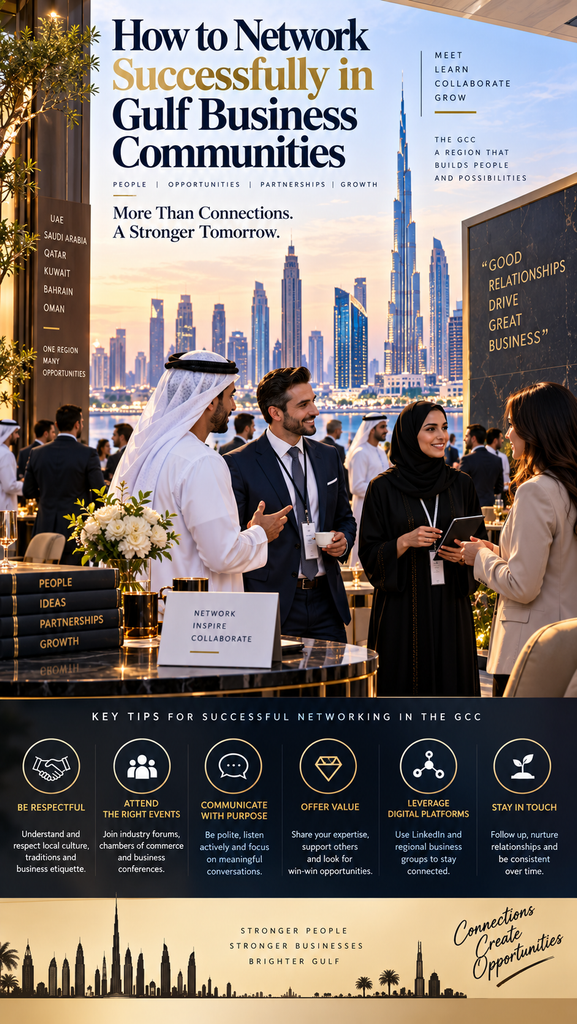
Many promising networking conversations disappear because nobody follows up.
At the other extreme, some people send messages every day until the recipient becomes uncomfortable.
The right approach sits between those two extremes.
Send a brief follow-up while the meeting is still fresh. Mention where you met, remind them what you discussed and suggest a logical next step if one exists.
If you promised to send a document, case study or introduction, send it.
Reliability matters.
If the person does not respond immediately, allow reasonable time before following up again. Senior professionals may have full calendars, travel schedules and internal priorities that have nothing to do with your proposal.
Professional persistence is valuable. Pressure is not.
A networking relationship should never feel like a countdown to a sales call.
9. Give Value Before Asking for Value
One of the best ways to build a strong business network is to become useful.
If someone mentions they are searching for a specialist and you know a suitable person, make the introduction. If you see a market report relevant to their industry, share it. If an event may be useful to them, send the invitation.
These actions should be genuine rather than calculated.
People remember professionals who help without immediately asking for payment or favours.
Value can take many forms, including:
- Industry information
- Relevant introductions
- Market knowledge
- Supplier recommendations
- Useful events
- Professional advice
This approach creates reciprocity naturally.
Over time, your network begins to associate you with useful connections and practical knowledge. That reputation can become commercially powerful.
10. Respect Gulf Business Culture
Networking in the Gulf also requires cultural awareness.
Relationships often develop through conversation rather than immediate commercial discussion. Hospitality, respectful greetings and professional titles can matter, particularly when meeting senior Gulf executives or traditional family businesses.
Avoid turning networking into an aggressive sales exercise.
Give people time to speak, show interest in their business and avoid interrupting constantly to explain your own achievements.
Physical greetings also deserve cultural awareness. In some situations, professionals of the opposite gender may prefer not to shake hands for religious or personal reasons. The simplest approach is to follow the other person’s lead.
Ramadan also changes the rhythm of business. Events, working hours and social activity may shift toward evenings, while daytime schedules can be shorter.
The most successful international professionals are not those who memorise every cultural rule. They are the ones who enter interactions respectfully, observe carefully and adapt naturally.
11. Maintain Relationships Over Time
A professional relationship loses value if you disappear immediately after getting what you need.
Strong networks require maintenance.
That does not mean messaging every contact each week. It means remaining visible and checking in when there is a genuine reason.
Useful moments include:
- New business launches
- Promotions
- Industry events
- Company milestones
- Ramadan and Eid greetings
- Relevant market news
- New partnership opportunities
LinkedIn makes light relationship maintenance easier because professionals can engage with one another’s updates without constantly arranging meetings.
Occasional coffee meetings can also be valuable when the relationship is important.
The strongest network is built gradually. Someone you meet at a conference today may become a close business contact after several conversations across a year.
12. Turn Networking Into Real Opportunities
Networking should eventually create outcomes.
The mistake is expecting every contact to become a customer. Some connections will create introductions, some will provide information and others may develop into partnerships many months later.
A useful networking process looks like this:
Meet → understand → follow up → build trust → identify opportunity → agree next step
Once commercial relevance becomes clear, move the conversation forward professionally.
Suggest a meeting.
Prepare a proposal.
Arrange an introduction.
Discuss a partnership.
Networking should not become endless social conversation without purpose. The relationship creates trust, but business still requires clear commercial action.
Keep simple notes after important meetings. Record what the person does, what you discussed and whether there is a next step.
That small habit makes follow-up far more effective.
Business Networking in the UAE
The UAE has one of the Gulf’s largest and most diverse professional networking environments. Dubai and Abu Dhabi host thousands of conferences, exhibitions, investment events, business councils and sector communities each year, creating opportunities across almost every major industry.
Dubai Chamber of Commerce provides particularly structured access through its Business Groups and Business Councils. The Chamber describes these groups as platforms that connect companies, create collaboration opportunities and link the private sector with policymakers. It also runs events, workshops and business-matching meetings throughout the year.
For entrepreneurs, the best UAE strategy is usually to identify two or three relevant communities rather than attending everything. A technology founder might participate in startup events and a technology business group, while an exporter could focus on trade chambers and country-specific business councils.
Abu Dhabi also has strong networking communities built around finance, energy, technology, government investment and industrial development.
The UAE rewards visibility, but consistent professional participation usually matters more than appearing everywhere.
Business Networking in Saudi Arabia
Saudi Arabia’s business networking environment has expanded rapidly alongside the Kingdom’s investment and economic transformation.
Riyadh has become particularly important for regional headquarters, investment conferences, technology events, construction, tourism, finance and professional services.
Local chambers provide one structured route into the market. Riyadh Chamber states that its role includes creating commercial opportunities, supporting business-sector communication and providing information and advice to entrepreneurs. It also operates sector committees and regularly hosts workshops, meetings and business-focused activities.
The Chamber’s entrepreneurship services also specifically highlight participation in exhibitions and events as a way for entrepreneurs to meet major companies, investors and potential partners.
Relationships and trusted introductions can carry significant value in Saudi Arabia, particularly when approaching established companies or senior decision-makers.
Foreign entrepreneurs should therefore combine formal events with patient relationship building.
Business Networking in Qatar
Doha’s business environment is smaller than Dubai or Riyadh, but that can sometimes make focused networking easier.
Qatar Chamber actively represents the private sector and currently provides an international B2B platform designed to support business matchmaking. Its activities include meetings with foreign delegations, business councils, training and commercial cooperation initiatives.
This creates opportunities for companies working in sectors such as construction, logistics, hospitality, finance, energy, technology and professional services.
In a relatively compact market, reputation can travel quickly.
That makes relationship quality especially important. A strong introduction can create several additional connections, but poor professional behaviour can also become widely known within a specialised business community.
Approach networking with a long-term reputation in mind.
Business Networking in Bahrain
Bahrain’s business community benefits from the country’s compact size and long commercial history.
Bahrain Chamber remains a major hub for engagement between business owners, entrepreneurs and government. In 2026 it launched Tojjar Talk to strengthen communication with business owners and opened specialised sector committees across eleven industries, including technology, tourism, real estate and financial services.
The Chamber also maintains an active events calendar with workshops, seminars and private-sector activities.
For entrepreneurs, Bahrain can be particularly useful for building close professional relationships because senior industry figures may be easier to encounter repeatedly through chambers, sector events and professional communities.
Consistency matters.
Attending one event creates recognition. Participating regularly creates relationships.
Business Networking in Oman
Oman’s business culture often rewards patience, courtesy and long-term relationship building.
The Oman Chamber of Commerce and Industry maintains business events, exhibitions and B2B activities. The government’s official service platform specifically provides registration for Chamber events such as seminars and business-to-business sessions.
OCCI also maintains directories, exhibitions and event information for the private sector, while current programmes continue to support business partnerships and SME growth.
For networking, Muscat remains the main commercial centre, but opportunities increasingly extend into logistics, tourism, manufacturing and regional development projects elsewhere in the Sultanate.
Approach Omani networking with professionalism rather than urgency. Building trust steadily can be more effective than pushing quickly for a transaction.
Business Networking in Kuwait
Kuwait has a well-established merchant culture and a business community shaped by family companies, major private groups, banks, government-linked activity and international trade.
The Kuwait Chamber of Commerce and Industry maintains business opportunities, events, exhibitions, commercial information and company resources through its current platform. Its 2026 agenda includes local and international events aimed at business owners, investors and companies.
In August 2026, for example, a Chamber seminar on commercial regulation attracted more than 450 participants from government entities, banks, major companies and other organisations, illustrating how chamber-led sessions can bring together a broad cross-section of Kuwait’s commercial community.
For foreign professionals, trusted introductions and repeated presence can be particularly useful.
Do not expect every important business relationship to begin through an online form. Personal credibility still matters.
Best Places to Network in the Gulf
Entrepreneurs have several useful networking environments available across the GCC.
| Networking Channel | Best For |
|---|---|
| Chambers of commerce | Established companies and local market contacts |
| Business councils | International and nationality-based networks |
| Industry exhibitions | Clients, suppliers and partners |
| Startup events | Founders, investors and technology companies |
| Professional associations | Sector specialists |
| Investment forums | Investors and senior executives |
| Maintaining and expanding professional contacts | |
| Workshops | Smaller, more focused conversations |
| B2B matchmaking | Pre-arranged commercial meetings |
| Private introductions | High-trust connections |
Large exhibitions are excellent for visibility but can be crowded. Smaller workshops can sometimes produce stronger conversations because participants share a specific interest.
Use both strategically.
Online vs In-Person Networking
Online networking is efficient, but it rarely replaces face-to-face relationships completely.
LinkedIn allows professionals to identify relevant people before an event, learn about their work and remain connected afterwards. In-person meetings provide much more information about communication style, trust and mutual interest.
The strongest strategy combines both.
Use online research to prepare for physical events. After meeting, connect digitally so the relationship continues. Then arrange a coffee, office meeting or video call when there is a real reason to continue the discussion.
Online networking creates reach.
In-person networking creates depth.
Networking for New Entrepreneurs
New entrepreneurs sometimes avoid networking because they believe they have nothing impressive to offer.
That is unnecessary.
You do not need to be the CEO of a major company to have valuable conversations. Curiosity, professionalism and useful knowledge can create strong relationships.
Start by choosing communities related to your industry. Attend regularly enough that people begin recognising you, and avoid pretending to know more than you do.
Ask intelligent questions and listen.
Entrepreneurs who constantly try to prove how successful they are often make weaker impressions than people who communicate clearly and genuinely.
Confidence is useful. Performance is not.
Networking for Expats in the GCC
Expats often have an advantage because Gulf business communities are already highly international.
However, staying only within your own nationality group can limit the value of your network.
Country-based business councils are useful starting points, but entrepreneurs should also join industry communities where they can connect with Gulf nationals and professionals from different backgrounds.
A strong regional network might include:
- Local entrepreneurs
- International executives
- Government-sector professionals
- Investors
- Suppliers
- Consultants
- Professional advisers
Diversity strengthens the network because opportunities rarely remain inside one social group.
The aim should be integration into the wider business ecosystem.
Common Gulf Networking Mistakes
Several mistakes repeatedly reduce networking effectiveness.
Selling immediately
People need a reason to trust you before discussing business.
Collecting contacts without following up
A business card has no value if the relationship disappears afterwards.
Attending irrelevant events
Choose quality over quantity.
Sending generic LinkedIn messages
Personal context improves response rates.
Asking for introductions too quickly
Build trust before requesting access to someone’s network.
Talking only about yourself
Good networking requires listening.
Ignoring cultural differences
Professional awareness matters across the GCC.
Following up too aggressively
Persistence should never become pressure.
Appearing only when you need something
Maintain relationships between transactions.
Failing to help others
Networks become stronger when value flows in both directions.
Gulf Business Networking Checklist
Before your next networking event, prepare a simple plan:
- Define what type of people you want to meet.
- Research the organiser and participating companies.
- Prepare a short professional introduction.
- Update your LinkedIn profile.
- Carry digital or physical contact details.
- Identify several target conversations.
- Avoid giving a sales pitch immediately.
- Ask relevant questions and listen carefully.
- Record important details after the event.
- Follow up with useful context.
- Keep promises made during conversations.
- Maintain relationships after the first meeting.
- Offer introductions when genuinely helpful.
- Join relevant chambers, councils or sector groups.
- Measure networking by relationships and opportunities, not contact count.
Final Thoughts on Gulf Business Networking
Successful Gulf Business Networking is less about meeting the largest possible number of people and more about becoming a trusted, visible and useful member of the business community.
Across the UAE, Saudi Arabia, Qatar, Bahrain, Oman and Kuwait, chambers of commerce continue to play an important role in connecting businesses, organising events and creating structured opportunities for collaboration. Dubai Chambers operates business groups, national councils and matchmaking initiatives, Riyadh Chamber maintains sector committees and entrepreneurship programmes, Qatar Chamber provides B2B connections, and Bahrain Chamber continues expanding engagement through events and specialised committees.
Oman’s Chamber provides access to seminars and B2B sessions, while Kuwait Chamber maintains an active calendar of commercial events, exhibitions and business resources.
These platforms are useful, but the platform itself does not create the relationship.
Entrepreneurs still need to show up consistently, introduce themselves clearly, listen to other people, follow up professionally and provide value before expecting something in return.
The best networkers also understand that business relationships develop at different speeds. Some contacts may turn into opportunities quickly, while others may remain professional acquaintances for years before the right project appears.
Do not judge every conversation by immediate revenue.
Build relationships with people you respect, stay visible within your industry and develop a reputation for reliability.
When people know what you do, trust the way you work and feel comfortable introducing you to others, networking stops being a collection of contacts and becomes a genuine business asset.
That is the real purpose of Gulf business networking.
Do follow us on Instagram
Read More – How to Network Successfully in Gulf Business Communities