


What Gulf Employers Look for in a CV
Gulf CV Writing requires more than listing previous jobs and educational qualifications. Employers across the UAE, Saudi Arabia, Qatar, Bahrain, Oman and Kuwait increasingly receive large numbers of applications, which means candidates need CVs that communicate their value quickly and clearly.
- Gulf CV Writing and the Modern GCC Job Market
- What Gulf Employers Look for in a CV
- 1. Keep the CV Clear and Professional
- 2. Write a Strong Professional Summary
- 3. Tailor the CV to Every Important Job
- 4. Use the Right Keywords for ATS Systems
- 5. Focus on Achievements Instead of Duties
- 6. Present Work Experience in Reverse Order
- 7. Highlight Skills Relevant to the Position
- 8. Show GCC and Regional Experience Clearly
- 9. Include Education and Relevant Certifications
- 10. Present Language Skills Honestly
- 11. Handle Personal Information Carefully
- 12. Explain Employment Gaps Professionally
- 13. Make the CV Easy to Scan
- 14. Check Accuracy Before Applying
- 15. Match Your CV With LinkedIn
- Ideal CV Structure for Gulf Job Markets
- How Long Should a Gulf CV Be
- Should You Include a Photo on a Gulf CV
- ATS-Friendly CVs for GCC Employers
- CV Writing for the UAE Job Market
- CV Writing for Saudi Arabia
- CV Writing for Qatar
- CV Writing for Bahrain
- CV Writing for Oman
- CV Writing for Kuwait
- Gulf CV Examples for Different Career Levels
- Common Gulf CV Mistakes
- Gulf CV Writing Checklist
- Final Thoughts on Gulf CV Writing
The basic purpose of a CV remains simple. It should help an employer understand what you have done, what you can do and why your experience is relevant to the position. The difficulty is presenting that information in a way that works for both recruiters and increasingly digital recruitment systems.
Official Gulf employment platforms also reinforce the importance of keeping professional information current. The UAE Government advises job seekers to prepare an honest CV, keep it updated, understand their professional field and build knowledge of the region. Oman’s official job-seeker service similarly tells candidates to create an up-to-date CV and build a professional profile that makes it easier for employers to find them.
Saudi Arabia is also digitising CV management. Its Ministry of Human Resources and Social Development now provides services through which CVs can be managed and made available to relevant employers, while government organisations can search registered job-seeker CVs through official platforms.
The message is increasingly clear across the region: a professional CV is not simply a document stored on your laptop. It is part of your wider professional identity.
Gulf CV Writing and the Modern GCC Job Market
The GCC employment market is highly international. A company in Dubai may receive applications from the UAE, India, Pakistan, Egypt, the Philippines, Europe and many other markets. A business in Riyadh may compare Saudi nationals, GCC professionals and international specialists depending on the role and applicable employment policies.
This competition makes clarity extremely important.
Recruiters may spend only a short period initially deciding whether a CV deserves closer attention. A complicated design, vague job descriptions or several paragraphs of unnecessary personal information can make it harder for them to identify what matters.
A strong Gulf CV should quickly answer five questions:
| Employer Question | Your CV Should Show |
|---|---|
| What do you do? | Clear professional title and summary |
| How experienced are you? | Relevant employment history |
| What have you achieved? | Measurable accomplishments |
| Which skills do you have? | Technical and professional capabilities |
| Why are you relevant? | Experience aligned with the vacancy |
The strongest CVs make these answers visible without forcing the recruiter to search through several pages.
What Gulf Employers Look for in a CV
Different employers value different qualities, but several elements appear repeatedly across strong professional applications.
Recruiters want relevant experience, credible skills, evidence of achievement and enough information to understand whether the candidate can perform the job.
Saudi Arabia’s Ministry of Human Resources has highlighted the importance of credible skill signals because employers may otherwise rely heavily on qualifications or previous job titles that do not always demonstrate actual capability. Research surfaced through the Ministry notes that recognised and relevant skill signals can improve how employers identify suitable candidates.
This is why vague statements such as “good communication skills” are weaker than evidence showing how those skills were used.
Instead of writing:
Good leadership abilities
a stronger CV might say:
Managed a 14-member sales team across three GCC markets and increased annual regional revenue by 21%.
The second version gives the employer context, responsibility and evidence.
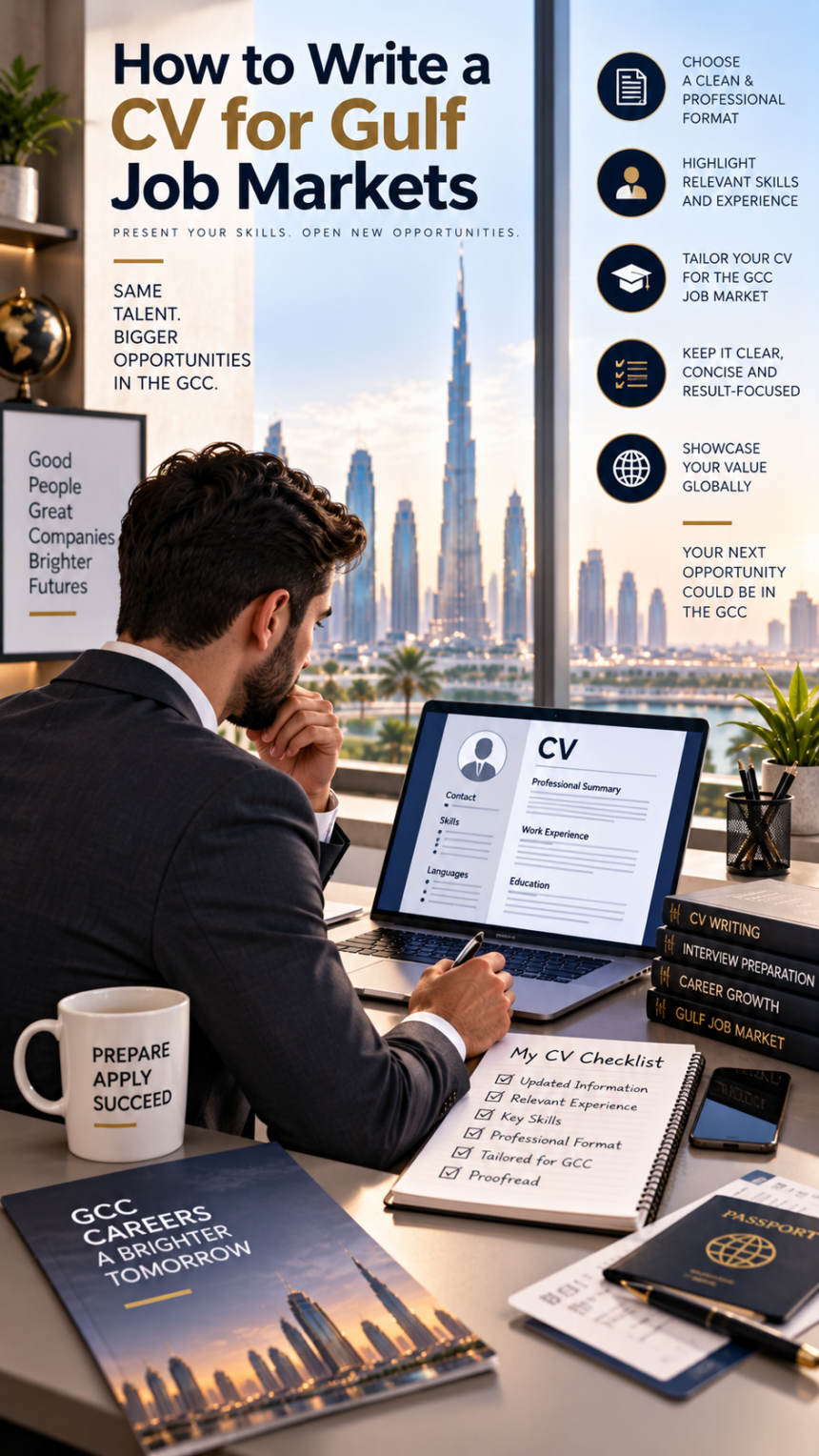
1. Keep the CV Clear and Professional
A professional CV should be easy to understand before it is visually impressive.
Use a clean layout, consistent headings, readable fonts and enough spacing between sections. Decorative graphics should never make important information difficult to find.
A simple structure usually works better than complicated magazine-style designs, particularly when applying through recruitment platforms.
Avoid large blocks of text. Even official educational guidance from Oman recommends separating CV information clearly rather than presenting dense paragraphs and notes that some traditional personal details are not obligatory.
Professional does not mean boring. A CV can still look polished through typography, spacing and hierarchy without adding unnecessary visual elements.
The design should support the information rather than compete with it.
2. Write a Strong Professional Summary
The top of the CV is valuable space.
After your name and contact information, include a short professional summary that explains your experience and strongest value.
A useful summary might read:
Senior Finance Manager with 11 years of experience across the UAE and Saudi Arabia, specialising in financial planning, budgeting, reporting and business transformation within retail and hospitality groups. Experienced in managing multicultural finance teams and supporting regional expansion projects.
This is much stronger than:
Hard-working individual looking for a challenging position where I can use my skills and grow professionally.
The second version could describe almost anyone.
Your summary should ideally communicate your profession, experience level, strongest specialisation, relevant industries and any particularly valuable regional experience.
Keep it concise enough that the recruiter can understand your profile immediately.
3. Tailor the CV to Every Important Job
Sending exactly the same CV to hundreds of positions can reduce your chances of getting interviews.
Different jobs emphasise different requirements.
Imagine you have experience across marketing, e-commerce and business development. A digital marketing vacancy may care most about performance campaigns and analytics, while a business-development position may value partnerships and client acquisition.
Your professional history remains the same, but the emphasis should change.
Read the job description carefully and identify the employer’s most important requirements. Then make sure your CV clearly demonstrates the relevant experience.
Tailoring does not mean changing facts.
Never invent experience, job titles, qualifications or numbers simply because they appear in the vacancy.
The UAE Government specifically advises applicants to maintain an honest CV. Accuracy matters because employers may verify experience, qualifications and references later.
4. Use the Right Keywords for ATS Systems
Many larger employers use digital recruitment platforms to organise applications.
An Applicant Tracking System can help recruiters store, search and filter candidate information. This makes relevant terminology increasingly important.
Suppose a job description repeatedly mentions:
Financial modelling, budgeting, forecasting, SAP and management reporting.
If you genuinely possess those skills, use those exact professional terms naturally inside your CV.
Do not replace clear industry language with unnecessary creative alternatives.
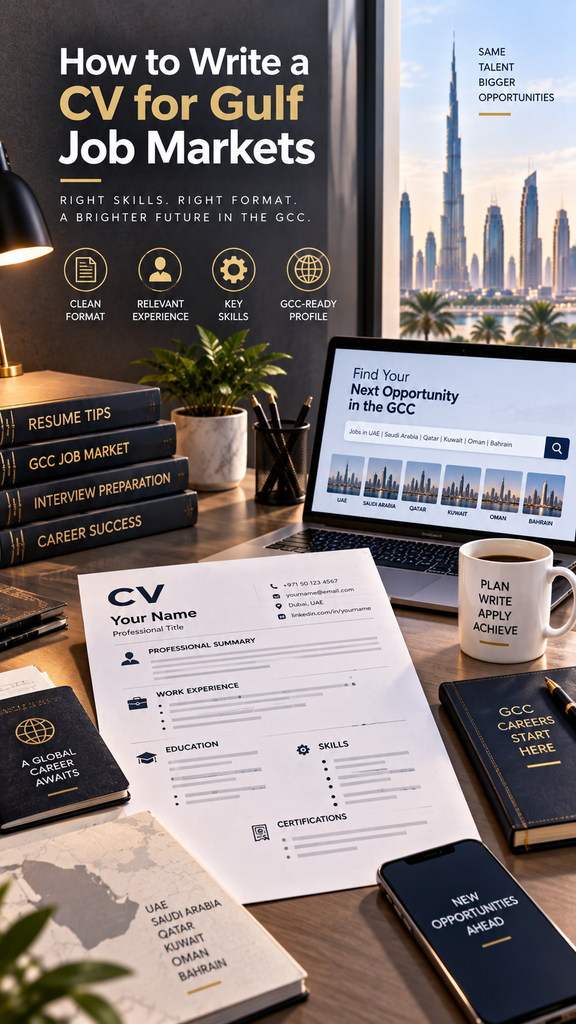
An ATS-friendly CV normally benefits from straightforward section titles such as:
Professional Summary
Work Experience
Education
Skills
Certifications
Avoid trying to manipulate systems by hiding keywords, repeating them excessively or copying the entire job description into the document.
Keyword optimisation should help the CV accurately describe your experience, not disguise whether you are qualified.
5. Focus on Achievements Instead of Duties
This is one of the biggest differences between an average CV and a strong CV.
Job duties explain what you were responsible for. Achievements explain what happened because of your work.
Compare these two examples:
Weak: Responsible for managing social media accounts and advertising campaigns.
Stronger: Managed paid and organic campaigns across Instagram, Facebook and LinkedIn, increasing qualified digital leads by 38% within nine months.
Another example:
Weak: Responsible for procurement activities.
Stronger: Renegotiated supplier contracts across three categories, reducing annual procurement costs by AED 420,000 while maintaining service levels.
Whenever possible, quantify achievements through:
- Revenue
- Cost savings
- Growth percentages
- Team sizes
- Number of clients
- Project values
- Time reductions
- Efficiency improvements
Do not invent numbers if exact information is unavailable. Specific qualitative achievements remain better than false precision.
6. Present Work Experience in Reverse Order
Your most recent employment is normally the most relevant, so work backwards.
A typical entry should include:
Job Title
Company Name | City, Country
Month Year to Month Year
Then provide several concise achievement-focused statements.
For example:
Operations Manager
ABC Logistics | Dubai, UAE
January 2022 to Present
You would then explain the scale of your responsibility, important achievements and relevant systems or markets.
Older positions can receive less space unless they are particularly important to the role.
A candidate with 15 years of experience does not need to explain an entry-level job from 13 years ago with the same level of detail as the current position.
The CV should give more attention to information that helps the current application.
7. Highlight Skills Relevant to the Position
A skills section should strengthen the employment history rather than become a random collection of attractive words.
Separate technical abilities from broader professional capabilities when useful.
For a finance professional, strong technical skills might include financial modelling, budgeting, IFRS reporting, SAP and Power BI.
For a digital marketing professional, they might include Google Ads, Meta Ads, analytics, SEO, CRM systems and content strategy.
Saudi Arabia’s current Skills Taxonomy reflects the broader regional movement toward connecting clearly defined skills with occupations and labour-market requirements.
The lesson for candidates is practical: describe skills specifically enough that employers can understand what you actually know.
“Computer skills” communicates very little.
“Advanced Excel, Power BI and SAP S/4HANA” communicates much more.
8. Show GCC and Regional Experience Clearly
If you already have Gulf experience, make it easy to identify.
Regional knowledge can be valuable because employers may prefer candidates who understand local customers, regulations, business culture or operating environments.
Instead of simply writing:
Regional Sales Manager
you might specify:
Managed enterprise accounts across the UAE, Saudi Arabia, Qatar and Bahrain.
Similarly, professionals with experience dealing with GCC government entities, free zones, regional distributors or localisation programmes can mention that experience when relevant.
International candidates without previous Gulf employment should not assume they are automatically disadvantaged.
Instead, demonstrate transferable experience.
A logistics specialist who managed operations across Southeast Asia may still have highly relevant expertise for Gulf logistics. A hotel manager from Europe may have experience directly applicable to UAE or Saudi tourism projects.
Your job is to explain the connection clearly.
9. Include Education and Relevant Certifications
Education should normally include your qualification, institution and graduation year or period.
Experienced professionals do not usually need to list every school they attended.
For example:
MBA, International Business
University Name, United Kingdom | 2021
Bachelor of Commerce
University Name, India | 2015
Certifications should be included when they provide meaningful professional value.
Examples might include:
PMP
CFA
ACCA
CISSP
AWS certifications
Google professional certifications
The exact qualification depends entirely on the profession.
Saudi workforce research also emphasises the value of credible skill signals that employers recognise and understand.
Do not fill your CV with dozens of short online courses simply to make the document longer.
Quality and relevance matter more than volume.
10. Present Language Skills Honestly
Language ability can be particularly valuable in the GCC because workplaces are highly international.
English is widely used across multinational companies, while Arabic can provide a significant advantage in many local, government-related and client-facing positions.
The UAE Government specifically notes that Arabic knowledge can be advantageous for job seekers.
Use realistic descriptions such as:
Arabic: Native
English: Professional fluency
Hindi: Native
French: Intermediate
Avoid claiming fluency simply because you completed a language course.
Employers can quickly discover your actual ability during interviews.
Language skills are most useful when they genuinely support the role.
11. Handle Personal Information Carefully
Gulf CV conventions have historically included more personal information than CVs in some Western markets. However, candidates should not assume every detail is mandatory.
Your essential information usually includes:
| Recommended Information | Example |
|---|---|
| Full name | Ahmed Hassan |
| Mobile number | Current reachable number |
| Professional email | name@email.com |
| Location | Dubai, UAE |
| Updated professional profile | |
| Professional title | Finance Manager |
Additional details such as nationality, residency or visa status can sometimes be relevant because they affect hiring logistics, but include them only when useful or specifically requested.
Date of birth, marital status and similar personal information should not automatically be added simply because an old CV template contains them. Oman educational guidance, for example, explicitly notes that nationality and birth date are not obligatory CV details.
The best approach is to include information that helps the employer assess your professional application without unnecessarily exposing personal information.
12. Explain Employment Gaps Professionally
Employment gaps are not automatically damaging.
People take career breaks for education, family responsibilities, relocation, entrepreneurship, health, redundancy and many other reasons.
The bigger problem is creating confusing or inaccurate dates.
If a gap was significant and relevant, explain it briefly and professionally.
For example:
Career Break | 2023 to 2024
Completed professional certifications and relocated to the UAE while preparing for a return to full-time employment.
Another example could explain independent consulting, postgraduate study or family leave.
Do not write a long personal explanation unless necessary.
Recruiters usually need clarity rather than your entire personal history.
Most importantly, never manipulate dates to hide a gap. Inconsistent employment dates can create larger credibility problems later.
13. Make the CV Easy to Scan
Recruiters should be able to locate your strongest information quickly.
Use consistent formatting for:
Job titles
Company names
Dates
Section headings
Achievements
Place the most important information toward the top of each section.
Avoid five-line paragraphs describing routine responsibilities. Convert dense information into concise statements where necessary, while keeping the overall CV visually balanced.
Use enough spacing between positions so that the document does not look compressed.
A CV that technically contains excellent experience can still underperform if the recruiter struggles to understand it.
Readability is therefore part of professional communication.
14. Check Accuracy Before Applying
Small errors can damage an otherwise strong CV.
Check:
Company names
Job titles
Employment dates
Phone numbers
Email address
Qualification names
Spelling
Pay particular attention when repeatedly editing different CV versions.
It is easy to accidentally leave the wrong professional summary or job title when adapting a document for another vacancy.
Your LinkedIn profile should also broadly match the employment history on your CV.
Minor differences in detail are normal, but contradictory dates or titles can raise unnecessary questions.
Accuracy communicates professionalism.
15. Match Your CV With LinkedIn
Recruiters increasingly research candidates beyond the document they receive.
Your LinkedIn profile should therefore support the same professional story as your CV.
The UAE Government explicitly recommends professional networking platforms as a source of employment opportunities and networking.
Use a professional headline describing your expertise rather than simply writing “Looking for opportunities.”
For example:
Senior Procurement Professional | Strategic Sourcing | GCC Supply Chains | Vendor Management
This immediately communicates professional value.
Your LinkedIn profile can contain more detail than the CV. Recommendations, projects, posts and professional activity can provide additional evidence of expertise.
The CV gets you considered for the role. Your wider professional presence can strengthen confidence in the person behind it.
Ideal CV Structure for Gulf Job Markets
A clear Gulf CV can follow this structure:
| Section | What to Include |
|---|---|
| Header | Name, title, contact details and location |
| Professional Summary | 3 to 5 lines explaining your value |
| Core Skills | Relevant technical and professional skills |
| Work Experience | Recent roles with achievements |
| Education | Degrees and relevant qualifications |
| Certifications | Valuable professional certifications |
| Languages | Honest level of ability |
| Additional Information | Relevant visa, licence or other information if needed |
You can adjust the order depending on your career level.
A recent graduate may place education relatively high because it represents a major qualification. A senior executive should normally prioritise professional experience.
Technical candidates can also include projects or specialist technologies when these significantly strengthen the application.
How Long Should a Gulf CV Be
There is no universal rule saying every GCC CV must contain exactly one or two pages.
The appropriate length depends on experience.
A graduate or early-career professional can often communicate everything important in one to two pages.
A mid-career professional may reasonably use two pages.
A senior executive with substantial regional experience may require two or occasionally three pages, particularly when the role involves large projects or several senior positions.
Length becomes a problem when pages are filled with irrelevant information.
A ten-year-old position should not receive half a page unless it remains directly relevant.
The objective is not to make the CV short at any cost.
It is to make every section useful.
Should You Include a Photo on a Gulf CV
CV photographs remain common in parts of the Gulf market, but they are not universally required.
The safest approach is to follow the employer’s instructions.
If the application specifically requests a photograph, provide a professional headshot. If it does not, consider whether the role and local industry convention make one useful.
Large international corporations and recruitment systems may not need one at all.
If you do include a photograph, it should be a straightforward professional image with neutral presentation rather than a social-media selfie.
A photograph should never occupy so much space that it pushes important professional information off the first page.
The candidate’s experience and suitability should remain the centre of the CV.
ATS-Friendly CVs for GCC Employers
An ATS-friendly CV is usually simpler than many candidates expect.
Complicated graphics, text embedded inside images and unusual layouts can make automated processing more difficult.
Use normal headings and clear text.
Avoid designing essential information entirely through:
- Icons
- Charts
- Skill-rating bars
- Decorative infographics
- Multiple complicated columns
Use professional keywords naturally and save the file in the format requested by the employer.
If the vacancy asks for PDF, submit a PDF. If it asks for DOCX, follow that instruction.
Do not assume one universal format works for every recruitment platform.
The best ATS strategy remains the simplest: use relevant terminology, clear formatting and accurate information.
CV Writing for the UAE Job Market
The UAE has one of the Gulf’s most competitive international employment markets.
Dubai attracts professionals in finance, real estate, technology, hospitality, consulting, logistics and media, while Abu Dhabi provides major opportunities in energy, investment, finance, healthcare and advanced industries.
The UAE Government recommends maintaining an honest, updated CV, using professional networking websites, understanding the region and continuing to develop industry knowledge.
Candidates should make UAE experience visible when they have it.
If your residency or visa status is relevant to immediate availability, it can also be useful to state it briefly. However, professional achievements should remain more prominent than administrative information.
Because UAE employers can recruit internationally, your CV needs to explain clearly why your experience creates value rather than assuming the job title alone will impress recruiters.
CV Writing for Saudi Arabia
Saudi Arabia’s employment market is rapidly becoming more skills-focused.
The Ministry of Human Resources operates systems that allow employers to access registered job-seeker CVs and has recently expanded CV-management services through Qiwa.
Saudi Arabia has also created an extensive skills taxonomy designed to connect specific skills and occupations with labour-market requirements.
Candidates should therefore describe technical capabilities clearly.
For Saudi nationals, relevant sector skills, certifications and private-sector experience can become especially valuable as localisation programmes continue developing.
International professionals should highlight specialist expertise and significant project experience rather than relying simply on international exposure.
Experience in Saudi regulations, clients, megaprojects or local industries should be made visible when relevant.
CV Writing for Qatar
Qatar’s labour market is smaller than the UAE or Saudi Arabia, which can make role-specific targeting especially important.
Candidates should emphasise expertise connected to the vacancy rather than sending broad general CVs.
Doha offers opportunities across energy, aviation, finance, construction, hospitality, logistics and increasingly technology.
Senior professionals should clearly explain the scale of projects they have managed, particularly when applying for leadership, infrastructure or specialist roles.
If you have previous Qatar or GCC experience, include it prominently.
Professionals without regional experience can still compete by demonstrating technical expertise, major project exposure and transferable international experience.
Avoid making the CV unnecessarily long simply because you have worked for well-known companies. Explain what you personally accomplished.
CV Writing for Bahrain
Bahrain’s relatively compact labour market means professional reputation and specialised experience can carry significant weight.
Financial services, fintech, professional services, manufacturing and technology remain important career areas.
Candidates applying to banking and financial roles should clearly show relevant regulatory, compliance, digital or technical capabilities where applicable.
Job seekers should also match the seniority of the CV to the position. A highly technical specialist needs enough detail to demonstrate expertise, while an administrative applicant should focus more heavily on organisation, communication, systems and measurable improvements.
Because Bahrain’s professional networks are interconnected, consistency between your CV, LinkedIn profile and actual experience becomes particularly important.
CV Writing for Oman
Oman’s official job-market services place direct emphasis on creating and maintaining an updated CV.
Gov.om tells job seekers to register their personal details, create an up-to-date CV and build a professional profile that allows employers to find them. The Ministry of Labour’s digital system can also allow employers to view information including education, experience, training, languages and CV details where permission is provided.
This provides a useful model for what job seekers should prioritise: experience, qualifications, training and languages.
Candidates targeting Oman’s growth industries can also highlight expertise connected to logistics, manufacturing, energy, tourism, sustainability and technology.
Keep the information updated across both your CV and official professional profile where relevant.
CV Writing for Kuwait
Kuwait’s job market includes major opportunities in energy, banking, government-linked business, retail, professional services and infrastructure.
Candidates should focus on clear evidence of specialist expertise and relevant regional experience.
International applicants should avoid assuming that one generic “Middle East CV” works equally well across all Gulf countries. Kuwait’s market structure, company culture and hiring requirements differ from those of Dubai or Riyadh.
Where the role involves a regulated profession, professional qualification or licence, place the relevant credential clearly.
Senior professionals should also highlight team leadership, budget responsibility and project scale rather than simply listing job titles.
As with every GCC market, the strongest CV is one written for the actual vacancy rather than for the country in general.
Gulf CV Examples for Different Career Levels
The emphasis should change as experience grows.
| Career Level | What the CV Should Emphasise |
|---|---|
| Graduate | Education, internships, projects and skills |
| Early career | Practical achievements and developing expertise |
| Mid-career | Results, responsibility and specialist capabilities |
| Manager | Team leadership, budgets, projects and business impact |
| Senior executive | Strategy, transformation, revenue, markets and leadership |
A graduate should not try to create a three-page CV by describing every university module.
Likewise, a senior executive should not allow the education section to occupy more space than major leadership achievements.
Your CV should reflect the professional level you are trying to communicate.
Common Gulf CV Mistakes
One common mistake is beginning with a long career objective that says little about the candidate. Replace generic ambitions with a concise summary explaining actual professional value.
Another problem is copying job descriptions directly into work experience. Employers already understand what a Finance Manager or Project Engineer generally does. They need to know what you achieved in that position.
Candidates also frequently add excessive personal information, complicated designs, outdated software skills or unrelated certificates.
Spelling and grammar errors can be particularly damaging in roles requiring communication.
Another major mistake is exaggeration.
Changing job titles, inflating responsibilities or inventing numbers may help a CV look stronger temporarily, but verification or interviews can expose inconsistencies quickly.
A strong CV should make your real career look impressive through clear presentation rather than false information.
Gulf CV Writing Checklist
Before submitting an application, review the following:
- Confirm that your name and contact details are correct.
- Use a professional email address.
- Include your current city and country.
- Write a focused professional summary.
- Tailor the CV to the vacancy.
- Use relevant job-description keywords naturally.
- Put recent experience first.
- Describe achievements rather than only duties.
- Add measurable results where accurate.
- Highlight relevant GCC experience.
- List important technical skills clearly.
- Keep education concise and accurate.
- Include only useful professional certifications.
- Describe language abilities honestly.
- Include visa or residency information only when relevant.
- Avoid unnecessary personal information.
- Keep formatting consistent.
- Use straightforward headings.
- Check employment dates carefully.
- Proofread spelling and grammar.
- Make sure LinkedIn broadly matches the CV.
- Save the document with a professional filename such as
Ahmed_Hassan_CV.pdf. - Follow the employer’s requested submission format.
- Never pay someone claiming they can guarantee you a job or visa.
The final point is particularly important. The UAE Government warns job seekers that legitimate employers and recruitment agencies should not demand payment from candidates to process employment visas or medical procedures.
Final Thoughts on Gulf CV Writing
Gulf CV Writing is becoming less about producing one standard document and more about presenting relevant skills and achievements clearly for a specific opportunity.
The UAE Government advises candidates to keep their CVs honest and updated, use professional networking platforms, develop industry knowledge and understand the region in which they are applying.
Saudi Arabia is moving further toward skills-based digital recruitment, with official CV-management systems and a national skills taxonomy connecting capabilities with occupations and labour-market needs.
Oman’s job-seeker ecosystem similarly emphasises an updated CV, professional profile, work experience, education, training and languages, while giving employers digital access to relevant candidate information where permitted.
Across the wider GCC, the strongest CV principles remain consistent.
Your document should be clear, relevant, accurate and easy to understand. It should explain what you have achieved rather than simply repeating job descriptions, and it should make your strongest skills visible without forcing recruiters to search for them.
Applicants should also recognise that CV conventions are evolving. Older Gulf templates may contain numerous personal details, decorative designs and long descriptions. Modern applications increasingly benefit from cleaner layouts and stronger evidence of skills.
Technology is changing recruitment as well. Digital job platforms make structured professional information more important, while AI and recruitment software can make relevant terminology easier for employers to search.
None of this changes the fundamental purpose of a CV.
A CV is not supposed to tell your entire life story. It is supposed to convince the employer that your experience deserves a closer conversation.
The strongest Gulf CV therefore does three things exceptionally well: it explains what you know, proves what you have achieved and makes it obvious why those abilities matter to the employer.
When those elements are supported by accurate information, a professional LinkedIn profile and strong interview preparation, the CV becomes far more than a list of previous jobs. It becomes a focused marketing document for your professional career.
Do follow us on Instagram
Read More – GCC Professional Networking: 12 Powerful Strategies for Career Success