



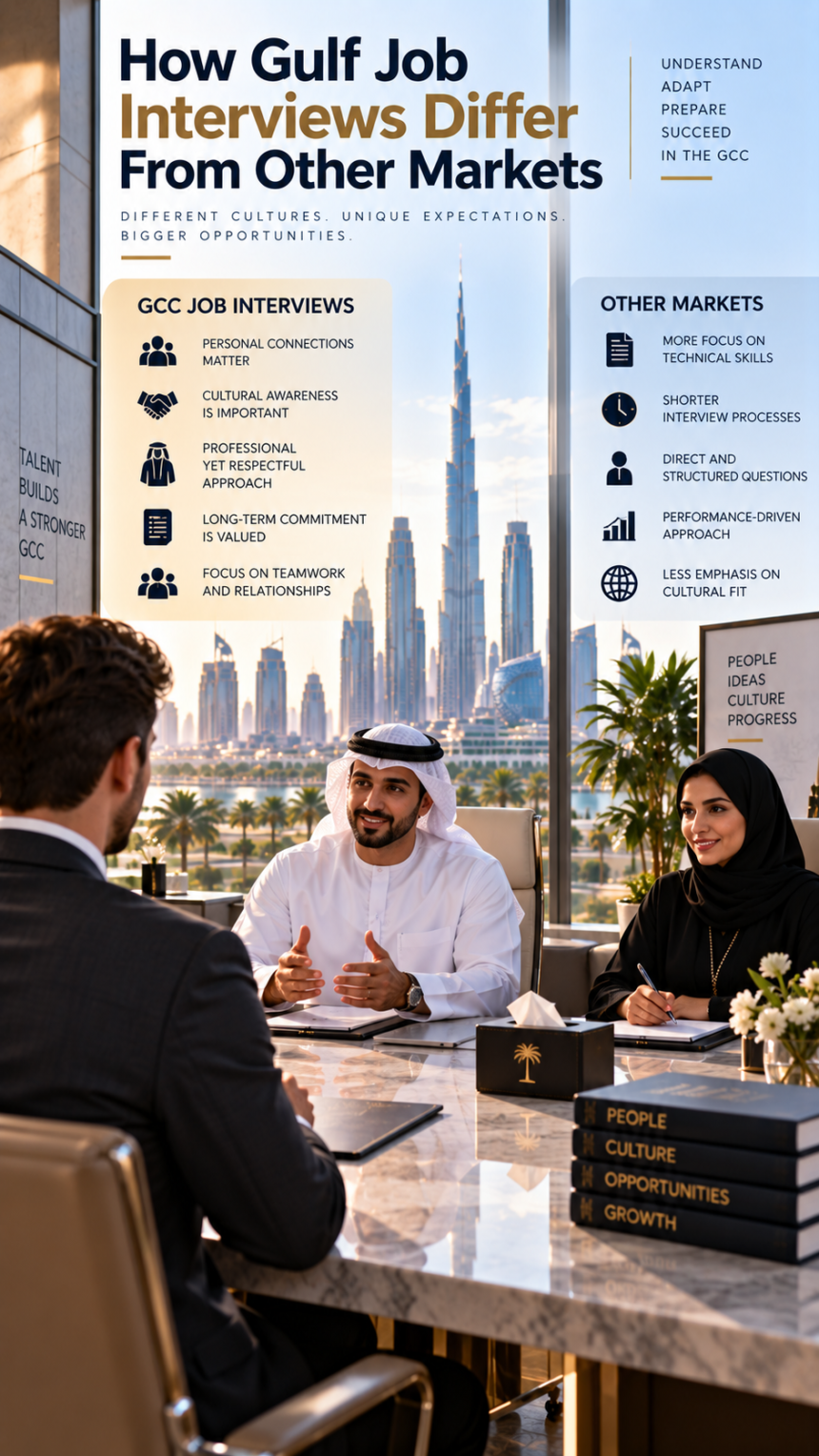
Why Gulf Interviews Can Feel Different
Gulf Job Interviews can feel different from recruitment processes in Europe, North America, Asia or other international employment markets because candidates are often being assessed on more than technical qualifications alone. Employers may also consider Gulf experience, cultural awareness, availability, residency status, language skills and understanding of the regional business environment.
- Gulf Job Interviews and the Modern GCC Hiring Market
- Why Gulf Interviews Can Feel Different
- 1. GCC Experience Can Receive Extra Attention
- 2. Cultural Awareness Matters More Than Many Candidates Expect
- 3. Interviews Can Be More Formal
- 4. Relationship Building Can Influence the Conversation
- 5. Visa and Residency Questions Are More Common
- 6. Notice Period and Availability Can Matter Early
- 7. Salary Discussions May Focus on the Complete Package
- 8. Nationalisation Policies Can Affect Recruitment
- 9. Language Skills Can Create an Advantage
- 10. Employers May Focus Strongly on Practical Skills
- 11. Multiple Interview Rounds Are Common for Senior Roles
- 12. Regional Knowledge Can Separate Strong Candidates
- Common Questions in Gulf Job Interviews
- The STAR Method for GCC Interviews
- What to Wear to a Gulf Job Interview
- Gulf Job Interviews in the UAE
- Gulf Job Interviews in Saudi Arabia
- Gulf Job Interviews in Qatar
- Gulf Job Interviews in Bahrain
- Gulf Job Interviews in Oman
- Gulf Job Interviews in Kuwait
- Online Interviews for Gulf Jobs
- Interview Advice for Expats
- Interview Advice for GCC Nationals
- Salary Negotiation During Gulf Interviews
- Questions Candidates Should Ask Employers
- Common Gulf Interview Mistakes
- Gulf Job Interview Preparation Checklist
- Final Thoughts on Gulf Job Interviews
However, there is no single Gulf interview style. An international technology company in Dubai may conduct almost exactly the same competency-based interview it uses in London or Singapore, while a family business in Kuwait, government-related organisation in Saudi Arabia or local company in Oman may follow a different process.
Candidates should therefore avoid treating the GCC as one identical employment market.
The six Gulf Cooperation Council countries have separate labour regulations, workforce policies and economic priorities. Even companies operating in the same city can have completely different recruitment cultures.
What makes the region distinctive is the combination of international business practices with local employment structures. The UAE Government, for example, advises job seekers to keep an honest and updated CV, learn about the region and its cultural values, improve professional knowledge, grow their networks and remain realistic about earning expectations.
Saudi Arabia is also moving strongly toward skills-based workforce development. Its current skills and training framework focuses on matching qualifications and practical capabilities with labour-market requirements, while professional verification programmes confirm qualifications and experience for certain expatriate professionals.
These factors mean successful interview preparation requires both professional competence and regional awareness.
Gulf Job Interviews and the Modern GCC Hiring Market
The GCC job market contains some of the world’s most international workforces. Employers may interview candidates who have worked in India, Pakistan, Egypt, the Philippines, the UK, Europe, Africa or elsewhere in the Middle East for the same position.
This creates intense competition, particularly for professional jobs in major cities such as Dubai, Abu Dhabi, Riyadh and Doha.
| Interview Factor | Why It Can Matter in the GCC |
|---|---|
| Relevant experience | Employers want evidence you can perform the role |
| GCC experience | Can reduce the learning curve for regional positions |
| Cultural awareness | Important in multicultural workplaces |
| Language ability | Arabic can help in selected roles |
| Availability | Employers may need someone to join quickly |
| Residency status | Can affect administrative hiring steps |
| Salary expectations | Packages may contain several components |
| Technical skills | Increasingly important as GCC economies specialise |
| Communication | International teams require clear communication |
| Regional knowledge | Important for client-facing and management roles |
Strong candidates prepare for all of these areas instead of memorising answers to generic questions.
The best interview preparation begins with understanding the specific employer. A multinational corporation, government entity, local family business and technology startup may all evaluate candidates differently.
Why Gulf Interviews Can Feel Different
Most interview fundamentals remain universal. Employers want evidence that a candidate is competent, reliable and capable of working successfully with colleagues.
The differences usually appear in the context around those fundamentals.
A recruiter may want to understand whether an expatriate candidate can relocate to the region. A company may ask whether someone already has GCC experience because the job involves local customers or regulations. Nationalisation programmes may influence which positions are available to nationals or expatriates.
Cultural expectations can also shape communication. Some interview environments place significant importance on professionalism, respect for seniority and careful communication.
Candidates should adapt without becoming artificial.
The objective is not to pretend to understand Gulf culture perfectly. It is to demonstrate respect, preparation and willingness to work effectively in the local environment.
1. GCC Experience Can Receive Extra Attention
Candidates frequently see job advertisements mentioning UAE experience, Saudi experience or GCC experience preferred.
Employers may value this because Gulf experience can indicate familiarity with local customers, business practices, regulations, suppliers or workplace environments.
For example, a construction company may prefer a project manager who understands regional contractors and approval processes. A sales company may value someone who already knows the GCC customer landscape.
However, candidates without Gulf experience should not automatically assume they cannot compete.
The correct approach is to translate international experience into regional relevance.
Instead of apologising for having no GCC experience, explain how your previous work prepares you for the position.
A logistics professional could discuss managing international supply chains. A hospitality manager could highlight experience with multicultural customers, while a technology specialist can demonstrate expertise directly relevant to the company’s systems.
Regional experience is an advantage in some positions, but expertise remains valuable wherever it was developed.
2. Cultural Awareness Matters More Than Many Candidates Expect
Professional knowledge should be combined with cultural awareness.
The UAE Government specifically advises job seekers to increase their understanding of the region and its social and cultural value system.
That does not mean memorising stereotypes about Gulf countries.
Instead, candidates should understand basic professional expectations such as respectful greetings, appropriate business dress and awareness of local customs.
In some environments, seniority receives significant respect. Interrupting a senior interviewer repeatedly or speaking too casually can create a poor impression.
Candidates should also be careful with gender-related greetings. If you are unsure whether someone of the opposite gender prefers a handshake, allowing the other person to initiate can avoid discomfort.
The most effective approach is professional, respectful and observant.
3. Interviews Can Be More Formal
Some Gulf workplaces maintain a comparatively formal professional culture, particularly in government entities, large local companies, banks and senior corporate environments.
Candidates should therefore avoid becoming overly casual simply because an interviewer is friendly.
Professional presentation includes arriving on time, dressing appropriately, maintaining respectful communication and using titles where suitable.
Saudi employment guidance provides a useful example. The Ministry of Human Resources describes punctual attendance and appropriate interview clothing as indicators of seriousness for job seekers participating in employment programmes.
The degree of formality depends heavily on industry.
A technology startup may have a relaxed interview environment, while a bank, government institution or senior executive office may expect considerably more traditional professional presentation.
Research the organisation rather than relying on one universal rule.
4. Relationship Building Can Influence the Conversation
Many candidates prepare for interviews as if every answer should be purely technical.
In the Gulf, professional rapport can also matter.
An interviewer may begin with general conversation before moving into formal questions. They may ask how long you have lived in the region or what attracted you to the company.
Do not treat this part of the interview as wasted time.
Relationship-building helps employers understand how comfortable you are communicating with other people. This is especially relevant in sales, consulting, hospitality, management and client-facing positions.
The key is balance.
Be personable without becoming too informal and conversational without sharing excessive personal information.
An interview is still a professional evaluation, even when the conversation feels relaxed.
5. Visa and Residency Questions Are More Common
International candidates may encounter questions rarely asked in their home countries.
Employers might want to know:
- Where you currently live
- Whether you are already in the country
- Your current residency status
- Whether employer sponsorship would be required
- Whether you are willing to relocate
- When you can legally start
These questions often relate to practical hiring requirements rather than your professional ability.
Answer clearly and accurately.
Do not claim to have a residency status or work authorisation that you do not possess.
Candidates should also understand that legitimate hiring costs should not be transferred improperly to job seekers. The UAE Government warns that candidates should not pay employers or recruitment agencies for employment visa or medical processing and advises people to be suspicious when such payments are demanded.
A genuine employment opportunity should not depend on paying someone privately to guarantee a job.
6. Notice Period and Availability Can Matter Early
Gulf recruiters often ask about notice periods relatively early in the process.
This is especially common when employers are comparing candidates who already work in the region with applicants who must relocate internationally.
A recruiter may ask:
What is your current notice period?
When can you join?
Are you currently based in the UAE?
Would you need relocation time?
Answer honestly.
Do not tell an employer you can join immediately if your current contract requires notice.
Companies may prefer someone available sooner, but dishonesty can create larger problems later.
If your notice period is long, explain whether there is any legitimate flexibility without promising something you cannot deliver.
Availability is one hiring factor, not the only one.
7. Salary Discussions May Focus on the Complete Package
Salary conversations can feel different because employment packages in the Gulf may contain several elements depending on company and seniority.
Candidates may need to understand whether the figure being discussed refers to:
- Basic salary
- Housing allowance
- Transportation allowance
- Total monthly package
- Bonus
- Medical insurance
- Annual flight benefits
- Other company benefits
Never assume the recruiter’s definition of “salary” is identical to yours.
Ask politely for clarification when necessary.
This is particularly important when comparing two offers. One employer may quote a single consolidated monthly amount, while another presents basic salary and allowances separately.
Candidates should also research realistic compensation before the interview. The UAE Government specifically advises job seekers to remain realistic about earning potential.
Your salary expectation should reflect role, industry, experience and location rather than online claims about what everyone in Dubai or Riyadh supposedly earns.
8. Nationalisation Policies Can Affect Recruitment
One major feature differentiating Gulf labour markets from many international markets is national workforce policy.
GCC governments are increasingly trying to increase citizen participation in private-sector and specialist employment.
In the UAE, private-sector companies with 50 or more employees are subject to Emiratisation requirements involving growth in the number of Emiratis employed in skilled positions. Specific smaller establishments in designated economic sectors are also covered by national employment requirements.
Saudi Arabia has extensive localisation policies that differ by profession and industry. For example, the localisation rate for targeted procurement professions increased to 70% from May 31, 2026 for covered establishments, while engineering professions are also subject to specific localisation requirements.
Oman is similarly continuing employment and Omanisation programmes, with more than 34,000 employment, localisation and on-the-job training opportunities registered during the first half of 2026.
These policies can affect who employers interview for particular vacancies.
International applicants should therefore check whether their targeted occupation is currently open to expatriate recruitment rather than assuming every advertised profession operates under identical rules.
9. Language Skills Can Create an Advantage
English is widely used in international Gulf businesses, particularly in multinational workplaces.
However, Arabic can provide an advantage in specific positions involving local clients, government relations, legal work, media, sales or management.
The UAE Government specifically notes that spoken Arabic knowledge can be advantageous for job seekers.
Do not exaggerate your ability.
If your Arabic is basic, say that it is basic. If you are professionally fluent, explain how you use it.
Other languages can also be useful because GCC workforces and customer markets are highly international.
A hospitality professional may benefit from Hindi, Russian or Mandarin, while a regional sales executive might find French valuable when covering North Africa.
Language skills become especially powerful when combined with professional expertise.
10. Employers May Focus Strongly on Practical Skills
Degrees and certifications matter, but employers increasingly want evidence that candidates can perform real work.
Saudi Arabia’s current workforce policy illustrates the regional shift toward skills. The Ministry of Human Resources has emphasised alignment between training and labour-market needs and operates professional verification mechanisms designed to confirm expatriate qualifications, specialisations and experience for relevant roles.
Separate research highlighted by the Ministry shows why credible skills signals matter. Employers can rely too heavily on education and previous job titles when actual capabilities are difficult to judge, while relevant recognised skill signals can improve hiring outcomes.
Candidates should therefore prepare practical evidence.
A digital marketer should know campaign results. An engineer should explain projects. A finance professional should demonstrate budgeting or forecasting experience, while a sales manager should be able to describe targets and revenue growth.
Specific evidence is more persuasive than claiming to be hardworking or passionate.
11. Multiple Interview Rounds Are Common for Senior Roles
A first interview does not necessarily mean the process is close to completion.
Professional and senior Gulf roles can involve several stages, including recruiter screening, hiring manager interviews, technical assessments and final executive discussions.
Panel interviews are also possible.
Official interview guidance published by Oman’s medical specialty authority describes several interview formats, including face-to-face, panel, telephone, group and sequential interviews. It notes that sequential processes can involve several interviewers assessing different competencies.
Senior candidates should therefore maintain consistency.
If you explain a major achievement differently in every interview, decision-makers may notice.
Prepare your important career examples before the process begins, including numbers, responsibilities and outcomes.
You should also expect later rounds to become more strategic. A department head may ask whether you can do the job, while a CEO may focus more on leadership style, business impact or organisational fit.
12. Regional Knowledge Can Separate Strong Candidates
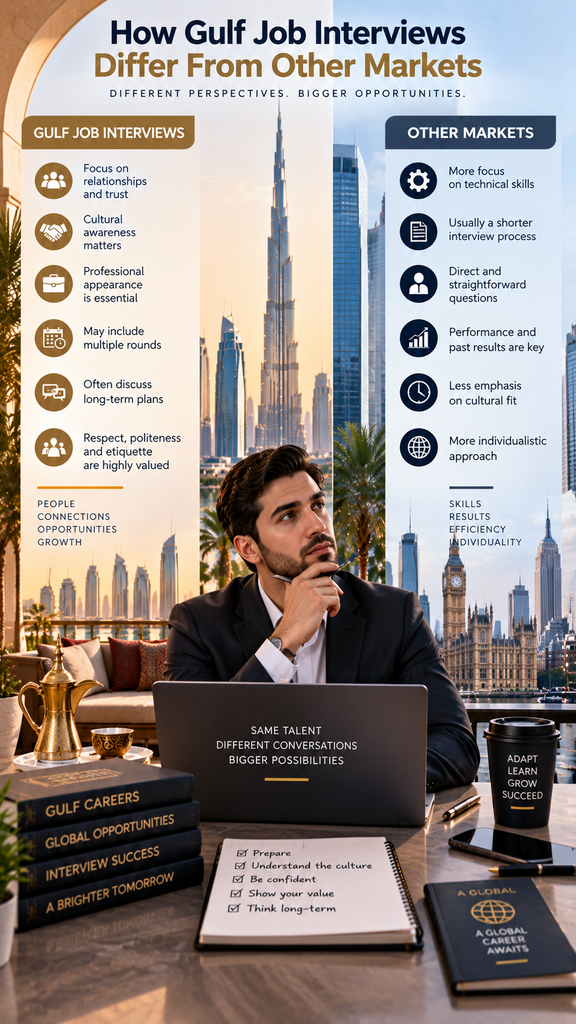
Candidates applying to Gulf companies should understand the market they want to join.
If you are interviewing for a tourism role in Saudi Arabia, understand why tourism is expanding. If you are applying to a logistics company in Oman, know the significance of the country’s ports and trade position.
A candidate interviewing for fintech in Bahrain should understand the country’s financial-services ecosystem, while someone applying for technology work in the UAE should know the basic direction of the digital economy.
You do not need to memorise hundreds of statistics.
Instead, understand:
- What the company does
- Who its customers are
- Which GCC markets it serves
- Which major trends affect its industry
- Who its main competitors are
This allows you to give answers connected to the employer’s actual environment.
Regional knowledge communicates seriousness.
Common Questions in Gulf Job Interviews
Many interview questions are similar to those used internationally.
Candidates should prepare for questions such as:
- Tell me about yourself.
- Why do you want this position?
- Why do you want to work in the GCC?
- What do you know about our company?
- What was your biggest achievement in your previous role?
- Tell me about a difficult problem you solved.
- Why are you leaving your current employer?
- How do you manage multicultural teams?
- What is your current notice period?
- When can you join?
- What are your salary expectations?
- Do you have GCC experience?
- Are you willing to relocate?
- Which languages do you speak?
Do not memorise robotic answers.
Instead, prepare key points and examples so that your response sounds natural.
Your strongest answers should normally connect your experience directly with the employer’s requirements.
The STAR Method for GCC Interviews
Behavioural questions are easier to answer when you use a clear structure.
The STAR method stands for:
| Stage | Meaning |
|---|---|
| Situation | Explain the context |
| Task | Describe your responsibility |
| Action | Explain what you personally did |
| Result | Show what happened |
Imagine you are asked:
Tell me about a time you reduced costs.
A strong answer would briefly explain the business problem, your responsibility, what action you took and the measurable savings achieved.
Avoid spending most of the answer describing the situation.
The interviewer is more interested in what you did than in a five-minute history of the company.
Whenever possible, include results such as revenue, cost savings, efficiency improvement or project completion.
What to Wear to a Gulf Job Interview
Professional and modest clothing is generally the safest choice.
For many corporate positions, men can choose a business suit or formal shirt and trousers depending on the employer. Women can choose professional business clothing that provides appropriate coverage and suits the organisation’s culture.
Local national dress can also be appropriate for GCC nationals depending on country and workplace convention.
The level of formality changes by industry.
A startup interview may be more relaxed than a meeting with a bank or government organisation, but appearing slightly more professional than necessary is usually safer than appearing underdressed.
Saudi employment guidance explicitly recognises appropriate clothing and punctuality as signs of seriousness during interviews.
Personal presentation should communicate respect for the opportunity rather than become the centre of attention.
Gulf Job Interviews in the UAE
The UAE job market is exceptionally international, especially in Dubai and Abu Dhabi.
Interview processes at multinational companies may closely resemble those in London, Singapore or New York. Candidates may encounter recruiter screens, competency interviews, technical assessments and final management discussions.
Local and regional businesses can have different processes.
UAE candidates should be prepared to discuss current location, notice period, visa situation and previous regional experience where these factors are relevant.
Cultural awareness also matters. The UAE Government explicitly advises job seekers to improve their knowledge of regional social and cultural values and notes that Arabic can provide an advantage.
Emiratisation should also be understood because some recruitment strategies are influenced by national employment targets. Companies with 50 or more employees must meet prescribed growth targets for Emirati employment in skilled positions.
International candidates should therefore focus on positions where their specialist experience is genuinely relevant.
Gulf Job Interviews in Saudi Arabia
Saudi interviews increasingly reflect a labour market undergoing rapid transformation.
Employers may place significant emphasis on professional qualifications, sector experience, local-market knowledge and whether the candidate’s occupation is affected by localisation requirements.
Saudi Arabia’s professional verification system is designed to confirm qualifications, specialisations and experience for relevant expatriate professions.
Localisation should also be considered carefully. Current Saudi policies apply different Saudisation percentages to specific professions, including engineering and procurement.
Professional formality can be important, particularly in traditional companies, major institutions and senior roles.
Candidates should research the organisation, understand its industry and demonstrate respect for local business culture.
International professionals should also be prepared to explain why their particular expertise adds value to the Saudi market rather than giving a generic answer about wanting to work in Riyadh.
Gulf Job Interviews in Qatar
Qatar’s smaller professional market means specialist reputation and exact role fit can be particularly important.
Employers in sectors such as energy, aviation, financial services, construction, hospitality and technology may look for candidates with substantial technical or project experience.
Candidates should prepare examples demonstrating scale.
A project manager might explain project values, timelines and team sizes, while a finance professional should discuss responsibility for reporting, budgets or regulatory requirements.
Doha’s multinational work environment also makes communication and cross-cultural ability valuable.
International applicants should be ready to discuss relocation, availability and previous Middle East experience where relevant.
As in other Gulf markets, avoid assuming that a friendly interview means the employer has already made a decision. Professional selection processes can still involve several internal approvals.
Gulf Job Interviews in Bahrain
Bahrain has a compact professional market, particularly in banking, fintech, manufacturing and professional services.
Because professional communities can be interconnected, reputation may matter considerably.
Interviewers may ask technical questions alongside broader questions about your understanding of the sector and why you want to work in Bahrain.
Finance candidates should be prepared to discuss regulatory awareness, compliance, digital transformation or customer experience depending on the role.
Strong communication can be particularly important in smaller organisations where employees often work across several responsibilities rather than remaining inside narrow job descriptions.
Do not underestimate the interview because the company is smaller than a multinational employer. Smaller organisations can expect candidates to demonstrate greater flexibility and independence.
Gulf Job Interviews in Oman
Oman’s interview environment can vary widely between government-related organisations, large companies, hospitals and private SMEs.
Professional preparation remains essential.
Oman-based official interview guidance recommends preparing thoroughly, making a positive first impression, demonstrating potential and completing appropriate post-interview follow-up. It also recognises panel and sequential interviewing as possible formats.
Omanisation is another important employment-market factor. The Ministry of Labour reported more than 34,000 opportunities in employment, Omanisation and on-the-job training during the first half of 2026.
Candidates should therefore understand whether the targeted position has specific national workforce requirements.
International professionals can strengthen their case by demonstrating technical expertise that supports sectors where Oman is expanding, such as logistics, energy, manufacturing, tourism and technology.
Gulf Job Interviews in Kuwait
Kuwait’s professional market contains strong sectors in energy, finance, retail, infrastructure and government-linked business.
Interview styles can range from highly structured corporate recruitment to more relationship-based processes inside privately held organisations.
Candidates should present themselves professionally and understand the company before arriving.
For experienced professionals, interviewers may focus heavily on previous responsibility, project size and technical expertise.
International candidates may also need to discuss relocation and availability.
Kuwait’s business environment should not simply be treated as identical to Dubai or Saudi Arabia. Candidates who demonstrate specific interest in the Kuwaiti employer and market will generally sound more credible than those who appear to be applying randomly throughout the Middle East.
Online Interviews for Gulf Jobs
Video interviews have made international GCC recruitment easier.
Candidates can now complete early interview rounds before travelling to the region.
Treat an online interview with the same seriousness as a physical meeting.
Check:
- Internet connection
- Camera position
- Microphone
- Lighting
- Background
- Meeting software
- Time zone
Join several minutes early.
Keep your CV and job description available, but do not constantly look away from the camera to read prepared answers.
Online interviewing also increases recruitment-scam risk because candidates may never meet the supposed employer physically.
Verify company email addresses, websites and recruiter identities. The UAE Government advises candidates to check whether employment communications come from a company-domain email and warns against paying recruitment-related charges.
Professional caution is as important online as interview preparation.
Interview Advice for Expats
Expats should prepare to explain why they want to work in the specific Gulf market.
Avoid answers such as:
“I heard salaries are high.”
A stronger response connects your experience with the employer’s business and explains why the role fits your career.
Candidates without Gulf experience should research the market rather than repeatedly apologising for being new to the region.
You can say:
“My experience has been in international logistics rather than directly in the GCC, but I have managed cross-border operations across six markets, and I have been studying how your regional distribution network operates.”
This sounds much stronger than:
“I don’t have Gulf experience, but please give me a chance.”
International professionals should present themselves as capable specialists adapting to a new market, not as applicants asking employers to overlook a weakness.
Interview Advice for GCC Nationals
GCC nationals increasingly have opportunities across private-sector industries as governments expand localisation and national workforce programmes.
Candidates should still compete through skills.
Saudi Arabia’s Ministry of Human Resources emphasises future skills, sector-specific development and alignment between education and labour-market requirements. UAE Emiratisation policies similarly aim to increase national participation in skilled private-sector positions.
During interviews, nationals should demonstrate professional expertise rather than relying on localisation status.
Explain internships, technical capabilities, projects and commercial knowledge.
Strong English can be useful in multinational companies, while Arabic is naturally valuable in local-market and government-related positions.
The most competitive GCC national professionals will combine local market understanding with internationally competitive skills.
Salary Negotiation During Gulf Interviews
Salary negotiation should begin with preparation rather than emotion.
Research market ranges for the specific role, country and industry. Compare jobs based on total compensation rather than only headline monthly salary.
If asked for expectations early, you can provide a realistic range while indicating that the complete role and benefits matter.
Avoid saying:
“Anything is fine.”
This can suggest you have not researched the market.
At the opposite extreme, avoid demanding a number based solely on personal expenses.
Employers pay according to market value and role responsibility, not because a candidate’s rent has increased.
When an offer arrives, clarify:
- Basic salary
- Allowances
- Bonus structure
- Medical insurance
- Annual leave
- Relocation support where applicable
- Other important benefits
Negotiate professionally and decide what matters most before entering the conversation.
Questions Candidates Should Ask Employers
An interview should not be completely one-sided.
Good questions show that you are evaluating the role thoughtfully.
Useful questions include:
- What would success look like during the first six months?
- What are the biggest challenges facing this position?
- How is the team structured?
- Who would I report to?
- Why is the position available?
- Which projects would I handle first?
- How is performance measured?
- What are the next stages of the recruitment process?
For senior roles, you can ask about business strategy, regional expansion or organisational priorities.
Avoid beginning the interview by asking only about leave, salary and working hours unless the recruiter has already moved the conversation toward employment terms.
Those questions are legitimate, but timing matters.
Common Gulf Interview Mistakes
Arriving without researching the company is one of the easiest ways to make a weak impression. Employers expect candidates to understand at least the basics of their business.
Giving very long answers can also create problems. Explain enough context to make the answer meaningful, but keep focus on your actions and results.
Criticising previous employers rarely helps. Even if your previous experience was difficult, explain why you want to move forward professionally.
Exaggerating Gulf experience is particularly risky because industries and professional communities can be interconnected.
Ignoring cultural expectations can make strong technical candidates appear poorly prepared.
Talking only about salary can suggest the company or role itself does not matter.
Pretending to know something you do not is another major mistake. A professional answer such as “I have not worked directly with that system, but I have used a comparable platform and would be comfortable learning it” is much stronger than improvising incorrect technical information.
Finally, candidates should avoid appearing desperate.
Enthusiasm is positive. Desperation can lead to poor communication and acceptance of suspicious recruitment practices.
Gulf Job Interview Preparation Checklist
Before attending an interview anywhere in the GCC, complete the following preparation:
- Research the company thoroughly.
- Read the job description again.
- Identify the five most important requirements.
- Prepare examples demonstrating each important skill.
- Research the employer’s industry.
- Understand the relevant GCC market.
- Know your CV thoroughly.
- Prepare measurable achievements.
- Practise a concise professional introduction.
- Prepare STAR examples for behavioural questions.
- Research realistic salary ranges.
- Know your current notice period.
- Understand your residency or relocation situation.
- Check whether the profession is subject to localisation requirements.
- Prepare appropriate professional clothing.
- Confirm the interview address or video link.
- Check the interviewer’s name and title when available.
- Prepare three thoughtful questions.
- Carry copies of relevant documents when appropriate.
- Arrive on time.
- Communicate respectfully with everyone you meet.
- Never invent qualifications or experience.
- Verify suspicious recruitment communications.
- Never pay someone to guarantee employment.
- Follow up professionally after a meaningful interview.
The objective is not to memorise perfect answers. It is to prepare enough that you can concentrate on the actual conversation.
Final Thoughts on Gulf Job Interviews
Gulf Job Interviews share many fundamentals with recruitment processes elsewhere in the world, but the regional environment creates several additional considerations.
Employers still want competence, professionalism and evidence of achievement. However, candidates may also encounter questions about GCC experience, regional knowledge, notice periods, relocation, residency and language capabilities.
Cultural awareness can matter as well. The UAE Government advises job seekers to understand the region’s social and cultural values, maintain an honest CV, improve their professional knowledge and remain realistic about compensation. Saudi employment guidance also recognises punctuality and appropriate interview presentation as indicators of serious job-seeking behaviour.
The regional labour market is also becoming increasingly skills-driven. Saudi Arabia’s workforce strategy focuses heavily on matching skills with market demand, while its professional verification system examines the qualifications and experience of relevant expatriate professionals.
Nationalisation adds another important difference. Emiratisation affects skilled private-sector employment in the UAE, while Saudi Arabia applies localisation requirements across selected professions and industries. Oman is similarly strengthening Omanisation alongside employment and training initiatives.
Candidates should not see these differences as reasons to overcomplicate the interview.
The most successful strategy remains straightforward.
Understand the employer, know your experience, demonstrate measurable value, communicate professionally and show that you understand the market you want to join.
A strong international candidate should explain how their expertise transfers into the Gulf. A professional who already has GCC experience should demonstrate what they actually achieved rather than relying on regional experience alone. GCC nationals should combine local knowledge with specialist skills that make them valuable in increasingly competitive private-sector economies.
Most importantly, candidates should remember that an interview is not simply a test.
It is a conversation designed to answer two questions: Can you help the company succeed, and is this company the right place for the next stage of your career?
When candidates prepare for both questions, Gulf interviews become far easier to approach with confidence.
Do follow us on Instagram
Read More – Gulf CV Writing: 15 Essential Tips for Career Success