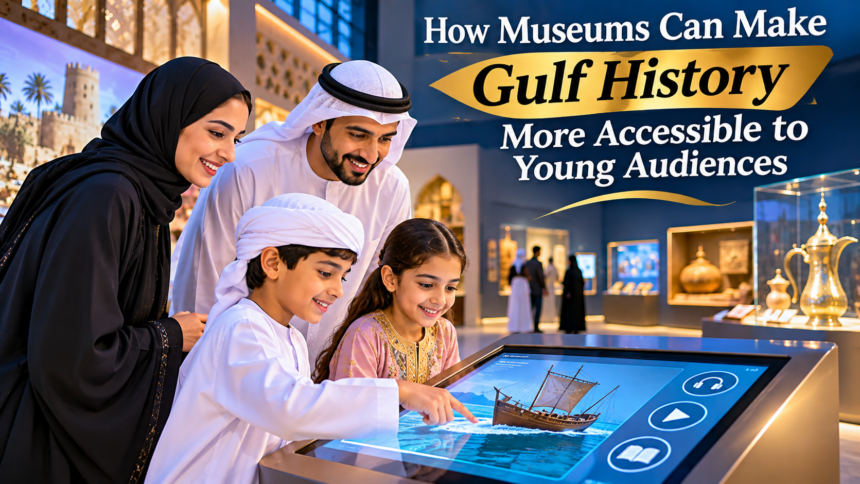
Building a New Generation of Young Heritage Explorers
The Arabian Gulf has a rich history shaped by maritime trade, pearl diving, desert communities, traditional craftsmanship, and cultural exchanges that connected the region with distant parts of the world. Museums across the Gulf Cooperation Council (GCC) play an important role in preserving these experiences and introducing visitors to the traditions that influenced modern Gulf societies. However, as younger generations grow up surrounded by digital entertainment, interactive technology, and rapidly changing educational experiences, museums face an important challenge: how can they make history engaging, understandable, and relevant to young audiences?
- 1. Why Gulf Museums Must Rethink How Young Audiences Experience History
- 2. How Interactive Exhibitions Can Bring Gulf Heritage to Life
- 3. The Powerful Role of Digital Technology in Museum Education
- 4. Why Storytelling Can Make Gulf History More Meaningful to Children
- 5. How Gulf Museums Are Developing Youth-Friendly Learning Experiences
- 6. Making Gulf Museums More Inclusive, Affordable, and Accessible
- 7. The Future of Gulf Museums: Building a New Generation of Heritage Explorers
- Conclusion
Gulf museums for young audiences have an opportunity to transform the way cultural heritage is experienced. Rather than relying exclusively on historical objects, written descriptions, and traditional exhibitions, museums can introduce storytelling, digital experiences, creative workshops, and participatory learning activities that encourage curiosity.
This transformation does not require museums to abandon their responsibility to preserve authentic historical knowledge. Instead, it involves presenting heritage in ways that connect with the interests, learning preferences, and everyday experiences of children and teenagers.
From the United Arab Emirates and Saudi Arabia to Qatar, Oman, Bahrain, and Kuwait, museums can become spaces where younger visitors discover not only what happened in the past, but also why those experiences continue to shape contemporary Gulf identity.
1. Why Gulf Museums Must Rethink How Young Audiences Experience History
Museums have traditionally been associated with carefully preserved artefacts, historical collections, and educational exhibitions. While these remain essential, younger audiences may respond differently to museum environments compared with older visitors.
Children often learn through observation, interaction, experimentation, and storytelling. Teenagers may be more interested in opportunities to explore independent perspectives, connect historical events to present-day issues, or participate in creative activities.
A museum designed entirely around lengthy written descriptions may therefore struggle to maintain the attention of every visitor.
Understanding Different Learning Needs
Young audiences are not a single group with identical interests.
A child visiting a museum for the first time may enjoy discovering historical objects through games and guided activities. A secondary-school student may prefer examining historical evidence, debating interpretations, or exploring technological exhibitions.
Museums can improve accessibility by designing learning experiences suitable for different age groups.
| Age Group | Learning Preferences | Suitable Museum Activities |
|---|---|---|
| Ages 4–7 | Sensory exploration and simple narratives | Storytelling, visual displays, supervised hands-on activities |
| Ages 8–12 | Discovery and problem-solving | Interactive exhibitions, treasure hunts, creative workshops |
| Ages 13–17 | Independent exploration and critical thinking | Digital exhibits, guided discussions, historical simulations |
| Ages 18–25 | Research, identity, and social relevance | Curated debates, internships, exhibitions, research projects |
These categories provide general planning guidance rather than rigid educational rules. Individual learning needs and interests vary considerably.
Connecting History With Everyday Life
One way to make Gulf history relevant is to demonstrate how historical practices influence contemporary society.
For example, an exhibition about traditional pearl diving could explain the economic importance of maritime industries while exploring the working conditions and skills involved.
Visitors might then compare these historical occupations with the region’s modern maritime, logistics, and tourism sectors.
Similarly, exhibitions about traditional markets can introduce young audiences to the commercial networks that existed before modern shopping centres.
Such connections help students recognise that history is not simply a collection of disconnected dates and events.
Encouraging Curiosity Rather Than Memorisation
Museums can also encourage visitors to approach history through questions.
Instead of presenting a traditional fishing vessel only as an artefact, an exhibition could ask how communities navigated the sea, stored supplies, and responded to difficult weather conditions.
This approach encourages observation and historical reasoning.
When visitors are invited to investigate evidence and consider different explanations, museum learning can become more meaningful and memorable.
2. How Interactive Exhibitions Can Bring Gulf Heritage to Life
Interactive exhibitions can help visitors engage with historical subjects through practical activities and direct participation.
Unlike passive displays, participatory experiences encourage visitors to explore concepts, make decisions, and discover information through involvement.
These methods are particularly valuable when explaining occupations, technologies, and social practices that may be unfamiliar to younger generations.
Recreating Traditional Gulf Experiences
Museums can develop carefully designed activities inspired by traditional occupations and cultural practices.
A maritime exhibition might include a navigational activity where children identify routes used by historical traders.
A craftsmanship gallery could offer supervised demonstrations of weaving, pottery, or traditional decorative techniques.
Such activities should make clear whether visitors are observing authentic practices, educational reconstructions, or modern interpretations.
Possible interactive experiences include:
- Simulated pearl-diving expeditions explaining historical maritime work.
- Model-building workshops exploring traditional Gulf architecture.
- Interactive trading games demonstrating historical commercial networks.
- Craft demonstrations introducing regional materials and techniques.
- Digital maps showing historical travel and migration routes.
- Story-based activities exploring family and community life.
These experiences can make historical information easier to understand by connecting abstract concepts with practical situations.
Learning Through Historical Problem-Solving
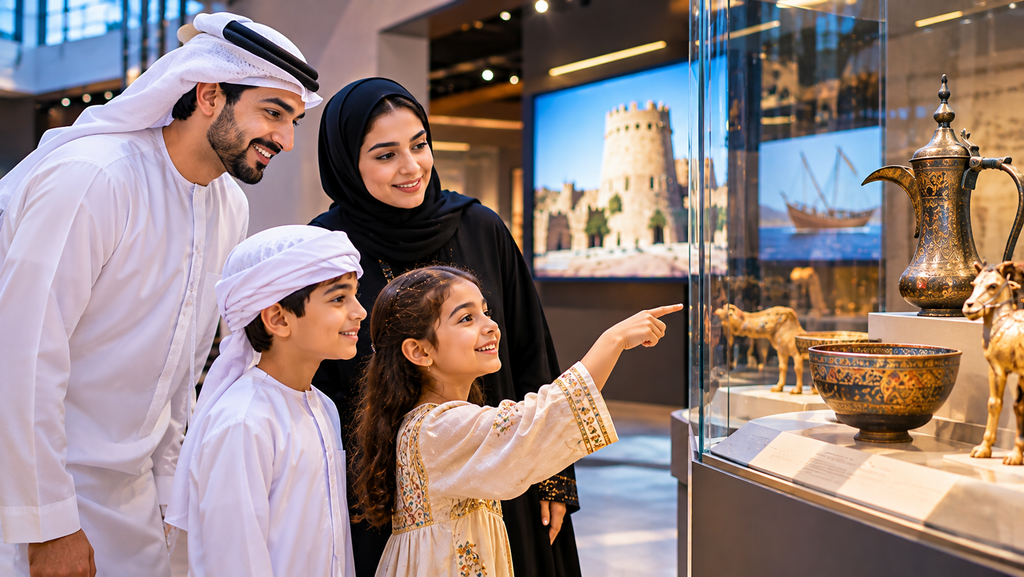
Interactive exhibitions can introduce challenges based on historical conditions.
For example, visitors could be asked to select appropriate materials for constructing a traditional building in a hot climate.
The activity could then explain how architectural features such as courtyards, shading, and ventilation responded to environmental conditions.
Another exhibition might allow students to investigate how communities accessed and conserved water.
These activities encourage visitors to consider the relationship between historical knowledge and everyday survival.
Balancing Entertainment and Historical Accuracy
Interactive technology should support educational objectives rather than become the sole attraction.
A historical simulation may be visually impressive, but its value depends on whether it accurately explains the subject.
Museums should collaborate with historians, educators, curators, and cultural practitioners when designing participatory experiences.
Clear explanations should distinguish verified historical information from reconstructed or speculative details.
This allows visitors to enjoy engaging exhibitions while developing respect for historical evidence.
3. The Powerful Role of Digital Technology in Museum Education
Digital technology offers museums new ways to communicate historical information and reach audiences beyond physical exhibition spaces.
Augmented reality, virtual reality, interactive screens, digital archives, and educational applications can help visitors explore history through different formats.
However, the effectiveness of these tools depends on accessibility, content quality, and appropriate integration with museum collections.
Augmented Reality and Historical Reconstruction
Augmented reality can place digital information over physical objects or environments.
For example, visitors examining the remains of a historical building could use an interactive display to explore a carefully researched reconstruction of its earlier appearance.
A maritime exhibition might use digital overlays to explain the structure and function of traditional vessels.
Such experiences can help visitors visualise historical environments that no longer exist in their original form.
Museums should clearly identify reconstructed elements so audiences understand the difference between historical evidence and interpretation.
Virtual Reality and Immersive Learning
Virtual reality can introduce visitors to recreated historical environments.
Students might explore a traditional marketplace, observe a maritime trading journey, or experience an interpretation of life within an earlier Gulf settlement.
These environments can provide context that static objects alone may not communicate.
However, virtual experiences must be designed carefully to avoid overwhelming younger visitors or presenting uncertain historical details as established facts.
Museums also need to consider motion sensitivity, accessibility, supervision, and alternative learning formats.
The Importance of Digital Archives
Digital collections can make historical photographs, documents, objects, and oral histories available to students who cannot easily visit a museum.
Online resources are especially valuable for teachers preparing lessons or students conducting independent research.
A well-organised digital archive should provide clear descriptions, historical context, and appropriate source information.
Comparing Traditional and Digital Museum Experiences
| Feature | Traditional Exhibition | Digital Exhibition |
|---|---|---|
| Main Experience | Physical objects and interpretive displays | Multimedia and interactive content |
| Visitor Interaction | Guided tours and observation | Interactive exploration and simulations |
| Historical Context | Labels, artefacts, and curator explanations | Animation, digital maps, and layered information |
| Remote Access | Usually requires a physical visit | Can support virtual access |
| Maintenance | Conservation and exhibition upkeep | Software updates, technical support, digital preservation |
| Accessibility | Depends on physical design and interpretation | Depends on interface, equipment, and alternative formats |
The strongest museum experiences may combine these approaches rather than treating them as competitors.
A physical artefact can provide an authentic connection to the past, while digital interpretation can explain its significance in greater detail.
4. Why Storytelling Can Make Gulf History More Meaningful to Children
Historical information becomes easier to understand when it is connected to people, experiences, and meaningful narratives.
Storytelling allows museums to communicate cultural heritage through personal perspectives rather than relying exclusively on dates and chronological descriptions.
For younger visitors, narratives can help explain why historical events mattered to the communities that experienced them.
Exploring History Through Personal Experiences
Museums can present historical subjects through documented accounts of traders, craftspeople, families, sailors, and community leaders.
A gallery about pearl diving, for instance, might explain the experiences of divers, vessel crews, and families whose livelihoods depended on the industry.
Where reliable first-person accounts exist, museums can incorporate them into exhibitions.
When stories are fictional reconstructions, they should be identified accordingly and developed using credible historical research.
The Importance of Oral History
Oral history provides valuable opportunities to preserve personal memories and community experiences.
Interviews with older residents can document changes in neighbourhoods, occupations, education, social customs, and family life.
These accounts can help young visitors understand historical transformation through human experiences.
However, personal memories should be interpreted alongside other historical sources because individual recollections may be incomplete or subjective.
Making Young Visitors Part of the Story
Storytelling becomes especially engaging when audiences can participate.
Museums could invite students to explore historical decisions, identify evidence, or compare different interpretations.
For example, visitors might examine objects associated with maritime trade and develop explanations of how they were used.
A guided discussion could then connect their observations with documented historical knowledge.
This approach encourages critical thinking while maintaining the educational purpose of the exhibition.
Connecting Gulf History With Multicultural Experiences
The Arabian Gulf has long maintained connections with communities across the Indian Ocean and neighbouring regions.
Exhibitions can explore these historical relationships through trade, migration, language, and cultural exchange.
Such narratives can help young residents from different backgrounds understand how regional identity developed through both local traditions and international relationships.
They can also encourage respect for the diverse communities that contributed to Gulf history.
5. How Gulf Museums Are Developing Youth-Friendly Learning Experiences
Museums across the GCC have introduced educational initiatives designed to make cultural learning more engaging for families, school groups, and younger visitors.
Although approaches differ across institutions, several examples illustrate how museums can connect collections with interactive education.
Louvre Abu Dhabi and Participatory Learning
Louvre Abu Dhabi provides learning resources for children, families, and educators, including activities designed to encourage independent exploration of museum collections.
Its Children’s Museum and school programmes demonstrate how exhibitions and educational activities can be adapted for younger audiences.
The museum also uses storytelling, artistic exploration, and participatory learning to support cultural understanding.
The National Museum of Qatar
The National Museum of Qatar offers school programmes involving guided tours, hands-on activities, and storytelling.
Educational themes include Qatari history, community traditions, cultural identity, and environmental relationships.
The museum also provides digital learning resources and interactive experiences that can help students explore heritage beyond conventional gallery interpretation.
Sharjah’s Museum Education Programmes
Sharjah Museums Authority offers educational visits incorporating discussion-based learning, workshops, and interactive digital activities.
Its museum network includes institutions dedicated to heritage, archaeology, science, art, and maritime history.
The variety of subjects creates opportunities for schools to connect local history with wider educational themes.
Oman Across Ages Museum
The Oman Across Ages Museum presents the country’s historical development through collections, audiovisual interpretation, and interactive exhibitions.
Its Knowledge Centre offers educational resources and learning spaces for different age groups.
The museum also provides accessibility features intended to support visitors with different needs.
Lessons for Museums Across the GCC
| Museum or Institution | Educational Approach | Potential Lesson |
|---|---|---|
| Louvre Abu Dhabi | Family resources and participatory programmes | Encourage independent discovery |
| National Museum of Qatar | Storytelling and hands-on school programmes | Connect heritage with student experiences |
| Sharjah Museums Authority | Workshops and interactive educational visits | Combine curriculum learning with museum collections |
| Oman Across Ages Museum | Interactive interpretation and learning facilities | Present history through multiple formats |
These examples demonstrate that youth engagement can involve different approaches.
Museums do not need identical technologies or exhibition designs to become more accessible.
Their effectiveness depends on how successfully educational programmes connect audiences with authentic collections and historical knowledge.
6. Making Gulf Museums More Inclusive, Affordable, and Accessible
Accessibility is not limited to the availability of digital technology.
A museum may contain sophisticated interactive exhibitions while remaining difficult to visit for families facing transportation, financial, linguistic, or physical barriers.
Making history accessible requires attention to the complete visitor experience.
Language and Cultural Accessibility
Gulf societies include residents from many linguistic and cultural backgrounds.
Providing clear interpretation in Arabic and English can support broad audiences, while additional language options may improve access for particular visitor groups.
Museums can also offer simplified explanations for children and more detailed material for older students or researchers.
Information should remain accurate while avoiding unnecessary technical language.
Physical and Sensory Accessibility
Museums should consider the needs of visitors with mobility, visual, hearing, or sensory differences.
Useful features may include accessible routes, tactile replicas, audio descriptions, captions, quiet areas, and alternative ways to interact with exhibitions.
Accessibility should be considered during exhibition planning rather than added only after installation.
Affordability and School Participation
Admission fees, transportation expenses, and limited school resources can prevent some young people from accessing museum education.
Institutions can explore school partnerships, subsidised visits, community programmes, and free educational resources.
Some Gulf museums already provide selected free-entry arrangements or educational opportunities, although eligibility and terms vary.
Practical Accessibility Checklist
- Provide age-appropriate information in clear language.
- Offer accessible routes and exhibition layouts.
- Include captions and audio alternatives.
- Consider visitors with sensory sensitivities.
- Provide clear information about admission and booking requirements.
- Develop programmes for schools with limited resources.
- Offer online learning materials for remote audiences.
- Collect feedback from families and young visitors.
An inclusive museum should provide meaningful learning opportunities to a wide range of visitors rather than relying on a single exhibition format.
7. The Future of Gulf Museums: Building a New Generation of Heritage Explorers
The future of museum education across the GCC will depend on how cultural institutions balance historical preservation with changing audience expectations.
As young people become increasingly familiar with digital communication, museums have opportunities to develop more participatory experiences.
However, technological innovation should remain connected to authentic historical knowledge and meaningful educational objectives.
Giving Young People a Voice in Museum Design
Museums can involve students and young adults in the development of educational programmes.
Youth advisory groups, school partnerships, internships, and collaborative exhibitions can help institutions understand what younger audiences find relevant.
Such initiatives can also introduce young participants to careers in heritage preservation, archaeology, museum education, and cultural management.
Using Artificial Intelligence Responsibly
Artificial intelligence may help museums develop multilingual interpretation, personalised learning activities, and improved access to digital collections.
However, historical accuracy, privacy, cultural representation, and transparency remain essential.
AI-generated reconstructions should be reviewed by qualified specialists and clearly distinguished from authentic historical records.
Measuring Meaningful Youth Engagement
Museums should evaluate more than visitor numbers when assessing the success of educational programmes.
Useful indicators may include:
- Students’ understanding of historical subjects.
- Participation in workshops and discussions.
- Visitor satisfaction and accessibility feedback.
- Repeat visits and school partnerships.
- Interest in further cultural learning.
- Engagement with digital educational resources.
These measures can help institutions understand whether exhibitions are producing meaningful educational outcomes.
Creating Lifelong Connections With Heritage
A successful museum experience should encourage curiosity beyond a single visit.
Students might continue exploring historical topics through school projects, family discussions, online archives, or community activities.
Museums can support this interest by providing educational materials that connect their collections with wider historical questions.
Conclusion
Gulf museums have an important opportunity to make regional history more accessible, engaging, and meaningful for younger generations.
Interactive exhibitions, digital technology, storytelling, educational partnerships, and inclusive design can help cultural institutions communicate the past in ways that connect with contemporary audiences.
However, accessibility requires more than modern equipment or visually impressive displays. Museums must also ensure historical accuracy, provide age-appropriate interpretation, and create opportunities for meaningful participation.
Across the GCC, cultural institutions are increasingly exploring ways to combine traditional collections with modern educational methods.
By involving young audiences in the learning process, museums can encourage a deeper appreciation of Gulf heritage while strengthening the connections between historical knowledge and contemporary identity.
The future of museum education will ultimately depend on helping young people recognise that history is not simply something preserved behind glass. It is a continuing source of knowledge, cultural understanding, and shared identity that can inform how future generations understand their place in the region.
Do follow us on Instagram
Read More – The Future of Vocational Education in the GCC: Beyond University Degrees