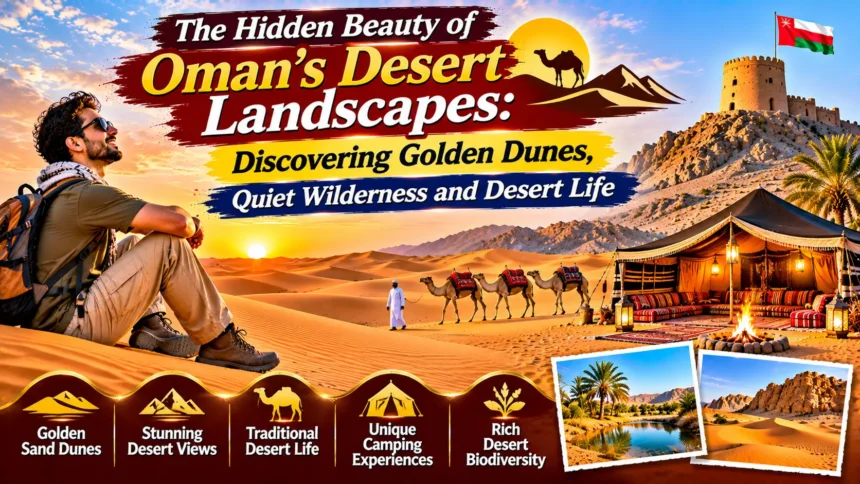
The Hidden Beauty of Oman’s Desert Landscapes
Oman is famous for its historic forts, beautiful beaches, high mountains and green valleys. However, one of the country’s most fascinating natural attractions is its desert. Away from busy towns and modern buildings, Oman has enormous areas of golden sand, rocky plains, quiet oases and wide open spaces that offer a completely different travel experience.
- 1. Sharqiya Sands: A Beautiful World of Golden Dunes
- 2. The Empty Quarter: A Vast Desert with Endless Views
- 3. Jiddat Al Harasis: The Beauty of Oman’s Rocky Desert
- 4. Desert Oases: Small Green Spaces Among the Sand
- 5. The Changing Colours of Oman’s Desert Landscapes
- 6. Desert Wildlife: Animals That Have Adapted to the Dry Environment
- 7. Bedouin Culture and Traditional Desert Life
- 8. Desert Adventures: Exciting Ways to Explore the Sand
- 9. Desert Sunsets and Beautiful Night Skies
- 10. The Best Time to Explore Oman’s Deserts
- 11. Important Tips for a Safe and Responsible Desert Trip
- 12. Why Oman’s Desert Landscapes Are Worth Exploring
- Conclusion
- Frequently Asked Questions (FAQs)
The beauty of Oman’s desert landscapes is not limited to sand dunes. Different regions have their own colours, shapes and natural features. Some are covered with soft golden sand, while others have reddish dunes, gravel plains and rocky ground. There are also small green areas where plants and trees grow despite the dry weather.
These deserts are also connected with Oman’s history and traditional way of life. For generations, local communities have learned how to live in this difficult environment, using their knowledge of the land, animals and weather. Today, visitors can explore these areas through guided desert trips, camping, camel rides and cultural experiences.
Let’s discover the hidden beauty of Oman’s desert landscapes and understand why these natural places are worth exploring.
1. Sharqiya Sands: A Beautiful World of Golden Dunes
One of the most famous desert destinations in Oman is Sharqiya Sands, also known as Wahiba Sands. Located in eastern Oman, this large sandy region is known for its beautiful dunes, open views and traditional desert experiences.
Sharqiya Sands, also known as Wahiba Sands, is one of the easiest deserts to visit in Oman. It covers around 12,500 square kilometres and is known for its beautiful golden and reddish sand dunes. It is located about 2.5 to 3 hours from Muscat.
The landscape changes as visitors travel deeper into the desert. The flat land gradually gives way to rolling dunes that stretch towards the horizon. Some dunes are small and smooth, while others rise high above the surrounding sand. Their colours vary from light yellow and orange to reddish-brown and deep golden shades.
One of the most interesting things about Sharqiya Sands is how its appearance changes throughout the day. In the early morning, the sand looks soft and light. During the afternoon, strong sunlight makes the dunes appear brighter. At sunset, the landscape takes on warm orange and red colours.
Sharqiya Sands is also popular because it offers several activities for visitors. Travellers can enjoy four-wheel-drive trips, camel riding, sandboarding and overnight desert camping. Some tours also include visits to nearby Bedouin communities, where visitors can learn about traditional customs and desert life.
Another beautiful feature of this region is its open and peaceful atmosphere. Standing on top of a high dune and looking across the surrounding landscape gives visitors a feeling of space and freedom that is difficult to find in busy cities.
2. The Empty Quarter: A Vast Desert with Endless Views
The Rub’ al Khali, commonly known as the Empty Quarter, is one of the most remarkable desert regions in the world. It is part of the largest continuous sand desert on Earth and stretches across several countries of the Arabian Peninsula, including Oman.
The Empty Quarter (Rub’ al Khali) is the world’s largest continuous sand desert, covering around 650,000 square kilometres. It stretches into the remote Dhofar region of southern Oman. Unlike the easier-to-reach Sharqiya Sands, this desert offers huge sand dunes, peaceful surroundings, and a chance to experience the wild beauty of nature.
The Omani part of the Empty Quarter lies in the western areas of the country, particularly towards Dhofar and Al Wusta. It is known for its enormous dunes, wide sandy spaces and remote surroundings.
Unlike the more accessible parts of Sharqiya Sands, some areas of the Empty Quarter are extremely isolated. There are long distances between settlements, and visitors may travel for hours through open desert terrain. The huge dunes create an impressive view, especially when sunlight falls across their slopes.
The Empty Quarter is a wonderful place for people who enjoy natural landscapes and quiet surroundings. There are fewer signs of modern life in its remote areas, allowing visitors to experience the scale and stillness of the desert.
However, exploring this region requires careful planning. Visitors should travel with experienced guides, use suitable four-wheel-drive vehicles and carry enough water and emergency supplies. It is not a place for an unplanned solo drive.
3. Jiddat Al Harasis: The Beauty of Oman’s Rocky Desert
When people imagine a desert, they usually think of golden sand dunes. But Oman has another kind of desert scenery that looks completely different. Jiddat Al Harasis, located in central Oman, is known for its rocky plateau, open plains and dry natural surroundings.
Much of the area is formed by limestone and other rocky surfaces. Instead of tall dunes, visitors find wide stretches of stony ground, gently sloping plains and occasional dry channels. The landscape may look simple from a distance, but it has a special beauty of its own.
The natural environment also supports plants and animals that can survive with limited water. Some areas receive seasonal moisture from light rainfall or fog, helping certain desert plants grow.
Jiddat al-Harasis is a large rocky desert covering around 27,000 square kilometres in Oman’s Al Wusta region. Unlike sandy deserts, it is known for its wide limestone plains, plants and animals that survive on moisture from fog, and rare meteorites. It is also an important natural home for the Arabian oryx.
Jiddat Al Harasis is also associated with the conservation story of the Arabian oryx. This desert antelope became an important part of Oman’s wildlife conservation efforts, particularly through reintroduction programmes in the country’s central desert region.
For nature lovers, Jiddat Al Harasis offers a different way to understand Oman’s deserts. It shows that desert beauty does not always come from colourful dunes. Sometimes, it can be found in the patterns of rocky ground, the shape of the land and the wildlife that survives in a challenging environment.
4. Desert Oases: Small Green Spaces Among the Sand
One of the most surprising features of Oman’s desert regions is the presence of green oases. These areas provide a beautiful contrast to the surrounding dry landscape.
An oasis may contain palm trees, small farms, shrubs and other plants that grow where water is available. Some oases are found near settlements, while others appear as green patches surrounded by large sand dunes.
Oman’s desert oases are small green areas with natural water springs, date palm trees, and farms. They grow in places where underground water reaches the surface or old irrigation channels bring water through the dry deserts and mountains.
In the Sharqiya Sands region, places such as Al Raka and Al Hawiyah are known for their oasis landscapes. Their trees and vegetation create a striking contrast with the nearby sand, making these areas especially interesting for visitors and photographers.
Oases have also played an important role in traditional desert life. They offered places where people could find water, grow crops and rest during long journeys. Date palms were particularly valuable because they provided food and shade.
Today, these green areas remind visitors that even dry desert regions can support plant life when the right natural conditions are present.
5. The Changing Colours of Oman’s Desert Landscapes
The colours of Oman’s deserts are among their most attractive features. Although many people imagine deserts as one large area of yellow sand, Oman’s landscapes show a much wider range of natural shades.
In Sharqiya Sands, the dunes can appear pale yellow, golden, orange or reddish-brown. The Empty Quarter is famous for its large sand formations, while rocky regions in central Oman have shades of grey, brown and earthy red.
The changing sunlight makes these colours even more beautiful.
Early morning: The first rays of sunlight create soft golden colours across the dunes. Long shadows highlight the curves and patterns of the sand. It is also a pleasant time to explore because temperatures are usually lower than later in the day.
Afternoon: Strong sunlight makes the sand look brighter and brings out the details of the dunes. The contrast between the blue sky and warm-coloured land can create beautiful views.
Sunset: The desert slowly changes into shades of orange, red and deep gold. The lower sunlight creates long shadows and makes the dunes look almost like waves.
Night: Once the sun disappears, the desert becomes quiet and dark. Away from busy towns, the sky can offer excellent opportunities for stargazing.
These changes make Oman’s deserts attractive to photographers, nature lovers and travellers looking for peaceful outdoor experiences.
6. Desert Wildlife: Animals That Have Adapted to the Dry Environment
Oman’s desert landscapes may look empty, but they support different types of wildlife. Many animals have developed special ways to survive in places where temperatures are high and water is limited.
Some desert animals are active during the cooler hours of the day, while others prefer to move around at night. Many also use burrows, rocky spaces or shaded areas to escape the heat.
Some of the wildlife associated with Oman’s desert and dry regions includes:
- Arabian oryx: A desert antelope recognised by its long, straight horns and white body.
- Arabian gazelle: A graceful animal that can survive in dry areas with suitable food and shelter.
- Sand fox: A small fox adapted to life in hot desert environments.
- Sand cat: A rare wild cat that lives in sandy and arid habitats.
- Desert reptiles: Lizards and other reptiles that use shelter and suitable activity times to avoid extreme heat.
- Desert birds: Different bird species use open plains and desert habitats for feeding, resting and movement.
The Arabian oryx has a particularly important place in Oman’s conservation history. It became extinct in the wild in 1972, but reintroduction efforts began in Oman in 1982. The Arabian Oryx Sanctuary was later recognised by UNESCO in 1994. UNESCO subsequently removed the property from the World Heritage List in 2007 after a major reduction in its protected area.
This history shows why protecting desert habitats is important. These environments may look harsh, but they provide food and shelter for wildlife that cannot easily survive elsewhere.
7. Bedouin Culture and Traditional Desert Life
The history of Oman’s deserts is closely connected with the people who have lived there for generations. Bedouin communities developed ways of life suited to dry weather, limited water and long distances between settlements.
Traditionally, some families moved between different areas depending on seasonal conditions and the availability of grazing land for their animals. Camels, goats and other livestock were important parts of their daily lives.
Oman’s Bedouin communities, including tribes like the Bani Wahiba, Al-Amr, and Harasis, have been part of desert life for many generations. They have preserved traditional ways of living, welcomed guests with great hospitality, and developed a deep understanding of the desert environment.
Camels were especially useful because they could travel across dry land and carry people and supplies. They also provided milk and other valuable resources. Their importance can still be seen in Omani traditions and cultural activities.
Traditional desert knowledge was also essential. People learned to recognise suitable routes, understand changes in the weather, find water sources and care for their animals. These skills were passed from one generation to another.
Visitors to Sharqiya Sands may have opportunities to meet local families, learn about Bedouin customs and experience traditional hospitality. Some organised desert camps introduce visitors to local food, crafts and aspects of desert life.
Exploring these cultural connections makes a desert trip more meaningful. It reminds visitors that the desert is not simply a tourist attraction but also a place with a long history and a living cultural identity.
8. Desert Adventures: Exciting Ways to Explore the Sand
Oman’s deserts offer plenty of activities for people who enjoy outdoor adventures. Visitors can choose between exciting experiences and slower activities that allow them to enjoy the natural surroundings.
Here are some popular ways to explore these landscapes:
- Dune driving: Travel across selected sandy areas in a four-wheel-drive vehicle with an experienced driver.
- Camel riding: Experience a traditional way of moving through the desert while enjoying the surrounding scenery.
- Sandboarding: Slide down suitable dunes on a special board for an exciting outdoor activity.
- Desert camping: Spend a night in an organised camp and enjoy the peaceful surroundings.
- Photography: Capture the changing colours, sand patterns, sunsets and wide desert views.
- Guided desert walks: Explore selected areas on foot with someone who understands the local environment.
- Stargazing: Enjoy the night sky in places away from bright artificial lights.
Some activities depend on the location, weather and services available. Visitors should check with local operators before booking and follow all safety instructions.
9. Desert Sunsets and Beautiful Night Skies
A sunset in the Omani desert can become one of the most memorable parts of a visit. As the sun moves towards the horizon, the sand slowly changes colour. The dunes appear golden, orange and red, while their long shadows create interesting patterns across the landscape.
Many visitors choose to climb a nearby dune to enjoy a wider view of the surroundings. It is also a popular time for photography because the softer light brings out the natural shapes of the sand.
After sunset, the desert becomes cooler and quieter. Away from city lights, visitors may be able to see many stars across the night sky.
Stargazing offers a different kind of desert experience. Instead of focusing on the dunes, visitors can look upwards and enjoy the wide, open sky. On clear nights, familiar constellations may be visible, making the experience even more interesting.
For travellers who want to escape busy surroundings, spending an evening in an organised desert camp can be a peaceful way to enjoy nature.
10. The Best Time to Explore Oman’s Deserts
The weather plays an important role when planning a trip to Oman’s desert regions. Summers can be extremely hot, especially in areas far from the coast. For this reason, the cooler months are generally more suitable for outdoor activities.
The official tourism information for Sharqiya Sands recommends visiting between September and April. During this period, conditions are usually more comfortable for dune driving, camel riding, camping and sightseeing.
Here is a simple seasonal guide:
- September to November: Temperatures begin to become more suitable for outdoor activities, although conditions can still be warm.
- December to February: These are popular months for desert camping and exploring because daytime temperatures are generally cooler. Nights can feel cold.
- March to April: Visitors can enjoy outdoor trips before the hotter summer conditions become more intense.
- May to August: Daytime heat can be extreme. Visitors should take extra care and avoid strenuous activities during the hottest hours.
Weather conditions can vary from one region to another. Always check the local forecast before travelling and follow advice from experienced guides.
11. Important Tips for a Safe and Responsible Desert Trip
A desert journey can be a wonderful experience, but it is important to prepare properly. Remote sandy areas may have limited services, and travelling without suitable equipment can create serious problems.
Before leaving for a desert trip, keep these tips in mind:
Carry enough water: Drinking water is essential in hot and dry conditions. Carry more than you expect to need, especially when travelling through remote areas.
Wear suitable clothing: Lightweight, comfortable clothing can help protect your skin from the sun. A hat, sunglasses and sunscreen are also useful.
Choose the right vehicle: Some sandy routes require a suitable four-wheel-drive vehicle. Do not attempt difficult dune driving without the right experience.
Travel with experienced guides: A local guide can help with routes, safety and knowledge of the surrounding area.
Check the weather: Avoid travelling during dangerous weather conditions and follow local advice.
Respect wildlife: Do not chase, feed or disturb wild animals. Observe them from a safe distance.
Keep the desert clean: Carry your rubbish back with you and avoid damaging plants or natural features.
Respect local traditions: Follow local customs when visiting communities and always ask permission before taking photographs of people.
Responsible travel helps protect the beauty of Oman’s deserts and supports the communities connected with these regions.
12. Why Oman’s Desert Landscapes Are Worth Exploring
Oman’s deserts offer much more than beautiful views. They provide an opportunity to discover the country’s natural environment, cultural heritage and traditional way of life.
Sharqiya Sands attracts visitors with its colourful dunes and desert activities. The Empty Quarter offers an experience of vast open wilderness, while Jiddat Al Harasis shows the beauty of rocky plains and the importance of wildlife conservation.
The green oases add another layer to these landscapes, creating a surprising contrast with the surrounding sand and dry ground. Meanwhile, traditional communities help visitors understand how people have adapted to desert conditions over many generations.
For travellers who want something different from crowded cities and popular tourist attractions, Oman’s desert regions offer peaceful surroundings and memorable experiences. Watching the sunset from a dune, learning about local traditions or enjoying a quiet night under the stars can make a visit truly special.
Conclusion
The hidden beauty of Oman’s desert landscapes lies in their variety, natural colours and connection with local culture. From the golden dunes of Sharqiya Sands to the remote wilderness of the Empty Quarter and the rocky plains of Jiddat Al Harasis, every region offers something different.
These deserts are also important homes for wildlife and places where traditional ways of life have continued for generations. Their beauty is not only found in the sand but also in the plants, animals, oases and people who are connected with the land.
Exploring Oman’s deserts helps visitors understand that these places are far from empty. They are living environments with natural wonders, cultural stories and unforgettable views.
Frequently Asked Questions (FAQs)
1. What are the most beautiful desert landscapes in Oman?
Sharqiya Sands, the Empty Quarter and Jiddat Al Harasis are among Oman’s best-known desert landscapes. They offer different scenery, including golden dunes, vast sandy areas and rocky plains.
2. What is the most famous desert in Oman?
Sharqiya Sands, also known as Wahiba Sands, is one of the most famous desert destinations in Oman. It is popular for its colourful dunes, desert camps and outdoor activities.
3. Can visitors stay overnight in Oman’s deserts?
Yes, visitors can enjoy overnight stays at organised desert camps, particularly in the Sharqiya Sands region. These stays may include meals, cultural experiences and opportunities for stargazing.
4. What animals can be found in Oman’s deserts?
Oman’s desert and dry regions support animals such as the Arabian oryx, Arabian gazelle, sand fox, sand cat, reptiles and different bird species. Many are adapted to survive with limited water.
5. What is the best time to visit Oman’s desert regions?
The cooler period from September to April is generally suitable for exploring Sharqiya Sands. December to February is especially popular for camping and outdoor activities, although nights can be cold.
6. What activities can tourists enjoy in Oman’s deserts?
Visitors can enjoy dune driving, camel riding, sandboarding, desert camping, photography, guided walks and stargazing. Activities depend on the location and local operators.
7. Why are Oman’s deserts important?
Oman’s deserts support wildlife, preserve traditional cultural practices and form an important part of the country’s natural environment. They also offer opportunities for responsible tourism and environmental education.
Do follow us on Instagram
Read More – The History Behind Oman’s Famous Forts and Castles