


Hospitality Jobs in Gulf Offering Exciting Career Opportunities
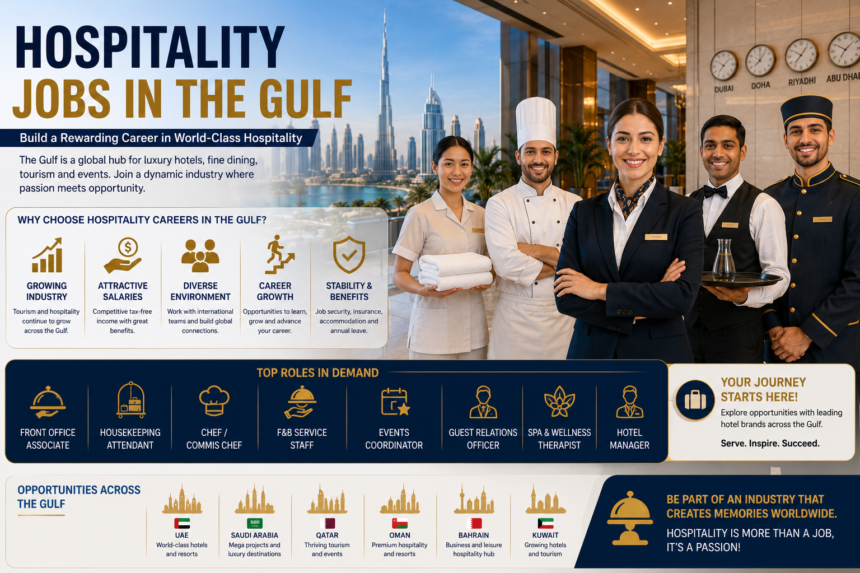
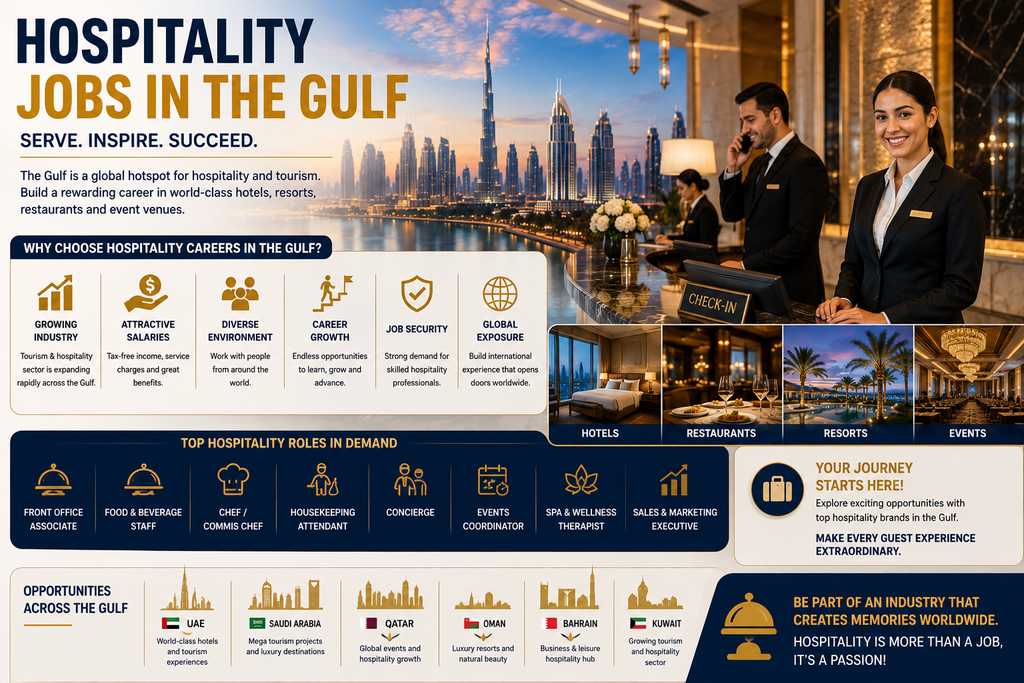
The Gulf has become one of the world’s most ambitious hospitality markets. Dubai continues attracting record numbers of international visitors, Saudi Arabia is rapidly expanding its tourism infrastructure, and countries including Qatar, Oman, Bahrain and Kuwait are investing in hotels, resorts, restaurants and destination experiences.
- Why Hospitality Jobs in Gulf Are Growing
- 1. Hotel General Managers
- 2. Front Office Professionals
- 3. Guest Relations Professionals
- 4. Chefs and Culinary Professionals
- 5. Food and Beverage Managers
- 6. Restaurant Managers
- 7. Housekeeping Professionals
- 8. Revenue Managers
- 9. Hotel Sales and Marketing Professionals
- 10. Event and Banquet Professionals
- 11. Concierge Professionals
- 12. Hospitality Technology Professionals
- Hospitality Jobs in Gulf at a Glance
- UAE Remains One of the Best Hospitality Markets
- Saudi Arabia Is Becoming a Major Hospitality Career Market
- Qatar Offers Specialist Hospitality Opportunities
- Oman Combines Hospitality With Nature Tourism
- Bahrain Has a Compact Hospitality Market
- Kuwait Offers Established Hotel and Restaurant Careers
- Which Gulf Country Is Best for Hospitality Jobs
- Hospitality Salaries in the Gulf
- Always Compare the Complete Employment Package
- Fresh Graduates Can Enter Gulf Hospitality
- Experienced Professionals Should Show Business Results
- Languages Can Improve Your Hospitality Career
- Technology Skills Are Becoming More Important
- Multiskilling Is Becoming a Major 2026 Trend
- Where to Find Hospitality Jobs in Gulf Countries
- Recruitment Agencies Can Help
- Avoid Gulf Hospitality Job Scams
- How to Build a Strong Hospitality CV
- Hospitality Leadership Requires Strong People Skills
- The Future of Hospitality Jobs in Gulf
- Frequently Asked Questions
- Conclusion
For professionals exploring Hospitality Jobs in Gulf, this creates opportunities that extend far beyond working at a hotel reception desk. Chefs, food and beverage managers, revenue specialists, guest relations professionals, event planners, housekeeping leaders, hotel sales teams and hospitality technology specialists are all part of the growing employment ecosystem.
The scale of expansion is significant. The UAE welcomed more than 32 million hotel guests in 2025, with hotel revenues reaching AED 49.21 billion. The country had around 217,000 hotel rooms across more than 1,240 establishments, while average occupancy reached 79.5 percent.
Saudi Arabia is developing at an even larger physical scale. Its 2025 Vision 2030 reporting showed more than 596,900 licensed tourism accommodation rooms and 5,937 licensed tourism facilities, reflecting rapid growth in hospitality capacity.
For job seekers, this means the Gulf remains an exciting market, but competition is also international. The strongest candidates need practical experience, good communication, customer service ability and, increasingly, digital and commercial skills.
Why Hospitality Jobs in Gulf Are Growing
Hospitality growth across the GCC is being driven by several connected trends.
These include:
- International tourism
- Luxury hotel development
- Business events
- New resorts
- Restaurant expansion
- Entertainment destinations
- Aviation growth
- Major sporting events
- Domestic tourism
Saudi Arabia’s tourism transformation is particularly important. In the first half of 2025 alone, 987 newly licensed hospitality facilities added more than 76,000 room keys, taking the country’s total licensed room inventory to around 545,000 at that point.
Dubai continues to provide another major employment base. The city welcomed 19.59 million international overnight visitors in 2025 and ended the year with 154,264 hotel rooms across 827 establishments.
This expansion supports employment across every level of hospitality.
1. Hotel General Managers
Hotel general management is one of the most senior hospitality career paths.
General managers are responsible for the complete operation of a property.
Their responsibilities can include:
- Financial performance
- Guest satisfaction
- Operations
- Staff leadership
- Sales
- Food and beverage
- Brand standards
- Owner relationships
A general manager cannot focus only on service.
They also need to understand business.
Hotel occupancy, revenue, staffing cost and customer satisfaction all influence the success of the property.
Senior professionals usually reach this level after several years working across operations, rooms, food and beverage or commercial departments.
Best for: Experienced hospitality leaders with strong commercial and operational backgrounds.
2. Front Office Professionals
Front office teams create one of the first human impressions of a hotel.
Career positions can include:
- Receptionist
- Front desk agent
- Front office supervisor
- Duty manager
- Front office manager
The job requires excellent communication.
Guests may arrive tired after international flights.
A booking may be incorrect.
A room may not be ready.
The employee needs to remain calm while finding a solution.
Technology is also changing the role.
Dubai introduced a citywide contactless hotel guest check in initiative, demonstrating how routine arrival processes are becoming more digital.
Future front office professionals therefore need to combine personal service with confidence using hotel technology.
3. Guest Relations Professionals
Luxury hospitality depends heavily on personalisation.
Guest relations professionals may support:
- VIP arrivals
- Special occasions
- Complaints
- Restaurant reservations
- Local experiences
- Room preferences
The strongest professionals remember details.
A returning guest may appreciate having their preferences recognised without needing to ask again.
Language skills can also be valuable because Gulf hotels serve highly international audiences.
English is important.
Arabic can be useful.
Other languages such as Russian, French, German or Mandarin may provide an advantage depending on the hotel’s guest mix.
4. Chefs and Culinary Professionals
The Gulf has become a major international dining destination.
Culinary careers can include:
- Commis chef
- Chef de partie
- Sous chef
- Executive sous chef
- Executive chef
- Pastry chef
- Speciality chef
Dubai in particular has built an increasingly sophisticated restaurant industry.
But Gulf culinary employment is much wider than fine dining.
Chefs can work in:
- Hotels
- Resorts
- Airlines
- Catering companies
- Hospitals
- Corporate kitchens
- Large event operations
Senior chefs need more than cooking ability.
They need to understand:
Food cost
Menu development
Team management
Food safety
Inventory
Supplier relationships
An executive chef is therefore both a culinary professional and an operational leader.
5. Food and Beverage Managers
Large Gulf hotels can operate several restaurants and dining concepts within one property.
A food and beverage manager may oversee:
- Restaurants
- Cafes
- Banquets
- Room service
- Bars where permitted
- Pool dining
The job requires understanding service and finance.
A restaurant can be busy but still unprofitable if costs are poorly controlled.
Managers therefore need knowledge of:
- Staffing
- Revenue
- Inventory
- Guest experience
- Cost control
Current UAE hospitality hiring analysis suggests employers in 2026 are increasingly interested in versatile leaders capable of managing multiple outlets rather than narrowly defined roles.
6. Restaurant Managers
Restaurant management is another important hospitality career.
Managers coordinate daily service and ensure guests receive a consistent experience.
Responsibilities can include:
- Reservations
- Staff scheduling
- Customer service
- Stock control
- Sales
- Training
Dubai, Riyadh, Doha and other Gulf cities have highly competitive restaurant markets.
This means service quality matters.
Guests have many alternatives.
A restaurant that repeatedly delivers slow or poor service may struggle even if the food is excellent.
Strong restaurant managers understand both people and operations.
7. Housekeeping Professionals
Housekeeping is one of the largest departments in many hotels.
Career paths can include:
- Room attendant
- Housekeeping supervisor
- Assistant housekeeping manager
- Executive housekeeper
Guests often judge a property by cleanliness before anything else.
A beautiful hotel cannot deliver a luxury experience if rooms are not properly maintained.
Supervisory housekeeping careers require skills in:
- Staff scheduling
- Room inspection
- Laundry
- Productivity
- Inventory
- Quality control
As Gulf hotel inventory continues expanding, housekeeping remains one of the fundamental areas of operational recruitment.
8. Revenue Managers
Revenue management is one of the most commercially important careers in hospitality.
Hotels do not simply set one room rate and keep it unchanged.
Prices can move according to:
- Demand
- Season
- Events
- Competitor rates
- Booking patterns
- Availability
Revenue managers analyse these factors and help determine pricing strategy.
Dubai’s 2025 performance demonstrates why this role matters. Average daily room rates increased 8 percent to AED 579, while revenue per available room increased 11 percent to AED 467.
Professionals in this field need strong analytical ability.
Knowledge of hotel revenue systems and distribution channels can become particularly valuable.
9. Hotel Sales and Marketing Professionals
A hotel needs customers before it can deliver hospitality.
Sales and marketing professionals help attract:
- Leisure travellers
- Companies
- Events
- Tour groups
- Weddings
- Travel agencies
Hotel sales roles may focus on corporate accounts or group bookings.
Marketing roles increasingly involve:
- Social media
- Digital advertising
- Content
- Influencer collaborations
- Public relations
- Email marketing
Professionals who understand both hospitality and digital marketing can offer strong value.
The Gulf’s international visitor market also means marketing teams often work across several countries and languages.
10. Event and Banquet Professionals
The GCC has become a major destination for events.
These can include:
- Conferences
- Weddings
- Exhibitions
- Government events
- Corporate meetings
- Luxury celebrations
Career positions include:
- Event coordinator
- Banquet manager
- Event sales manager
- Conference manager
Dubai alone secured 249 successful bids for future international meetings and incentive programmes during the first half of 2025, expected to attract more than 127,000 delegates.
That supports employment in hotels and dedicated event venues.
Event professionals need exceptional organisation because one programme may involve accommodation, food, audiovisual systems, transport and hundreds of guests.
11. Concierge Professionals
Concierge professionals play an important role in luxury hospitality.
Guests may ask them to arrange:
- Restaurants
- Transportation
- Attractions
- Shopping
- Tours
- Special celebrations
The role requires detailed local knowledge.
A strong concierge does not simply search online for an answer.
They understand what recommendation actually fits the guest.
This career is especially relevant in Dubai, Abu Dhabi, Doha and major Saudi luxury tourism destinations.
Professional networks can become extremely valuable because concierge work often depends on relationships across the local hospitality ecosystem.
12. Hospitality Technology Professionals
Technology is creating entirely new career possibilities.
Hotels increasingly use:
- Property management systems
- Mobile applications
- Automated check in
- Customer databases
- Digital payments
- AI tools
- Revenue platforms
This creates demand for professionals working between hospitality and technology.
Potential roles include:
- Hotel systems manager
- Hospitality IT specialist
- CRM specialist
- Digital guest experience manager
Technology does not remove the importance of human service.
Instead, it can remove repetitive administrative work and allow employees to focus on more valuable guest interaction.
Hospitality Jobs in Gulf at a Glance
| Career | Main Strength |
|---|---|
| Hotel General Manager | Leadership and business |
| Front Office | Customer service |
| Guest Relations | Personalised hospitality |
| Chef | Culinary expertise |
| F&B Manager | Operations and commercial control |
| Restaurant Manager | Service leadership |
| Housekeeping | Quality and operations |
| Revenue Manager | Pricing and analytics |
| Sales and Marketing | Customer acquisition |
| Event Professional | Organisation |
| Concierge | Local expertise |
| Hospitality Technology | Digital hotel operations |
UAE Remains One of the Best Hospitality Markets
The UAE has one of the Gulf’s most mature hospitality industries.
Nationally, the country recorded more than 32 million hotel guests in 2025 and around 100 million hotel nights. Hotel revenues grew 9.7 percent to AED 49.21 billion.
Dubai remains the centre of international tourism employment.
Its 827 hotel establishments and more than 154,000 rooms create a huge range of careers across luxury, business, resort and budget hospitality.
Abu Dhabi also offers opportunities across:
- Luxury hotels
- Resorts
- Cultural tourism
- Events
- Restaurants
For international workers, the UAE is particularly attractive because of the number and diversity of employers.
Saudi Arabia Is Becoming a Major Hospitality Career Market
Saudi Arabia may offer the most dramatic long term expansion.
The Kingdom is developing tourism destinations alongside existing religious and business travel.
Vision 2030 reporting shows licensed tourism accommodation capacity more than doubled between 2023 and 2025, reaching more than 596,900 rooms.
This growth creates opportunities across:
- Hotel openings
- Resort operations
- Culinary services
- Tourism
- Events
- Entertainment
New developments require professionals before the first guest even arrives.
Pre opening careers can include:
Recruitment
Training
Operations
F&B
Engineering
Revenue management
Experienced hospitality professionals with luxury and opening experience may therefore find particularly interesting opportunities.
Qatar Offers Specialist Hospitality Opportunities
Qatar built major hospitality infrastructure around the FIFA World Cup and continues operating a strong tourism and aviation ecosystem.
Hospitality careers can exist in:
- Doha hotels
- Resorts
- Restaurants
- Aviation
- Events
The market is smaller than Dubai or Saudi Arabia, so job seekers should generally target employers carefully.
Current regional geopolitical and economic conditions also deserve attention because Qatar has faced significant economic pressure in 2026 related to conflict and disruption in its energy sector.
Candidates should therefore evaluate both the employer and wider environment before relocating.
Oman Combines Hospitality With Nature Tourism
Oman offers a different hospitality environment.
Its tourism identity is closely connected with:
- Mountains
- Beaches
- Desert
- Heritage
- Eco tourism
This creates careers in:
- Resorts
- Hotels
- Tour operations
- Adventure tourism
- Restaurants
The employment market is smaller than the UAE or Saudi Arabia.
However, experienced professionals may find opportunities where international hospitality standards and destination tourism meet.
Job seekers should also understand Omanisation policies affecting certain roles.
Bahrain Has a Compact Hospitality Market
Bahrain’s smaller size means its hotel sector is more concentrated.
Hospitality employment can exist across:
- Hotels
- Restaurants
- Events
- Business tourism
Its close economic and physical connections with Saudi Arabia also support regional travel.
For job seekers, Bahrain may be better suited to a targeted strategy rather than applying to hundreds of generic positions.
Kuwait Offers Established Hotel and Restaurant Careers
Kuwait is not as tourism focused as Dubai or Saudi Arabia, but it still has an established hospitality sector.
Career opportunities can include:
- International hotels
- Restaurants
- Catering
- Events
- Corporate hospitality
The market can be attractive for experienced F&B and hotel professionals.
However, localisation policies and the smaller volume of tourism vacancies should be taken into account.
Which Gulf Country Is Best for Hospitality Jobs
The answer depends on your career stage.
For the broadest number of international hotel opportunities
The UAE is one of the strongest choices.
For major new projects and hotel openings
Saudi Arabia deserves particular attention.
For specialist luxury and aviation hospitality
Qatar can provide attractive opportunities when the right vacancy is available.
For resort and nature tourism
Oman can be interesting.
Bahrain and Kuwait provide smaller but established markets.
Hospitality Salaries in the Gulf
There is no reliable single Gulf hospitality salary.
Pay depends heavily on:
- Country
- Role
- Experience
- Hotel category
- Employer
- Languages
- Management responsibility
A room attendant cannot be compared directly with a general manager.
Similarly, an executive chef running several outlets will have a very different package from an entry level kitchen employee.
The better approach is to research the exact role.
Always Compare the Complete Employment Package
Gulf hospitality employers may provide:
- Basic salary
- Accommodation
- Transport
- Medical insurance
- Meals
- Annual flight
- Service charge
- Bonus
Accommodation can make a huge difference.
A hotel worker earning a slightly lower salary but receiving accommodation and meals could potentially save more than someone earning a higher basic salary without benefits.
Always ask what the package actually includes.
Fresh Graduates Can Enter Gulf Hospitality
Hospitality is one of the industries where entry level workers can build careers through practical experience.
Possible starting roles include:
- Front desk agent
- Guest service associate
- Waiter
- Commis chef
- Reservation agent
These jobs can later lead to supervisory and management roles.
For young professionals, the first goal should be learning.
Experience with a respected international brand can provide valuable training and future mobility.
Experienced Professionals Should Show Business Results
Senior professionals need to demonstrate impact.
A revenue manager should show commercial performance.
An F&B manager can highlight outlet revenue or cost improvements.
An executive chef can discuss team size, food cost or successful openings.
A hotel manager can describe occupancy, guest satisfaction or operational performance.
Specific evidence strengthens a CV.
Languages Can Improve Your Hospitality Career
English is widely used in Gulf hospitality.
Arabic can provide additional value.
Other languages can also be useful depending on guest markets.
Hotels may particularly value professionals who speak:
- Russian
- Mandarin
- French
- German
- Hindi
Language is valuable because hospitality depends on communication.
However, language alone does not replace service skills.
Technology Skills Are Becoming More Important
Hospitality employers increasingly need employees who can use:
- PMS systems
- POS platforms
- Revenue software
- CRM systems
- Digital reservations
Even operational roles are becoming more digital.
Employees who resist technology may find career growth more difficult.
The strongest hospitality professionals understand both systems and people.
Multiskilling Is Becoming a Major 2026 Trend
One important trend is leaner staffing.
Current UAE hospitality hiring analysis suggests employers are increasingly looking for versatile people who can handle multiple responsibilities rather than simply expanding headcount.
For example:
A guest relations professional may also support events.
A restaurant manager may need strong revenue awareness.
A front office manager may need to understand digital check in systems.
This does not mean expertise is becoming unimportant.
It means adaptability is becoming more valuable.
Where to Find Hospitality Jobs in Gulf Countries
Useful channels include:
- Hotel career websites
- International hotel groups
- Hospitality recruiters
- Restaurant groups
- Tourism companies
Major hotel brands often operate properties across several GCC countries.
Applying through their central career portals can therefore reveal opportunities across Dubai, Riyadh, Doha, Muscat and other destinations.
Recruitment Agencies Can Help
Specialist hospitality recruitment firms can help experienced professionals reach employers.
But candidates should never depend entirely on recruiters.
Use several approaches:
Direct applications
Networking
Recruitment agencies
Industry events
Professional platforms
The more relevant channels you use, the more visible your experience becomes.
Avoid Gulf Hospitality Job Scams
International hospitality workers can be targets of fraudulent recruiters.
Warning signs include:
- Guaranteed jobs
- No formal interview
- Requests for large upfront fees
- Unrealistically high salaries
- Pressure to make immediate payments
- Recruiters using suspicious personal accounts
Always verify a hotel through its official website.
Never assume that a logo or employment letter proves an offer is genuine.
How to Build a Strong Hospitality CV
Your CV should clearly show:
- Job title
- Years of experience
- Hotel or restaurant type
- Team size
- Responsibilities
- Achievements
Instead of writing:
Worked as restaurant manager.
consider:
Managed daily operations for a 150 seat hotel restaurant with a 30 person multicultural team.
Specific information allows the employer to understand your experience quickly.
Hospitality Leadership Requires Strong People Skills
Senior hotel professionals manage people from many backgrounds.
This requires:
- Communication
- Conflict management
- Training
- Motivation
- Cultural awareness
Technical knowledge matters.
But hospitality teams perform better when employees feel supported and understand expectations.
Leadership therefore becomes particularly important in environments with large multicultural workforces.
The Future of Hospitality Jobs in Gulf
The Gulf hospitality market is becoming larger and more sophisticated.
Dubai continues breaking tourism records.
The wider UAE has more than 217,000 hotel rooms.
Saudi Arabia has expanded licensed accommodation capacity to almost 600,000 rooms as tourism investment grows.
At the same time, technology is changing hotel operations.
Luxury tourism is increasing expectations.
New destinations are creating opportunities outside traditional cities.
And employers are increasingly interested in adaptable, commercially aware professionals.
This means future hospitality careers will require more than simply being friendly to guests.
Frequently Asked Questions
Are Hospitality Jobs in Gulf in demand in 2026?
Yes. Hospitality continues expanding in major GCC markets, particularly the UAE and Saudi Arabia. The UAE welcomed more than 32 million hotel guests in 2025, while Saudi Arabia continues rapidly increasing its tourism accommodation capacity.
Which Gulf country is best for hospitality jobs?
The UAE currently offers one of the broadest hotel employment markets. Saudi Arabia is particularly attractive for professionals interested in new hotels, resorts and large tourism projects.
What hospitality jobs are most common in the Gulf?
Common positions include hotel operations, chefs, front office, food and beverage, housekeeping, guest relations, restaurant management, sales, revenue management and events.
Can freshers get Gulf hotel jobs?
Yes. Entry level opportunities can exist in front office, food service, kitchens, housekeeping and reservations, although competition varies.
Do Gulf hospitality jobs include accommodation?
Many employers provide accommodation or housing support, particularly for operational positions, but this is not guaranteed. Always check the employment package.
Are chef jobs available across the Gulf?
Yes. Hotels, resorts, restaurants, catering companies and large tourism developments all recruit culinary professionals.
Is Saudi Arabia good for hospitality careers?
Yes. Saudi Arabia’s licensed tourism room capacity expanded to more than 596,900 rooms by 2025, reflecting large scale development in the sector.
Is Dubai still hiring hospitality professionals?
Dubai remains one of the Gulf’s largest hospitality markets, with 827 hotel establishments and more than 154,000 rooms at the end of 2025.
Conclusion
Hospitality Jobs in Gulf are entering an important period of growth and change.
The UAE remains a major international tourism market, with more than 32 million hotel guests and AED 49.21 billion in hotel revenues recorded during 2025. Dubai alone welcomed 19.59 million international overnight visitors and maintained more than 154,000 hotel rooms.
Saudi Arabia is creating another major employment story. Tourism investment has helped increase licensed accommodation capacity to nearly 600,000 rooms, opening opportunities across hotels, resorts, restaurants, events and destination management.
Qatar, Oman, Bahrain and Kuwait offer smaller but still relevant markets for professionals whose experience matches local demand.
For job seekers, the strongest strategy is simple.
Build practical hospitality experience.
Improve communication and language skills.
Understand hotel technology.
Learn the commercial side of operations.
Compare full employment packages rather than basic salary alone.
And verify every job offer carefully.
The Gulf can provide extraordinary hotels, ambitious tourism projects and international guests.
But hospitality is ultimately a people business.
The professionals most likely to succeed will be those who can combine service, adaptability, commercial awareness and genuine attention to the guest experience.
follow us on Instagram
Read More – IT Careers in Gulf: 12 Amazing Tech Jobs for 2026