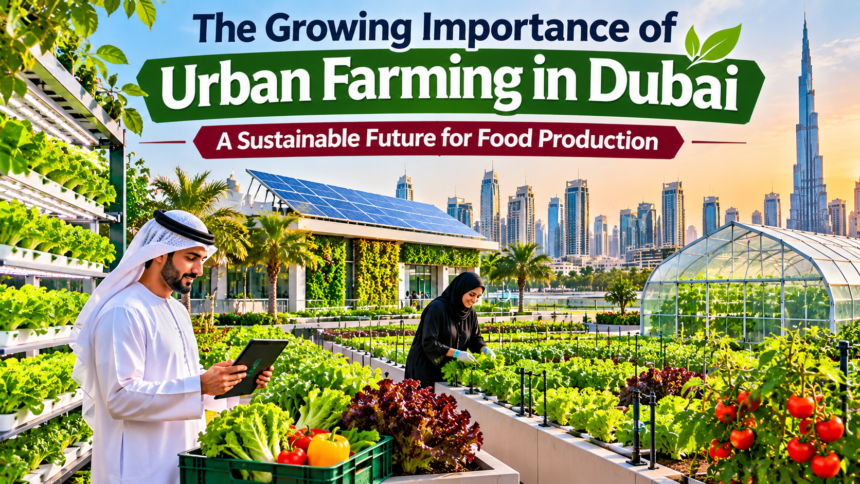
The Growing Importance of Urban Farming in Dubai
Dubai is known for its modern buildings, shopping centres, luxury hotels, and fast-growing business districts. However, another important development is taking place across the city: the growth of urban farming. From indoor vertical farms and rooftop gardens to hydroponic systems and home vegetable gardens, Dubai is finding new ways to produce fresh food within an urban environment.
- 1. What Is Urban Farming and Why Is It Important?
- 2. Why Is Urban Farming Suitable for Dubai?
- 3. Vertical Farming Is Transforming Food Production
- 4. Hydroponics Helps Farmers Use Water More Efficiently
- 5. Smart Greenhouses Support Year-Round Farming
- 6. Rooftop Farming Makes Better Use of Urban Space
- 7. Residential Buildings Are Becoming Part of Urban Farming
- 8. Food Tech Valley Can Support Dubai’s Farming Innovation
- 9. Home Gardens and Community Farming Are Growing
- 10. Government Support Is Encouraging Local Farming
- 11. Urban Farming Can Support Dubai’s Local Economy
- 12. Artificial Intelligence and Technology Will Improve Urban Farming
- 13. The Challenges Facing Urban Farming in Dubai
- 14. What Does the Future of Urban Farming in Dubai Look Like?
- Conclusion: Urban Farming Is Helping Build a Greener Dubai
- Frequently Asked Questions (FAQs)
Indoor and vertical farms often grow crops without using chemical pesticides. This helps people to produce fresher and cleaner food to eat.
Urban farming means growing food in cities or nearby areas instead of depending entirely on traditional farms located far away. It can take place inside buildings, on rooftops, in greenhouses, in residential communities, and even in specially designed indoor farming facilities.
For Dubai, this approach is particularly useful. The emirate has a hot desert climate, limited fertile land, and a strong need to manage water carefully. It also depends on international food supplies to meet much of its demand. Modern farming technologies are creating new opportunities to grow selected vegetables, herbs, and other food products locally.
Projects such as Bustanica, Dubai’s Food Tech Valley, and community gardening initiatives show how urban agriculture is becoming part of the city’s future.
In this article, we explore the growing importance of urban farming in Dubai, including its benefits, farming technologies, major projects, economic opportunities, challenges, and future potential.
1. What Is Urban Farming and Why Is It Important?
Urban farming is becoming increasingly important in Dubai and across the UAE. It helps the region grow more food locally despite hot weather, limited water supplies, and heavy dependence on food imported from other countries.
Urban farming is the practice of growing food within or around cities. It allows people and businesses to use available urban spaces for agricultural activities.
Unlike traditional farming, which usually requires large areas of farmland, urban farming can take place in smaller spaces using modern growing methods. These include hydroponics, vertical farming, rooftop gardening, aquaponics, and controlled-environment agriculture.
In Dubai, urban farming can support food production while making better use of available land and water.
It is becoming important for several reasons:
- Local food production: Farms within the emirate can supply fresh vegetables and herbs to nearby customers.
- Food security: Local production adds another source of food alongside international imports.
- Water efficiency: Some modern farming systems can reuse water and reduce irrigation requirements.
- Fresh food supply: Crops can reach supermarkets, restaurants, and households without travelling long distances.
- Business opportunities: Urban farming creates demand for agricultural technology, equipment, logistics, and food processing.
- Community involvement: Home and community gardens encourage residents to take an interest in food production.
Urban farming cannot replace every type of traditional agriculture or remove the need for imports. However, it can make Dubai’s food system more diverse and resilient.
2. Why Is Urban Farming Suitable for Dubai?
Dubai’s natural environment creates challenges for traditional farming. High temperatures, low rainfall, limited fertile land, and water scarcity can make outdoor crop production difficult.
However, modern agricultural technology provides different ways to manage these conditions.
Indoor farms and greenhouses can control important growing conditions such as temperature, humidity, lighting, and irrigation. This allows selected crops to grow throughout the year rather than depending only on seasonal weather.
Dubai also has a growing urban population and a large food service industry. Hotels, restaurants, supermarkets, and catering companies need regular supplies of fresh vegetables and herbs.
Growing some of these products closer to customers can create useful connections between farms and local businesses.
The United Arab Emirates’ National Food Security Strategy 2051 encourages sustainable food production, modern agricultural technologies, and stronger local production. Dubai’s Food Security Strategy also focuses on improving local food production, reducing food waste, and preparing the emirate for supply disruptions.
These policies provide an important foundation for urban farming and food innovation.
3. Vertical Farming Is Transforming Food Production
Vertical farming is one of the most important developments in Dubai’s urban agriculture sector.
Traditional farming in desert areas uses a lot of water but often produces less food. Modern methods, such as vertical farming and hydroponics, can use up to 95% less water by reusing water and nutrients. This makes it possible to grow fresh crops throughout the year, even in hot and dry climates.
Instead of growing crops across large fields, vertical farms use several layers of shelves inside buildings. Plants are grown in controlled conditions with carefully managed water, nutrients, temperature, and lighting.
This method is especially useful for leafy vegetables and herbs because they can grow in relatively small spaces.
A major example is Bustanica, an indoor vertical farm located near Al Maktoum International Airport at Dubai World Central.
The facility covers approximately 330,000 square feet across three floors and has the capacity to produce more than one million kilograms of leafy greens annually. Its operators report that the farming system uses up to 95% less water than conventional outdoor farming.
The farm uses advanced growing technology, including closed-loop irrigation and digital systems that monitor plant conditions. Its products include lettuce, spinach, parsley, kale, and other leafy greens.
Bustanica demonstrates how a large commercial farm can produce fresh food inside a controlled indoor environment. It also shows how technology can support local production in a city where land and water are limited.
4. Hydroponics Helps Farmers Use Water More Efficiently
Water management is one of the biggest reasons why modern farming methods are becoming important in Dubai.
Hydroponics is a method of growing plants without traditional soil. Instead, the roots receive water containing the nutrients required for growth. Plants are supported by suitable growing materials or specialised structures.
In many hydroponic systems, water is collected, filtered, and circulated again. This can reduce water loss compared with some conventional irrigation methods.
Hydroponics can be used in:
- Indoor vertical farms.
- Greenhouses.
- Rooftop growing systems.
- Small home gardens.
- Commercial vegetable farms.
It is particularly suitable for crops such as lettuce, spinach, tomatoes, cucumbers, and herbs.
However, hydroponics still requires a reliable water supply, suitable nutrient solutions, electricity, and regular maintenance. The amount of water saved depends on the design and operation of the system.
For Dubai, the main advantage is the ability to grow selected crops while managing water more carefully.
5. Smart Greenhouses Support Year-Round Farming
Greenhouses are another useful option for urban and commercial farming in Dubai. They protect plants from some of the difficult outdoor conditions and allow farmers to manage the growing environment.
Modern greenhouses can include automatic irrigation, shade systems, ventilation, temperature controls, and sensors.
These systems help farmers understand what plants need at different stages of growth.
For example, sensors can measure temperature and moisture levels. An automatic irrigation system can then provide water according to the condition of the growing area.
Some crops suitable for greenhouse farming include:
- Tomatoes.
- Cucumbers.
- Peppers.
- Lettuce.
- Spinach.
- Fresh herbs.
- Selected seasonal vegetables.
The main challenge is managing heat. Greenhouses in Dubai may require cooling and shading systems, which can increase energy costs. Farmers therefore need efficient designs that balance plant health, electricity use, and production costs.
6. Rooftop Farming Makes Better Use of Urban Space
Dubai has many residential towers, commercial buildings, hotels, and offices. Some of these buildings have rooftops and unused spaces that may be suitable for growing selected plants.
Rooftop farming involves using these spaces to grow vegetables, herbs, and other crops.
A rooftop garden can contain raised growing beds, pots, hydroponic equipment, or small greenhouse structures. With the right design, it can provide fresh produce while making buildings greener.
Some possible benefits include:
- Using otherwise unused building space.
- Providing fresh herbs and vegetables.
- Creating attractive green areas.
- Encouraging residents to learn about agriculture.
- Improving awareness of sustainable food production.
- Supporting small community gardening activities.
However, rooftop farming requires proper planning. Buildings must be able to support the weight of growing equipment, water, and soil. Waterproofing, drainage, sunlight, and safe access also need attention.
The system should be designed by suitable professionals rather than simply placing heavy garden structures on an existing rooftop.
7. Residential Buildings Are Becoming Part of Urban Farming
One interesting development in Dubai is the integration of vertical farming into residential buildings.
In June 2026, Dubai Municipality officials visited a vertical farm operating inside Meera Tower at Al Habtoor City in Business Bay. Developed by Urban Agritechs with support from Al Habtoor Group, the facility was described as the emirate’s first vertical farm integrated within a residential tower.
The project includes controlled growing conditions, irrigation systems, lighting, plant nutrition, and food safety practices.
This example shows how farming can become part of the built environment rather than remaining separate from residential areas.
In the future, similar projects could help developers explore ways to include small food-growing facilities in selected residential and mixed-use developments.
However, successful building-based farming needs clear maintenance arrangements, suitable operating costs, and proper food safety management.
8. Food Tech Valley Can Support Dubai’s Farming Innovation
Dubai is also developing a wider ecosystem for food and agricultural technology through Food Tech Valley.
The initiative is designed to bring food producers, technology companies, researchers, logistics businesses, and investors together in one connected development.
Its planned facilities include:
- A food production zone.
- A logistics zone.
- A business park.
- Research and innovation facilities.
- Business support services.
- An academy and training facilities.
The food production zone is designed to support technologies such as vertical farming, aeroponics, hydroponics, fish farming, and algae cultivation.
This approach is important because food production involves more than growing crops. Businesses also need research, packaging, transportation, storage, distribution, and access to customers.
Food Tech Valley aims to connect these activities and support new ideas in agriculture and food production.
It is a planned development and should be understood as part of Dubai’s longer-term food innovation ambitions rather than a fully operational farming centre.
9. Home Gardens and Community Farming Are Growing
Urban farming is not limited to large commercial companies. Residents can also contribute by growing vegetables, herbs, and other plants at home.
Balconies, small gardens, terraces, and suitable outdoor spaces can be used to grow plants in pots or containers.
Dubai Municipality has supported home gardening through competitions and awareness programmes. In July 2026, it announced the winners of the third edition of its Most Beautiful Sustainable Home Garden competition.
The competition received more than 100 entries and offered a total prize pool of AED 300,000. Winning gardens were recognised for using water efficiently, maintaining healthy soil, choosing suitable plant species, and using sustainable gardening practices.
These activities show how residents can become part of the city’s wider environmental efforts.
Home farming can begin with simple crops such as:
- Mint.
- Coriander.
- Parsley.
- Basil.
- Chillies.
- Cherry tomatoes.
- Lettuce.
Residents should choose plants that suit the local season and available growing space. Water-efficient irrigation, suitable containers, and good-quality growing materials are also important.
10. Government Support Is Encouraging Local Farming
Government support is an important part of the growth of urban farming in Dubai.
The Dubai Farms programme provides support and services for Emirati farmers who own productive agricultural projects. Its services include farming advice, subsidised agricultural supplies, laboratory testing, pest control support, and help connecting farmers with local market requirements.
The programme also includes the Plant Your Food initiative, which encourages people to grow food at home.
Other activities include the Hatta Farming Festival and seasonal farmers’ market events.
These initiatives can help small farmers and residents develop practical agricultural skills while creating a stronger connection between food producers and consumers.
The UAE’s National Food Security Strategy 2051 also supports modern technologies and sustainable agriculture. It aims to improve local production while maintaining reliable international food supplies.
11. Urban Farming Can Support Dubai’s Local Economy
Urban farming is becoming an area of business opportunity in Dubai. It creates demand for more than farmers and agricultural workers. The sector also needs technology providers, engineers, food safety specialists, transport services, equipment suppliers, and marketing professionals.
Some possible business opportunities include:
- Starting a small hydroponic farm.
- Supplying fresh herbs to restaurants.
- Developing indoor growing systems.
- Providing greenhouse installation and maintenance.
- Selling seeds and gardening equipment.
- Offering agricultural training.
- Producing packaged vegetables.
- Providing farm management software.
Local food producers can also develop partnerships with supermarkets, hotels, restaurants, and catering companies.
For small businesses, supplying fresh and specialised products to nearby customers may provide a useful market opportunity.
However, success depends on more than growing crops. Businesses need to understand their costs, manage water and electricity use, maintain food safety standards, and find customers who are willing to buy their products.
12. Artificial Intelligence and Technology Will Improve Urban Farming
Artificial intelligence (AI), sensors, and automation are creating new ways to manage farms.
Modern indoor farms can collect large amounts of information about temperature, humidity, lighting, water quality, and plant growth.
AI tools can help analyse this information and support decisions about irrigation, nutrients, and environmental settings.
Some possible uses include:
- Monitoring plant health.
- Identifying signs of disease.
- Adjusting lighting schedules.
- Managing water and nutrients.
- Tracking crop production.
- Predicting harvest times.
- Improving food quality and traceability.
For example, a sensor may detect that a growing area has become too warm. A connected control system can then adjust the cooling settings to protect the plants.
These technologies may improve consistency and reduce unnecessary resource use.
However, technology cannot replace skilled farm workers. Plants still require observation, maintenance, and proper care. Modern farms need trained employees who understand both agriculture and digital systems.
13. The Challenges Facing Urban Farming in Dubai
Although urban farming has many advantages, it also faces challenges. Growing food inside a city is not automatically cheaper or more sustainable than growing it on traditional farms.
Some important difficulties include:
High initial investment: Indoor farms require equipment, growing structures, lighting, irrigation, and climate-control systems.
Electricity costs: Artificial lighting and cooling can use significant electricity, especially during Dubai’s hot months.
Water management: Hydroponics can reduce water use, but systems still need clean water and regular monitoring.
Limited crop choices: Vertical farming is suitable for selected vegetables and herbs, but it is not an economical replacement for all staple crops.
Maintenance: Pumps, sensors, filters, lighting systems, and nutrient supplies need regular servicing.
Skilled workers: Urban farms require staff who understand plant science, technology, equipment, and food safety.
A 2026 research paper published in Frontiers in Sustainable Cities examined the possibility of integrating vertical farms into residential buildings in the UAE. It identified challenges such as capital costs, maintenance, water treatment, nutrient management, and the need for clear responsibility for shared farming spaces.
This research highlights an important point: urban farming needs proper planning and long-term management, not just modern equipment.
14. What Does the Future of Urban Farming in Dubai Look Like?
The future of urban farming in Dubai is likely to involve a combination of commercial indoor farms, rooftop growing spaces, home gardens, controlled greenhouses, and technology-based food production.
As the city grows, there may be more opportunities to include small farming areas in residential developments, hotels, schools, and commercial buildings.
Some developments to watch include:
- More vertical farms producing leafy vegetables and herbs.
- Greater use of hydroponics and aeroponics.
- Rooftop and community gardening projects.
- More connections between farms and local retailers.
- Improved water and energy management.
- Digital farming systems using AI and sensors.
- More training and support for small agricultural businesses.
- New research through food and agricultural innovation centres.
Dubai’s urban farming sector will also benefit from better cooperation between government organisations, property developers, farmers, investors, and technology companies.
However, urban farming should be seen as one part of a wider food security system. Traditional farms, international food trade, storage, and logistics will remain essential.
Conclusion: Urban Farming Is Helping Build a Greener Dubai
The growing importance of urban farming in Dubai reflects the city’s efforts to develop a more diverse and sustainable food system. Vertical farms, hydroponics, rooftop gardens, smart greenhouses, and community gardening programmes are creating new ways to produce food within the urban environment.
Projects such as Bustanica show how large-scale indoor farming can produce fresh vegetables while using significantly less water, according to the operator’s figures. The residential vertical farm at Al Habtoor City and initiatives such as Dubai’s sustainable home garden competition also demonstrate how farming can become part of everyday city life.
Urban farming will not solve every food security challenge. It still faces issues related to energy costs, investment, maintenance, and crop selection. Nevertheless, it can provide fresh local produce, support businesses, encourage innovation, and help people understand where their food comes from.
The future of urban farming in Dubai is about using available space wisely, managing natural resources carefully, and bringing food production closer to the people who need it. With continued innovation and community participation, urban farming can become an important part of a greener and more resilient Dubai.
Frequently Asked Questions (FAQs)
1. What is urban farming in Dubai?
Urban farming in Dubai means growing food within the city or nearby urban areas. It includes vertical farms, hydroponics, rooftop gardens, greenhouses, and home vegetable gardens.
2. Why is urban farming important in Dubai?
It helps increase local food production, supports food security, makes better use of limited space, and encourages efficient water use. It also creates business and employment opportunities.
3. What is vertical farming?
Vertical farming is a method of growing plants in stacked layers, usually inside a controlled building. It often uses artificial lighting and hydroponic systems to grow crops without traditional soil.
4. What is Bustanica in Dubai?
Bustanica is a large indoor vertical farm near Al Maktoum International Airport. Its facility covers around 330,000 square feet and has the capacity to produce more than one million kilograms of leafy greens each year.
5. How does hydroponic farming save water?
Hydroponic systems deliver water and nutrients directly to plant roots. Many systems collect and reuse water, helping reduce losses compared with some conventional farming methods.
6. Can people grow vegetables at home in Dubai?
Yes. Residents can grow herbs and vegetables in suitable balconies, gardens, and other spaces. Plants such as mint, basil, coriander, chillies, and tomatoes can be suitable choices when properly managed.
7. What is Dubai Food Tech Valley?
Food Tech Valley is an initiative designed to bring agricultural technology, food production, research, logistics, and food businesses together. Its plans include facilities for vertical farming, hydroponics, fish farming, and innovation.
8. Does urban farming help Dubai’s food security?
Yes. It can add local sources of selected fresh foods and diversify supply. However, it cannot replace imports or traditional agriculture for all food categories.
9. What are the main challenges of urban farming in Dubai?
The main challenges include high electricity costs, initial investment, water quality, maintenance, limited crop choices, and the need for trained agricultural workers.
10. What is the future of urban farming in Dubai?
The future may include more indoor farms, rooftop gardens, hydroponic systems, community agriculture, smart farming technology, and stronger connections between local producers and retailers.
Do follow us on Instagram
Read More – The Future of Renewable Energy in Muscat