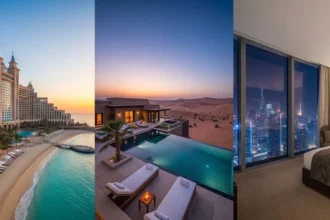
Bringing Fresh Thinking to Dubai Architecture
Architecture careers rarely begin with landmark buildings or major design announcements. They begin with drawings, studio deadlines, site observations, revisions, mistakes, internships and the patience required to keep learning. Kesar Joijode’s professional journey reflects this quieter but important side of becoming an architect.
- From India to Dubai, A New Understanding of Architecture
- Questioning the Relationship Between Profit and People
- A Foundation Built Through Architecture Education
- Learning Beyond the Classroom
- A Significant Early Project in Dubai
- From Graduate Intern to Junior Architect
- Learning From Mentors Who Believe in Growth
- Seeing Design Beyond a Building
- Exploring Architecture Across the World
- Building With a Bigger Purpose
Today, Kesar works as a Junior Architect at John R Harris and Partners in Dubai. Her interests extend across architecture, interior design and urban design, but her ambitions are increasingly moving beyond creating visually impressive buildings. She is interested in a larger question: how can the built environment become more habitable, sustainable and responsive to the people who live within it?
Coming from India, where she experienced buildings and cities on a different scale, Kesar arrived in Dubai with an established understanding of architecture but quickly encountered a completely different built environment. Dubai introduced her to a world where buildings can be enormous, highly ambitious and designed to make a powerful visual statement.
The contrast fascinated her.
It also made her question what architecture should ultimately achieve.
For Kesar, the challenge is not to choose between prominent architecture and human comfort. It is to understand whether both can coexist.
From India to Dubai, A New Understanding of Architecture
Kesar studied architecture at the Wadiyar Center for Architecture between 2019 and 2024. Her education introduced her to the fundamentals of architectural design while giving her an opportunity to understand buildings through the social and environmental context in which they exist.
Her experience in India shaped an early belief that buildings should not simply occupy a site. They should have a relationship with the lives taking place around them.
Coming from an environment where buildings can be significantly smaller in scale compared with Dubai, she was interested in how architecture could make a difference by allowing the built environment and everyday life to coexist and complement one another.
Dubai changed that perspective.
The city presented architecture at a much larger scale, where towers and developments often become defining elements of the skyline. For Kesar, this created an opportunity to understand a different market, different expectations and different approaches to design.
She became fascinated by the city’s luxury, ambition and architectural presence, while also beginning to ask what lies beyond visual impact.
Can a building be prominent while remaining comfortable?
Can development respond more thoughtfully to Dubai’s climate?
Can sustainability become part of the design process rather than an addition made later?
And how much should developers consider the quality of the space created for people alongside the financial potential of a project?
These questions are increasingly shaping the way Kesar thinks about architecture.
Questioning the Relationship Between Profit and People
For Kesar, architecture is closely connected to the decisions made before a building is even designed.
She is interested in the relationship between maximum built-up area, commercial priorities and the quality of the spaces people eventually inhabit.
Her questions are not necessarily about rejecting development or ambition. Instead, she wants to understand where the balance can be found.
When does the pursuit of maximum profit begin to affect the quality of a built environment? How much can developers compromise on maximising GFA in order to create spaces that are more sustainable, climate-responsive and pleasant to inhabit?
For Kesar, these should not be questions considered only after construction begins. They should become part of the architectural conversation from the start.
Dubai’s climate makes this particularly important. Buildings have to respond to heat, sunlight, energy consumption, landscape and human comfort. For a young architect working within the city, these realities provide an opportunity to think about how ambitious architecture can also become responsible architecture.
Her interest therefore goes beyond whether a building looks impressive.
She wants to understand how buildings influence people’s lives and whether the environments being created are genuinely improving everyday experiences.
A Foundation Built Through Architecture Education
Kesar’s academic journey at the Wadiyar Center for Architecture between 2019 and 2024 gave her the foundation from which these questions could develop.
Five years of architectural education require far more than learning how to draw buildings. Students study planning, materials, construction, design history, human behaviour, climate, context and the relationship between buildings and cities.
The process is demanding. Ideas that appear strong at the beginning of a project often change after criticism, technical study or deeper research.
For young designers, learning to accept that process is essential.
Kesar’s university years helped her develop her design skills while also expanding her interest in interiors and urban environments. Her involvement as Cultural Head added another dimension to her education, giving her experience in coordination, participation and communication outside the studio.
Learning Beyond the Classroom
Architecture becomes different when a student moves from university projects into professional practice.
Academic projects allow experimentation, but professional architecture comes with clients, budgets, regulations, deadlines, site conditions, technical requirements and teams with different responsibilities.
Kesar began developing this practical understanding through internships.
Her early professional experience included time with PNC Architects, followed by an internship at ANA Design Consultants. These experiences gave her an opportunity to observe how architectural ideas move from discussions and drawings towards real project decisions.
Internships can sometimes involve relatively small responsibilities, but they play an important role in shaping young architects. They teach how offices communicate, how drawings are coordinated and why even small details matter when multiple professionals are working together.
A Significant Early Project in Dubai
One of Kesar’s early professional experiences in Dubai gave her the opportunity to work with Naz Alsi Atasoy on the interior design of an office space for Axys.
The project brought together several of the ideas that continue to interest Kesar: luxury, sustainability, material choices, connectivity and the relationship between people and their surroundings.
According to Kesar, the design incorporated locally sourced materials while maintaining a luxurious character. Innovative partitions were used to create a more connected experience, while natural planters were integrated to strengthen the relationship between the interior and nature.
The project demonstrated how luxury and sustainability do not necessarily have to exist on opposite sides of the design conversation.
The Axys project went on to receive the Best Commercial Interior Design of the Year award in Saudi Arabia, giving Kesar an early opportunity to contribute to recognised design work.
For a recent graduate, the experience became an important reminder that thoughtful design can combine aesthetics, functionality and environmental considerations.
From Graduate Intern to Junior Architect
Another significant development in Kesar’s journey came through her work at John R Harris and Partners.
After completing her architectural education and early internships, she joined the practice as a Graduate Intern in late 2024.
She progressed to the position of Junior Architect in 2025.
The move from graduate intern to junior architect represents an important stage in her professional development. It brings greater exposure to drawings, design development, coordination, presentations and communication within project teams.
It also requires an understanding that architecture is fundamentally collaborative.
A building is never created by one person. Architects work alongside engineers, interior designers, consultants, contractors, clients, authorities and numerous other specialists.
For Kesar, this professional environment has become another form of education.
Learning From Mentors Who Believe in Growth
Kesar credits the people around her with playing an important role in her development.
She specifically acknowledges Mr Subraya Kalkura, Managing Director of John R Harris, for giving her the opportunity to learn within the practice and develop her professional experience.
She also recognises Mr Shailesh Bhandari, Director, as a constant mentor who has guided her through the early stages of her architectural career.
Kesar describes his mentorship through a personal comparison, saying he has taught her architecture “like a father would teach his baby to walk.”
For a young architect, that kind of support can be significant. Architecture requires technical knowledge, but confidence, professional judgment and the willingness to question and learn also develop through guidance.
The support Kesar has received continues to encourage her to improve, learn more and think about how her work can contribute not only to clients and projects but also to the wider world.
Seeing Design Beyond a Building
Kesar’s interests in architecture, interior design and urban design reflect her belief that different scales of design are connected.
Architecture shapes buildings. Interior design influences how people experience spaces from within. Urban design considers how buildings, streets, public spaces, transportation and communities interact.
For Kesar, these layers cannot be considered separately.
A visually striking building can still struggle to create a comfortable environment if it does not respond to the people using it. An attractive interior can become disconnected if it ignores function and movement. Similarly, a city cannot become truly successful through individual landmarks alone.
The larger question is how the built environment influences everyday life.
This is where Kesar sees the future of her learning.
Exploring Architecture Across the World
Having developed her experience primarily through India and Dubai, Kesar now wants to broaden her understanding of architecture by exploring different parts of the world.
Her goal is not simply to collect experiences in different countries.
She wants to understand how people live, how cultures influence design, how communities interact with their surroundings and how buildings affect everyday life in different environments.
Every city has its own story.
Climate, history, culture, economics and social behaviour all influence the way people occupy space. Exploring those differences could help Kesar develop a more nuanced understanding of what makes architecture meaningful.
Her experience in India gave her one perspective. Dubai introduced another. Her next ambition is to continue expanding that perspective through global exposure.
Building With a Bigger Purpose
Kesar Joijode is still at an early stage of her professional career, and she recognises that there is a long way to go before defining her journey through major achievements.
But that does not make the current stage any less important.
She is already learning inside a major architectural environment, working with experienced professionals, exploring different scales of design and developing a personal approach to the relationship between architecture and human life.
Her ambitions are increasingly clear.
She wants to create architecture that can be prominent without becoming disconnected from the people who inhabit it. She wants to explore how sustainability and climate responsiveness can become fundamental parts of design. She wants to understand whether cities can grow while still protecting the quality of human experience.
Most importantly, she wants to keep asking questions.
For Kesar, the future of architecture is not only about how much can be built. It is also about what kind of life that built environment makes possible.
Her journey from India to Dubai has already changed the way she sees architecture. The next chapter will be about taking those lessons further, learning from different cultures and environments, and continuing to design with the belief that buildings should not simply dominate their surroundings.
They should belong to them.
And, ultimately, they should make life within them better.
Do follow Kesar Joijode on LinkedIn
Read More – 7 Powerful Ways AI Is Transforming HealthCare In GCC