The Hidden Ecosystems of the Arabian Gulf
The Arabian Gulf is often associated with modern cities, luxury developments, oil reserves and vast desert landscapes. However, beyond its impressive infrastructure and busy coastal areas lies a natural world that receives far less attention. The hidden ecosystems of the Arabian Gulf include underwater seagrass meadows, coral reefs, mangrove forests, coastal wetlands, salt flats and diverse marine habitats that support an incredible variety of life.
- 1. Understanding the Hidden Ecosystems of the Arabian Gulf
- 2. Mangrove Forests: The Natural Guardians of Gulf Coastlines
- 3. Seagrass Meadows and Coral Reefs: Life Beneath the Surface
- 4. Coastal Wetlands, Salt Flats and Other Overlooked Habitats
- 5. Marine Wildlife and Biodiversity in the Arabian Gulf
- 6. Why the Arabian Gulf’s Ecosystems Are Important for People
- 7. Major Threats to the Hidden Ecosystems of the Arabian Gulf
- 8. Protecting the Future of the Arabian Gulf’s Natural Environment
- Conclusion
- Frequently Asked Questions
Despite extreme temperatures, high salt levels and limited freshwater resources, these ecosystems have developed remarkable ways to survive. From tiny marine organisms living beneath the sand to dugongs feeding in shallow waters, the Gulf is home to species that have adapted to some of the most challenging environmental conditions on Earth.
These natural environments also provide important benefits to human communities. They support fishing, protect coastlines, store carbon and contribute to regional biodiversity. Understanding their importance is essential as Gulf countries continue to balance economic development with environmental protection.
1. Understanding the Hidden Ecosystems of the Arabian Gulf
The Arabian Gulf is a relatively shallow, semi-enclosed body of water connected to the Gulf of Oman through the Strait of Hormuz. Its surrounding landscape is largely dry, with limited rainfall and extremely hot summers. High evaporation rates also make its waters saltier than many other marine environments.
Although these conditions may appear unsuitable for wildlife, the Gulf supports a surprising range of plants and animals. Over thousands of years, many species have adapted to the changing temperatures and high salt levels that characterise this region.
Corals in the Arabian Gulf can survive bigger changes in water temperature than many other tropical reefs. They do this partly by living with special algae that help them tolerate extreme heat. Researchers have also found that oxygen levels in shallow coastal waters of Abu Dhabi can become very low during summer nights, creating difficult conditions for marine life.
What makes the Arabian Gulf particularly interesting is the connection between its different ecosystems. Fish may begin their lives among mangrove roots, move into seagrass meadows as they grow and later settle around coral reefs. Each habitat contributes to the survival of the others.
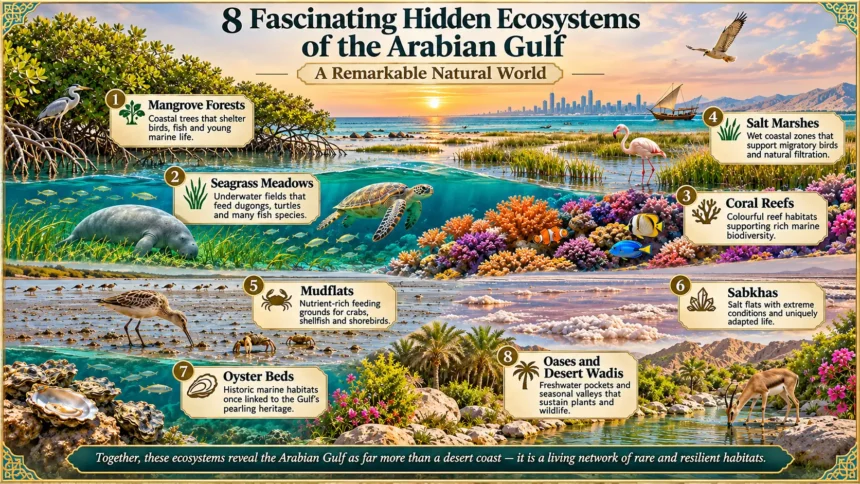
The major ecosystems of the Arabian Gulf include:
| Ecosystem | Main Characteristics | Ecological Importance |
|---|---|---|
| Mangrove forests | Salt-tolerant coastal trees | Coastal protection and fish breeding |
| Seagrass meadows | Underwater flowering plants | Food and shelter for marine animals |
| Coral reefs | Underwater structures formed by living organisms | Marine biodiversity |
| Mudflats | Coastal areas exposed during low tide | Feeding grounds for birds |
| Salt flats | Land with high salt concentrations | Specialised plants and microorganisms |
| Oyster beds | Natural shellfish communities | Water filtration and marine habitats |
| Sandy seabeds | Soft underwater surfaces | Home to buried marine organisms |
| Coastal islands | Relatively isolated natural habitats | Bird and turtle nesting grounds |
These environments demonstrate that biodiversity is not limited to tropical rainforests or deep oceans. Even regions with harsh climates can support complex natural systems that deserve attention and protection.
2. Mangrove Forests: The Natural Guardians of Gulf Coastlines
Mangrove forests are among the most valuable coastal ecosystems in the Arabian Gulf. These remarkable trees grow in shallow coastal waters where most ordinary plants would struggle to survive. Their ability to tolerate salty water and changing tidal conditions makes them particularly suitable for the region.
The grey mangrove (Avicennia marina) is commonly found in sheltered coastal areas. It can survive in very salty water and handle changes in temperature throughout the year. These trees also provide a safe home for many marine animals and coastal wildlife
The grey mangrove is the dominant native mangrove species in the Gulf. Its specialised roots help it survive in muddy sediments with limited oxygen.
Mangrove forests are especially important in the UAE, where natural coastal forests and restoration projects contribute to environmental conservation. Older mangrove forests provide complex habitats that support numerous species.
Why Are Mangrove Forests Important?
- They reduce coastal erosion by holding sediments together.
- They provide shelter for young fish and marine animals.
- They store carbon in their vegetation and surrounding soils.
- They offer feeding and nesting areas for birds.
- They help reduce the impact of waves on coastlines.
- They support local fisheries and responsible nature-based tourism.
Mangroves also provide an opportunity for people to experience nature without travelling far from urban areas. Activities such as guided kayaking and wildlife observation can help residents develop a stronger understanding of coastal biodiversity.
However, planting new mangroves alone cannot solve every environmental problem. Successful restoration requires suitable water conditions, healthy sediments and long-term monitoring. Protecting existing mature forests is equally important because their ecological networks have developed over many years.
3. Seagrass Meadows and Coral Reefs: Life Beneath the Surface
Much of the Arabian Gulf’s biodiversity remains hidden beneath its waters. Seagrass meadows and coral reefs are two of its most important underwater ecosystems. Although they differ in appearance and structure, both provide food, shelter and breeding opportunities for marine wildlife.
The Arabian Gulf is home to underwater seagrass beds and coral reefs that support a wide variety of marine life. Even when water temperatures rise to 36°C and salt levels become very high, these natural habitats continue to support thousands of species.
They also help scientists understand how marine life survives in changing climate conditions.
The Underwater World of Seagrass
Seagrasses are flowering plants that grow underwater. Unlike seaweed, they have roots, leaves and reproductive structures similar to those of land-based flowering plants. They generally grow in shallow waters where sunlight can reach the seabed.
Extensive seagrass habitats are found along the coastal waters of the UAE, Bahrain and Qatar. Several seagrass species are particularly well adapted to the environmental conditions of the Arabian Gulf.
These underwater meadows provide essential feeding grounds and homes for the world’s second largest pupulations of dugongs with an estimated 5,800 to 7,500 individuals, which are sometimes called sea cows because of their plant-based diet. Green sea turtles also depend on healthy seagrass habitats for food.
Their dense roots help keep the seabed stable and prevent sand from moving. In areas like Abu Dhabi, these underwater plants also store more than 52 tonnes of carbon per hectare. They provide food and shelter for young shrimp, pearl oysters, seahorses, and many commercially important fish.
Coral Reefs and Their Remarkable Survival
Coral reefs are formed by colonies of small marine animals known as coral polyps. Over time, many of these organisms produce hard structures that become habitats for fish, crabs and other forms of marine life.
The Arabian Gulf’s corals are particularly interesting because they survive unusually high summer temperatures and significant seasonal changes. However, their ability to tolerate difficult conditions does not make them immune to climate change.
When seawater becomes excessively warm, corals may experience bleaching. During this process, corals lose the microscopic algae that normally provide much of their energy. Prolonged environmental stress can eventually lead to coral death.
| Feature | Seagrass Meadows | Coral Reefs |
|---|---|---|
| Living structure | Flowering plants | Colonies of coral animals |
| Typical location | Shallow, soft seabeds | Suitable hard underwater surfaces |
| Main benefits | Feeding grounds and carbon storage | Shelter and biodiversity |
| Common wildlife | Dugongs, turtles and small fish | Reef fish, crabs and molluscs |
| Major challenges | Dredging and reduced water clarity | Marine heatwaves and pollution |
Protecting both ecosystems is necessary because the loss of one habitat can affect wildlife across the wider marine environment.
4. Coastal Wetlands, Salt Flats and Other Overlooked Habitats
Not every valuable ecosystem is visually impressive. Some of the Arabian Gulf’s most important habitats appear to be empty stretches of mud, sand or salty land. However, closer observation reveals that these environments support specialised plants, animals and microorganisms.
Mudflats and Migratory Birds
Mudflats develop in coastal areas where fine sediments accumulate. During low tide, these surfaces become exposed, allowing birds to search for worms, shellfish, crabs and other small organisms.
For migratory birds travelling long distances, these coastal feeding grounds provide opportunities to rest and regain energy. Flamingos and various shorebirds benefit from suitable wetland environments.
The protection of mudflats is particularly important because their ecological value can easily be overlooked when coastal land is assessed for development.
The Unique World of Sabkhas
Sabkhas are salt flats commonly found along the Arabian Gulf coastline. They develop under conditions involving saline water, mineral accumulation and high evaporation.
Although they may appear lifeless, some sabkhas contain salt-tolerant microorganisms and complex microbial communities. Certain coastal areas also support plants that have adapted to highly salty soils.
These habitats offer scientists an opportunity to study how life survives in extreme environments. Their natural layers can also help researchers understand changes in coastal landscapes over long periods.
Oyster Beds and the Gulf’s Cultural Heritage
Natural oyster habitats are another important part of the Gulf’s underwater environment. Oysters filter particles from seawater as they feed, while their shells can create small habitats for other marine creatures.
Historically, pearl diving played a major role in the economy and cultural identity of Arabian coastal communities. The natural environment supported generations of divers, traders, boatbuilders and fishing families.
Protecting oyster habitats therefore has both environmental and cultural significance. It helps preserve a connection between the Gulf’s natural resources and its traditional way of life.
5. Marine Wildlife and Biodiversity in the Arabian Gulf
The Arabian Gulf supports a wide range of wildlife, from microscopic organisms to large marine mammals. Each species has a role within the natural environment, whether through feeding, controlling populations, recycling nutrients or supporting larger animals.
The region’s marine biodiversity becomes especially remarkable when its demanding environmental conditions are considered. Many creatures have developed natural adaptations that allow them to survive in waters with high temperatures and salt concentrations.
Some important animals found in the Arabian Gulf include:
- Dugongs: Marine mammals that depend heavily on seagrass for food.
- Green sea turtles: Turtles that feed largely on marine vegetation as adults.
- Hawksbill turtles: Marine reptiles associated with reef habitats and coastal nesting areas.
- Dolphins: Marine mammals that feed on fish and other sea creatures.
- Sharks and rays: Animals that contribute to balanced marine food networks.
- Pearl oysters: Shellfish with ecological and historical importance.
- Crabs and shrimps: Small marine animals that support larger food chains.
- Flamingos: Coastal birds that feed in suitable shallow wetlands.
The Gulf’s waters and coastal islands provide important habitats for several of these species. Southwestern Abu Dhabi, in particular, contains internationally significant natural areas that support marine mammals, turtles and birds.
Smaller organisms are equally important. Plankton, for example, forms the foundation of many marine food chains. Without these tiny organisms, numerous fish and larger marine animals would struggle to find sufficient food.
The survival of marine biodiversity depends on maintaining healthy habitats rather than protecting individual species alone. A turtle conservation programme will have limited success if feeding grounds disappear or nesting beaches become unsuitable.
6. Why the Arabian Gulf’s Ecosystems Are Important for People
The benefits of healthy marine ecosystems extend far beyond environmental conservation. They contribute to economic activity, food security, cultural heritage and the quality of life experienced by coastal communities.
For centuries, people living around the Arabian Gulf depended on the sea for fishing, transportation, trade and pearl diving. These activities helped shape local traditions and supported economic development long before the discovery of major oil reserves.
Today, healthy ecosystems continue to provide valuable services that are sometimes difficult to replace through technology or infrastructure.
| Environmental Benefit | Importance for Human Communities |
|---|---|
| Coastal protection | Reduces erosion and exposure to waves |
| Marine food production | Supports fisheries and food security |
| Carbon storage | Contributes to climate change mitigation |
| Nature-based tourism | Creates economic and recreational opportunities |
| Water filtration | Supports healthier marine conditions |
| Scientific research | Improves understanding of extreme environments |
| Cultural preservation | Protects traditional coastal heritage |
Mangroves, salt marshes and seagrass meadows are also associated with a concept known as blue carbon. This refers to carbon captured and stored by certain coastal and marine ecosystems.
Protecting these habitats can help prevent the loss of stored carbon while maintaining their wider ecological benefits. However, conservation should complement rather than replace efforts to reduce greenhouse gas emissions.
Healthy coastlines can also make cities more attractive places to live. Natural spaces provide opportunities for outdoor recreation, environmental education and a stronger connection with the surrounding landscape.
7. Major Threats to the Hidden Ecosystems of the Arabian Gulf
Rapid development has transformed the Gulf into an important global economic region. However, industrial expansion, growing populations and increasing pressure on coastal resources have also created environmental challenges.
Coastal development, fishing, climate change and desalination are among the important pressures on regional marine environments. Gaps in available scientific information also make it difficult to accurately assess the condition of some habitats and species.
The major environmental challenges include:
| Environmental Threat | Potential Impact |
|---|---|
| Coastal construction | Loss of natural habitats |
| Climate change | Rising temperatures and coral bleaching |
| Plastic pollution | Harm to marine animals |
| Overfishing | Declining fish populations |
| Oil pollution | Contamination of marine and coastal habitats |
| Desalination discharge | Local changes in water chemistry and salinity |
| Dredging | Damage to seabeds and reduced water clarity |
| Unsustainable tourism | Disturbance of sensitive wildlife |
Coastal development is particularly challenging because many valuable marine habitats are located in shallow waters near rapidly growing cities. Careful planning is necessary to prevent unnecessary damage to these environments.
Climate change presents another serious concern. Marine species that already live near their temperature tolerance limits may struggle as seawater becomes warmer. Repeated periods of extreme heat can make it difficult for damaged ecosystems to recover.
Plastic waste can also remain in marine environments for extended periods. Turtles, birds and fish may accidentally swallow plastic or become trapped in discarded fishing equipment.
Addressing these challenges requires cooperation between governments, businesses, scientists and local communities. Environmental protection should become a regular part of development planning rather than an activity introduced only after damage occurs.
8. Protecting the Future of the Arabian Gulf’s Natural Environment
The future of the Arabian Gulf’s ecosystems depends on decisions made today. As countries continue developing new cities, industries and tourism destinations, protecting natural environments must remain an important priority.
Marine protected areas can help safeguard sensitive habitats by limiting damaging activities. Restoration programmes can support the recovery of degraded environments, while improved fishing practices can help maintain healthier marine populations.
Scientific research is equally important. Better monitoring can help identify changes in coral health, seagrass coverage, wildlife populations and coastal water quality before environmental problems become more difficult to manage.
Practical Steps for Protecting Gulf Ecosystems
- Protect existing mangrove forests and seagrass meadows.
- Restore damaged coral reefs where conditions support recovery.
- Reduce single-use plastic waste.
- Encourage responsible fishing practices.
- Improve environmental assessments before coastal construction.
- Monitor industrial discharge and coastal water quality.
- Promote responsible marine tourism.
- Strengthen environmental education in schools.
- Encourage cooperation between Gulf countries.
- Support long-term marine research and conservation programmes.
Individuals can also contribute through responsible everyday behaviour. Avoiding litter, respecting protected areas, participating in beach clean-up programmes and choosing responsibly sourced seafood can collectively make a meaningful difference.
Conclusion
The hidden ecosystems of the Arabian Gulf reveal a remarkable natural world that exists alongside modern cities, expanding industries and desert landscapes. Mangrove forests, coral reefs, seagrass meadows, coastal wetlands and salt flats demonstrate nature’s extraordinary ability to adapt to difficult environmental conditions.
These habitats are more than homes for wildlife. They protect coastlines, support livelihoods, preserve cultural traditions and contribute to environmental stability. Their conservation is essential for building a sustainable future across the region.
As the Arabian Gulf continues to develop, its natural wealth deserves the same attention as its economic achievements. Protecting these overlooked ecosystems will help ensure that future generations inherit a region where human progress and environmental health can exist together.
Frequently Asked Questions
What are the main ecosystems of the Arabian Gulf?
The main ecosystems include mangrove forests, coral reefs, seagrass meadows, coastal wetlands, salt flats, oyster habitats and sandy seabeds. Each supports different forms of wildlife and contributes to regional environmental balance.
Why are Arabian Gulf coral reefs unique?
They are particularly well adapted to high summer temperatures, elevated salt levels and significant seasonal changes. Scientists study these corals to better understand marine survival under extreme conditions.
Are dugongs found in the Arabian Gulf?
Yes. The Arabian Gulf contains internationally important dugong populations, particularly in its southern waters. These marine mammals depend on healthy seagrass meadows for their survival.
How do mangroves protect Gulf coastlines?
Mangrove roots hold sediments together, reduce erosion and help weaken wave energy. They also provide natural habitats for fish, birds and other wildlife.
Why are seagrass meadows important?
Seagrass meadows provide food and shelter for marine animals, stabilise underwater sediments and store carbon. They also support marine biodiversity and contribute to healthy coastal environments.
Can economic development and marine conservation coexist?
Yes. Responsible development, effective environmental regulations, scientific monitoring and careful coastal planning can help reduce environmental damage while supporting economic growth.
Do follow us on Instagram
Read More – The Importance of Camels in Traditional Arabian Life