


Final Thoughts on Opening a Gulf Bank Account
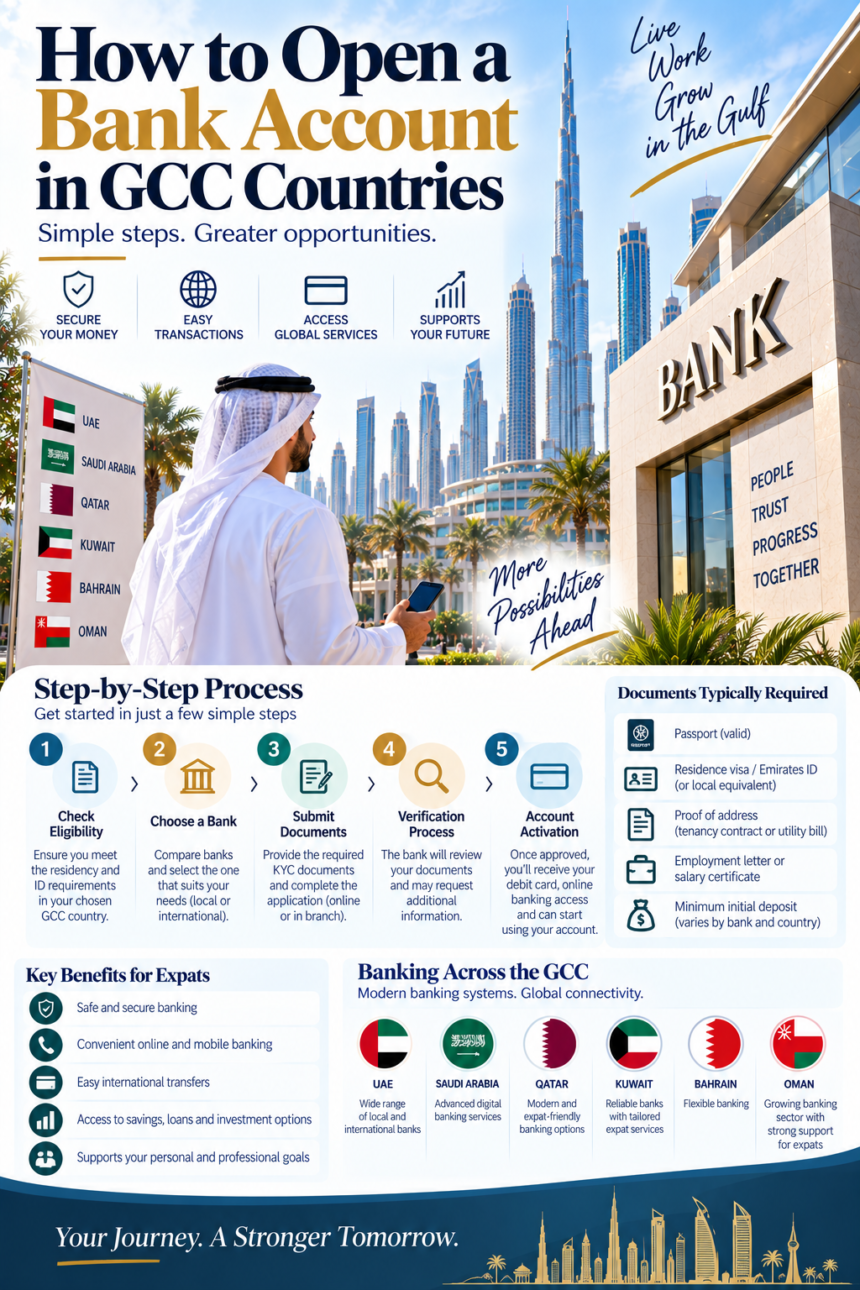
How to Open a Bank Account in GCC Countries is one of the first financial processes many expatriates need to understand after moving to the UAE, Saudi Arabia, Qatar, Bahrain, Oman or Kuwait. A local account can be essential for receiving a salary, paying rent and utility bills, using debit cards, transferring money home and managing everyday expenses.
- How to Open a Bank Account in GCC Countries: 2026 Overview
- 1. Completing Residency Requirements
- 2. Choosing the Right Type of Bank Account
- 3. Preparing Identification Documents
- 4. Providing Employment and Salary Documents
- 5. Completing KYC and Source of Funds Checks
- 6. Comparing Minimum Salary and Balance Requirements
- 7. Selecting Conventional or Islamic Banking
- 8. Completing Digital or Branch Account Opening
- 9. Activating Debit Cards and Mobile Banking
- 10. Setting Up Salary Transfers and IBAN
- 11. Managing International Transfers and Remittances
- 12. Keeping Banking Information Updated
- Opening a Bank Account in the UAE
- Opening a Bank Account in Saudi Arabia
- Opening a Bank Account in Qatar
- Opening a Bank Account in Bahrain
- Opening a Bank Account in Oman
- Opening a Bank Account in Kuwait
- Resident and Non-Resident Bank Accounts
- Bank Accounts for Self-Employed Expats
- Choosing the Right Bank in the GCC
- Common Bank Account Opening Problems
- Banking Security for New Expats
- Practical GCC Bank Account Checklist
- Final Thoughts on Opening a Gulf Bank Account
The process is generally straightforward once residency documents are available, but there is no single GCC-wide account-opening procedure.
Each country has its own identification system and banking regulations. The UAE commonly uses Emirates ID, Saudi Arabia uses the Iqama, Qatar uses the Qatar ID, Bahrain uses the CPR or Smart Card, Oman uses the Resident Card, and Kuwait relies heavily on the Civil ID.
Individual banks can also apply different salary requirements, minimum balances, account fees and eligibility rules.
For new expats, the most useful approach is therefore to complete residency first, prepare the correct documents and compare several banks before opening an account.
How to Open a Bank Account in GCC Countries: 2026 Overview
Banks across the Gulf operate under national financial regulators and must follow customer identification, anti-money laundering and financial crime prevention requirements.
This means a bank generally needs to establish:
- Who you are
- Where you live
- Your residency status
- Where you work
- Your source of income
- Why you need the account
- How you expect to use it
The precise documents depend on the country and bank.
In the UAE, official government guidance states that expatriate residents commonly provide an Emirates ID, valid residence visa, passport and salary certificate or employment letter. Proof of address may also be requested.
Saudi Arabia’s current account-opening rules similarly require banks to maintain information on non-Saudi customers including their residency identification, nationality, addresses, contact information and employer where applicable.
The easiest process therefore begins with having complete and valid residency documents.
1. Completing Residency Requirements
For most expatriates, obtaining legal residency makes opening an everyday bank account considerably easier.
A tourist or someone who has only recently arrived may not have access to the same products as a resident employee.
The resident identification document varies across the GCC:
| Country | Common resident identification |
|---|---|
| UAE | Emirates ID |
| Saudi Arabia | Iqama |
| Qatar | Qatar ID or QID |
| Bahrain | CPR/Smart Card |
| Oman | Resident Card |
| Kuwait | Civil ID |
Banks normally verify that the identification is current.
Saudi Arabia provides a particularly clear example. SAMA’s rules allow expatriates holding valid Iqamas to open accounts subject to the required identification and customer information. The rules also provide limited arrangements for certain workers during their initial temporary work-visa period before an Iqama has been issued.
In most situations, however, waiting until your permanent local identification has been issued makes the process simpler.
2. Choosing the Right Type of Bank Account
Do not begin by asking only which bank is best.
First decide which type of account you need.
Current accounts
Current accounts are designed for everyday transactions and may include:
- Salary deposits
- Debit cards
- Transfers
- Bill payments
- ATM access
- Cheque facilities where available
They are generally the most useful account type for employed expats.
Savings accounts
Savings accounts are designed more for holding money. They may offer interest at conventional banks or a profit-based arrangement at Islamic banks, depending on the product.
Salary accounts
Many Gulf banks offer accounts specifically designed for people receiving monthly salaries.
These can sometimes provide reduced fees, cards or access to additional banking products.
However, eligibility may depend on a minimum salary.
Always compare the account conditions rather than assuming the bank account offered through your employer is automatically the best option.
3. Preparing Identification Documents
Identification documents form the foundation of the application.
A typical expat may need:
- Passport
- Residence permit
- Local resident ID
- Local address
- Mobile number
- Email address
The UAE Government lists a passport, residence visa and Emirates ID among common documents required from expatriate residents.
In Qatar, Qatar Islamic Bank’s current guidance for new residents states that expat applicants generally require a valid QID, passport, employment contract or salary certificate and residence-address details.
In Bahrain, BBK lists the original CPR/Smart Card and passport with applicable residency documentation among requirements for non-Bahraini customers opening various personal accounts.
The exact list differs between banks, so check the chosen institution before visiting a branch.
4. Providing Employment and Salary Documents
Many Gulf bank accounts are connected closely to employment.
A bank may request:
- Salary certificate
- Employment contract
- Employer letter
- Salary transfer letter
- Staff identification
This information allows the bank to verify income and determine eligibility for particular products.
Qatar Islamic Bank, for example, lists an employment contract or salary certificate as part of its account-opening requirements for new expat residents.
In Kuwait, National Bank of Kuwait’s Express Account requires a salary certificate or salary-transfer letter, with specific salary eligibility applying to that particular account.
However, not every banking product requires the same income.
Some banks provide basic or financial-inclusion accounts for people with lower salaries or no conventional minimum salary requirement.
This is why someone rejected for one premium salary account may still qualify for another account type.
5. Completing KYC and Source of Funds Checks
KYC means Know Your Customer.
It is part of the process banks use to verify customers and understand financial activity.
Questions may include:
- Your occupation
- Employer
- Monthly salary
- Other income
- Tax residence
- Expected monthly deposits
- Expected international transfers
- Purpose of opening the account
Do not be concerned if a bank asks detailed questions.
These procedures form part of modern banking regulation.
Oman’s BankDhofar, for example, lists employment verification, address proof and tax-related declarations among KYC information required from individual customers in relevant circumstances.
Customers expecting to deposit a large amount may also be asked to prove its source.
Supporting evidence could include:
- Employment income
- Property sale documents
- Investment statements
- Inheritance documentation
- Business income records
Providing accurate information can prevent account delays later.
6. Comparing Minimum Salary and Balance Requirements
One of the most common misconceptions among new Gulf expats is that every bank account has the same salary requirement.
They do not.
Individual products can have their own:
- Minimum salary
- Minimum opening deposit
- Minimum monthly balance
- Salary transfer requirement
For example, BBK’s standard current account in Bahrain currently lists different minimum salary conditions for Bahrainis and non-Bahrainis, while its other account types have different eligibility requirements.
In Kuwait, NBK provides both accounts with specific salary criteria and financial-inclusion banking options designed to make essential banking available more broadly to residents.
Do not assume you cannot open a bank account because you do not meet the requirement for one particular product.
Ask whether the bank offers a basic salary, savings or financial-inclusion account.
7. Selecting Conventional or Islamic Banking
The GCC has highly developed conventional and Islamic banking sectors.
Islamic banks structure products according to Sharia principles, while conventional banks use traditional interest-based banking structures.
Both can offer services such as:
- Salary accounts
- Savings
- Debit cards
- Mobile banking
- International transfers
- Vehicle finance
- Home finance
An expat who specifically prefers Sharia-compliant banking can find extensive options across all six GCC states.
The correct choice should depend on personal preferences and the actual account terms.
Compare:
- Fees
- Minimum balance
- Salary conditions
- ATM access
- International transfers
- App quality
- Customer service
The type of bank matters, but so does the quality and cost of the specific account.
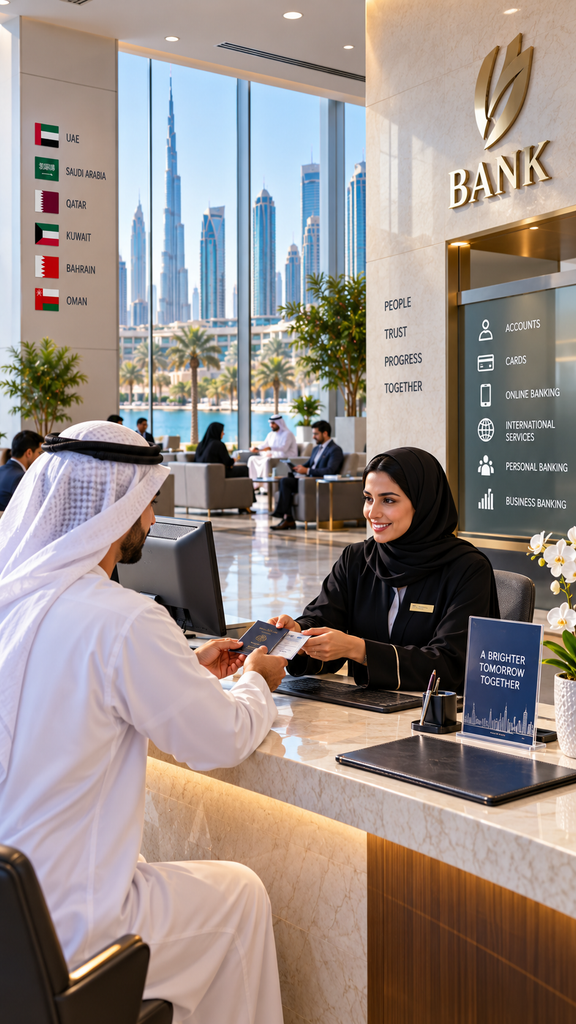
8. Completing Digital or Branch Account Opening
Bank account opening is becoming increasingly digital across the Gulf.
Some banks allow eligible customers to complete almost the entire process through a mobile application.
In the UAE, official government guidance notes that many banks allow applications through websites or mobile apps, including digital identity verification.
Qatar Islamic Bank allows eligible new residents to apply through its mobile application once they have the necessary QID and supporting information.
BankDhofar in Oman also provides digital onboarding through its Intilaqa app for eligible resident customers, including non-Omani residents with the required identification.
However, digital approval is not guaranteed.
A bank may request a branch visit if:
- Identification cannot be verified
- Additional compliance information is required
- The customer has unusual financial circumstances
- The requested product requires physical documentation
Keep original documents available even when applying digitally.
9. Activating Debit Cards and Mobile Banking
After approval, the account normally needs to be fully activated.
The bank may provide:
- Account number
- IBAN
- Debit card
- Mobile banking access
- Online banking access
Complete security setup immediately.
Choose a strong password and enable biometric authentication where available.
Do not share:
- PIN
- Password
- CVV
- One-time verification codes
Mobile banking can then become the main way to manage everyday finances.
Common services include:
- Transfers
- Bill payments
- Card controls
- Statements
- International payments
- Card freezing
- Transaction notifications
Make sure the mobile number registered with the bank is one you control and expect to keep active.
10. Setting Up Salary Transfers and IBAN
Once your account is open, give your employer the correct banking details.
This normally includes the IBAN, or International Bank Account Number, where applicable.
The UAE Government describes IBAN as the standard account identifier used for making and receiving many domestic and international payments.
Kuwait also operates an IBAN system for bank transfers.
Avoid typing banking information from memory.
Use the official IBAN displayed in the bank app, statement or account certificate.
One incorrect character can delay a salary or transfer.
After giving the information to HR, check the first salary carefully to confirm that everything is working correctly.
11. Managing International Transfers and Remittances
Many Gulf expats regularly send money to their home countries.
Banks are one option, but licensed remittance providers and exchange houses may also be available depending on the country.
Compare the total transfer cost rather than only the stated transaction fee.
Consider:
- Exchange rate
- Transfer fee
- Receiving-bank fee
- Transfer speed
- Transfer limits
A transfer with a zero headline fee can still cost more if the exchange rate is poor.
For large transfers, expect additional compliance checks.
Banks may request information about the source and purpose of the money.
This is especially common when transaction sizes are significantly different from the customer’s normal salary and account activity.
12. Keeping Banking Information Updated
Opening the account is not the final administrative task.
Banks need current customer information.
Update the bank when important information changes, including:
- Passport
- Resident ID
- Mobile number
- Address
- Employer
- Employment status
Saudi Arabia’s account rules demonstrate how strongly banking access can be connected to residency validity. Accounts may face restrictions when applicable identification expires, and specific rules apply when expatriates permanently leave Saudi Arabia.
Do not ignore messages requesting legitimate KYC updates.
At the same time, beware of phishing attempts pretending to be account-update requests.
Use the bank’s official application or website rather than clicking suspicious links.
Opening a Bank Account in the UAE
The UAE provides one of the Gulf’s most accessible banking environments for expatriate residents.
According to the UAE Government, common documents include:
- Emirates ID
- Valid residence visa
- Passport
- Salary certificate or employment letter
- Proof of address in some situations
Self-employed applicants may additionally need trade-licence and company documentation.
Applications may be completed at a branch or through digital banking channels depending on the institution.
Residents should compare minimum-balance charges carefully.
The account that looks most attractive when a salary is being transferred may become less suitable after employment changes.
Opening a Bank Account in Saudi Arabia
Saudi Arabia’s banking system places strong emphasis on the Iqama.
SAMA’s current rules allow expatriates holding valid residence permits to open accounts after banks obtain the required identification and customer information.
Banks record information including:
- Full name
- Nationality
- Iqama details
- Address
- Contact information
- Employer
Saudi rules also provide a special temporary arrangement for some workers during the first 90 days before an Iqama is issued. Such accounts are subject to additional conditions and restrictions.
For most long-term expats, completing the Iqama process before opening the main personal account remains the simplest route.
Opening a Bank Account in Qatar
For most expatriate residents, the QID is central to account opening in Qatar.
Qatar Islamic Bank currently states that new expatriate residents generally need:
- Valid QID
- Passport
- Employment contract or salary certificate
- Residence address details
Eligible applicants can complete account setup digitally through the bank’s mobile application or use a branch.
QNB’s published requirements for relevant individual account services similarly reference QID, passport for expats and salary documentation.
Different banks and products can still apply different conditions, so compare salary and account requirements before applying.
Opening a Bank Account in Bahrain
Bahrain has a well-established conventional and Islamic banking sector.
Non-Bahraini residents commonly use their CPR/Smart Card together with passport and residency information.
For example, BBK lists an original CPR/Smart Card and passport with relevant residence documentation for non-Bahrainis opening several personal account types. Some account products also require salary documentation or minimum income.
The National Bank of Bahrain also lists valid identification, passport and residency documentation for non-Bahraini residents applying for its current account.
This highlights an important point: local residency may establish basic eligibility, but the bank can still apply product-specific salary or balance requirements.
Opening a Bank Account in Oman
Expats in Oman generally need valid local residency identification before accessing standard resident banking products.
BankDhofar’s current KYC guidance identifies a Resident Card as an important identification document for expatriates living in Oman, along with address and employment verification for relevant customer processes.
Digital account opening is increasingly available.
BankDhofar’s Intilaqa service states that non-Omani residents aged 18 or older can complete digital onboarding using items including a valid Resident ID, mobile number, address proof and passport information for applicable account types.
Requirements will differ between Omani banks, so confirm the exact account before preparing documents.
Opening a Bank Account in Kuwait
Kuwait’s Civil ID is particularly important for expatriate banking.
Banks may also request salary or employer documentation depending on the account.
NBK’s current financial-inclusion information states that expat customers with valid Civil IDs can access banking options, while certain account packages are specifically structured around salary levels or employer arrangements.
A standard salary account may have different eligibility.
For example, NBK’s Express Account currently lists specific minimum salary criteria for expatriate applicants and requires a salary certificate or salary-transfer letter.
Always distinguish between a particular commercial account’s requirements and general access to banking.
Resident and Non-Resident Bank Accounts
Residents generally have access to the widest range of everyday banking products.
Non-resident account opening can be considerably more restrictive.
A non-resident may face:
- Higher minimum balances
- Fewer card facilities
- Additional source-of-funds checks
- Limited account types
- More documentation
Saudi Arabia is particularly restrictive for non-Saudi and non-GCC individuals who are not resident. Current SAMA rules generally require specific official approval before such individuals can open accounts, subject to defined exceptions.
Other GCC countries and individual banks have their own policies.
Do not assume that owning property or frequently visiting a Gulf country automatically gives you the same banking access as a resident employee.
Bank Accounts for Self-Employed Expats
Entrepreneurs and freelancers may need more documentation than salaried employees.
A bank may request:
- Trade licence
- Company registration
- Business activity information
- Ownership details
- Contracts
- Bank statements
- Proof of business income
- Tax information
The UAE Government specifically notes that self-employed customers may need to provide a trade licence and company documents when opening accounts. (u.ae)
Do not mix personal and company finances unnecessarily.
If you operate a registered business, understand whether the bank expects business revenue to pass through a corporate account instead of your personal account.
Choosing the Right Bank in the GCC
The best bank depends on how you expect to use it.
| Priority | Feature to compare |
|---|---|
| Salary | Salary eligibility and fees |
| Saving | Savings return or Islamic profit structure |
| Remittances | Exchange rate and transfer charges |
| Travel | International card fees |
| Cash | ATM network |
| Digital banking | App quality |
| Islamic banking | Sharia-compliant products |
| Borrowing | Finance eligibility and total cost |
| Low income | Basic or financial-inclusion account |
| Frequent relocation | International banking support |
Do not choose purely because of a joining bonus or free credit card.
Account fees and exchange rates matter much more over several years.
Common Bank Account Opening Problems
Applications can be delayed for simple reasons.
Common issues include:
Expired residency documents
Make sure all identification is valid.
Name mismatch
Your name should be consistent across passport, visa and local resident ID.
Missing salary certificate
Check whether the bank requires a recent document.
Incomplete address information
Some banks require proof of local or overseas address.
KYC questions
Unusual expected transaction activity may require further explanation.
Wrong account selection
You may not meet the salary requirement for one product but qualify for another.
If an application is refused, ask whether another account type is suitable rather than repeatedly submitting the same application.
Banking Security for New Expats
New residents can be attractive targets for scams because they are still learning local banking procedures.
Never give anyone:
- OTP
- Card PIN
- Password
- CVV
Be cautious of calls claiming that your account will be blocked unless you immediately provide verification information.
If in doubt, end the call and contact the bank through its official number.
Similarly, avoid giving another person access to your account for receiving or transferring money.
Transactions conducted through an account registered in your name may need to be explained by you.
Practical GCC Bank Account Checklist
Before applying:
- Complete your residency process
- Receive the relevant local ID
- Check that your passport is valid
- Obtain a salary certificate or employment letter
- Prepare proof of address if required
- Compare at least three banks
- Check minimum salary requirements
- Check minimum balance fees
- Decide between current and savings accounts
- Compare conventional and Islamic options
- Review international transfer charges
- Apply through an official bank channel
- Activate mobile banking securely
- Give your correct IBAN to your employer
- Keep residency and contact information updated
Final Thoughts on Opening a Gulf Bank Account
Learning How to Open a Bank Account in GCC Countries becomes much simpler once the process is broken into three stages: establish residency, prepare your documents and choose the right banking product.
In the UAE, expatriate residents typically rely on Emirates ID, residence documentation, passport and employment information.
In Saudi Arabia, the Iqama is central to ordinary expatriate banking, with SAMA maintaining detailed rules on accounts for foreign residents and temporary workers.
In Qatar, the QID, passport and employment information commonly form the basis of resident applications, while digital onboarding is available from some banks.
Bahrain, Oman and Kuwait similarly rely heavily on their respective local resident identification systems alongside bank-specific employment and KYC requirements.
The most important lesson is that there is no universal GCC bank-account requirement.
One bank may ask for a certain minimum salary while another offers a basic account. One institution may allow full digital onboarding while another asks you to visit a branch. Non-residents may face substantially different conditions from people holding local residency.
Prepare your documents, compare account fees carefully and use only regulated financial institutions.
A good Gulf bank account should make everyday life easier rather than more expensive. It should allow you to receive salary, manage bills, transfer money securely and maintain control of your finances without unnecessary fees or complicated conditions.
Do follow us on Instagram
Read More – How Banking Works for Expats in the Gulf: 12 Essential Things to Know in 2026