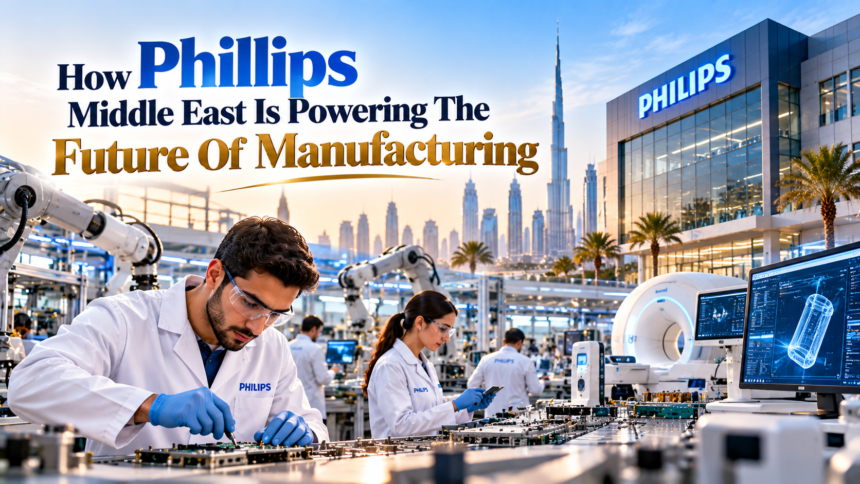
How Phillips Middle East Is Powering the Future of Manufacturing
Phillips Middle East is helping manufacturers across the region move toward a more advanced production model built around precision machining, automation, additive manufacturing, hybrid systems and stronger technical capability on the factory floor.
- Phillips Middle East Is Supporting a Broader Industrial Transformation
- CNC Machining Remains at the Core of Modern Manufacturing
- Additive Manufacturing Is Expanding What Regional Factories Can Produce
- Phillips Middle East Is Bringing Hybrid Manufacturing to the Factory Floor
- Industrial 3D Printing Can Strengthen Local Supply Chains
- Industry 4.0 Is Changing the Way Factories Operate
- Automation Is Becoming Essential for Productivity
- Phillips 360 Connects Technology With Local Service
- Workforce Skills Will Determine How Fast Advanced Manufacturing Grows
- Additive Manufacturing Can Help Companies Move From Prototyping to Production
- Manufacturing Sustainability Is Also Becoming More Important
- Phillips Middle East Is Expanding Its Role Across the GCC
- Why Gulf Manufacturing Needs More Than Imported Machinery
- The Future Factory Will Combine Multiple Manufacturing Technologies
- How Phillips Middle East Is Powering the Future of Manufacturing
The company operates in a region where industrial transformation has become a major economic priority. In the UAE, Operation 300bn aims to increase the industrial sector’s contribution to GDP from AED 133 billion to AED 300 billion by 2031 while accelerating advanced technology adoption and improving productivity. Saudi Arabia is pursuing a similar shift through its National Industrial Strategy, localisation policies and investment in advanced manufacturing.
Within that environment, manufacturers are under pressure to produce more locally, improve quality, reduce lead times, adopt digital systems and develop a workforce capable of operating increasingly sophisticated equipment.
Phillips Middle East positions itself as more than a machine supplier. Its regional model combines CNC technology, additive manufacturing, applications expertise, service, spare parts and training through what it calls the Phillips 360 approach. The company says it has installed more than 600 Haas machines across the Middle East and has more than three decades of experience as a Haas partner in the region.
That combination of technology and technical support is becoming increasingly important as Gulf manufacturers move from conventional production toward smarter, more flexible and increasingly localised manufacturing systems.
Phillips Middle East Is Supporting a Broader Industrial Transformation
Manufacturing across the Gulf is changing rapidly.
For many years, regional industrial growth was closely connected with oil, gas, petrochemicals and infrastructure. Those sectors remain important, but national economic strategies are now pushing manufacturing into a much wider range of areas.
These can include:
- Aerospace
- Defence
- Energy
- Automotive
- Medical manufacturing
- Industrial equipment
- Consumer products
- Advanced materials
- Precision engineering
The UAE’s Operation 300bn specifically aims to establish the country as a global hub for future industries and increase the use of advanced technologies throughout the industrial value chain.
Saudi Arabia’s industrial strategy similarly emphasises advanced manufacturing, localisation, stronger supply chains and the development of a competitive private-sector-led industrial economy.
This creates a clear opportunity for companies that can help manufacturers modernise existing factories rather than simply selling new equipment.
Phillips Middle East fits into that transition by combining conventional CNC machining with newer technologies such as industrial 3D printing, laser systems, hybrid additive manufacturing and digital production tools.
CNC Machining Remains at the Core of Modern Manufacturing
Advanced manufacturing does not mean abandoning traditional machining.
CNC technology remains one of the most important foundations of modern industrial production because manufacturers still need accurate, repeatable and efficient methods for producing metal components.
Phillips Middle East describes itself as one of the region’s major CNC machine suppliers and operates as a Haas Factory Outlet, providing machine selection, installation, service and after-sales support.
CNC machining is particularly important for industries that require tight tolerances and consistent output.
Typical applications can include:
| Industry | Common CNC Requirement |
|---|---|
| Aerospace | High-precision structural and engine components |
| Oil and gas | Valves, fittings and specialised parts |
| Automotive | Engine and drivetrain components |
| Defence | Precision mechanical systems |
| Medical | Instruments and device components |
| General engineering | Custom and production parts |
The biggest transformation is therefore not that CNC machining is disappearing.
It is that CNC machines are becoming part of a more connected production ecosystem involving automation, software, digital monitoring and additive processes.
For regional manufacturers, this can create an important pathway toward higher productivity without completely replacing existing production methods.
Additive Manufacturing Is Expanding What Regional Factories Can Produce
One of the most important technologies in Phillips Middle East’s portfolio is additive manufacturing.
Industrial 3D printing allows manufacturers to create components layer by layer rather than removing material from a larger block.
Phillips Middle East works with additive manufacturing brands including EOS, Markforged and Formlabs, covering technologies used for metals, composites, polymers and professional prototyping.
This can create several advantages.
Manufacturers may be able to:
- Produce complex geometries
- Reduce material waste
- Create prototypes faster
- Manufacture low-volume parts
- Produce lightweight components
- Customise products
- Shorten development cycles
The technology can be particularly useful where conventional machining would require several setups or where a geometry is difficult to manufacture through traditional methods.
However, additive manufacturing should not be treated as a replacement for every production process.
Its value depends on part design, material requirements, production volume and economics.
That is why technology selection becomes as important as the machine itself.
A manufacturer needs to understand when additive production creates a real operational advantage and when conventional machining remains more efficient.
Phillips Middle East Is Bringing Hybrid Manufacturing to the Factory Floor
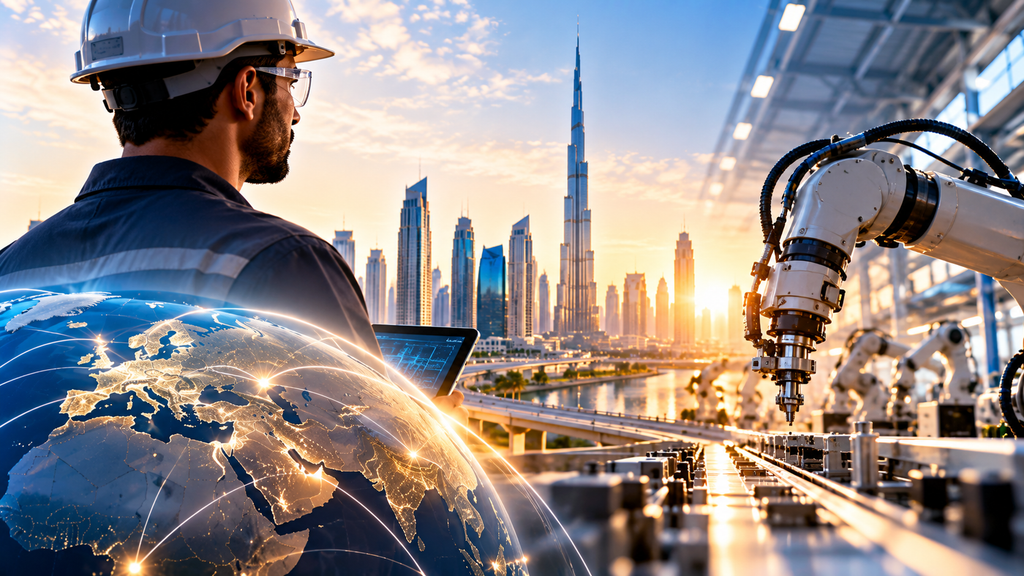
Hybrid manufacturing takes the relationship between additive and conventional machining one step further.
Phillips has integrated Meltio’s laser metal Directed Energy Deposition technology with Haas CNC machining centres, allowing additive and subtractive processes to be combined within the same manufacturing platform.
The concept can be summarised simply:
Add material → Machine it → Add again → Finish
This combination can allow manufacturers to create or repair complex metal parts while maintaining the surface finish and dimensional accuracy associated with CNC machining.
Phillips lists several advantages of its hybrid systems, including the ability to repair components, manufacture complex parts, produce near-net-shape parts and use different materials within one component.
Traditional vs hybrid manufacturing
| Traditional Process | Hybrid Approach |
|---|---|
| Material is mainly removed | Material can be added and removed |
| Repair may require separate processes | Material can be deposited directly |
| Complex geometry can require many setups | Additive can simplify part creation |
| Multiple machines may be needed | More processes can occur in one platform |
| High material removal may create waste | Near-net-shape production can reduce waste |
Hybrid manufacturing can therefore be especially valuable for high-value components where repair, modification or complex geometry is important.
Phillips says its systems can also reduce lead times and material waste while giving manufacturers more flexibility to respond to changing production requirements.
Industrial 3D Printing Can Strengthen Local Supply Chains
One of the broader implications of additive manufacturing is its potential effect on supply chains.
Traditional manufacturing can involve long lead times when specialised components need to be imported from overseas.
This becomes particularly difficult when:
- Suppliers are far away
- Shipping is delayed
- Parts are obsolete
- Volumes are too small for traditional production
- Emergency replacements are required
Digital manufacturing can reduce some of these dependencies.
A component can potentially be redesigned, stored digitally and manufactured closer to where it is needed.
That does not eliminate global supply chains, but it can provide manufacturers with more options.
This is highly relevant in the Gulf, where governments are actively encouraging localisation and stronger domestic production.
Saudi Arabia’s Vision 2030 framework places significant emphasis on local manufacturing and building resilient supply chains. Its National Industrial Strategy identifies advanced manufacturing and local-content development as major enablers of industrial growth.
For Phillips Middle East, additive manufacturing therefore represents more than a new machine category.
It can support a broader shift toward making more components regionally.
Industry 4.0 Is Changing the Way Factories Operate
Modern manufacturing is becoming increasingly digital.
Machines are no longer isolated pieces of equipment performing one repetitive task.
Factories are beginning to connect production systems with:
- Sensors
- Manufacturing software
- Automation
- Data analytics
- Digital monitoring
- Predictive maintenance
- Connected workflows
This broader transformation is commonly described as Industry 4.0.
Phillips Middle East has highlighted the increasing integration of CNC technology with digital manufacturing environments across the GCC, including hybrid machining and smart-production systems.
The potential benefits extend beyond production speed.
A more connected factory can help managers understand:
- Machine utilisation
- Downtime
- Maintenance requirements
- Production bottlenecks
- Quality trends
- Operator performance
This information can improve decision-making.
Instead of waiting for a machine to fail unexpectedly, manufacturers may be able to identify warning signs earlier.
Instead of assuming a production line is efficient, companies can measure actual performance.
For manufacturers competing internationally, this kind of visibility can become a significant advantage.
Automation Is Becoming Essential for Productivity
Labour productivity is another major issue facing manufacturers.
Factories cannot always increase output simply by adding more employees.
Automation can help machines operate more consistently, extend productive hours and reduce repetitive manual work.
In CNC environments, automation may involve:
- Automatic tool changes
- Robotic loading
- Part handling
- Pallet systems
- Automated inspection
- Connected production scheduling
The goal is not necessarily to remove workers.
It is often to allow skilled employees to focus on higher-value tasks.
For example, an operator who previously spent most of the shift loading and unloading identical parts may instead supervise several machines, manage quality or optimise production.
This changes the skill profile required on the factory floor.
Automation therefore needs to be accompanied by workforce development.
Without trained operators, engineers and technicians, expensive technology can be underused.
Phillips 360 Connects Technology With Local Service
One of the most important aspects of Phillips Middle East’s approach is what the company calls Phillips 360.
The model combines local:
- Sales
- Service
- Applications engineering
- Parts
- Training
- Additive expertise
Phillips says the purpose is to support manufacturers throughout the entire technology lifecycle rather than treating machine installation as the end of the relationship.
That matters because modern manufacturing equipment is increasingly complex.
A factory may invest heavily in CNC or additive technology, but its productivity depends on more than the specification sheet.
Long-term performance can also depend on:
- Correct setup
- Operator knowledge
- Application engineering
- Maintenance
- Fast spare-parts access
- Technical troubleshooting
Machine purchase vs manufacturing solution
| Machine-Only Approach | Phillips 360 Model |
|---|---|
| Buy equipment | Select technology for application |
| Install machine | Installation and commissioning |
| Train operator once | Ongoing skills development |
| Call service after failure | Preventive support |
| Manufacturer solves process issues | Applications team supports optimisation |
| Separate vendors | Coordinated technology support |
For Gulf manufacturers trying to scale quickly, access to local expertise can be particularly important.
Waiting for international specialists to travel into the region every time a technical issue occurs can create expensive downtime.
Workforce Skills Will Determine How Fast Advanced Manufacturing Grows
Machines alone cannot create an advanced manufacturing economy.
People still need to understand how to design parts, program equipment, maintain machines and optimise production.
The UAE’s Operation 300bn explicitly includes the creation of quality industrial jobs and training programmes as part of its industrial transformation objectives.
Saudi Arabia’s National Industrial Strategy similarly identifies talent development, applied research and innovation as core industrial enablers.
For manufacturers, this means technology investment and workforce investment need to happen together.
Skills increasingly required can include:
- CNC programming
- CAD/CAM
- Additive manufacturing
- Robotics
- Machine maintenance
- Data interpretation
- Quality control
- Design for additive manufacturing
Phillips positions training as part of its broader customer support model rather than an optional extra.
This is important because a factory may purchase advanced equipment yet achieve disappointing productivity if operators use only a small percentage of its capabilities.
The future of manufacturing therefore depends as much on people as it does on machines.
Additive Manufacturing Can Help Companies Move From Prototyping to Production
Industrial 3D printing was once associated mainly with prototypes.
That is changing.
Phillips describes additive manufacturing as increasingly relevant for complex production, low-volume manufacturing, customisation and faster production cycles rather than simply rapid prototyping.
This evolution is important for sectors where production volumes are relatively low but individual parts are valuable.
Examples can include:
- Aerospace
- Defence
- Energy
- Medical devices
- Industrial tooling
A company may not need one million identical parts.
It may need 50 highly complex components that would be expensive or slow to produce conventionally.
This is where additive manufacturing can become commercially attractive.
Prototype stage
Design → Print → Test → Modify
Production stage
Validated design → Repeatable printing → Machining → Inspection → Final component
Moving from the first stage to the second requires more than purchasing a printer.
Manufacturers need repeatable processes, qualified materials, quality control and operator expertise.
That is why technical support and process knowledge become increasingly important as additive manufacturing moves deeper into production.
Manufacturing Sustainability Is Also Becoming More Important
Industrial competitiveness is increasingly connected with sustainability.
Manufacturers are being asked to improve productivity while reducing waste, energy use and environmental impact.
The UAE’s industrial strategy specifically links advanced technology adoption with more efficient and sustainable production.
Advanced manufacturing can contribute in several ways.
Additive processes may use material more selectively than conventional machining for some components.
Hybrid manufacturing can help repair high-value parts rather than replacing them completely.
Digital monitoring can help manufacturers understand energy use and equipment efficiency.
Automation can improve consistency and reduce production errors.
However, advanced technology is not automatically sustainable.
Manufacturers still need to evaluate energy use, material sourcing, waste and the entire lifecycle of each process.
The strongest approach is therefore to use technology where it creates measurable improvements in both productivity and resource efficiency.
Phillips Middle East Is Expanding Its Role Across the GCC
Phillips Middle East’s regional presence extends beyond the UAE.
Its Middle East operations support manufacturing markets across the wider region, including Saudi Arabia, where industrial localisation has become a major strategic priority.
The company is also participating in FABEX Saudi Arabia 2026, held from October 11 to 14 at Riyadh International Exhibition and Convention Centre. Phillips says it is demonstrating CNC machining, fibre laser cutting, additive manufacturing and 3D scanning technology during the event.
Its displayed technologies include:
- Haas VF-3 YT50
- Han’s Laser fibre laser system
- Formlabs Fuse X1
- Markforged X7
- Haas tooling
This combination illustrates how manufacturing technology is increasingly being presented as an integrated ecosystem rather than a single machine category.
A modern factory may need subtractive machining, additive manufacturing, laser processing, inspection and digital systems working together.
For regional manufacturers, access to all of these technologies through local technical teams can simplify the process of modernising production.
Why Gulf Manufacturing Needs More Than Imported Machinery
For decades, industrial development in many markets could be achieved by importing equipment.
The next stage is more demanding.
Countries such as the UAE and Saudi Arabia increasingly want to build domestic industrial capability, localise production and develop technical expertise.
That means success is no longer simply measured by how many machines are installed.
A stronger measure includes:
- How much local production increases
- Whether productivity improves
- How quickly machines are maintained
- Whether workers develop new skills
- Whether supply chains become more resilient
- Whether factories can produce more complex products
This is where companies such as Phillips Middle East can play a broader role.
The value proposition moves from selling machines to building manufacturing capability.
That difference becomes increasingly important as the Gulf competes for investment in advanced industries.
The Future Factory Will Combine Multiple Manufacturing Technologies
The factory of the future is unlikely to rely on one technology.
Instead, different processes will work together.
A typical advanced manufacturing workflow could look like this:
| Stage | Technology |
|---|---|
| Design | CAD and simulation |
| Prototype | Industrial 3D printing |
| Initial production | Additive or hybrid manufacturing |
| Precision finishing | CNC machining |
| Inspection | 3D scanning and metrology |
| Production | Automated machining |
| Monitoring | Connected Industry 4.0 systems |
| Maintenance | Predictive and preventive service |
Phillips’ portfolio already reflects this type of integrated manufacturing environment.
Its technologies cover CNC machining, additive systems, hybrid manufacturing, laser solutions and supporting engineering services.
For manufacturers, the challenge will be deciding which combination produces the best business result.
Not every factory needs every technology.
The most successful investments will be those that solve specific problems such as reducing lead time, increasing capacity, improving part quality or localising components that were previously imported.
How Phillips Middle East Is Powering the Future of Manufacturing
The future of manufacturing in the Middle East is being shaped by a combination of national industrial strategy, technology adoption and demand for stronger local production.
The UAE wants its industrial sector to contribute AED 300 billion to GDP by 2031 through Operation 300bn, with advanced technology and productivity at the centre of that strategy. Saudi Arabia is simultaneously working to localise manufacturing, strengthen supply chains and expand its industrial base under Vision 2030.
Phillips Middle East operates directly within this transformation.
Its regional offering combines established CNC technology with industrial 3D printing, hybrid additive manufacturing, automation, service and training. The company says it has installed more than 600 Haas machines across the region while supporting customers through dedicated local sales, service and applications teams.
Its additive portfolio also shows how manufacturing is moving beyond conventional production. Partnerships with companies including EOS, Markforged, Formlabs and Meltio give manufacturers access to metal, polymer, composite and hybrid technologies designed for applications ranging from prototyping to end-use production.
The most important part of this transition, however, may not be any individual machine.
It is the movement toward factories that are more flexible, connected and technically capable.
CNC provides precision.
Additive manufacturing expands design possibilities.
Automation improves productivity.
Digitalisation creates visibility.
Training helps people use those technologies effectively.
Together, those elements are helping manufacturers across the region move from importing industrial capability toward building more of it locally.
That is ultimately where Phillips Middle East’s role becomes most significant: not simply supplying machines, but helping manufacturers develop the technology, processes and skills required for the next generation of industrial production.
Do follow us on Instagram
Read More – Professional Indemnity Insurance in the UAE: A Complete Guide for Businesses and Professionals