


Why the Future of GCC Transportation Is Changing
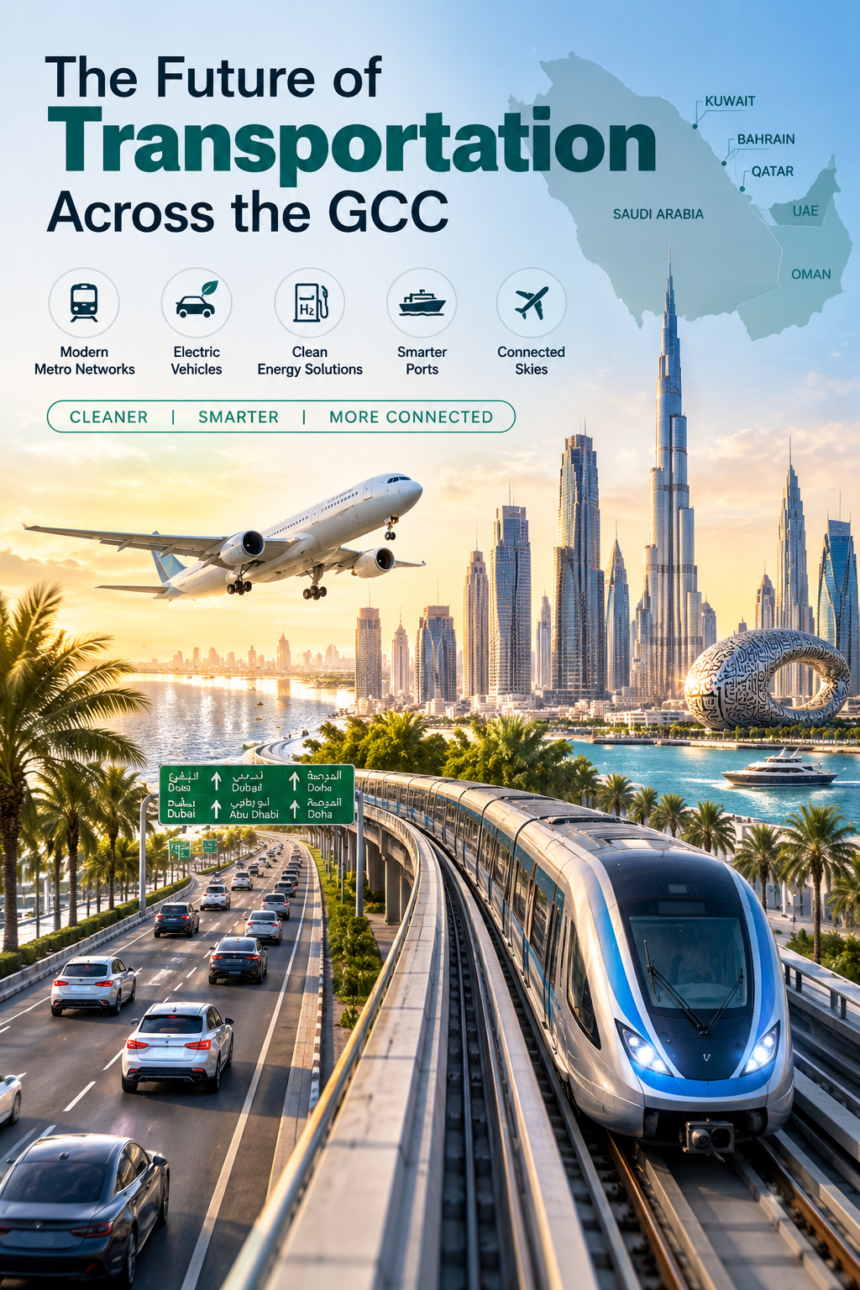
The future of transportation across the GCC is taking shape through one of the region’s biggest infrastructure transformations. Roads will remain important, but the way people and goods move across the Gulf is becoming far more diverse. Railways, metro systems, electric buses, autonomous taxis, artificial intelligence, smart traffic management and integrated transport platforms are gradually becoming part of everyday mobility.
- Why Transportation Across the GCC Is Changing
- Railways Are Becoming a Bigger Part of Gulf Mobility
- The GCC Railway Could Change Cross-Border Travel
- The UAE and Oman Are Building a New Cross-Border Rail Link
- Metro Systems Are Changing How Gulf Cities Move
- Electric Public Transport Will Play a Larger Role
- Autonomous Vehicles Are Moving From Experiments to Real Transport
- Artificial Intelligence Will Become Part of Everyday Transportation
- One Journey Could Use Several Types of Transport
- Smartphones Could Become the Main Gateway to Mobility
- Roads Will Remain Essential Across the GCC
- Freight and Logistics Could See an Even Bigger Transformation
- Air Taxis Could Add Another Layer to Urban Mobility
- How Each GCC Country Is Approaching Future Transportation
- What Challenges Could Slow the Transformation?
- What Could a GCC Journey Look Like in the Future?
- Why Better Transportation Matters Beyond Travel
- The Future of Transportation Across the GCC Will Be Connected
For decades, Gulf cities developed largely around private cars and extensive highway networks. Rapid population growth, new economic centres, expanding tourism and the development of large urban projects are now creating different demands. Governments need transport networks that can move more people efficiently while reducing congestion, improving connectivity and supporting sustainability goals.
The change is already visible. Saudi Arabia operates a major driverless metro network in Riyadh. Qatar is electrifying its public bus fleet. Passenger rail services have started operating in the UAE. Oman and the UAE are building a cross-border railway. Bahrain continues planning its metro network, while Kuwait is considering metro, bus rapid transit and GCC railway connectivity within its longer-term transport vision.
Transportation across the Gulf is therefore moving toward something much bigger than simply building more roads. The next phase will be about creating connected mobility ecosystems where trains, buses, cars, taxis, bicycles, aircraft and digital platforms work together.
Why Transportation Across the GCC Is Changing
The GCC has some of the world’s most modern road infrastructure, but population growth and urban expansion are changing the mobility requirements of cities such as Dubai, Abu Dhabi, Riyadh, Doha, Muscat, Manama and Kuwait City.
As metropolitan areas become larger, depending entirely on private vehicles becomes increasingly difficult. Road congestion, parking requirements, travel times and environmental pressures are encouraging governments to increase investment in public transportation and alternative mobility.
Economic diversification is another major factor. Saudi Arabia, the UAE, Qatar, Oman, Bahrain and Kuwait are all developing industries beyond traditional hydrocarbons. Tourism, logistics, manufacturing, technology, entertainment and international business require efficient transportation networks.
This means transport infrastructure is increasingly being treated as economic infrastructure rather than simply a way of moving people.
| Major Change | What It Could Mean for GCC Mobility |
|---|---|
| Expanding rail networks | Easier travel between cities and potentially GCC countries |
| Metro expansion | Less dependence on private vehicles inside major cities |
| Electric transport | Lower-emission buses, taxis and private vehicles |
| Autonomous mobility | Driverless taxis, buses and other transport services |
| AI traffic management | Smarter routing and more efficient road networks |
| Integrated mobility | Easier transfers between trains, buses, taxis and other modes |
| Digital ticketing | One app or platform potentially managing multiple journeys |
| Smart logistics | Faster movement of freight between ports, railways and industrial zones |
| Air mobility | New options such as electric aerial taxis for selected urban routes |
The biggest transformation will not necessarily come from one technology. It will come from connecting these different systems.
Railways Are Becoming a Bigger Part of Gulf Mobility
Rail transport is emerging as one of the most important changes in GCC transportation.
Saudi Arabia already operates major passenger rail services, while the Riyadh Metro has transformed public transportation in the capital. The network stretches 176 kilometres across six lines and 85 stations and operates as a fully driverless system. Saudi Arabia’s Vision 2030 Annual Report also highlights growing passenger and freight use across the country’s wider railway network.
The UAE has also moved into a significant new stage. Etihad Rail passenger services began in phases in 2026. The first passenger route connecting Abu Dhabi and Fujairah launched on June 30, 2026. Dubai and Al Dhaid stations are scheduled to open on September 30, followed by additional stations later in 2026 and Sharjah in March 2027.
These projects show how rail is becoming more than a freight solution. It is gradually becoming a practical alternative for intercity passenger travel.
For Gulf residents, this could eventually mean travelling between major cities without depending on a private car or domestic flight. For businesses, rail can provide another option for moving goods between ports, industrial areas, logistics centres and international borders.
The GCC Railway Could Change Cross-Border Travel
The most ambitious transport development is not limited to a single country. The GCC Railway is designed as an integrated network connecting all six GCC member states.
The GCC established the GCC Railways Authority to coordinate implementation and operation between member states, with the aim of developing an interoperable regional railway connected to national networks. GCC officials were still reviewing implementation progress and accelerating joint transport projects during 2026.
If fully connected, the railway could provide an alternative to driving or flying between Gulf countries.
A passenger might eventually be able to travel through several GCC states using interconnected rail services, while freight could move between ports, industrial centres and markets through a regional land network.
Bahrain’s planned connection provides an example of how this system could work. The country’s transport ministry says the proposed King Hamad Causeway would include road lanes and two railway tracks connecting Bahrain with Saudi Arabia. Bahrain’s future metro system is also intended to connect with the international railway station, creating links between regional and urban transportation.
Regional rail could therefore become one of the most important pieces of GCC economic integration.
The UAE and Oman Are Building a New Cross-Border Rail Link
One part of this regional rail vision is already under construction.
Hafeet Rail is developing a 238-kilometre railway connecting Sohar in Oman with the UAE national railway network. In April 2026, the project announced that construction had reached 40 percent completion.
The railway is designed to support both transportation and logistics, connecting important economic areas in the two countries. Its infrastructure includes tunnels, bridges and modern signalling technology, demonstrating the engineering scale required to create rail networks across the Gulf’s varied terrain.
For Oman, rail connectivity is particularly important because of the country’s ports and ambitions to strengthen its position as a global logistics hub. Oman Vision 2040 includes greater integration between roads, buses, ports and future railways, while the country’s transport authorities are also working on digital systems that connect different parts of the logistics network.
This shows how passenger transport and freight logistics are becoming increasingly connected.
Metro Systems Are Changing How Gulf Cities Move
Urban rail is another major part of the GCC transport transition.
Riyadh provides one of the clearest examples. The city’s metro network covers 176 kilometres across six lines and 85 stations. In November 2025, it was officially recognised as the world’s longest fully driverless metro network.
The significance extends beyond the technology itself. A large metro network gives residents another way to reach employment districts, universities, commercial centres and other parts of the city without using a private car for every journey.
Doha has already developed an integrated metro and tram ecosystem, supported by an increasingly electrified bus network.
Bahrain is also working toward rail-based urban transport. Its planned metro network totals 109 kilometres across several phases. Under existing plans, Phase 1 would cover around 29 kilometres with 20 stations on two lines.
Kuwait is exploring a similar direction. Kuwait Public Transport Company said during preparations for the 2025 UITP MENA Public Transport Conference that projects including metro, bus rapid transit and the GCC railway fit within the country’s broader push toward integrated and smart transportation under Kuwait Vision 2035.
The result could be a GCC where rail becomes increasingly normal for everyday urban journeys.
Electric Public Transport Will Play a Larger Role
Electric vehicles are often discussed in terms of private cars, but some of the Gulf’s biggest transportation changes are taking place in public fleets.
Qatar is particularly advanced in this area. Its Ministry of Transport Strategy 2025-2030 reported that 73 percent of public buses had become electric and set a target of reaching full electric conversion by 2030.
Qatar’s Electric Bus Transition Plan also covers the gradual conversion of school buses and other public transport vehicles. The ministry says electrification had already resulted in substantial emissions reductions by the end of 2024.
Other Gulf countries are developing charging networks, cleaner vehicle fleets and policies supporting electric mobility.
Over time, electrification could extend far beyond passenger cars. Buses, taxis, delivery fleets, government vehicles and commercial transport could increasingly use electric or other lower-emission power systems.
The transition will depend heavily on charging infrastructure. High-speed charging at homes, offices, shopping centres, public parking areas, highways and transport hubs will need to grow alongside vehicle adoption.
Autonomous Vehicles Are Moving From Experiments to Real Transport
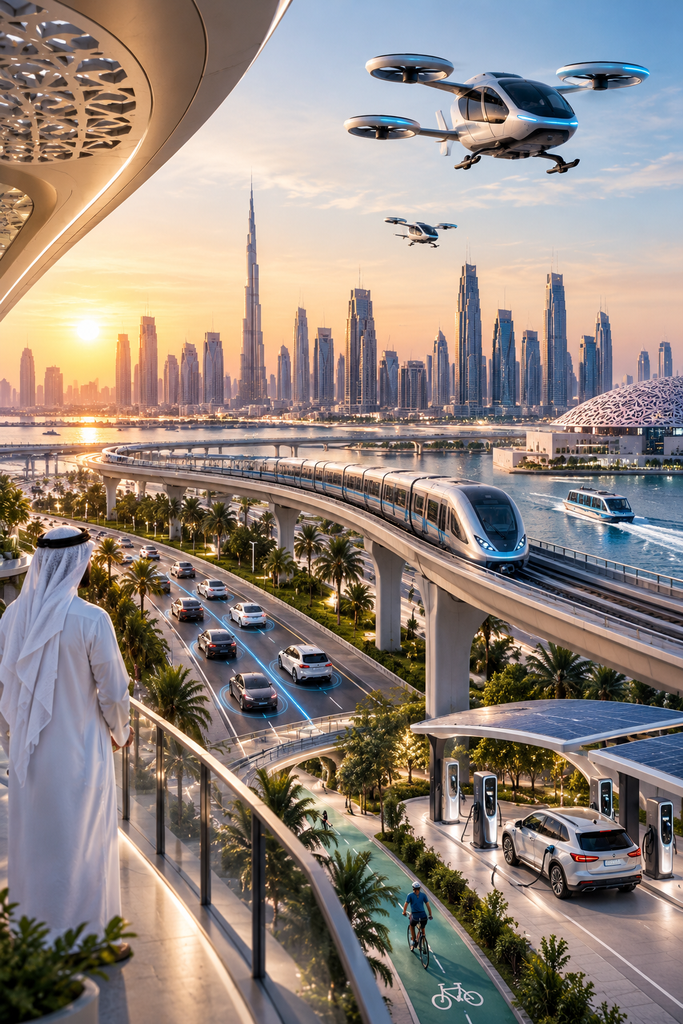
Driverless mobility is one of the technologies most closely associated with futuristic transportation. In parts of the Gulf, however, it is already moving beyond small demonstrations.
Dubai has a strategic target for autonomous transportation to account for 25 percent of mobility journeys by 2030.
By August 2026, Dubai’s robotaxi programme had recorded more than four million kilometres of operation and thousands of passenger trips. RTA reported a fleet of 144 vehicles within the programme, with fully driverless Apollo Go vehicles also becoming available to riders through the Uber platform.
The significance of autonomous transport extends beyond taxis.
Dubai’s future mobility strategy covers autonomous vehicles, buses, marine transport and other modes. The broader vision is for automation to become one part of an integrated transportation network rather than a separate technology experiment.
Autonomous systems could eventually be especially useful for predictable routes, transport hubs, airports, business districts and first and last mile connections.
However, widespread adoption will depend on regulation, safety testing, digital mapping, cybersecurity and public confidence.
Artificial Intelligence Will Become Part of Everyday Transportation
The future of GCC transportation will also depend on technologies that passengers may never directly see.
Artificial intelligence can analyse traffic flows, adjust signals, predict congestion, manage public transport schedules and identify incidents more quickly.
Instead of traffic management responding after congestion has already developed, AI-powered systems could increasingly predict where problems are likely to appear and change traffic signals or recommend alternative routes.
Public transport could also become more responsive.
Demand data may allow operators to understand when passengers need additional buses or trains. Maintenance systems could identify potential mechanical problems before equipment fails. Transport authorities could analyse millions of journeys to determine where new stations or services are required.
Dubai’s transport strategy already places AI-enabled infrastructure, intelligent traffic management and stronger digital infrastructure among its future priorities.
This digital layer could eventually become as important as physical roads and railways themselves.
One Journey Could Use Several Types of Transport
Future transportation is increasingly based on the idea of multimodal mobility.
A passenger might leave home using an electric bicycle or neighbourhood shuttle, connect to a metro station, take a train across the city and complete the final part of the journey using an autonomous taxi.
The important part is making those transfers simple.
This is why GCC cities are paying more attention to first and last mile mobility. Dubai, for example, approved a five-year soft mobility plan covering 25 residential areas and infrastructure around 63 public transport stations through 2030.
Walking routes, cycling tracks, scooters, neighbourhood buses and on-demand transport can increase the usefulness of metro and rail networks because passengers still need convenient ways to reach stations.
The long-term goal is therefore not simply to construct more metro lines. It is to create a complete journey where every transport option connects with the next.
Smartphones Could Become the Main Gateway to Mobility
Digitalisation will also change how people interact with transportation.
Instead of purchasing separate tickets from different operators, passengers could increasingly use mobile applications to plan, book and pay for complete journeys.
These platforms could combine route planning, public transport timetables, taxi bookings, parking availability and payment systems.
For visitors, this would make Gulf cities easier to navigate. A tourist arriving at an airport could potentially use one application to identify the fastest combination of metro, bus and taxi services to reach a hotel.
For residents, integrated applications could compare journey times and transport choices before a trip begins.
Data generated by these systems could also help authorities understand where and when people travel, allowing infrastructure investment to better match actual demand.
Roads Will Remain Essential Across the GCC
The growth of rail and public transport does not mean highways will disappear.
GCC countries cover large geographic areas, and private cars remain practical for many journeys. Roads will continue to support personal mobility, freight, tourism, construction and access to areas where rail transport may not be economically practical.
The difference will be how roads are managed.
Future highways are likely to contain more digital monitoring, connected infrastructure, intelligent traffic management and charging facilities for electric vehicles.
Vehicles may communicate with road infrastructure to receive information about accidents, congestion, weather conditions or lane closures.
Eventually, connected and autonomous vehicles may require roads to function partly as digital infrastructure.
Oman illustrates how traditional road development and digital transport can progress together. The country’s transport ministry continues to invest in major road projects while also developing digital ticketing, vehicle tracking, smart transport services and integrated public transport infrastructure.
Freight and Logistics Could See an Even Bigger Transformation
Transportation is not only about passengers.
The Gulf’s location between Asia, Africa and Europe has made logistics a major part of economic diversification strategies. Ports, airports, free zones, industrial areas, roads and railways increasingly need to operate as one connected system.
Rail could become particularly important for freight because large quantities of goods can be transported efficiently between ports and inland logistics centres.
The GCC Railway and projects such as Hafeet Rail could strengthen these connections.
Digitalisation will also matter. Oman, for example, is developing a Port Community System intended to integrate ports, airports, dry ports, border crossings, free zones and railways into a single digital environment.
Similar systems across the region could reduce paperwork, improve cargo tracking and make cross-border supply chains faster.
For businesses deciding where to establish manufacturing or distribution centres, transportation connectivity could therefore become an increasingly important competitive advantage.
Air Taxis Could Add Another Layer to Urban Mobility
Another technology attracting attention is advanced air mobility.
Instead of travelling entirely by road, small electric vertical take-off and landing aircraft could eventually connect selected parts of large cities.
Dubai has been developing plans for aerial taxi operations as part of its wider future mobility strategy, with RTA reporting preparations for an official launch targeted for the end of 2026.
The initial role of aerial mobility is likely to be limited compared with metro systems, buses and roads. Aircraft capacity is smaller and specialised infrastructure is required.
However, the technology could eventually serve premium, airport or time-sensitive journeys between major business and tourism districts.
More importantly, the development of aerial mobility shows that GCC transport planners are considering mobility in three dimensions rather than focusing only on roads and rail.
How Each GCC Country Is Approaching Future Transportation
While GCC countries share many mobility goals, each market is developing according to its own geography, population and economic priorities.
| Country | Key Direction |
|---|---|
| UAE | Passenger rail, autonomous taxis, metro expansion, electric mobility, smart transport and advanced air mobility |
| Saudi Arabia | Large-scale metro systems, national rail expansion, high-speed rail and integrated public transport |
| Qatar | Electric buses, metro integration, sustainable public transport and smart mobility |
| Oman | Cross-border rail, logistics integration, road development and multimodal connectivity |
| Bahrain | Planned metro network, bus improvement and GCC railway connectivity |
| Kuwait | Integrated public transport planning, future metro and BRT concepts, and GCC railway connectivity |
These different approaches could eventually complement each other.
Saudi Arabia has the geographic scale for extensive national rail. The UAE is becoming an important testing ground for autonomous mobility. Qatar has made rapid progress in electric public transport. Oman has a strategic logistics position. Bahrain can become an important link between Saudi Arabia and the wider GCC railway system, while Kuwait’s future transport planning could strengthen the northern end of regional connectivity.
What Challenges Could Slow the Transformation?
Building the next generation of transportation will not be simple.
Technology is only one part of the challenge. GCC governments also need to make different transport systems work together while maintaining safety, affordability and reliability.
Among the biggest issues will be the cost of large infrastructure projects, coordination between government authorities, cross-border rail standards, charging infrastructure, cybersecurity, passenger behaviour and integration between older transport networks and new technology.
Extreme summer temperatures must also be considered. Walking, cycling and public transport connections need shaded, cooled or otherwise climate-appropriate infrastructure if they are expected to become realistic alternatives to cars.
Autonomous vehicles create additional regulatory questions. Authorities need standards governing liability, testing, passenger safety, data protection and the interaction between driverless and human-operated vehicles.
These challenges do not mean transformation will stop. They show that the future of mobility depends as much on planning and regulation as it does on technology.
What Could a GCC Journey Look Like in the Future?
Imagine a future traveller beginning a journey in Muscat.
A digital mobility application recommends a bus connection to a rail station. The passenger boards a train heading toward the UAE using the cross-border network, then transfers to another rail service.
After arriving in a major city, an autonomous taxi completes the final part of the journey.
Payment is handled digitally, while live information automatically adjusts the itinerary if a service is delayed.
Another passenger might travel between Saudi Arabia and Bahrain using regional rail before connecting directly to Bahrain’s urban transport network.
These journeys will not appear everywhere at once. Different projects will develop at different speeds.
Yet the infrastructure being planned and constructed today points toward a Gulf where transportation becomes more connected across cities and national borders.
Why Better Transportation Matters Beyond Travel
Transport infrastructure affects almost every part of an economy.
Better public transportation can expand the area where people can realistically live and work. Faster intercity connections can support tourism. Rail freight can improve industrial competitiveness. Smart logistics can help ports attract international trade.
Transport stations can also influence real estate development.
Areas surrounding major metro and railway stations may become attractive locations for offices, residential projects, hotels and retail developments because people can reach them without relying completely on cars.
For tourists, improved connectivity makes multi-city and potentially multi-country travel easier.
For companies, it can widen access to employees and customers.
For governments, efficient transport can help new economic districts develop without creating unsustainable levels of road congestion.
Transportation therefore becomes part of a much larger economic strategy.
The Future of Transportation Across the GCC Will Be Connected
The future of transportation across the GCC will not be defined by one vehicle, one railway or one technology.
It will be defined by integration.
Metro networks will connect with buses. Passenger rail will connect cities. Regional railway projects could connect countries. Electric vehicles will use expanding charging networks. Autonomous taxis will work alongside traditional public transport. Digital platforms will help passengers move between different systems.
Projects already operating or under development across Saudi Arabia, the UAE, Qatar, Oman, Bahrain and Kuwait show that this transformation is no longer only a distant concept.
The Gulf was built during an era when highways and private vehicles shaped modern cities. The next era could look very different.
Roads will remain important, but railways, electric mobility, autonomous systems, artificial intelligence and integrated public transportation are gradually creating a more diverse transport network.
If these projects continue to connect successfully, travelling across the GCC in the future may become faster, smarter and easier, not because one revolutionary technology replaces everything that came before it, but because many different forms of transportation finally begin working as one system.
Do follow us on Instagram
Read More – Future of Gulf Tourism: 12 Powerful Trends Reshaping Travel