



Renting vs Buying Property in the Gulf: Which Is Better for Expats?
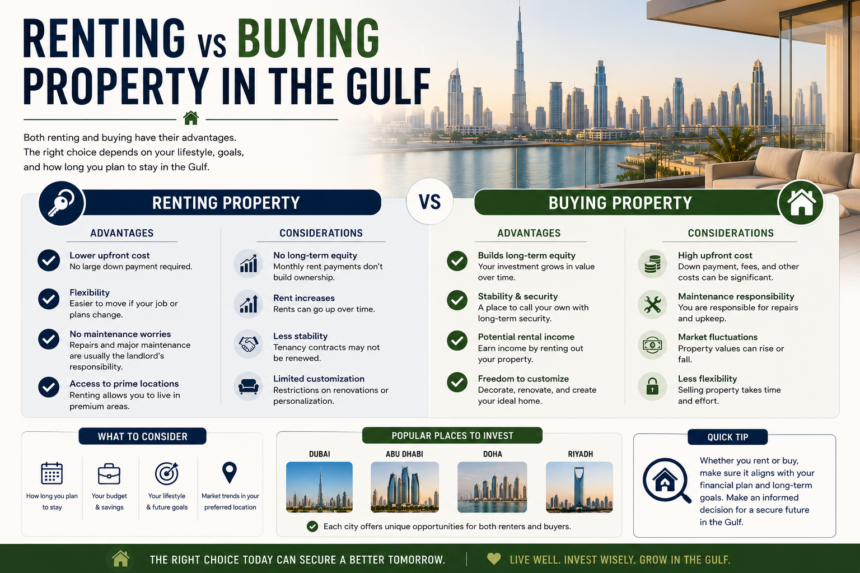
For many expatriates, the question of renting or buying property begins after they have spent a few years living in the Gulf. At first, renting often feels like the natural choice because it allows newcomers to understand the city, settle into their careers and avoid making a large financial commitment too early. Over time, however, rising rents, greater career stability and longer-term family plans can make property ownership look increasingly attractive.
- Renting vs Buying Property in the Gulf at a Glance
- 1. Start With How Long You Expect to Stay
- 2. Compare the Full Cost of Buying, Not Only the Mortgage
- 3. Renting Also Has Hidden Costs
- 4. Buying Requires Far More Money Upfront
- 5. Renting Provides Valuable Career Flexibility
- 6. Buying Can Offer Valuable Long-Term Stability
- 7. Understand Foreign Ownership Rules Across the Gulf
- Renting vs Buying Property in the UAE
- Renting vs Buying Property in Saudi Arabia
- Renting vs Buying Property in Qatar
- Renting vs Buying Property in Bahrain
- Renting vs Buying Property in Oman
- Renting vs Buying Property in Kuwait
- 8. Do Not Assume Property Prices Will Always Rise
- 9. Service Charges Can Significantly Affect Returns
- 10. Mortgage Payments Should Be Stress Tested
- 11. Buying a Home and Buying an Investment Are Different Decisions
- 12. Consider What Else Your Deposit Could Do
- When Renting Property in the Gulf Makes More Sense
- When Buying Property in the Gulf May Make More Sense
- Renting vs Buying Property in the Gulf for Families
- Renting vs Buying for Young Professionals
- Does Buying Property Provide Gulf Residency?
- Off-Plan or Ready Property
- A Simple Rent vs Buy Financial Test
- Gulf Property Ownership Comparison for Expats
- Common Mistakes Gulf Property Buyers Should Avoid
- Renting vs Buying Property in the Gulf: Which Is Better?
- Final Thoughts on Renting vs Buying Property in the Gulf
The decision is more complicated than simply comparing annual rent with a monthly mortgage payment. The UAE, Saudi Arabia, Qatar, Bahrain, Oman and Kuwait have different foreign-ownership rules, financing environments and property markets. Even within one country, the decision can change significantly depending on the city, neighbourhood and type of property. Buying an apartment in Dubai is a very different decision from purchasing a home in Riyadh, Doha or Muscat.
Expats also need to think beyond investment returns. Career mobility, family stability, school location, residency plans, maintenance costs and the amount of savings required upfront can all influence whether renting or buying makes more sense. Someone expecting to relocate within two years may benefit greatly from renting, while a family planning to remain in the same Gulf city for a decade may see more value in ownership.
This guide compares Renting vs Buying Property in the Gulf through 12 important factors and explains how the decision differs across the GCC.
Renting vs Buying Property in the Gulf at a Glance
Before looking at country-specific rules, it helps to understand the basic differences between the two options. Renting generally provides greater flexibility and requires less cash upfront, while buying can provide stability and potential long-term asset growth. Neither option is automatically better because the correct choice depends on how long you expect to stay, how secure your income is and how much financial flexibility you want to preserve.
| Factor | Renting | Buying |
|---|---|---|
| Initial cash required | Usually lower | Usually much higher |
| Flexibility | High | Lower |
| Long-term stability | Moderate | High |
| Exposure to property prices | None | Yes |
| Maintenance responsibility | Often shared with landlord | Mainly owner |
| Ability to relocate | Easier | More complicated |
| Potential capital growth | No | Possible |
| Mortgage commitment | None | Often long-term |
| Property customisation | Limited | Greater freedom |
| Best suited to | New or mobile expats | Long-term residents |
The table provides a useful starting point, but the real decision begins when you calculate the complete financial and lifestyle impact.
1. Start With How Long You Expect to Stay
The length of time you expect to remain in one city is one of the most important factors in the rent-versus-buy decision. Property purchases involve significant initial costs, and those costs become harder to justify if you sell again shortly after buying. Someone who expects to remain in the same country for only two or three years may therefore find renting much more practical.
This is particularly relevant in the Gulf because international professionals often move between cities as their careers develop. A worker may begin in Dubai, receive a stronger opportunity in Riyadh and later transfer to Doha or Abu Dhabi. Renting allows someone to respond to those opportunities without needing to sell a property, find a tenant or manage a home from another country.
Long-term residents face a different calculation. If you have lived in one city for several years, expect to remain for the foreseeable future and have built a stable career there, buying can become more attractive. A family whose children attend a nearby school may place considerable value on staying in the same neighbourhood without worrying about future tenancy changes.
As a general principle, buying becomes easier to justify when your plans are measured in years rather than months.
2. Compare the Full Cost of Buying, Not Only the Mortgage
A common mistake is comparing monthly rent directly with a mortgage instalment and assuming that the lower number represents the better option. Buying property includes several additional costs that can significantly affect the calculation.
Depending on the country and transaction, buyers may need to pay registration charges, brokerage commission, valuation costs, mortgage-related charges, insurance and other administrative expenses. An apartment owner may also face annual service charges covering building management, security, swimming pools, gyms, lifts and common-area maintenance.
Maintenance costs need to be included as well. Air-conditioning systems, plumbing, appliances and general wear eventually require repairs. Villa owners may face additional costs for gardens, external maintenance and larger cooling systems.
These expenses do not mean buying is a poor financial decision. They simply mean that buyers should compare the complete ownership cost rather than treating the mortgage payment as the only expense.
3. Renting Also Has Hidden Costs
Renting is usually simpler financially, but it is not cost-free beyond the advertised rental amount. Tenants may need to pay deposits, agency fees, utility setup charges and moving expenses. Depending on the market, rent may also increase when a tenancy is renewed under applicable local rules.
Frequent moves can become particularly expensive. Each relocation may involve movers, deposits, new utility connections, furniture adjustments and time spent searching for another property. Families may also need to remain within a certain area because of school locations, which can limit their ability to move to cheaper neighbourhoods.
For long-term residents, the uncertainty around future rent can become one of the strongest reasons to consider purchasing. Ownership can provide more predictable housing arrangements, although owners still need to manage mortgage costs, service charges and maintenance.
The correct comparison should therefore include the total cost of both options rather than assuming one contains no additional expenses.
4. Buying Requires Far More Money Upfront
The initial financial commitment is one of the biggest differences between renting and buying. Renters usually need enough cash to cover deposits, advance rent and related setup expenses. Buyers may need a substantial down payment in addition to transaction and financing costs.
That difference matters because purchasing a property can absorb a large portion of an expatriate’s savings. Before using most of your available cash for a home, consider what would happen if your employment situation changed unexpectedly. Gulf careers can be rewarding, but expatriate income can still depend heavily on a particular employer, business or visa arrangement.
A buyer should ideally retain an emergency reserve after completing the purchase. If acquiring a property leaves you without enough savings to cover several months of essential expenses, the financial commitment may be too aggressive.
Property ownership should improve long-term financial stability rather than eliminate short-term financial flexibility.
5. Renting Provides Valuable Career Flexibility
One of the strongest arguments for renting in the Gulf is mobility. The region has become increasingly connected professionally, and experienced workers frequently move between the UAE, Saudi Arabia, Qatar and other GCC markets as new projects and opportunities appear.
A young consultant, engineer, marketing professional or technology specialist may receive an opportunity in another country that offers a significantly better career path. Someone who rents can usually relocate once their tenancy obligations are completed. A homeowner needs to decide whether to sell, rent out the property or manage it remotely.
This is especially important during the early stages of a Gulf career. Salary growth from accepting the right professional opportunity may be more significant than potential returns from owning a property too early. Remaining mobile can therefore have its own economic value.
Rent is not necessarily wasted money if it allows you to pursue better career opportunities without being tied to one location.
6. Buying Can Offer Valuable Long-Term Stability
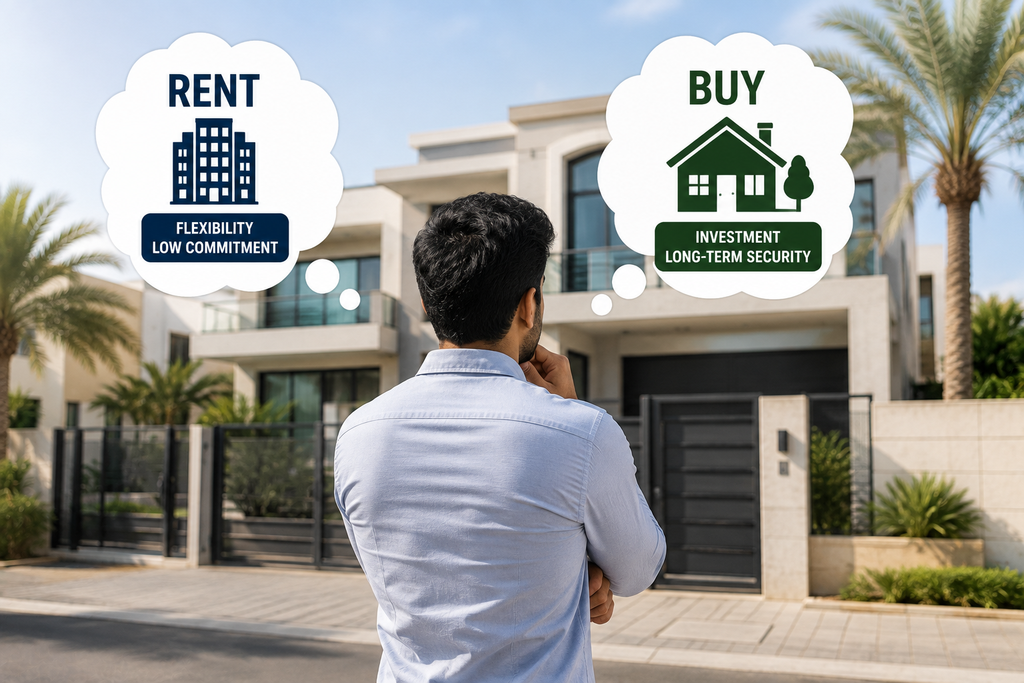
Ownership becomes more attractive when your life in the Gulf becomes established. Families often develop strong connections with a particular neighbourhood because of schools, friends, work and daily routines. Moving every few years can then become disruptive.
Owning a property can provide greater control over where and how you live. Homeowners can normally make more personal improvements to their property, subject to community and regulatory requirements. They also avoid the uncertainty of whether a landlord will renew the tenancy or whether rental costs will become less attractive over time.
This stability can be particularly valuable for families with children. Remaining close to the same school, social community and everyday facilities can improve quality of life even if the property does not produce extraordinary investment returns.
A home should therefore be evaluated as both a financial asset and a place where you actually intend to live.
7. Understand Foreign Ownership Rules Across the Gulf
Foreign property ownership is one of the areas where the six GCC countries differ most. Expats should never assume that a property available for sale can automatically be purchased by every nationality or residence category.
The UAE has one of the region’s most established foreign-buyer markets. In Dubai, foreigners and expatriate residents can acquire freehold property in designated areas. Abu Dhabi also permits non-UAE nationals to acquire property rights within officially designated investment areas.
Saudi Arabia has undergone an important change. Its new Real Estate Ownership System for Non-Saudis entered into force on January 22, 2026. The system allows applications from residents, non-residents and qualifying foreign entities through the official Saudi Properties platform, subject to applicable eligibility rules and geographical restrictions.
Qatar provides designated freehold and usufruct areas for non-Qataris, while Bahrain publishes officially approved areas and projects where non-Bahrainis may own property. Oman allows non-Omanis to acquire qualifying property within Integrated Tourism Complexes under its established regulatory framework.
Kuwait remains more restrictive for typical expatriate buyers, which means renting remains the more relevant option for many foreign workers.
Before paying any reservation amount, buyers should verify whether they are legally eligible to own that exact property.
Renting vs Buying Property in the UAE
The UAE is one of the easiest Gulf markets in which expatriates can seriously consider property ownership because foreign buyers have access to a well-established property ecosystem. Dubai is particularly prominent, with designated freehold areas offering apartments, villas and townhouses across different price segments. Foreign residents and non-residents can acquire freehold property within these designated zones, while long-term usufruct or leasehold rights are also possible under the applicable framework.
Abu Dhabi provides another significant market. Non-UAE nationals may own and acquire property rights within designated investment areas, which has opened several important residential communities to international buyers. This means long-term residents in both Dubai and Abu Dhabi can realistically compare renting and buying rather than assuming property ownership is unavailable to them.
For new residents, however, renting can still be the smarter first step. Dubai neighbourhoods vary greatly in price, commuting conditions and lifestyle. Someone who buys immediately after arrival may later discover that another area suits their workplace or family much better. Renting for the first year or two allows newcomers to understand the city before making a major commitment.
Buying becomes more compelling when income is stable, the buyer has sufficient savings and the intended ownership period is long enough to justify transaction costs.
Renting vs Buying Property in Saudi Arabia
Saudi Arabia deserves particular attention because the regulatory environment changed significantly in 2026. The Real Estate General Authority confirmed that the new non-Saudi property ownership framework entered into force on January 22, 2026, creating a formal digital process for residents, non-residents and qualifying foreign companies.
The new framework has made Saudi property ownership far more relevant to international professionals than it was previously. However, buyers still need to understand that eligibility and geographical rules apply, and special considerations exist for certain locations.
Riyadh is likely to be the main market of interest for many international workers because of the city’s rapid growth and expanding professional sectors. A person planning to remain in Riyadh for many years may eventually find ownership attractive, especially if career and family plans become firmly tied to the city.
Short-term workers should still approach buying cautiously. Someone employed on a limited project or expecting future relocation may benefit more from renting, particularly while the new ownership environment continues to develop.
Renting vs Buying Property in Qatar
Qatar allows non-Qataris to own or use property within designated areas. The Ministry of Justice distinguishes between freehold and usufruct areas, meaning foreign buyers need to understand the type of property right attached to the location they are considering.
Property ownership can also connect with residence benefits. Under the current framework, purchasing qualifying property worth at least QAR 730,000 can make the owner eligible for real estate residence without a sponsor, provided the required residency conditions are met. A higher qualifying threshold can provide additional benefits.
This can make buying attractive to people who want a longer-term connection with Qatar that is not completely dependent on an employer. However, the financial decision should still be considered separately from the residence benefit.
Doha has a substantial rental market, and expats who expect to remain for only a few years may still find renting easier. Buyers should compare purchase price, service charges, financing costs and realistic rental demand before deciding that ownership represents better value.
Renting vs Buying Property in Bahrain
Bahrain offers foreign ownership in officially approved locations and projects. The Survey and Land Registration Bureau provides maps showing where non-Bahrainis are permitted to own property, making it important for potential buyers to verify the exact location before completing a transaction.
Bahrain’s smaller geographical size changes the lifestyle calculation compared with cities such as Riyadh or Dubai. Residents can often consider a wider range of neighbourhoods without facing the same level of long-distance commuting. This can give buyers more freedom to choose according to lifestyle, building quality and investment potential.
Long-term expatriates may see ownership as a way to gain housing stability, particularly if they expect to remain in the country for many years. However, professionals who may later move to Saudi Arabia, the UAE or another international market may still prefer the flexibility of renting.
The decision should depend on the individual property’s quality, service charges, resale demand and expected ownership period rather than the assumption that buying is automatically superior.
Renting vs Buying Property in Oman
Oman allows foreign nationals to purchase qualifying property within Integrated Tourism Complexes. Official government services continue to support the ownership and registration of real estate in these approved developments, giving expatriates and international buyers a defined path to property ownership.
This can be attractive to long-term residents who value Oman’s quieter lifestyle, natural surroundings and more relaxed pace compared with some larger Gulf cities. Muscat in particular offers residential options that appeal to professionals and families seeking access to the coast, mountains and established communities.
However, the smaller employment market means career flexibility deserves careful consideration. A professional who unexpectedly needs to relocate may need to rent out or sell the property, and liquidity can vary considerably between developments.
Before buying, examine the community’s tenant demand, resale history, maintenance quality and long-term attractiveness rather than focusing only on the purchase price.
Renting vs Buying Property in Kuwait
Kuwait is different from markets such as Dubai and Doha because property ownership by typical foreign expatriates remains considerably more restrictive. As a result, renting continues to be the normal housing model for much of the international workforce.
The rental market offers a broad range of options, from smaller apartments suitable for individual workers to larger homes for families. Areas such as Salmiya and other established expatriate districts provide convenient access to shops, restaurants and everyday services.
Anyone considering ownership in Kuwait should obtain current professional legal advice based on their nationality, residence status and exact property type. General GCC property guidance should not be assumed to apply automatically.
For most conventional foreign employees, the practical decision is therefore more likely to involve choosing the right rental property rather than comparing large numbers of foreign-owned freehold opportunities.
8. Do Not Assume Property Prices Will Always Rise
Real estate can appreciate over time, but no property market moves upward forever. Prices are influenced by supply, demand, population growth, interest rates, economic conditions, employment trends and the amount of new construction entering the market.
This matters especially in rapidly developing Gulf cities where thousands of new properties can be delivered over relatively short periods. Even when the overall market performs well, individual developments may behave very differently.
A highly desirable established community may maintain strong demand, while another building nearby may struggle because of poor maintenance, excessive supply or inconvenient access. Waterfront projects, suburban villas and city-centre apartments can also respond differently to changing market conditions.
Buyers should therefore base decisions on realistic scenarios rather than assuming guaranteed appreciation.
9. Service Charges Can Significantly Affect Returns
Apartment buyers need to pay particular attention to annual service charges. These fees contribute toward the operation and maintenance of the building and community and may cover security, cleaning, lifts, pools, gyms, landscaping and other shared facilities.
Luxury developments can carry particularly high annual costs. A property may appear to generate an attractive rental income until service charges and maintenance are deducted.
Owner-occupiers should also include these costs when comparing ownership with rent. If two similar apartments exist in the same area but one building has significantly higher annual charges, the long-term financial difference can become substantial.
Before buying, request information about current service charges and understand exactly which costs are included.
10. Mortgage Payments Should Be Stress Tested
A mortgage allows buyers to spread the cost of property over many years, but it also creates a long-term financial commitment. The fact that a bank is willing to lend a certain amount does not necessarily mean borrowing the maximum is financially sensible.
Buyers should test their budget against less comfortable scenarios. Consider whether payments would remain manageable if financing costs increased, household income declined or an unexpected family expense appeared. If the property is intended as an investment, consider what happens if it remains vacant for several months.
A comfortable mortgage leaves room for savings, normal living expenses and emergencies. A mortgage that consumes nearly all available income can turn property ownership into a source of financial stress.
Affordability should therefore be judged according to your wider financial life rather than only the lender’s approval.
11. Buying a Home and Buying an Investment Are Different Decisions
People often confuse a property they love with a property that represents the strongest investment. The two may overlap, but they are not necessarily the same.
A family home may be worth purchasing because it is close to children’s schools, provides enough space and is located in a community where the family wants to remain. Even if another property offers a slightly better rental return, the lifestyle value of the first home may justify the decision.
An investment property should be judged much more objectively. Buyers need to consider tenant demand, achievable rent, vacancy risk, service charges, maintenance, financing and resale potential.
A visually impressive luxury property can sometimes produce weaker investment returns than a smaller, well-located apartment with consistent tenant demand.
Decide first whether the property is primarily for living or investing, then evaluate it according to that objective.
12. Consider What Else Your Deposit Could Do
A large property deposit ties capital to one asset. That money remains part of your wealth, but it becomes less liquid and may be difficult to access quickly without selling or refinancing.
This creates an opportunity cost. The same money could potentially remain in diversified investments, support a business, provide an emergency reserve or contribute toward education and other financial goals.
Property can still be the correct choice, but buyers should compare it with these alternatives. Using nearly all available savings simply because you have enough for a deposit can create unnecessary concentration in one asset.
A balanced decision considers both the potential benefits of ownership and the value of keeping some capital flexible.
When Renting Property in the Gulf Makes More Sense
Renting is often the stronger choice for people who are still establishing their lives in the GCC. It allows newcomers to understand neighbourhoods, employment conditions and future plans without committing large amounts of capital.
Renting may make particular sense if you:
- Have recently moved to the Gulf.
- Expect to change employers or countries.
- Have a short or uncertain employment contract.
- Want to preserve savings and liquidity.
- Do not yet understand the local property market.
- Expect family or housing needs to change soon.
- Prefer investing your savings elsewhere.
- Want to test different neighbourhoods before settling permanently.
For these residents, the flexibility provided by renting can be more valuable than immediate ownership.
When Buying Property in the Gulf May Make More Sense
Buying becomes more attractive when career, family and financial circumstances become stable. The strongest candidates are usually people who know where they want to live, expect to remain there for years and can purchase without creating excessive financial pressure.
Buying may be worth serious consideration when you:
- Expect to remain in the same city long term.
- Have stable employment or business income.
- Can afford the deposit and transaction costs comfortably.
- Maintain a separate emergency fund.
- Understand the local property market.
- Are legally eligible to own the selected property.
- Want greater housing stability.
- Can manage mortgage payments comfortably.
- Understand service and maintenance costs.
- Have a clear plan if you later relocate.
The ability to purchase a property and the ability to comfortably own one are not the same thing.
Renting vs Buying Property in the Gulf for Families
Families often have stronger reasons to consider buying because their housing decisions are tied to schools, children’s friendships and community routines. Once parents find the right neighbourhood, repeated moves may become disruptive and expensive.
Ownership can allow a family to remain close to the same school and social network while gaining more control over the home itself. This can make buying appealing even when the financial return is not dramatically better than renting.
At the same time, families usually have higher ongoing expenses. School fees, healthcare, travel and daily living costs can make it dangerous to commit too much household savings to property.
Parents should therefore calculate the mortgage together with education and family costs before deciding how much home they can genuinely afford.
Renting vs Buying for Young Professionals
Young professionals should give particular importance to career flexibility. During the early stages of a Gulf career, changing employer or country can sometimes lead to significantly stronger professional opportunities.
Owning a property may make those decisions more complicated. Someone who recently bought in Dubai may hesitate when offered an excellent opportunity in Riyadh, while a renter can usually make the move with fewer financial and administrative consequences.
For that reason, renting for several years while building savings and understanding the region can be a sensible strategy. There is no financial requirement to become a homeowner as quickly as possible.
Buying should happen when it supports your career and lifestyle rather than limiting them.
Does Buying Property Provide Gulf Residency?
Property ownership can connect with residence opportunities in some GCC countries, but buying property does not automatically guarantee residency everywhere.
Qatar currently provides a clear property-linked residence framework. Qualifying non-Qatari owners who purchase property worth at least QAR 730,000 can apply for real-estate residence without a sponsor, subject to the required conditions. Higher-value purchases may provide additional benefits.
The UAE also offers property-related residence pathways under qualifying visa programmes. Other Gulf countries maintain their own rules and eligibility requirements.
Anyone considering property primarily for residency should verify immigration rules independently before purchasing. A real-estate salesperson’s statement should never replace confirmation through official government channels.
Off-Plan or Ready Property
Buying an off-plan property and purchasing a completed home involve different levels of risk. Ready property allows the buyer to inspect the actual building, neighbourhood and facilities before completing the transaction. Rental demand and existing service charges may also be easier to evaluate.
Off-plan property can offer attractive payment structures and access to new developments before completion. However, the final property, surrounding infrastructure and future market conditions are not yet fully known.
Buyers considering off-plan property should research the developer, project approvals, buyer protections and payment arrangements carefully. Marketing material should not be treated as a guarantee of future property value.
For inexperienced buyers, understanding these differences is especially important before committing to a long-term investment.
A Simple Rent vs Buy Financial Test
The easiest way to compare renting and buying is to model both options over the period you realistically expect to stay.
| Renting Calculation | Buying Calculation |
|---|---|
| Annual rent | Deposit |
| Expected rent increases | Mortgage payments |
| Moving costs | Purchase and registration costs |
| Tenant-related charges | Service charges |
| Utility setup where relevant | Maintenance and insurance |
| Future relocation costs | Potential selling costs |
| No exposure to property prices | Final property value |
When modelling the purchase scenario, use conservative assumptions about future property prices. Calculate what happens if the property’s value barely changes and what happens if you need to sell sooner than expected.
A strong purchase decision should still make reasonable sense without relying on aggressive price-growth assumptions.
Gulf Property Ownership Comparison for Expats
| Country | General Foreign Buyer Position | Main Consideration |
|---|---|---|
| UAE | Ownership available in designated areas | Large and established expat property market |
| Saudi Arabia | Expanded regulated framework active since January 2026 | Check eligibility and permitted geography |
| Qatar | Freehold and usufruct opportunities in designated areas | Qualifying purchases can link to residency |
| Bahrain | Ownership available in approved areas and projects | Verify the exact permitted location |
| Oman | Ownership available through qualifying tourism developments | Check ITC eligibility and project conditions |
| Kuwait | More restrictive for typical expatriates | Specialist legal advice is important |
Foreign-ownership rules can change and may vary according to nationality, property type and residence status. Buyers should verify their position before transferring money.
Common Mistakes Gulf Property Buyers Should Avoid
Most costly property mistakes begin when buyers rush into a transaction without understanding the wider financial picture. New residents should avoid purchasing simply because they fear prices will rise before they have had time to understand neighbourhoods and market conditions.
Other common problems include ignoring service charges, using almost all savings for the deposit and relying entirely on optimistic rental-income projections. Buyers may also assume that every property available for sale is legally open to foreign ownership.
The safest approach is to review the transaction from several angles: legal eligibility, affordability, lifestyle suitability, rental demand and potential resale. If one of those areas is unclear, additional research is usually worthwhile before committing.
Renting vs Buying Property in the Gulf: Which Is Better?
There is no single winner because the best decision changes according to the person.
Renting is generally stronger for newcomers, short-term residents and professionals who value mobility. It requires less capital and makes changing neighbourhoods, employers or countries easier.
Buying becomes more attractive for long-term residents with stable finances and clear future plans. It can provide greater housing stability and the possibility of long-term asset growth, particularly when the property is purchased carefully.
The key is to avoid treating either choice as automatically financially superior. A renter who preserves savings and remains professionally mobile can make an excellent financial decision. A buyer who chooses the right home, remains for many years and manages costs carefully can do the same.
Final Thoughts on Renting vs Buying Property in the Gulf
Renting vs Buying Property in the Gulf should ultimately be decided by three things: how long you expect to stay, how financially secure you are and how much flexibility you want to preserve. These factors are usually more important than the simple argument that renting is wasted money or that property prices will always rise.
For most newcomers, renting first is a practical strategy because it provides time to understand the city, employer, commute and property market. After several years, the calculation may change. Long-term residents with stable income, sufficient savings and confidence in one location can begin evaluating ownership more seriously.
Country-specific rules also matter. The UAE has one of the region’s most established foreign-buyer markets, while Saudi Arabia introduced a significant new non-Saudi ownership framework in January 2026. Qatar offers designated ownership and usufruct areas with qualifying property-linked residence benefits. Bahrain permits non-Bahraini ownership in approved areas, and Oman provides foreign ownership opportunities through qualifying Integrated Tourism Complexes. Kuwait remains more restrictive for many typical expatriates.
The best approach is therefore not simply to rent forever or buy as quickly as possible. Rent while flexibility has greater value. Buy when your finances, career and long-term plans are strong enough to make ownership genuinely useful.
follow us on Instagram
Read More – How to Find Accommodation in Gulf Countries: 15 Essential Tips for Expats