


Residence Visa Guide Gulf for Expats
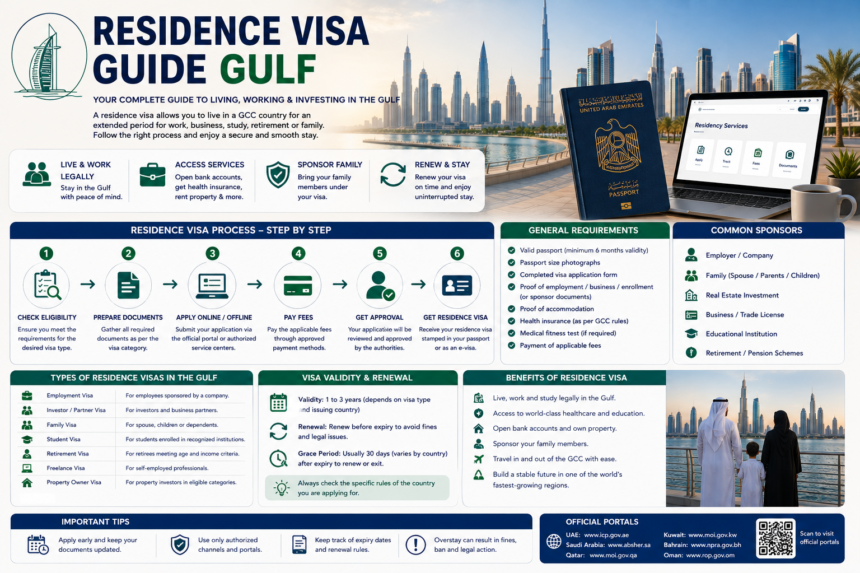
Residence Visa Guide Gulf is essential for anyone planning to move to the Gulf for work, family life, investment, business or a long term career. The Gulf Cooperation Council includes the UAE, Saudi Arabia, Qatar, Kuwait, Bahrain and Oman, but these six countries do not operate one common residence permit for expatriates.
- Residence Visa Guide Gulf at a Glance
- 1. UAE Residence Visa Options
- Standard UAE Employment Residence
- UAE Green Visa
- UAE Golden Visa
- Virtual Work Residence
- UAE Family Sponsorship
- 2. Saudi Arabia Residence and Iqama
- Saudi Work Permit and Regular Residence
- Saudi Premium Residency
- Saudi Unlimited Duration Residence
- Saudi Family Residence
- 3. Qatar Work Residence Permit
- Benefits of Qatar Residence
- Qatar Family Residence
- Changing Employers in Qatar
- 4. Kuwait Residence Visa Categories
- Kuwait Article 18 Requirements
- Kuwait Residence Renewal
- Kuwait Family Residence
- 5. Bahrain Residence and Work Permits
- Bahrain Medical and Identity Procedures
- Bahrain Registered Worker Permit
- Bahrain Employer Transfers
- 6. Oman Residence Through Employment
- Oman Residence Renewal
- Oman Family Joining Visa
- Oman Family Documents
- Residence Visa Guide Gulf for Employees
- Residence Visa Guide Gulf for Families
- Common Documents for Gulf Residence Applications
- Passport Validity
- Medical Fitness Requirements
- Professional Licensing Is Separate From Residence
- Residence Visa Renewal Across the Gulf
- Changing Employers
- Residence Visa vs Tourist Visa
- Residence Visa vs Work Permit
- Which Gulf Country Has the Most Flexible Residence Options
- Common Gulf Residence Visa Mistakes
- Avoid Gulf Residence Visa Scams
- Residence Visa Guide Gulf Checklist
- Frequently Asked Questions
- Conclusion
A UAE residence visa does not allow someone to relocate permanently to Saudi Arabia. A Qatar residence permit does not automatically provide residence rights in Bahrain. Each GCC country has its own immigration, labour and family sponsorship rules.
For most employees, residence begins with a genuine employment offer. The employer then starts the work permit or entry visa process, after which the employee completes medical, identity and residence formalities.
However, the Gulf residence market is becoming more flexible. The UAE offers Green, Golden and virtual work residence options. Saudi Arabia now offers seven Premium Residency products, including investor, entrepreneur, real estate owner and unlimited duration residency. (my.gov.sa)
That means long term Gulf residency is no longer limited entirely to traditional employer sponsorship.
Residence Visa Guide Gulf at a Glance
| Country | Common Employee Residence Route | Alternative Long Term Options |
|---|---|---|
| UAE | Employer sponsored residence | Green, Golden, virtual work, investor |
| Saudi Arabia | Work permit and regular residence | Premium Residency |
| Qatar | Work Residence Permit | Family residence and selected alternatives |
| Kuwait | Article 18 private residence | Other residence categories |
| Bahrain | LMRA work permit and residence | Registered Worker and other legal routes |
| Oman | Employer sponsored work residence | Family joining and qualifying investor routes |
The exact route depends on why the person wants to live in the country.
1. UAE Residence Visa Options
The UAE has one of the most diverse residence systems in the Gulf.
Official UAE guidance currently lists residence categories for employees, families, retirees, students and people working remotely outside the UAE. It also provides Golden and Green residence options. (u.ae)
For ordinary employees, the standard work visa remains one of the main routes.
The UAE government distinguishes between:
Standard work visa for private and government sector employees
Green Visa for qualifying skilled employees on self sponsorship
Domestic worker residence
Virtual work residence for people employed outside the UAE
(u.ae)
This gives different professionals different ways to establish legal residence.
Standard UAE Employment Residence
For a normal employment route, the employer sponsors the employee and handles the relevant work and residence process.
The worker may need to complete:
Entry procedures
Medical fitness examination
Emirates ID registration
Residence processing
Health insurance requirements
The residence validity depends on the specific route and sponsor.
A standard employment residence should not be confused with a tourist or jobseeker visa.
If you plan to work regularly for a UAE company, the correct employment authorisation is required.
UAE Green Visa
The Green Visa is one of the UAE’s major self sponsored options.
It can be available to qualifying skilled employees, freelancers, self employed professionals, investors and partners.
This is important because it allows eligible residents to reduce their dependence on a traditional employer sponsor.
For internationally mobile professionals, that can offer greater career flexibility.
However, applicants still need to satisfy the specific qualification, employment, income or investment requirements of the category they use.
UAE Golden Visa
Golden Residence offers longer term stability.
Qualifying investors, entrepreneurs, scientists, executives, doctors, exceptional professionals, outstanding students and other eligible categories can receive long term residency without a traditional sponsor.
The exact duration and eligibility depend on the category.
Golden Residence can be particularly attractive to people who want to establish a longer term future in Dubai, Abu Dhabi or another emirate without tying their residence completely to one employer.
Virtual Work Residence
The UAE also allows people employed outside the country to live legally in the UAE through virtual work residence.
Official guidance currently describes this as a one year self sponsored residence route for people working remotely for organisations outside the UAE. (u.ae)
This can be particularly useful for digital professionals, international managers and remote workers.
UAE Family Sponsorship
Residents can also sponsor qualifying family members.
Current UAE rules allow employees to sponsor family members regardless of their job title if they earn at least AED 4,000 monthly or AED 3,000 plus accommodation. (u.ae)
Documents can include:
Marriage certificate
Birth certificates
Sponsor residence details
Salary evidence
Accommodation evidence
Medical fitness documentation for adults
Family sponsorship rules should always be checked before relocating dependants.
2. Saudi Arabia Residence and Iqama
Saudi Arabia remains one of the largest employment markets in the Gulf.
For foreign workers holding long term employment contracts, the normal route begins with a permanent work visa.
Current official Saudi guidance states that applicants use the work visa system, enter the correct profession, complete professional qualification approval where required, undergo medical examination and biometric fingerprinting, and finish visa procedures through the Saudi mission abroad. (my.gov.sa)
Once the worker reaches Saudi Arabia, the employer completes the work permit and residence process.
Saudi Work Permit and Regular Residence
A valid work permit is an important part of regular expatriate residence.
Saudi Arabia’s Ministry of Human Resources states that the work permit is one of the conditions required for issuing or renewing regular residence for foreign workers. (my.gov.sa)
The expatriate residence identity is commonly known as the Iqama.
Workers should check that:
Their profession is correct
Their work permit is valid
Their residence remains valid
Their employer information matches reality
Professionals in regulated sectors may also need additional professional registration.
Saudi Premium Residency
Saudi Arabia has expanded beyond traditional employer sponsored residence.
The Premium Residency system currently offers seven options:
Exceptional Competence Residency
Talent Residency
Business Investor Residency
Entrepreneur Residency
Real Estate Owner Residency
Unlimited Duration Premium Residency
Limited Duration Premium Residency
This creates one of the Gulf’s most varied long term residence systems.
Premium Residency can appeal to investors, entrepreneurs, exceptional professionals and people seeking greater independence from conventional employment sponsorship.
Saudi Unlimited Duration Residence
One of the biggest differences between Saudi Arabia and several neighbouring systems is the presence of an official unlimited duration Premium Residency option.
This can be attractive to qualifying applicants whose priority is long term stability.
However, Premium Residency products can require substantial financial, investment, professional or other eligibility conditions.
Applicants should compare the specific product rather than assuming all Premium Residency categories work in the same way.
Saudi Family Residence
Saudi Arabia also provides residence visa services for qualifying first degree relatives of residents and citizens.
Current official guidance says family residence can remain valid for the duration of the sponsor’s residence permit when the sponsor is a foreign resident. Required items include a valid passport, photograph and medical insurance during the visa process. (my.gov.sa)
Premium Residency holders have separate family related services. (my.gov.sa)
3. Qatar Work Residence Permit
Qatar’s standard expatriate residence route is known as the Work Residence Permit, often shortened to RP.
Official Qatar guidance states that newcomers who want to work and live in the country generally need a Qatari employer. The employer normally handles the residence permit process. (portal.www.gov.qa)
The process usually begins with temporary entry permission.
After arrival, this status is converted into a Work Residence Permit.
Qatar currently states that this conversion typically takes two to four weeks and can sometimes take longer. (portal.www.gov.qa)
Benefits of Qatar Residence
Once the Work Residence Permit has been issued, expatriates can use it to complete many practical activities.
These can include:
Renting accommodation
Applying for licences
Accessing services
Sponsoring qualifying family members
The employer generally renews the employee’s Work Residence Permit each year. (portal.www.gov.qa)
This employer linked model remains central to ordinary Qatar employment.
Qatar Family Residence
Qualifying expatriates can sponsor immediate family members.
Every family member, including infants, needs their own Family Residence Visa.
Qatar’s official guidance says family residence can be issued for periods between one and five years. Applicants may need:
Authenticated marriage certificate
Birth certificates
Employer documentation
Salary certificate
Other supporting evidence
Families should check current income and housing requirements before relocating.
Changing Employers in Qatar
Qatar also provides a formal process for changing employers.
Its official residence portal includes an employer change service. (portal.www.gov.qa)
This means foreign workers should not simply start working for another company while remaining registered with the old employer.
The legal employment and residence records need to be updated correctly.
4. Kuwait Residence Visa Categories
Kuwait operates several residence categories under different articles.
For private sector workers, Article 18 residence is one of the most important.
Kuwait Government Online currently lists Article 18 services covering:
First time private residence
Renewal
Cancellation
Transfer from private residence to government residence
Transfer from private residence to family residence
(e.gov.kw)
This makes Article 18 the key route for many expatriates employed in Kuwait’s private sector.
Kuwait Article 18 Requirements
For first time private residence, current official requirements can include:
Signed residence application
Original work entry visa
Authenticated criminal record certificate
Medical fitness certificate
Personal photographs
Valid sponsor signature authorisation
Passport
Work permit
Health insurance certificate
(e.gov.kw)
This illustrates why Gulf relocation requires significant document preparation.
The work permit and residence permit are connected but should not be confused as the same document.
Kuwait Residence Renewal
Article 18 residence can also be renewed.
Current requirements include the passport, valid work permit, sponsor documentation, health insurance and photographs. (e.gov.kw)
Employees should ensure the employer starts renewal procedures before expiry.
Kuwait also maintains several other residence categories.
The official government portal currently lists:
Government Residence Article 17
Private Residence Article 18
Business and skilled labour Residence Article 19
Domestic Work Residence Article 20
Family Residence Article 22
Student Residence Article 23
Residence for persons with a source of income Article 24
(e.gov.kw)
Kuwait Family Residence
Family residence is handled separately from ordinary employment residence.
The ability to sponsor family can depend on income, relationship and immigration requirements.
For transfers from Article 18 to family residence, current official rules include proof of relationship and a minimum sponsor salary of KWD 450 for the specified transfer route. (e.gov.kw)
Applicants should check the exact current family sponsorship route because conditions can differ between new sponsorship and residence transfers.
5. Bahrain Residence and Work Permits
Bahrain’s expatriate employment system is strongly connected to the Labour Market Regulatory Authority, known as LMRA.
For most normal expatriate employment, the worker needs a valid work permit.
LMRA’s foreign employee guidance states that the authority works with relevant government bodies to provide entry visas, residence permits, multiple entry permission and identity cards for workers and family members. (lmra.gov.bh)
New foreign workers may also need to complete medical examination procedures after arrival.
Bahrain Medical and Identity Procedures
LMRA’s expatriate employee guidance tells workers to complete their medical examination within the required period after arriving in the country.
Workers also provide fingerprints, photographs and signatures during the relevant onboarding process. (lmra.gov.bh)
This means residence processing in Bahrain involves more than receiving a visa by email.
Workers need to complete local identity and medical procedures as part of legal residence.
Bahrain Registered Worker Permit
Bahrain also offers a Registered Worker Permit for certain workers already legally present in the country with terminated permits.
Visit visa holders are not eligible for this route. Applicants also need a passport valid for at least six months. (lmra.gov.bh)
This option is different from ordinary overseas recruitment.
It demonstrates that Bahrain provides specific legal pathways for different categories of expatriates already in the local labour market.
Bahrain Employer Transfers
LMRA also provides employer transfer mechanisms.
Foreign workers who want to change employers should use the proper transfer process instead of beginning work informally for a new company.
The worker’s residence and employment records should always reflect the real employer.
6. Oman Residence Through Employment
Oman’s normal expatriate route is also employer sponsored.
Foreign employees entering for work generally receive employment permission through an Omani employer and the relevant labour and Royal Oman Police procedures.
Oman’s visa rules emphasise an important point: an employee may not work for anyone other than their registered sponsor. (rop.gov.om)
This means employment residence is tied closely to the authorised employer.
Oman Residence Renewal
Royal Oman Police guidance states that applicants should be inside Oman when renewing their residence permits. (rop.gov.om)
Workers should therefore avoid planning long overseas trips close to residence expiry unless they have confirmed how renewal will be handled.
Oman also makes clear that simply having a valid entry visa does not guarantee admission if immigration authorities identify another legal reason to refuse entry.
Oman Family Joining Visa
Foreign employees may be able to bring qualifying spouses and children through the Family Joining Visa.
Current Royal Oman Police guidance states that the visa is available to the employee’s spouse and children below 21 years.
The visa is valid for two years from the date it is stamped in the passport and allows multiple entry. (rop.gov.om)
Current requirements include:
Employee holding a senior job according to GCC standards
Suitable rented residence
Monthly salary of at least OMR 600
Family relationship documentation
Passport valid for at least six months
Additional medical documentation for adults from specified nationalities
Oman Family Documents
Applicants bringing a spouse need an authenticated marriage certificate.
They may also need housing proof and employment or bank documents showing the required salary.
The exact list varies according to the family member and applicant’s nationality. (rop.gov.om)
This makes early document attestation important.
Residence Visa Guide Gulf for Employees
Across all six countries, employees should follow a similar basic principle.
First obtain a genuine job offer.
Then make sure the employer completes the correct work visa or entry process.
After arrival, complete:
Medical testing where required
Biometrics
Identity registration
Work permit
Residence processing
Professional licensing where necessary
Do not begin employment under a tourist or visitor visa simply because the employer promises to regularise the situation later.
Residence Visa Guide Gulf for Families
Family sponsorship rules vary considerably.
The UAE uses a general income threshold for ordinary spouse and child sponsorship.
Qatar requires employer and salary documentation and gives every family member their own residence visa.
Saudi residents can use family residence services tied to their own residence duration.
Kuwait uses separate family residence categories.
Oman currently requires qualifying employment, housing and a minimum OMR 600 monthly salary for the Family Joining Visa route. (rop.gov.om)
Families should therefore compare immigration rules before accepting an international job.
Common Documents for Gulf Residence Applications
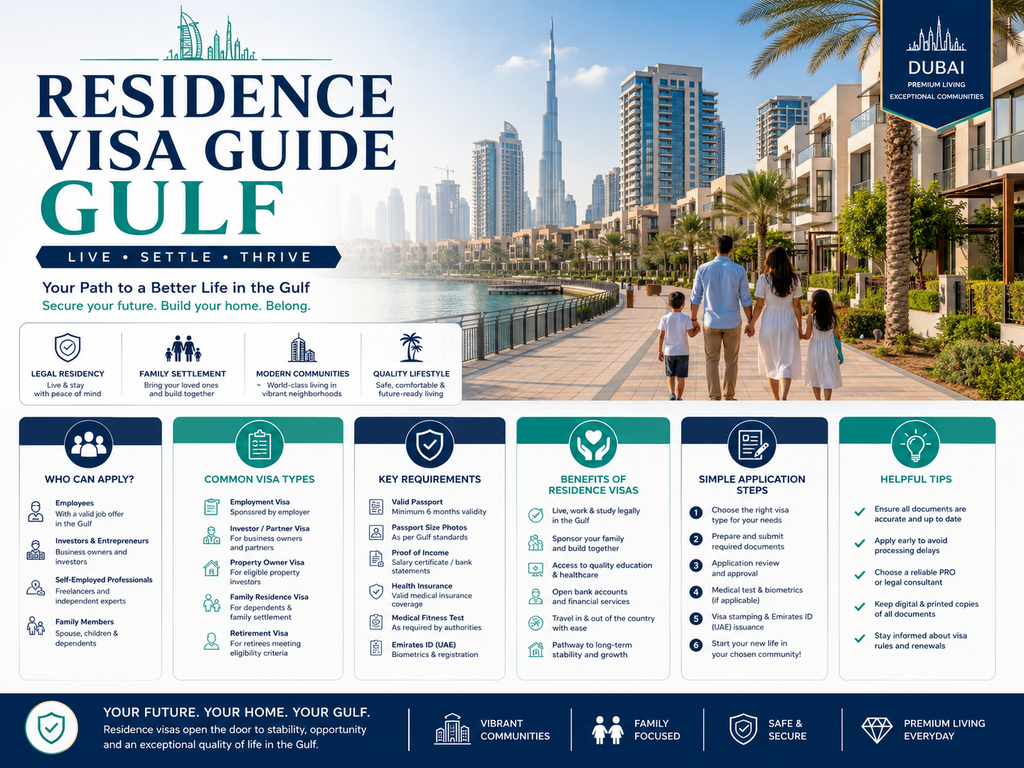
Requirements differ, but expatriates commonly need some combination of:
- Valid passport
- Passport photographs
- Employment contract
- Work entry visa
- Work permit
- Medical fitness certificate
- Criminal record certificate
- Health insurance
- Educational qualifications
- Professional licences
- Marriage certificate
- Birth certificates
- Housing documentation
- Salary certificate
The exact checklist should always come from the relevant government service.
Passport Validity
A passport close to expiry can cause unnecessary delays.
Many Gulf immigration processes require at least six months of passport validity at particular stages.
Oman’s family joining route, for example, requires a passport valid for no less than six months. (rop.gov.om)
Bahrain’s Registered Worker route also requires a passport with at least six months of validity. (lmra.gov.bh)
Renew the passport early when possible.
Medical Fitness Requirements
Medical examinations are common throughout the Gulf.
Saudi permanent work visa applicants undergo medical examination as part of the official process. (my.gov.sa)
Kuwait Article 18 first time residence requires a medical fitness certificate. (e.gov.kw)
Bahrain’s foreign employee process also includes medical procedures.
Oman requires approved medical certificates for certain adult family applicants from specified nationalities. (rop.gov.om)
Use approved medical centres only.
Professional Licensing Is Separate From Residence
A residence visa gives immigration status.
It does not automatically authorise every professional activity.
Doctors may need healthcare licensing.
Engineers may need professional registration.
Teachers may need education authority approval.
Accountants or financial professionals may need sector specific credentials.
This means an expatriate can legally reside in a Gulf country while still needing separate permission before practising a regulated profession.
Residence Visa Renewal Across the Gulf
Renewal procedures also vary.
The UAE uses different renewal processes depending on residence type and sponsor.
Saudi work permits must remain valid for regular residence renewal. (my.gov.sa)
Qatar employers generally renew Work Residence Permits annually. (portal.www.gov.qa)
Kuwait’s Article 18 system has a separate renewal service.
Oman requires residence holders to be inside the country when submitting residence renewal through the stated system. (rop.gov.om)
Never assume renewal happens automatically.
Changing Employers
Changing jobs can also affect residence.
In many Gulf countries, the new employer needs to complete formal labour and immigration procedures.
Qatar has an official employer change service. (portal.www.gov.qa)
Kuwait provides formal residence transfer routes between different categories. (e.gov.kw)
Bahrain also allows transfers through LMRA procedures.
Do not start with the new employer until the required legal process is complete.
Residence Visa vs Tourist Visa
A tourist or visit visa is designed for temporary entry.
A residence visa is designed for someone legally living in the country under an approved category.
Tourist status should not be treated as an ordinary employment solution.
Likewise, holding a business visit visa does not automatically create residence rights.
The purpose stated on the immigration record should match the person’s real activity.
Residence Visa vs Work Permit
These two documents are related but different.
The work permit authorises employment.
The residence permit authorises legal residence.
Saudi Arabia makes this relationship clear by requiring a valid work licence as one of the conditions for regular residence. (my.gov.sa)
Kuwait Article 18 similarly requires a valid work permit as part of residence issuance and renewal. (e.gov.kw)
Employees should make sure both remain valid.
Which Gulf Country Has the Most Flexible Residence Options
There is no single answer, but the UAE and Saudi Arabia currently stand out for their range of alternatives to normal employer sponsorship.
The UAE offers:
Golden Residence
Green Residence
Virtual work residence
Investor pathways
Retirement residence
Saudi Arabia offers seven Premium Residency products covering professionals, talent, investors, entrepreneurs, property owners and limited or unlimited duration residence. (my.gov.sa)
For ordinary employees, however, employer sponsored residence remains the dominant route throughout the GCC.
Common Gulf Residence Visa Mistakes
Avoid these frequent problems:
Working before proper authorisation
Using outdated immigration information
Submitting expired passports
Providing inaccurate profession details
Failing to authenticate family certificates
Ignoring medical fitness requirements
Assuming residence automatically transfers to a new employer
Forgetting dependent visas when changing jobs
Allowing residence to expire
Using unverified visa agents
Good preparation can prevent most of these issues.
Avoid Gulf Residence Visa Scams
Residence and employment scams target international workers because many applicants are unfamiliar with local systems.
Warning signs include:
Guaranteed residence without eligibility checks
Jobs without interviews
Requests for large payments to personal accounts
Fake government approvals
Promises of permanent residence through a normal tourist visa
Companies asking you to work while your legal status remains a visit visa
Verify the employer independently.
Use government immigration channels whenever possible.
Residence Visa Guide Gulf Checklist
Before moving, confirm:
- Genuine employment, investment or residence basis
- Correct visa category
- Passport validity
- Qualification attestation
- Work permit requirements
- Medical testing
- Professional licence
- Family eligibility
- Residence renewal responsibility
- Rules for changing employers
Keep both digital and physical copies of your documents.
Frequently Asked Questions
What is Residence Visa Guide Gulf?
Residence Visa Guide Gulf explains how expatriates can legally live in the UAE, Saudi Arabia, Qatar, Kuwait, Bahrain and Oman through employment, family, investment or other qualifying residence routes.
Is there one GCC residence visa?
No. Each GCC country has its own residence and immigration system.
What is the main residence route in the UAE?
Employees generally use employer sponsored residence, while qualifying applicants can also use Green, Golden or virtual work residence. (u.ae)
What is Saudi Premium Residency?
It is a group of seven long term residence products for qualifying professionals, talent, investors, entrepreneurs, property owners and applicants seeking limited or unlimited duration residence. (my.gov.sa)
What is Qatar’s main residence permit?
Foreign employees normally use the Work Residence Permit sponsored by a Qatari employer. (portal.www.gov.qa)
What is Article 18 residence in Kuwait?
Article 18 is Kuwait’s private sector work residence category and covers first issuance, renewal, cancellation and certain transfers. (e.gov.kw)
Can expatriates sponsor family members in Oman?
Yes, subject to conditions. The current Family Joining Visa applies to qualifying spouses and children below 21 and includes requirements related to job level, housing and a minimum monthly salary of OMR 600. (rop.gov.om)
Can Bahrain residents change employers?
Yes, but foreign workers should use the formal LMRA transfer process rather than working informally for another employer. (lmra.gov.bh)
Conclusion
Residence Visa Guide Gulf rules become easier to understand once expatriates recognise that each GCC country operates its own residence system.
The UAE offers one of the broadest selections, combining traditional employer sponsorship with Green, Golden and virtual work residence.
Saudi Arabia uses work permits and regular residence for most employees but has expanded long term options through seven Premium Residency products. (my.gov.sa)
Qatar’s Work Residence Permit remains strongly employer linked and can provide a pathway to family sponsorship. (portal.www.gov.qa)
Kuwait uses clearly defined residence articles, with Article 18 covering private sector employment and separate categories for government workers, families, students and other residents. (e.gov.kw)
Bahrain regulates expatriate work and residence through LMRA and connected immigration authorities.
Oman remains heavily sponsor based for employment while offering Family Joining Visa options to qualifying workers and dependants. (rop.gov.om)
For anyone planning a Gulf move, the most important rule is simple.
Use the residence category that matches your real circumstances.
Verify the employer.
Prepare your documents.
Check passport and medical requirements.
Understand family sponsorship before relocating dependants.
Renew permits on time.
And confirm professional licensing separately from immigration.
A Gulf residence permit can provide the legal foundation for a new career, business or family life, but the strongest relocation starts with understanding exactly which country’s rules apply and which residence route genuinely fits your plans.
follow us on Instagram
Read More – GCC Entry Requirements: 7 Essential Rules for Travelers in 2026