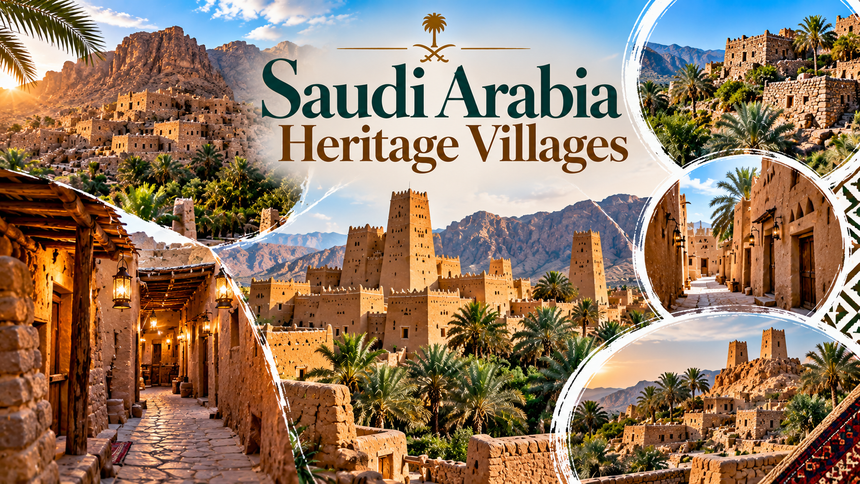
Saudi Arabia Heritage Villages Show a Different Side of the Kingdom
Saudi Arabia Heritage Villages offer a very different way to experience the Kingdom. Beyond Riyadh’s modern skyline, Jeddah’s waterfront and the dramatic desert landscapes of AlUla, historic settlements reveal how communities once adapted their homes, streets and public spaces to mountains, deserts, oases and coastal environments.
- Saudi Arabia Heritage Villages at a Glance
- 1. Rijal Almaa Is One of Saudi Arabia’s Most Striking Heritage Villages
- 2. Thee Ain Looks Like a Stone Fortress Above a Green Oasis
- 3. Ushaiqer Is an Easy Heritage Escape From Riyadh
- 4. AlUla Old Town Connects Heritage With One of Saudi Arabia’s Biggest Destinations
- 5. Al-Khabra Preserves a Traditional Qassim Town Layout
- 6. Al-Qassar Brings Heritage Travel to the Farasan Islands
- 7. Al Olayan Heritage Village Offers History High in the Sarawat Mountains
- 8. Al-Muftaha Adds Heritage Character in the Heart of Abha
- 9. Al-Akkas Shows Another Side of Aseer Heritage
- 10. Al-Dar’i Quarter in Dumat Al-Jandal Feels Like a Historic Stone Village
- Which Saudi Arabia Heritage Villages Are Best for First-Time Visitors?
- Saudi Heritage Architecture Changes From Region to Region
- Best Time to Explore Saudi Arabia Heritage Villages
- How to Behave Respectfully in Heritage Villages
- How to Build a Saudi Heritage Village Road Trip
- Common Mistakes When Visiting Saudi Arabia Heritage Villages
- Saudi Arabia Heritage Villages Show a Different Side of the Kingdom
The architecture changes dramatically from one region to another. In Najd, mud-brick houses, shaded courtyards and narrow lanes reflect the hot, dry central landscape. In Aseer, tall stone buildings rise against green mountains, while in Al-Baha entire villages appear to grow directly from rocky slopes. Farasan Island adds another style shaped by palm trees, sea routes and locally available stone.
These villages are not simply collections of old houses. Many contain mosques, markets, defensive towers, museums, agricultural terraces and traditional gathering spaces that help explain how Saudi communities lived before modern urban expansion.
Several sites have also been restored or adapted for visitors. Visit Saudi currently promotes destinations such as Rijal Almaa, Thee Ain, Ushaiqer and AlUla Old Town as part of the Kingdom’s cultural-tourism offering.
Saudi Arabia Heritage Villages at a Glance
Different villages suit different types of travellers. Some are easy day trips from major cities, while others are worth building into a wider road trip.
| Heritage Village | Region | Best Known For |
|---|---|---|
| Rijal Almaa | Aseer | Multi-storey stone forts and colourful architecture |
| Thee Ain | Al-Baha | Stone village beside a centuries-old spring |
| Ushaiqer | Riyadh Province | Najdi mud-brick streets and historic mosques |
| AlUla Old Town | AlUla | More than 900 mud-brick houses |
| Al-Khabra | Qassim | Historic mud-brick town and central market |
| Al-Qassar | Farasan Islands, Jazan | Palm-framed stone houses and island heritage |
| Al Olayan | Aseer | Mountain architecture and heritage museum |
| Al-Muftaha | Abha | Traditional Aseer houses and cultural character |
| Al-Akkas | Aseer | Historic clay buildings and defensive forts |
| Al-Dar’i Quarter | Al-Jawf | Old stone houses beside Marid Castle |
A first-time visitor does not need to see all ten. Choosing two or three from the same region often creates a better trip than trying to cross the entire country quickly.
1. Rijal Almaa Is One of Saudi Arabia’s Most Striking Heritage Villages
Rijal Almaa is one of the strongest places to start because its architecture looks unlike the mud-brick settlements many travellers associate with central Saudi Arabia.
The village lies in Rijal Alma Governorate in Aseer, around 45 kilometres west of Abha. Saudipedia describes it as roughly 900 years old, with around 60 closely grouped stone buildings. Some rise between three and seven floors and resemble fortified towers built into the mountain landscape.
What makes the village especially memorable is the contrast between dark stone walls and brightly coloured windows and interiors. Traditional Al-Qatt Al-Asiri decorative patterns also form an important part of the visual identity of the region.
Visitors can explore the heritage setting as well as the local museum. Saudipedia says the Alma Permanent Heritage Museum contains around 2,800 artefacts spread across 12 rooms, including clothing, agricultural tools, cooking equipment, manuscripts and objects connected with earlier caravan life.
Visit Saudi’s current Rijal Almaa visitor centre also offers Arabic- and English-language interpretation of Aseer’s history and the village’s architectural heritage.
Why go: Architecture, photography and Aseer culture
Good base: Abha
Do not rush: Allow time for both the village streets and museum
2. Thee Ain Looks Like a Stone Fortress Above a Green Oasis
Thee Ain, also written Dhee Ayn or Zee Ain, is one of the most visually unusual heritage villages in Saudi Arabia.
Located in Al-Baha Province, the settlement rises above lush agricultural land and is surrounded by mountains. The village takes its name from a spring flowing from the mountains, which has supplied water for centuries and supports vegetation including bananas, lemons and aromatic plants.
The contrast is what makes it exceptional.
From a distance, its tightly packed stone buildings resemble one large fortress sitting above a green oasis.
Saudipedia says the village contains about 85 multi-storey houses, some reaching five floors. The buildings use hard local granite, while their external appearance is associated with pale quartz stone.
The current Visit Saudi visitor centre describes Thee Ain as a living-history destination and notes that entry to the visitor centre does not require a ticket.
Why go: Dramatic landscapes and historic architecture
Best for photography: Late afternoon when light softens across the stone
Pair it with: A wider Al-Baha mountain trip
3. Ushaiqer Is an Easy Heritage Escape From Riyadh
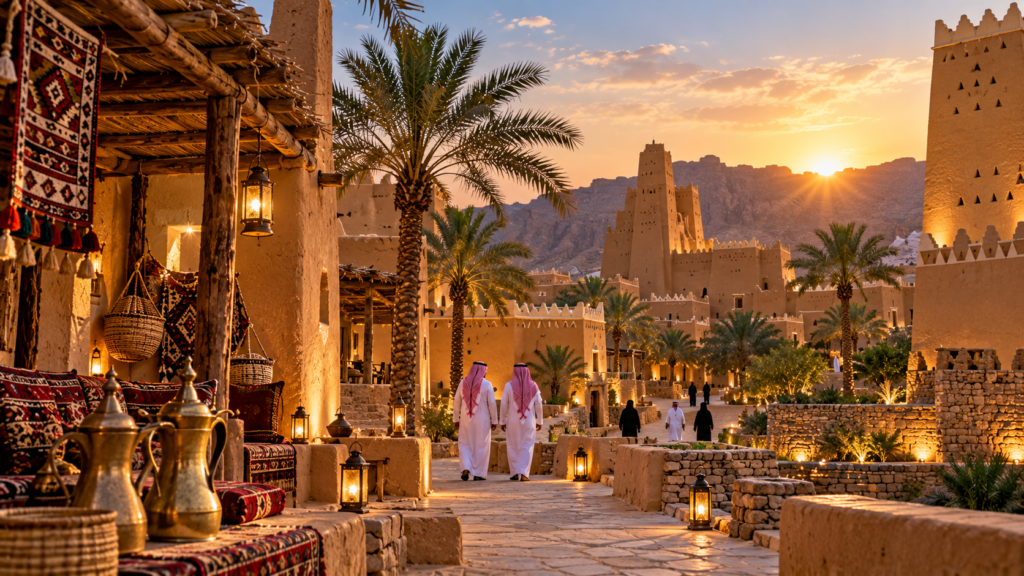
Travellers staying in Riyadh who want to experience traditional Najdi architecture should consider Ushaiqer.
The village is around 200 kilometres from Riyadh in Shaqra Governorate. Saudipedia says Ushaiqer covers about four square kilometres and contains approximately 400 mud-brick houses, 25 mosques and a network of narrow lanes leading towards palm farms and gardens.
The settlement’s architecture was designed around materials available locally.
Mud bricks form the walls, limestone was used in foundations, while tamarisk and palm trunks supported roofs covered with palm fronds and layers of mud.
Ushaiqer also has deep historical associations with travellers. It became an important stop for pilgrims heading towards Makkah because its springs, gardens and palm groves provided a useful stopping point.
Today’s visitor experience includes restored houses, traditional restaurants, museums and old mosques. Visit Saudi currently sells guided day trips from Riyadh that combine Ushaiqer with Shaqra and other nearby heritage stops.
Why go: Najdi architecture and an accessible Riyadh day trip
Travel time: Better treated as a full-day excursion
Look for: Carved doors, courtyards and shaded mud-brick alleys
4. AlUla Old Town Connects Heritage With One of Saudi Arabia’s Biggest Destinations
AlUla is best known internationally for Hegra and its monumental Nabataean tombs, but AlUla Old Town offers a very different layer of history.
Visit Saudi describes the Old Town as a preserved heritage settlement containing more than 900 mud-brick houses.
That density creates a very different experience from visiting isolated archaeological monuments.
Instead of one major structure, visitors move through an entire historic urban fabric of narrow streets, old homes and public spaces that once formed a living settlement.
AlUla itself stood at the crossroads of major ancient trade routes, while nearby Hegra became Saudi Arabia’s first UNESCO World Heritage Site. Hegra contains more than 110 ancient tombs, including 94 with decorated façades carved directly into the rock.
That means travellers can combine several layers of heritage in one destination:
- AlUla Old Town
- Hegra
- Ancient inscriptions
- Oasis landscapes
- Historic caravan routes
Why go: Best combination of heritage, archaeology and modern tourism infrastructure
Best trip length: At least two to three days in AlUla
Do not confuse: Old Town and Hegra are separate experiences
5. Al-Khabra Preserves a Traditional Qassim Town Layout
Al-Khabra Historical Village in Qassim provides another example of Najdi-style urban planning.
The village sits on the northern bank of Wadi Rumah, about 60 kilometres from Buraydah. Saudipedia dates its recognised historical development to the early 18th century and describes a settlement once containing around 400 mud houses.
What makes Al-Khabra particularly interesting is its town plan.
A large central square was surrounded by neighbourhoods, and an important market operated around the centre. The settlement had four main gates and narrow streets converging around the central commercial area.
Its buildings were generally one or two storeys high, creating a lower and more compact appearance than the tall stone towers of Aseer.
For travellers interested in urban design rather than only dramatic landscapes, this can be especially rewarding because the village demonstrates how traditional Saudi towns organised commerce, worship and residential life within defensive walls.
Why go: Qassim heritage and traditional town planning
Good base: Buraydah or a wider Qassim itinerary
Look for: Gates, old market layout and mud-brick construction
6. Al-Qassar Brings Heritage Travel to the Farasan Islands
Not all Saudi heritage villages sit in the desert or mountains.
Al-Qassar is located on Farasan Island in Jazan Province, giving visitors a completely different setting shaped by island life.
Saudipedia describes the village as one of the oldest inhabited settlements on Farasan and says it contains around 400 houses. Its buildings use carved stone, while roofs historically incorporated palm trunks, palm fronds and locally available materials.
Palm trees surrounding the village make it visually distinctive.
Fresh groundwater also helped support settlement and agriculture, turning Al-Qassar into an important seasonal place for Farasan residents.
This heritage experience can be combined with the wider attractions of the Farasan Islands, which are known for Red Sea landscapes and biodiversity.
Why go: Island heritage and coastal Saudi culture
Best combined with: A Farasan Islands trip rather than a standalone journey
Architecture: Stone walls with palm-based roofing traditions
7. Al Olayan Heritage Village Offers History High in the Sarawat Mountains
Al Olayan is a smaller destination but a strong choice for travellers exploring the highlands north of Abha.
The heritage village lies in Al-Namas Governorate in Aseer and is situated in the Sarawat Mountains. A paved road connects it from the Al-Sarh area near the Abha-Taif route.
Its biggest attraction is its museum.
Saudipedia says the three-storey museum is built from local stone with juniper-wood roofing and contains more than 3,000 heritage objects. Collections include agricultural equipment, traditional clothing, jewellery, weapons, manuscripts, photographs and household objects.
That makes the village particularly useful for travellers who want to understand everyday historical life rather than simply photograph old architecture.
Why go: Heritage collections and mountain setting
Best for: Road trips through Aseer
Highlight: Three-floor museum with thousands of historic objects
8. Al-Muftaha Adds Heritage Character in the Heart of Abha
Travellers do not always need to drive deep into the countryside to experience historic architecture.
Al-Muftaha Historical Village sits within Abha itself.
Saudipedia identifies it as one of Aseer’s notable heritage villages and dates its traditional built environment back around 260 years. Its historic houses were constructed close together with thick walls, small openings and traditional pathways adapted to the region’s climate and social life.
Its urban location makes it a practical addition to an Abha itinerary, especially for travellers who are already visiting Rijal Almaa, the Soudah highlands or other parts of Aseer.
The appeal here is less about seeing an isolated settlement preserved in time and more about understanding how traditional architecture continues to influence the cultural identity of modern Abha.
Why go: Easy cultural stop in Abha
Combine with: Rijal Almaa and wider Aseer attractions
Best for: Shorter city itineraries
9. Al-Akkas Shows Another Side of Aseer Heritage
Aseer contains thousands of traditional villages and stone-house settlements, so Rijal Almaa is far from the only heritage destination in the province.
Saudipedia identifies Al-Akkas as one of the largest heritage villages in Aseer. It contains around 50 clay houses and buildings along with historic defensive forts, and parts of the settlement are estimated to date back around 300 years.
This makes Al-Akkas interesting for travellers who have already visited the better-known heritage sites and want to explore further.
The broader Aseer region itself contains an extraordinary density of historic settlement. Saudipedia notes that there are about 4,275 heritage villages across the province featuring traditional stone-house architecture shaped by climate, topography and local building materials.
That figure helps explain why Aseer deserves more than a single-day visit for serious heritage travellers.
Why go: Less obvious Aseer heritage
Best for: Travellers exploring beyond major attractions
Regional strength: One of Saudi Arabia’s richest concentrations of traditional villages
10. Al-Dar’i Quarter in Dumat Al-Jandal Feels Like a Historic Stone Village
Al-Dar’i is technically a historic quarter rather than a standalone village, but it belongs on a heritage itinerary because it preserves the atmosphere of an old northern Saudi settlement.
Located in Dumat Al-Jandal in Al-Jawf Province, the quarter consists of interconnected stone houses and lanes. Saudipedia describes structures dating from the medieval Islamic period, built over archaeological layers extending much further back in time.
The setting becomes even more impressive because several important historic landmarks sit nearby.
These include:
- Marid Castle
- Omar Bin Al-Khattab Mosque
- Historic Dumat Al-Jandal market
- Oasis landscapes
The old stone houses also stand among orchards and former water channels, giving the area a very different appearance from the mud-brick towns of central Saudi Arabia.
Why go: Northern Saudi history and stone architecture
Best combined with: Wider Al-Jawf heritage tour
Major landmark nearby: Marid Castle
Which Saudi Arabia Heritage Villages Are Best for First-Time Visitors?
With so many possibilities, choosing can be difficult.
A simple approach is to select according to the type of experience you want.
| If You Want… | Choose |
|---|---|
| Most dramatic mountain architecture | Rijal Almaa |
| Stone village with green oasis | Thee Ain |
| Easy Riyadh heritage trip | Ushaiqer |
| Heritage plus world-famous archaeology | AlUla Old Town |
| Traditional Qassim town planning | Al-Khabra |
| Island and coastal culture | Al-Qassar |
| Small mountain museum experience | Al Olayan |
| Heritage inside Abha | Al-Muftaha |
| Less touristy Aseer exploration | Al-Akkas |
| Northern stone settlement | Al-Dar’i |
For a first Saudi heritage trip, Ushaiqer, Rijal Almaa, Thee Ain and AlUla Old Town offer particularly strong contrasts.
Together, they demonstrate just how different Saudi regional architecture can be.
Saudi Heritage Architecture Changes From Region to Region
One of the biggest mistakes travellers can make is assuming Saudi heritage architecture looks the same everywhere.
It does not.
Najd
Central Saudi architecture relied heavily on mud brick, enclosed courtyards, thick walls and relatively small openings. Ushaiqer is an excellent example. Saudipedia notes that traditional Najdi homes centred much of daily life around internal courtyards, with spaces organised to provide privacy and protection from the climate.
Aseer
Mountain settlements frequently use stone, timber and fortified multi-level buildings. Rijal Almaa’s towers are among the clearest examples.
Al-Baha
Thee Ain combines hard local stone with steep terrain and agricultural springs.
Farasan
Al-Qassar reflects island conditions through stone construction and palm-based roofing materials.
This regional variation turns heritage-village travel into something much more interesting than repeatedly visiting similar-looking ruins.
Best Time to Explore Saudi Arabia Heritage Villages
The ideal travel season depends heavily on the region.
Central Saudi Arabia can become extremely hot during summer, making winter and the cooler parts of spring and autumn more comfortable for walking through exposed historic streets.
Aseer and Al-Baha have higher elevations and generally offer a different climate from Riyadh or Qassim, which is one reason mountain tourism is especially popular there.
AlUla’s official tourism portal currently lists winter temperatures around 6–25°C and summer temperatures potentially reaching about 45°C, illustrating how dramatically the experience can change by season.
| Region | Generally Better Period |
|---|---|
| Riyadh/Ushaiqer | Cooler months |
| Qassim | Autumn to spring |
| AlUla | Winter and cooler shoulder seasons |
| Aseer | Can work well in warmer months due to elevation |
| Al-Baha | Spring, summer and autumn can be attractive |
| Farasan/Jazan | Winter is particularly popular |
Always check current weather and attraction hours before travelling because seasonal opening schedules can change.
How to Behave Respectfully in Heritage Villages
Many heritage destinations contain restored public buildings, museums and commercial spaces, but visitors should remember that these sites represent real communities and cultural traditions.
Dress respectfully and follow local guidance around mosques or residential spaces.
Do not enter closed houses simply because a door is open.
Photography is generally part of the visitor experience, but ask permission before photographing local people closely.
Visitors should also avoid climbing old walls or sitting on fragile structures for photographs. Mud-brick and stone heritage buildings may look strong but can be sensitive to unnecessary physical pressure.
A few simple habits make a difference:
- Follow marked paths
- Respect prayer spaces
- Ask before photographing people
- Do not remove stones or historic objects
- Support local museums, cafés and craft sellers
- Keep noise reasonable in residential areas
Heritage tourism works best when visitors help preserve the places they have come to see.
How to Build a Saudi Heritage Village Road Trip
Saudi Arabia’s size means these villages should be grouped regionally.
Trying to see Ushaiqer, Rijal Almaa and AlUla on consecutive days would involve unnecessary travel.
A better plan is to create smaller regional trips.
Riyadh and Najd route
Riyadh → Ushaiqer → Shaqra
Visit Saudi currently offers an organised version of this type of day trip, combining Ushaiqer and Shaqra with nearby heritage experiences.
Aseer and Al-Baha route
Abha → Al-Muftaha → Rijal Almaa → Al Olayan → Thee Ain
This route highlights the dramatic mountain architecture of southwest Saudi Arabia.
Qassim route
Buraydah → Al-Khabra → nearby Qassim heritage towns
AlUla route
AlUla Old Town → Hegra → Oasis → other archaeological sites
Jazan route
Jazan → Farasan Islands → Al-Qassar
Grouping destinations this way creates more time for actual exploration and less time on highways.
Common Mistakes When Visiting Saudi Arabia Heritage Villages
One common mistake is treating every village as a quick photo stop.
The architecture becomes much more meaningful when visitors spend time understanding why buildings were designed in a particular way.
Another mistake is arriving at midday during the hottest season.
Many traditional villages involve outdoor walking with limited shade. Early morning or late afternoon can be much more comfortable and also provide better photography light.
Visitors should also check whether museums and visitor centres have separate operating hours from the village itself.
For example, Visit Saudi currently lists specific opening hours for the Rijal Almaa visitor centre, including different Friday hours.
Finally, do not limit a trip only to famous UNESCO-related attractions.
Saudi Arabia has hundreds of lesser-known heritage settlements that reveal everyday architecture and local identity in ways monumental archaeological sites cannot.
Saudi Arabia Heritage Villages Show a Different Side of the Kingdom
The most fascinating thing about Saudi Arabia Heritage Villages is how clearly they reflect geography.
Rijal Almaa rises vertically through the mountains of Aseer in multi-storey stone buildings.
Thee Ain sits above flowing spring water and green agricultural terraces in Al-Baha.
Ushaiqer uses mud, palm trunks and tamarisk to create the enclosed architecture of Najd.
Al-Qassar reveals how island communities on Farasan adapted stone and palm materials to coastal life.
AlUla Old Town preserves more than 900 mud-brick houses within one of Saudi Arabia’s most important historical destinations.
Together, these places show that there has never been one single Saudi architectural tradition.
Different communities built according to the climate, materials, trade routes and landscapes around them.
For travellers, that makes heritage villages valuable for more than photography.
They provide a way to understand how ordinary families lived, how towns were organised, how travellers were hosted and how people adapted to environments ranging from mountain valleys to desert oases and Red Sea islands.
For a first heritage-focused journey, start with one region rather than trying to cover the entire country.
Explore Ushaiqer from Riyadh.
Spend several days around Abha and Rijal Almaa.
Combine Thee Ain with Al-Baha.
Or make AlUla Old Town part of a wider archaeological trip.
The slower you explore these places, the more clearly the stories behind their walls begin to emerge.
Do follow us on Instagram
Read More – UAE Weather: More Rain, Strong Winds Forecast as Unsettled Weather Persists