
How the Saudi Arabia Travel Warning Could Affect Tourists and Business Travellers
The United Kingdom has significantly tightened its Saudi Arabia travel warning, advising British nationals against all but essential travel to the whole of Saudi Arabia as regional security concerns continue to rise.
- Saudi Arabia Travel Warning Now Covers the Whole Country
- Why the UK Changed Its Saudi Arabia Travel Warning
- Riyadh Airport Has Been at the Centre of the Disruption
- Airlines Have Cancelled and Suspended Saudi Services
- Travellers Should Check Flights Before Going to the Airport
- The Warning Could Affect Travel Insurance
- “All But Essential Travel” Does Not Mean the Border Is Closed
- Tourist Trips Are Likely to Be Reconsidered
- Business Travellers Are Also Affected
- Pilgrims Need to Watch the Situation Carefully
- The Yemen Border Remains Under the Strongest Warning
- Airports and Energy Infrastructure Are Considered Higher-Risk Locations
- The FCDO Says Further Attacks Are Very Likely
- British Nationals in Saudi Arabia May Consider Leaving by Land
- Driving Out of Saudi Arabia Comes With Important Conditions
- Do Not Assume Every Saudi Airport Has the Same Risk Level
- Jeddah, Dammam and Other Major Cities Are Included in the Warning
- Saudi Arabia Has Continued Some Major Events Despite the Disruption
- UK Advice Is Specifically for British Nationals
- What Travellers With Existing Saudi Bookings Should Do
- What to Do If You Are Already in Saudi Arabia
- Why This Saudi Arabia Travel Warning Matters More Than a Routine Advisory
- Saudi Arabia Travel Warning: What Is Confirmed Right Now?
- Saudi Arabia Travel Warning Could Change Again at Short Notice
The updated guidance from the UK Foreign, Commonwealth & Development Office, or FCDO, was published on October 16, 2026. It marks a major expansion of earlier restrictions that had focused mainly on selected provinces, cities and airports. The FCDO now advises against all but essential travel across the rest of the kingdom, while maintaining an even stronger warning against all travel within 10 kilometres of the Saudi-Yemen border.
The change follows a series of missile and drone attacks on Saudi territory, including serious incidents involving King Khalid International Airport in Riyadh. The UK government says airports, military sites, ports and energy infrastructure remain at heightened risk and warns that further attacks, flight disruption and cancellations are very likely.
For travellers, the practical consequences go beyond whether a holiday should be postponed. FCDO advice can affect travel insurance, airline plans, airport access and the routes British nationals may need to use if they decide to leave Saudi Arabia.
The situation is also changing quickly, making it particularly important for anyone travelling to Saudi Arabia in the coming days or weeks to check official guidance shortly before departure.
Saudi Arabia Travel Warning Now Covers the Whole Country
The biggest change is the geographic scope of the UK warning.
As of October 16, the FCDO advises against all but essential travel to Saudi Arabia, effectively extending the warning across the country rather than limiting it to specific higher-risk areas.
At the same time, one area remains under the strongest category of travel advice.
The UK advises against all travel within 10km of the border with Yemen. This reflects the particularly high security risks associated with the frontier and the renewed military conflict involving the Houthi movement in Yemen and Saudi-backed forces.
The current position can be summarised as follows:
| Area | UK FCDO Advice |
|---|---|
| Saudi Arabia generally | Against all but essential travel |
| Within 10km of Yemen border | Against all travel |
| Saudi airports | Heightened risk and disruption warning |
| Riyadh airport | Avoid until considered secure; check latest updates |
| Land exits | May be considered where safe and practical |
This is a substantial change for travellers because destinations that would normally be regarded as major business or tourism centres now fall under the same nationwide “all but essential” warning.
Why the UK Changed Its Saudi Arabia Travel Warning
The updated advice comes after a sharp increase in attacks inside Saudi Arabia.
The FCDO says that since July 13, Houthi forces in Yemen have launched missiles and drones targeting multiple locations across the kingdom. It specifically identifies a heightened threat to airports, military and defence buildings, military bases, ports and energy infrastructure.
The warning names areas including:
- Riyadh
- Jeddah
- Dammam
- Abha
- Jizan
- Najran
- Yanbu
These locations include some of Saudi Arabia’s most important aviation, industrial and commercial centres.
The security environment became particularly serious following attacks on King Khalid International Airport in Riyadh.
Reuters reported that a major strike on October 10 killed at least 12 people and injured more than 300, while further attacks followed in the days afterwards.
Those incidents turned airport security from a theoretical risk into a direct concern for international travellers.
Riyadh Airport Has Been at the Centre of the Disruption
King Khalid International Airport has faced repeated security incidents and significant operational disruption.
Reuters reported that the airport was expected to remain closed until at least October 17 following the attacks, while airlines across Europe, Asia and the Gulf suspended or cancelled services.
The FCDO specifically advises British nationals to stay away from King Khalid International Airport until it is secure and to follow instructions from Saudi authorities.
The situation matters because Riyadh is one of Saudi Arabia’s most important international gateways.
It is also a major destination for:
- Business travellers
- Government delegations
- International conferences
- Corporate workers
- Connecting passengers
- Residents returning from overseas
Even travellers who are not visiting Riyadh directly may still be affected if their airline relies on the airport for connections or aircraft rotations.
Airlines Have Cancelled and Suspended Saudi Services
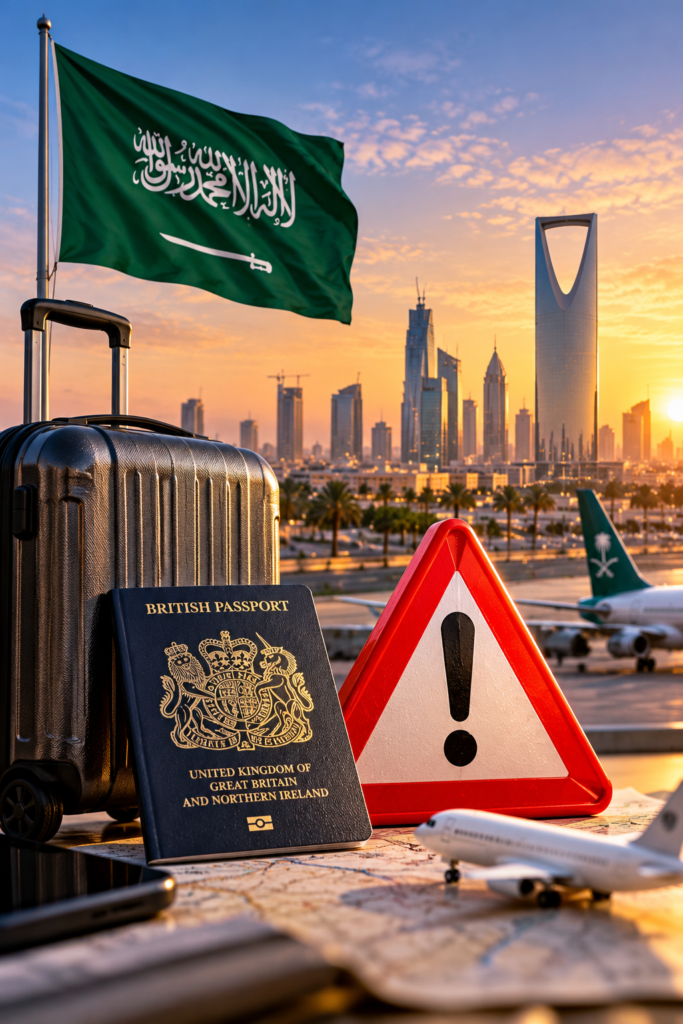
The security situation has already disrupted international aviation.
Reuters reported that multiple airlines suspended or cancelled flights to Saudi Arabia following the attacks on Riyadh airport. Carriers affected included Air France-KLM, Air India, Akasa Air, Cathay Pacific, Delta, Etihad Airways, Gulf Air, IndiGo, Lufthansa, Malaysia Airlines, Philippine Airlines and Qatar Airways.
The duration of the suspensions varies significantly between airlines.
Some carriers have announced relatively short-term pauses, while others have pushed services back by weeks or months.
Delta, for example, delayed the launch of its planned Atlanta-Riyadh route until March 2027 after the airport attacks and wider regional tensions.
Qatar Airways also temporarily suspended services to Riyadh and Dammam amid the security situation.
For travellers, this means a valid ticket does not necessarily guarantee that the flight will operate as scheduled.
Travellers Should Check Flights Before Going to the Airport
One of the most important practical steps is to verify the latest flight status before leaving for the airport.
During periods of major disruption, airline schedules can change quickly.
A flight that appears active several days in advance can still be:
- Cancelled
- Delayed
- Rerouted
- Suspended
- Moved to another airport
Passengers should check directly with their airline rather than relying only on third-party booking apps or old itinerary emails.
This is particularly important for travellers flying through Riyadh or Dammam because both cities have been affected by recent security warnings and airline schedule changes.
Where possible, travellers should also avoid arriving at an airport many hours early unless specifically instructed to do so.
Large groups of stranded passengers can create additional pressure on terminals during disruption.
The Warning Could Affect Travel Insurance
The UK government explicitly warns that travelling against FCDO advice can affect insurance coverage.
The Saudi Arabia guidance states that travel insurance could be invalidated if a traveller goes against FCDO advice.
This does not mean every policy automatically becomes invalid in exactly the same way.
Insurance contracts differ.
However, travellers should not assume that an existing policy will cover them normally if they decide to take a non-essential trip despite the warning.
Before travelling, policyholders should contact their insurer and ask specifically about:
- Medical coverage
- Trip cancellation
- Flight disruption
- Security incidents
- Emergency evacuation
- Repatriation
- Accommodation extensions
It is also useful to obtain the answer in writing wherever possible.
Travellers who booked before the warning changed should check whether cancellation or postponement benefits apply under their policy.
“All But Essential Travel” Does Not Mean the Border Is Closed
The wording of travel advisories can sometimes cause confusion.
An FCDO warning against all but essential travel is not the same as the Saudi government closing its borders or banning British nationals from entering.
Saudi entry rules continue to be determined by Saudi authorities.
The UK warning is advice to British nationals based on its assessment of security risk.
This means travellers may still technically be able to enter the country if flights and border routes are operating.
However, they should consider the FCDO warning, possible insurance consequences and their own reason for travel before doing so.
Essential travel may include circumstances such as urgent professional, family or humanitarian needs, but the FCDO does not make that decision individually for every traveller.
Tourist Trips Are Likely to Be Reconsidered
The nationwide warning is particularly relevant for leisure travellers.
Tourism has expanded rapidly in Saudi Arabia in recent years, with international visitors travelling to destinations such as Riyadh, Jeddah, AlUla and the Red Sea.
Under the latest UK advice, British travellers planning a purely recreational trip should review whether their journey qualifies as essential.
For many tourists, postponement may be the most straightforward response while the warning remains in place.
That does not mean Saudi tourism sites are necessarily closed.
The key issue is that the official British risk assessment has changed.
Travellers should therefore distinguish between whether an attraction or hotel is operating and whether the UK government currently advises making the trip.
Business Travellers Are Also Affected
Saudi Arabia hosts major international conferences, investment events and energy gatherings, making business travel particularly important.
Recent security incidents have already affected that calendar.
Reuters reported that the Future Investment Initiative in Riyadh moved towards a hybrid format following the airport attacks, allowing some international executives to participate remotely.
The European Union and Gulf Cooperation Council also postponed a summit that had been scheduled in Riyadh, with aviation and security concerns contributing to the disruption.
The Asian Tour later postponed the Saudi International golf tournament, citing logistical and security concerns following the attacks.
Companies sending employees to Saudi Arabia should therefore reassess both security and travel logistics rather than assuming business events will continue unchanged.
Pilgrims Need to Watch the Situation Carefully
Saudi Arabia is also one of the world’s most important religious travel destinations.
Millions of Muslims visit the kingdom for Umrah and Hajj, with Makkah and Madinah receiving large numbers of international pilgrims.
Recent attacks and flight disruption have already affected pilgrims.
Reuters reported that religious travellers were among those caught up in the disruption caused by attacks on Saudi airports, with some groups rerouting or changing plans.
The FCDO’s nationwide advice therefore matters for pilgrims as well as tourists and business visitors.
Madinah’s airport had previously been treated differently in some parts of UK guidance, but the updated nationwide warning now advises against all but essential travel to the country as a whole.
Travellers planning Umrah should check:
- Airline status
- Visa validity
- Tour operator instructions
- Hotel cancellation rules
- Local transport
- FCDO updates
- Saudi authority guidance
Pilgrims travelling as part of organised groups should remain in close contact with their tour operator.
The Yemen Border Remains Under the Strongest Warning
Although the whole country now falls under an all-but-essential travel warning, the Saudi-Yemen border is treated more severely.
The FCDO advises against all travel within 10km of the Yemen border.
This is because direct military conflict involving the Houthis and Saudi-backed forces resumed in 2026, increasing the risks associated with southern border areas.
The regions most closely associated with this risk include parts of:
- Jizan
- Najran
- Aseer
Travellers should not assume that being away from major cities automatically makes travel safer.
Border regions can face a different category of risk from Riyadh, Jeddah or Dammam.
Airports and Energy Infrastructure Are Considered Higher-Risk Locations
The UK warning specifically highlights the heightened threat to infrastructure.
Potential targets identified in the FCDO guidance include airports, military sites, ports and energy facilities.
That matters because many business travellers work around industrial zones, airports or energy projects.
Saudi Arabia’s major oil infrastructure is concentrated in parts of the Eastern Province, including areas around Dhahran and Dammam.
Reuters reported attacks and threats involving Saudi Aramco infrastructure during the latest escalation.
Travellers working in these sectors should therefore follow company security procedures closely and avoid assuming that routine travel patterns remain appropriate.
The FCDO Says Further Attacks Are Very Likely
One of the most important phrases in the updated UK guidance is that further attacks against airports, along with disruption and cancellations, are considered very likely.
This is stronger than simply warning travellers to be cautious.
It suggests that disruption should be treated as an ongoing possibility rather than an isolated event.
For anyone who must travel, that means building flexibility into the itinerary.
A sensible plan may include:
- Longer connection times
- Flexible hotel bookings
- Refundable tickets where available
- Backup transport arrangements
- Extra medication
- Emergency cash and payment options
- Copies of important documents
Travellers should also keep phones charged and make sure they can receive emergency alerts.
British Nationals in Saudi Arabia May Consider Leaving by Land
The updated FCDO advice includes unusual guidance for British nationals who are already in Saudi Arabia.
Because of the threat to airports and ongoing aviation disruption, the UK says those wishing to leave the country should consider travelling by land to a neighbouring country and then flying from there, if they judge that option to be safe.
Possible neighbouring states include:
- United Arab Emirates
- Bahrain
- Qatar
- Kuwait
- Jordan
- Oman
However, travellers should not simply drive towards a border without planning.
The FCDO says anyone considering a land journey should check the travel advice, entry requirements and border status for the country they intend to enter.
Documentation requirements may differ considerably depending on nationality, visa status and vehicle ownership.
Driving Out of Saudi Arabia Comes With Important Conditions
The FCDO guidance contains a particularly important point for anyone considering leaving by car.
It says the vehicle should be wholly owned and registered in the traveller’s name.
This can complicate plans for people using:
- Rental vehicles
- Company cars
- Family-owned cars
- Financed vehicles
Travellers using commercial transport should check whether the transport provider can legally and practically cross the relevant border.
Before setting off, they should also confirm:
- Border crossing is open
- Visa or visa-free eligibility
- Vehicle documentation
- Fuel availability
- Route safety
- Accommodation options
- Emergency supplies
Water and essential medication should be carried, particularly for longer journeys.
Do Not Assume Every Saudi Airport Has the Same Risk Level
The FCDO has identified a nationwide threat to airports, but conditions can vary from one city to another.
Some airports may remain operational while others face temporary restrictions or airline cancellations.
That creates a complicated travel picture.
For example, a passenger may find that a domestic airport is open but the international carrier needed for the onward journey has suspended flights.
Another airport may be operational but subject to delays, route changes or additional security checks.
Travellers should therefore check both:
- The airport’s operating status.
- Their individual airline’s schedule.
One being operational does not automatically mean the other will be.
Jeddah, Dammam and Other Major Cities Are Included in the Warning
The nationwide advice means travellers should not interpret the recent focus on Riyadh as suggesting other cities are unaffected.
The FCDO explicitly identifies threats affecting locations including Jeddah and Dammam, alongside Riyadh and several southern cities.
Dammam is particularly important because of its role in the Eastern Province and its proximity to major energy infrastructure.
Jeddah is a major commercial city and an important gateway for pilgrims travelling towards Makkah.
This means rerouting from Riyadh to another Saudi airport is not automatically the safest or simplest solution.
Any alternative should be checked against current security and airline information.
Saudi Arabia Has Continued Some Major Events Despite the Disruption
It is important to distinguish between heightened security risk and a complete shutdown of normal activity.
Saudi Arabia has continued with some major events even while others were postponed or moved online.
Reuters reported that organisers initially planned to proceed with major conferences in Riyadh despite the attacks, while security arrangements were increased and alternative travel routes were considered.
This creates a mixed picture.
Hotels, offices, restaurants and events may remain open while international travel advice becomes stricter.
Travellers should therefore avoid using the existence of a scheduled event as evidence that travel is officially considered low risk.
Different organisations make decisions based on different responsibilities and risk assessments.
UK Advice Is Specifically for British Nationals
The FCDO warning is issued by the UK government and is primarily intended for British nationals.
Travellers from other countries should also check the advice issued by their own government.
Different governments may use different warning levels, terminology and geographic boundaries.
For example, one government may advise reconsidering travel while another uses “all but essential travel.”
Those differences do not necessarily mean that one government believes conditions are safe and another does not.
Travel-advisory systems use different categories and legal frameworks.
Anyone travelling on a non-British passport should therefore consult the official advice relevant to their nationality.
What Travellers With Existing Saudi Bookings Should Do
People with upcoming flights, hotels or tours should act methodically rather than cancel everything immediately without checking conditions.
First, confirm whether the airline is operating the flight.
Second, check the latest FCDO advice and read the policy wording for any travel insurance purchased.
Third, contact the hotel, tour company or booking platform to understand the cancellation or amendment options.
Travellers should also check whether airlines are offering:
- Free date changes
- Travel credits
- Refunds
- Alternative routing
- Rebooking through another airport
The options can differ depending on whether the airline cancelled the flight or the passenger chooses not to travel.
What to Do If You Are Already in Saudi Arabia
British nationals who are already in Saudi Arabia should monitor official updates closely and avoid areas affected by security incidents.
The FCDO advises travellers to follow instructions from Saudi authorities and specifically warns people to stay away from King Khalid International Airport until it is secure.
People in the country should consider keeping essential items easily accessible, including:
- Passport
- Residence permit or visa documents
- Medication
- Mobile charger
- Power bank
- Water
- Emergency contacts
- Insurance information
It is also sensible to keep family or colleagues informed about travel plans, particularly if making a long road journey.
Travellers should not approach military facilities, damaged infrastructure or sites of recent attacks.
Why This Saudi Arabia Travel Warning Matters More Than a Routine Advisory
Travel advice changes regularly around the world, but this update is significant because it extends a higher level of caution across an entire major Gulf country.
Saudi Arabia is a major international destination for business, religious travel, tourism and employment.
Its airports handle millions of passengers and connect directly with cities across Europe, Asia, Africa and the Middle East.
A nationwide all-but-essential travel warning therefore has implications well beyond British tourists.
It can affect:
- Corporate travel policies
- Insurance coverage
- International conferences
- Pilgrimage groups
- Airline schedules
- Tour operators
- Travel agencies
The warning also arrives during a period when regional aviation routes are already under pressure from wider Middle East security concerns.
Saudi Arabia Travel Warning: What Is Confirmed Right Now?
Because conditions can change quickly, it is useful to separate confirmed information from assumptions.
| Question | Current Position |
|---|---|
| Has the UK expanded its warning nationwide? | Yes |
| What is the current advice? | Against all but essential travel to Saudi Arabia |
| Is any area under a stronger warning? | Yes, within 10km of Yemen border |
| Are Saudi borders completely closed? | No nationwide closure stated by FCDO |
| Are flights operating normally? | No, widespread disruption has occurred |
| Is Riyadh airport affected? | Yes, major security incidents and disruption |
| Could insurance be affected? | Yes |
| Can travellers consider leaving by land? | Yes, if safe and properly planned |
| Are further attacks possible? | FCDO says further attacks and disruption are very likely |
The most important point is that this is a fast-moving situation.
Anyone travelling should check official information again immediately before acting.
Saudi Arabia Travel Warning Could Change Again at Short Notice
The UK’s current Saudi Arabia travel warning is significantly broader than the advice that was in place only a few days earlier.
On October 13, the FCDO was still specifically advising against all but essential travel to several provinces, cities and most Saudi airports. By October 16, that advice had been expanded to cover Saudi Arabia nationwide.
That rapid change shows why travellers should not rely on information saved earlier in the week.
The security picture remains unpredictable.
Missile and drone attacks have affected Saudi infrastructure, international airlines have altered schedules, Riyadh airport has faced serious disruption and several major events have changed their plans.
For British nationals, the current official message is clear: avoid non-essential travel to Saudi Arabia, avoid all travel within 10km of the Yemen border, keep checking airline and FCDO updates, and carefully review insurance and exit options.
Anyone already in the kingdom should remain alert, follow Saudi authority instructions and be prepared for further changes to travel arrangements.
Until the security environment stabilises, flexibility may be one of the most important parts of any Saudi Arabia travel plan.
Do follow us on Instagram
Read More – Sunset Hospitality Group Expands Abu Dhabi Portfolio With Three Yas Island Openings