


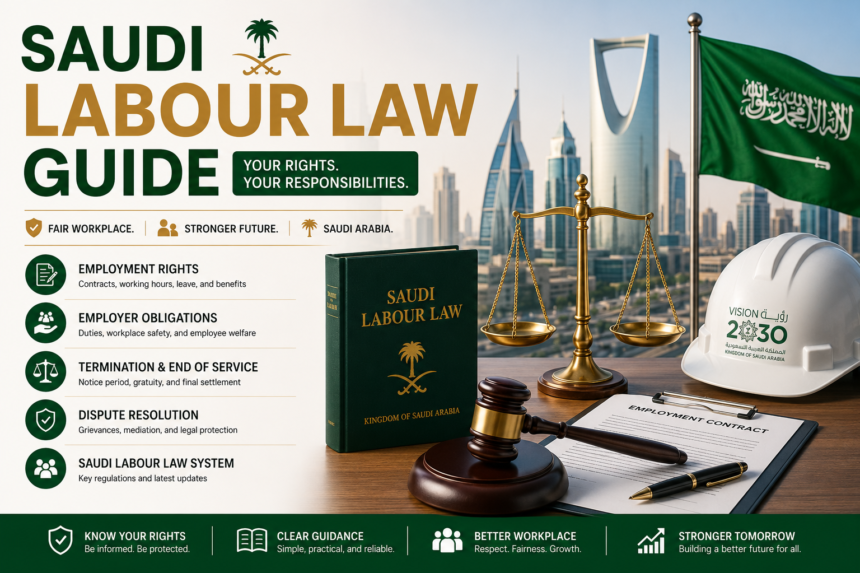
Saudi Labour Law Guide 2026 Complete Guide to Employee Rights, Contracts, Leave, Salaries & End-of-Service Benefits
Saudi Arabia has one of the largest employment markets in the Middle East, attracting millions of professionals from around the world. Whether you are a Saudi national, an expatriate employee, or an employer, understanding the Saudi Labour Law is essential for maintaining a fair, productive, and legally compliant workplace.
- What Is the Saudi Labour Law?
- Who Does the Saudi Labour Law Apply To?
- Types of Employment Contracts
- Employment Contract Requirements
- Working Hours in Saudi Arabia
- Salary and Wage Protection
- Annual Leave
- Public Holidays
- Sick Leave
- Maternity Leave
- Paternity Leave
- Hajj Leave
- Employee Rights
- Employer Responsibilities
- Workplace Safety
- End-of-Service Benefits (Gratuity)
- Employment Termination
- Notice Period
- Resignation
- Labor Disputes
- Saudization (Nitaqat Program)
- Digital Employment Services
- Tips for Employees
- Tips for Employers
- Frequently Asked Questions (FAQs)
The Saudi Labour Law governs employment relationships in the private sector by defining employee rights, employer obligations, working hours, wages, leave entitlements, termination procedures, end-of-service benefits, and dispute resolution mechanisms. Recent reforms under Saudi Vision 2030 have modernized employment practices, improved worker protections, and enhanced labor market flexibility.
This comprehensive Saudi Labour Law Guide explains everything you need to know about employment regulations in Saudi Arabia in simple, easy-to-understand language.
What Is the Saudi Labour Law?
The Saudi Labour Law is the legal framework regulating employer-employee relationships in Saudi Arabia’s private sector. It establishes rules regarding:
- Employment contracts
- Employee rights
- Employer responsibilities
- Working hours
- Salaries and wages
- Annual leave
- Sick leave
- Overtime
- Health and safety
- Termination procedures
- End-of-service benefits
- Workplace disputes
The law aims to protect both employers and employees while encouraging a fair and competitive labor market.
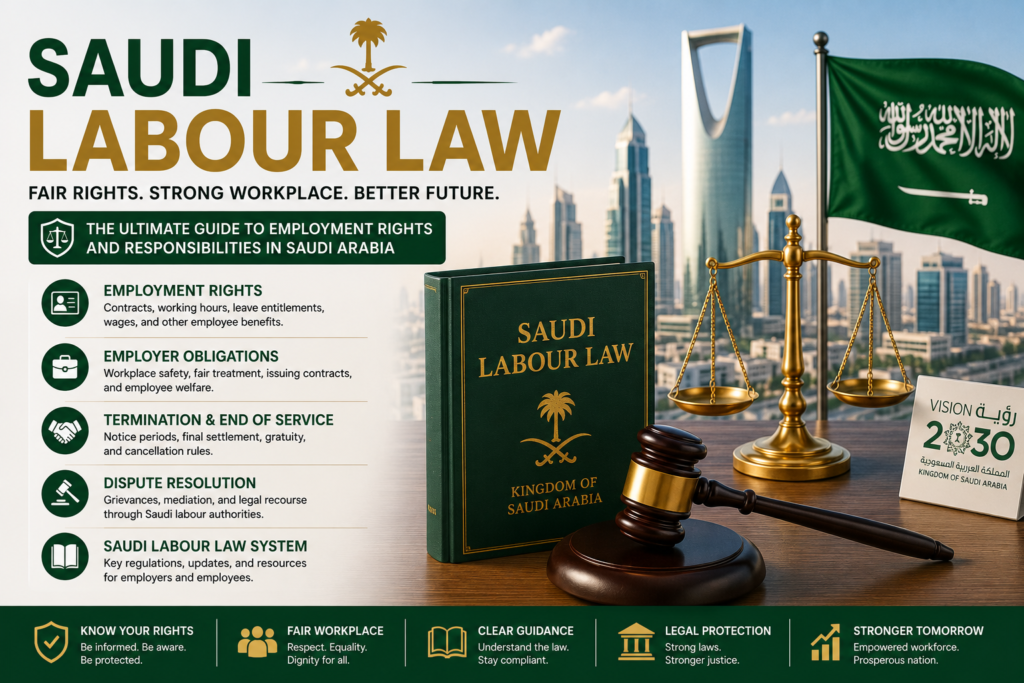
Who Does the Saudi Labour Law Apply To?
The Saudi labour law generally applies to:
- Saudi nationals employed in the private sector
- Expatriate employees
- Full-time workers
- Part-time workers (subject to applicable regulations)
- Fixed-term contract employees
- Permanent employees
Certain categories, such as domestic workers, are governed by separate regulations.
Types of Employment Contracts
Employment contracts define the rights and responsibilities of both parties.
1. Fixed-Term Contract: A fixed-term contract specifies:
- Start date
- End date
- Salary
- Job responsibilities
- Benefits
- Renewal conditions
Many expatriate employees work under fixed-term contracts.
2. Unlimited (Open-Ended) Contract: An unlimited contract has no specified end date and continues until either party terminates it according to legal procedures.
3. Part-Time Contract: Part-time contracts include:
- Reduced working hours
- Pro-rated benefits (where applicable)
- Flexible employment arrangements
4. Temporary Employment: Temporary contracts are used for:
- Seasonal work
- Project-based assignments
- Short-term business needs
Employment Contract Requirements
A valid employment contract should clearly state:
- Employee’s name
- Employer details
- Job title
- Salary
- Working hours
- Contract duration
- Probation period
- Leave entitlements
- Notice period
- Benefits
- Termination conditions
Employees should carefully review the contract before signing.
Probation Period
Employers may require a probation period for new employees.
During Probation
- Performance is evaluated.
- Either party may terminate the employment in accordance with the contract and applicable legal provisions.
- Employees are expected to meet performance standards and workplace policies.
Always check your contract for the agreed probation terms.
Working Hours in Saudi Arabia
Standard working hours are generally:
- Up to 8 hours per day
- Up to 48 hours per week
Working hours may be reduced during the month of Ramadan for Muslim employees, in accordance with applicable regulations.
Employers should also provide appropriate daily breaks and rest periods.
Overtime Rules
Employees who work beyond normal working hours may be entitled to overtime compensation as provided under Saudi Labour Law.
Overtime commonly applies to:
- Extra working hours
- Public holidays
- Weekly rest days (where applicable)
Employers should clearly record overtime hours and compensate eligible employees according to legal requirements.
Weekly Rest Day
Employees are generally entitled to at least one paid weekly rest day, commonly Friday, although businesses may designate another day depending on operational requirements.
Salary and Wage Protection
Saudi Arabia operates a Wage Protection System (WPS) to help ensure employees receive salaries on time through approved banking channels.
Employers are expected to:
- Pay salaries on time.
- Maintain payroll records.
- Comply with wage regulations.
Employees should regularly review salary payments and keep payroll documentation.
Annual Leave
Employees become entitled to paid annual leave under Saudi Labour Law.
Annual leave generally increases with longer periods of continuous service.
Employers and employees should agree on leave schedules while considering business needs and employee rights.
Public Holidays
Employees are generally entitled to paid leave during officially recognized holidays, including occasions such as:
- Eid Al-Fitr
- Eid Al-Adha
- Saudi National Day
- Other public holidays announced by the authorities
Holiday dates may vary based on official announcements.
Sick Leave
Employees who are unable to work due to illness may be eligible for sick leave, subject to the conditions set out in Saudi Labour Law and the employer’s policies.
Medical documentation may be required.
Maternity Leave
Eligible female employees are entitled to maternity leave under Saudi Labour Law.
The law provides protections related to:
- Paid maternity leave (subject to legal provisions)
- Childbirth recovery
- Employment protection during maternity
- Return to work
Employers must comply with applicable maternity regulations.
Paternity Leave
Eligible fathers may also receive paternity leave where provided under current regulations or employer policies.
Hajj Leave
Eligible Muslim employees may receive Hajj leave if they meet the legal conditions and have not previously used this entitlement.
Employee Rights
Employees in Saudi Arabia enjoy various legal protections, including the right to:
- Receive agreed wages on time
- Work in a safe environment
- Be treated fairly and without unlawful discrimination
- Receive leave entitlements
- Access health and safety protections
- Receive overtime pay when applicable
- Obtain an employment contract
- Receive an end-of-service benefit when eligible
- Raise workplace grievances through the proper channels
Employer Responsibilities
Employers are expected to:
- Provide written employment contracts
- Pay salaries on time
- Maintain safe workplaces
- Respect working-hour limits
- Provide leave benefits
- Follow termination procedures
- Comply with labor regulations
- Protect employee records and privacy
Workplace Safety
Employers should implement health and safety measures, including:
- Safe working environments
- Necessary protective equipment
- Safety training
- Emergency procedures
- Compliance with occupational safety regulations
Employees are expected to follow workplace safety rules.
End-of-Service Benefits (Gratuity)
One of the most important employee rights is the End-of-Service Benefit (EOSB).
This gratuity is generally based on:
- Length of service
- Final salary
- Reason for termination
- Applicable provisions of Saudi Labour Law
The exact calculation depends on the circumstances of employment and the current legal requirements.
Employment Termination
Employment may end due to:
- Contract expiry
- Mutual agreement
- Resignation
- Retirement
- Redundancy
- Misconduct (where permitted by law)
- Other lawful reasons
Termination should always follow the procedures established by Saudi Labour Law.
Notice Period
Employees and employers are generally required to provide notice before terminating an employment relationship, unless an exception under the law applies.
The required notice period typically depends on:
- Contract type
- Employment agreement
- Applicable legal provisions
Resignation
Employees wishing to resign should:
- Submit written notice
- Complete the notice period (if required)
- Return company property
- Settle outstanding obligations
- Obtain employment documents
Keeping copies of resignation letters and employment records is recommended.
Labor Disputes
If a workplace dispute arises, employees and employers are encouraged to seek an amicable resolution first.
If this is unsuccessful, disputes may be referred to the appropriate labor authorities and dispute resolution bodies in Saudi Arabia.
Common disputes include:
- Unpaid wages
- Contract violations
- Unfair dismissal
- Leave disagreements
- End-of-service benefit calculations
Maintain copies of contracts, salary records, and correspondence to support your case if needed.
Saudization (Nitaqat Program)
Saudi Arabia’s Nitaqat program encourages private-sector employers to hire Saudi nationals by setting localization targets for different industries.
For employers, compliance with Saudization requirements is an important aspect of workforce planning.
Digital Employment Services
Saudi Arabia has expanded digital labor services, enabling employees and employers to:
- Access employment information
- Review contracts
- Manage employment-related services
- Submit certain labor-related requests online
These digital initiatives support transparency and efficiency.
Tips for Employees
- Read your employment contract carefully before signing.
- Keep copies of contracts, salary slips, and important documents.
- Understand your leave and overtime entitlements.
- Follow workplace policies and safety procedures.
- Report concerns through the appropriate channels.
- Stay informed about updates to labor regulations.
Tips for Employers
- Issue clear written employment contracts.
- Maintain accurate payroll records.
- Pay wages on time.
- Comply with working-hour and leave regulations.
- Create a safe and respectful workplace.
- Keep up to date with changes in Saudi labor laws.
Frequently Asked Questions (FAQs)
Q1. Is a written employment contract required?
Ans: Yes. A written employment contract is essential because it outlines the rights and obligations of both the employer and employee.
Q2. What are the normal working hours in Saudi Arabia?
Ans: The standard limit is generally 8 hours per day and 48 hours per week, with specific provisions for certain situations, including reduced working hours for Muslim employees during Ramadan.
Q3. Are employees entitled to annual leave?
Ans: Yes. Eligible employees receive paid annual leave in accordance with Saudi Labour Law.
Q4. What is the End-of-Service Benefit?
Ans: The End-of-Service Benefit (EOSB) is a gratuity that eligible employees receive when employment ends, based on factors such as length of service, final salary, and the circumstances of termination.
Q5. Can employers terminate employees at any time?
Ans: Employers may terminate employment only in accordance with the employment contract and the provisions of Saudi Labour Law.
Q6. What should employees do if they face a labor dispute?
Ans: Employees should first attempt to resolve the issue with their employer. If the dispute cannot be settled, they may seek assistance through the appropriate labor authorities and dispute resolution mechanisms.
Final Thoughts
Understanding the Saudi Labour Law is essential for building a successful and compliant employment relationship in the Kingdom. Whether you are an employee seeking to understand your rights or an employer aiming to meet legal obligations, staying informed about employment contracts, working hours, leave policies, wages, workplace safety, termination procedures, and end-of-service benefits helps reduce disputes and promote a fair working environment.
As Saudi Arabia continues to modernize its labor market under Vision 2030, keeping up with official updates and complying with current regulations is more important than ever. By understanding the law and maintaining clear communication, both employers and employees can contribute to productive, transparent, and legally compliant workplaces across the Kingdom.
Do follow us on Instagram
Read More – Looking for Saudi Jobs? Start With These Trusted Platforms