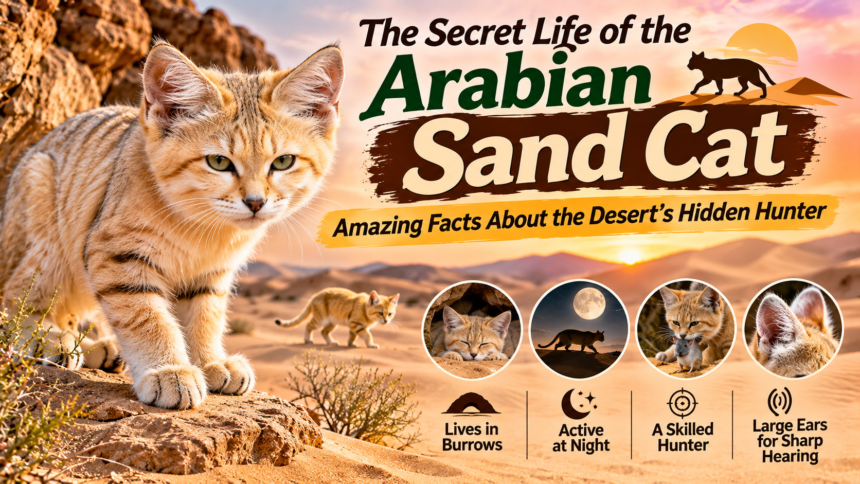
The Secret Life of the Arabian Sand Cat
Deep inside the deserts of the Arabian Peninsula lives a small wild cat that is rarely seen by people. It has sandy-coloured fur, large ears, wide paws, and an incredible ability to survive in some of the harshest desert conditions. This mysterious animal is known as the Arabian sand cat.
- 1. What Is the Arabian Sand Cat?
- 2. Where Does the Arabian Sand Cat Live?
- 3. What Does the Arabian Sand Cat Look Like?
- 4. How Does the Sand Cat Survive Extreme Desert Temperatures?
- 5. Why Does the Arabian Sand Cat Have Such Large Ears?
- 6. The Secret Night-Time Hunting Habits of the Sand Cat
- 7. What Does the Arabian Sand Cat Eat?
- 8. How Does the Sand Cat Survive Without Drinking Much Water?
- 9. The Sand Cat Is a Skilled Burrow Builder
- 10. Is the Arabian Sand Cat a Social Animal?
- 11. How Do Arabian Sand Cats Have Babies?
- 12. What Is the Conservation Status of the Arabian Sand Cat?
- 13. What Threats Are Facing the Arabian Sand Cat?
- 14. Conservation Efforts to Protect Sand Cats in the Arabian Peninsula
- 15. How Can People Help Protect the Arabian Sand Cat?
- Conclusion: The Arabian Sand Cat Is a Small Survivor with a Big Role in Nature
- Frequently Asked Questions (FAQs)
Unlike domestic cats, the Arabian sand cat lives in dry desert environments, where water is limited, temperatures can change sharply, and food is not always easy to find. It spends much of its time hiding in burrows and usually comes out at night to search for food. Its natural appearance helps it blend into the sandy landscape, making it difficult to spot.
Although it looks small and gentle, this wild cat is a skilled hunter. It can catch rodents, lizards, birds, insects, and even venomous snakes. Special features such as thick fur on its paws, sensitive hearing, and a strong ability to conserve water help it live in the desert.
The Arabian sand cat is part of the natural wildlife of countries such as Saudi Arabia, Oman, and the United Arab Emirates. However, habitat loss and human activities are creating challenges for desert wildlife, including this secretive species.
In this article, we explore the secret life of the Arabian sand cat, including its appearance, habitat, hunting skills, daily behaviour, reproduction, survival adaptations, and the conservation work that can help protect it.
1. What Is the Arabian Sand Cat?
The Arabian sand cat is a small wild feline belonging to the species Felis margarita. It is commonly known as the sand cat because it lives mainly in desert environments.
The Arabian sand cat is the only wild cat that lives entirely in desert areas. It is found across the Arabian Peninsula, North Africa, and parts of Central Asia. Often called the “ghost of the desert,” this small wild cat is well adapted to survive extreme heat and harsh desert conditions.
The sand cat is sometimes described as the Arabian sand cat when referring to populations living in the Arabian Peninsula. Older scientific classifications used the subspecies name Felis margarita harrisoni. However, the IUCN Cat Specialist Group currently discusses a proposed classification in which Arabian and other southwest Asian populations are included under Felis margarita thinobia. Further research is needed to confirm the classification.
The sand cat is difficult to study because it is secretive and mainly active at night. As a result, researchers still have limited information about its population size and behaviour in several parts of its range.
2. Where Does the Arabian Sand Cat Live?
The Arabian sand cat lives in dry landscapes where vegetation is limited and food animals can be found. It prefers sandy deserts, sand dunes, gravel plains, and some rocky areas.
It does not need a thick forest or a permanent water source to survive. Instead, it uses natural shelters and burrows to protect itself from extreme temperatures and other dangers.
In the Arabian Peninsula, sand cats have been recorded in different desert regions. In Saudi Arabia, the species has been documented in protected areas, including the Saja and Umm Ar-Rimth area. In Oman, historical records include locations such as the Arabian Oryx Sanctuary, As Saleel Nature Reserve, and the Wahiba Sands.
In the United Arab Emirates, the Environment Agency – Abu Dhabi monitors sand cats in six protected areas within the Sheikh Zayed Protected Areas Network.
Important features of suitable sand cat habitat include:
- Sandy or rocky ground.
- Sparse vegetation.
- Places where small prey animals live.
- Natural burrows and sheltered areas.
- Relatively undisturbed desert landscapes.
These habitats provide food, shelter, and space for the animal to move around.
3. What Does the Arabian Sand Cat Look Like?
The Arabian sand cat is one of the smallest wild cats found in the Arabian region. Its small body and sandy appearance help it blend into the desert environment.
Its fur is usually pale yellowish-brown or sandy beige, with a lighter colour underneath. Some individuals have faint dark markings on their legs and body. These markings may be easier to notice in certain lighting conditions.
The sand cat has several features that make it different from a domestic cat:
- Large ears: Help it detect sounds from small animals moving nearby.
- Broad, flat head: Gives the cat a distinctive appearance.
- Sandy-coloured coat: Helps it blend into desert surroundings.
- Short, strong legs: Support movement across sandy and rocky ground.
- Thickly furred paws: Protect its feet from hot and cold surfaces.
- Long, ringed tail: Often has dark bands and a dark tip.
An adult sand cat generally weighs between 1.35 and 3.4 kilograms, although size varies between individuals.
Its appearance may look similar to a small domestic cat, but its body and natural features are specialised for desert life.
4. How Does the Sand Cat Survive Extreme Desert Temperatures?
Desert temperatures can become extremely high during the day and drop sharply at night. For a small animal, surviving these changes requires special adaptations.
One of the most useful features of the sand cat is the thick fur covering its paws and the areas between its toes. This protects the feet from hot sand during the day and cold ground during cooler periods.
Its body fur also provides insulation. In colder parts of its range, the winter coat can become much thicker.
The sand cat also avoids unnecessary exposure to extreme heat. During hot summer days, it usually rests inside a burrow rather than remaining outside.
This behaviour helps it:
- Avoid direct sunlight.
- Reduce exposure to extreme temperatures.
- Conserve body moisture.
- Stay protected from potential predators.
- Rest safely before hunting at night.
Its adaptations are the result of living in a difficult environment over many generations. The sand cat does not escape the desert heat; it manages its exposure to it.
5. Why Does the Arabian Sand Cat Have Such Large Ears?
The large ears of the Arabian sand cat are more than just an interesting feature. They help the animal locate prey in areas where vegetation is sparse.
Many small desert animals, including rodents and reptiles, can move beneath sand, among stones, or inside burrows. Spotting them is not always easy.
The sand cat has an excellent sense of hearing. Its specialised ear structures help it detect faint sounds and work out where small animals are moving.
Once it identifies a possible target, it can move quietly towards the source of the sound and attempt to catch it.
This ability is especially useful at night, when visibility is limited.
Its hearing gives the sand cat an important advantage because finding food in the desert often requires patience and careful observation.
6. The Secret Night-Time Hunting Habits of the Sand Cat
The Arabian sand cat is mainly nocturnal, meaning it is most active at night. It generally avoids the hottest part of the day and rests in burrows or empty holes made by foxes and gerbils. during summer.
When the temperature becomes more comfortable, it comes out to search for food. It moves through the desert around 6 to 9 kilometres across the desert carefully, using its hearing, sight, and sense of smell to locate prey.
Unlike larger predators that may chase animals over long distances, the sand cat often depends on patience, stealth, and quick movements.
It may search near shrubs, small dunes, rocky ground, and areas where rodents are likely to be found.
Its hunting behaviour includes:
- Listening carefully for movement.
- Moving slowly towards possible prey.
- Approaching without attracting attention.
- Pouncing when an opportunity appears.
- Carrying food to a sheltered place.
Although it is mainly active at night, some daytime activity has been recorded in Arabian populations, especially during cooler winter conditions.
This flexible behaviour helps the animal adjust its activity to the weather.
7. What Does the Arabian Sand Cat Eat?
The sand cat is a carnivore, which means it eats other animals. Its diet depends on what is available in its environment.
It hunts different types of small desert animals, including:
- Rodents.
- Lizards.
- Small snakes.
- Birds.
- Insects.
- Small mammals, including young hares.
The sand cat is also known to hunt venomous snakes. Its ability to catch dangerous prey makes it an interesting desert hunter, although not every hunting attempt is successful.
The animal uses its sharp claws and teeth to capture and kill prey. According to the Royal Commission for AlUla’s mammal field guide, it may bury a captured animal under sand and return later to feed.
By hunting rodents and other small animals, the sand cat also plays a role in the desert food chain. It helps control populations of some small prey species and serves as part of the natural balance of the ecosystem.
8. How Does the Sand Cat Survive Without Drinking Much Water?
Water is difficult to find in many desert areas. Unlike animals that depend on regular visits to rivers or watering holes, the sand cat can obtain much of the moisture it needs from its food.
Rodents, birds, reptiles, and other prey contain water. Eating these animals helps the sand cat meet its moisture needs. This helps them survive for weeks or even months without drinking water.
The Environment Agency – Abu Dhabi notes that sand cats can survive for weeks without drinking free-standing water by obtaining moisture from their prey. However, this does not mean that they never drink water. They may drink when a suitable source is available.
Other behaviours also help them conserve moisture:
- Resting in burrows during hot conditions.
- Avoiding unnecessary activity during the hottest hours.
- Hunting mainly at night.
- Staying in sheltered areas during extreme weather.
These habits allow the sand cat to live in places where open water is scarce.
9. The Sand Cat Is a Skilled Burrow Builder
One of the most interesting facts about the Arabian sand cat is its ability to dig its own burrow.
Burrows are important because the desert can become too hot during the day and very cold at night. A sheltered underground space provides more protection from these outside conditions.
The sand cat can also use burrows made by other animals when suitable ones are available.
A burrow gives the animal a place to:
- Rest during the day.
- Escape extreme temperatures.
- Protect kittens.
- Hide from potential threats.
- Stay sheltered between hunting trips.
The Royal Commission for AlUla’s field guide describes the sand cat as the only Arabian cat species that digs its own burrow.
It can also use the same burrow throughout the year, making these shelters an important part of its daily life.
10. Is the Arabian Sand Cat a Social Animal?
The sand cat is generally a solitary animal. It usually lives and hunts alone rather than in groups.
Adult males and females normally come together during the mating period. After mating, the female takes responsibility for raising the kittens.
Because the animal is difficult to observe in the wild, researchers still have questions about some parts of its social behaviour.
One unusual feature is its mating call. The AlUla field guide describes the sound as loud and similar to a small dog’s bark.
The call can help sand cats communicate during the breeding season.
Its solitary behaviour and wide movements also mean that suitable desert habitat needs to provide enough space for individual animals to find food and shelter.
11. How Do Arabian Sand Cats Have Babies?
Breeding is an important part of the sand cat’s life cycle. After mating, the female prepares a sheltered place where her kittens can be born and raised.
The gestation period generally lasts around 59 to 67 days. Litter sizes can vary from two to eight kittens, with an average of about three reported by the IUCN Cat Specialist Group.
Newborn kittens are very small and depend on their mother for warmth, protection, and food.
As they grow, the mother teaches them important survival skills, including how to move around, recognise prey, and hunt.
The early months are especially important because young sand cats must learn how to survive in an environment where food and shelter can be difficult to find.
The exact breeding season may vary across the species’ wide geographical range.
12. What Is the Conservation Status of the Arabian Sand Cat?
The conservation status of the sand cat needs to be understood at different geographical levels.
Globally, the sand cat is listed as Least Concern on the IUCN Red List. However, the IUCN Cat Specialist Group explains that reliable population estimates and long-term population trends are not available. The species is secretive, mainly nocturnal, and difficult to study.
At the regional level, the situation can be more worrying. The Arabian Peninsula’s regional carnivore assessment classified the sand cat as Near Threatened. The AlUla mammal field guide also lists the species as globally Least Concern but regionally Vulnerable in its local assessment.
In Abu Dhabi, the species is listed as Endangered on the emirate’s regional Red List.
These classifications are not contradictory: they refer to different geographical areas and assessments. A species may have a wide global range while facing greater pressure in a particular region.
The lack of reliable population information is another reason why regular monitoring is important.
13. What Threats Are Facing the Arabian Sand Cat?
Although the sand cat is adapted to desert conditions, it still depends on healthy natural habitats. Changes to the desert environment can affect its food supply, shelter, and ability to move between areas.
Some of the main threats include:
Habitat loss: Roads, buildings, settlements, and other development can reduce or divide suitable desert habitat.
Off-road driving: Driving vehicles over dunes and natural desert areas can damage fragile habitats and disturb wildlife.
Overgrazing: Large numbers of livestock can reduce vegetation and affect the small animals that sand cats depend on for food.
Human disturbance: Frequent activity around burrows and natural shelters can affect the animals’ resting and breeding areas.
Trapping and illegal capture: Sand cats may be caught for the wildlife trade, although the full scale of this threat is not clearly known.
Domestic animal interactions: The Environment Agency – Abu Dhabi also identifies possible crossbreeding with domestic cats as a concern.
Protecting desert habitats and reducing disturbance are important steps in helping sand cats survive.
14. Conservation Efforts to Protect Sand Cats in the Arabian Peninsula
Protecting the Arabian sand cat requires research, habitat protection, and cooperation between wildlife organisations and local communities.
In Abu Dhabi, the Environment Agency – Abu Dhabi monitors sand cats in six protected areas within the Sheikh Zayed Protected Areas Network. Since 2015, the agency has recorded more than 90 sightings.
These records help researchers understand where sand cats are found and how they use protected desert habitats.
A separate conservation project supported through Abu Dhabi’s Ma’an platform aims to build more scientific knowledge about the Arabian sand cat. Its approach includes:
- Environmental DNA testing.
- GPS tracking technology.
- Camera monitoring.
- Artificial intelligence-based data analysis.
- Research into population size and distribution.
These methods can help researchers understand the animal without needing to see or disturb it regularly.
Protected areas are also important because they can reduce habitat damage and provide safer spaces for desert wildlife.
Conservation work is not only about protecting one animal. It also supports the wider desert ecosystem, including plants, rodents, reptiles, and birds.
15. How Can People Help Protect the Arabian Sand Cat?
People living in or visiting desert areas can play a useful role in wildlife protection.
Even small actions can reduce disturbance to animals and help preserve natural habitats.
Some practical steps include:
- Avoid driving off-road in sensitive wildlife areas.
- Do not disturb burrows or suspected animal shelters.
- Never attempt to capture or keep a sand cat as a pet.
- Follow rules inside protected areas.
- Keep litter and waste away from desert habitats.
- Support responsible wildlife conservation projects.
- Share accurate information about desert animals.
- Report suspected illegal wildlife capture to the relevant authorities.
Visitors should also avoid using strong lights or approaching wild animals to take photographs.
Sand cats are difficult to observe, and keeping a respectful distance is important. The best wildlife experience is one that does not disturb the animal.
Conclusion: The Arabian Sand Cat Is a Small Survivor with a Big Role in Nature
The Arabian sand cat may be small and difficult to see, but it has an impressive set of skills that allow it to survive in some of the harshest environments of the Arabian Peninsula.
Its large ears help it locate hidden prey, its thickly furred paws protect it from extreme ground temperatures, and its ability to obtain moisture from food allows it to live where open water is limited. Its burrowing and night-time hunting habits also help it avoid harsh daytime conditions.
However, these natural adaptations cannot protect it from every threat. Habitat loss, off-road driving, human disturbance, and changes to desert ecosystems can affect its survival.
Wildlife monitoring, protected areas, scientific research, and responsible behaviour are therefore important for its future.
The secret life of the Arabian sand cat reminds us that even the smallest desert animals play an important role in nature. Protecting this remarkable hunter means protecting the fragile desert environments that support wildlife across the Arabian Peninsula.
Frequently Asked Questions (FAQs)
1. What is the Arabian sand cat?
The Arabian sand cat is the sand cat species (Felis margarita) found in the Arabian Peninsula. It is a small wild cat adapted to sandy and rocky desert environments.
2. Where does the Arabian sand cat live?
Sand cats have been recorded in desert areas of Saudi Arabia, Oman, and the United Arab Emirates, as well as other countries across North Africa, the Middle East, and Central Asia.
3. What does the Arabian sand cat eat?
It eats rodents, lizards, snakes, birds, insects, and other small animals. Venomous snakes can also form part of its prey.
4. Can a sand cat survive without drinking water?
Yes. It can obtain much of the moisture it needs from its prey and may survive for weeks without drinking free-standing water. It will still drink when a suitable source is available.
5. Why does the sand cat have large ears?
Its large ears and specialised hearing help it detect small animals moving beneath sand, among stones, or in nearby burrows.
6. Is the Arabian sand cat active during the day?
It is mainly nocturnal and usually hunts at night. Some daytime activity has been recorded in Arabian populations, particularly during cooler winter conditions.
7. How does the sand cat protect its paws from hot sand?
It has dense fur on the soles of its feet and between its toes. This provides insulation against hot and cold ground temperatures.
8. Is the Arabian sand cat endangered?
The sand cat is classified globally as Least Concern by the IUCN. However, regional assessments show greater concern in parts of the Arabian Peninsula, including an Endangered classification in Abu Dhabi.
9. How many kittens can a sand cat have?
A female sand cat can have between two and eight kittens in a litter, with an average of about three. The exact number varies.
10. What are the main threats to the Arabian sand cat?
Major threats include habitat loss, road and settlement development, off-road driving, overgrazing, human disturbance, and possible capture for the wildlife trade.
Do follow us on Instagram
Read More – Future of Quality of Life in Saudi Arabia